ELSEVIER
Journal of Geochemical Exploration 59 (1997) 75-86
The nickel hyperaccumulator plant Alyssum bertolonii as a potential agent for phytoremediation and phytomining of nickel B.H. Robinson a,c, A. Chiarucci b, R.R. Brooks ‘3 * , D. Petit a, J.H. Kirkman ‘, P.E.H. Gregg ‘, V. De Dominicis b
a Laboratoire de G&nktique et Evolution, CNRS, Uniuersite’ de Lille, F-59655 Villeneuue d’Ascq, France b Dipariimento di Biologia Ambientale, Uniuersita degli Studi di Siena, Siena, Italy ’ Department of Soil Science, Massey Uniuersity, Palmerston North, New Zealand
a 里尔大学 CNRS 遗传与进化实验室(Laboratoire de Génétique et Evolution),F-59655 Villeneuve d’Ascq,法国 b 锡耶纳大学环境生物学系(Dipartimento di Biologia Ambientale),锡耶纳,意大利 c 梅西大学土壤科学系,Palmerston North,新西兰
Received 24 October 1996; accepted 6 February 1997
Abstract摘要
Experiments were carried out in Italy on the potential use of the hyperaccumulator Alyssum bertolonii in phytomining of ultramafic soils for Ni. In situ experimental plots at Murlo, Tuscany were fertilized with various regimes during a Z-year period. The best fertilizer treatment (N + K + P) gave a threefold increase of the biomass of reproductive matter to 9.0 t/ha without dilution of the unfertilized Ni content. A Ni content of 0.8% in dry matter (11% in ash), would give a Ni yield of 72 kg/ha without need of resowing for a further crop. There was no correlation between the age of a plant and its Ni content. The long-term cropping sustainability of the soils was simulated by sequential extractions with KH phthalate solutions at pH 2, 4 and 6 that showed a limiting available Ni content of 768 pg/g. Thus just over seven croppings at pH 6 in the rhizosphere would reduce the available Ni pool by 30%. A proposed model for phytomining involves harvesting the crop after 12 months and burning the material to produce a sulphur-free bio-ore with about 11% Ni. Utilising the energy of combustion is also discussed. It is considered that Alyssum bertolonii or other Alyssum species might be used for phytomining throughout the Mediterranean area including Anatolia, as well as in Western Australia and the western United States. The economic limits of phytomining are proposed and at current world prices, the technique would only be feasible for Ni and Co with plants of at least the same biomass as Alyssum. Plants of higher biomass and similar uptake potential as for Ni, could extend the limits to other elements.
在意大利开展了试验,研究超富集植物Alyssum bertolonii用于超基性(蛇纹岩)土壤镍植物采矿的潜力。在托斯卡纳Murlo的原位试验小区中,于2年期间施用了不同的施肥方案。最佳施肥处理(N + K + P)使繁殖器官生物量增加了3倍,达到9.0 t/ha,且未稀释未施肥时的Ni含量。若干物质中Ni含量为0.8%(灰分中为11%),则Ni产量可达72 kg/ha,且下一茬无需重新播种。植株年龄与其Ni含量之间无相关性。采用pH 2、4和6的邻苯二甲酸氢钾溶液进行连续提取,模拟了土壤长期种植的可持续性,结果表明有效Ni含量的极限值为768 μg/g。因此,根际pH为6时,仅需7茬多即可使有效Ni库减少30%。本文提出的植物采矿模式为:12个月后收获作物,并焚烧植物材料,生产Ni含量约11%的无硫生物矿石。文中还讨论了燃烧能量的利用。作者认为,Alyssum bertolonii或其他Alyssum属植物可用于整个地中海地区(包括安纳托利亚)以及西澳大利亚和美国西部的植物采矿。本文提出了植物采矿的经济极限:按当前国际价格,该技术仅对Ni和Co可行,且所用植物的生物量至少须与Alyssum相当。若植物生物量更高且对其他元素具有与Ni类似的吸收潜力,则可将这一极限扩展至其他元素。
Keywords: Alyssum bertolonii; phytomining; bio-ore; Tuscany
关键词:Alyssum bertolonii;植物采矿;生物矿石;托斯卡纳
1Introduction引言
Alyssum bertolonii Desv. (Brassicaceae) is a most unusual plant. It was first reported by Caesalpino (1583) who described an ‘alyson’ that appeared to be confined to nickel-rich serpentines in the vicinity of Florence, Italy. Its presence over all Tuscan ultramafic outcrops was recorded by several authors (see Pichi Sertnolli, 1948). In the late 194Os, Minguzzi and Vergnano (1948) discovered that this plant had an extraordinarily high Ni content of about 10,000 pg/g (ppm) [ l%] in dried matter which translated to well over 10% of this element in the ash.
Alyssum bertolonii Desv.(十字花科)是一种极不寻常的植物。Caesalpino (1583) 首次对其进行了报道,他描述了一种似乎仅分布于意大利佛罗伦萨附近富镍蛇纹岩上的“alyson”。多位作者记录了该植物在托斯卡纳所有超基性岩露头上均有分布(见Pichi Sertnolli, 1948)。20世纪40年代末,Minguzzi and Vergnano (1948) 发现该植物的Ni含量极高,干物质中约为10,000 μg/g (ppm) [1%],折合灰分中该元素含量远超10%。
* Corresponding author. FAX: + 64-6-3505632; E-mail: R.Brooks@massey.ac.nz.
0375-6742/97/$17.00 0 1997 Elsevier Science B.V. All rights reserved. PZZ SO375-6742(97)00010-l in Streptunthus polygaloides Gray from California by Reeves et al. (198 1) who reported up to 14,800 kg/g (1.48%) in the dried matter of this plant. This is the only truly native nickel hyperaccumulator so far discovered in North America. Over a decade was to pass until it was realised that the hyperaccumulator plants might be used for removal of pollutants from soil (McGrath et al., 1993). A group at Rutgers University is also actively engaged in exploring the commercial potential of phytoremediation (removal of pollutants from soils by use of plants) and has formed a company for this purpose.
0375-6742/97/$17.00 © 1997 Elsevier Science B.V. 版权所有。PII S0375-6742(97)00010-1 ……Reeves et al. (1981) 在产自加利福尼亚的Streptunthus polygaloides Gray中也记录到Ni超富集现象,报道该植物干物质中Ni含量高达14,800 μg/g(1.48%)。这是迄今在北美发现的唯一真正本土的镍超富集植物。此后又过了十余年,人们才认识到超富集植物可用于去除土壤中的污染物(McGrath et al., 1993)。Rutgers大学的一个研究小组也在积极探索植物修复(利用植物去除土壤中的污染物)的商业潜力,并为此成立了一家公司。
Since the discovery of the world’s first ‘nickel plant’ several others were identified by Brooks et al. (1977) who named them ‘hyperaccumulators of Ni’ . They set the threshold of hyperaccumulation at 1000 p,g/g (0.1%) in the case of Ni. Since this early work, the total of hyperaccumulators of Ni has now exceeded 400 (Jaffre, 1980; Brooks, 1987; Baker and Brooks, 1989; Reeves et al., 1996). There are also hyperaccumulators of Cu and Co (Brooks et al., 1980) and of Zn (Baumann, 1885; Reeves and Brooks, 1983). The hyperaccumulation threshold level for Zn has been set at 10,000 kg/g (Reeves and Brooks, 1983).
自世界上第一种“镍植物”被发现以来,Brooks et al. (1977) 又鉴定出其他几种,并将其命名为“Ni超富集植物”。他们将Ni的超富集阈值定为1000 μg/g(0.1%)。自这一早期工作以来,Ni超富集植物总数已超过400种(Jaffre, 1980; Brooks, 1987; Baker and Brooks, 1989; Reeves et al., 1996)。此外还有Cu和Co的超富集植物(Brooks et al., 1980)以及Zn的超富集植物(Baumann, 1885; Reeves and Brooks, 1983)。Zn的超富集阈值定为10,000 μg/g(Reeves and Brooks, 1983)。
The potential for using hyperaccumulators as a
利用超富集植物作为
Hyperaccumulation of Ni has also been recorded means of ‘growing a commercial crop of nickel’ represents a quantum leap in the possible extension of phytoremediation to this new technology and is due to the pioneering work of L. Nicks and M.F. Chambers at the U.S. Bureau of Mines, Reno, Nevada (Nicks and Chambers, 1994, 1995). Their work was based on the principle that it might be possible to use plants to extract Ni from low-grade ores that would otherwise not be economic. Low-grade nickel ores cover large areas of the Earth’s surface, particularly in Western Australia, Italy, Brazil, Canada, Russia and many other countries and territories.
Ni超富集现象也见于……“种植商业化镍作物”的一种手段,这一潜力代表着植物修复向这一新技术拓展的巨大飞跃,这归功于美国矿务局(内华达州里诺)L. Nicks和M.F. Chambers的开创性工作(Nicks and Chambers, 1994, 1995)。他们的工作基于这样一个原理:可以利用植物从原本不具经济开采价值的低品位矿石中提取Ni。低品位镍矿覆盖了地球表面的大片区域,尤其是在西澳大利亚、意大利、巴西、加拿大、俄罗斯以及许多其他国家和地区。
Nicks and Chambers grew the Californian hyperaccumulator Streptanthus polygaloides in various soil mixtures and found that there was a five-fold increase of biomass when N,K,P fertilizer was added. Over an area of serpentine soils near Chinese Camp in California, they found that a natural crop of this plant was capable of producing up to 100 kg/ha of Ni (worth $550/ha at the prices at that time). If a large-scale industry could be developed with continuous incineration of the crop, an additional $219/ha from the energy of combustion would be available. They concluded that the return to a farmer growing a ‘crop of nickel’ (i.e., half the gross yield) would be roughly comparable, or superior to, that obtained for a crop of wheat.
Nicks and Chambers在不同土壤混合物中种植了加利福尼亚超富集植物Streptanthus polygaloides,发现施加N、K、P肥料后生物量增加了5倍。在加利福尼亚Chinese Camp附近的一片蛇纹岩土壤上,他们发现该植物的天然作物可产出高达100 kg/ha的Ni(按当时价格计值$550/ha)。若能发展出连续焚烧作物的大规模产业,还可从燃烧能量中额外获得$219/ha。他们得出结论:种植“镍作物”的农民所获收益(即总产值的一半)大致相当于甚至优于种植小麦的收益。
The work that we report below is based on the principles established by Nicks and Chambers (1994) and as far as we know, represents only the second report ever published on the potential of phytomining based on field work under natural conditions and using native plant species rather than exotic taxa. The work was carried out in Tuscany, Italy, using populations of Alyssum bertolonii growing under natural conditions over the ultramafic (serpentine) soils of the region. The aims of the experiments were to assess: (1) the approximate yield of Ni per hectare; (2) the relation between the Ni content of the plant and the available Ni status of the soil; (3) the effect of plant age and size on the Ni content of the plant; (4) the effect of fertilizers on biomass and Ni content of the plants; (5) the reduction of Ni availability in the soil after successive croppings.
下文报道的工作基于Nicks and Chambers (1994) 所建立的原理;据我们所知,这仅是第二篇基于自然条件下的野外工作、并使用本土植物物种而非外来类群来探讨植物采矿潜力的报道。该工作在意大利托斯卡纳进行,使用了在该地区超基性(蛇纹岩)土壤上自然生长的Alyssum bertolonii种群。试验目的是评估:(1)每公顷Ni的大致产量;(2)植物Ni含量与土壤有效Ni状况之间的关系;(3)植株年龄和大小对植物Ni含量的影响;(4)肥料对植物生物量和Ni含量的影响;(5)连续种植后土壤Ni有效性的降低。
2Site description研究区概况
The test areas were located on Mont Pelato (350 m) in Livomo Province and near the village of
试验区位于Livorno省的Monte Pelato(350 m)以及以下村庄附近:
Fig. 2. Alyssum bertolonii a hyperaccumulator of nickel containing 1% of this element.图2. Alyssum bertolonii,一种含镍量达1%的镍超富集植物。
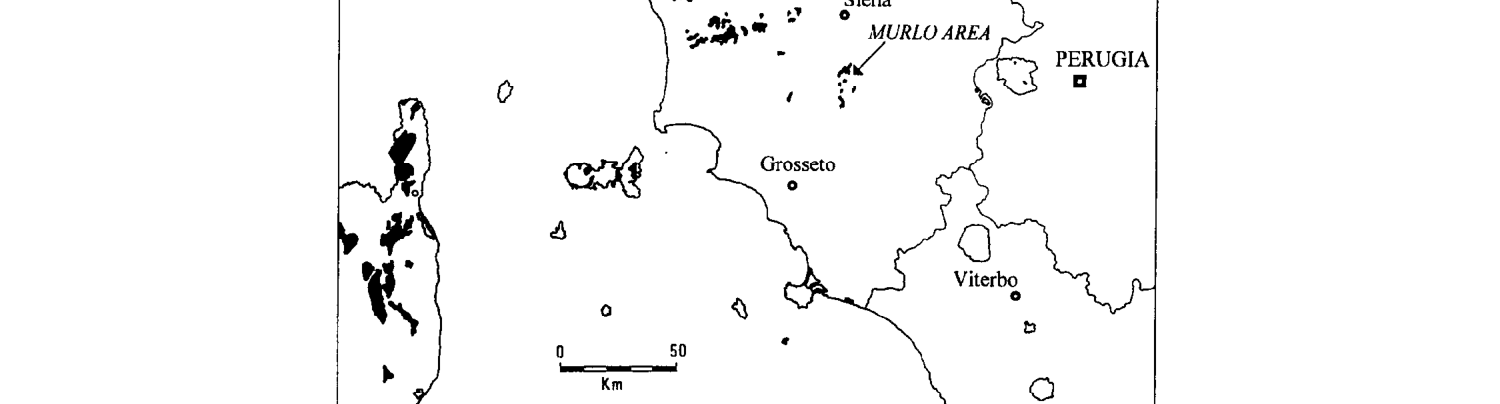
Mm10 (350 m> south of Siena, ltaly (Fig. 1). The rocks are composed of lherzolitic serpentinites emplaced in gabbro and basalt. The soils are often skeletal with a low water-holding capacity (Vergnano Gambi, 1992). The pH ranges from 6.6 to 7.4 on serpentinite and from 6.8 to 7.0 on gabbro.
Murlo(350 m),位于意大利锡耶纳以南(图1)。岩石由侵位于辉长岩和玄武岩中的二辉橄榄岩质蛇纹岩组成。土壤多为粗骨土,持水能力低(Vergnano Gambi, 1992)。蛇纹岩上的土壤pH为6.6–7.4,辉长岩上为6.8–7.0。
Arrigoni et al. (1983) distinguished a specific vegetation community on the screes and debris. It is known as the Armerio-Alyssetum bertolonii vegetation type and is spread over all of the Tuscan ultramafic outcrops. It encompasses all the serpentine-endemic plants including of course, Alyssum bertolonii (Fig. 2) itself (Chiamcci et al., 1995). This species and its community are absent over the gabbro and basalt.
Arrigoni et al. (1983) 在岩屑坡和碎石上区分出一种特定的植被群落,称为Armerio-Alyssetum bertolonii植被类型,广泛分布于托斯卡纳所有超基性岩露头上。它包含所有蛇纹岩特有植物,当然也包括Alyssum bertolonii(图2)本身(Chiamcci et al., 1995)。该物种及其群落在辉长岩和玄武岩上均不存在。
Climatic data are available for both Monte Pelato (Cozzi, 1996) and Murlo. Both sites can be classified bioclimatically as Mediterranean pluvio-seasonal oceanic (Rivas Martinez, 1996).
Monte Pelato(Cozzi, 1996)和Murlo均有气候数据。按生物气候学分类,两地均属于地中海雨季型海洋性气候(Rivas Martinez, 1996)。
For Murlo the mean annual temperature is 13.8”C ranging from 5.8” in January to 22.7” in July. The total annual rainfall is 893 mm ranging from 37 mm in July to 129 mm in November.
Murlo的年均气温为13.8 °C,1月为5.8 °C,7月为22.7 °C。年总降雨量为893 mm,7月为37 mm,11月为129 mm。
For Monte Pelato the mean annual temperature is 12.6”C ranging from 4.3” in January to 21.7” in July/August. The total annual rainfall is 978 mm ranging from 2 1 mm in July to 137 mm in November.
Monte Pelato的年均气温为12.6 °C,1月为4.3 °C,7/8月为21.7 °C。年总降雨量为978 mm,7月为21 mm,11月为137 mm。
3Materials and methods材料与方法
Forty plants of Alyssum bertolonii were selected over serpentines of the Monte Pelato area of Livorno Province, Italy. The crown and stem diameters of each plant were measured along with the biomass and Ni content of the reproductive and vegetative structures. The ages were determined by ring counting. Soil (ca. 100 g) was collected below each plant and the soluble fraction of various elements was determined by extraction with ammonium acetate at pH 7.
在意大利Livorno省Monte Pelato地区的蛇纹岩上选取了40株Alyssum bertolonii。测定了每株植物的冠幅和茎径,以及繁殖器官和营养器官的生物量和Ni含量。通过年轮计数确定植株年龄。在每株植物下方采集土壤(约100 g),用pH 7的乙酸铵提取测定各元素的可溶态组分。
At Monte Murlo, 35 random quadrats (1 m X 1 m) were selected in Spring 1994 on a gently sloping hillside. In each plot the presence of all vascular plants was recorded and their coverage estimated by the points-quadrat method which estimates the ground cover of a given plant by the relative interceptions of the plant canopy with regularly spaced point observations which, in this case, were made on a square grid with 5 cm spacing of each point. These quadrats encompassed natural stands of Alyssum bertolonii that were treated with the following fertilizer regimes in Autumn (October) of the same year: (1) calcium carbonate at 100 g/m2; (2) sodium dihydrogen phosphate at 10 g/m2; (3) ammonium nitrate at 10 g/m2; (4) sodium dihydrogen phosphate + ammonium nitrate each at 10 g/m2; (5) sodium dihydrogen phosphate + ammonium nitrate + potassium chloride each at 10 g/m2; and (6) calcium carbonate + sodium dihydrogen phosphate + ammonium nitrate + potassium chloride each at the loadings shown above. There were five replicates of each treatment including five controls. The fertilizer treatment was repeated one year later in October 1995. The increase in biomass of Alyssum bertolonii was noted by measuring the increase in cover (the relationship between cover and biomass having been previously established by experiments in which plants were harvested, dried and weighed at the end of each year for a period of 2 years). The plants were harvested from each quadrat at the end of the 2-year period and a soil sample (O-15 cm depth and weighing 100 g> was also taken. Measurement of plant-available trace elements in the soils was performed by placing 2 g of sieved (2 mm) soil samples in polythene containers and adding 20 ml of 1 A4 ammonium acetate. The containers were shaken overnight and the filtered liquid phase was analysed by plasma emission (ICP) spectrometry.
1994年春季,在Monte Murlo一处缓坡上随机选取了35个样方(1 m × 1 m)。记录每个样方内所有维管植物的出现情况,并采用点样方法估算其盖度:该方法通过植物冠层与规则间隔观测点的相对截取率来估算某一植物的地面盖度,本研究中观测点按间距5 cm的方形网格布设。这些样方包含Alyssum bertolonii的天然群落,于同年秋季(10月)施用以下施肥方案:(1)碳酸钙100 g/m2;(2)磷酸二氢钠10 g/m2;(3)硝酸铵10 g/m2;(4)磷酸二氢钠 + 硝酸铵,各10 g/m2;(5)磷酸二氢钠 + 硝酸铵 + 氯化钾,各10 g/m2;(6)碳酸钙 + 磷酸二氢钠 + 硝酸铵 + 氯化钾,用量均同上。每个处理设5个重复,另设5个对照。一年后(1995年10月)重复施肥处理。通过测定盖度的增加来记录Alyssum bertolonii生物量的增加(盖度与生物量之间的关系已预先通过试验建立:在2年期间,每年年末收获植物,烘干并称重)。2年期结束时收获每个样方中的植物,并采集土壤样品(0–15 cm深度,重100 g)。土壤中植物有效微量元素的测定方法为:将2 g过筛(2 mm)土样置于聚乙烯容器中,加入20 ml 1 M乙酸铵,振荡过夜,过滤后的液相用等离子体发射光谱(ICP)分析。
Measurement of pH in soils before and after fertilisation experiments was performed by preparing a 1: 2.5 soil/water suspension in which the readings were made.
施肥试验前后土壤pH的测定:按1:2.5的土水比制备悬浮液后进行读数。
In order to simulate removal of plant-available nickel by successive crops, sequential extractions of the soils were made at pH 2, 4, and 6 using potassium hydrogen phthalate buffered with HCl (pH 2) and NaOH (pH 4 and 6). This extractant was used because there are no chelating effects and the extractant does not contain Ca or Mg (of interest in this study). These extractions were carried out using 0.7 g soil and 7 ml of extractant contained in 40 ml centrifuge tubes. The tubes were shaken for 24 h and centrifuged at 9000 rpm for 5 min. A portion of the extractant (5 ml) was removed and replaced with a
为模拟连续种植对植物有效镍的去除,在pH 2、4和6下用邻苯二甲酸氢钾对土壤进行连续提取,其中pH 2用HCl缓冲,pH 4和6用NaOH缓冲。选用该提取剂是因为其无螯合作用,且不含Ca或Mg(本研究关注的元素)。提取在40 ml离心管中进行,用土0.7 g,提取剂7 ml。离心管振荡24 h,然后以9000 rpm离心5 min。移出部分提取液(5 ml),并补加
B.H. Robinson et al. /JournalB.H. Robinson et al. /Journal
further 5 ml of extractant. The procedure was repeated for eight successive extractions.
5 ml新鲜提取剂。该步骤重复进行,共连续提取8次。
Subsamples (0.5 g> of the vegetative and reproductive parts of the plants were removed and placed in small borosilicate test tubes. These were ashed overnight at 500°C and 10 ml of hot 2 M HCl added to each tube to dissolve the ash. The solutions were analysed for trace elements using flame atomic absorption spectrometry.
取植物营养器官和繁殖器官的子样品(0.5 g),置于小型硼硅玻璃试管中,于500°C灰化过夜,每管加入10 ml热的2 M HCl溶解灰分。溶液中的微量元素采用火焰原子吸收光谱法测定。
In statistical tests on the biomass of Alyssum, the total biomass was transformed logarithmically and submitted to analysis of variance (ANOVA). Statistically significant differences at the 5% level (P < 0.05) were determined by the LSD test.
在对Alyssum生物量的统计检验中,总生物量经对数转换后进行方差分析(ANOVA)。采用LSD检验确定5%水平(P < 0.05)上的显著差异。
Fig. 3. Ni extracted by a crop of Alyssum bertolonii (kg/ha) as a function of the available Ni content of the soil as determined by ammonium acetate extraction at pH 7.图3. Alyssum bertolonii作物提取的Ni量(kg/ha)与土壤有效Ni含量(pH 7乙酸铵提取法测定)的关系。
4Results and discussion结果与讨论
4.2. Relationship between age and nickel content of Alyssum bertolonii4.2. Alyssum bertolonii年龄与镍含量的关系
4.1. Natural levels of nickel in Alyssum bertolonii4.1. Alyssum bertolonii中镍的自然含量水平
Natural concentration levels of Ni in 40 specimens of Alyssum bertolonii from Monte Pelato are given in Table 1. The mean value of 0.70% for dried tissue of reproductive and vegetative structures is almost exactly the same as the 0.71% recorded for the 15 specimens analysed by Brooks and Radford (1978). The latter reported a maximum value of 1.35% compared with our somewhat higher maximum of 1.65%.
表1列出了Monte Pelato的40个Alyssum bertolonii样本中Ni的自然浓度水平。繁殖器官和营养器官干组织的平均值为0.70%,与Brooks and Radford (1978) 分析的15个样本的0.71%几乎完全相同。后者报道的最大值为1.35%,而本研究的最大值略高,为1.65%。
In absolute terms, mean Ni concentrations in plant ash were on average over 60 times that of the soil and in some cases could exceed this soil content by a factor of over 160.
按绝对量计,植物灰分中的平均Ni浓度平均为土壤的60倍以上,某些情况下可超过土壤含量160倍以上。
Nickel concentrations (5%) in soil and in Alyssum bertolonii (N = 40) from Monte Pelato
Monte Pelato土壤和Alyssum bertolonii(N = 40)中的镍浓度(%)
| Material材料 | Dry | Ash | Ash/soil灰分/土壤 |
|---|---|---|---|
| Plant | |||
| Reproductive tissue mean | 0.72 | 10.24 | 64 |
| Reproductive tissue range | 0.3- 1.48 | 4.33-21.12 | 27-132 |
| Vegetative tissue mean | 0.69 | 9.8 1 | 61 |
| Vegetative tissue range | 0.23-1.83 | 3.32-26.11 | 21-163 |
| Soil | 0.16 |
Statistical analysis of the data indicated that there was no strong correlation between the age of the plant and its Ni content (P > 0.05). This implies that Ni crops could be harvested from all plants up to the maximum age recorded (11 years) without there being any differences in yield associated with varying ages of the plants.
数据统计分析表明,植株年龄与其Ni含量之间无显著相关性(P > 0.05)。这意味着,在所记录的最大年龄(11年)以内,所有植株均可收获镍作物,且不会因植株年龄不同而产生产量差异。
4.3. Effect of fertilizers on biomass increase and nickel content of Alyssum bertolonii
4.3. 肥料对Alyssum bertolonii生物量增加和镍含量的影响
In the experimental quadrats at Murlo, there was a highly significant positive correlation (0.01 :> P > 0.001) between Ni uptake in the reproductive structures of A. bertolonii and the extractable Ni content of the associated soils (Fig. 3-because of overlap only 28 of 35 points appear to be shown). This indicates that addition of fertilizers that increase this available Ni content should increase the Ni content of the plants. Table 2 shows the effect of six fertilizer regimes on the extractability at pH 7 of various heavy metals from the soils. Extractability of Ni was virtually unaffected by the nature of the treatment except in the case of CaCO, where the extractability of the former was halved. A similar result was obtained with the N + K + P + Ca fertilizer. Robinson et al. (1996) have shown that the availability of trace elements in serpentine soils decreases exponentially as the pH is raised. This highlights the imporunfertilized yield (4.5 t/ha) by a factor of two rather than three in order to err on the conservative side. This gives a fertilized biomass of about 9.0 t/ha. In experimental 1 m2 serpentine plots here at Massey University we obtained yields of 3.4 and 13.0 t/ha for unfertilised and fertilised plots, respectively. This is in very good agreement with the Italian findings on natural stands of Alyssum. This also compares with the 23.0 t/ha obtained by McGrath et al. (1993) for fertilised plots of Alyssum tenium.
在Murlo的试验样方中,A. bertolonii繁殖器官的Ni吸收量与相应土壤可提取Ni含量之间存在极显著正相关(0.01 > P > 0.001)(图3;由于重叠,35个点中仅显示28个)。这表明,添加能提高有效Ni含量的肥料应能提高植物Ni含量。表2显示了6种施肥方案对土壤中各种重金属在pH 7下可提取性的影响。除CaCO3处理使Ni的可提取性减半外,Ni的可提取性几乎不受处理类型的影响。N + K + P + Ca肥料处理也得到类似结果。Robinson et al. (1996) 已证明,蛇纹岩土壤中微量元素的有效性随pH升高呈指数下降。这突显了……未施肥产量(4.5 t/ha)乘以2而非3,以求偏于保守。由此得到施肥后的生物量约为9.0 t/ha。在梅西大学的1 m2蛇纹岩试验小区中,未施肥和施肥小区的产量分别为3.4和13.0 t/ha。这与意大利天然Alyssum群落的结果非常吻合。相比之下,McGrath et al. (1993) 在施肥小区中种植Alyssum tenium获得的产量为23.0 t/ha。
qf Geochemical Exploration 59 (1997) 75-86
qf Geochemical Exploration 59 (1997) 75-86
| Mean (N = 5) e original soil) in平均(N = 5) 原始土壤)中 | xtractabi serpenti可提取 蛇纹 | lity at ne soil性 于 岩 土壤 | pH 7 of from MpH 7下的 来自M | trace urlo微量元素 urlo | elements元素 | @g/g in |
|---|---|---|---|---|---|---|
| Treatment | Ni | Co | Cr | Ca | Mg | Ca/Mg |
| Control | 4.43 | 0.095 | 0.048 | 837 | 1555 | 0.54 |
| Ca | 2.23 | 0.072 | 0.034 | 3801 | 1274 | 2.98 |
| N | 4.51 | 0.082 | 0.026 | 790 | 1702 | 0.46 |
| P | 3.53 | 0.084 | 0.036 | 817 | 1918 | 0.42 |
| N+P | 3.64 | 0.088 | 0.012 | 822 | 1855 | 0.44 |
| N+K+P | 4.37 | 0.072 | 0.026 | 959 | 1808 | 0.53 |
| N+K+P+Ca | 2.39 | 0.090 | 0.012 | 3718 | 1148 | 3.23 |
tance of avoiding CaCO, if a Ni ‘crop’ is desired. There was a similar reduction in Mg availability when Ca was used in fertilizers. Paradoxically, addition of CaCO,, though reducing Ni and Mg availability, has the effect of rendering the soil more fertile for non-serpentinic plants by increasing the Ca/Mg quotient from ca. 0.5 to 3.0. This increase would clearly improve a crop such as wheat or barley but reduce a ‘crop’ of Ni.
避免使用CaCO3的重要性(若希望获得Ni“作物”)。施用含Ca肥料时,Mg有效性也出现类似下降。矛盾的是,添加CaCO3虽然降低了Ni和Mg的有效性,却能将Ca/Mg比从约0.5提高到3.0,从而使土壤对非蛇纹岩植物更为肥沃。这种提高显然有利于小麦或大麦等作物,但会降低Ni“作物”的产量。
With the addition of fertilizers, the maximum annual biomass increase (ABI) was about 300% (Table 3). The highest individual increase (129%) was with N alone, and the highest combined increase (308%) was with N + P + K. Table 3 shows the product of ABI and Ni content. It appears that there is no appreciable decrease of Ni concentration with increase in ABI. In other words there is no trade-off in reduced Ni concentration to offset the gain in biomass. We have calculated the biomass of a fertilized crop of Alyssum bertolonii by multiplying the 4.4. Cropping sustainability of nickel uptake by Alyssum bertolonii
施肥后,最大年生物量增量(ABI)约为300%(表3)。单一肥料中增幅最高的是单施N(129%),组合肥料中增幅最高的是N + P + K(308%)。表3列出了ABI与Ni含量的乘积。结果表明,Ni浓度并未随ABI的增加而明显下降。换言之,生物量的增加并未以Ni浓度降低为代价。我们计算施肥后Alyssum bertolonii作物生物量的方法是将 4.4. Alyssum bertolonii镍吸收的种植可持续性
A question which readily comes to mind is whether ‘growing a crop of nickel’ will entail quick removal of the soluble fraction of this element from the soil in the way that a conventional crop will quickly remove plant nutrients. It would be scarcely feasible to grow a crop on an annual basis for a decade in order to answer this question. An altemative approach is the method of sequential extraction that we have developed in our laboratories. Using cumulative extraction of Ni by KH phthalate at pH 2, 4 and 6 shows that:
一个显而易见的问题是:“种植镍作物”是否会像常规作物迅速带走植物养分那样,迅速耗尽土壤中该元素的可溶态组分。为回答这一问题而连续十年逐年种植作物几乎不可行。另一种方法是我们实验室开发的连续提取法。用pH 2、4和6的邻苯二甲酸氢钾对Ni进行累积提取,结果表明:
t,=t-tc/(x+c)
where: t, = cumulative extracted concentration of Ni; t = concentration of potentially available Ni; x = number of extractions; and c = a constant dependent on the type of soil and the amount of Ni removed in a single extraction. The cumulative extractions approach a limiting value where fewer extractions are needed at lower pH values. The limiting value was found to be 768 kg/g Ni in the Murlo soil (approximately the amount of Ni removed in a single extraction with 0.1 M HCl). If we assume that removal of up to 30% of this limiting value would be acceptable economically, a simple calculation shows how many crops could be sustained by the site. Assuming that the soil is being phytomined to a depth of 0.15 m, the volume of a hectare of soil to this depth would be 1500 m3. For a density of 1.5, the mass would be 2250 t. For a crop producing 72 kg Ni/ha, the concentration of removable Ni would be 72,000/2250 g/t = 32 p,g/g for a single crop. The number of potential croppings before the soil was exhausted would therefore be 30% of 768 divided by 32, i.e., 230/32 = 7.2 croppings.
式中:tx = Ni的累积提取浓度;t = 潜在有效Ni浓度;x = 提取次数;c = 取决于土壤类型和单次提取Ni去除量的常数。累积提取量趋近于一个极限值,pH越低,达到该值所需的提取次数越少。Murlo土壤中Ni的极限值为768 μg/g(约相当于用0.1 M HCl单次提取所去除的Ni量)。若假定去除该极限值的30%在经济上可以接受,通过简单计算即可得出该场地可维持的种植茬数。假设植物采矿的土壤深度为0.15 m,则每公顷该深度土壤的体积为1500 m3。按容重1.5计,土壤质量为2250 t。若作物Ni产量为72 kg Ni/ha,则单茬可去除的Ni浓度为72,000/2250 g/t = 32 μg/g。因此,土壤耗竭前可种植的茬数为768的30%除以32,即230/32 = 7.2茬。
| Percentage annual bi百分比 年生 | omass increase (A物量 增量(A | BI) and elemeBI)及元素 | ntal composit组 成 | ion ofAly Aly | ssum berrolossum berrolo | niigiven varinii在不同 | ous fertilizer施肥 | treatments at Murlo处理下 (Murlo) |
|---|---|---|---|---|---|---|---|---|
| Treatment | ABI | Ni | K | Na | Ca | Mg. | NiB | PH |
| Control | 21.6 ab * | 0.77 | 1.19 | 0.13 | 1.66 | 0.74 | 16.6 | 7.37 a |
| Ca | 51.3 abc | 0.68 | 1.20 | 0.16 | 1.65 | 0.46 | 34.9 | 7.94 e |
| N | 129.7 abc | 0.54 | 1.09 | 0.13 | 1.01 | 0.43 | 68.7 | 7.50 bc |
| P | 100.8 a | 0.6 1 | 1.39 | 0.16 | 0.81 | 0.41 | 61.4 | 7.41 ab |
| N+P | 188.6 abd | 0.76 | 1.60 | 0.19 | 1.10 | 0.49 | 143.3 | 6.93 cd |
| N+P+K | 308.4 cd | 0.76 | 1.41 | 0.17 | 0.99 | 0.40 | 234.4 | 6.86 d |
| N+P+K+Ca | 294.2 bc | 0.53 | 1.18 | 0.15 | 0.89 | 0.25 | 155.0 | 7.75 e |
All values given as % on a dry matter basis. The pH of the soils after treatment are shown in the final column. NiB = product of nickel content and biomass. The biomass and pH data were subjected to ANOVA and statistically significant differences at the 5% level (P < 0.05) were determined by the SNK test and indicated as letters after the ABI data. Groups having the same letters were not statistically different.
所有数值均以干物质计的%表示。末列为处理后土壤的pH。NiB = 镍含量与生物量的乘积。对生物量和pH数据进行ANOVA,采用SNK检验确定5%水平(P < 0.05)上的显著差异,并以字母标注于ABI数据之后。字母相同的组之间无显著差异。
* This value is the normal annual biomass increase without use of fertilizers.
* 该值为未施肥条件下的正常年生物量增量。
After each of the sequential extracts, the equilibrium of soluble : total Ni restores the soluble fraction to almost its original value otherwise it would be quickly depleted. The procedure obviously cannot reproduce the exact field conditions but will certainly err on the conservative side since, in the laboratory, we are looking at an equilibrium recovery time of only as long as it takes to replace the extractant with a fresh supply compared with a period of 12 months under field conditions. The reality is therefore that under field conditions, as many as seven croppings would keep within the guidelines of 30% removal of available nickel. An undeniable advantage of using a perennial with a life of about 10 years is that resowing would not be needed. After harvesting, the plant would regenerate and would be reinforced by seedlings from the crop itself. When the pool of available Ni is reduced by 300/c, ploughing to bring fresh soil to the surface would be followed by resowing. The latter might even not be necessary if sufficient seed from the current crop were already distributed in the soil.
每次连续提取后,可溶态与全量Ni之间的平衡会使可溶态组分几乎恢复到初始值,否则该组分将很快耗尽。该方法显然无法完全再现田间条件,但肯定偏于保守,因为在实验室中,平衡恢复时间仅为用新鲜提取剂替换原提取剂所需的时间,而田间条件下则为12个月。因此,实际情况是在田间条件下,多达7茬种植仍可控制在有效镍去除30%的准则之内。使用寿命约10年的多年生植物的一个无可否认的优势是无需重新播种。收获后,植株会再生,并有作物自身产生的幼苗补充。当有效Ni库减少30%时,可通过翻耕将新鲜土壤翻至表层,随后重新播种。如果当季作物的种子已充分散布于土壤中,甚至可能无需重新播种。
4.5. A proposed model for phytomining for nickel on a pilot scale using Alyssum bertolonii
4.5. 利用Alyssum bertolonii进行中试规模镍植物采矿的 拟议模式
From our experience in the field at Murlo, we envisage that a pilot project might involve the following programme: (I) select a suitable site where the topography would permit harvesting of the crop, ploughing, and fertilizer addition to the serpentine soil; (2) seed the site directly or plant out seedlings at a rate of approximately sixteen plants per m* (160,000 per ha); (3) after a period of 12 months, harvest the reproductive structures with a harvester set to collect all vegetation above 10 cm from the ground; (4) bum the crop in some type of incinerator and collect the bio-ore which will have a Ni content of about 11%. With application of N + K + P fertilizer, the yield of upper reproductive tissue should be about 9.0 t/ha. There would be no problem in producing the seedlings as Alyssum bertolonii grows very quickly and produces a large quantity of viable seed that germinates in a few days. It must be emphasized that the first crop could not be taken during the first season in order to allow the plants to grow large enough in the second season for sustainable cropping.
根据我们在Murlo的田间经验,设想中试项目可包括以下方案:(1)选择合适场地,其地形应便于收获作物、翻耕以及向蛇纹岩土壤施肥;(2)直接播种,或按每m2约16株(每公顷160,000株)的密度移栽幼苗;(3)12个月后,用收割机收获繁殖器官,收割机设定为收集离地10 cm以上的全部植被;(4)在某种焚烧炉中焚烧作物,收集Ni含量约11%的生物矿石。施用N + K + P肥料后,上部繁殖组织的产量应约为9.0 t/ha。幼苗生产不存在问题,因为Alyssum bertolonii生长极快,且能产生大量可在数天内萌发的有活力种子。必须强调的是,第一季不能收获作物,以便植株在第二季长得足够大,从而实现可持续收获。
4.6. The economics of commercial exploitation of Alyssum bertolonii for phytomining or phytoremediation
4.6. 利用 Alyssum bertolonii进行植物采矿或植物修复的商业开发经济性
Nicks and Chambers (1995) have proposed that commercial exploitation of the annual Californian hyperaccumulator Streptanthus polygaloides would produce about 100 kg/ha of Ni after moderate application of fertilizers. Our own calculations with Alyssum bertolonii have arrived at a conservative value of 72 kg Ni/ha containing 0.08% Ni worth $539 at the present world price of Ni. However, this Italian plant is a perennial with a life of about 10 years that might be extended with annual removal of the crowns. If only half of this sum represented a net return to the ‘phytominer’, the value of the crop would be $269, a little lower than the net return of a hectare of wheat ($309). This of course presupposes that the costs associated with farming a crop of Ni would be the same as for wheat. It must be remembered, however, that native plants growing in their own natural environment should require less fertilizer and irrigation than a crop of wheat. There is also the fact that the Alyssum bertolonii crop is perennial and will not require resowing the following year.
Nicks and Chambers (1995) 提出,商业化开发加利福尼亚一年生超富集植物Streptanthus polygaloides,在适量施肥后可产出约100 kg/ha的Ni。我们对Alyssum bertolonii的计算得出一个保守值,即72 kg Ni/ha(含0.08% Ni),按当前国际Ni价格计值$539。不过,这种意大利植物是寿命约10年的多年生植物,若每年去除冠部,其寿命还可能延长。若该金额仅一半为“植物采矿者”的净收益,则作物价值为$269,略低于每公顷小麦的净收益($309)。当然,这是以镍作物的种植成本与小麦相同为前提的。然而必须记住,在自身自然环境中生长的本土植物所需的肥料和灌溉应少于小麦作物。此外,Alyssum bertolonii作物为多年生,次年无需重新播种。
The yield of Ni could be increased by removing some of the vegetative tissue of the plant along with the reproductive material. Another approach might be to add a complexing agent to the soil in order to increase the availability of Ni. Such a procedure would not be without risk. In experiments carried out in the United States, a crop of Brussicu juncea has been grown in lead-contaminated soil and EDTA added to the soil once the plants became well established. At this stage the formerly immobile lead is complexed and taken up by the plant which then starts to die because of the phytotoxic nature of this element. The plants were harvested at this stage to phytoremediate the polluted soil. If such a procedure were carried out with Alyssum bertolonii, there would be a danger of death of the plant so that it could not be reharvested in the following growing season. Residual EDTA in the soil might also be a problem. There is nevertheless scope for controlled trials with EDTA or other complexing agents.
在收获繁殖器官的同时收获部分营养组织,可提高Ni产量。另一种方法是向土壤中添加络合剂以提高Ni的有效性。这一做法并非没有风险。在美国开展的试验中,在铅污染土壤中种植Brussicu juncea,待植株充分定植后向土壤中添加EDTA。此时,原本不移动的铅被络合并被植物吸收,植物随后因该元素的植物毒性而开始死亡。此时收获植物,以对污染土壤进行植物修复。若对Alyssum bertolonii采用这种方法,植株可能死亡,从而无法在下一生长季再次收获。土壤中残留的EDTA也可能成为问题。尽管如此,仍有必要开展EDTA或其他络合剂的对照试验。
Another cost-effective strategy that might be adopted would be to recover some of the energy released during incineration of the biomass (17,500 W/kg for cellulose material). To quote Nicks and Chambers (1995) if only 25% of this energy were recovered, an additional $219/ha could be recovered making a gross return of $758/ha. If half of this sum were recovered by the company after making allowance for capital costs, fertilizers, etc., the net return of $379 would be well above the net return of $309 from a crop of wheat obtained by American farmers in the period 1993/1994.
另一种具有成本效益的策略是回收生物质焚烧过程中释放的部分能量(纤维素材料为17,500 W/kg)。引用Nicks and Chambers (1995) 的观点,即使仅回收25%的能量,也可额外获得$219/ha,使总收益达到$758/ha。若公司在扣除资本成本、肥料等费用后回收其中一半,则$379的净收益将远高于1993/1994年间美国农民种植小麦所获得的$309净收益。
An obvious problem with the use of an incinerator to produce steam for power generation is that the crop harvesting would occur over a fairly short space of time and therefore the power plant should be situated near an urban area where domestic waste might be used as a feedstock to keep the plant going the rest of the year. There is also the possibility of two crops a year that would not only increase Ni yield but would give more work to a nearby incineration plant.
利用焚烧炉产生蒸汽发电的一个明显问题是,作物收获集中在相当短的时间内,因此发电厂应位于城区附近,以便在一年中其余时间利用生活垃圾作为原料维持运行。此外,还有可能一年收获两茬,这不仅能提高Ni产量,还能为附近的焚烧厂提供更多原料。
Although it must be clearly stated that the economics of A. bertolonii for phytomining are at the lower range of economic viability, the same is not true if instead this plant is used for phytoremediation of soils polluted with nickel. The costs of conventional methods of remediation such as removal and replacement of polluted soil and storage of the toxic material ($l,OOO,OOO/ha according to Salt et al., 1995) are so great, that a ‘green’ method that would also permit recouping some of the costs by sale of an environmentally friendly ‘bio-ore’ will clearly be of economic benefit.
尽管必须明确指出,利用A. bertolonii进行植物采矿的经济性处于经济可行性的下限,但若将该植物用于镍污染土壤的植物修复,情况则不然。传统修复方法(如移除和置换污染土壤并贮存有毒物质)的成本极高(据Salt et al., 1995,达$1,000,000/ha),因此一种能通过出售环境友好型“生物矿石”收回部分成本的“绿色”方法显然具有经济效益。
In contemplating the possibility of phytomining in the future, a number of questions need to answered: (I) Would conservationists allow a large area of serpentine soil to be colonised by commercial crops of A. bertolonii? To answer this question, it must be appreciated that in Italy at least, the species is endemic to serpentine soils and there would be no question of introducing an exotic species. In the worst-case scenario the Alyssum would merely be replacing other serpentine-tolerant plants. Nevertheless, it would be unreasonable to expect Italian conservationists to allow unrestricted use of serpentine environments for phytomining unless such use were confined to degraded land such as in the vicinity of former mines. The most likely sites where phytomining could be allowed, either in Italy or elsewhere, would be as a ‘green’ alternative to opencast mining. If Alyssum bertolonii were to be used for phytoremediation of soils polluted by nickel as a result of industrial activity, a very different situation would arise, a situation where the blessing of conservationists might be expected.
在展望未来植物采矿的可能性时,需要回答若干问题:(1)自然保护者是否会允许大面积蛇纹岩土壤被A. bertolonii商业作物占据?回答这一问题时必须认识到,至少在意大利,该物种是蛇纹岩土壤特有种,因此不存在引入外来物种的问题。在最坏的情况下,Alyssum只不过是取代其他耐蛇纹岩植物。尽管如此,期望意大利自然保护者允许不受限制地利用蛇纹岩环境进行植物采矿是不合理的,除非此类利用仅限于退化土地,如废弃矿山附近。无论在意大利还是其他地方,最有可能允许开展植物采矿的场地,将是作为露天采矿“绿色”替代方案的地点。若将Alyssum bertolonii用于修复因工业活动而受镍污染的土壤,情况将截然不同,届时有望得到自然保护者的支持。
(2) Would phytomining involve using land that might have been used for agriculture? The answer here is very clear. By its very nature, ultramafic soils are extremely hostile for unadapted plant life and are almost never used for food production.
(2)植物采矿是否会占用可能 用于农业的土地?答案非常明确。超基性土壤就其本质而言,对未适应的植物极为不利,几乎从未用于粮食生产。
(3) What will happen to the price of Ni in the future? This question is hard to answer. The metal has been constantly rising in price for the past few years, but there is no guarantee that its price will not one day collapse. It is, however, a metal whose price is relatively stable unlike metals such as tin. In any case, phytomining will be just another mining technique no more susceptible than others to fluctuating world prices.
(3)未来Ni价格将如何变化?这一问题难以回答。过去几年该金属价格持续上涨,但不能保证其价格不会在某一天暴跌。不过,与锡等金属不同,镍的价格相对稳定。无论如何,植物采矿只是另一种采矿技术,受国际价格波动的影响并不比其他技术更大。
(4) Are there any other Italian hyperaccumulators that might usefully be used? Alyssum argenteum Burtt. occurs over ultramafic outcrops to the northwest of Italy and has an even higher biomass than the closely related A. bertolonii. It might be equally useful for phytomining, though this will have to be tested by experimentation.
(4)是否还有其他可有效利用的意大利超富集植物?Alyssum argenteum Burtt.分布于意大利西北部的超基性岩露头上,其生物量甚至高于近缘种A. bertolonii。它可能同样适用于植物采矿,但这有待试验验证。
(5) Could Alyssum bertolonii be used for phytomining in other parts of the world? This plant is only one of 48 species of Alyssum reported by Brooks et al. (1979) as being hyperaccumlators of nickel. These plants are found in most parts of southern Europe where there are extensive areas of serpentine rocks. The centre of diversity of these plants is in Anatolia, Turkey, where there are large areas of ultramafic rocks (see Fig. 4). Most of the Turkish Alyssum species have similar biomass and metal accumulation as A. bertolonii. There is no reason why phytomining could not be carried out in that country using the Italian plant or local Alyssum species. Throughout the Balkans there are also extensive outcrops of ultramafic rocks which might be colonised by other high biomass/high Ni uptake species such as A. murale. Other areas that might be considered for phytomining are the extensive outcrops of nickel-rich serpentine soils in Western Australia, California and Oregon where climatic conditions are similar to those of the Mediterranean area.
(5)Alyssum bertolonii能否用于 世界 其他地区的植物采矿?该植物只是Brooks et al. (1979) 报道的48种镍超富集Alyssum属植物之一。这些植物见于南欧大部分蛇纹岩分布广泛的地区。其多样性中心位于土耳其安纳托利亚,那里有大面积超基性岩(见图4)。大多数土耳其Alyssum物种的生物量和金属积累能力与A. bertolonii相似。没有理由认为不能在该国利用这种意大利植物或当地的Alyssum物种开展植物采矿。整个巴尔干地区也有大面积超基性岩露头,可由其他高生物量/高Ni吸收的物种(如A. murale)定植。其他可考虑开展植物采矿的地区包括西澳大利亚、加利福尼亚和俄勒冈州大面积出露的富镍蛇纹岩土壤,那里的气候条件与地中海地区相似。
Fig. 4. Map of Anatolia, Turkey, showing location of ultramafic rocks and the distribution of Turkish Alyssum species. The Key for the latter is as follows (all Ni concentrations in dry material): W, > 1% Ni; 0, O.l-1.0% Ni: 0, O.Ol-0.1% Ni: 0, < 0.01% Ni. Source: Brooks et al. (1979).图4. 土耳其安纳托利亚地图,显示超基性岩的位置及土耳其Alyssum物种的分布。后者的图例如下(所有Ni浓度均以干物质计):W,> 1% Ni;0,0.1–1.0% Ni;0,0.01–0.1% Ni;0,< 0.01% Ni。资料来源:Brooks et al. (1979)。
(6) How hardy is A. bertolonii and resistant to insect attack or disease, i.e., could a crop be wiped out in a single year by such agencies? Hyperaccumulators of Ni and other elements have a strong protection against predator attack because of their high Ni content. Boyd and Martens (1992) have carried out experiments on nickel hyperaccumulators to illustrate this protection. In the course of extensive trials on the above plant we have not observed any tendency to disease. A. bertolonii is an exceptionally hardy plant that will withstand extremes of temperature. Our tests in New Zealand have shown that it will even grow over asbestos tailings where no other dicotyledonous plant will survive.
(6)A. bertolonii的抗逆性如何,对虫害或病害的抵抗力如何,即作物是否可能在一年内因此类因素而全部毁灭?Ni及其他元素的超富集植物因其高Ni含量而对捕食者攻击具有很强的防御能力。Boyd and Martens (1992) 对镍超富集植物开展了试验以证明这种防御作用。在对上述植物进行的大量试验中,我们未观察到任何患病倾向。A. bertolonii是一种抗逆性极强的植物,能够耐受极端温度。我们在新西兰的试验表明,它甚至能在其他双子叶植物均无法存活的石棉尾矿上生长。
(7) How environmentally acceptable would phytomining be? By its very nature phytomining will be seen as ‘green’ by many critics of the mining industry. There will be others, however, who will decry the suggestion of bulldozing away other native plants to make way for large crops of A. bertolonii. This question is a moral one and hopefully some solution will be found to satisfy all interested parties.
(7)植物采矿在环境上的可接受程度如何?就其本质而言,许多采矿业批评者会将植物采矿视为“绿色”技术。然而,也会有人谴责为大面积种植A. bertolonii而铲除其他本土植物的提议。这是一个道德问题,希望能找到令各方满意的解决方案。
4.7. The economic limits of phytomining4.7. 植物采矿的经济极限
Although there are clearly economic limits in terms of biomass production and metal content in respect of the potential use of A. bertolonii or other plants of similar biomass for phytomining, the same is not true for the wider subject of phytoremediation. This burgeoning technology is now being developed (Salt et al., 1995) in which hyperaccumulators are proposed as a means of removing many pollutants from soils using this essentially ‘green’ and inexpensive technique, of which phytomining is merely an extension. Whereas phytomining is limited by the need to produce a commercially viable metal crop, this is not the case for phytoremediation where A. bertolonii should also have a wide application. Table 4 shows the elemental content (p,g/g in dry matter) that would be required in a plant with the same biomass as A. bertolonii in order to give the same gross financial return as that which our experiments have suggested for the Murlo area. So far, only Co and Ni appear to be suitable candidates for phytomining with plants of this size of biomass. Hyperaccumulators with 1% (10,000 kg/g) Co are known from Zaire (Brooks and Malaisse, 1985) and many Alyssum species can have Ni contents well exceeding 1% (Brooks et al., 1979). There are no records of plants whose noble metal contents exceed the values shown in Table 4 and neither are there any for Sn, Cd, Cu, Zn or Pb.
尽管就生物量生产和金属含量而言,利用A. bertolonii或其他生物量相近的植物进行植物采矿显然存在经济极限,但对于更广泛的植物修复领域则不然。这一新兴技术目前正在发展之中(Salt et al., 1995),其中超富集植物被提议作为从土壤中去除多种污染物的手段;这是一种本质上“绿色”且廉价的技术,而植物采矿仅是其延伸。植物采矿受限于需要生产具有商业可行性的金属作物,而植物修复则不然,A. bertolonii在植物修复中也应有广泛应用。表4列出了与A. bertolonii生物量相同的植物,要获得与我们试验对Murlo地区所预测的相同总经济收益,所需的元素含量(μg/g干物质)。迄今为止,对于这种生物量规模的植物,似乎只有Co和Ni适合用于植物采矿。已知扎伊尔有含Co 1%(10,000 μg/g)的超富集植物(Brooks and Malaisse, 1985),许多Alyssum物种的Ni含量可远超1%(Brooks et al., 1979)。尚无植物贵金属含量超过表4所示数值的记录,Sn、Cd、Cu、Zn或Pb亦无此类记录。
Concentration of trace metals (in dry matter) that would be needed in a plant with the same biomass as fertilized (N + K + P) Alyssum bertolonii (9.0 t/h) to provide a crop with a gross value of $5OO/ha
与施肥(N + K + P)Alyssum bertolonii(9.0 t/ha)生物量相同的植物要使作物总价值达到$500/ha所需的微量金属浓度(以干物质计)
| Metal金属 | Price/tonne in $US a价格/吨 (美元)a | % | (Lg/g |
|---|---|---|---|
| Gold or platinum | 13,600,OOO | 0.0004 | 4 |
| Palladium | 4,464,OOO | 0.00124 | 12 |
| Silver | 183,000 | 0.0304 | 304 |
| Cobalt | 48,000 | 0.12 | 1,157 |
| Nickel | 7,485 | 0.74 | 7,422 |
| Tin | 6,200 | 0.90 | 8,960 |
| Cadmium | 3,750 | 1.48 | 14,815 |
| Copper | 1,961 | 2.83 | 28,330 |
| Manganese | 1,700 | 3.27 | 32,679 |
| Zinc | 1,007 | 5.52 | 55,169 |
| Lead | 817 | 6.80 | 67,999 |
a September 1996 prices.
Biomass (t/ha) of a hypothetical hyperaccumulator containing 1% (dry weight) of a given metal that would be required to give a crop with a gross metal value of $5OO/ha
含1%(干重)某种金属的假想超富集植物要使作物金属总价值达到$500/ha所需的生物量(t/ha)
| Metal金属 | Biomass生物量 |
|---|---|
| Gold or platinum | 0.0037 |
| Palladium | 0.011 |
| Silver | 0.27 |
| Cobalt | 1.04 |
| Nickel | 6.68 |
| Tin | 8.06 |
| Cadmium | 13.3 |
| Copper | 25.5 |
| Manganese | 29.3 |
| Zinc | 49.6 |
| Lead | 61.2 |
The above problem can be addressed to some extent by use of hyperaccumulators of higher biomass combined with a sufficiently high metal content. Table 5 shows the biomass needed to give a gross return of $500/ha assuming that the plant contains 1% (dry weight) of the target metal. The table shows that values range from 0.0037 t/ha for gold and platinum to 61 t/ha for lead. For annual crops the biomass range is up to about 30 t/ha (maize) with a value of about 5 t/ha for hay. It is not likely that an unfertilized hyperaccumulator annual crop will be found with a biomass exceeding that of maize although there are several large trees that can hyperaccumulate metals. The reproductive matter of Alyssum bertolonii after fertilizing, has a biomass of about 13.5 t/ha. This value is in the middle to low part of the potential economic range. The South African Berkheyu coddii (Morrey et al., 1992) has an unfertilized biomass of about 12 t/ha, a value that should be able to be increased considerably by fertilizing. Together with its high Ni content of over l%, it is probably the best candidate to extend the outermost limits of phytomining for Ni.
使用生物量更高且金属含量足够高的超富集植物,可在一定程度上解决上述问题。表5列出了假定植物含1%(干重)目标金属时,获得$500/ha总收益所需的生物量。该表显示,所需生物量从金和铂的0.0037 t/ha到铅的61 t/ha不等。对于一年生作物,生物量最高约为30 t/ha(玉米),干草约为5 t/ha。不太可能找到生物量超过玉米的未施肥一年生超富集作物,尽管有几种大型乔木能够超富集金属。施肥后Alyssum bertolonii繁殖器官的生物量约为13.5 t/ha,该值处于潜在经济范围的中低部分。南非的Berkheyu coddii(Morrey et al., 1992)未施肥生物量约为12 t/ha,通过施肥应可大幅提高。加之其Ni含量高达1%以上,它可能是将镍植物采矿推向最外极限的最佳候选植物。
5General conclusions and final comments总体结论与结语
It is concluded that our experiments have demonstrated that the Italian serpentine-endemic shrub
我们得出结论,本研究的试验已证明,意大利蛇纹岩特有灌木
Alyssum bertolonii has a potential for phytomining for Ni in Italy and elsewhere, particularly in the Mediterranean area. We believe that we have set the potential limits for phytomining as a realistic commercial possibility. These limits are set by the biomass production and natural Ni content of the plant. We have also shown that adding fertilizer to the plants can result in a dramatic increase of biomass without corresponding loss of nickel concentration in the tissue.
Alyssum bertolonii在意大利及其他地区(特别是地中海地区)具有镍植物采矿的潜力。我们认为,已确定了植物采矿作为现实商业可能性的潜在极限。这些极限由植物的生物量生产和天然Ni含量决定。我们还证明,对植物施肥可使生物量大幅增加,而组织中的镍浓度不会相应降低。
A clear differentiation must be made between phytomining and phytoremediation (green remediation) where commercial yields of metals are not required. In this latter technique many elements may be removed from polluted soils using a wide variety of plant extractors including Alyssum bertolonii. Another approach to phytomining could be the use of biotechnology to introduce hyperaccumulatory genes into other plants of high annual biomass production. Such an approach is being investigated in several research centres, principally in the United States.
必须明确区分植物采矿与无需获得商业金属产量的植物修复(绿色修复)。在后一种技术中,可利用包括Alyssum bertolonii在内的多种植物提取剂从污染土壤中去除多种元素。植物采矿的另一种途径可能是利用生物技术将超富集基因导入其他年生物量高的植物。多个研究中心(主要在美国)正在研究这一途径。
Although our data do not represent an intensive evaluation of the potential of commercial phytomining, we believe that we have pointed the way to future research into the use of hyperaccumulator plants in order to exploit the world’s vast reserves of ‘subeconomic’ deposits of metals such as cobalt, and nickel.
尽管我们的数据并不构成对商业化植物采矿潜力的深入评估,但我们认为已为今后利用超富集植物开发全球大量钴、镍等金属“亚经济”矿床的研究指明了方向。
It is difficult in the enthusiasm of describing a new technique not to be accused of overstating the case. but who in the 1950s would have ever believed that Brazil would one day be able to grow a crop of motor fuel by producing alcohol from sugar cane for this purpose? The potential of phytomining is but a corollary to this.
在热情介绍一项新技术时,很难不被指责言过其实。但在20世纪50年代,谁会相信巴西有朝一日能够通过用甘蔗生产酒精来“种植”汽车燃料呢?植物采矿的潜力不过是这一先例的必然延伸。
Acknowledgements致谢
We would like to acknowledge Julie Hanna for assistance in field collection and analysis as well as Carlo Celesti for assistance with plasma emission (ICP) analysis. We are particularly grateful to the French Government for providing a bursary for B.H. Robinson to carry out research in France and in Europe. Our special thanks are also due to the Laboratoire de Gtnttique et Ecologic, CNRS, Universite de Lille who are acted as his host whilst he was in Europe. Thanks are also due to the following persons who assisted in field operations in Italy: Ilaria Bonini, Simona Maccherini, Davide Morrochi and Michele Riccuci. We also thank CODERE (Consorzio Deamnio Regionale) of the Tuscan Regional Adminstration for providing access to the Murlo area and giving other logistic support. We are particularly grateful to Dr. Lamberto Brogi (formerly of the Tuscan Regional Administration, Dr. Enrico Tesi and Dr. Gianluca Calvani.
感谢Julie Hanna协助野外采样和分析,感谢Carlo Celesti协助等离子体发射光谱(ICP)分析。特别感谢法国政府为B.H. Robinson提供奖学金,使其得以在法国及欧洲开展研究。同时特别感谢里尔大学CNRS遗传与生态实验室(Laboratoire de Génétique et Ecologie)在其旅欧期间接待他。还要感谢以下在意大利协助野外工作的人员:Ilaria Bonini、Simona Maccherini、Davide Morrochi和Michele Riccuci。我们也感谢托斯卡纳大区行政部门的CODERE(Consorzio Demanio Regionale)为进入Murlo地区提供许可并给予其他后勤支持。特别感谢Lamberto Brogi博士(原托斯卡纳大区行政部门)、Enrico Tesi博士和Gianluca Calvani博士。
References参考文献
Arrigoni, P.V., Ricceri, C., Mazzanti, A., 1983. La vegetazione serpentincola de1 Monte Ferrato di Prato in Toscano. Centr. Scienz. Nat. Prato Cat. Quarr., Pistoia, 27 pp. Baker, A.J.M., Brooks, R.R., 1989. Terrestrial higher plants which hyperaccumulate chemical elements-a review of their distribution, ecology and phytochemistry. Biorecovery 1, 81- 126. Baumann, A., 1885. Das Verhalten von Zinksalzen gegen Pflanzen und in Bliden. Landwirt. Vers. Stn. 31. l-53. Boyd, R.S., Martens, S.N., 1992. The raison d’hre for metal hyperaccumulation by plants. In: A.J.M. Baker, J. Proctor and R.D. Reeves (Editors), The Vegetation of Ultramafic (Serpentine) Soils. Intercept, Andover, pp. 279-289. Brooks, R.R., 1987. Serpentine and its Vegetation-a Multidisciplinary Approach. Dioscorides Press, Portland, OR, 454 pp. Brooks, R.R., Malaisse. F., 1985. The Heavy-Metal Tolerant Flora of Southcentral Africa. Balkema, Rotterdam, 199 pp. Brooks, R.R., Radford, CC., 1978. Nickel accumulation by Euro pean species of the genus Alwwm. Proc. R. Sot. London, Sect. B 200, 217-224.
Brooks, R.R., Lee, J., Reeves, R.D., Jaffre. T., 1977. Detection of nickeliferous rocks by analysis of herbarium specimens of indicator plants. J. Geochem. Explor. 7. 49-57. Brooks. R.R., Morrison, R.S.M., Reeves. R.D., Dudley, T.R.. Akman, Y., 1979. Hyperaccumulation of nickel by A!wsum Linnaeus (Cruciferael. Proc. R. Sot. London, Sect, B 203, 387-403.
Brooks. R.R., Reeves, R.D., Morrison, R.S., Malaisse, F., 1980. Hyperaccumulation of copper and cobalt-a review. Bull. Sot. R. Bot. Belg. 113, 166-172.
Caesalpino, A., 1583. De Plantis Libri, Vol. 16, Florentiae, p. 369. Chiarucci, A., Foggi, B., Selvi, F., 1995. Garigue plant communities of ultramafic outcrops of Tuscany. Italy. Webbia 49, 179-192.
Cozzi, A., 1996. Monitoring sites. In: L. Bartolozzi, F. Bussotti. V. De Dominicis and M. Ferretti (Editors), Program ‘MONITO, Concepts, Structure and 1995 Results, Regione Toscana. Giunta Regionale Publisher, Firenze, pp. 3 l-36.
Jaffre, T., 1980. Etude Ecologique du Peuplement V&g&al des Sols Derives des Roches Ultrabasiques en Nouvelle Caledonie. ORSTOM, Paris. 273 pp.
McGrath, S.P., Sidoli, C.M.D., Baker, A.J.M., Reeves, R.D., 1993. The potential for the use of metal-accumulating plants for the in situ decontamination of metal-polluted soils. In: H.J.P. Eijsackers and T. Hamers (Editors), Integrated Soil and Sediment Research: A Basis for Proper Protection. Kluwer Academic Publishers, Dordrecht, pp. 673-676.
Minguzzi, C., Vergnano, O., 1948. 11 contenuto di niche1 nelle ceneri di Alyssum bertolonii. Atti Sot. Tosc. Sci. Nat. 55, 49-74.
Morrey, D.R., Balkwill, K., Balkwill, M.J., Williamson, S., 1992. The serpentine flora of Southern Africa. In: A.J.M. Baker, J. Proctor and R.D. Reeves (Editors), The Vegetation of Ultramafic (Serpentine) Soils, Intercept, Andover, pp. 147-158. Nicks, L., Chambers, M.F., 1994. Nickel farm. Discover September, 19.
Nicks, L., Chambers, M.F., 1995. Farming for metals. Mining Environ. Mgt. September, 15- 18.
Pichi Sermolli, R., 1948. Flora e vegetazione delle serpentine e delle altre ofioliti dell’alta valle del Tevere (Toscana). Webbia 6, l-380.
Reeves, R.D., Brooks, R.R., 1983. European species of Thlaspi L. (Cruciferae) as indicators of nickel and zinc. J. Geochem. Explor. 18, 275-283.
Reeves, R.D., Brooks, R.R., McFarlane, R.M., 1981. Nickel uptake by Californian Streptanthus and Caulanthus with particular reference to the hyperaccumulator Xpolygaloides Gray (Brassicaceae). Am. J. Bot. 68, 708-712. Reeves, R.D., Baker, A.J.M., Borhidi, A., Berezain, R., 1996. Nickel-accumulating plants from the ancient serpentine soils of Cuba. New Phytol. 133, 217-224.
Rivas Martinez, S., 1996. Bioclimatic Map of Europe. Cartographic Service of the University of Leon, Lebn.
Robinson, B.H., Brooks, R.R., Kirkman, J.H., Gregg, P.E.H., Gremigni, P., 1996. Plant-available elements in soils and their influence on the vegetation over ultramafic (serpentine) rocks in New ‘Zealand. J. R. Sot. N.Z. 26, 45.5-466.
Salt, D.E., Blaylock, M., Kumar, N.P.B.A., Dushenkov, V., Ensley, B., Chet, I., Raskin, I., 1995. Phytoremediation: a novel strategy for the removal of toxic metals from the environment using plants. Bio/Technology 13, 468-474.
Vergnano Gambi, O., 1992. The distribution and ecology of the vegetation of ultramafic soils in Italy. In: B.A. Roberts and J. Proctor (Editors), The Ecology of Areas with Serpentinized Rocks: a World View. Kluwer Academic Publishers, Dordrecht, 427 pp.