www.elsevier.com/locate/jenvman
Tessa Millsa,*, Barbara Arnolda, Siva Sivakumarana, Grant Northcottb, Iris Vogelera, Brett Robinsona, Cara Norlinga, Doris Leonilc
aHortResearch, Sustainable Landuse Group, Private Bag 11030, Palmerston North, New Zealand
bHortResearch, Ruakura Research Centre, Private Bag 3123, Hamilton, NZ
cUniversite´ de la Re´union, Maitrise sciences et techniques,Valorisation chimique et biologique du ve´ge´tal, Campus du Moufia,
15 avenue Rene´ Cassin, BP 7151-97 715 Saint-Denis messag cedex 9, France
Received 16 December 2004; revised 14 May 2005; accepted 18 July 2005 Available online 3 October 2005
Abstract摘要
Pentachlorophenol (PCP) is a persistent organic pollutant (POP) previously used as a timber treatment chemical to prevent sap stain and wood rot. Commonly used in wood treatment industries for the last 50 years, there are now many sites worldwide that are contaminated with PCP. Although persistent, PCP is a mobile contaminant and therefore has a propensity to leach and contaminate surrounding environments.
五氯苯酚(PCP)是一种持久性有机污染物(POP),过去曾作为木材处理化学品用于防止蓝变(边材变色)和木材腐朽。在过去50年中,PCP被广泛用于木材处理行业,目前全球已有大量场地受到PCP污染。PCP虽具持久性,但属于可迁移污染物,因而易于发生淋溶并污染周边环境。
Both willow (Salix sp., ‘Tangoio’) and poplar (Populus sp. ‘Kawa’) growing in an open-ended plastic greenhouse were found to tolerate soil PCP concentrations of 250 mg kgK1 or less and both species stimulated a significant increase in soil microbial activity when compared to unplanted controls. Both poplar and willow could not survive PCP concentrations above 250 mg kg-1 in soil. Pentachlorophenol degradation occurred in both planted and unplanted pots, but a higher rate of degradation was observed in the planted pots.
在一端开放的塑料温室中生长的柳树(Salix sp.,‘Tangoio’)和杨树(Populus sp.,‘Kawa’)均能耐受不高于250 mg kg-1的土壤PCP浓度,且与未种植对照相比,两种植物均显著提高了土壤微生物活性。当土壤PCP浓度高于250 mg kg-1时,杨树和柳树均无法存活。种植与未种植盆钵中均发生了五氯苯酚降解,但种植盆钵中的降解速率更高。
Soil contaminated by wood-treatment activities often contains co-contaminants such as B, Cr, Cu and As, that are also used as timber preservatives. An additional column leaching experiment, done along side the potted trial, found that PCP, B, Cr, Cu and As were all present in the column leachate. This indicates that although Cu, Cr and As are generally considered immobile in the soil, they were mobilised under our column conditions.
受木材处理活动污染的土壤常含有B、Cr、Cu和As等共存污染物,这些元素同样被用作木材防腐剂。与盆栽试验同步开展的土柱淋溶试验表明,土柱淋出液中均检出PCP、B、Cr、Cu和As。这说明,尽管Cu、Cr和As通常被认为在土壤中不易迁移,但在本研究的土柱条件下它们发生了活化迁移。
If a contaminated site were to be hydraulically ‘sealed’ using plants, a reticulation irrigation system should be installed to capture any contaminant leachate resulting from heavy rains. This captured leachate can either be independently treated, or reapplied to the site. Our data demonstrate a reduction in soil hydraulic conductivity with repeated application of leachate containing PCP and metal compounds but the soil did not become anaerobic. This would need to be considered in site remediation design. © 2005 Elsevier Ltd. All rights reserved.
若利用植物对污染场地进行水力“封闭”,则应安装循环灌溉系统,以收集强降雨产生的污染物淋出液。收集的淋出液既可单独处理,也可回灌至场地。本研究数据表明,反复施用含PCP和金属化合物的淋出液会降低土壤导水率,但土壤并未转为厌氧状态。在场地修复设计中需考虑这一点。© 2005 Elsevier Ltd. 版权所有。
Keywords: Boron; Arsenic; Poplar; Willow
关键词:硼;砷;杨树;柳树
1Introduction引言
Pentachlorophenol (PCP) has been used as an antisapstain treatment in the timber industry worldwide over the last 50 years. In New Zealand, PCP use ceased in 1988 with no import of PCP permitted after 1991. But previous widespread application since the 1940s has resulted in an estimated 600 contaminated timber treatment sites throughout New Zealand (Taylor and Smith, 1997). Soil contamination occurred when sawn logs were treated and stacked in unsealed yards while excess chemicals drained from the timber. Spillage of the chemical stock or working-treatment solutions was also common and contributed to soil contamination in timber yards. Pentachlorophenol was generally applied as a sodium salt or dissolved in oil, diesel and/or creosote (Taylor and Smith, 1997). Therefore, other co-contaminants, including hydrocarbons, boron (B), arsenic (As), chromium (Cr) and copper (Cu) are often present in these contaminated soils. The application of PCP within an oily solution such as creosote not only facilitates PCP penetration into the wood, but also increases PCP solubility within soil. It therefore poses an increased risk of groundwater contamination (Christodoulatos and Korfiatis, 1994). Groundwater contamination by Cu, Cr, As and B is also common, but the level of metals and PCP leaching from contaminated soil depends upon many factors including soil type, organic matter content and pH. Sandy soils with low organic matter (OM) content are less able to bind mobile metals, in comparison to heavier soils or those with higher OM content. Similarly, low pH conditions usually favour metal leaching (Armishaw, 1994) but not always (Podlesa´kova et al., 2001). In contrast PCP is more mobile under high pH conditions (S7) (Christodoulatos and Korfiatis, 1994).
在过去50年中,五氯苯酚(PCP)在全球木材工业中被用作防蓝变处理剂。在新西兰,PCP于1988年停止使用,1991年后禁止进口。但自20世纪40年代以来的广泛使用,已导致新西兰境内约600处木材处理场地受到污染(Taylor and Smith, 1997)。锯材原木经处理后堆放在未硬化封闭的场地上,多余的化学品从木材中滴落,从而造成土壤污染。化学品原液或工作处理液的溢洒也十分常见,加剧了木材堆场的土壤污染。五氯苯酚通常以钠盐形式施用,或溶于油、柴油和/或杂酚油中使用(Taylor and Smith, 1997)。因此,此类污染土壤中常同时存在烃类、硼(B)、砷(As)、铬(Cr)和铜(Cu)等其他共存污染物。将PCP溶于杂酚油等油性溶液中施用,不仅有利于PCP渗入木材,还会提高PCP在土壤中的溶解度,从而增加地下水污染风险(Christodoulatos and Korfiatis, 1994)。Cu、Cr、As和B造成的地下水污染也较为普遍,但污染土壤中金属和PCP的淋溶程度取决于土壤类型、有机质含量和pH等多种因素。与质地较黏重或有机质(OM)含量较高的土壤相比,有机质含量低的砂质土壤结合可移动金属的能力较弱。同样,低pH条件通常有利于金属淋溶(Armishaw, 1994),但并非总是如此(Podlesa´kova et al., 2001)。相反,PCP在高pH条件下(>7)迁移性更强(Christodoulatos and Korfiatis, 1994)。
* Corresponding author. Tel.: C64 6 356 8080; fax: C64 6 354 6731. E-mail address: tmills@hortresearch.co.nz (T. Mills).
0301-4797/$ - see front matter q 2005 Elsevier Ltd. All rights reserved. doi:10.1016/j.jenvman.2005.07.005
0301-4797/$ - see front matter © 2005 Elsevier Ltd. 版权所有。doi:10.1016/j.jenvman.2005.07.005
Pentachlorophenol is a persistent organic pollutant (POP) that is sparingly soluble in water at soil pH values between 5 and 7, which are common. It has strong biocidal activity, which renders it resistant to microbial degradation. The negative effect of PCP on soil microbial populations has been recognised for some time (Brown, 1978) and can occur at levels as low as 4 mg LK1 PCP in soil and aqueous systems (Davis et al., 1996).
五氯苯酚是一种持久性有机污染物(POP),在常见的土壤pH(5~7)条件下微溶于水。其具有很强的杀生活性,因而难以被微生物降解。PCP对土壤微生物种群的负面影响早已为人们所认识(Brown, 1978),在土壤和水体系中,PCP浓度低至4 mg L-1即可产生此类影响(Davis et al., 1996)。
Pentachlorophenol is regarded as a priority pollutant by the USEPA (United States Environmental Protection Agency, 2004) and its environmental toxicity has resulted in low permitted maximum concentration levels (MCL) being assigned. For example, the USEPA have set an MCL for PCP in groundwater of 0.001 mg LK1 (Davis et al., 1996). In New Zealand, the maximum allowable value (MAV) for PCP in drinking water is 0.01 mg LK1 (New Zealand Ministry of Health, 2000). Given the environmental and human health threat of PCP and its co-contaminants, and the often-high cost of existing remediation technology, the use of plants to prevent offsite contaminant movement and facilitate the degradation of organic compounds is attractive.
五氯苯酚被USEPA列为优先控制污染物(United States Environmental Protection Agency, 2004),其环境毒性使其被规定了很低的最大允许浓度(MCL)。例如,USEPA规定地下水中PCP的MCL为0.001 mg L-1(Davis et al., 1996)。在新西兰,饮用水中PCP的最大允许值(MAV)为0.01 mg L-1(New Zealand Ministry of Health, 2000)。鉴于PCP及其共存污染物对环境和人体健康的威胁,以及现有修复技术往往成本高昂,利用植物阻止污染物向场外迁移并促进有机化合物降解具有吸引力。
We investigated the ability of both poplar and willow trees to tolerate PCP- contaminated soil, and to assist in its degradation. It is well established that root exudates and improved soil aeration can induce changes in microbial communities, as compared to non-rhizospheric soil (Marschner et al., 2001). These changes in microbial populations may stimulate degradation of organic compounds. We discuss changes in soil micro flora and fauna of contaminated soil under vegetation and the impact this may have on PCP degradation. We also present results from a column leaching experiment using aged contaminated material containing PCP and heavy metals. We report the effect on soil properties and the leachate composition of the captured leachate being re-irrigated onto the contaminated soil column. This leaching experiment provides additional information on long-term strategies required to manage disused timber treatment sites using phytoremediation.
本研究考察了杨树和柳树对PCP污染土壤的耐受能力及其促进PCP降解的能力。已有充分研究表明,与非根际土壤相比,根系分泌物和土壤通气性的改善可引起微生物群落的变化(Marschner et al., 2001)。微生物种群的这些变化可能促进有机化合物的降解。本文讨论了植被覆盖下污染土壤中微生物区系和土壤动物的变化及其对PCP降解可能产生的影响。此外,还报道了以含PCP和重金属的老化污染材料开展的土柱淋溶试验结果,阐述了将收集的淋出液回灌至污染土柱后对土壤性质及淋出液组成的影响。该淋溶试验为利用植物修复管理废弃木材处理场地所需的长期策略提供了补充信息。
2Materials and methods材料与方法
2.1. Plant tolerance and PCP degradation2.1. 植物耐受性与PCP降解
One hundred litres of PCP contaminated soil/bark mixture (17,000 mg PCP kgK1 material) were collected from the now disused Waipa mill site in the central North Island, New Zealand. All experimental work was carried out at research facilities located in Palmerston North (lat. 40.2oS, long. 175.4oE with a cool temperate climate). The contaminated material was diluted with topsoil (Kairanga silt loam, CEC 27.7 cmolc kgK1) and homogenised using a soil mixer to give PCP concentrations of 250 and 600 mg kg-1. The PCP contaminated soil mixture was stored for one month before planting in order to allow sufficient time for equilibration between the soil and the contaminated material added (Christodoulatos and Mohiuddin, 1996). On the 30th of September 2002 (Day Of Experiment (DOE) 1), 15 L plastic pots (270 mm high!290 mm top diameter) containing the soil/bark/topsoil mixture was planted with one each of either poplar (Populus sp. ‘Kawa’) or willow (Salix sp., ‘Tangoio’) poles (500 mm long, 10 mm diameter), or left unplanted (four pots per treatment for six treatments). Eight additional pots containing PCP concentrations of 600 mg kgK1 had 10% by volume of commercial compost (Boost organic compost, pine bark/fish product blend, Agrich organics Ltd, Napier, NZ) added to each pot. Of these eight pots, four were planted with the poplar Kawa and 4 were left unplanted. Each treatment had four replicates and a total of 32 pots were prepared for the experiment. Pots were maintained in a plastic-skinned greenhouse that excluded UV radiation. All pots were watered to maintain soil close to pot capacity, with the aim to minimise leaching from the base of the pot. Leachate exiting the pots was trapped in individual trays and re-applied to the soil surface. All pots were regularly (6 weekly) fertilised with NitrosolTM blood and bone liquid fertiliser (N:P:K 8:3:6) according to the manufacturer’s instructions.
从新西兰北岛中部现已废弃的Waipa木材厂场地采集了100 L受PCP污染的土壤/树皮混合物(17,000 mg PCP kg-1材料)。所有试验工作均在位于Palmerston North(40.2oS,175.4oE,冷温带气候)的研究设施中进行。用表土(Kairanga粉砂壤土,CEC 27.7 cmolc kg-1)稀释污染材料,并用土壤混合机混匀,使PCP浓度分别为250和600 mg kg-1。PCP污染土壤混合物在种植前放置1个月,使土壤与添加的污染材料之间有足够时间达到平衡(Christodoulatos and Mohiuddin, 1996)。2002年9月30日(试验第1天,DOE 1),在装有土壤/树皮/表土混合物的15 L塑料盆(高270 mm × 上口径290 mm)中分别种植1根杨树(Populus sp.,‘Kawa’)或柳树(Salix sp.,‘Tangoio’)插干(长500 mm,直径10 mm),或不种植(6个处理,每处理4盆)。另有8盆PCP浓度为600 mg kg-1的盆钵中每盆添加体积比10%的商品堆肥(Boost有机堆肥,松树皮/鱼产品混合料,Agrich organics Ltd, Napier, NZ)。这8盆中,4盆种植杨树Kawa,4盆不种植。每个处理设4个重复,试验共准备32盆。盆钵置于可隔绝紫外辐射的塑料膜温室中。所有盆钵均通过浇水使土壤保持接近盆栽持水量,以尽量减少盆底的淋溶。从盆底流出的淋出液收集于各自的托盘中,并重新施用于土壤表面。所有盆钵均按生产商说明定期(每6周)施用NitrosolTM血骨液体肥料(N:P:K 8:3:6)。
Monthly measurements of plant growth were recorded as total shoot length and the general condition of plant growth and condition noted. By day of experiment (DOE) 73, all plants originally planted in the 600 mg kg-1 PCP contaminated soil, and including those amended with compost, were dead. A PCP-tolerance test for poplar and willow was then set-up to identify upper limits of PCP tolerance. The contaminated soil/bark mixture was diluted with topsoil (Kairanga silt loam) to give concentrations of 100, 200, 300, 400, and 500 mg kgK1 PCP. Three replicates each of the varieties of poplar (Kawa) and willow (Tangoio) was planted for each concentration. These were maintained under the same watering regime as the other pots, until they were destructively harvested at DOE 300. These plants were planted on DOE 132. Dry weights of both roots and shoots were recorded for all treatments.
每月记录植物生长情况,测定总枝条长度,并记录植物生长的总体状况。至试验第73天(DOE 73),最初种植于600 mg kg-1 PCP污染土壤中的所有植物(包括添加堆肥的处理)均已死亡。随后开展了杨树和柳树的PCP耐受性试验,以确定其耐受PCP的上限。用表土(Kairanga粉砂壤土)稀释污染土壤/树皮混合物,使PCP浓度分别为100、200、300、400和500 mg kg-1。每个浓度分别种植杨树(Kawa)和柳树(Tangoio)品种各3个重复。这些植物于DOE 132种植,采用与其他盆钵相同的浇水方式管理,直至DOE 300进行破坏性收获。记录了所有处理根和地上部的干重。
2.2. Soil sampling and analysis2.2. 土壤采样与分析
Monthly soil samples were taken from each pot for analysis of PCP concentration, microbial activity and microbial population demographic determinations. Soil samples were obtained by extracting cores 10 mm in diameter, and approximately 50 mm in length, from each pot. The holes resulting from repeated soil sampling from pots were back-filled using bentonite, an inert filler.
每月从各盆钵采集土样,用于测定PCP浓度、微生物活性和微生物种群组成。从各盆钵中钻取直径10 mm、长约50 mm的土芯获得土样。反复采样在盆中留下的孔洞用惰性填料膨润土回填。
2.3. Soil microbial activity2.3. 土壤微生物活性
Dehydrogenase activity has been reported to be a suitable measure of microbial activity in soil (Taylor et al., 2002). Five gram soil samples were collected from each pot at each of the five sampling dates and used to perform a dehydrogenase assay to determine overall soil microbial activity (Chandler and Brooks, 1991). The 5 g-soil samples were individually placed in 30 mL plastic vials with 0.1 g of CaCO3, and 3 mL of 2,3,5-triphenyltetra-zolium chloride added. The sample was mixed and placed in the dark at 30 8C for 24 h. After incubation, 20 mL of methanol was added, the sample shaken and then filtered through Whatman 41 filter paper to extract the triphenylformazan (TPF). Following extraction, the absorbance of the filtered solutions was measured at 485 nm using a spectrophotometer (Beckman DU 640). TPF concentration (mg kg-1) was determined by comparison against a standard curve and TPF concentration per sample calculated to provide a measure of overall microbial activity in the soil. Following individual dehydrogenase evaluations for each pot, the soil from each treatment was amalgamated and diluted serially with sterile water by using the dilution plate method (Parkinson et al., 1971). Dilution plates of media selective for growth of bacteria and fungi were prepared as follows. A peptone-glucose- acid-agar medium containing 1 g of KH2PO4, 0.5 g of MgSO4–7H2 0, 5 g of peptone, 10 g of glucose, 20 g of agar, 1000 mL of distilled water, and 1.0 mL of 80.5 NH2SO4 for each 100 mL of medium was used to isolate and grow fungi. The yeast extract agar selective for bacteria contained 15 g of agar, 1.0 g of dextrose, 0.5 g of KNO3, 1.0 g of K2 HPO4 (after autoclaving), 0.2 g of MgSO4 7H2 0, 0.1 g of CaCl2, 0.1 g of NaCl, 0.01 g of FeCl3, 1.0 g of yeast extract, and 1 L of H20. The pH was adjusted to 6.8 with HCl or NaOH. A 10K1 dilution was prepared by adding 10 g of soil to 90 mL of sterile, deionized, distilled water. Decimal dilutions through 10-7 were prepared from the 10K1 dilution (Dietrich and Lamar, 1990). Three plates each were made on selective media at dilutions of 10-5,10K6, and 10-7 for bacteria and 10K4, 10-5, and 10K6 for fungi and then incubated in the dark at 23 8C for 5–10 days. Following incubation the number of colonies on each plate was determined and the average calculated. The remaining amalgamated soil was retained and used for PCP determinations.
脱氢酶活性已被证明是衡量土壤微生物活性的合适指标(Taylor et al., 2002)。在5个采样日期分别从各盆钵采集5 g土样,进行脱氢酶测定以确定土壤微生物总体活性(Chandler and Brooks, 1991)。将5 g土样分别置于30 mL塑料管中,加入0.1 g CaCO3和3 mL 2,3,5-氯化三苯基四氮唑。样品混匀后于30 °C避光放置24 h。培养结束后加入20 mL甲醇,振荡样品后经Whatman 41滤纸过滤,以提取三苯基甲臜(TPF)。提取后用分光光度计(Beckman DU 640)在485 nm处测定滤液吸光度。通过与标准曲线比较确定TPF浓度(mg kg-1),并计算每个样品的TPF浓度,作为土壤微生物总体活性的量度。在对各盆钵分别进行脱氢酶测定后,将每个处理的土壤合并,采用稀释平板法(Parkinson et al., 1971)以无菌水进行梯度稀释。按如下方法制备细菌和真菌选择性培养基稀释平板。采用蛋白胨-葡萄糖-酸-琼脂培养基分离和培养真菌,其组成为:KH2PO4 1 g、MgSO4–7H2 0 0.5 g、蛋白胨5 g、葡萄糖10 g、琼脂20 g、蒸馏水1000 mL,每100 mL培养基加入1.0 mL 80.5 NH2SO4。细菌选择性酵母浸膏琼脂培养基含琼脂15 g、葡萄糖1.0 g、KNO3 0.5 g、K2 HPO4 1.0 g(高压灭菌后加入)、MgSO4 7H2 0 0.2 g、CaCl2 0.1 g、NaCl 0.1 g、FeCl3 0.01 g、酵母浸膏1.0 g和H20 1 L。用HCl或NaOH将pH调至6.8。将10 g土壤加入90 mL无菌去离子蒸馏水中,制得10-1稀释液。由10-1稀释液依次制备10倍梯度稀释液至10-7(Dietrich and Lamar, 1990)。细菌在10-5、10-6和10-7稀释度、真菌在10-4、10-5和10-6稀释度下,分别在选择性培养基上各制备3个平板,然后于23 °C避光培养5~10 d。培养结束后统计各平板菌落数并计算平均值。剩余的合并土壤留存用于PCP测定。
2.4. Analysis of chlorophenols2.4. 氯酚类化合物分析
2.4.1. Soil residue analysis2.4.1. 土壤残留分析
Chlorophenols were analysed using a modified method based on US-EPA and US-NOAA protocols (Holland et al., 1993). Between 10 and 20 g of field-wet soil was mixed with sodium sulphate and concentrated phosphoric acid. Chlorophenols were extracted with a solution of hexane/acetone (3:2 v/v) using sonication followed by shake extraction. The hexane containing the chlorophenols was partitioned from the soil–solvent mixture by the addition of water. An aliquot of the separated hexane extract was transferred to a glass culture tube and derivitised to the corresponding acetyl esters using acetic anhydride in the presence of sodium hydroxide. The hexane layer containing the acetylated chlorophenols was transferred to an autosampler vial for analysis
采用基于US-EPA和US-NOAA规程的改进方法分析氯酚类化合物(Holland et al., 1993)。将10~20 g田间湿土与硫酸钠和浓磷酸混合。以正己烷/丙酮(3:2 v/v)溶液经超声后振荡提取氯酚类化合物。加水使含氯酚类化合物的正己烷从土壤–溶剂混合物中分配出来。取一份分离所得的正己烷提取液转移至玻璃培养管中,在氢氧化钠存在下用乙酸酐将其衍生化为相应的乙酰酯。将含乙酰化氯酚类化合物的正己烷层转移至自动进样瓶中待测
2.4.2. Liquid sample analysis2.4.2. 液体样品分析
Chlorophenols were analysed using a modification of the methods of Abrahamsson and Xie (1983); Lee et al. (1984). An aliquot of liquid sample was transferred to a glass flask and spiked with 2,6-dibromo-4-methyl phenol as an internal standard. Disodium hydrogen phosphate, iso-octane and acetic anhydride were added to the contents of each flask, which were shaken vigorously to simultaneously derivitise and extract the chlorophenols present in the samples. After settling, the iso-octane layer was removed from the extraction flasks and transferred directly to a glass auto sampler vial for analysis.
采用Abrahamsson and Xie (1983)及Lee et al. (1984)方法的改进方法分析氯酚类化合物。取一份液体样品转移至玻璃烧瓶中,加入2,6-二溴-4-甲基苯酚作为内标。向各烧瓶中加入磷酸氢二钠、异辛烷和乙酸酐,剧烈振荡,使样品中的氯酚类化合物同时完成衍生化和提取。静置后,从提取瓶中取出异辛烷层,直接转移至玻璃自动进样瓶中待测。
Sap samples were collected following Lang and Volz (1998). Due to small sap sample sizes the samples were diluted further to provide adequate volume for extraction. Chlorophenols in these samples were subsequently derivitised and extracted as described above for leachate samples.
树液样品按照Lang and Volz (1998)的方法采集。由于树液样品量较少,对样品进行了进一步稀释,以提供足够的提取体积。随后按上述淋出液样品的方法对这些样品中的氯酚类化合物进行衍生化和提取。
Calibration standards for quantifying liquid/leachate samples were prepared by spiking aliquots of a mixed chlorophenol standard and 2,6-dibromo-4-methyl phenol surrogate standard in methanol into a predetermined volume of Milli-Q water in separate extraction flasks.
用于定量液体/淋出液样品的校准标准溶液的配制方法为:将混合氯酚标准品和2,6-二溴-4-甲基苯酚替代标准品的甲醇溶液分别加标至装有预定体积Milli-Q水的提取瓶中。
The acetylated calibration standards and sample extracts were analysed by gas chromatography and electron capture detection using a Varian 3500 GC and J&W DB-5 glass capillary column (30 m length!0.25 mm i.d!0.5 mm film thickness) with helium carrier gas. The injector temperature was 250 8C and 1 mL of sample and standard was injected in split/splitless mode, the detector temperature was 320 8C and nitrogen was used as make-up gas. The GC column oven was temperature programmed to optimise separation and resolution of the eight chlorophenols and surrogate standard. Detection limits for the measured chlorophenols in each sample matrix are provided in Table 1.
乙酰化校准标准溶液和样品提取液采用气相色谱–电子捕获检测法分析,仪器为Varian 3500 GC,色谱柱为J&W DB-5玻璃毛细管柱(长30 m × 内径0.25 mm × 膜厚0.5 mm),载气为氦气。进样口温度为250 °C,以分流/不分流模式进样1 mL样品和标准溶液;检测器温度为320 °C,以氮气作为尾吹气。GC柱温箱采用程序升温,以优化8种氯酚类化合物和替代标准品的分离度。各样品基质中所测氯酚类化合物的检出限见表1。
2.5. Column leaching experiment2.5. 土柱淋溶试验
Two soil columns (dimensions 170 mm!100 mm) were packed with PCP contaminated material diluted with topsoil to provide a concentration of either 600 mg kg-1 or 250 mg kgK1 PCP.
在两根土柱(尺寸170 mm × 100 mm)中填装经表土稀释的PCP污染材料,使PCP浓度分别为600 mg kg-1或250 mg kg-1。
Chlorophenols measured in soil and sap samples and respective detection limits
土壤和树液样品中测定的氯酚类化合物及其检出限
| Compound化合物 | Detection lim检出限 | it | |
|---|---|---|---|
| Soil (mg kgK1) | Sap (mg L-1) | Water (mg LK1) | |
| 2,4,6-Trichlorophenol | 5 | 5 | 5 |
| 2,4,5-Trichlorophenol | 5 | 5 | 5 |
| 2,3,6-Trichlorophenol | 5 | 5 | 5 |
| 2,3,4-Trichlorophenol | 5 | 5 | 5 |
| 2,3,5,6-Tetrachlorophenol | 5 | 5 | 5 |
| 2,3,4,6-Tetrachlorophenol | 5 | 5 | 5 |
| 2,3,4,5-Tetrachlorophenol | 5 | 5 | 5 |
| Pentachlorophenol, | 5 | 5 | 5 |
| 2,6-Dibromo-4-methyl phenol | 10 | 10 | 10 |
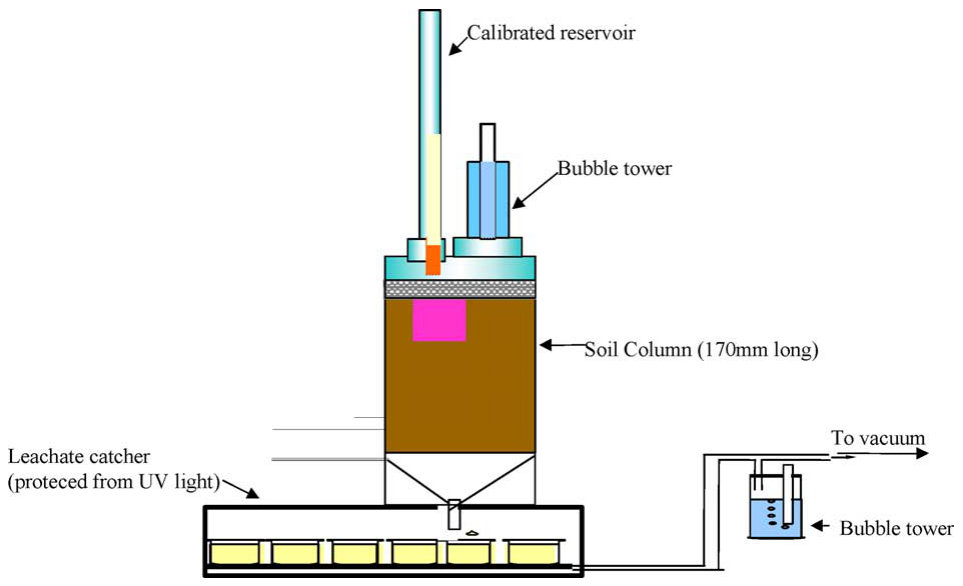
A disc permeameter (White and Perroux, 1987) was used to apply the leachate solution to the soil columns at a preset pressure head of K100 mm. Leachate exiting the column was collected under the same pressure head as that applied to the top (Fig. 1). This ensured unsaturated gravity-driven flow of liquid through the soil column. The vacuum-sealed plexiglass case underneath (Fig. 1) was covered with thick brown paper to exclude sunlight and minimise photolytic degradation of any PCP contained in the leachate (Liu et al., 2002). Tap water (2 L, pH 6.8) was initially applied to each column via the disc permeameter. Once soil within the column was fully wet drainage was initiated. Approximately 0.4 L of water was retained in the column at field capacity. Two subsequent leachate events on each column re-applied the leachate collected following the first and second leaching events, respectively. Following each of the three leaching events per column, a 200 mL leachate sub-sample was put aside in glass containers covered with aluminium foil and stored at 4 8C for further analysis.
采用圆盘渗透仪(White and Perroux, 1987)在−100 mm的预设压力水头下向土柱施加淋溶液。在与顶部施加相同的压力水头下收集流出土柱的淋出液(图1),从而保证液体在土柱中呈非饱和重力驱动流。下方的真空密封有机玻璃箱(图1)用厚牛皮纸覆盖,以遮挡阳光,尽量减少淋出液中PCP的光解(Liu et al., 2002)。首先通过圆盘渗透仪向每根土柱施加自来水(2 L,pH 6.8)。待柱内土壤完全湿润后开始排水。土柱在田间持水量下约保持0.4 L水分。随后在每根土柱上进行两次淋溶,分别回灌第一次和第二次淋溶后收集的淋出液。每根土柱每次淋溶(共3次)后,取200 mL淋出液子样置于铝箔包裹的玻璃容器中,于4 °C保存以供进一步分析。
Flow rate (mm h-1) through each column was calculated from the rate of leachate collection throughout all leaching events for each column. Leachate pH and electrical conductivity were measured after each leachate application event using a Multiline P3 pH/electrical conductivity meter (WTW 82362, Weilheim, Germany). Redox potential was recorded using water test apparatus (Hana Instruments, Portugal).
根据各土柱所有淋溶过程中淋出液的收集速率计算通过每根土柱的流速(mm h-1)。每次施加淋出液后,采用Multiline P3 pH/电导率仪(WTW 82362, Weilheim, Germany)测定淋出液pH和电导率。采用水质测试仪(Hana Instruments, Portugal)记录氧化还原电位。
2.6. Metals in soil and leachate2.6. 土壤和淋出液中的金属
Analysis of Cr, Cu and B in soil and leachate was carried out by an accredited analytical laboratory (e-lab Limited, Hamilton, NZ). For B and Cu analysis the samples were digested using cold HCl acid. Chromium was determined following boiling N acid digestion. Arsenic was analysed in leachate samples using a graphite furnace atomic absorption spectrophotometer (GFAAS) following acidification of the solution with 1 mL nitric acid in 30 mL of leachate. Soil As levels were determined using the GFAAS following digestion of 0.2 g of soil with 10 mL of nitric acid.
土壤和淋出液中Cr、Cu和B的分析由一家经认证的分析实验室(e-lab Limited, Hamilton, NZ)完成。测定B和Cu时,样品采用冷HCl消解。Cr经煮沸N酸消解后测定。淋出液样品中的As在每30 mL淋出液中加入1 mL硝酸酸化后,采用石墨炉原子吸收分光光度计(GFAAS)测定。土壤As含量的测定方法为:以10 mL硝酸消解0.2 g土壤后,采用GFAAS测定。
3Results and discussion结果与讨论
3.1. Potted experiment—PCP as a persistent biocide3.1. 盆栽试验——作为持久性杀生剂的PCP
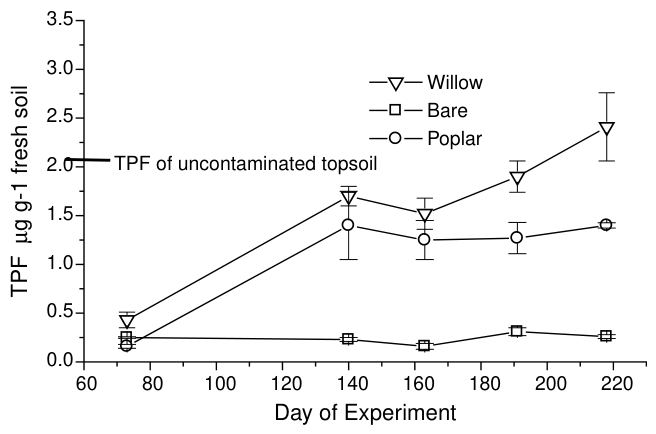
Dehydrogenase activity is indicated by the evolution of triphenolformazan (TPF). A sharp drop in dehydrogenase activity is noted for all treatments following addition of PCP contaminated material to topsoil to a level of 250 mg kgK1 PCP across all treatment pots one month before DOE 1 (Fig. 2). Initial levels of activity in uncontaminated topsoil were recorded at 2.05 mg kg-1 (Fig. 2, dehydrogenase activity of uncontaminated soil is marked by a horizontal line on the Y axis), considerably higher than levels of between 0.2 and 0.5 mg kgK1 recorded following the addition of PCP contaminated material one month before DOE 1 (Fig. 2, DOE 73). At DOE 73, microbial activity in the pots planted with willow was slightly higher compared to both the unplanted and poplar treatments (Fig. 2). By DOE 140 there was significant recovery in microbial activity in the planted pots. There was no significant recovery in dehydrogenase activity in the unplanted pots throughout the experimental period.
脱氢酶活性以三苯基甲臜(TPF)的生成量表示。在DOE 1前1个月向表土中添加PCP污染材料、使所有处理盆钵中的PCP含量达到250 mg kg-1后,所有处理的脱氢酶活性均急剧下降(图2)。未污染表土的初始活性为2.05 mg kg-1(图2,未污染土壤的脱氢酶活性以Y轴上的水平线标出),显著高于DOE 1前1个月添加PCP污染材料后测得的0.2~0.5 mg kg-1(图2,DOE 73)。在DOE 73时,种植柳树的盆钵中微生物活性略高于未种植和种植杨树的处理(图2)。至DOE 140,种植盆钵中的微生物活性已显著恢复。整个试验期间,未种植盆钵中的脱氢酶活性均未见显著恢复。
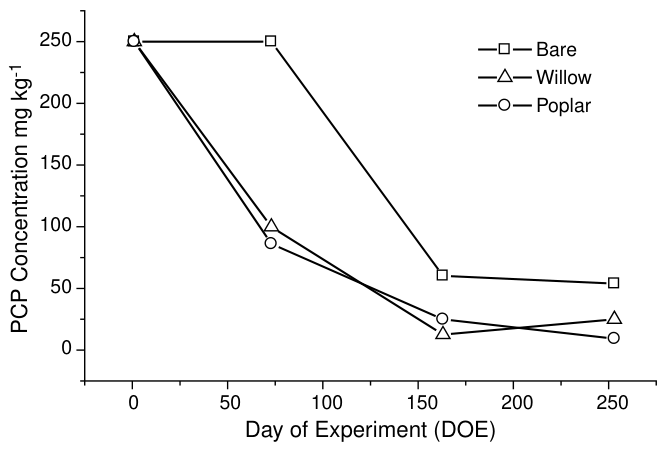
The continued suppression of microbial activity in the unplanted pots contaminated with PCP was similar to results obtained by McGrath and Singleton (2000) who report no recovery of dehydrogenase activity after 6 weeks in soil contaminated with 250 mg kg-1 PCP. The lack of recovery in soil dehydrogenase activity reported by McGrath and Singleton (2000) occurred despite corresponding decreases in PCP concentration during the experiment. We also found this (Fig. 3)
PCP污染的未种植盆钵中微生物活性持续受到抑制,这与McGrath and Singleton (2000)的结果相似,他们报道在250 mg kg-1 PCP污染土壤中,6周后脱氢酶活性仍未恢复。McGrath and Singleton (2000)报道的土壤脱氢酶活性未能恢复的现象,是在试验期间PCP浓度相应下降的情况下发生的。本研究也发现了这一现象(图3)
By DOE 218, the soil of the willow treatment recorded dehydrogenase levels close to those recorded initially for the uncontaminated soil. Soil from the poplar treatment also showed significant recovery in dehydrogenase activity over the experimental period, however, values recorded in the poplar treatment were consistently lower than levels measured for willow. This may be due to the relatively high level of total organic carbon (TOC) extracted from willow roots when compared to poplar roots. Rentz et al., 2004 reported TOC in root extracts of poplar and willow as 25 and 84 mg LK1, respectively, however, these measurements were not made in this study.
至DOE 218,柳树处理土壤的脱氢酶水平已接近未污染土壤的初始水平。杨树处理土壤的脱氢酶活性在试验期间也显著恢复,但其测定值始终低于柳树处理。这可能是由于与杨树根系相比,柳树根系提取出的总有机碳(TOC)水平相对较高。Rentz et al., 2004报道杨树和柳树根系提取液中的TOC分别为25和84 mg L-1,但本研究未进行此项测定。
3.2. PCP degradation3.2. PCP降解
Over the experimental period PCP levels declined steadily in all treatments. However, a significantly greater and earlier reduction (p!0.0001) in PCP concentration occurred in the planted treatments (Fig. 3). A reduction in PCP concentration in unplanted soil was also observed by Puhakka and Melin (1996) and was attributed to microbial activity. McGrath and Singleton (2000) also report a decrease in PCP concentration in non-sterilised unplanted control soils following incubation of soil at 25 8C for 6 weeks. We observed a similar decline in PCP concentration in the soil of unplanted pots, which indicates PCP can be degraded slowly in soils given suitable environmental conditions. In contrast, sterilised unplanted soil spiked with PCP showed no decrease in PCP levels following 6 weeks of incubation at 25 8C (McGrath and Singleton, 2000). These results support our hypothesis, which is that soil microbial populations are able to facilitate PCP breakdown under favourable conditions, even if they have no previous exposure to PCP.
试验期间,所有处理中的PCP含量均稳定下降。但种植处理中PCP浓度的下降幅度显著更大且出现更早(p < 0.0001)(图3)。Puhakka and Melin (1996)也观察到未种植土壤中PCP浓度下降,并将其归因于微生物活动。McGrath and Singleton (2000)同样报道,未灭菌的未种植对照土壤在25 °C下培养6周后PCP浓度下降。本研究在未种植盆钵土壤中也观察到类似的PCP浓度下降,表明在适宜的环境条件下PCP可在土壤中缓慢降解。相比之下,加标PCP的灭菌未种植土壤在25 °C下培养6周后PCP含量未见下降(McGrath and Singleton, 2000)。这些结果支持了本研究的假设,即在有利条件下,即使此前未接触过PCP,土壤微生物种群也能够促进PCP的分解。
Pentachlorophenol, although only sparingly soluble in soil under normal conditions, has still been reported to be taken up in low concentrations by some plants (Howard, 1991). Sap samples, which were taken from poplar and willow at DOE 173, showed no detectable levels of chlorophenols. The lack of PCP recorded in the sap samples suggests that values of plant uptake are low and therefore not a significant contributor to the PCP disappearance from the pots.
尽管五氯苯酚在正常条件下在土壤中仅微溶,但仍有报道称某些植物可低浓度吸收PCP(Howard, 1991)。DOE 173时采集的杨树和柳树树液样品中均未检出氯酚类化合物。树液样品中未检出PCP,表明植物吸收量很低,因而不是盆钵中PCP消失的重要途径。
Soil temperatures within the pots regularly exceeded 25 8C during the summer months. These elevated temperatures may have reduced the amount of PCP absorbed by soil and enhanced its dissolution (Divincenzo and Sparks, 2001). This can increase the amount of PCP available in solution for photolytic and microbial degradation (Levinson et al., 1994). No significant loss of PCP through leaching should have occurred in this experiment as leachate was recycled to each pot daily. Similarly, the greenhouse was covered in a polycarbonate material that absorbed UV radiation and this will limit phytolytic degradation of PCP.
夏季盆内土壤温度经常超过25 °C。温度升高可能降低了土壤对PCP的吸附量,并促进了其溶解(Divincenzo and Sparks, 2001)。这可增加溶液中可供光解和微生物降解的PCP量(Levinson et al., 1994)。由于淋出液每天回灌至各盆钵,本试验中不应发生显著的PCP淋溶损失。同样,温室覆盖材料为可吸收紫外辐射的聚碳酸酯,这将限制PCP的光解。
3.3. Soil microbial population demographics3.3. 土壤微生物种群组成
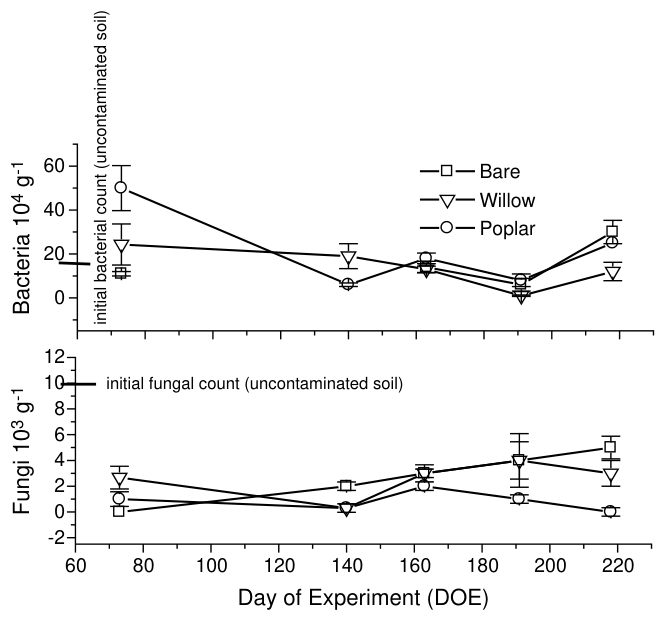
Soil microbial populations are often influenced by the presence of contaminants in soil (Nichols et al., 1997; Kelly et al., 1999). Our uncontaminated topsoil had initial counts of 18!104 bacterial colonies, and 1!104 fungal colonies. Following addition of PCP-contaminated material one month before the commencement of the experiment (30 August 2002), the bacterial colony count remained at levels comparable to the uncontaminated soil at DOE 73 (Fig. 4). However, fungal colony counts were significantly reduced from 1!104 in uncontaminated topsoil to between 0 and 3!103 once soil was contaminated with PCP (Fig. 4). We might have expected a strong influence of PCP on soil fungal populations as it is an effective fungicide protecting timber against microorganisms responsible for rot and sap stain. Bacteria appear less sensitive to PCP contamination in soil. Other co-contaminants present in the mixture, including As, Cr, Cu and B appear to have a minimal effect on bacteria. Copper however is also a powerful fungicide, which may impact on soil fungal numbers. No consistent trend in either fungi or bacteria numbers were found for any treatment during the experimental period (Fig. 4). This may be due to the limitations in our ability to culture all colonies on the media selected for the dilution plate technique. Approximately, 1% of the soil bacterial population can be cultured by standard laboratory practices. It is not known if this 1% is representative of the bacterial population (Torsvik et al., 1998). Giller et al. (1997) estimate 1.5 million species of fungi exist worldwide but unlike bacteria, many fungi cannot be cultured by current standard laboratory methods (Thorn, 1997; van Elsas et al., 2000). Although molecular methods have been used to study soil bacterial communities, very little research has been undertaken for soil fungi (van Elsas et al., 2000).
土壤微生物种群常受土壤中污染物存在的影响(Nichols et al., 1997; Kelly et al., 1999)。本研究未污染表土的初始菌落数为细菌18 × 104、真菌1 × 10⁴。在试验开始前1个月(2002年8月30日)添加PCP污染材料后,DOE 73时细菌菌落数仍与未污染土壤相当(图4)。然而,土壤受PCP污染后,真菌菌落数从未污染表土的1 × 10⁴显著降至0~3 × 10³(图4)。PCP是一种有效的杀真菌剂,可保护木材免受引起腐朽和蓝变的微生物侵害,因此预期其会对土壤真菌种群产生强烈影响。细菌对土壤PCP污染的敏感性似乎较低。混合物中存在的其他共存污染物,包括As、Cr、Cu和B,对细菌的影响似乎很小。但铜也是一种强效杀真菌剂,可能影响土壤真菌数量。试验期间,任何处理中的真菌或细菌数量均未呈现一致的变化趋势(图4)。这可能是由于稀释平板法所选培养基无法培养所有菌落。采用常规实验室方法仅能培养约1%的土壤细菌种群,而这1%能否代表整个细菌种群尚不清楚(Torsvik et al., 1998)。Giller et al. (1997)估计全球存在150万种真菌,但与细菌不同,许多真菌无法通过现行常规实验室方法培养(Thorn, 1997; van Elsas et al., 2000)。尽管分子方法已被用于研究土壤细菌群落,但针对土壤真菌的研究还很少(van Elsas et al., 2000)。
Total shoot and root dry weight biomass for poplar and willow poles growing in PCP contaminated soil
PCP污染土壤中生长的杨树和柳树插干地上部及根系总干重生物量
| PCP Concentration (mg kg-1)PCP浓度 (mg kg-1) | Plant植物 | Total dry shoot weight for each treatment (g)各处理 地上部总 干重(g) | Total dry root weight for each treatment (g)各处理 根系总 干重(g) |
|---|---|---|---|
| 100 | Poplar | 5.352 | 18.103 |
| Willow | 9.708 | 47.469 | |
| 200 | Poplar | 2.881 | 14.30 |
| Willow | 2.838 | 10.54 | |
| 300 | Poplar | 3.902 | 3.59 |
| Willow | 0 | 0 | |
| 400 | Poplar | 0.394 | 0.636 |
| Willow | 0 | 0 | |
| 500 | Poplar | 0.353 | 0.326 |
| Willow | 0 | 0 |
3.4. Poplar and willow tolerance to PCP and its3.4. 杨树和柳树对土壤中PCP及其
co-contaminants in soil
共存污染物的耐受性
Table 2 presents data illustrating the influence of PCP and its co-contaminants such as Cr, As, Cu and B on plant growth. As PCP levels increased total biomass production in both poplar and willow dropped significantly. Poplar appear more tolerant to PCP than willow. Both are able to survive, but not thrive, at concentrations of 200 mg kg-1 PCP. However, willows were unable to grow in soil contaminated with 300 mg kgK1 PCP or more. We therefore suggest that phytoremediation of PCP contaminated soil should use poplars rather than willows. Soil properties will influence plant sensitivity to PCP in soil. High clay and organic matter content may allow plants to tolerate higher PCP levels. Under our conditions the addition of 10% compost by volume did not allow either poplar or willow cuttings to survive 600 mg kg-1 PCP.表2列出了PCP及其共存污染物(如Cr、As、Cu和B)对植物生长影响的数据。随着PCP含量升高,杨树和柳树的总生物量均显著下降。杨树对PCP的耐受性似乎高于柳树。两者在200 mg kg-1 PCP浓度下均能存活,但生长不佳。然而,柳树无法在PCP含量为300 mg kg-1及以上的污染土壤中生长。因此,建议在PCP污染土壤的植物修复中选用杨树而非柳树。土壤性质会影响植物对土壤PCP的敏感性,较高的黏粒和有机质含量可能使植物耐受更高的PCP水平。在本研究条件下,添加体积比10%的堆肥并不能使杨树或柳树插条在600 mg kg-1 PCP下存活。
3.5. Column leaching experiment3.5. 土柱淋溶试验
A column leaching experiment was initiated following our observations of the planted pots after re-irrigation of leachate to the soil surface. Initially, irrigation applied to the pot surface quickly infiltrated the soil. However, following numerous applications of leachate, the solution began to pond and the soil appeared waterlogged. Our leaching experiments were conducted to establish whether or not soil clogging could have a detrimental effect on plant growth.
土柱淋溶试验是基于对种植盆钵在淋出液回灌至土壤表面后的观察而开展的。起初,灌溉至盆面的水分迅速入渗土壤。然而,经多次施用淋出液后,溶液开始在表面积水,土壤出现渍水现象。开展淋溶试验的目的是确定土壤堵塞是否会对植物生长产生不利影响。
Fig. 5 shows the leachate flow rate declined in both 250 and 600 mg kgK1 PCP contaminated soil columns during the three successive leaching events. Each leaching event following the first event immediately followed the previous one to give a total leaching time of approximately 24 h through each column (Fig. 5). These data indicate soil clogging occurred when leachate was re-applied to the soil surface. Anaerobic conditions did not develop during this图5显示,在连续3次淋溶过程中,250和600 mg kg-1 PCP污染土柱的淋出液流速均下降。第一次淋溶之后的每次淋溶均紧接前一次进行,每根土柱的总淋溶时间约为24 h(图5)。这些数据表明,将淋出液回灌至土壤表面时发生了土壤堵塞。本
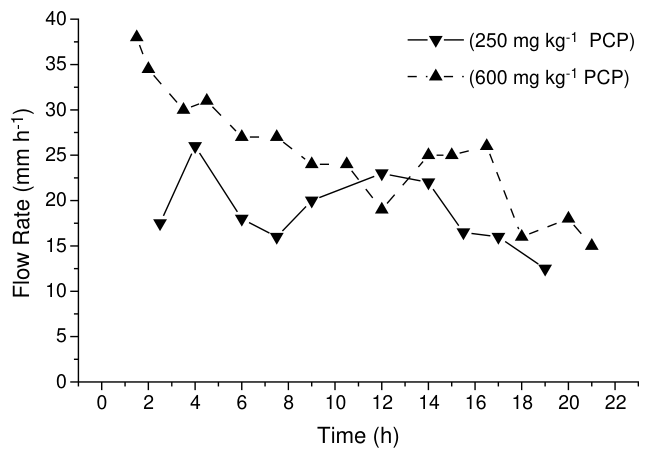
experiment as a positive redox potential was maintained in all leachate collected during the experiment (data not shown). However, continued leaching events might eventually result in the development of anaerobic conditions within the soil column.
试验期间未形成厌氧条件,因为试验期间收集的所有淋出液均保持正的氧化还原电位(数据未列出)。然而,持续的淋溶最终可能导致土柱内形成厌氧条件。
The pH of the leachate solution remained between 6 and 7 throughout all leaching events in both columns. The first leachate collected from each column was more acidic than subsequent samples. At these pH levels, PCP is not ionised and therefore expected to be moderately bound to soil.
两根土柱在所有淋溶过程中淋出液的pH均保持在6~7之间。每根土柱首次收集的淋出液酸性强于后续样品。在此pH水平下,PCP未发生电离,因此预计会与土壤发生中等程度的结合。
3.6. Heavy metal leaching3.6. 重金属淋溶
Boron, a mobile element and poorly absorbed by soils is therefore prone to leaching (Vogeler et al., 2001). In contrast arsenic, copper and chromium are characterised by low solubility in soil (Podlesa´kova et al., 2001, pg. 38) and should therefore pose less risk to groundwater or surrounding environments. Traces of B, Cu, Cr and As were detected in the soil and leachate of both columns (Tables 3 and 4).
硼是一种易迁移元素,土壤对其吸附能力弱,因而易发生淋溶(Vogeler et al., 2001)。相反,砷、铜和铬在土壤中溶解度低(Podlesa´kova et al., 2001, pg. 38),因此对地下水或周边环境的风险应较小。两根土柱的土壤和淋出液中均检出痕量的B、Cu、Cr和As(表3和表4)。
Boron concentrations were reduced in the soil of both columns following leaching (Table 3). Boron levels in the leachate exiting the 600 mg kg-1 PCP column exceed the NZDWS (New Zealand Drinking Water Standard) of 1.4 mg LK1 (New Zealand Ministry of Health, 2000) but were below the NZDWS in the leachate from the 250 mg kg-1 PCP column.
淋溶后两根土柱土壤中的硼浓度均降低(表3)。600 mg kg-1 PCP土柱流出淋出液中的硼含量超过了NZDWS(新西兰饮用水标准)规定的1.4 mg L-1(New Zealand Ministry of Health, 2000),而250 mg kg-1 PCP土柱淋出液中的硼含量低于NZDWS。
For As, Cr, and Cu we recorded an increase in soil concentration following leaching of the 250 mg kgK1 PCP column. Copper and Cr within the soil of the 600 mg kg-1 PCP column showed a sight decline following leaching however As levels in the 600 mg kgK1 PCP column were higher in the final compared to initial values. These increase in metal concentrations may indicate that As, Cr and Cu were redistributed within the column profile during the leaching event in the 250 mg kg-1 PCP column and also in the 600 mg kgK1 PCP column for As. Isolated pockets within the column may have had had initial concentrations of Cr, As and Cu higher than those recorded for the bulk sample. It is likely that the contaminated soil/bark mixture had much higher concentrations of metals associated with bark fragments than the rest of the contaminant material. Arsenic, Cu and Cr are more likely to leach at high concentrations (As and Cr O400 mg kg-1and Cu O150 mg kgK1 Podlesa´kova et al., 2001), but leaching of these recalcitrant metals is also dependent on other soil factors including pH and organic matter content. The presence of these metals within the leachate (Table 4) demonstrates that even at relatively low concentrations of metals in the bulk sample, leaching of metals can still occur.
250 mg kg-1 PCP土柱淋溶后,土壤中As、Cr和Cu的浓度均升高。600 mg kg-1 PCP土柱淋溶后,土壤中Cu和Cr略有下降,但600 mg kg-1 PCP土柱中As的最终含量高于初始值。金属浓度的这些升高可能表明,在淋溶过程中,250 mg kg-1 PCP土柱中的As、Cr和Cu以及600 mg kg-1 PCP土柱中的As在土柱剖面内发生了重新分布。土柱内某些局部区域的Cr、As和Cu初始浓度可能高于混合样品的测定值。污染土壤/树皮混合物中与树皮碎片结合的金属浓度很可能远高于其余污染材料。砷、Cu和Cr在高浓度下更易淋溶(As和Cr >400 mg kg-1,Cu >150 mg kg-1;Podlesa´kova et al., 2001),但这些难迁移金属的淋溶还取决于pH和有机质含量等其他土壤因素。淋出液中存在这些金属(表4)表明,即使混合样品中的金属浓度相对较低,仍可能发生金属淋溶。
Levels of Cu, Cr and As within the 2nd and 3rd leachate samples did not differ markedly from the first, indicating that metals in solution were probably at at equilibrium with the solid phase of the column.
第2和第3次淋出液样品中Cu、Cr和As的含量与第1次无明显差异,表明溶液中的金属可能已与土柱固相达到平衡。
Chromium was recorded at levels higher than the other metal co-contaminants within the unleached soil. Chromium is only sparingly soluble within soil (Kabata-Pendias and Pendias, 1992) and only low concentrations of chromium were recorded in the leachate exiting the column (Kabata- Pendias and Pendias, 1992). The NZDWS for Cr in drinking water is 0.05 mg L-1 (New Zealand Ministry of Health, 2000) and levels of Cr in the leachate do not exceed this (Table 4). Levels of Cr recorded in the captured leachate may however be phytotoxic for both poplar and willow, given that Cr can be taken up by plants and some plant species exhibit toxicity symptoms with Cr solution levels at 0.5 mg kgK1. The concentrations of Cr within the column soil are relatively low compared to levels that may be present at a contaminated site. Armishaw et al. (1994) reports Cr levels of between 500 and 1500 mg kg-1 at CCA (copper, chromium, arsenic) contaminated sites in New Zealand.
在未淋溶土壤中,铬的含量高于其他金属共存污染物。铬在土壤中仅微溶(Kabata-Pendias and Pendias, 1992),流出土柱的淋出液中铬浓度很低(Kabata- Pendias and Pendias, 1992)。NZDWS规定饮用水中Cr的限值为0.05 mg L-1(New Zealand Ministry of Health, 2000),淋出液中的Cr含量未超过该限值(表4)。然而,由于Cr可被植物吸收,且部分植物在溶液Cr含量为0.5 mg kg-1时即表现出毒害症状,收集的淋出液中的Cr含量可能对杨树和柳树均具有植物毒性。与污染场地中可能存在的含量相比,土柱土壤中的Cr浓度相对较低。Armishaw et al. (1994)报道,新西兰CCA(铜、铬、砷)污染场地的Cr含量为500~1500 mg kg-1。
Both B and Cu are essential plant elements, and Cr is a required element for both humans and animals (Kabata- Pendias and Pendias, 1992). Levels of B and Cu in the leachate from our column experiment are unlikely to be phytotoxic (Kabata-Pendias and Pendias, 1992). Despite its role in human and animal health and its relative immobility in soil, Cr toxicity in plants has been recorded. With Cr present in the leachate it may be readily taken up by plants growing in the soil used for our experiments, or alternatively leached to surrounding environments. If plant uptake of Cr has occurred it is likely that Cr will be retained in the roots of the plants and not translocated to leaves (Ma et al., 2003). Arsenic is not a required plant element, and may also be toxic to plants at levels recorded in the leachate. Our data show As levels in the leachate far in excess of those reported for naturally occurring As in soil solutions which range from 0.004 to 0.012 mg LK1 (Kabata-Pendias and Pendias, 1992, pg 35).
B和Cu均为植物必需元素,Cr是人和动物的必需元素(Kabata- Pendias and Pendias, 1992)。本土柱试验淋出液中B和Cu的含量不大可能产生植物毒性(Kabata-Pendias and Pendias, 1992)。尽管Cr对人和动物健康具有作用且在土壤中相对不易迁移,但已有Cr对植物产生毒害的记录。由于淋出液中存在Cr,它可能易被生长在本试验所用土壤中的植物吸收,或淋溶至周边环境。若植物吸收了Cr,Cr很可能滞留于植物根系而不向叶片转运(Ma et al., 2003)。砷不是植物必需元素,在淋出液所测含量下也可能对植物有毒。本研究数据显示,淋出液中的As含量远超土壤溶液中天然As的报道值(0.004~0.012 mg L-1)(Kabata-Pendias and Pendias, 1992, pg 35)。
Concentrations of metals in column soils before and after the leaching events (column length 170 mm)
淋溶前后土柱土壤中的金属浓度(土柱长度170 mm)
| Sample样品 | Boron (B)硼(B) | (mg kgK1) | Copper (Cu铜(Cu | ) (mg kg-1) | Chromium铬 | (Cr) (mg kgK1) | Arsenic (砷( | As) (mg kg-1) |
|---|---|---|---|---|---|---|---|---|
| Initial | Final | Initial | Final | Initial | Final | Initial | Final | |
| 250 mg kgK1 PCP | 1.7 | 1.0 | 3.1 | 3.4 | 18 | 27 | 3.0 | 7.0 |
| 600 mg kg-1 PCP | 3.7 | 2.0 | 8.0 | 6.5 | 49 | 40 | 9.0 | 46.0 |
Concentrations of metals in the leachate from columns contaminated with either 250 or 600 mg kgK1 PCP
250或600 mg kg-1 PCP污染土柱淋出液中的金属浓度
| Sample样品 | Boron (B)硼(B) | Copper (Cu)铜(Cu) | Chromium (Cr)铬(Cr) | Arsenic (As)砷(As) | |
|---|---|---|---|---|---|
| PCP (mg kg-1) | Leaching event | (mg L-1) | (mg LK1) | (mg L-1) | (mg LK1) |
| 250 | 1 | 0.83 | 0.05 | 0.01 | 0.02 |
| 2 | 0.40 | 0.03 | 0.01 | 0.01 | |
| 3 | 0.78 | 0.02 | 0.01 | 0.02 | |
| 600 | 1 | 2.86 | 0.07 | 0.03 | 0.01 |
| 2 | 1.64 | 0.05 | 0.03 | 0.01 | |
| 3 | 2.62 | 0.06 | 0.03 | 0.01 |
Values presented here align closely with data reported by Robinson et al. (2003) for leachate exiting a sawdust pile contaminated with Cu, Cr, As and B. Data on the accumulation of B, Cr, Cu and As in leaves are also presented by Robinson et al. (2003) and indicate that all 4 metals are taken up by plants but that As does not accumulate in the leaves. However, Cr does accumulate with 4.9 mg kg-1 DW Cr having been recorded in poplar leaves by Robinson et al. (2003). Normal leaf concentrations of Cr may be between 0.02 and 0.2 mg kgK1 DW ((Kabata-Pendias and Pendias, 1992). Copper, an essential plant element, is normally present in leaves. Values of Cu concentrations in poplar leaves growing in contaminated sawdust (Robinson et al., 2003) were not elevated, when compared to concentrations in plant leaves growing on uncontaminated material (Kabata-Pendias and Pendias, 1992). Robinson et al. (2003) also showed B is accumulated to high concentrations in poplar leaves (BZ654 mg kg-1 DW), well above B concentrations in leaves grown in uncontaminated soil. Despite high concentrations of B accumulating in poplar leaves, no toxicity symptoms have been noted. This suggests no phytotoxic effect. Our B leachate concentrations are similar as those reported by Robinson et al. (2003).
本文所列数值与Robinson et al. (2003)报道的受Cu、Cr、As和B污染的锯末堆淋出液数据非常接近。Robinson et al. (2003)还给出了B、Cr、Cu和As在叶片中的累积数据,表明这4种金属均可被植物吸收,但As不在叶片中累积。然而,Cr会发生累积,Robinson et al. (2003)在杨树叶片中测得Cr含量为4.9 mg kg-1 DW。叶片中Cr的正常浓度为0.02~0.2 mg kg-1 DW(Kabata-Pendias and Pendias, 1992)。铜是植物必需元素,通常存在于叶片中。与生长在未污染材料上的植物叶片中的浓度相比(Kabata-Pendias and Pendias, 1992),生长在污染锯末中的杨树叶片Cu浓度(Robinson et al., 2003)并未升高。Robinson et al. (2003)还表明,B在杨树叶片中累积至高浓度(B = 654 mg kg-1 DW),远高于生长在未污染土壤中的叶片B浓度。尽管杨树叶片中累积了高浓度的B,但未观察到毒害症状,表明未产生植物毒性效应。本研究淋出液中的B浓度与Robinson et al. (2003)的报道值相近。
3.7. PCP and semi-volatile organic compounds in column leachate
3.7. 土柱淋出液中的PCP和半挥发性有机化合物
Both PCP and tetrachlorophenol (TCP) were present in leachate samples collected from the column leaching experiment (Table 5). Concentrations of tetrachlorophenol were low compared to PCP. This indicates little degradation of PCP under the column conditions. All other semi-volatile compounds tested were below detection limits, including creosote, a common co-contaminant at timber treatment sites. An oily film observed on the initial leachate sample collected from each column may have been oil or diesel but measurements of these specific compounds were not carried out. Variation in PCP and TCP levels recorded in the leachate from the two columns, with differing initial PCP concentrations, highlights the heterogeneous nature of PCP contaminated material in the soil. Depending on both organic matter and clay content, PCP and its related degradation products will have differing propensity to leach (Podlesa´kova et al., 2001). Despite soil and PCP contaminated material being well mixed, variation in PCP concentration within the column is still apparent. These variations are also illustrated by data presented in Tables 3 and 4 where levels of B, Cu, Cr and As are presented. They vary markedly between initial and final concentrations of metals in the soil of both columns.
土柱淋溶试验采集的淋出液样品中均检出PCP和四氯苯酚(TCP)(表5)。
4Conclusions结论
Pentachlorophenol and tetrachlorophenol concentrations in leachate exiting the column
土柱流出淋出液中的五氯苯酚和四氯苯酚浓度
| Sample样品 | PCP 1 | TCP 1 | |
|---|---|---|---|
| PCP mg kgK1 in soil | Leaching event | mg kgK | mg kg- |
| 250 | 1 | 13.5 | 0.8 |
| 2 | 1.6 | nd* | |
| 3 | 1.1 | nd | |
| 600 | 1 | 0.5 | nd |
| 2 | 7.0 | 0.5 | |
| 3 | 6.1 | 0.5 |
*nd indicates substance not detected
*nd表示未检出
Soil and water contaminated with pentachlorophenol and its associated co-contaminants are widespread. Often concentrations of PCP and metals are high (Armishaw et al., 1994) and this prohibits the use of plants to stimulate the natural degradation of organic compounds. However plants are able to tolerate PCP concentrations of 250 mg kgK1 or less. This would allow site remediation of large volumes of low-level contamination once ‘hot spots’, areas high in contaminant concentration, have been removed or diluted by mixing. Column leaching experiments indicate that PCP, Cr, As, B and Cu all leach from soils contaminated with the yard scrapings from timber treatments sites. This highlights the requirement not only to remediate the site but also to ‘seal’ the site hydrologically and limit off-site contaminant migration (Mills and Robinson, 2003). Vegetation also prevents wind erosion whereas bare soil may be blown off-site. In order to keep the phytoremediation trees healthy, periodic fertiliser applications would be required. The addition of nutrients to the system would stimulate soil microbial activity but they may also lower the soil pH. This has implications for heavy metal mobility. Metals are more likely to leach under acid conditions. But PCP will be less likely to leach given acid soil conditions (Christodoulatos et al., 1994). We suggest soil pH levels be maintained close to neutral to ensure minimal metal leaching while still favouring the biodegradation of PCP and other organic compounds.
受五氯苯酚及其相关共存污染物污染的土壤和水体分布广泛。PCP和金属的浓度往往很高(Armishaw et al., 1994),这使得利用植物促进有机化合物自然降解的方法无法实施。然而,植物能够耐受不高于250 mg kg-1的PCP浓度。因此,在清除“热点”(即污染物浓度高的区域)或通过混合将其稀释后,即可对大量低浓度污染土壤进行场地修复。土柱淋溶试验表明,受木材处理场地堆场刮除物污染的土壤中,PCP、Cr、As、B和Cu均会发生淋溶。这凸显出不仅需要修复场地,还需要在水文上“封闭”场地,限制污染物向场外迁移(Mills and Robinson, 2003)。植被还可防止风蚀,而裸露土壤则可能被吹离场地。为保持用于植物修复的树木健康生长,需要定期施肥。向系统中添加养分可刺激土壤微生物活性,但也可能降低土壤pH,进而影响重金属的迁移性。金属在酸性条件下更易淋溶,而PCP在酸性土壤条件下则较不易淋溶(Christodoulatos et al., 1994)。建议将土壤pH维持在接近中性的水平,以尽量减少金属淋溶,同时仍有利于PCP及其他有机化合物的生物降解。
There is a common perception that if contaminants are bound to soil and therefore unable to either leach or be taken up by plants then they pose little environmental threat (Alexander, 1999). By using phytoremediation we not only protect surrounding soil and water from the effects of migrating compounds but the organic contaminants present will more rapidly degrade. The release of PCP and metal contaminants into the soil solution will fluctuate with time and prevailing environmental conditions. Bound compounds are released from decomposing organic matter and rainfall initiates drainage. Site monitoring of leachate is recommended as part of a long-term contaminated site management plan. The use of plants to ‘seal’ the site and remediate PCP contaminated sites requires careful management to ensure soil and plant health is retained. In using reticulation of captured leachate it would be necessary to ensure that the rates of reapplication do not irreversibly damage soil health and structure, and therefore limit plant health. This would become increasingly easy to manage as plants grow and their water-use increases.
人们普遍认为,若污染物与土壤结合而既不能淋溶也不能被植物吸收,则其环境威胁很小(Alexander, 1999)。利用植物修复,不仅可以保护周边土壤和水体免受迁移性化合物的影响,还能加快现存有机污染物的降解。PCP和金属污染物向土壤溶液中的释放会随时间和环境条件而波动:结合态化合物会随有机质分解而释放,降雨则引发排水。建议将淋出液的场地监测纳入污染场地长期管理计划。利用植物“封闭”场地并修复PCP污染场地需要精心管理,以确保维持土壤和植物健康。在对收集的淋出液进行循环回灌时,须确保回灌速率不会对土壤健康和结构造成不可逆的损害,进而限制植物健康。随着植物生长及其耗水量增加,这一管理将变得越来越容易。
Acknowledgements致谢
The authors wish to thank the Royal Society of New Zealand who provided Barbara Arnold with a one-year teacher fellowship to allow her to pursue research work at HortResearch.
作者感谢新西兰皇家学会为Barbara Arnold提供为期一年的教师奖学金,使其得以在HortResearch开展研究工作。
Brown, A.W.A., 1978. Ecology of Pesticides. John Wiley and Sons, New York.
Brown, A.W.A., 1978. Ecology of Pesticides. John Wiley and Sons, New York.
Chandler, K., Brooks, P.C., 1991. Is the dehydrogenase assay invalid as a method to estimate microbial activity in copper contaminated soils. Soil Bio. Biochem. 23 (10), 909–915.
Chandler, K., Brooks, P.C., 1991. Is the dehydrogenase assay invalid as a method to estimate microbial activity in copper contaminated soils. Soil Bio. Biochem. 23 (10), 909–915.
Christodoulatos, C., Mohiuddin, M., 1996. Generalised models for prediction of pentachlorophenol absorption by natural soils. Water Environ. Res. 68 (3), 370–378.
Christodoulatos, C., Mohiuddin, M., 1996. Generalised models for prediction of pentachlorophenol absorption by natural soils. Water Environ. Res. 68 (3), 370–378.
Christodoulatos, C., Korfiatis, G., Talimcioglu, N.M., Mohiuddin, M., 1994. Adsorption of pentachlorophenol by natural soils. J. Environ. Sci. Health. 29 (5), 883–898.
Christodoulatos, C., Korfiatis, G., Talimcioglu, N.M., Mohiuddin, M., 1994. Adsorption of pentachlorophenol by natural soils. J. Environ. Sci. Health. 29 (5), 883–898.
Davis, A., Campbell, J., Gilbert, C., Ruby, M., Bennett, M., Tobin, S., 1996. Attenuation and biodegradation of chlorophenols in ground water at a former wood treating facility. Ground Water 32 (2), 248–257.
Davis, A., Campbell, J., Gilbert, C., Ruby, M., Bennett, M., Tobin, S., 1996. Attenuation and biodegradation of chlorophenols in ground water at a former wood treating facility. Ground Water 32 (2), 248–257.
Dietrich, D.M., Lamar, R.T., 1990. Selective Medium for Isolating Phanerochaete chrysosporium in soil. Appl. Environ. Microbiol. 56, 3093–3100.
Dietrich, D.M., Lamar, R.T., 1990. Selective Medium for Isolating Phanerochaete chrysosporium in soil. Appl. Environ. Microbiol. 56, 3093–3100.
Divincenzo, J.P., Sparks, D.L., 2001. Sorption of the neutral and charged forms of pentachlorophenol on soil: Evidence for different mechanisms. Arch. Environ. Contam. Toxicol. 40, 445–450.
Divincenzo, J.P., Sparks, D.L., 2001. Sorption of the neutral and charged forms of pentachlorophenol on soil: Evidence for different mechanisms. Arch. Environ. Contam. Toxicol. 40, 445–450.
Giller, K.E., Beare, M.H., Lavelle, P., Izac, A.-M.N., Swift, M.J., 1997. Agricultural intensification, soil biodiversity and agroecosystem function. Appl. Soil. Ecol. 6, 3–16. Holland, P.T., Hickey, C.W., Roper, D.S., Trower, T.M., 1993. Variability of organic contaminants in inter-tidal sandflat sediments from Manukau Harbour. New Zealand. Arch. Environ. Contam. Toxicol. 25, 456–463.
Giller, K.E., Beare, M.H., Lavelle, P., Izac, A.-M.N., Swift, M.J., 1997. Agricultural intensification, soil biodiversity and agroecosystem function. Appl. Soil. Ecol. 6, 3–16. Holland, P.T., Hickey, C.W., Roper, D.S., Trower, T.M., 1993. Variability of organic contaminants in inter-tidal sandflat sediments from Manukau Harbour. New Zealand. Arch. Environ. Contam. Toxicol. 25, 456–463.
Howard, P.H., 1991. Handbook of Environmental Fate and Exposure Data for Organic Chemicals and Pesticides. Lewis Publishers, Chelsea, MI. Kabata-Pendias, A., Pendias, H., 1992., second ed. Trace Elements in Soil and Plant CRC Press, Boca Raton, USA.
Howard, P.H., 1991. Handbook of Environmental Fate and Exposure Data for Organic Chemicals and Pesticides. Lewis Publishers, Chelsea, MI. Kabata-Pendias, A., Pendias, H., 1992., second ed. Trace Elements in Soil and Plant CRC Press, Boca Raton, USA.
Kelly, J., Ha¨ggblom, M., Tata, R., 1999. Changes in soil microbial communities over time resulting from on time application of zinc: a laboratory microcosm study. Soil Bio. Biochem. 31, 1455–1465.
Kelly, J., Ha¨ggblom, M., Tata, R., 1999. Changes in soil microbial communities over time resulting from on time application of zinc: a laboratory microcosm study. Soil Bio. Biochem. 31, 1455–1465.
Lang, A., Volz, R.K., 1998. Spur leaves increase calcium in young apples by promoting xylem inflow and outflow. J. Amer. Soc. Hort. Sci. 123 (6), 956–960.
Lang, A., Volz, R.K., 1998. Spur leaves increase calcium in young apples by promoting xylem inflow and outflow. J. Amer. Soc. Hort. Sci. 123 (6), 956–960.
Lee, H.B., Weng, L.D., Chau, A.S.Y., 1984. Chemical derivitization analysis of pesticide residues, VIII. Analysis of 15 chlorophenols in natural water by in situ acetylation. J Assoc. Off. Anal. Chem. 64, 789–794.
Lee, H.B., Weng, L.D., Chau, A.S.Y., 1984. Chemical derivitization analysis of pesticide residues, VIII. Analysis of 15 chlorophenols in natural water by in situ acetylation. J Assoc. Off. Anal. Chem. 64, 789–794.
Levinson, W.E., Stormo, K.E., Tao, H-L., Crawford, R.L., 1994. Hazardous Waste Cleanup and Treatment with Encapsulated or Entrapped Microorganisms. In: Chaudhry, G.R. (Ed.), Biological Degradation and Bioremediation of Toxic Chemicals. Dioscorides Press, Portland, Oregon.
Levinson, W.E., Stormo, K.E., Tao, H-L., Crawford, R.L., 1994. Hazardous Waste Cleanup and Treatment with Encapsulated or Entrapped Microorganisms. In: Chaudhry, G.R. (Ed.), Biological Degradation and Bioremediation of Toxic Chemicals. Dioscorides Press, Portland, Oregon.
Liu, P-Y., Zheng, M-H., Xu, X-B., 2002. Phototransformation of polychlorinated dibenzo-p-dioxins from photolysis of pentachlorophenol on soil surface. Chemosphere 46, 1191–1193.
Liu, P-Y., Zheng, M-H., Xu, X-B., 2002. Phototransformation of polychlorinated dibenzo-p-dioxins from photolysis of pentachlorophenol on soil surface. Chemosphere 46, 1191–1193.
Ma, H., Wang, X., Zhang, C., 2003. Cr(III) accumulation and phytoavailability in alkaline soils contaminated with tannery sludge. Chem. Spec. Bioavail. 15 (1), 15–22.
Ma, H., Wang, X., Zhang, C., 2003. Cr(III) accumulation and phytoavailability in alkaline soils contaminated with tannery sludge. Chem. Spec. Bioavail. 15 (1), 15–22.
Marschner, P., Yang, C-H., Lieberei, R., Crowley, D.E., 2001. Soil and plant specific effects on bacterial community composition in the rhizosphere. Soil Biol. Biochem. 33 (11), 1437–1445.
Marschner, P., Yang, C-H., Lieberei, R., Crowley, D.E., 2001. Soil and plant specific effects on bacterial community composition in the rhizosphere. Soil Biol. Biochem. 33 (11), 1437–1445.
References参考文献
Abrahamsson, K., Xie, T.M., 1993. Direct determination of trace amounts of chlorophenols in fresh water, wastewater and seawater. J. Chromatogr. 279, 199–208.
Alexander, M., 1999. Bioavailability: aging, Sequestering and complexing, second ed., Biodegradation and Bioremediation Academic Press, San Diego, Calif. pp. 157–167.
Armishaw, R.F., Fricker, A.G., Fenton, G.A., 1994. Soil and Groundwater studies at some CCA timber treatment sites, Water and Waste in New Zealand 1994 (March 1994) pp. 44–48.
McGrath, R., Singleton, I., 2000. Pentachlorophenol transformation in soil: a toxicological assessment. Soil Bio. and Biochem. 32, 1311–1314.
Mills, T.M., Robinson, B.H., 2003. Hydrological management of contaminated sites using vegetation, Encyclopedia of Water Science. Marcel Dekker Inc, New York.
New Zealand Ministry of Health., 2000. Drinking water standards for New Zealand 2000. Wellington, New Zealand.
Nichols, T.D., Wolf, D.C., Rogers, H.B., Beyrouty, C., A, Reynolds, C.M., 1997. Rhizosphere microbial populations in contaminated soil. Water Air. Soil. Poll. 95, 165–178.
Parkinson, D.T., Gray, R.G., Williams, S.T., 1971. Methods for studying the ecology of soil microorganisms, IBP Handbook no. 19. Blackwell Scientific Publications Ltd, Oxford.
Podlesa´kova, E., Nemecek, J., Va´cha, R., 2001. Mobility and bioavailability of trace elements in soil. In: Iskandar, I.K., Kirkham, M.B. (Eds.), Trace Elements in Soil. Lewis Publishers, USA.
Puhakka, J.A., Melin, E.S., 1996. Bioremediation of chlorinated phenols. In: Crawford, R.L., Crawford, D.L. (Eds.), Bioremediation: Principles and Applications. Cambridge University Press, UK.
Rentz, J.A., Alvarez, P.J.J., Schnoor, J.L., 2004. Repression of Pseudomonas putida phenanthrene-degrading activity by plant root extracts and exudates. Environ. Microbio. 6 (6), 574–583.
Robinson, B., Green, S., Mills, T., Clothier, B., van der Velde, M., Laplane, R., Fung, L., Deurer, M., Hurst, S., Thayalakumaran, T., van den Dijssel, C., 2003. Phytoremediation: Using plants as biopumps to improve degraded environments. Aust. J. Soil Res. 41, 599–611.
Taylor, R., Smith, I., 1997. The state of New Zealand’s environment, New Zealand Ministry for the Environment. Wellington, New Zealand.
Taylor, J., Wilson, B., Mills, M., Burns, R., 2002. Comparison of microbial numbers and enzymatic activities in surface soil and subsoil using various techniques. Soil Bio. Biochem. 34, 387–401.
Thorn, G., 1997. The fungi in soil. In: van Elsas, J.D., Trevors, J.T., Wellington, E.M.H. (Eds.), Modern Soil Microbiology. Marcel Dekker, New York, pp. 63–127.
Torsvik, V., Daae, F.L., Sandaa, R.-A., Ovreas, L., 1998. Review article: novel techniques for analysing microbial diversity in natural and perturbed environments. J. Biotechnol. 64, 53–62.
United States Environmental Protection Agency, 2004. Semivolatile target compound list and corresponding CRQLs (Contract Required Quantitation Limits), retrieved 27 Oct 2004 from http://www.epa.gov/ superfund/programs/clp/svtarget.htm.
van Elsas, J.D., Frois-Duarte, G., Keijzer-Woltersa, A., Smit, E., 2000. Analysis of the dynamics of fungal communities in soil via fungalspecific PCR of soil DNA followed by denaturing gradient gel electrophoresis. J. Microbiol. Methods 43, 133–151.
Vogeler, I., Green, S., Clothier, B., Kirkham, M.B., Robinson, B., 2001. Contaminant Transport in the Root Zone. In: Iskandar, I.K., Kirkham, M.B. (Eds.), Trace Elements in Soil. Lewis Publishers, USA, pp. 175–195.
White, I., Perroux, K.M., 1987. Use of sorptivity to determine field soil hydraulic properties. Soil Sci. Soc. Amer. J. 51 (5), 1093– 1101.