Hydrol. Earth Syst. Sci. Discuss., 3, 2037–2061, 2006 www.hydrol-earth-syst-sci-discuss.net/3/2037/2006/ © Author(s) 2006. This work is licensed under a Creative Commons License.
Papers published in Hydrology and Earth System Sciences Discussions are under open-access review for the journal Hydrology and Earth System Sciences
B. E. Clothier1, S. R. Green1, I. Vogeler1, M. M. Greven2, R. Agnew2, C. W. van den Dijssel1, S. Neal2, B. H. Robinson4, and P. Davidson3
1Sustainable Land Use Team, HortResearch, Private Bag 11-030, Palmerston North, New Zealand
2Sustainable Land Use Team, HortResearch, Private Bag 845, Blenheim, New Zealand
3Marlborough District Council, Private Bag 443, Blenheim, New Zealand
4Institute of Terrestrial Ecology, ETHZ, Grabenstrasse 3, 8952 Schlieren, Switzerland
Received: 15 February 2006 – Accepted: 3 July 2006 – Published: 2 August 2006
Correspondence to: B. E. Clothier (bclothier@hortresearch.co.nz)
Abstract摘要
Winegrape growing in many parts of the world, including Marlborough, New Zealand, uses treated-timber posts to act as supports for the grapevine’s canopy. At a density of 580 posts per hectare, the H4-process treated supports result in an areal loading 5 of CCA of: Copper (12 kg-Cu ha−1), Chromium (21 kg-Cr ha−1) and Arsenic (17 kg- As ha−1). Arsenic is the most mobile and toxic of the CCA-treatment cocktail. We describe experiments which indicate that about 4–6 mg-As month−1 post−1 is released from the subterranean part of the post. We have used SPASMO (Soil Plant Atmosphere System Model) to predict post-to-soil leakage, as well as the pattern dynamics of leach- 10 ing and exchange around the post. Locally the pattern dynamics of transport and fate are controlled by the soil’s chemical characteristics and the prevailing weather. Over its 20-year lifetime, the concentration of arsenic, both that adsorbed on the soil and in the soil solution, exceeds guideline values for soils (100 mg-As kg−1) and drinking water (10 µg-As L−1). Under a regime of 5% annual replacement of posts, the spatially 15 averaged concentration of arsenic leaching through the soil is predicted to rise to 1.25 to 1.7 times the drinking water standard, depending only slightly on the soil type. The steady value is primarily controlled by the arsenic-release rate from the post. These steady values were used in a simple hydrogeological model of the major Marlborough aquifer systems to determine whether the subterranean flow of water could dilute the
世界上许多地区(包括新西兰马尔堡)的酿酒葡萄种植均采用经防腐处理的木桩作为葡萄树冠层的支撑。按每公顷580根木桩的密度计,经H4级处理的支撑桩所带来的CCA面积负荷为:铜(12 kg-Cu ha−1)、铬(21 kg-Cr ha−1)和砷(17 kg- As ha−1)。砷是CCA处理药剂各组分中迁移性最强、毒性最大的元素。本文所述试验表明,木桩地下部分的砷释放量约为4–6 mg-As month−1 post−1。我们利用SPASMO(土壤-植物-大气系统模型)预测了木桩向土壤的渗漏,以及木桩周围淋溶与交换的格局动态。在局地尺度上,迁移与归趋的格局动态受土壤化学特性和当地天气条件的控制。在木桩20年的使用寿命内,土壤吸附态砷和土壤溶液中砷的浓度均超过土壤(100 mg-As kg−1)和饮用水(10 µg-As L−1)的指导值。在每年更换5%木桩的情形下,预测经土壤淋溶的砷的空间平均浓度将升至饮用水标准的1.25至1.7倍,且受土壤类型的影响很小。该稳态值主要受木桩砷释放速率的控制。我们将这些稳态值用于马尔堡主要含水层系统的简单水文地质模型,以确定地下水流能否稀释
20 descending plumes of arsenic coming from above. Except for the sluggish aquifers of the southern valleys in Marlborough, most of the aquifer systems seem capable of diluting the leachate to between one tenth and one twentieth of the drinking water standard. The upscaling of our modelling of the local pattern dynamics spanned six orders of spatial magnitude, and four orders of time dimension.
自上方下渗的砷羽流。除马尔堡南部河谷中流动迟缓的含水层外,大多数含水层系统似乎能够将淋溶液稀释至饮用水标准的十分之一至二十分之一。我们对局地格局动态模拟结果的尺度上推跨越了6个空间数量级和4个时间数量级。
1Introduction引言
New winegrape-growing regions of New Zealand, Australia, South Africa, Chile and California are characterised by the use of novel viticultural techniques and innovative wine-making procedures, which take full advantage of the unusual terroir of these en-
新西兰、澳大利亚、南非、智利和加利福尼亚的新兴酿酒葡萄产区的特点是采用新型葡萄栽培技术和创新的酿酒工艺,充分利用这些环
5 vironments. One characteristic of winegrape growing in many of these regions is the use of chemically treated timber-posts to act as supports for the grape-vine’s canopy. At a density of 580 posts per hectare, H4-process treated supports result in an areal loading of CCA of: Copper (12 kg-Cu ha−1), Chromium (21 kg-Cr ha−1) and Arsenic (17 kg-As ha−1).
境独特的风土条件。这些产区中许多地方酿酒葡萄种植的一个特点是使用经化学处理的木桩作为葡萄树冠层的支撑。按每公顷580根木桩的密度计,经H4级处理的支撑桩所带来的CCA面积负荷为:铜(12 kg-Cu ha−1)、铬(21 kg-Cr ha−1)和砷(17 kg-As ha−1)。
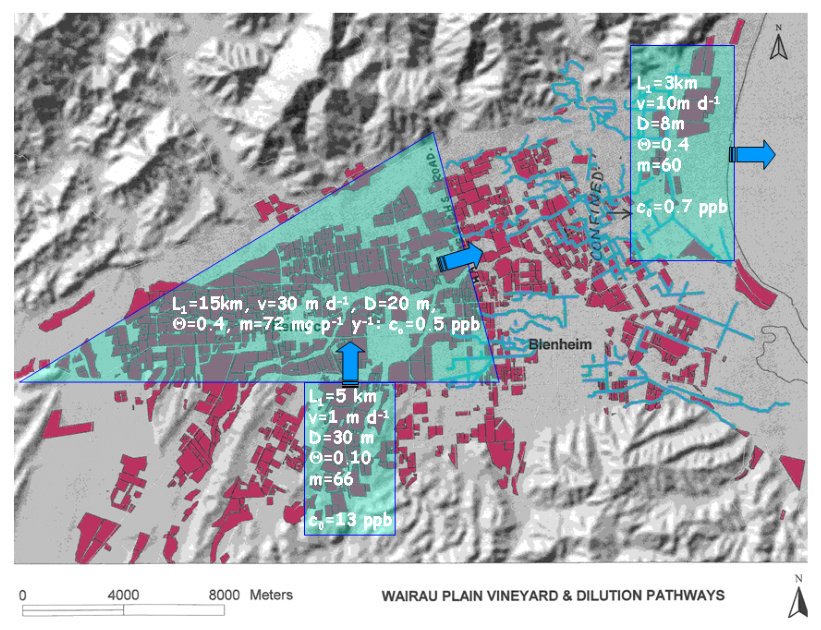
10 There have been concerns raised in Marlborough, New Zealand, where over 15 000 ha of grapes are grown, that the pattern dynamics around the 9 million vineyard posts might have a detrimental impact on the quality of water in the aquifers underlying the Wairau Plains (Bourne, 2003). There are three major aquifer systems in the Wairau Valley, as shown in Fig. 8. The major groundwater system is the trian-
新西兰马尔堡的葡萄种植面积逾15 000 ha,当地有人担心,900万根葡萄园木桩周围的格局动态可能对Wairau平原下伏含水层的水质产生不利影响(Bourne, 2003)。如图8所示,Wairau河谷有三个主要含水层系统。主要地下水系统为呈三
15 gularly shaped Wairau aquifer, which after about 15 km meets an aquiclude around Hammerichs’ Road. This leads to springs which result in the discharge to surface waters of about 90% of the groundwater flow. The Rarangi shallow aquifer near the coast, above which there is a burgeoning development of vineyards, discharges into the sea of Cloudy Bay. Flowing north into Wairau Valley are the aquifers of the southern valleys 20 of the Brancott, Omaka, and the Fairhall. All these aquifer systems are a prime source of potable water and irrigation. Furthermore the former two discharge into sensitive receiving waters.
角形的Wairau含水层,其在约15 km后于Hammerichs’ Road附近遇到隔水层,由此形成泉水,约90%的地下水流排泄至地表水体。靠近海岸的Rarangi浅层含水层(其上方葡萄园正快速发展)排泄入Cloudy Bay海域。向北流入Wairau河谷的是南部河谷Brancott、Omaka和Fairhall的含水层。所有这些含水层系统都是饮用水和灌溉用水的主要来源。此外,前两者排泄至敏感的受纳水体。
It is therefore critical that the pattern dynamics of local-scale leaching around these CCA-treated posts in vineyards does not, in spatial and temporal sum, compromise 25 the quality of water in the underlying aquifers. In a previous paper (Robinson et al., 2006), we described the results of a general survey of the soil immediately around posts of various ages across a range of soil types. Very close to the posts, within 50 mm, we found that about 25% of our soil samples exceeded the guideline values
因此,至关重要的是,葡萄园中这些CCA处理木桩周围局地尺度淋溶的格局动态在空间和时间上累加后,不会损害下伏含水层的水质。在此前的论文中(Robinson et al., 2006),我们报道了对不同土壤类型上不同年限木桩紧邻周围土壤的普查结果。在紧靠木桩50 mm范围内,约25%的土壤样品超过了
for arsenic in Australia’s National Environmental Protection Measures (NEPM, 1999). Some 10% of our samples exceeded guideline values for chromium (Cr). Obviously, CCA is leaching from the post into the receiving environment of the soil. Now, our goal here is to assess the risk that the pattern dynamics of CCA, in particular the 5 most mobile and toxic arsenic, might lead to leaching into the underlying aquifers and degrade the groundwater.
澳大利亚《国家环境保护措施》(NEPM, 1999)中砷的指导值,约10%的样品超过了铬(Cr)的指导值。显然,CCA正从木桩淋溶进入土壤这一受纳环境。本文的目标是评估CCA(尤其是迁移性最强、毒性最大的砷)的格局动态可能导致淋溶进入下伏含水层并使地下水质量下降的风险。
The local regulatory agency, the Marlborough District Council, first sought an understanding of the long-term impact of the use of CCA-treated posts on the soil immediately surrounding the posts, say within 50 mm of the post, across the range of soils 10 found in the Wairau Valley. Further, they wished to understand the underlying impact of these posts, at a density of 580 ha−1, on their major aquifers. These aquifers range in spatial extent from 10–75 km2. They sought long-term predictions, over 500 years, of the use of treated posts. In addition, we needed to incorporate sequences of post replacement, for on average, each post is replaced every 20 years.
地方监管机构马尔堡区议会(Marlborough District Council)首先希望了解,在Wairau河谷的各类土壤上,使用CCA处理木桩对木桩紧邻周围(如距木桩50 mm以内)土壤的长期影响。此外,他们还希望了解这些木桩在580 ha−1的密度下对其主要含水层的潜在影响。这些含水层的空间范围为10–75 km2。他们需要对使用处理木桩超过500年的长期预测。此外,由于平均每根木桩每20年更换一次,我们还需要纳入木桩更换序列。
15 To realise spatial and temporal predictions that would be useful for the Council, we needed to understand the pattern dynamics of arsenic leakage and leaching at the local scale around the post under different As-soil exchange conditions. As well, we needed to determine the pattern dynamics of transport and flow at the spatial scale of the vineyard and landscape over several centuries.
为了实现对议会有用的时空预测,我们需要了解在不同砷-土壤交换条件下木桩周围局地尺度上砷渗漏与淋溶的格局动态。同时,我们还需要确定葡萄园和景观空间尺度上数百年间迁移与流动的格局动态。
20 In this paper we describe our measurement and modelling of the pattern dynamics of arsenic leakage and leaching at the local scale surrounding the post. Here it is likely that the “chemistry” dominates. Next, we outline how we upscaled these findings to model leaching at the landscape scale of assemblages of vineyards above the key aquifers. Here the pattern dynamics are probably dominated by the source strength of 25 arsenic, and the “physics” of the flow system. Our study focuses mainly on arsenic, as this is the most mobile and toxic of the CCA-treatment cocktail.
本文描述了我们对木桩周围局地尺度砷渗漏与淋溶格局动态的测定和模拟。在此尺度上,“化学”过程可能占主导。随后,我们概述了如何将这些结果进行尺度上推,以模拟关键含水层上方葡萄园集合体在景观尺度上的淋溶。在此尺度上,格局动态可能主要受砷源强度和流动系统“物理”过程的控制。本研究主要关注砷,因为砷是CCA处理药剂各组分中迁移性最强、毒性最大的元素。
We describe the SPASMO (Soil Plant Atmosphere System Model) scheme that we used to predict the post-to-soil leakage, leaching and soil exchange. We outline the parameterisations used in SPASMO, and then we describe the application of the scheme
我们介绍了用于预测木桩向土壤渗漏、淋溶及土壤交换的SPASMO(土壤-植物-大气系统模型)方案,概述了SPASMO中使用的参数化方法,随后描述了该方案的应用,
to predict the build-up around the post and leaching under it, over the time scale of a single post’s life in the soil, namely 20–30 years. These predictions are compared with the results from our general survey (Robinson et al., 2006). We then discuss our predictions of the impact of sequential post replacement every 20 years, over a period of
以预测在单根木桩于土壤中的使用寿命(即20–30年)时间尺度上木桩周围的累积及其下方的淋溶。将这些预测结果与我们的普查结果(Robinson et al., 2006)进行比较。随后讨论了在
5 500 years. The predictions of the pattern dynamics from this modelling are then used in a simple mass-balance model of the hydrogeology of the key aquifers to predict the exit concentration of arsenic at the distal interface of the subterranean system. This exit interface is either where it rises to feed surface waters, or where the subterranean flow enters the sea, or another aquifer system. Our analyses of the pattern dynamics
500年期间每20年依次更换木桩所产生影响的预测结果。该模拟所得的格局动态预测随后被用于关键含水层水文地质的简单质量平衡模型,以预测地下系统远端界面处的砷出口浓度。该出口界面为地下水上涌补给地表水之处、地下水流入海之处或进入另一含水层系统之处。我们对格局动态的分析
10 transcends many spatial scales: spatially – from the mm scale around the post, to the km scale of aquifers (six orders of magnitude); and temporally – from the daily scale to that of half a millennium (four orders of magnitude).
跨越了多个尺度:空间上从木桩周围的毫米尺度到含水层的千米尺度(6个数量级);时间上从日尺度到半个千年(4个数量级)。
2SPASMO modellingSPASMO模拟
Our mechanistic transport and fate model, SPASMO, (Green et al., 2002; Rosen et al.,
我们的机理性迁移与归趋模型SPASMO(Green et al., 2002; Rosen et al.,
15 2004), was modified to describe the series of processes that control: the rate of chemical release from the post to the soil solution, the equilibrium partitioning of chemical between adsorbed and aqueous phases in the soil, and the downward movement of dissolved arsenic through the soil profile. The SPASMO modelling approach predicts the temporal evolution of each process. Parameters for the modelling were taken from 20 data collected during laboratory studies on a range of Marlborough soils, and from lysimeter studies using vineyard posts submerged in water. Water and chemical movement through the soil is modelled by considering a 1- dimensional soil profile 5 m deep, which is divided into 0.1 m intervals, or slabs. The calculations were run with a daily time-step, and they consider the water balance to
2004)经修改后用于描述控制以下一系列过程:化学物质从木桩向土壤溶液的释放速率、化学物质在土壤吸附相与水相之间的平衡分配,以及溶解态砷在土壤剖面中的向下迁移。SPASMO模拟方法可预测各过程的时间演变。模型参数取自对一系列马尔堡土壤的实验室研究数据,以及将葡萄园木桩浸没于水中的渗漏计研究数据。水分和化学物质在土壤中的运动通过一个深5 m的一维土壤剖面来模拟,该剖面被划分为0.1 m的间隔(即薄层)。计算以日为时间步长运行,并将水量平衡视为
25 be that of a bare soil, for that is what immediately surrounds the post. A standard crop-factor approach was used to relate the soil evaporation to the prevailing weather (Allen et al., 1999). Water movement through the soil profile was calculated using a
裸土的水量平衡,因为紧邻木桩周围的正是裸土。采用标准作物系数法将土壤蒸发与当时的天气条件相关联(Allen et al., 1999)。土壤剖面中的水分运动采用
water-capacity approach (Hutson and Wagenet, 1993) that considers the soil to have both mobile and immobile pathways for water and chemical transport. The mobile domain represents the soil’s connected macropores (e.g. old root channels, worm holes and cracks), with the immobile domain being the micropores of the soil’s matrix. After 5 rainfall or irrigation, any dissolved chemical is allowed to percolate rapidly through the soil in the mobile domain only. Subsequently, on days when there is no significant rainfall, there is a slow approach to equilibrium between the mobile and immobile phases, driven by a difference in water content between the two domains.
持水容量法计算(Hutson and Wagenet, 1993),该方法认为土壤中水分和化学物质的迁移存在可动和不可动两种路径。可动域代表土壤中连通的大孔隙(如旧根孔、蚯蚓孔和裂隙),不可动域则为土壤基质中的微孔隙。降雨或灌溉后,任何溶解态化学物质仅在可动域中快速渗滤穿过土壤。随后,在无显著降雨的日子里,在两个域之间含水量差异的驱动下,可动相与不可动相缓慢趋于平衡。
Once the chemical enters the soil, it is partitioned into either the liquid (mg L−1) , 10 or adsorbed phase (mg kg−1). Chemical mobility and its propensity to leach depend on how the chemical is partitioned. Any chemical adsorbed onto the soil particles will not leach. For modelling purposes, we assume a linear equilibrium partitioning between the solution and adsorbed phases. The adsorbed-liquid partitioning is expressed through the isotherm:
化学物质进入土壤后,被分配至液相(mg L−1)或吸附相(mg kg−1)。化学物质的迁移性及其淋溶倾向取决于其分配方式。吸附于土壤颗粒上的化学物质不会被淋溶。为便于建模,我们假设溶液相与吸附相之间为线性平衡分配。吸附相-液相分配通过以下等温线表示:
15 Cs = KDCL
where CS is the adsorbed concentration [mg-As kg−1], CL is the solution concentration [mg-As L−1], and KD [L kg−1] is the distribution coefficient. We assume here for simplicity that the isotherm is linear, even though it has been shown that as concentration rises the adsorption curve flattens (Islam et al., 2003). At our somewhat low values of 20 arsenic in the soil solution, a linear isotherm is nonetheless reasonable. Our particular KD values were taken from measurements of arsenic exchange using just the 2 mm sieved fraction of the soil. The adsorption isotherms for arsenic, which provided the distribution factor, KD, were measured, using batch methods, by the Institute of Natural Resources at Massey University, Palmerston North, New Zealand. These results were
式中,CS为吸附态浓度[mg-As kg−1],CL为溶液浓度[mg-As L−1],KD [L kg−1]为分配系数。为简化起见,此处假设等温线为线性,尽管已有研究表明随浓度升高吸附曲线趋于平缓(Islam et al., 2003)。在土壤溶液中砷浓度较低的情况下,线性等温线仍是合理的。本研究的KD值取自仅使用过2 mm筛土壤组分的砷交换测定结果。提供分配系数KD的砷吸附等温线由新西兰北帕默斯顿梅西大学自然资源研究所采用批量平衡法测定。这些结果
25 extrapolated by incorporating the fraction greater than 2 mm, and also by accounting for the varying organic-carbon fractions using a koc approach. This general approach is broadly supported by the findings of Goldberg et al. (2005) and Islam et al. (2003), who noted the link between arsenic adsorption and organic carbon (C) content. The
通过纳入粒径大于2 mm的组分进行外推,并采用koc方法考虑了有机碳含量的差异。这一总体方法得到了Goldberg et al. (2005)和Islam et al. (2003)研究结果的广泛支持,他们注意到砷吸附与有机碳(C)含量之间的关联。
total carbon content (TC) was measured with a Leco furnace (Laboratory Equipment Corporation), St Joseph, Michigan, USA) by Landcare Research, Palmerston North. Other land management factors could, nonetheless, have an impact on arsenic leaching, for as Alvarez-Benedi´ et al. (2005) and Smith et al. (2002) found, phosphates,
总碳含量(TC)由Landcare Research(北帕默斯顿)使用Leco炉(Laboratory Equipment Corporation,美国密歇根州St Joseph)测定。然而,其他土地管理因素也可能影响砷的淋溶,正如Alvarez-Benedi´ et al. (2005)和Smith et al. (2002)所发现的,磷酸盐
5 through competition for exchange sites, decreased the adsorption of arsenic, whereas nitrate had the opposite effect. We have not considered this. The detailed analytical results can be found in our report to the Marlborough District Council (Vogeler et al., 2005). Here, we concentrate on our predictions of the spatial-pattern dynamics of the arsenic fluxes at the local and regional scales, over temporal scales from daily through to 500 years.
通过竞争交换位点降低了砷的吸附,而硝酸盐则具有相反的作用。本研究未考虑这一因素。详细的分析结果见我们提交给马尔堡区议会的报告(Vogeler et al., 2005)。本文重点关注在局地和区域尺度上、从日尺度到500年时间尺度内砷通量空间格局动态的预测。
10 to 500 years. We consider the case of a single, H4-treated, full-round post of radius 75 mm, rammed into a bare vineyard soil. The post is considered buried to depth dp=0.6 m. Chemical release is modelled as a buried source with 1/3 of the chemical being released through the side face, and the remaining 2/3 being released through the post
至500年。我们考虑单根经H4级处理、半径75 mm的整圆木桩打入裸露葡萄园土壤的情形。假设木桩埋深dp=0.6 m。化学物质释放被模拟为埋藏源,其中1/3的化学物质经侧面释放,其余2/3经木桩
15 end. This fraction is consistent with the end-grain diffusivity being 40 times greater than the face-grain (Brookes, 2005). Total chemical release through the outer surfaces of the buried post into soil Qis [µg (CCA species i) m−2 d−1] is calculated by modifying the loss we could measure by submerging posts in water, Qiw. We assume all leaching into the soil occurs from the subterranean part of the post only. The loss rate from the post 20 into the soil-water solution we take as being that we could measure into water alone, multiplied by the volume fraction of water in the soil at saturation, θs, so
端面释放。该比例与端面纹理扩散系数为侧面纹理40倍的结论一致(Brookes, 2005)。埋入木桩外表面向土壤的化学物质总释放量Qis [µg (CCA组分i) m−2 d−1]通过修正将木桩浸没于水中所测得的损失量Qiw来计算。我们假设所有向土壤的淋溶仅发生于木桩的地下部分。木桩向土壤水溶液的损失速率取为仅向水中释放所测得的速率乘以土壤饱和时的水分体积分数θs,即
Qis = θsQiw
This assumption provides a worse-case scenario, for the soil will often be at water contents less than saturation; θ≤θs. However, this saturated assumption would be 25 quite realistic at Rarangi, where the shallow aquifer can rise to inundate the lower parts of the post, especially the end-grain. Also, we limit lateral chemical movement to within 50 mm of the post, and carry out our hydraulic modelling, to depth, within this annular cylinder (Fig. 1).
该假设代表最不利情景,因为土壤含水量常低于饱和含水量,即θ≤θs。然而,在Rarangi,这一饱和假设相当符合实际,因为该处浅层含水层水位上升时可淹没木桩下部,尤其是端面。此外,我们将化学物质的横向迁移限制在距木桩50 mm范围内,并在该环形圆柱体内进行向深部的水力学模拟(图1)。
Model calculations were first run on a daily time-step using a 32-year sequence of weather data (1972–2004) recorded from the Marlborough Research Centre. These data were obtained from the National Institute of Water and Atmosphere’s (NIWA) climate database using the on-line search engine “METSEEK” developed by HortRe- 5 search. The soil physical and hydraulic properties were deduced from data contained in the NZ Soils Database of Landcare Research, or by using our own measurements made earlier at Rarangi.
模型计算首先以日为时间步长,采用马尔堡研究中心记录的32年(1972–2004)气象数据序列运行。这些数据通过HortResearch开发的在线检索引擎“METSEEK”从国家水与大气研究所(NIWA)气候数据库获取。土壤物理和水力学性质由Landcare Research的新西兰土壤数据库中的数据推算,或采用我们此前在Rarangi的实测数据。
3Post-to-Soil leakage, exchange and leaching木桩向土壤的渗漏、交换与淋溶
Fixation of CCA in treated wood is a complex process. The metals are strongly bound
处理木材中CCA的固定是一个复杂过程。金属通过多种机制被强烈结合,
10 by a number of mechanisms, including ion exchange and hydrogen bonding (Jin and Archer, 1991). Conversely, how the chemical then leaves the wood, and how quickly these losses will occur are both governed by complex processes. The literature contains conflicting reports regarding release rates of CCA from treated posts, partly because of the different ratios of face to end-grain in the samples being studied (Brookes, 15 2005). In our quest, the first critical step in modelling the leaching risk to groundwater was to get the correct rate of chemical release from the posts. Here we used data where full-round posts (three replicates) had been submerged in freshwater. Water samples were collected at one-month intervals to assess the release rate from the posts. Data from these submerged posts are used here to determine the rate of re- 20 lease of CCA species i through the surfaces of the post into the water, Qiw [µg (CCA species i) m−2 d−1]. Figure 2 shows the rise in the concentration of the three CCA species in the container containing full-round posts. Chemical leaching from the posts submerged in water, can, we consider, be described using a first-order rate equation of the form
包括离子交换和氢键作用(Jin and Archer, 1991)。反之,化学物质如何离开木材以及损失发生的快慢均受复杂过程的控制。关于CCA从处理木桩中释放速率的文献报道相互矛盾,部分原因在于所研究样品的侧面与端面纹理比例不同(Brookes, 2005)。在本研究中,模拟地下水淋溶风险的首个关键步骤是获得正确的木桩化学物质释放速率。为此,我们采用了将整圆木桩(3个重复)浸没于淡水中的数据。每隔1个月采集水样,以评估木桩的释放速率。这些浸没木桩的数据用于确定CCA组分i经木桩表面释放至水中的速率Qiw [µg (CCA组分i) m−2 d−1]。图2显示了装有整圆木桩的容器中三种CCA组分浓度的上升。我们认为,浸没于水中木桩的化学物质淋溶可用如下形式的一级速率方程描述
25 Qiw = �S1A � dPdti = k1i Pi
25 Qiw = �S1A � dPdti = k1i Pi
where Qiw (µg m−2 d−1 ) is the release rate of species i into the water, Pi [µg] is the total chemical content in the post, and k1i is a “constant” we determined from the rise in solution concentration over time (Fig. 2). The parameterisation of k1i was achieved using a linear fit to the concentration-rise data, assuming that the submerged area SA (m2) 5 includes both cylindrical face and end-grain areas. Our values of k1i for Cu, Cr and As were 0.019 (±0.003), 0.068 (±0.011) and 0.055 (±0.013), which suggest that about 2%, 7% and 5% of the post’s resident CCA is released annually. The concentration data collected in our lysimeters (Fig. 2) confirm that chemical release of CCA is ranked as Cr>Cu>As, reflecting the different resident concentrations, as well as the varying 10 release rates. Unfortunately, arsenic is, however, the most toxic and mobile of the CCA species.
式中,Qiw(µg m−2 d−1)为组分i向水中的释放速率,Pi [µg]为木桩中化学物质总含量,k1i为根据溶液浓度随时间的上升确定的“常数”(图2)。k1i的参数化通过对浓度上升数据进行线性拟合实现,并假设浸没面积SA(m2)同时包括圆柱侧面和端面面积。Cu、Cr和As的k1i值分别为0.019(±0.003)、0.068(±0.011)和0.055(±0.013),表明木桩中残留CCA每年约有2%、7%和5%被释放。渗漏计中采集的浓度数据(图2)证实,CCA的化学释放量排序为Cr>Cu>As,这反映了各组分残留浓度及释放速率的差异。然而遗憾的是,砷是CCA各组分中毒性最强、迁移性最大的。
Model predictions of the rise in the soil’s arsenic concentration some 50 mm under the post are shown (Fig. 3) for three soil types typical of the Marlborough region: the Woodbourne, Rarangi and Spring Creek series. In the heavier and more-adsorptive 15 soils of the Woodbourne series, over the lifetime of the post, the concentration in the soil just under the post would exceed 200 mg-As kg−1. In the lighter soils of Rarangi, the arsenic concentration would not quite exceed 100 mg-As kg−1 over the post’s lifetime. The Spring Creek soils are intermediate to the other two. The NEPM guideline level for arsenic in agricultural soils has been set at 100 mg kg−1 (National Environmental 20 Protection Measures, 1999). Our calculations suggest this value could be reached on the heavier soils after just 10 years (Fig. 3). However, it is worth noting that the actual zone into which the arsenic is released represents just 0.05% of the vineyard surface area, given that the spatial density of posts, ρ, is 580 ha−1. We consider that the flux and adsorption of arsenic is contained within a 50 mm annular cylinder of the post.
图3显示了马尔堡地区三种典型土壤类型(Woodbourne、Rarangi和Spring Creek土系)中木桩下方约50 mm处土壤砷浓度上升的模型预测结果。在质地较黏重、吸附能力较强的Woodbourne土系中,在木桩使用寿命内,紧邻木桩下方土壤中的砷浓度将超过200 mg-As kg−1。在质地较轻的Rarangi土壤中,木桩使用寿命内砷浓度略低于100 mg-As kg−1。Spring Creek土壤介于二者之间。NEPM规定的农业土壤砷指导值为100 mg kg−1(National Environmental Protection Measures, 1999)。我们的计算表明,在质地较黏重的土壤上,仅10年后即可达到该值(图3)。然而值得注意的是,鉴于木桩的空间密度ρ为580 ha−1,砷实际释放进入的区域仅占葡萄园表面积的0.05%。我们认为砷的通量和吸附局限于木桩周围50 mm的环形圆柱体内。
25 We are encouraged by the fact that the predicted pattern dynamics are broadly similar to the general survey data reported by Robinson et al. (2006) who sampled soil around many vineyard posts of varying ages on many soils (Fig. 3). This comparison is across a broad range of soils and location, and the measured variation is naturally
令人鼓舞的是,预测的格局动态与Robinson et al. (2006)报道的普查数据大体相似,该研究在多种土壤上采集了大量不同年限葡萄园木桩周围的土壤(图3)。这一比较涵盖了广泛的土壤类型和地点,实测数据的变异自然
large. Nonetheless, the similarity of these general survey results with our simulation modelling is heartening. So the model output seems to have been generally verified, as the data are of a similar magnitude, and show an accumulation over time. We would not expect an exact match between those measurements and our modelling, not only 5 because of simplifications in our modelling, but also because of the natural variability in the general survey measurements.
较大。尽管如此,普查结果与我们的模拟结果相近,这令人振奋。因此,模型输出似乎在总体上得到了验证,因为两者数据量级相近,且均呈现随时间累积的趋势。我们并不期望实测值与模拟结果完全吻合,这不仅是因为模型存在简化,也因为普查测定结果存在自然变异。
4Spatial-pattern dynamics over the lifetime of a post木桩使用寿命期间的空间格局动态
For the soil at Rarangi, we show in Fig. 4 the pattern of penetration of the flux of arsenic, m(z) [mg-As post−1 month−1], at the depths of z=1, 2 and 3 m. Also shown in Fig. 4 10 is the gradual decline in the integrated flux of arsenic quitting the subterranean portion of the post. We predict this source strength of arsenic using a surface integration of Eq. (3) in our SPASMO scheme. The loss of arsenic from the post drops from just under 6 mg month−1, to around about 4.5 over the 30-year period. The depthwise penetration of the As plume under the post, through a circle of radius 125 mm (Fig. 1), shows that 15 in this soil of low As-adsorptive capacity, there are high flux densities, and there is only a moderate diminution of the flux with depth. Our simulations on the other soils, reported by Vogeler et al. (2005) revealed the strong influence of the soil’s chemical characteristics on the spatial pattern of fluxes, and adsorption. In Fig. 4 can also be seen the strong influence of daily and seasonal weather patterns
对于Rarangi土壤,图4显示了砷通量m(z) [mg-As post−1 month−1]在z=1、2和3 m深度处的穿透格局。图4还显示了离开木桩地下部分的砷积分通量的逐渐下降。我们在SPASMO方案中通过对式3进行表面积分来预测该砷源强度。在30年期间,木桩的砷损失量从略低于6 mg month−1降至约4.5。木桩下方砷羽流穿过半径125 mm圆面(图1)的深度方向穿透表明,在这种砷吸附能力较低的土壤中,通量密度较高,且通量随深度仅有中等程度的减小。我们在其他土壤上的模拟(Vogeler et al., 2005)揭示了土壤化学特性对通量和吸附空间格局的强烈影响。从图4中还可看出日和季节天气格局的强烈影响
20 5 Temporal-pattern dynamics over 500 years5 500年间的时间格局动态
To predict the long-term pattern dynamics of As, we then carried out SPASMO modelling over 500 years. To do this, we used in the model sequentially, the same 32-year weather record. We considered first, the transport and fate from a single post sitting in the soil for the entire 500-year period. Then we modelled the system dynamics with an annual rate of post replacement of 5%. This means that, on average, any given post is replaced after 20 years, and a ‘fresh’ one installed in the same hole. Thus the leaching process begins anew, some 25 times during the 500-year simulation. In presenting the results from these long-term simulations, for ease of graphing we have only plotted the values for the 1st of every month.
为预测砷的长期格局动态,我们随后进行了500年的SPASMO模拟。为此,我们在模型中依次循环使用同一32年气象记录。首先考虑单根木桩在整个500年期间留置于土壤中的迁移与归趋。随后,我们模拟了每年更换5%木桩情形下的系统动态。这意味着平均而言,任一木桩在20年后被更换,并在同一孔中安装一根“新”木桩。因此,在500年模拟期间,淋溶过程约重新开始25次。在展示这些长期模拟结果时,为便于作图,仅绘制了每月1日的数值。
5 values for the 1st of every month. Figure 5 shows the long-term trend in dissolved arsenic in soil close to, and alongside a CCA-treated timber post in the heavier Woodbourne soil. In the case of a single permanent post, the arsenic concentration locally in the soil solution reaches a peak of just under 4 mg/L after about 100 years. Thereafter the solution concentration declines 10 because less arsenic is released from the ageing post. Next, we modelled the replacement scenario by assuming a “fresh” post is placed back into the same hole in the soil every 20 years. In this case, it takes about 300 years for the dissolved concentration to reach a steady concentration of about 8 mg-As L−1. This is over twice the peak solution-concentration for soil around a single, permanent timber post. Now the pattern 15 dynamics of the replacement scenario is dominated by the source strength of arsenic over the post’s lifetime. This is about 5 mg-As post−1 month−1 (Fig. 4). After 300 years, the soil’s adsorptive capacity surrounding the post would become quenched, and there would be little impact of the soil’s chemistry on the pattern dynamics of the flux, rather it would be dominated by the transport “physics”, and primarily by the source strength 20 of arsenic as a result of the cycles of post replacement.
每月1日的数值。图5显示了质地较黏重的Woodbourne土壤中CCA处理木桩附近及其侧旁土壤溶解态砷的长期趋势。对于单根永久木桩,局部土壤溶液中砷浓度约在100年后达到略低于4 mg/L的峰值。此后,由于老化木桩释放的砷减少,溶液浓度下降。随后,我们假设每20年在土壤中同一孔内放回一根“新”木桩,模拟了更换情景。在此情形下,溶解态浓度需约300年才能达到约8 mg-As L−1的稳态浓度,为单根永久木桩周围土壤溶液峰值浓度的两倍以上。此时,更换情景的格局动态主要受木桩使用寿命内砷源强度的控制,约为5 mg-As post−1 month−1(图4)。300年后,木桩周围土壤的吸附容量将趋于饱和,土壤化学对通量格局动态的影响很小,而主要受迁移“物理”过程的控制,尤其是木桩循环更换所产生的砷源强度。
20 of arsenic as a result of the cycles of post replacement. Next, these flux patterns, under a replacement regime, were upscaled to a unit area of vineyard by considering there to be 580 posts ha−1, and spatially averaging the flux by noting that the arsenic plumes within the 50 m cylinders surrounding each post only represent 0.05% of the vineyard area. From this spatially averaged flux, since the 25 flow of water was also predicted by our model, we could predict the spatially averaged concentration of arsenic that would be in the solution (mg-As L−1) leaching through the soil.
木桩循环更换所产生的砷源强度。随后,将更换情景下的这些通量格局上推至单位面积葡萄园,即按每公顷580根木桩(580 posts ha−1)计,并考虑到每根木桩周围50 mm圆柱体内的砷羽流仅占葡萄园面积的0.05%,对通量进行空间平均。由于模型同时预测了水流,根据该空间平均通量,我们可以预测经土壤淋溶的溶液中砷的空间平均浓度(mg-As L−1)。
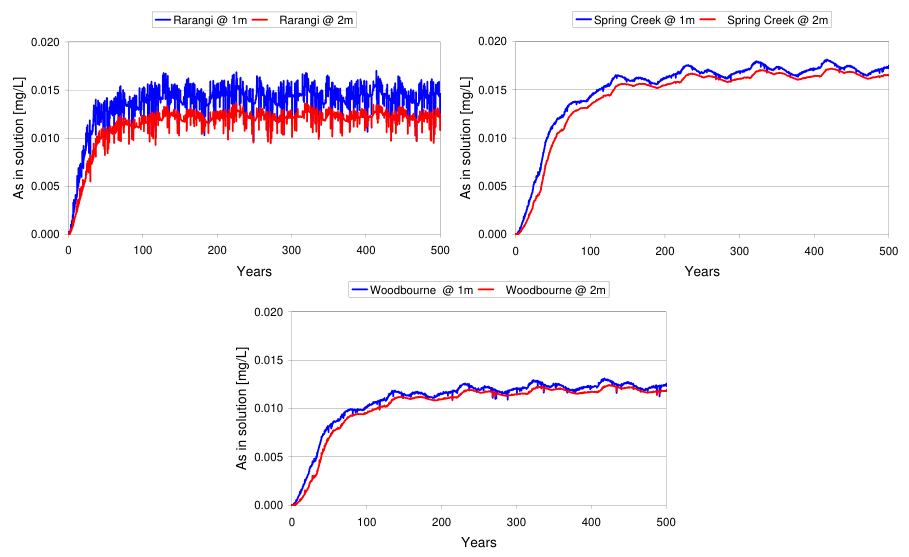
For three soil types shown in Fig. 6, we present the spatially averaged solution concentration of As at the depths of 1 and 2 m. In the highly permeable soil of Rarangi, the 2047
图6给出了三种土壤类型在1 m和2 m深度处As的空间平均溶液浓度。在渗透性很强的Rarangi土壤中,
signal is very spiky, in part because we have only plotted monthly values, but in greater part because of the high hydraulic conductivity of the soil, and low saturated water content of the soil. The pattern dynamics reflect the intermittent nature of the rainfall events which lead to drainage. As noted, the “physics” of the flow system, and the 5 source strength of As in the posts dominates in the long-term, and the steady concentration is similar across all soil types. In all cases, the steady value is about 1.25 to 1.7 times the New Zealand Drinking Water Standard NZDWS (Ministry of Health, 2000) of 10 µg-As L−1. Nonetheless, the ‘chemistry’ affects the time taken to reach steady state. This would be achieved in the low adsorptive soil of Rarangi after about 80–100 years, 10 whereas it would take some 300 years to realise this for the Woodbourne and Spring Creek soils.
信号呈明显尖峰状,部分原因是我们仅绘制了月值,但更主要的原因是该土壤的导水率高、饱和含水量低。格局动态反映了引起排水的降雨事件的间歇性。如前所述,流动系统的“物理”过程和木桩中As的源强度在长期内起主导作用,各土壤类型的稳态浓度相近。在所有情形下,稳态值约为新西兰饮用水标准NZDWS(Ministry of Health, 2000)10 µg-As L−1的1.25至1.7倍。尽管如此,“化学”过程影响达到稳态所需的时间:在吸附能力较低的Rarangi土壤中约80–100年后即可达到稳态,而Woodbourne和Spring Creek土壤则需约300年。
Because these values of the spatially averaged leachate concentration exceed the drinking water standard, unless the groundwater dynamics are such that sufficient lateral subterranean flows can dilute and flush the As-leachate arriving from above, then there are prospects for groundwater degradation through an eventual build-up of As.
由于这些空间平均淋溶液浓度超过饮用水标准,除非地下水动态足以使侧向地下水流稀释并冲刷自上方到达的含As淋溶液,否则As的最终累积有可能导致地下水质量下降。
15 there are prospects for groundwater degradation through an eventual build-up of As. Next, therefore, we carried out simple hydrogeological modelling of the major Marlborough aquifer systems to assess whether the descending As plume might possibly be diluted by lateral flow in the aquifer.
As的最终累积有可能导致地下水质量下降。因此,我们随后对马尔堡主要含水层系统进行了简单的水文地质模拟,以评估下渗的As羽流是否可能被含水层中的侧向流稀释。
6Hydrogeological modelling of the dynamics in aquifer systems含水层系统动态的水文地质模拟
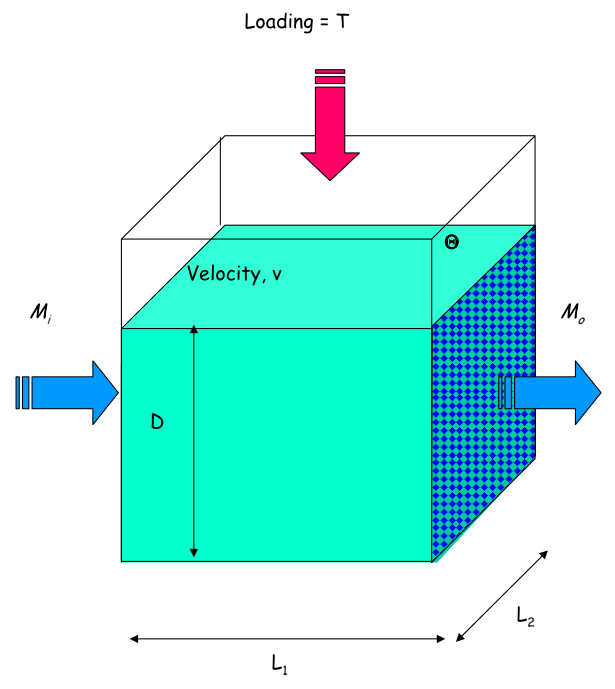
20 A simple mass-balance model of the hydrogeology was developed to predict the likely long-term concentration of arsenic in the groundwater systems of the plains. Our simple rectangular-slab model of an aquifer is presented in Fig. 7. This aquifer is of thickness D [m], and has its phreatic surface some distance below the soil surface, and it is considered to have water travelling at pore velocity v [m day−1] along its length L1
我们建立了一个简单的水文地质质量平衡模型,以预测平原地下水系统中砷的可能长期浓度。图7给出了我们的含水层简单矩形板模型。该含水层厚度为D [m],其潜水面位于土壤表面以下一定深度,并认为水以孔隙流速v [m day−1]沿其长度L1
25 (km). The aquifer is of width L2 (km) and has porosity Θ. The arsenic loading from the
(km)流动。含水层宽度为L2(km),孔隙度为Θ。来自上方
posts above is taken as T (mg-As yr−1), which can be found from
木桩的砷负荷记为T(mg-As yr−1),可由下式求得
where m is the average flux density of As release from the post over its 20-year life [mg-As post−1 yr−1] (see Fig. 4), and ρ is the effective density of posts in the plan area 5 above the aquifer [posts ha−1]. In Figs. 7 and 1, Mi and Mo are the mass fluxes of arsenic into and out of the aquifer slab;
式中,m为木桩在20年使用寿命内砷释放的平均通量密度[mg-As post−1 yr−1](见图4),ρ为含水层上方平面区域内木桩的有效密度[posts ha−1]。在图7和图1中,Mi和Mo分别为进入和流出含水层板体的砷质量通量;
Mi = vΘciDL2 ; Mo = ΘcoDL2 (5) where ci and co [µg-As L−1] are the concentrations of arsenic in the groundwater en- 10 tering and exiting the system. Since Mi+T =Mo, the concentration of As in the groundwater leaving the slab system, if none is entering and the aquifer is well-mixed, will be, 1 mρL1 co = (6) 3650 vDΘ For an prismoidal-shaped aquifer, there would only be loading via the triangular upper- 15 surface, so the mass-balance calculation for co would give an exit concentration of half that of Eq. (6). Calculations were carried out using Eq. (6), to predict the As concentration of water leaving the major aquifer of the plains, the prism-shaped Wairau system (Woodbourne soil series) (Fig. 8), as well as the rectangular Brancott (Spring Creek soils), 20 and Rarangi (Rarangi soils) shallow aquifer systems. As noted already, the Wairau system meets an aquiclude at Hammerich’s Road, halfway down the valley. Beyond here, most of the groundwater rises to enter surface streams. The Rarangi shallow aquifer feeds springs under the sea in Cloudy Bay. Whereas the density of posts within a vineyard is 580 ha−1, we take the spatially averaged value across the whole surface 25 land-area to be three-quarters of this: so in Eq. (4), ρ=435 ha−1. The location of the 15 000 ha of vineyards can be seen in red in Fig. 8. 2049
Mi = vΘciDL2 ; Mo = ΘcoDL2 (5) 式中,ci和co [µg-As L−1]分别为进入和流出系统的地下水中砷浓度。由于Mi+T =Mo,若无砷进入且含水层充分混合,则流出板体系统的地下水中As浓度为:1 mρL1 co = (6) 3650 vDΘ 对于棱柱状含水层,仅有经三角形上表面的负荷,因此co的质量平衡计算所得出口浓度为式6的一半。利用式6进行计算,以预测平原主要含水层——棱柱状Wairau系统(Woodbourne土系)(图8),以及矩形的Brancott(Spring Creek土壤)和Rarangi(Rarangi土壤)浅层含水层系统出水的As浓度。如前所述,Wairau系统在河谷中段的Hammerich’s Road处遇到隔水层,在此以下,大部分地下水上涌进入地表溪流。Rarangi浅层含水层补给Cloudy Bay海底的泉水。葡萄园内木桩密度为580 ha−1,而我们取整个地表陆地面积上的空间平均值为其四分之三,因此式4中ρ=435 ha−1。15 000 ha葡萄园的位置在图8中以红色表示。
Water moves rapidly (v=30 m d−1) along the long axis (L1=15 km) of the Wairau aquifer system, so that despite the steady-state loading of m=72 mg-As post−1 yr−1, the long-term exit concentration, where the water rises to the surface on the aquiclude, would be just co=0.5 µg-As L−1. The long-term spatially averaged concentration of 5 arsenic in the leachate under a vineyard would be a steady 12.5 µg-As L−1 (Fig. 6). However, the dilution provided by the aquifer system means that the groundwater entering surface bodies at Hammerich’s Road has a level of arsenic just one twentieth the NZDWS. Likewise, for the rectangular Rarangi shallow aquifer system, the high velocity of flow (v=10 m d−1) results in a dilution to achieve an exit concentration just 0.7 ppb of arsenic.
水沿Wairau含水层系统长轴(L1=15 km)快速流动(v=30 m d−1),因此尽管稳态负荷为m=72 mg-As post−1 yr−1,在隔水层处水上涌至地表的长期出口浓度仅为co=0.5 µg-As L−1。葡萄园下方淋溶液中砷的长期空间平均浓度将稳定在12.5 µg-As L−1(图6)。然而,由于含水层系统的稀释作用,在Hammerich’s Road进入地表水体的地下水中砷含量仅为NZDWS的二十分之一。同样,对于矩形的Rarangi浅层含水层系统,高流速(v=10 m d−1)使其稀释后出口砷浓度仅为0.7 ppb。
10 arsenic. The southern valley aquifer systems, of which the Brancott aquifer is one example, are sluggish, with just v=1 m d−1. Furthermore, these aquifers are not formed from uniform gravels, rather they tend to be non-uniformly distributed throughout the envelope of the surrounding matrix. The overall porosity is now estimated to be just Θ≈0.1. 15 In this case then, the aquifer system cannot provide sufficient dilution of the arsenic leaching from above, and the long-term exit concentration is predicted to be 13 ppb. The Marlborough District Council now seeks further investigation of the southern-valley aquifers.
南部河谷含水层系统(Brancott含水层即为一例)流动迟缓,流速仅为v=1 m d−1。此外,这些含水层并非由均匀砾石构成,而是往往不均匀地分布于周围基质之中,目前估计其总孔隙度仅为Θ≈0.1。因此在这种情况下,含水层系统无法对上方淋溶下来的砷提供足够的稀释,预测长期出口浓度为13 ppb。马尔堡区议会目前正寻求对南部河谷含水层开展进一步调查。
7Conclusions结论
20 Measurements of arsenic leaching from H4-treated posts indicate a release rate into the soil of around 5–6 mg-As month−1 post−1. Using a mechanistic model running on a daily time-step, we have predicted the local pattern dynamics of arsenic transport and fate around the post over a period of 30 years. The rise in the arsenic concentration in the soil, and the pattern of arsenic flux in the soil solution is controlled by the “chemistry”
对H4级处理木桩砷淋溶的测定表明,其向土壤的释放速率约为5–6 mg-As month−1 post−1。利用以日为时间步长运行的机理模型,我们预测了30年期间木桩周围砷迁移与归趋的局地格局动态。土壤中砷浓度的上升以及土壤溶液中砷通量的格局受土壤吸附特性的“化学”过程
25 of the soil’s adsorptive characteristics, and the pattern of weather events. In most soils of the Marlborough region, the level of arsenic close to the post is predicted to rise, over
以及天气事件格局的控制。在马尔堡地区的大多数土壤中,预测木桩附近的砷含量将在
the post’s lifetime, to meet or exceed the NEPM guideline value of 100 mg-As kg−1.
木桩使用寿命内上升至或超过NEPM指导值100 mg-As kg−1。
Sustainability is about the long-term, and concerns have been raised about the eventual impact of the use of CCA-treated posts for which there is a 5% annual replacement rate. On average, therefore, any given post is replaced every 20 years. Our modelling 5 over 500 years, under a replacement regime, revealed that the spatially averaged arsenic concentration leaching through the soil underneath a vineyard would eventually reach a steady-state value. This value, some 1.25 to 1.7 times the drinking water standard, was not strongly affected by the soil’s chemical characteristics, although the time taken to reach the steady value was. The steady concentration was primarily deter- 10 mined by the release rate of As from the post over its lifetime, and the physics of the flow.
可持续性关乎长期,人们对每年更换5%的CCA处理木桩的使用所产生的最终影响表示担忧。因此平均而言,任一木桩每20年更换一次。我们在更换情景下进行的500年模拟表明,葡萄园下方经土壤淋溶的砷的空间平均浓度最终将达到稳态值。该值约为饮用水标准的1.25至1.7倍,受土壤化学特性的影响不大,但达到稳态所需的时间受其影响。稳态浓度主要取决于木桩在其使用寿命内的As释放速率以及水流的物理过程。
Finally, we developed a simple hydrogeological model of an aquifer, which we could apply to the major subterranean systems of Marlborough. This mass-balance model predicts the concentration of arsenic at the distal interface of an aquifer receiving a 15 steady loading of arsenic plumes from above. For the major Marlborough aquifer system, the Wairau, the high velocity of flow (30 m d−1) through this deep (20 m) aquifer results in dilution of the received arsenic to one twentieth of the drinking water standard. However for the sluggish and distributed aquifers in the southern valleys, the flow appears incapable of diluting the leachate. It is predicted that the water leaving these 20 aquifers would be around 1.3 times the drinking water standard.
最后,我们建立了一个可应用于马尔堡主要地下系统的简单含水层水文地质模型。该质量平衡模型预测了接受上方稳定砷羽流负荷的含水层远端界面处的砷浓度。对于马尔堡主要含水层系统Wairau,水流以高流速(30 m d−1)穿过这一深厚(20 m)含水层,使接收的砷被稀释至饮用水标准的二十分之一。然而,对于南部河谷流动迟缓且分散分布的含水层,水流似乎无法稀释淋溶液,预测流出这些含水层的水中砷浓度约为饮用水标准的1.3倍。
25
Using our mechanistic modelling tool, SPASMO, we have been able to determine key characteristics of the pattern dynamics of arsenic flow locally around H4-treated posts. Furthermore, we have been able to use this approach to upscale our results, both in time and space, so that we could assess the long-term risks at the vineyard and regional scale.
利用我们的机理模拟工具SPASMO,我们确定了H4级处理木桩周围局地砷流动格局动态的关键特征。此外,我们还能够利用该方法在时间和空间上对结果进行尺度上推,从而评估葡萄园和区域尺度上的长期风险。
Acknowledgements. Funding for these research projects was provided by the Marlborough District Council and the Marlborough Research Centre Trust.
致谢。本研究项目由马尔堡区议会和马尔堡研究中心信托基金(Marlborough Research Centre Trust)资助。
References参考文献
Allen, R. G., Pereira, L. S., Raes, D., and Smith, M.: Crop evapotranspiration. Guidelines for computing crop water requirements, FAO Irrigation and Drainage Paper No. 56, FAO, Rome, 301pp., 1999.
5 ´Alvarez-Benedi, J., Bolado, S., Cancillo, I., Calvo, C., and Garc´ıa-Sinovas, D. Adsorptiondesorption of arsenate in three Spanish soils, Vadose Zone J., 4, 282–290, 2005. Brookes, K. M.: A critical review of Townsend et al. (2001) “Leaching and toxicity of CCA-treated and alternative treated wood products, Aquat. Environ. Sci., Port Townsend, Washington, USA, 23pp., 2005.
10 Bourne R.: Post-mortem: Research spotlight falls on treated timber, Horticulture News, August edition, 21–24. 2003.
Goldberg, S., Lesch, S. M., Suarez, D. L., and Basta, N. T.: Predicting arsenate adsorption by soils using soil chemical parameters in the constant capacitance model, Soil Sci. Soc. J., 69, 1389–1398, 2005.
15 Green, S. R., Vogeler, I., Clothier, B. E., Mills, T. M., and van den Dijssel, C.: Modelling water uptake by a mature apple tree, Australian J. Soil Res., 41, 365–380, 2002. Hutson, J. L. and Wagenet, R. J.: A pragmatic field-scale approach for modelling pesticides, J. Environ. Qual., 22, 494–499, 1993.
Islam, A., Karim, A. J. M. S., Khaled, H. M., Mitra, B. K., and Miah, M. A. M.: Arsenic sorption 20 characteristics of four agricultural soils of Bangladesh, Asian J. Plant Sci., 2, 1149–1152, 2003.
Jin, L. and Archer, K.: Copper based wood preservatives: observations on fixation, distribution and performance, Proc. Annu. Meet. Am. Wood Preserv. Assoc., Woodstock, Md.: The Association, 87, 169–184, 1991.
25 Ministry of Health Drinking water standards for New Zealand, New Zealand MoH, Wellington, (http://www.ephc.govt.au). National Environmental Protection Measures, Guidelines on the Investigation Levels for Soil and Groundwater Schedule B(1), Environmental Protection and Heritage Council, (http:// www.moh.govt.nz), 1999.
30 Robinson, B. H., Greven, M. M., Green, S. R., Sivakumaran, S., Davidson, P., and Clothier, B. E.: Leaching of copper, chromium and arsenic from treated timber vineyard posts in Marlborough, New Zealand, Sci. Total Environ., 364, 113–123, 2006.
Rosen, M. R., Reeves, R. R., Green, S. R., Clothier, B. E., and Ironside, N.: Prediction of groundwater nitrate contamination after closure of an unlined sheep feedlot in New Zealand, Vadose Zone J., 3, 990–1006, 2004.
Smith, E., Naidu, R., and Alston, A. M.: Chemistry of inorganic arsenic in soils: II Effect of 5 phosphorus, sodium and calcium on arsenic sorption, J. Environ. Qual., 31, 557–563, 2002. Vogeler, I., Green, S. R., Greven, M. M., Robinson, B. H., van den Dijssel, C. W., and Clothier, B. E.: Environmental risk assessment of CCA leaching from treated vineyard posts, HortResearch Client Report No. 17659, 44pp, 2005.
2053 2059
![Fig. 1. The CCA leaching processes described in the SPASMO model. Here dg is the depth to groundwater, θ is the soil water content, m [mg-As post−1 month−1] is the flux of As leaving the post, and Mi and Mo [mg-As yr−1]](52/figure-01.png)
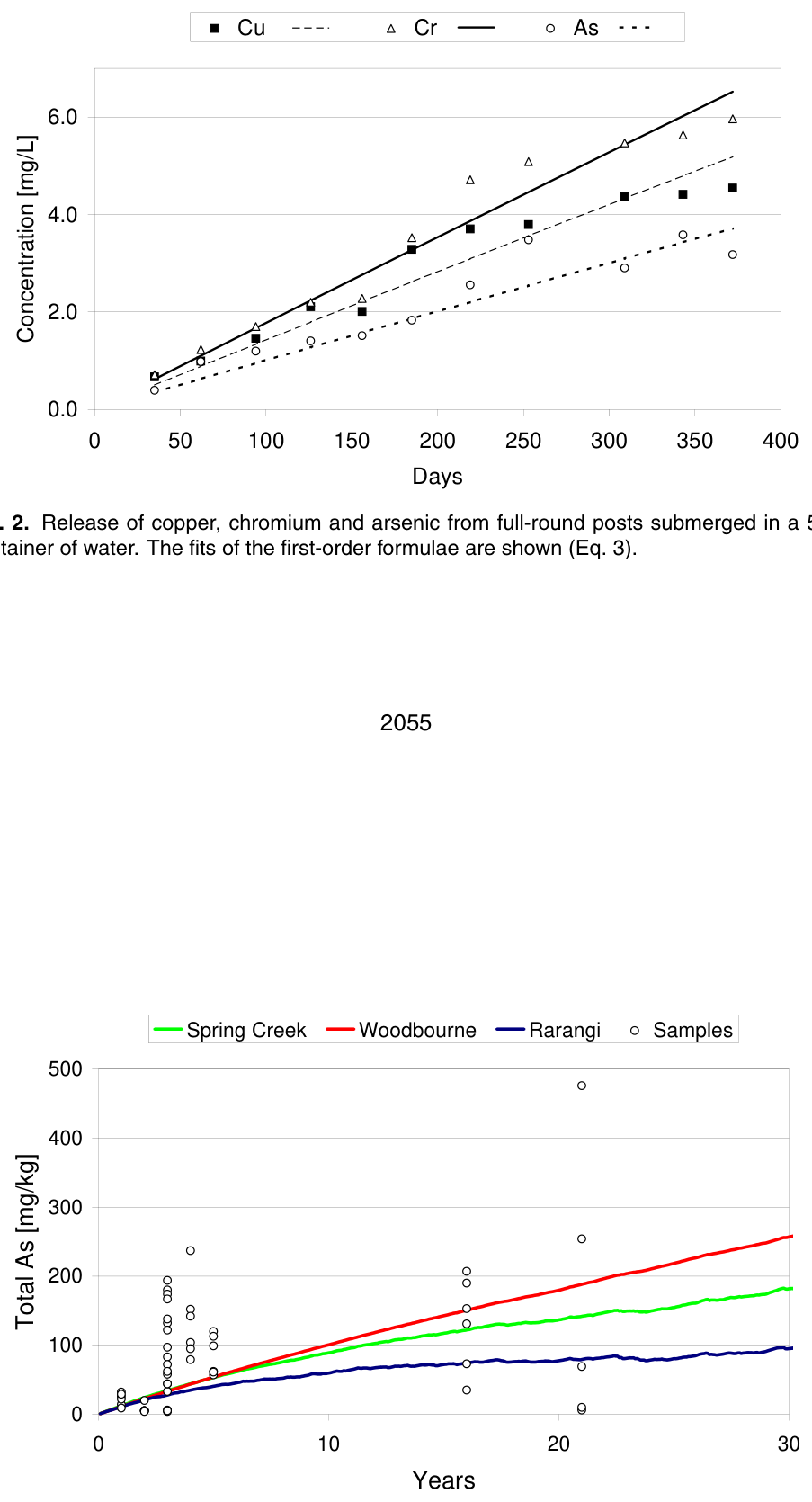
Fig. 2. Release of copper, chromium and arsenic from full-round posts submerged in a 50 L container of water. The fits of the first-order formulae are shown (Eq. 3).图2. 浸没于50 L水容器中的整圆木桩释放的铜、铬和砷。图中显示了一级公式的拟合结果(式3)。
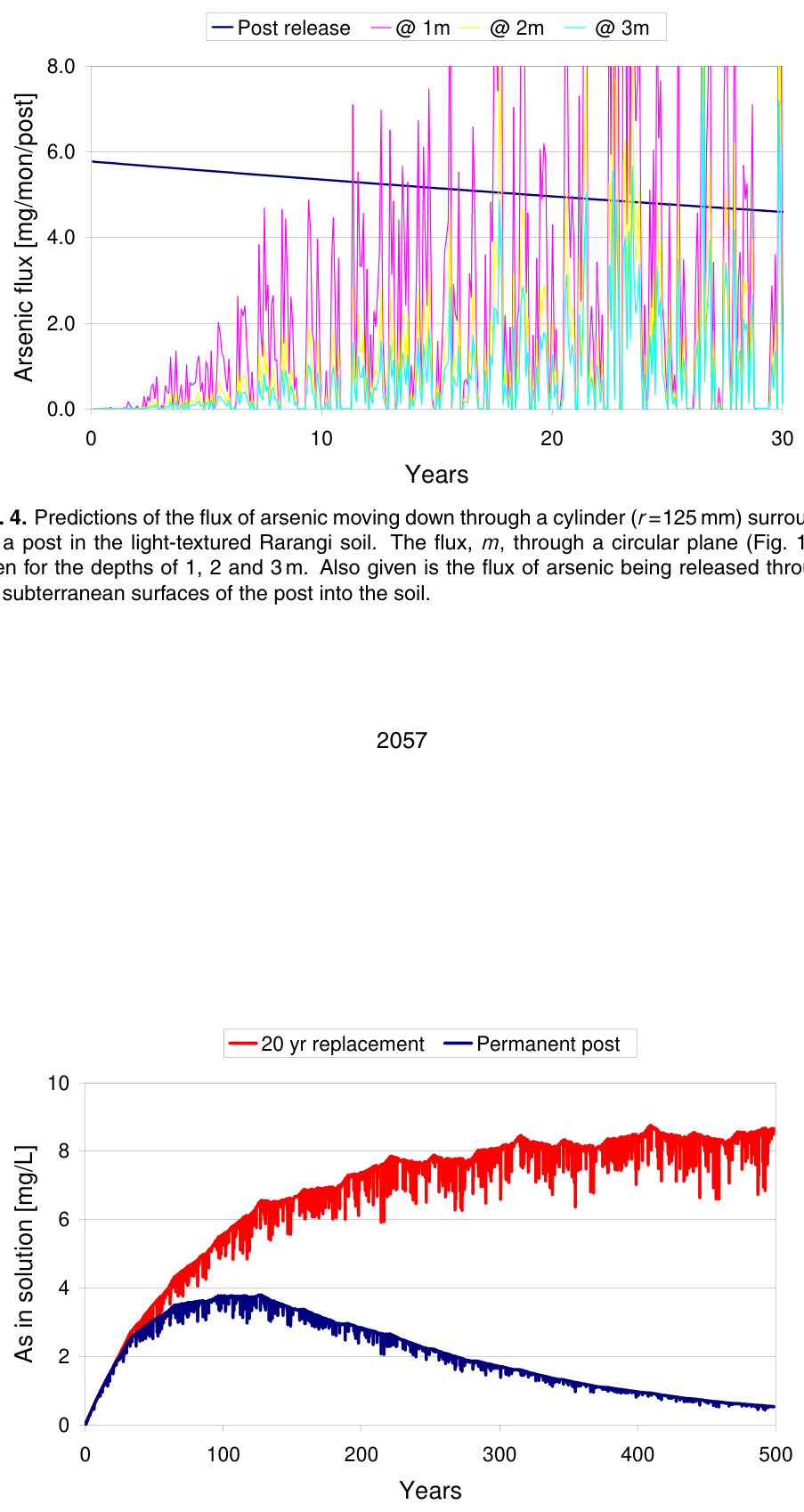
Fig. 4. Predictions of the flux of arsenic moving down through a cylinder (r=125 mm) surround-125 mm) surrounding a post in the light-textured Rarangi soil. The flux, m, through a circular plane (Fig. 1) is given for the depths of 1, 2 and 3 m. Also given is the flux of arsenic being released through the subterranean surfaces of the post into the soil.图4. 质地较轻的Rarangi土壤中穿过木桩周围圆柱体(r=125 mm)向下迁移的砷通量预测值。给出了1、2和3 m深度处穿过圆形平面(图1)的通量m,同时给出了经木桩地下表面释放进入土壤的砷通量。