B E R N D N O W A C K , * R A I N E R S C H U L I N , A N D B R E T T H . R O B I N S O N Institute of Terrestrial Ecosystems, ETH Zurich Universitaetstrasse 16, 8092 Zu¨rich, Switzerland
Chelant-enhanced phytoextraction has received a lot of attention in the past decade. In theory, this technique could cleanse metal polluted soils by solubilizing contaminating metals, allowing them to be taken up by plants that would subsequently be removed from the site. We review the processes of metal solubilization, uptake by plants, and leaching during chelant-enhanced phytoextraction. A large excess of chelant is required to solubilize the target metal due to the co-solubilization of Ca and Fe. Chelated metals are taken up via the apoplastic pathway. Disruption of the Casparian Band is required to achieve the high shoot concentrations needed for phytoextraction. Therefore, adding chelants to a soil increases not only the total dissolved metal concentration but also changes the primary route of plant metal-uptake from the symplastic to the apoplastic pathway. Depending on metal, plant species, and chelant concentration, significant increases in metal uptake are likely. Soil solution chelate concentrations of at least several mM are required to induce appreciable shoot concentrations. A simple calculation reveals that at such soil solution concentrations plants will remove only a small fraction of the solubilized metals. Leaching, exacerbated by preferential flow processes, is unavoidable. Chelant-enhanced phytoextraction is therefore limited to areas where the connection with groundwater has been broken, or where leaching is unimportant. Chelant-enhanced phytoextraction may nonetheless have a role in enhancing the uptake of essential trace metals. Such a role warrants further investigations into the use of biodegradable chelants such as ethylenediaminedisuccinic acid (EDDS).
螯合剂强化植物提取在过去十年中受到了广泛关注。理论上,该技术可通过溶解污染金属来净化金属污染土壤,使金属被植物吸收,随后将植物从场地移除。本文综述了螯合剂强化植物提取过程中金属的溶解、植物吸收以及淋溶等过程。由于Ca和Fe的共溶解,溶解目标金属需要大量过量的螯合剂。螯合态金属经质外体途径被吸收。要达到植物提取所需的较高地上部浓度,必须破坏凯氏带。因此,向土壤中添加螯合剂不仅提高了溶解态金属总浓度,而且使植物吸收金属的主要途径由共质体途径转变为质外体途径。视金属种类、植物种类和螯合剂浓度而定,金属吸收量可能显著增加。土壤溶液中螯合物浓度至少需达到数mM,才能使地上部金属浓度明显升高。简单计算表明,在如此高的土壤溶液浓度下,植物只能移除被溶解金属中的一小部分。淋溶不可避免,且优先流过程会加剧淋溶。因此,螯合剂强化植物提取仅限于与地下水的联系已被切断或淋溶无关紧要的区域。尽管如此,螯合剂强化植物提取在促进必需微量金属吸收方面可能仍有一定作用,这值得进一步研究乙二胺二琥珀酸(EDDS)等可生物降解螯合剂的应用。
1Introduction引言
In the past decade, chelant-enhanced phytoextraction has received much attention from the scientific community. This technique aims to cleanse metal-polluted soils by inducing plants to accumulate the contaminating metal in the harvestable parts by adding chelating agents to the soil. The metal-rich biomass could then be removed from the site, and stored in an area where it does not pose a risk to the environment, such as a sealed landfill, or burned (1). However, adding chelating agents to soil may be harmful. The environmentalfateofaminopolycarboxylatechelatingagents has been discussed extensively (2-4) because they perturb the natural speciation of metals and influence metal bioavailability (5). Many chelating agents (e.g., EDTA) are not readily degraded under natural conditions and thus persist in the environment (6). The addition of large amounts of chelating agents to soils therefore warrants a thorough evaluation.
过去十年中,螯合剂强化植物提取受到了科学界的广泛关注。该技术旨在通过向土壤中添加螯合剂,促使植物将污染金属累积于可收获部位,从而净化金属污染土壤。富含金属的生物质随后可从场地移除,并贮存于不会对环境构成风险的区域(如封闭式填埋场),或进行焚烧(1)。然而,向土壤中添加螯合剂可能有害。氨基多羧酸类螯合剂的环境归趋已被广泛讨论(2-4),因为它们会扰乱金属的自然形态并影响金属的生物有效性(5)。许多螯合剂(如EDTA)在自然条件下不易降解,因而在环境中持久存在(6)。因此,向土壤中大量添加螯合剂需要进行全面评估。
* Corresponding author present address: EMPA - Materials Science & Technology, Lerchenfeldstrasse 5, CH-9014 St. Gallen, Switzerland. Phone: +41 (0)71 274 7692; Fax: +44 (0)71 274 7862; E-mail: nowack@empa.ch.
Research into the interaction of plants with chelating agents started in the 1950s with a view to alleviating deficiencies in the essential nutrient metals Fe, Mn, Cu, and Zn (5). Initial results also showed that chelants such as EDTA enhanced plant uptake of Pb and Hg (7). Jorgensen in 1993 (8) and Huang and Cunningham in 1996 (9) showed that addition of chelating agents to soils increased Pb accumulation by crop plants to such an extent that they might be used for cleanup of Pb-contaminated soils. A subsequent flurry of research showed that the addition of chelating agents could increase Pb accumulation in shoots of various plants by factors as high as 265 (9-12). Enhanced uptake was not only observed in nutrient solution and pot experiments but also in the field (13-15).
植物与螯合剂相互作用的研究始于20世纪50年代,旨在缓解必需营养金属Fe、Mn、Cu和Zn的缺乏(5)。早期结果还表明,EDTA等螯合剂可促进植物对Pb和Hg的吸收(7)。Jorgensen于1993年(8)以及Huang和Cunningham于1996年(9)的研究表明,向土壤中添加螯合剂可使作物对Pb的累积显著增加,以至于可能利用其修复Pb污染土壤。随后涌现的大量研究表明,添加螯合剂可使多种植物地上部Pb累积量提高多达265倍(9-12)。吸收增强不仅在营养液培养和盆栽试验中被观察到,在田间也同样存在(13-15)。
Publications about chelant-enhanced phytoextraction have increased steadily to about 15-20 per year in the last few years, indicating that this is a growing and active research field. Although some reviews and compilations of the available literature have been published (16, 17), there is only limited discussion of the key mechanisms of chelant-induced phytoextraction. Two groups of mechanisms dominate chelant-enhanced phytoextraction. Soil processes determine the mobilization and transport of metals, while plant processes control the uptake and translocation of the solubilized metals. We aim to provide a critical evaluation of the underpinning processes of chelant-enhanced phytoextraction with a view to elucidating the feasibility of this technology and reveal fertile areas for future research.
近年来,有关螯合剂强化植物提取的论文数量稳步增加,达到每年约15-20篇,表明这是一个不断发展且十分活跃的研究领域。尽管已有一些综述和文献汇编发表(16, 17),但对螯合剂诱导植物提取关键机制的讨论仍较有限。螯合剂强化植物提取主要受两类机制支配:土壤过程决定金属的活化和迁移,而植物过程控制被溶解金属的吸收和转运。本文旨在对螯合剂强化植物提取的基础过程进行批判性评估,以阐明该技术的可行性,并揭示未来值得深入研究的领域。
2Terminology术语
The term “chelate-enhanced phytoextraction” has been frequently used in the literature. However, this term is misleading because it suggests that chelates are applied to the soil. The term “chelate” denotes a complex between a metal and a chelating agent and not the chelating agent itself (18, 19). A shorter word for chelating agent is “chelant” or “chelator”. We therefore suggest using the term “chelant-enhanced phytoextraction”. Other terms such as “chelant-induced”and “chelant-assisted”phytoextraction can be used assynonymstochelant-enhancedphytoextraction.“Chelate” should be used whenever a metal-chelating agent complex is meant, e.g., when talking about a specific complex.
文献中经常使用“螯合物强化植物提取”(chelate-enhanced phytoextraction)一词。然而,该术语具有误导性,因为它暗示施入土壤的是螯合物。“螯合物”(chelate)是指金属与螯合剂形成的络合物,而非螯合剂本身(18, 19)。螯合剂(chelating agent)的简称为“chelant”或“chelator”。因此,我们建议使用“螯合剂强化植物提取”(chelant-enhanced phytoextraction)这一术语。“螯合剂诱导”和“螯合剂辅助”植物提取等其他术语可作为螯合剂强化植物提取的同义词使用。凡指金属-螯合剂络合物时(例如讨论某一特定络合物时),均应使用“螯合物”一词。
3Soil Factors土壤因素
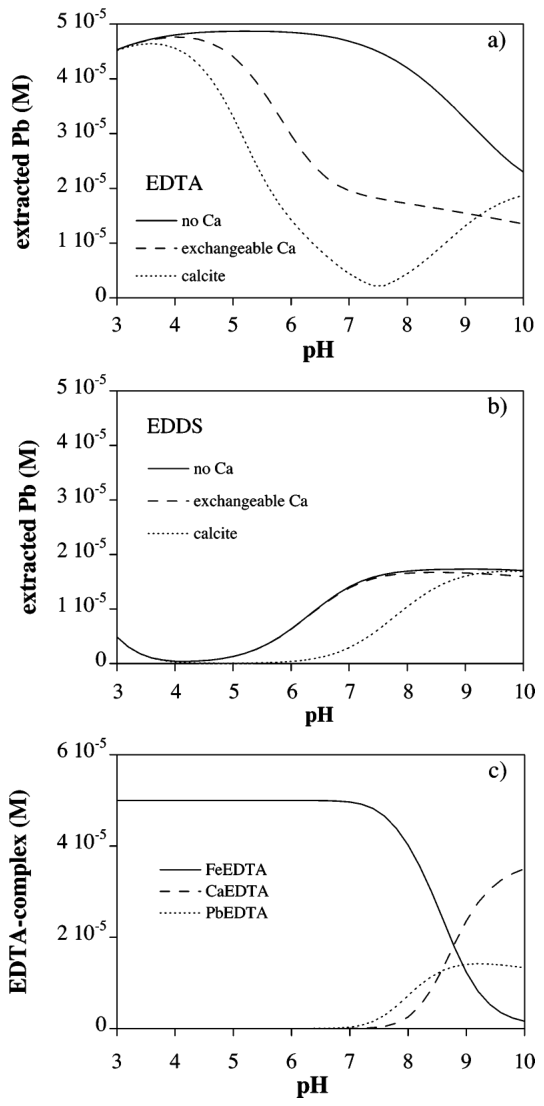
The addition of chelants to soil usually increases the concentration of total dissolved metals. Under normal soil conditions, one mole of an aminopolycarboxylate chelating (contaminated by sewage sludge applications in the field) is agent complexes one mole of metal. The ratio of chelants to given in the Supporting Information. Three cases are metals in the soil is of overriding importance. As the ratio considered: (1) no Ca is present, (2) the solution is in increases, more chelant is present in soil solution, and metal equilibrium with exchangeable Ca, and (3) the solution is in solubilization is faster and more complete (20). However, equilibrium with 10% calcite. this ratio is seldom used to guide the design of experiments. Without any Ca present (case 1, Figure 2a), EDTA would Theapplicationratesofchelantsarenormally0.5-5gchelant be able to extract most of the Pb up to pH 8. When kg-1 soil (9, 11, 21-24), or 1-20 mmol kg-1 (10, 25-28), which exchangeable Ca is present (case 2, Figure 2a), the extraction corresponds to 0.3-6 g EDTA kg-1. Unfortunately, the of Pb is greatly reduced above pH 6 due to the co-extraction knowledge of the applied amount is not sufficient to calculate of Ca and competition between Ca and Pb for EDTA. If the the concentrations of solubilized metals. soil contains calcite, the Pb extractability is reduced over an
向土壤中添加螯合剂通常会提高溶解态金属总浓度。在正常土壤条件下,1 mol氨基多羧酸类螯合剂络合1 mol金属。土壤中螯合剂与金属的比值至关重要。随着该比值增大,土壤溶液中存在的螯合剂增多,金属的溶解更快、更完全(20)。然而,该比值很少被用于指导试验设计。螯合剂的施用量通常为0.5-5 g螯合剂 kg-1土壤(9, 11, 21-24),或1-20 mmol kg-1(10, 25-28),相当于0.3-6 g EDTA kg-1。遗憾的是,仅知道施用量并不足以计算被溶解金属的浓度。(田间因施用污水污泥而受污染的)土壤的相关说明见支持信息。共考虑了三种情形:(1)不存在Ca;(2)溶液与交换性Ca处于平衡;(3)溶液与10%方解石处于平衡。在不存在任何Ca的情况下(情形1,图2a),EDTA能够在pH 8以下提取大部分Pb。当存在交换性Ca时(情形2,图2a),由于Ca的共提取以及Ca与Pb对EDTA的竞争,pH 6以上Pb的提取量大幅降低。若土壤含有方解石,Pb的可提取性在更宽的pH范围内降低。
Without any Ca present (case 1, Figure 2a), EDTA would be able to extract most of the Pb up to pH 8. When exchangeable Ca is present (case 2, Figure 2a), the extraction of Pb is greatly reduced above pH 6 due to the co-extraction of Ca and competition between Ca and Pb for EDTA. If the soil contains calcite, the Pb extractability is reduced over an even wider pH range. The large excess of co-extracted Ca effectively prevents the mobilization of Pb. AlthoughCaEDTA has a much lower log K value than PbEDTA (10.65 compared to18.0,alllogKvaluesarefromref30),thehighconcentration and high solubility of Ca2+ makes this ion a powerful competitor for metals around neutral pH values. Figure 2b shows the analogous calculations for EDDS, which is a weaker chelating agent for both Pb (log K PbEDDS 12.7 compared to 18.0 for PbEDTA) and Ca (log K CaEDDS 4.6 compared to 10.65 for CaEDTA). Pb extraction by EDDS is lower than by EDTA at pH <8. Due to the relatively weak CaEDDS complex, the presence of Ca does not result in a large reduction in the extraction efficiency of Pb (case 2). The presence of calcite (case 3) shifts the Pb-mobilization edge from pH 6 to 7, thereby further decreasing the already weak extraction of Pb by EDDS. However, it should be noted that at pH 8 EDTA and EDDS have a similar extraction efficiency for Pb. Weak extraction of Pb by EDDS has been reported several times (20, 31, 32).
在不存在任何Ca的情况下(情形1,图2a),EDTA能够在pH 8以下提取大部分Pb。当存在交换性Ca时(情形2,图2a),由于Ca的共提取以及Ca与Pb对EDTA的竞争,pH 6以上Pb的提取量大幅降低。若土壤含有方解石,Pb的可提取性在更宽的pH范围内降低。大量过量的共提取Ca有效地阻止了Pb的活化。尽管CaEDTA的log K值远低于PbEDTA(10.65对18.0,所有log K值均引自文献30),但Ca2+的高浓度和高溶解度使其在中性pH附近成为金属的强有力竞争者。图2b给出了EDDS的类似计算结果;EDDS对Pb(PbEDDS的log K为12.7,而PbEDTA为18.0)和Ca(CaEDDS的log K为4.6,而CaEDTA为10.65)均为较弱的螯合剂。在pH <8时,EDDS对Pb的提取量低于EDTA。由于CaEDDS络合物相对较弱,Ca的存在并不会导致Pb提取效率大幅降低(情形2)。方解石的存在(情形3)使Pb活化边从pH 6移至pH 7,从而使EDDS本已较弱的Pb提取能力进一步下降。但应指出,在pH 8时EDTA和EDDS对Pb的提取效率相近。EDDS对Pb提取能力较弱已有多次报道(20, 31, 32)。
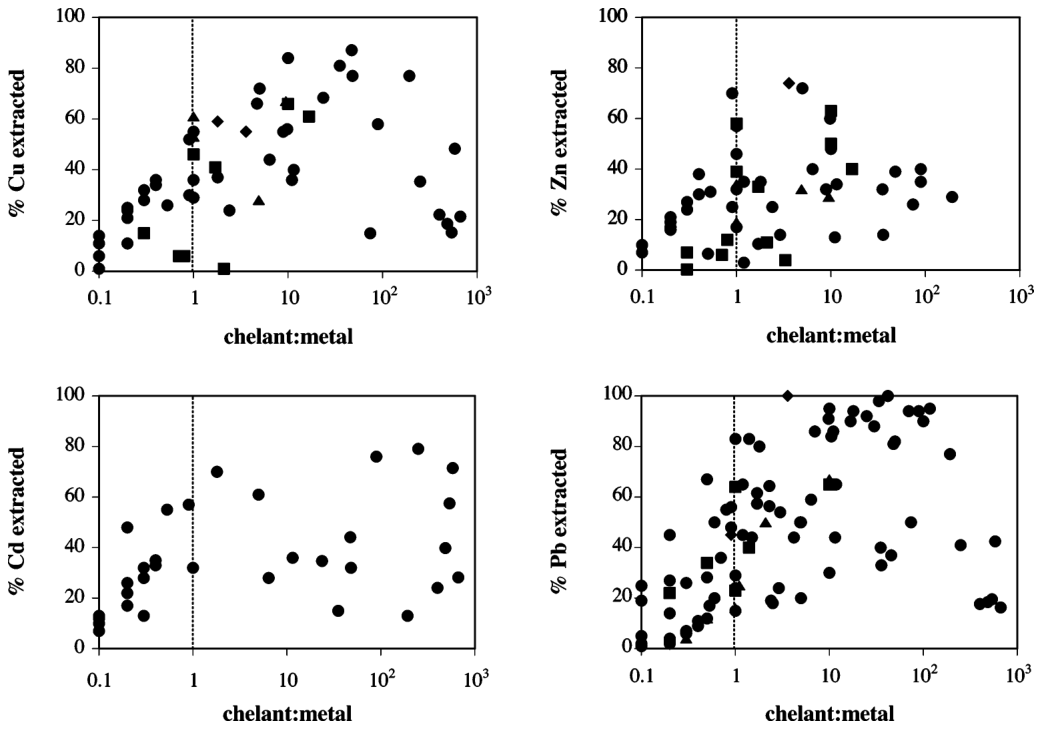
To evaluate the metal extraction potential of chelating agents, we compiled data from 28 publications. We selected articles that used soils contaminated under field conditions and where the extractions were carried out over about 24 h at an approximately neutral pH. Figure 1 shows the percentage of extracted metals as a function of the ratio of chelant to total metals in the soil for Cu, Zn, Cd, and Pb. A chelantto-metal ratio of at least 1 is needed to solubilize all the target metal. However, except for Pb, complete solubilization did not occur, even at a chelant-to-metal ratio of greater than 10. The data show a large variation between soils for a given chelant-to-metal ratio. In particular, the extraction of Zn varied between <5% and 70% at equimolar ratio. This indicates that other factors had a strong influence on the amount of target metal extracted at a given rate of chelant addition.
为评估螯合剂的金属提取潜力,我们汇编了28篇文献的数据。所选文献均使用在田间条件下受污染的土壤,且提取在近中性pH下进行约24 h。图1显示了Cu、Zn、Cd和Pb的提取百分比与土壤中螯合剂/金属总量比值的关系。要溶解全部目标金属,螯合剂与金属的比值至少需达到1。然而,除Pb外,即使螯合剂与金属之比大于10,也未实现完全溶解。数据表明,在给定的螯合剂/金属比值下,不同土壤之间差异很大。尤其是在等摩尔比下,Zn的提取率在<5%至70%之间变化。这表明在给定螯合剂添加量下,其他因素对目标金属提取量有很大影响。
Modeling Metal Extraction. Effect of Ca. Clearly, not all chelant added to soil binds the target metals and other ions also interact with the chelant. In most soils, Ca and Fe are likely to compete with the target metal, due to their high concentrations and the relatively high stability of their complexes (29). The effect of Ca on Pb extraction from a model soil in the presence and absence of EDTA and EDDS (ethylenediaminedisuccinic acid) in the extracting solution is used to discuss the importance of co-dissolved Ca. First, we modeled the effect of Ca on the extraction of Pb. Calculations were done for different concentrations and sources of Ca in the extraction solution. The description of the used model for Pb binding and solubilization from a soil
金属提取的模拟。 Ca的影响。 显然,添加到土壤中的螯合剂并非全部与目标金属结合,其他离子也会与螯合剂发生作用。在大多数土壤中,由于Ca和Fe浓度高且其络合物稳定性相对较高,它们很可能与目标金属发生竞争(29)。本文以提取液中存在和不存在EDTA及EDDS(乙二胺二琥珀酸)时Ca对模型土壤中Pb提取的影响为例,讨论共溶解Ca的重要性。首先,我们模拟了Ca对Pb提取的影响,针对提取液中不同浓度和来源的Ca进行了计算。所用的土壤Pb结合与溶解模型的说明
These calculations show that Ca, which is always present in soils at high concentrations, will greatly reduce the mobilization of target metals. Even at chelant-to-metal ratios >1 where enough chelant is present to complex all target metals, a large fraction of the chelating agent may actually be complexed by Ca.
上述计算表明,土壤中始终以高浓度存在的Ca会大幅降低目标金属的活化。即使在螯合剂与金属之比 >1、有足够螯合剂络合全部目标金属的情况下,仍可能有很大一部分螯合剂实际上被Ca络合。
Effect of Iron. Fe(III) is another important competitor for chelating agents. In contrast to Ca, Fe(III) complexes are many orders of magnitude more stable than most metal complexes (30). To illustrate the importance of Fe for chelant speciation in soil solution, we performed another model calculation (case 4). The model described above was adapted to assume that amorphous Fe hydroxide controls the solubility of Fe (Table 2S, Supporting Information). Figure 2c shows that, under these conditions, Fe(III) would complex almost 100% of the EDTA up to a pH of 7. PbEDTA only starts toappearabovepH7.5togetherwithCaEDTA.Atequilibrium, most of the chelating agents added to a soil will be bound to Fe below neutral pH because of the much higher stability of Fe(III) complexes compared to Ca or metal complexes. Above neutral pH Ca becomes the main competitor of Pb because of the low solubility of Fe at alkaline pH.
铁的影响。 Fe(III)是螯合剂的另一重要竞争者。与Ca不同,Fe(III)络合物的稳定性比大多数金属络合物高出许多个数量级(30)。为说明Fe对土壤溶液中螯合剂形态的重要性,我们进行了另一项模型计算(情形4)。对上述模型进行了调整,假定无定形氢氧化铁控制Fe的溶解度(表2S,支持信息)。图2c表明,在此条件下,pH 7以下Fe(III)几乎会络合100%的EDTA。PbEDTA仅在pH 7.5以上才与CaEDTA一同开始出现。平衡时,由于Fe(III)络合物的稳定性远高于Ca或其他金属络合物,在中性pH以下,添加到土壤中的大部分螯合剂将与Fe结合。在中性pH以上,由于碱性条件下Fe的溶解度很低,Ca成为Pb的主要竞争者。
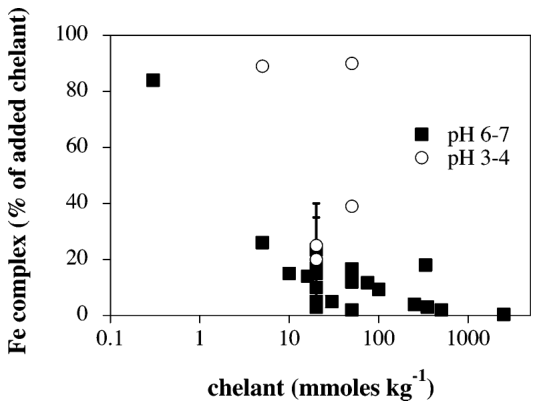
However, the dissolution of Fe oxides is a slow process (33). The time to reach equilibrium depends on the type (amorphous or crystalline) and amount of Fe oxides in the soil. This explains why in most cases the measured Fe-chelate concentration was lower than the value calculated using stability constants. Despite the importance of Fe for the speciation of chelants, Fe has rarely been measured. In column studies Fe was found at very high concentrations in theleachate(23,29,34-38).Weusedthefewavailablestudies providing data from which the fraction of Fe complex could be calculated to construct Figure 3. The percentage of the Fe complex is shown as a function of the added amount of chelant. For most soils, in the range of 5-20 mmol kg-1 chelatingagent,about5-30%oftotalchelantcanbeexpected to be complexed with Fe after 2 days or less. The Fe-bound chelant is no longer available to extract the target metals. At lower pH values or where less chelant is added the amount of Fe complex will be relatively higher.
然而,Fe氧化物的溶解是一个缓慢的过程(33)。达到平衡所需的时间取决于土壤中Fe氧化物的类型(无定形或结晶态)和数量。这解释了为何在大多数情况下,实测的Fe-螯合物浓度低于根据稳定常数计算的值。尽管Fe对螯合剂形态十分重要,但很少有研究测定Fe。在土柱研究中,渗滤液中Fe的浓度非常高(23, 29, 34-38)。我们利用为数不多的、可据以计算Fe络合物比例的研究数据绘制了图3,图中给出了Fe络合物百分比随螯合剂添加量的变化。对于大多数土壤,在螯合剂用量为5-20 mmol kg-1范围内,2 d或更短时间后,预计约5-30%的螯合剂总量与Fe络合。与Fe结合的螯合剂不再能提取目标金属。在较低pH或螯合剂添加量较少时,Fe络合物所占比例相对更高。
Knowledgeofthespeciationoftheappliedchelatingagent in soil solution is critical when assessing phytoextraction. With a few notable exceptions (e.g., 35, 39-41), this information is absent in most studies concerning chelant-enhanced phytoextraction. Information on the target metal in soil solution is more useful if accompanied by measurements of Ca, Mg, and Fe, which are also solubilized by the chelants. Because under most conditions the chelant in solution is present in excess of the metals, it is reasonable to assume that all dissolved metals are present complexed to the chelant. For weaker complexes (e.g., Ca or Mg) speciation calculations could give information about their presence (42).
在评估植物提取时,了解所施螯合剂在土壤溶液中的形态至关重要。除少数值得注意的例外(如35, 39-41),大多数有关螯合剂强化植物提取的研究均缺乏此类信息。若同时测定同样被螯合剂溶解的Ca、Mg和Fe,土壤溶液中目标金属的信息将更有价值。由于在大多数条件下溶液中螯合剂相对于金属过量,因此可以合理地假定所有溶解态金属均以螯合剂络合物形式存在。对于较弱的络合物(如Ca或Mg),可通过形态计算获得其存在情况的信息(42)。
When biodegradable chelants such as EDDS are used, the total chelant concentration in soil solution should also be reported. Simple HPLC methods for the analysis of these compounds are available (43-45). The use of dissolved organic carbon (DOC) as a surrogate measurement for dissolved chelants may give misleading results because chelants are also effective in extracting organic matter from the soil (46). Therefore, the total DOC overestimates the chelant concentration. DOC may also be a competitor for metal complexation but calculations have shown that this only becomes important at very low chelant concentrations (47).
使用EDDS等可生物降解螯合剂时,还应报告土壤溶液中螯合剂的总浓度。已有分析这些化合物的简便HPLC方法(43-45)。以溶解性有机碳(DOC)作为溶解态螯合剂的替代测定指标可能得出误导性结果,因为螯合剂也能有效地从土壤中提取有机质(46)。因此,总DOC会高估螯合剂浓度。DOC也可能与螯合剂竞争金属络合,但计算表明,这仅在螯合剂浓度极低时才变得重要(47)。
Transport Limitations. Metal transport from the bulk soil to plant roots can occur by diffusion as well as by convection with the transpiration water stream. There is only limited information about the relative importance of the two mechanisms. Diffusion appears to be the dominant mechanism of Zn is transport to the roots of the hyperaccumulator Thlaspi caerulescens (48, 49). Formation of complexes can considerably enhance diffusive fluxes toward roots by increasing the dissolved metal concentration and increase uptake, even if the complexes themselves are excluded from uptake. Theoretically it is sufficient that the time scale of complex dissociation is small in comparison to the time scale of the diffusion process (50-52). By increasing the total metal concentration in solution, the formation of chelates will also increase any convective transport.
迁移限制。 金属从土体向植物根系的迁移可通过扩散以及随蒸腾水流的对流进行。关于这两种机制相对重要性的信息十分有限。扩散似乎是Zn向超富集植物Thlaspi caerulescens根系迁移的主导机制(48, 49)。络合物的形成可通过提高溶解态金属浓度而显著增强向根系的扩散通量并增加吸收,即使络合物本身不被吸收。理论上,只要络合物解离的时间尺度小于扩散过程的时间尺度即可(50-52)。通过提高溶液中金属总浓度,螯合物的形成也会增加对流迁移。
4Plant Factors植物因素
Uptake of Chelants and Chelates. There are two parallel transport pathways for water through the root cortex toward the stele: a pathway of passive transport by diffusion and convection through the apoplasm, namely cell walls and intercellular spaces, and a pathway of active transport from cell to cell in the symplasm (selective transport across membranes) (53). The apoplastic pathway is discontinuous, being interrupted by the endodermis, the innermost layer of cells of the cortex. In the radial and transverse walls of the endodermis, hydrophobic incrustations of suberin, i.e., the Casparian band, obstruct the passive transfer of solutes into the stele. However, the endodermis is an imperfect barrier for apoplastic transport (54). In addition to passage cells, therearesitesdistributedalongtherootaxiswherethisbarrier is “leaky”. At the root apex the Casparian strip is not yet fully developed and, thus, allows apoplastic transport to reach the stele.
螯合剂及螯合物的吸收。 水分经根皮层向中柱运输存在两条平行途径:一条是经质外体(即细胞壁和细胞间隙)以扩散和对流方式进行的被动运输途径,另一条是在共质体中细胞间的主动运输途径(跨膜选择性运输)(53)。质外体途径是不连续的,被皮层最内层细胞即内皮层所阻断。在内皮层的径向壁和横向壁中,木栓质的疏水性沉积物即凯氏带阻碍溶质被动进入中柱。然而,内皮层对质外体运输而言并非完美的屏障(54)。除通道细胞外,沿根轴分布着一些该屏障“渗漏”的部位。在根尖处,凯氏带尚未完全发育,因而质外体运输可到达中柱。
VOL. 40, NO. 17, 2006 / ENVIRONMENTAL SCIENCE & TECHNOLOGY 9 5227
VOL. 40, NO. 17, 2006 / ENVIRONMENTAL SCIENCE & TECHNOLOGY 9 5227
Cellular active uptake mechanisms are highly selective for essential metals such as Cu and Zn as free metal ions. There is limited cellular uptake of nonessential metals such as Pb through this pathway. There is debate whether some metal complexes are taken up into plants (55), but it is generally assumed that anionic metal-ligand complexes are not bioavailable (56). This is contradicted by the observed increase in metal uptake in the presence of high concentrations of chelants. However, it is widely accepted that uptake of chelants and their metal complexes occurs via the apoplastic pathway (5, 35, 54, 57, 58). Disruption of the endodermis could therefore facilitate plant-metal accumulation by allowing the free passage of chelated metals into the stele. This may be achieved by the addition of herbicides, which, when combined with chelating agents, have been shown to enhance plant-metal accumulation (59, 60). The endodermis may also be damaged when high concentrations of chelants are added to the soil, or if a crop is transplanted into contaminated soil.
细胞主动吸收机制对Cu和Zn等必需金属的自由离子具有高度选择性。Pb等非必需金属经此途径进入细胞的量有限。关于某些金属络合物能否被植物吸收尚存争议(55),但一般认为阴离子型金属-配体络合物不具有生物有效性(56)。而在高浓度螯合剂存在下观察到的金属吸收增加与此相矛盾。然而,普遍认为螯合剂及其金属络合物是经质外体途径被吸收的(5, 35, 54, 57, 58)。因此,破坏内皮层可使螯合态金属自由进入中柱,从而促进植物对金属的累积。这可以通过添加除草剂实现;研究表明,除草剂与螯合剂联合施用可增强植物的金属累积(59, 60)。向土壤中添加高浓度螯合剂或将作物移栽到污染土壤中时,内皮层也可能受到损伤。
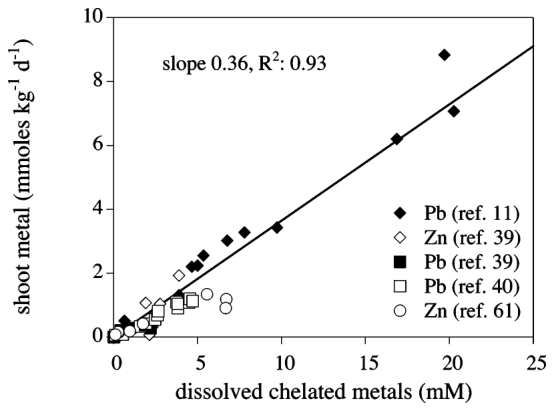
If the “leakiness” of the root is not influenced by the added chelant, a linear relationship between the soil solution concentration and the amount taken up is expected. This has been observed for Cu, Zn, and Pb uptake in the presence of chelants (11, 39, 40, 61) (Figure 4). Although a variety of plants and soils have been used, there is a good agreement between the uptake in the different experiments for both Pb and Zn. For Zn the uptake data are corrected for the uptake of Zn into the leaves before addition of the chelant (61). Zn is an essential micronutrient that is usually present in shoots at 100-1000 mg kg-1. Such correction is not necessary for Pb because there is almost no translocation into the shoots in the absence of chelants. The linear relationship may break down at high chelant concentrations when the root cells are damaged and uncontrolled inflow of soil solution may occur into the stele (35).
若根系的“渗漏性”不受所加螯合剂影响,则预期土壤溶液浓度与吸收量之间呈线性关系。在螯合剂存在下,Cu、Zn和Pb的吸收已观察到这种关系(11, 39, 40, 61)(图4)。尽管所用植物和土壤各不相同,不同试验中Pb和Zn的吸收均吻合较好。对于Zn,吸收数据已扣除添加螯合剂之前叶片中Zn的吸收量(61)。Zn是一种必需微量营养元素,地上部含量通常为100-1000 mg kg-1。对于Pb则无需此类校正,因为在无螯合剂时Pb几乎不向地上部转运。在高螯合剂浓度下,当根细胞受损、土壤溶液可能不受控制地流入中柱时,这种线性关系可能不再成立(35)。
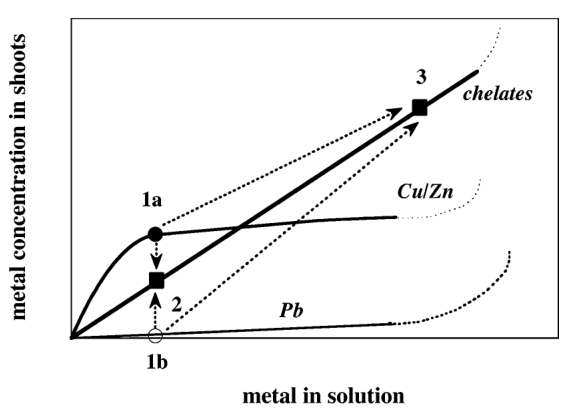
Figure 5 gives a simplified schematic of the accumulation of Cu, Zn, and Pb in shoots or translocation from roots to shoots in the absence and presence of chelating agents based on actual pot and hydroponic experiments (61, 62). In the absence of chelants, Zn and Cu accumulation is governed by uptake of free metal ions in the symplastic pathway, which is efficient at low solution concentrations (Figure 5, line labeled “Cu/Zn”). Only a little Pb is taken up into the shoots (line labeled “Pb”). If the same metal concentrations in solution were chelated, then the uptake would occur through the apoplastic pathways (line labeled “chelates”) and Cu and Zn uptake would be reduced while Pb uptake would be strongly increased. From Figure 5 it becomes clear why there is in most cases an increase in Pb uptake in the presence of the chelants. In contrast, the few hydroponic data on Cu and Zn uptake in the presence of chelants mostly show a decrease in metal uptake in the presence of chelants (62-64).
图5基于实际盆栽和水培试验(61, 62),给出了无螯合剂和有螯合剂条件下Cu、Zn和Pb在地上部累积或由根向地上部转运的简化示意图。在无螯合剂时,Zn和Cu的累积受共质体途径中自由金属离子吸收的控制,该途径在低溶液浓度下效率较高(图5,标注为“Cu/Zn”的曲线)。仅有少量Pb被吸收进入地上部(标注为“Pb”的曲线)。若溶液中相同浓度的金属被螯合,则吸收将经由质外体途径进行(标注为“chelates”的曲线),Cu和Zn的吸收将减少,而Pb的吸收将大幅增加。由图5可以清楚地看出,为何在大多数情况下螯合剂的存在会使Pb吸收增加。相反,为数不多的有关螯合剂存在下Cu和Zn吸收的水培数据大多显示螯合剂的存在使金属吸收降低(62-64)。
With a high dissolved metal concentration, translocation ofallthreemetalstotheshootswouldincreaseinthepresence of chelants because the nonselective uptake in the presence ofchelantswouldexceedselectiveuptakealongthesymplatic pathway for both essential and nonessential metals. The positions of the lines for the metals in the absence and presence of chelants depends on the plant species and may vary considerably. Adding chelants to a soil therefore increases not only the total dissolved metal concentration but also changes the uptake mechanism and depending on metal, plant species, and chelant concentration, significant increases not only of plant Pb but also of plant Cu and Zn are likely.
在溶解态金属浓度较高时,螯合剂的存在会增加所有三种金属向地上部的转运,因为对于必需和非必需金属而言,螯合剂存在下的非选择性吸收均会超过沿共质体途径的选择性吸收。无螯合剂和有螯合剂时各金属曲线的位置取决于植物种类,并可能相差很大。因此,向土壤中添加螯合剂不仅提高了溶解态金属总浓度,还改变了吸收机制;视金属种类、植物种类和螯合剂浓度而定,不仅植物Pb含量,植物Cu和Zn含量也可能显著增加。
The variability in uptake of chelants by different plant species also needs to be considered. Accumulation of Pb varied considerably from 94 to 1820 mg kg-1 for 10 different plant species after addition of EDTA to soils, with an average value of 800 mg kg-1 (34). Also, xylem sap concentrations of EDTA were found to vary considerably between plant species at the same solution concentration (35). This indicates that differences in uptake are not only related to the cumulative transpiration, and therefore flow of xylem sap to the leaves, but also the plant-dependent leakiness of the root, and the efficacy of chelate transport in the xylem.
还需考虑不同植物种类对螯合剂吸收的差异。向土壤中添加EDTA后,10种不同植物的Pb累积量在94至1820 mg kg-1之间变化很大,平均值为800 mg kg-1(34)。此外,在相同溶液浓度下,不同植物种类木质部汁液中的EDTA浓度差异也很大(35)。这表明吸收差异不仅与累积蒸腾量(从而与流向叶片的木质部汁液量)有关,还与根系渗漏性的植物依赖性以及木质部中螯合物运输的效率有关。
In addition to increasing the concentration of target metal in soil solution, chelants also alter the chemical and physical properties of the soil. Chelant addition increases the ionic strength of the soil solution. The increase in dissolved salts and complexes will reduce the water potential in the rootzone,thereforereducingtranspiration(65).Asaconsequence of reduced transpiration, the crop will also take up less of the target metal complex (66).
除提高土壤溶液中目标金属浓度外,螯合剂还会改变土壤的化学和物理性质。添加螯合剂会提高土壤溶液的离子强度。溶解态盐分和络合物的增加将降低根区的水势,从而减少蒸腾(65)。由于蒸腾减少,作物对目标金属络合物的吸收也将减少(66)。
5228 9 ENVIRONMENTAL SCIENCE & TECHNOLOGY / VOL. 40, NO. 17, 2006
5228 9 ENVIRONMENTAL SCIENCE & TECHNOLOGY / VOL. 40, NO. 17, 2006
Sodium salts of the chelants are commonly used because of their high solubility and low cost. In addition to reducing the available water, as described above, sodium also alters the soil structure by dispersing clays and bringing organic matter into soil solution. This can increase metal leaching by colloidal transport. Alternatives to sodium salts are more expensive, and do not overcome the problem of increased soil solution strength.
由于溶解度高且成本低,通常使用螯合剂的钠盐。除如上所述减少有效水分外,钠还会使黏粒分散并使有机质进入土壤溶液,从而改变土壤结构。这会通过胶体迁移增加金属淋溶。钠盐的替代品价格更高,且无法解决土壤溶液浓度升高的问题。
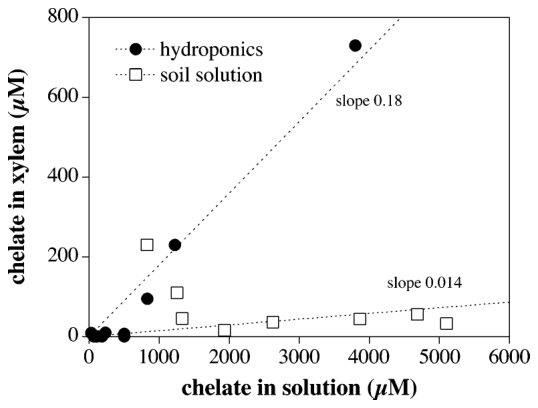
Calculation of Chelant Uptake. The chelants taken up by the root pass through the xylem to the shoots where they are deposited. Information on the xylem concentration of chelants and their metal complexes can therefore provide information about the efficiency of a plant uptake via the unselective apoplastic pathway. Figure 6 shows a summary of the few published data relating the solution chelant concentration with that of the xylem sap concentration. The efficiency of solute transfer into the xylem can be described by a dimensionless root absorption factor, φ, (66) as follows:
螯合剂吸收的计算。 被根系吸收的螯合剂经木质部运输至地上部并在此沉积。因此,木质部中螯合剂及其金属络合物的浓度可反映植物经非选择性质外体途径吸收的效率。图6汇总了为数不多的已发表数据,将溶液中螯合剂浓度与木质部汁液浓度联系起来。溶质进入木质部的效率可用无量纲的根系吸收系数φ来描述(66),如下式:

where Cr is the solute concentration in the root xylem and C is the ambient soil solution concentration. Available values of φ range between 0.014 and 0.18. In soils, most measured values are close to the lower limit, while some xylem sap concentrations from hydroponic experiments are higher (Figure 6). A low value of φ is expected due to the efficiency of the Casparian band in blocking the inflow of unwanted compounds and the nonexistence of specific transporters for chelated metals. It has been shown that there was no significant difference between the uptake of free chelants and their metal complexes (62). If we therefore know the soil solution concentration of a chelate, we can predict its xylem concentration.
式中,Cr为根木质部中的溶质浓度,C为周围土壤溶液浓度。现有的φ值范围为0.014-0.18。在土壤中,大多数实测值接近下限,而水培试验中的部分木质部汁液浓度较高(图6)。由于凯氏带能有效阻挡非需要化合物的流入,且不存在针对螯合态金属的特异性转运蛋白,预期φ值较低。研究表明,游离螯合剂与其金属络合物的吸收无显著差异(62)。因此,若已知某螯合物在土壤溶液中的浓度,即可预测其在木质部中的浓度。
Whenthexylemconcentrationofthechelatesasafunction of the solution concentration is known, we can calculate the amount of chelates that are transferred to the shoots of the plants from the amount of transpired water. The assumption is that once the chelate is in the xylem, it is transported to the leaves with the water stream and is stored there. The accumulation of a metal in the shoots is then given by where ∆M ) change in plant metal content (moles or g), t ) time (days), T ) water use (L day-1), C ) concentration of metal in soil solution (moles L-1 or g L-1), φ ) root absorption factor for the metal. The transpiration of plants in the field can be calculated using environmental variables and a crop coefficient (67).
若已知螯合物的木质部浓度与溶液浓度的函数关系,即可根据蒸腾水量计算转移至植物地上部的螯合物量。假设螯合物一旦进入木质部,即随水流运输至叶片并贮存于叶片中。地上部金属累积量由下式给出,式中∆M为植物金属含量的变化量(moles或g),t为时间(d),T为耗水量(L day-1),C为土壤溶液中金属浓度(moles L-1或g L-1),φ为该金属的根系吸收系数。田间植物的蒸腾量可利用环境变量和作物系数计算(67)。

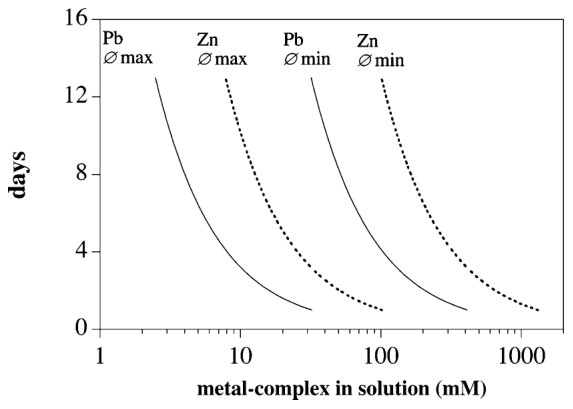
We will now present some calculations based on eq 2 using the soil and plant parameters summarized in Table 3S (Supporting Information). We calculated the metal concentration in soil solution that is needed to achieve a metal concentration in the plant tissue after a given time. We calculated this for a targeted concentration of 2000 mg kg-1 Pb or Zn in the dry shoots, using a soil with 1000 mg kg-1 metal, a transpiration rate of 5 mm d-1, and a biomass of 30 t ha-1. Figure 7 shows the concentrations of Pb and Zn that need to be present in soil solution to achieve this target after different times. To reach 2000 mg kg-1 Pb in the shoots, a soil solution concentration of 6 mM (1200 mg L-1) has to be sustained for one week for the highest φ and around 60 mM (12 400 mg L-1) for the low φ. To reach 2000 mg kg-1 Zn, concentrations of more than 15 mM (980 mg L-1) are needed for the high φ and 190 mM (12 400 mg L-1) are needed for the low φ. These conditions are difficult, if not impossible, to obtain in the field situation.
下面基于式2,利用表3S(支持信息)中汇总的土壤和植物参数进行一些计算。我们计算了在给定时间后使植物组织达到某一金属浓度所需的土壤溶液金属浓度。计算以干地上部Pb或Zn目标浓度2000 mg kg-1为目标,土壤金属含量为1000 mg kg-1,蒸腾速率为5 mm d-1,生物量为30 t ha-1。图7给出了在不同时间后达到该目标所需的土壤溶液中Pb和Zn浓度。要使地上部Pb达到2000 mg kg-1,在最高φ下需维持6 mM(1200 mg L-1)的土壤溶液浓度一周,而在低φ下需约60 mM(12 400 mg L-1)。要使Zn达到2000 mg kg-1,在高φ下需要超过15 mM(980 mg L-1)的浓度,在低φ下则需要190 mM(12 400 mg L-1)。这些条件在田间即便并非不可能,也是很难实现的。
Given that high concentrations of chelating agents reduce transpiration and may kill the plant, the time available for the plant uptake of solution will be shorter at higher solution concentration. Uncomplexed chelants are more toxic to plants than metal chelates (58), and may further reduce plant growth and transpiration. As discussed above, only a fraction of the chelant is complexed to the target metal and the total concentrationofthechelantinsolutionhastobemuchhigher toachievethedesiredconcentrationofmetalcomplex.Figure 7 also shows that reducing the chelant concentration will not be feasible because the increase in uptake will be too small.
鉴于高浓度螯合剂会降低蒸腾并可能导致植物死亡,溶液浓度越高,植物吸收溶液的可用时间就越短。未络合的螯合剂对植物的毒性高于金属螯合物(58),可能进一步降低植物生长和蒸腾。如上所述,只有部分螯合剂与目标金属络合,为达到所需的金属络合物浓度,溶液中螯合剂总浓度必须高得多。图7还表明,降低螯合剂浓度并不可行,因为吸收的增加量将过小。
Calculation of the Time Needed to Cleanse a Moderately Contaminated Soil. The critical ratio for phytoextraction is the amount of metal extracted per hectare compared to that left in the soil. Here we examine the time needed to halve the Pb concentration in the moderately contaminated model soil under optimal conditions with the values given in Table 3S. If all Pb were solubilized then the initial rate of uptake would be 30 kg ha-1 d-1 for the highest φ and 2.3 kg ha-1 d-1 for the lowest φ. If we assume that the water content of the soil is maintained, which is necessary to achieve 5 mm of transpiration, then the soil solution Pb concentration must decrease in proportion to plant Pb uptake. Maintaining a constant soil moisture content, the time needed to achieve a concentration below 200 mg kg-1 (the investigation threshold in Switzerland) of Pb would be between 128 and >1200 high transpiration days. However, this could not be achieved in a single cropping, as the plants rapidly die after the application of the chelant. If we optimistically assume that plants continued to transpire for 10 days after chelant application, then between 8 and 100 crops would be needed to reduce the soil Pb concentration to 200 mg kg-1. More chelant would have to be added after each cropping, as the Pb-chelate is unstable with respect to Fe-chelate, there is downward leaching, and, depending on the used chelant, biodegradation. These calculations assume that the plant takes up all of the chelated Pb. However, mass balance calculations in greenhouse experiments show that, at the most, just 10% of the soil metal is taken up by the plant (41, 68). The remainder is either reprecipitated in the soil, or leaches into receiving waters. We now discuss the environmental implications of such massive additions of chelants to soils.
净化中度污染土壤所需时间的计算。 植物提取的关键比值是每公顷提取的金属量与残留在土壤中的金属量之比。本文利用表3S中给出的数值,考察在最佳条件下使中度污染模型土壤中Pb浓度减半所需的时间。若全部Pb均被溶解,则最高φ下的初始吸收速率为30 kg ha-1 d-1,最低φ下为2.3 kg ha-1 d-1。若假设土壤含水量保持不变(这是实现5 mm蒸腾所必需的),则土壤溶液Pb浓度必然随植物Pb吸收成比例下降。在保持土壤含水量恒定的情况下,使Pb浓度降至200 mg kg-1(瑞士的调查阈值)以下所需时间为128至>1200个高蒸腾日。然而,这无法通过单季种植实现,因为施用螯合剂后植物会迅速死亡。若乐观地假设施用螯合剂后植物仍持续蒸腾10 d,则需要种植8至100茬作物才能使土壤Pb浓度降至200 mg kg-1。每茬种植后都必须补加螯合剂,因为相对于Fe-螯合物而言Pb-螯合物不稳定,且存在向下淋溶,并视所用螯合剂而定还存在生物降解。上述计算假定植物吸收了全部螯合态Pb。然而,温室试验的质量平衡计算表明,植物最多只吸收土壤金属的10%(41, 68)。其余部分或在土壤中再沉淀,或淋溶进入受纳水体。下面讨论向土壤中大量添加螯合剂的环境影响。
5Environmental Concerns环境问题
EDTA as a Persistent Contaminant. The use of EDTA in phytoextraction has received considerable attention due to its low cost and high efficacy of metal solubilization. EDTA offers the best cost/performance ratio of all chelants. However, EDTA has also received a lot of attention due to its persistence in the environment. While biodegradation of EDTA has been reported in pure cultures under controlled conditions, negligible degradation has been observed under natural conditions in soil and water (6). Due to this persistence, EDTA is found in almost all natural waters (19). EDTAhasthereforebeenselectedbytheEuropeanauthorities as part of the priority substances for extensive evaluation. According to the completed risk assessment report, EDTA has a low toxicity profile for humans and environmental risks are limited to some localized cases of high emissions to surface waters (69). The report concludes that risk reduction measures should be considered at concentrations above 2.2 mg L-1 (about 10 µM), a value hardly ever reached in natural waters. When applied to soil during phytoextraction, EDTA concentrations in soil solution are typically 1-100 mM, some 100-10 000 times higher than the 10 µM threshold above which risk reduction measures should be considered.
EDTA作为持久性污染物。 由于成本低、金属溶解效率高,EDTA在植物提取中的应用受到了相当多的关注。在所有螯合剂中,EDTA的性价比最高。然而,EDTA也因其在环境中的持久性而备受关注。尽管在受控条件下的纯培养中已有EDTA生物降解的报道,但在土壤和水体的自然条件下,其降解可忽略不计(6)。由于这种持久性,几乎所有天然水体中都能检出EDTA(19)。因此,欧洲主管部门已将EDTA列为需进行全面评估的优先物质之一。根据已完成的风险评估报告,EDTA对人体的毒性较低,环境风险仅限于向地表水高排放的个别局部情况(69)。该报告的结论是,当浓度超过2.2 mg L-1(约10 µM)时应考虑采取风险削减措施,而天然水体中几乎从未达到该值。在植物提取过程中施入土壤时,土壤溶液中EDTA浓度通常为1-100 mM,比应考虑风险削减措施的10 µM阈值高出约100-10 000倍。
Usingeq2,wecanalsocalculatethefractionofthechelant that is taken up by the plants. We used again our model soil for this calculation and assumed uptake during 10 days. The chelant uptake during that time is between 0.14 and 0.011 mol m-2 using the highest and the lowest φ value. This is 12 and 1% of the total amount of chelant in the topsoil. At least 90% of the chelant stays in solution and can be leached down to groundwater. To reach the concentration of 10 µM which was found to be safe by the European risk assessment report on EDTA (69), the plants would need to take up 99.95% of the added EDTA. The deliberate “pollution” of groundwater byEDTAoranotherchelantinthecourseofaphytoextraction procedure is therefore unavoidable when using an environmentally persistent chelant such as EDTA except under climatic conditions that completely prevent any leaching of solutes out of the rooted zone.
利用式2,还可以计算被植物吸收的螯合剂比例。我们再次以模型土壤进行计算,并假设吸收持续10 d。按最高和最低φ值计算,该期间内螯合剂吸收量分别为0.14和0.011 mol m-2,分别占表土中螯合剂总量的12%和1%。至少90%的螯合剂留在溶液中,并可能淋溶至地下水。要达到欧洲EDTA风险评估报告认定为安全的10 µM浓度(69),植物需要吸收所添加EDTA的99.95%。因此,在使用EDTA等环境持久性螯合剂时,除非气候条件完全阻止溶质从根区淋出,否则在植物提取过程中EDTA或其他螯合剂对地下水的蓄意“污染”是不可避免的。
Metal Contamination of Receiving Waters. Even if a chelating agent is found that is effective, low-cost, and biodegradable, metal leaching into receiving waters is still anenvironmentalconcern.Freechelantsonlyweaklyinteract with mineral surfaces at pH values in the plant-growth range, while strong adsorption occurs under acidic conditions (2). The adsorption of metal complexes generally differs from that of the free ligand (70). The relatively weak adsorption of chelates around neutral pH therefore results in excessive leaching. This has been observed in column experiments and in lysimeters (36, 38, 42, 71, 72). Leaching in the presence of the biodegradable chelant EDDS, however, was found to be significantly less than that for EDTA in small soil column (25).
受纳水体的金属污染。 即使找到一种高效、低成本且可生物降解的螯合剂,金属淋溶进入受纳水体仍是一个环境问题。在适宜植物生长的pH范围内,游离螯合剂与矿物表面的相互作用较弱,而在酸性条件下则发生强烈吸附(2)。金属络合物的吸附通常不同于游离配体(70)。因此,螯合物在中性pH附近吸附相对较弱,导致过度淋溶。这已在土柱试验和渗漏计中被观察到(36, 38, 42, 71, 72)。然而,在小型土柱中,可生物降解螯合剂EDDS存在时的淋溶量显著低于EDTA(25)。
The action level for Pb in water in the United States is 0.015 mg L-1, equivalent to 0.07 µM. To reduce the 16 mM Pb in our example in the topsoil to this level, the plants would need to take up 99.99999% of the solubilized Pb. One liter of topsoil solution with 16 mM Pb would raise the Pb concentration of 220 000 L of water above the action level without plant uptake. Even if the plants would take up 99% of the mobilized Pb from the example used above, the remaining 1% leached from 1 m2 of soil surface would raise 50 million L of water above the action level for Pb.
美国水中Pb的行动水平为0.015 mg L-1,相当于0.07 µM。要将本例中表土的16 mM Pb降至该水平,植物需要吸收99.99999%的被溶解Pb。在无植物吸收的情况下,1 L含16 mM Pb的表土溶液可使220 000 L水的Pb浓度超过行动水平。即使植物吸收了上例中99%的被活化Pb,从1 m2土壤表面淋出的剩余1%仍会使5000万L水的Pb浓度超过行动水平。
Solute transport through soils occurs via percolation through the soil matrix and preferential flow through macropores and other structures of rapid transport. Preferential flow, occurring in virtually all soils (73), permits the rapid passage of solutes through the soil with minimal interaction with soil particles and plant roots (74) and may result in solute transport up to 2 orders of magnitude faster than matrix flow (75). Even with noncomplexed metals, these transport pathways have been shown to exacerbate groundwater contamination by reducing the contact time of the soil solution with organic and clay material that could otherwise retard the movement of dissolved metals (76). Therefore, some leaching of chelant and chelated metals is unavoidable.
溶质在土壤中的迁移通过土壤基质中的渗流以及经大孔隙和其他快速运输结构的优先流进行。优先流几乎存在于所有土壤中(73),它使溶质能够快速穿过土壤,而与土壤颗粒和植物根系的相互作用极少(74),其溶质迁移速度可比基质流快2个数量级(75)。即使对于非络合态金属,研究也表明这些迁移途径会缩短土壤溶液与本可阻滞溶解态金属移动的有机质和黏土物质的接触时间,从而加剧地下水污染(76)。因此,螯合剂和螯合态金属的部分淋溶是不可避免的。
Implications for Phytoremediation. In the best case scenario, where chelant-induced phytoextraction is used to remediate a modestly contaminated soil under optimal conditions, this technology requires large masses of chelant to be applied to soil over the course of several years. Leaching is unavoidable during this time. Preferential flow processes will result in a significant proportion of the chelant and solubilized metal descending below the root zone, possibly into receiving waters.
对植物修复的启示。 在最理想的情形下,即在最佳条件下利用螯合剂诱导植物提取修复中度污染土壤,该技术也需要在数年内向土壤中施用大量螯合剂。在此期间,淋溶不可避免。优先流过程将导致相当比例的螯合剂和被溶解金属下移至根区以下,并可能进入受纳水体。
Chelant-inducedphytoextractionmaythereforebelimited to applications where the connection to receiving waters has been broken, or where leaching is unimportant. In the former case, phytoextraction could be conducted ex situ. Here, the contaminated material would be placed on a liner whereby any leachate could be collected and recycled. Such systems are already used for soil washing and the recovery of gold from low-grade ore bodies. Plants would aid in metal recovery by concentrating the metal in their biomass. The economicfeasibilityofinducedgoldphytoextractionhasbeen demonstrated (77).
因此,螯合剂诱导植物提取可能仅限于与受纳水体的联系已被切断或淋溶无关紧要的应用场合。对于前一种情况,植物提取可异位进行,即将污染物料置于防渗衬层上,收集并循环利用所有渗滤液。此类系统已用于土壤淋洗和从低品位矿体中回收金。植物通过在其生物质中富集金属来辅助金属回收。诱导金植物提取的经济可行性已得到证实(77)。
Alternatively, if groundwater contamination is not an issue, chelants may be used as chemical ploughs, reducing soil metal contamination by leaching below the root zone and precipitating the metal where it is unavailable for plant uptake.
另一种情况是,若地下水污染不是问题,螯合剂可用作“化学犁”,通过将金属淋溶至根区以下并使其沉淀于植物无法吸收的部位,从而降低土壤金属污染。
Some research has also been carried out with biodegradable chelating agents. A promising chelant is EDDS, which has received attention in the last years as potential replacement for EDTA in soil washing and chelant-enhanced phytoextraction (20, 25, 31, 42, 61, 78, 79). Metal-EDDS complexes have been shown to be easily biodegradable in soils (42, 47, 80). An approach combining the application of a biodegradable chelant (EDDS), phytoextraction by plants, andareactivepermeablebarrierforcompletebiodegradation of the leached chelant has been proposed (26). An additional factor that should also receive more attention ia possible adverse effects of high chelant doses on soil microbial and fungal activity (25, 81, 82).
也有一些研究使用了可生物降解的螯合剂。EDDS是一种很有前景的螯合剂,近年来作为土壤淋洗和螯合剂强化植物提取中EDTA的潜在替代品而受到关注(20, 25, 31, 42, 61, 78, 79)。研究表明,金属-EDDS络合物在土壤中易于生物降解(42, 47, 80)。有研究提出了一种将施用可生物降解螯合剂(EDDS)、植物提取以及用于彻底降解淋出螯合剂的可渗透反应墙相结合的方法(26)。另一个应得到更多关注的因素是高剂量螯合剂对土壤微生物和真菌活性可能产生的不利影响(25, 81, 82)。
6Supporting Information Available支持信息
A description of modeling the extraction of Pb and Ca in the presence of chelants; a description of the conditions used to calculate the extraction of Pb in the presence of Ca and Fe(III) by EDTA and EDDS; the list of references used to drawFigure1;atablesummarizingtheconditionstocalculate uptake of Pb into the shoots. This material is availabe free of charge via the Internet at http.//pubs.acs.org.
螯合剂存在下Pb和Ca提取的模拟说明;EDTA和EDDS在Ca和Fe(III)存在下提取Pb的计算条件说明;绘制图1所用的参考文献列表;汇总计算Pb向地上部吸收条件的表格。上述材料可通过互联网 http://pubs.acs.org 免费获取。
5230 9 ENVIRONMENTAL SCIENCE & TECHNOLOGY / VOL. 40, NO. 17, 2006
5230 9 ENVIRONMENTAL SCIENCE & TECHNOLOGY / VOL. 40, NO. 17, 2006
7Literature Cited参考文献
(1) Keller, C.; Ludwig, C.; Davoli, F.; Wochele, J. Thermal treatment of metal-enriched biomass produced from heavy metal phytoextraction. Environ. Sci. Technol. 2005, 39, 3359-3367.
(2) Nowack, B. Environmental chemistry of aminopolycarboxylate chelating agents. Environ. Sci. Technol. 2002, 36, 4009-4016.
(3) Nowack, B.; VanBriesen, J. M. Biogeochemistry of Chelating Agents; ACS Symposium Series Vol. 910; American Chemical Society: Washington, DC, 2005.
(4) Wolf, K.; Gilbert, P. A. EDTA - Ethylenediaminetetraacetic acid. In The Handbook of Environmental Chemistry; Hutzinger, O., Ed.; Springer: New York, 1992; Vol. 3, Part F, pp 243-259.
(5) Wenger, K.; Tandy, S.; Nowack, B. Effects of chelating agents on trace metal speciation and bioavailability. In Biogeochemistry of Chelating Agents; Nowack, B., VanBriesen, J. M., Eds.; ACS Symposium Series Vol. 910; American Chemical Society: Washington, DC, 2005; pp 204-224.
(6) Bucheli-Witschel, M.; Egli, T. Environmental fate and microbial degradationofaminopolycarboxylicacids. FEMSMicrobiol.Rev. 2001, 25, 69-106.
(7) Hale, V. Q.; Wallace, A. Effect of chelates on uptake of some heavy metal radionuclides from soils by bush beans. Soil Sci. 1970, 109, 262-263.
(8) Jorgensen, S. E. Removal of heavy metals from compost and soil by ecotechnological methods. Ecol. Eng. 1993, 2, 89-100.
(9) Huang, J. W.; Cunningham, S. D. Lead phytoextraction: species variation in lead uptake and translocation. New Phytol. 1996, 134, 75-84.
(10) Blaylock, M. J.; Salt, D. E.; Dushenkov, S.; Zakharova, O.; Gussman, C.; Kapulnik, Y.; Ensley, B. D.; Raskin, I. Enhanced accumulation of Pb in Indian Mustard by soil-applied chelating agents. Environ. Sci. Technol. 1997, 31, 860-865.
(11) Huang, J. W. W.; Chen, J.; Berti, W. R.; Cunningham, S. D. Phytoremediation of lead-contaminated soils: role of synthetic chelates in lead phytoextraction. Environ. Sci. Technol. 1997, 31, 800-805.
(12) Epstein, A. L.; Gussman, C. D.; Blaylock, M. J.; Yermiyahu, U.; Huang, J. W.; Kapulnik, Y.; Orser, C. S. EDTA and PbEDTA accumulation in Brassica juncea grown in Pb-amended soil. Plant Soil 1999, 208, 87-94.
(13) Liphadzi, M. S.; Kirkham, M. B.; Mankin, K. R.; Paulsen, G. M. EDTA-assisted heavy-metal uptake by poplar and sunflower grown at a long-term sewage-sludge farm. Plant Soil 2003, 257, 171-182.
(14) Kayser, A.; Wenger, K.; Keller, A.; Attinger, W.; Felix, H. R.; Gupta, S. K.; Schulin, R. Enhancement of phytoextraction of Zn, Cd, and Cu from calcareous soil: the use of NTA and sulfur amendments. Environ. Sci. Technol. 2000, 34, 1778-1783.
(15) Blaylock, M. J. Field demonstrations of phytoremediation of lead contaminated soils. In Phytoremediation of Contaminated Soil and Water; Terry, N., Ban˜uelos, G., Eds.; Lewis Publishers: Boca Raton, FL, 2000; pp 1-12. (16) Alkorta, I.; Hernandez-Allica, J.; Becerril, J. M.; Amezaga, I.; Albizu, I.; Onaindia, M.; Garbisu, C. Chelate-enhanced phytoremediation of soils polluted with heavy metals. Rev. Environ. Sci. Bio/Technol. 2004, 3, 55-70.
(17) Schmidt, U. Enhancing phytoextraction: the effect of chemical soilmanipulationonmobility,plantaccumulation,andleaching of heavy metals. J. Environ. Qual. 2003, 32, 1939-1954. (18) Haworth, D. T. Some linguistic detail on chelation. J. Chem. Educ. 1998, 75, 47.
(19) Nowack, B.; VanBriesen, J. M. Chelating agents in the environment. In Biogeochemistry of Chelating Agents; Nowack, B., VanBriesen, J. M., Eds.; ACS Symposium Series; American Chemical Society, Washington, DC, 2005; Vol. 910, pp 1-18.
(20) Tandy, S.; Bossart,K.;Mueller,R.;Ritschel,J.;Hauser,L.;Schulin, R.; Nowack, B. Extraction of heavy metals from soils using biodegradable chelating agents. Environ. Sci. Technol. 2004, 38, 937-944.
(21) Kirkham, M. B. EDTA-facilitated phytoremediation of soil with heavy metals from sewage sludge. Int. J. Phytorem. 2000, 2, 159-172.
(22) Puschenreiter, M.; Sto¨ger, G.; Lombi, E.; Horak, O.; Wenzel, W. W. Phytoextraction of heavy metal contaminated soils with Thlaspi goesingense and Amaranthus hybridus: rhizosphere manipulation using EDTA and ammonium sulfate. J. Plant Nutr. Soil Sci. 2001, 164, 615-621.
(23) Madrid, F.; Liphadzi, M. S.; Kirkham, M. B. Heavy metal displacement in chelate-irrigated soil during phytoremediation. J. Hydrol. 2003, 272, 107-119.
(24) Chen, H.; Cutright, T. EDTA and HEDTA effects on Cd, Cr, and Ni uptake by Helianthus annuus. Chemosphere 2001, 45, 21- 28.
(25) Grcman, H.; Vodnik, D.; Velikonja-Bolta, S.; Lestan, D. Ethylenediaminedissuccinate as a new chelate for environmentally safe enhanced lead phytoextraction. J. Environ. Qual. 2003, 32, 500-506.
(26) Kos, B.; Lestan, D. Induced phytoextraction/ soil washing of lead using biodegradable chelate and permeable barriers. Environ. Sci. Technol. 2003, 37, 624-629.
(27) Cooper, E. M.; Sims, J. T.; Cunningham, S. D.; Huang, J. W.; Berti, W. R. Chelate-assisted phytoextraction of lead from contaminated soils. J. Environ. Qual. 1999, 28, 1709-1719.
(28) Wu, J.; Hsu, F. C.; Cunningham, S. D. Chelate-assisted Pb phytoextraction: Pb availability, uptake, and translocation constraints. Environ. Sci. Technol. 1999, 33, 1898-1904.
(29) Thayalakumaran, T.; Vogeler, I.; Scotter, D. R.; Percival, H. J.; Robinson, B. H.; Clothier, B. E. Leaching of copper from contaminatedsoilfollowingtheapplicationofEDTA.I.Repacked soil experiments and a model. Aust. J. Soil Res. 2003, 41, 323- 333.
(30) Martell, A. E.; Smith, R. M.; Motekaitis, R. J. NIST critically selected stability constants of metal complexes, Version 6.0; National Institute of Standards and Technology: Gaithersburg, MD, 2001. (31) Luo, C.; Shen, Z.; Li, X. Enhanced phytoextraction of Cu, Pb, Zn and Cd with EDTA and EDDS. Chemosphere 2005, 59, 1-11. (32) Finzgar, N.; Kos, B.; Lestan, D. Washing of Pb contaminated soil using (S,S) ethylenediamine disuccinate and horizontal permeable barriers. Chemosphere 2004, 57, 655-661. (33) Nowack,B.;Sigg,L.Dissolutionofiron(III)(hydr)oxidesbymetal- EDTA complexes. Geochim. Cosmochim. Acta 1997, 61, 951- 963.
(34) Chen, Y.; Li, X.; Shen, Z. Leaching and uptake of heavy metals by ten different species of plants during an EDTA-assisted phytoextraction process. Chemosphere 2004, 57, 187-196.
(35) Collins, R. N.; Merrington, G.; McLaughlin, M. J.; Knudsen, C. Uptake of intact zinc-ethylenediaminetetraacetic acid from soil is dependent on plant species and complex concentration. Environ. Toxicol. Chem. 2002, 21, 1940-1945.
(36) Wu, L. H.; Luo, Y. M.; Xing, X. R.; Christie, P. EDTA-enhanced phytoremediationofheavymetalcontaminatedsoilswithIndian mustard and associated potential leaching risk. Agric., Ecosyst. Environ. 2004, 102, 307-318.
(37) Sun, B.; Zhao, F. J.; Lombi, E.; McGrath, S. P. Leaching of heavy metals from contaminated soils using EDTA. Environ. Pollut. 2001, 113, 111-120.
(38) Thayalakumaran, T.; Vogeler, I.; Scotter, D. R.; Percival, H. J.; Robinson, B. H.; Clothier, B. E. Leaching of copper from contaminated soil following the application of EDTA. II. Intact core experiments and model testing. Aust. J. Soil Res. 2003, 41, 335-350.
(39) Lai, H. Y.; Chen, Z. S. Effects of EDTA on solubility of cadmium, zinc, and lead and their uptake by rainbow pink and vetiver grass. Chemosphere 2004, 55, 421-430. (40) Shen, Z. G.; Li, X. D.; Wang, C. C.; Chen, H. M.; Chua, H. Lead phytoextractionfromcontaminatedsoilwithhigh-biomassplant species. J. Environ. Qual. 2002, 31, 1893-1900. (41) Lombi, E.; Zhao, F. J.; Dunham, S. J.; McGrath, S. P. Phytoremediation of heavy metal-contaminated soils: natural hyperaccumulation versus chemically enhanced phytoextraction. J. Environ. Qual. 2001, 30, 1919-1926. (42) Hauser, L.; Tandy, S.; Schulin, R.; Nowack, B. Column extraction of heavy metals from soils using the biodegradable chelating agent EDDS. Environ. Sci. Technol. 2005, 39, 6819-6824.
(43) Sillanpa¨a¨, M.; Sihvonen, M. L. Analysis of EDTA and DTPA. Talanta 1997, 44, 1487-1497.
(44) Tandy, S.; Schulin, R.; Suter, M. J. F.; Nowack, B. Determination of [S,S′]-ethylenediamine disuccinic acid (EDDS) by high performance liquid chromatography after derivatization with FMOC. J. Chromatogr., A 2005, 1077, 37-43.
(45) Schmidt, C. K.; Brauch, H. J. Analysis of aminopolycarboxylates and organophosphonates. In Biogeochemistry of Chelating Agents; Nowack, B., VanBriesen, J. M., Eds.; ACS Symposium Series Vol. 910; American Chemical Society: Washington, DC, 2005; pp 76-107.
(46) Yang, Y.; Ratte, D.; Smets, B. F.; Pignatello, J. J.; Grasso, D. Mobilization of soil organic matter by complexing agents and implications for polycyclic aromatic hydrocarbon desorption. Chemosphere 2001, 43, 1013-1021.
(47) Tandy,S.;Schulin,R.;Nowack,B.Biodegradationandspeciation of residual SS-ethylenediaminedisuccinic acid (EDDS) in soil solution left after soil washing. Environ. Pollut. 2006, 142, 191- 199.
(48) Whiting, S. N.; Broadley, M. R.; White, P. J. Applying a solute transfer model to phytoextraction: zinc acquisition by Thlaspi caerulescens. Plant Soil 2003, 249, 45-56.
(49) McGrath, S. P.; Zhao, F. J.; Lombi, E. Plant and rhizosphere processes involved in phytoremediation of metal-contaminated soils. Plant Soil 2001, 232, 207-214.
(50) Scally, S.; Davison, W.; Zhang, H. In situ measurements of dissociationkineticsandlabilitiesofmetalcomplexesinsolution using DGT. Environ. Sci. Technol. 2003, 37, 1379-1384.
(51) Tusseau-Vuillemin, M. H.; Gilbin, R.; Taillefert, M. A dynamic numerical model to characterize labile metal complexes collected with diffusion gradient in thin fims devices. Environ. Sci. Technol. 2003, 37, 1645-1652.
(52) Van Leeuwen, H. P. Metal speciation dynamics and bioavailability: inert and labile complexes. Environ. Sci. Technol. 1999, 33, 3743-3748.
(53) Steudle, E.; Peterson, C. A. How does water get through roots? J. Exp. Bot. 1998, 49, 775-788.
(54) Crowdy, S. H.; Tanton, T. W. Water pathways in higher plants. I. Free space in wheat leaves. J. Exp. Bot. 1970, 21, 102-111.
(55) Parker, D. R.; Pedler, J. F.; Ahnstrom, Z. A. S.; Resketo, M. Reevaluating the free-ion activity model of trace metal toxicity toward higher plants: experimental evidence with copper and zinc. Environ. Toxicol. Chem. 2001, 20, 899-906.
(56) Parker, D. R.; Chaney, R. L.; Norvell, W. A. Chemical equilibrium models: application to plant nutrition research. In Chemical Equilibrium and Reaction Models; Soil Science Society of America, American Society of Agronomy: Madison, WI, 1995.
(57) Bell, P. F.; McLaughlin, M. J.; Cozens, G.; Stevens, D. P.; Owens, G.; South, H. Plant uptake of 14C-EDTA, 14C-Citrate and 14C-histidine from chelator-buffered and conventional hydroponic solutions. Plant Soil 2003, 253, 311-319.
(58) Vassil, A. D.; Kapulnik, Y.; Raskin, I.; Salt, D. E. The role of EDTA in lead transport and accumulation by Indian Mustard. Plant Physiol. 1998, 117, 447-453.
(59) Ensley, B. D.; Blaylock, M. J.; Dushenkov, S.; Kumar, N. P. B. A.; Kapulnik, Y. Inducing hyperaccumulation of metals in plant shoots. U.S. Patent 5917117, 1999.
(60) Mathis, P.; Kayser, A. Plant uptake of heavy metals following glyphosate treatment. In Proceedings of the 6th International Conference on the Biogeochemistry of Trace Elements; 29.7.-2.8.2001; Guelph, ON. (61) Tandy, S.; Schulin, R.; Nowack, B. Uptake of metals during chelant-assisted phytoextraction with EDDS related to the solubilized metal concentration. Environ. Sci. Technol. 2006, 40, 2753-2758.
(62) Tandy, S.; Schulin, R.; Nowack, B. The influence of EDDS on the uptake of heavy metals in hydroponically grown sunflowers. Chemosphere 2006, 62, 1454-1463.
(63) Taylor, G. J.; Foy, C. D. Differential uptake and toxicity of ionic and chelated copper in Triticum aestivum. Can. J. Bot. 1985, 63, 1271-1275.
(64) Wenger, K.; Gupta, S. K.; Furrer, G.; Schulin, R. The role of nitrilotriacetate in copper uptake by tobacco. J. Environ. Qual. 2003, 32, 1669-1676.
(65) Salisbury, F. B.; Ross, C. W. Plant Physiology; Wadsworth Publishing Co.: Belmont, CA, 1992.
(66) Robinson,B.;Fernandez,J.E.;Madejon,P.;Maranon,T.;Murillo, J. M.; Green, S.; Clothier, B. Phytoextraction: an assessment of biogeochemical and economic viability. Plant Soil 2003, 249, 117-125.
(67) Allen, R. G.; Pereira, L. S.; Raes, D.; M., S. Crop evapotranspiration: Guidelines for computing crop water requirements; FAO Irrigation and Drainage Paper 56; FAO: Rome, 1999. (68) Thayalakumaran, T.; Robinson, B. H.; Vogeler, I.; Scotter, D. R.; Clothier, B. E.; Percival, H. J. Plant uptake and leaching of copper during EDTA-enhanced phytoremediation of repacked and undisturbed soil. Plant Soil 2003, 254, 415-423.
(69) Grundler, O. J.; van der Steen, A. T. M.; Wilmot, J. Overview of the European Risk Assessment on EDTA. In Biogeochemistry of Chelating Agents; Nowack, B., VanBriesen, J. M., Eds.; ACS
Syposium Series Vol. 910; American Chemical Society: Washington, DC, 2005; pp 336-347.
(70) Nowack, B.; Sigg, L. Adsorption of EDTA and metal-EDTA complexes to goethite. J. Colloid. Interface Sci. 1996, 177, 106- 121.
(71) Wenzel, W. W.; Unterbrunner, R.; Sommer, P.; Sacco, P. Chelate-assisted phytoextraction using canola (Brassica napus L.) in outdoors pot and lysimeter experiments. Plant Soil 2003, 249, 83-96.
(72) Ro¨mkens, P.; Bouwman, L.; Japenga, J.; Draaisma, C. Potential drawbacks of chelate-enhanced phytoremediation of soils. Environ. Pollut. 2002, 116, 109-121. (73) Flury, M.; Flu¨hler, H.; Jury, W. A.; Leuenberger, J. Susceptibility of soils to preferential flow of water - a field study. Water Resour. Res. 1994, 30, 1945-1954.
(74) Loague,K.;R.,G.Statisticalandgraphicalmethodsforevaluating solute transport models: Overview and application. J. Contam. Hydrol. 1991, 7, 51-74.
(75) Jarvis, N. Macropore and preferential flow. In Encyclopaedia of Agrochemicals; Plimmer, J. R., Gammon, D. W., Ragsdale, N. N., Eds.; Wiley: New York, 2003; pp 1005-1013.
(76) Bundt, M.; Albrecht, A.; Froidevaux, P.; Blaser, P.; Flu¨hler, H. Impact of preferential flow on radionuclide distribution in soil. Environ. Sci. Technol. 2000, 34, 3895-3899. (77) Anderson, C.; Moreno, F.; Meech, J. A field demonstration of gold phytoextraction technology. Miner. Eng. 2005, 18, 385- 392.
(78) Meers, E.; Ruttens, A.; Hopgood, M. J.; Samson, D.; Tack, F. M. G.ComparisonofEDTAandEDDSaspotentialsoilamendments for enhanced phytoextraction of heavy metals. Chemosphere 2005, 58, 1011-1022. (79) Vandevivere, P.; Hammes, F.; Verstraete, W.; Feijtel, T.; Schowanek, D. Metal decontamination of soil, sediment, and sewage sludge by means of transition metal chelant (S,S)-EDDS. J. Environ. Eng. 2001, 127, 802-811.
(80) Schowanek, D.; Feijtel, T. C. J.; Perkins, C. M.; Hartman, F. A.; Federle, T. W.; Larson, R. J. Biodegradation of (S,S), (R,R) and mixedstereoisomersofethylenediaminedisuccinicacid(EDDS), a transition metal chelator. Chemosphere 1997, 34, 2375-2391. (81) Chen, Y. X.; Wang, Y. P.; Wu, Y. X.; Lin, Q.; Xue, S. G. Impacts of chelate-assisted phytoremediation on microbial community composition in the rhizosphere of a copper accumulator and a nonaccumulator. Sci. Total Environ. 2006, 356, 247-255. (82) Ultra, V. U.; Yano, A.; Iwasaki, K.; Tanaka, S.; Kang, Y.; Sakurai, K. Influence of chelating agent addition on copper distribution and microbial activity in soil and copper uptake by Brown Mustard (Brassica juncea). Soil Sci. Plant Nutr. 2005, 51, 193- 202. (83) Kim, C.; Lee, Y.; Ong, S. K. Factors affecting EDTA extraction of lead from lead-contaminated soils. Chemosphere 2003, 51, 845- 853.
(84) Fangueiro, D.; Bermond, A.; Santos, E.; Carapuca, H.; Duarte, A. Heavy metal mobility assessment in sediments based on a kinetic approach of the EDTA extraction: search for optimal experimental conditions. Anal. Chim. Acta 2002, 459, 245-256. (85) Ghestem, J. P.; Bermond, A. EDTA extractability of trace metals in polluted soils: a chemical-physical study. Environ. Technol. 1998, 19, 409-416. (86) Manouchehri, N.; Besancon, S.; Bermond, A. Major and trace metal extraction from soil by EDTA: equilibrium and kinetic studies. Anal. Chim. Acta 2006, 559, 105-112.
(87) Collins, R. N.; Onisko, B. C.; McLaughlin, M. J.; Merrington, G. Determination of metal-EDTA complexes in soil solution and plant xylem by ion chromatography-electrospray mass spectrometry. Environ. Sci. Technol. 2001, 35, 2589-2593.
(88) Schaider, L. A.; Sedlak, D. L. Uptake of metal-EDTA complexes by Brassica juncea: implications for the free-ion activity model and phytoremediation design. In 226th ACS National Meeting, New York, Preprint of Extended Abstracts, Division of Environmental Chemistry, 43/2; American Chemical Society: Washington, DC; pp 616-620.
Received for review March 2, 2006. Revised manuscript received June 16, 2006. Accepted June 28, 2006.