Brett Robinson and Chris Anderson
Summary摘要
Phytoremediation in New Zealand and Australia stemmed from pioneering work by Professor R. R. Brooks on plants that hyperaccumulate heavy metals. Although original work focused on the extraction of heavy metals from contaminated sites, successful phytoremediation now employs plants as biopumps to reduce contaminant mobility and enhance the in situ degredation of some pesticides. In the first years of the 21st century, phytoremediation became established in the commercial environment with the appearance of dedicated phytoremediation companies. Phytoremediation offers a low-cost means of maintaining Australasia's "clean-green" image abroad. Use of this technology will increase because of increased pressure from regulators and future scientific achievements. In New Zealand, phytoremediation is used to improve degraded lands resulting from agricultural and silvicultural production, whereas in Australia its greatest potential is the remediation of mining-affected lands. Phytoremediation is most effective on lands where the clean-up cost of alternative technologies is greater than the land value. This reduces the importance of the longer time needed for phytoremediation. This chapter discusses, using case studies, the development of phytoremediation in Australia applied to a range of contaminated lands under various climatic conditions.
新西兰和澳大利亚的植物修复研究源于R. R. Brooks教授对重金属超富集植物的开创性工作。虽然早期研究侧重于从污染场地中提取重金属,但目前成功的植物修复是将植物用作“生物泵”,以降低污染物的迁移性并促进部分农药的原位降解。21世纪初,随着专业植物修复公司的出现,植物修复在商业领域中得以确立。植物修复为维护澳大拉西亚在海外的“清洁绿色”形象提供了一种低成本途径。由于监管机构压力的增加以及未来的科学进展,该技术的应用将不断扩大。在新西兰,植物修复用于改良农业和林业生产所造成的退化土地;而在澳大利亚,其最大潜力在于修复受采矿影响的土地。在其他替代技术的治理成本高于土地价值的场地上,植物修复最为有效,这也削弱了植物修复所需时间较长这一缺点的重要性。本章通过案例研究,论述了澳大利亚植物修复技术的发展及其在不同气候条件下对多种污染土地的应用。
Key Words: Biopumps; biosolids; hydraulic control; mining; sheep dip; timber production.
关键词:生物泵;生物固体(污泥);水力控制;采矿;羊只药浴;木材生产。
1Introduction引言
Phytoremediation is the use of plants to improve degraded environments (1). Pioneering work by the late Professor Robert Brooks at Massey University, Palmerston North, New Zealand, popularized the study of plants that accumulate inordinate amounts of heavy metals. Phytoremediation research in Australasia has stemmed from the investigation of these so-called "hyperaccumulator" plants. Professor Brooks was responsible for setting up a New Zealand phytoremediation program in the mid-1990s. Since these early studies on the plant extraction of heavy metals, phytoremediation has been developed for the treatment of a whole suite of contaminated sites. In Australasia, this technology has been successfully transferred to the commercial environment.
植物修复是利用植物改善退化环境的技术(1)。新西兰北帕默斯顿梅西大学已故的Robert Brooks教授所开展的开创性工作,推动了对积累超常量重金属的植物的研究。澳大拉西亚的植物修复研究正是源于对这类所谓“超富集植物”的调查。Brooks教授于20世纪90年代中期主持建立了新西兰植物修复研究计划。自这些早期关于植物提取重金属的研究以来,植物修复已发展到可用于处理各类污染场地。在澳大拉西亚,该技术已成功转移至商业领域。
From: Methods in Biotechnology, vol. 23: Phytoremediation: Methods and Reviews Edited by: N. Willey © Humana Press Inc., Totowa, N
出自:Methods in Biotechnology, vol. 23: Phytoremediation: Methods and Reviews,N. Willey 主编 © Humana Press Inc., Totowa, N
In New Zealand, HortResearch (www.hortresearch.co.nz) and the Soil and Earth Sciences Group of the Institute of Natural Resources at Massey University (soils-earth.massey.ac.nz) have active phytoremediation programs. Tiaki Resources Ltd. (projects@tiaki.co.nz) provides commercial phytoremediation. In Australia, the Botany Department at the University of Melbourne (www.botany. unimelb.edu.au), the Centre for Mined Land Rehabilitation (www.cmlr.uq.edu. au), the Commonwealth Scientific and Industrial Research Organisation (CSIRO) (www.csiro.au), and several other universities have phytoremediation programs. Phytolink Australia Pty (www.phytolink.com.au) is a dedicated phytoremediation company. As elsewhere, the commercial use of phytoremediation in Australasia is driven by pressure from regulators.
在新西兰,HortResearch(www.hortresearch.co.nz)以及梅西大学自然资源研究所土壤与地球科学组(soils-earth.massey.ac.nz)设有活跃的植物修复研究计划。Tiaki Resources Ltd.(projects@tiaki.co.nz)提供商业化植物修复服务。在澳大利亚,墨尔本大学植物学系(www.botany. unimelb.edu.au)、矿区土地复垦中心(Centre for Mined Land Rehabilitation,www.cmlr.uq.edu. au)、联邦科学与工业研究组织(CSIRO)(www.csiro.au)以及其他几所大学均设有植物修复研究计划。Phytolink Australia Pty(www.phytolink.com.au)是一家专业的植物修复公司。与其他地区一样,澳大拉西亚植物修复的商业应用是由监管机构的压力所推动的。
Phytoremediation in Australasia has focused on the use of plants as biopumps (1). Here, plants use the sun's energy to dewater contaminated sites and control leaching, as well as enhance the organic matter and microbial activity in the rhizosphere. These root-zone processes thereby augment contaminant degradation and reduce the mobility of heavy metals. We therefore use the term phytoremediation to cover a wide-range of plant-based environmental applications, ranging from mine-site revegetation through to riparian management and phytoextraction. In Australasia, the most important role of phytoremediation is to reduce contaminant mobility and to degrade organic pollutants, rather than the phytoextraction of heavy metals. In this chapter, we discuss the most important environmental issues in New Zealand and Australia and demonstrate, using case studies, how phytoremediation can be used to address land degradation.
澳大拉西亚的植物修复侧重于将植物用作生物泵(1)。在此过程中,植物利用太阳能使污染场地脱水并控制淋溶,同时提高根际有机质含量和微生物活性。这些根区过程进而促进污染物降解并降低重金属的迁移性。因此,本文使用“植物修复”一词涵盖范围广泛的基于植物的环境应用,从矿区植被重建到河岸带管理以及植物提取。在澳大拉西亚,植物修复最重要的作用是降低污染物迁移性和降解有机污染物,而非植物提取重金属。本章论述了新西兰和澳大利亚最重要的环境问题,并通过案例研究说明如何利用植物修复应对土地退化。
2The Relevance of Phytoremediation in the Australasian Context植物修复在澳大拉西亚背景下的意义
The New Zealand economy is underpinned by an internationally perceived "clean-green" image. Contaminant-free agricultural exports and tourism contribute 16 and 9%, respectively to New Zealand's gross domestic product (2). Environmental degradation thus poses a significant risk to economic growth, and the government has consequently implemented strict environmental controls via the Resource Management Act, 1992. Australia's economy is similar to New Zealand's, although mining is now Australia's single biggest export earner. Unlike New Zealand, however, Australia has no overarching environmental legislation. Rather, disparate bills have been passed that address specific environmental issues. These may vary between states.
新西兰经济以其在国际上树立的“清洁绿色”形象为支撑。无污染农产品出口和旅游业分别占新西兰国内生产总值的16%和9%(2)。因此,环境退化对经济增长构成重大风险,政府据此通过1992年《资源管理法》(Resource Management Act)实施了严格的环境管控。澳大利亚的经济结构与新西兰相似,但采矿业目前是澳大利亚最大的单一出口创汇产业。然而,与新西兰不同,澳大利亚没有统领性的环境立法,而是通过了针对具体环境问题的分散法案,且各州之间可能存在差异。
Most contaminated sites in New Zealand are associated with agricultural and silvicultural production: there are an estimated 50,000 disused sheep-dipping sites that may contain elevated levels of persistent pesticides such as dieldrin and sodium arsenate. Similarly, there are numerous sites contaminated with timber treatment compounds such as copper-chromium-arsenate, pentachlorophenol, and boron. In addition to agricultural- and silvicultural-contaminated sites, Australia has over 2 million ha of open-cast mining and many contaminated sites associated with smelting and processing (3). Both countries face environmental issues associated with urban development, especially the disposal and treatment of sewage sludge and burgeoning landfills.
新西兰的大多数污染场地与农业和林业生产有关:估计有50,000处废弃的羊只药浴场地,可能含有较高水平的持久性农药,如狄氏剂和砷酸钠。同样,还有大量场地受到铬化砷酸铜、五氯苯酚和硼等木材防腐化合物的污染。除农业和林业污染场地外,澳大利亚还有超过200万ha的露天采矿区,以及许多与冶炼和加工相关的污染场地(3)。两国均面临与城市发展相关的环境问题,尤其是污水污泥的处置与处理以及日益扩张的垃圾填埋场。
New Zealand has a temperate oceanic climate with high rainfall. Meteorological conditions seldom prohibit plant growth making phytoremediation a viable option for many contaminated sites. However, the high rainfall:evapotranspiration ratio can limit the effectiveness of phytoremediation to provide hydraulic control on contaminated sites. Australia, on the other hand, often suffers from drought and associated soil salinity, both of which can negatively affect plant growth, but render phytoremediation effective for the mitigation of leaching.
新西兰属温带海洋性气候,降雨量大。气象条件很少限制植物生长,因此植物修复对许多污染场地而言是一种可行的选择。然而,较高的降雨量与蒸散量之比可能限制植物修复对污染场地实施水力控制的效果。另一方面,澳大利亚常遭受干旱及与之相关的土壤盐渍化,二者均会对植物生长产生不利影响,但却使植物修复在减缓淋溶方面十分有效。
Phytoremediation is best suited to the long-term cleanup of low-value land where other remediation options are prohibitively expensive (4). This technology is therefore well suited for use on contaminated sites in the extensive production systems of Australasia. The low population densities of both New Zealand (14.8 people/km') and Australia (2.4 people/km?) keep land values relatively low and reduce the pressure for the rapid remediation of contaminated sites.
植物修复最适合于低价值土地的长期治理,因为在这类土地上其他修复方案的成本过高(4)。因此,该技术非常适用于澳大拉西亚粗放型生产系统中的污染场地。新西兰(14.8人/km²)和澳大利亚(2.4人/km²)的人口密度均较低,使土地价值保持在相对较低的水平,并减轻了快速修复污染场地的压力。
3Phytoremediation Case Studies植物修复案例研究
3.1. Phytoremediation of a Timber-Industry Waste Site3.1. 木材工业废弃物场地的植物修复
New Zealand has 1.6 million ha of Pinus radiata plantations for pulp and timber production. Most timber products are treated with biocides to prevent decay. In the past, pentachlorophenol and boron have been used to treat timber. Currently, copper-chromium-arsenic is the treatment of choice. Treatment sites and wood-waste disposal sites have become contaminated with the aforementioned biocides and pose a risk to ground and surface waters through contaminant leaching. Here, we outline the use of phytoremediation to mitigate the environmental risk associated with a timber-industry waste site.
新西兰拥有160万ha用于纸浆和木材生产的辐射松(Pinus radiata)人工林。大多数木材产品经过杀菌剂处理以防腐烂。过去曾使用五氯苯酚和硼处理木材,目前首选的处理剂为铜-铬-砷。木材处理场地和木材废弃物处置场地已受到上述杀菌剂的污染,并通过污染物淋溶对地下水和地表水构成风险。本文概述了利用植物修复减轻木材工业废弃物场地相关环境风险的实例。
The Kopu timber-waste pile is located at the base of the Coromandel peninsula, North Island, New Zealand (37.2°S, 175.6°E). The pile has a surface area of 3.6 ha and an average depth of 15 m. Over a 30-yr period from 1966, sawdust and yard scrapings from timber milling in the region were dumped on the pile. Land around the pile has been engineered so that no surface or ground water enters the pile, and all leachate resulting from rainfall is collected in a small holding pond at the foot of the pile. In the past, vegetation has failed to establish and evaporation from the surface of the pile has been negligible, even in the summer months. This was demonstrated by the presence of saturated material at depths as shallow as 20 mm.
Kopu木材废弃物堆位于新西兰北岛科罗曼德尔半岛基部(37.2°S,175.6°E)。该堆体表面积为3.6 ha,平均深度为15 m。自1966年起的30年间,该地区木材加工产生的锯末和场地刮削物被倾倒于此。堆体周围的土地经过工程改造,使地表水和地下水均不进入堆体,降雨产生的所有渗滤液均被收集到堆体底部的一个小型蓄水池中。过去,植被未能在堆体上定植,即使在夏季,堆体表面的蒸发量也可忽略不计。在浅至20 mm的深度即存在饱和物料,证明了这一点。
Fig. 1. Aerial photograph of the revegetated Kopu timber waste pile, October 2003.图1. 已重建植被的Kopu木材废弃物堆航拍照片,2003年10月。
Leachate resulting from the annual rainfall of 1135 mm, as measured at a nearby meteorological station at Thames, regularly caused the holding pond to overflow and enter a local stream. This overflow elevated boron concentrations in the stream to levels that were in excess of 1.4 mg/L, the New Zealand drinking water standard, especially in the summer months when stream flow was low. In response to these breaches, the local environmental authority placed an order on the torestry company responsible for the site that the problem be remedied.
据附近Thames气象站的测量,年降雨量为1135 mm,由此产生的渗滤液经常导致蓄水池溢流并进入当地溪流。这种溢流使溪流中的硼浓度升高至超过新西兰饮用水标准(1.4 mg/L)的水平,在溪流流量较低的夏季尤为严重。针对这些超标情况,当地环境管理机构向负责该场地的林业公司下达了整改令。
In July 2000, a 1-ha trial was established on the Kopu site using 10 poplar and willow clones, as well as two species of Eucalyptus. Two Populus deltoides hybrid clones were then chosen as the best candidates for phytoremediation based on survival, biomass production, and B uptake. The following year, the remainder of the pile was planted in these two clones at a density of 7000 trees/ha. Fertilizers were periodically added to the trees and a pump was installed near the holding pond at the foot of the pile for irrigation during the summer months. Figure 1 shows tree growth on the Kopu pile after 3 yr. Figure 1 demonstrates clearly how phytoremediation helps the contaminated site become part of the landscape by covering the bare pile with an actively growing green mantle.
2000年7月,在Kopu场地建立了1 ha的试验区,种植了10个杨树和柳树无性系以及两种桉树(Eucalyptus)。随后根据存活率、生物量产量和B吸收量,选出两个美洲黑杨(Populus deltoides)杂交无性系作为植物修复的最佳候选。次年,堆体其余部分以7000株/ha的密度种植了这两个无性系。定期对树木施肥,并在堆体底部蓄水池附近安装了水泵,用于夏季灌溉。图1显示了3年后Kopu堆体上的树木生长状况。图1清楚地表明,植物修复以一层生长旺盛的绿色覆盖层覆盖裸露堆体,从而帮助污染场地融入周围景观。
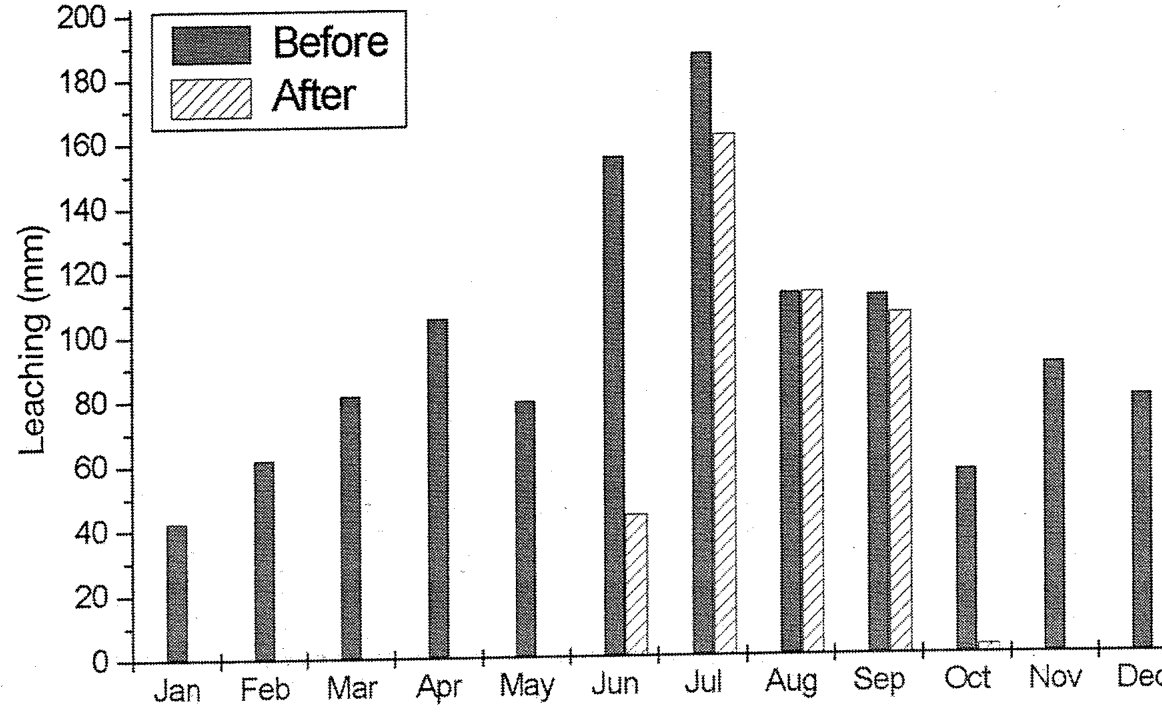
Robinson et al. (1) calculated the monthly water balance of the pile using a computer model similar to that described in Green et al. (5). The model used daily weather data taken from a meteorological station at nearby Thames and other parameters obtained experimentally. Model calculations of leaching are shown in Fig. 2. As expected for such a high rainfall site, the bare pile leaches a considerable amount of drainage water through all months of the year. The impact of trees is to substantially reduce the drainage of water during the summer months when the trees are fully leafed and transpiring at their maximum. The summer months are of greatest concern for contamination of the local waterways because stream flows are lower and there is less dilution of the contaminants. The leaching that occurs during the winter months can be irrigated onto the trees in times of drought during the summer, or alternatively, released into a nearby stream at times of high flow when the risk of exceeding the New Zealand drinking water standard is minimal. Poplar leaves sampled from the sawdust pile contained Cu and Cr concentrations that were on average 6.6 and 4.9 mg/kg dry mass, respectively. Arsenic concentrations were below detection limits (1 mg/kg).
Robinson et al.(1)利用与Green et al.(5)所述类似的计算机模型计算了堆体的逐月水分平衡。该模型采用附近Thames气象站的逐日气象数据以及通过试验获得的其他参数。淋溶的模型计算结果如图2所示。正如这类高降雨场地所预期的那样,裸露堆体全年各月均有大量排水淋出。树木的作用是在夏季(树木枝叶繁茂、蒸腾达到最大)显著减少排水。夏季是当地水道污染最受关注的时期,因为此时溪流流量较低,污染物稀释程度较小。冬季产生的淋溶液可在夏季干旱时灌溉至树木上,或在溪流高流量期(此时超过新西兰饮用水标准的风险极小)排入附近溪流。从锯末堆采集的杨树叶片中Cu和Cr浓度平均分别为6.6和4.9 mg/kg干重。砷浓度低于检出限(1 mg/kg)。
At the end of the growing season, the average leaf B concentration was nearly 700 mg/kg on a dry matter basis, over 28 times higher than the B concentration in the sawdust (40 mg/kg dry matter). Bañuelos et al. (6) have previously reported this B accumulation trait in poplars. The results indicate that in addition to controlling leaching at the site, poplars may also be able to reduce the B loading by phytoextraction. Unless the trees are harvested, most of the B is returned to the sawdust via leaf fall. Harvested material could, however, be used as an organic B supplement to trees in orchards that are B deficient in other parts of the country. The concentrations of other heavy metals in the leaves are unlikely to cause further environmental problems.
生长季末,叶片B平均浓度接近700 mg/kg(以干物质计),是锯末中B浓度(40 mg/kg干物质)的28倍以上。Bañuelos et al.(6)此前已报道过杨树的这一B积累特性。结果表明,杨树除能控制场地淋溶外,还可能通过植物提取降低B负荷。除非收获树木,否则大部分B会随落叶返回锯末中。然而,收获的材料可作为有机B补充剂,用于该国其他地区缺B的果园树木。叶片中其他重金属的浓度不太可能引发进一步的环境问题。
The cost of phytoremediation at Kopu is estimated to be New Zealand $200,000 including a site-maintenance plan more than 5 yr. Half of this total cost was taken up as site assessment, involving scientist time to conduct the plant trial and chemical analysis. The alternative cost of capping the site was estimated by the local environmental authority to be over New Zealand $1.2 million. Capping would also require ongoing maintenance to ensure its integrity.
Kopu植物修复的成本估计为200,000新西兰元,其中包括为期5年以上的场地维护计划。该总成本的一半用于场地评估,包括科研人员开展植物试验和化学分析的时间。据当地环境管理机构估计,采用覆盖封场的替代方案成本超过120万新西兰元,且覆盖封场还需持续维护以确保其完整性。
3.2. Phytoremediation of a Disused Sheep-Dipping Site3.2. 废弃羊只药浴场地的植物修复
Until 1966, there was a legal requirement that all sheep sold in New Zealand were free of pest infestations such as lice, blowflies, ticks, and mites (7). The most effective means of dealing with this problem was dipping the sheep in a pesticide solution. The active ingredients of these solutions were arsenic, organochlorines, and organophosphates, the former two being persistent in the environment. Disposal of the pesticides after use resulted in areas adjacent to the sheep dip becoming contaminated. These areas pose a risk to human and animal health through groundwater contamination (8), as well as direct ingestion of soil. Dipping sites were often located near wells or streams, to prepare the pesticide solution. The exact numbers and locations of historical dip sites in New Zealand are unknown, but there are probably many tens of thousands on both private and public land.
1966年以前,新西兰法律规定所有出售的羊只必须无虱、丽蝇、蜱和螨等害虫侵染(7)。应对这一问题最有效的方法是将羊只浸入农药溶液中药浴。这些溶液的有效成分为砷、有机氯和有机磷,其中前两者在环境中具有持久性。农药使用后的处置导致药浴池邻近区域受到污染。这些区域通过地下水污染(8)以及直接摄入土壤,对人类和动物健康构成风险。为配制农药溶液,药浴场地通常位于水井或溪流附近。新西兰历史药浴场地的确切数量和位置尚不清楚,但在私有和公共土地上可能有数万处之多。
A disused sheep-dipping site in an asparagus field was discovered near the city of Hamilton, North Island, following the measurement of elevated dieldrin concentrations in a nearby well. Soil analyses revealed dieldrin concentrations from 10 to 70 mg/kg over 100 m'. The Dutch intervention value for dieldrin in soil is 4 mg/kg. In late September 2001, the site was planted using HortResearch willow clones. In October 2003, the average height of the trees was over 3 m (Fig. 3). Soil collected from the site before planting was homogenized and placed in 12- to 15-L pots in HortResearch's plant-growth facilities. Willow clones were planted in eight of the pots. All pots were watered and fertilized equally. Atter 5 mo, soils from the pots were analyzed for dieldrin, as well as biological (dehydrogenase activity) activity. Substrate dehydrogenase activity is estimated from the rate of conversion of triphenyltetrazolium chloride to triphenyltormazan (TPF). This is a measure of biological activity.
在北岛汉密尔顿市附近,因附近一口水井中测得狄氏剂浓度升高,从而在一片芦笋田中发现了一处废弃的羊只药浴场地。土壤分析显示,在100 m²范围内狄氏剂浓度为10–70 mg/kg。荷兰土壤狄氏剂干预值为4 mg/kg。2001年9月下旬,该场地种植了HortResearch的柳树无性系。至2003年10月,树木平均高度超过3 m(图3)。将种植前从场地采集的土壤混匀后,装入HortResearch植物生长设施中12–15 L的盆中,其中8盆种植柳树无性系。所有盆均等量浇水和施肥。5个月后,分析盆中土壤的狄氏剂含量及生物活性(脱氢酶活性)。基质脱氢酶活性根据氯化三苯基四氮唑转化为三苯基甲臜(TPF)的速率估算,这是衡量生物活性的一项指标。
Figure 4 shows the biological activity in the root zones of grass and willows. The data shown in Fig. 4 may approximate the surface of the site at Ngahinapouri before planting (i.e., when grass was growing on the site), and now after the planting of willows. Clearly, willows greatly enhance biological activity in the soil. Previous studies (9,10) have shown that biological activity图4显示了草和柳树根区的生物活性。图4中的数据可近似反映Ngahinapouri场地表层在种植前(即场地上生长草时)以及目前种植柳树后的状况。显然,柳树大大提高了土壤生物活性。以往研究(9,10)表明,生物活性
Fig. 3. Phytoremediation at the Ngahinapouri site.图3. Ngahinapouri场地的植物修复。
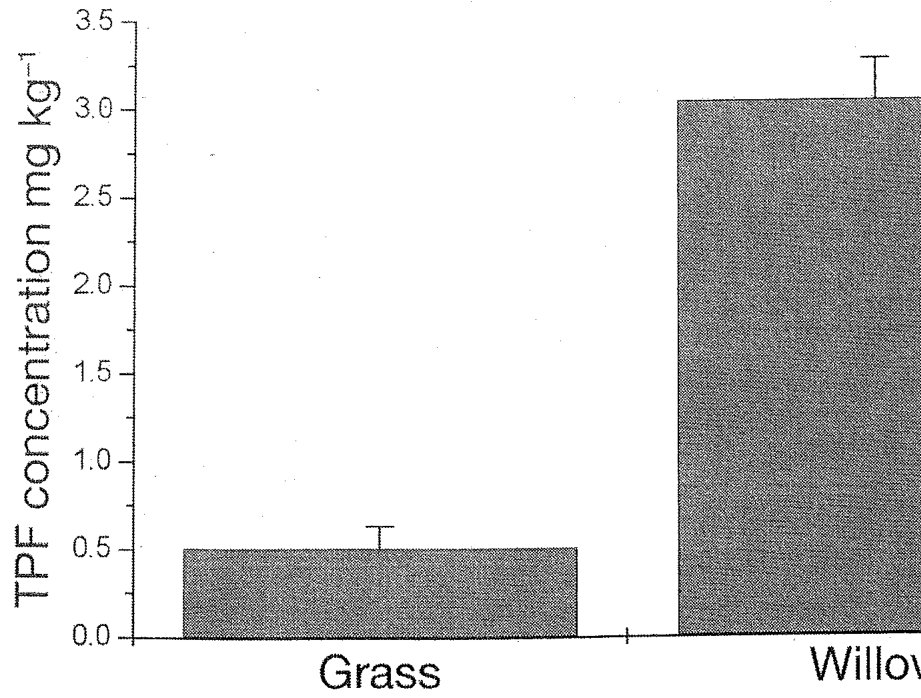
leads to a greater rate of the decomposition of some contaminants. This increase in biological activity is caused by root exudates, such as sugars and organic acids, on which bacteria and fungi can feed. Willows have a much greater biomass production than grasses, and consequently have a greater quantity of root exudates. Willow roots also penetrate further than grass roots (up to 1 m) and improve soil aeration because of their high water use. The willows caused a significant decrease (p < 0.05) in the soil dieldrin concentration over the treatment period (Fig. 5). This 20% reduction was achieved in only 5 mo of growth. The dieldrin degradation effected by the willows was greater than that by the grass species that may first colonize many disused sheep-dipping sites.
的提高会加快某些污染物的分解速率。生物活性的增加是由糖类和有机酸等根系分泌物引起的,细菌和真菌可以此为食。柳树的生物量产量远高于草类,因此根系分泌物数量也更多。柳树根系的穿透深度也大于草根(可达1 m),并因其高耗水量而改善土壤通气性。在处理期间,柳树使土壤狄氏剂浓度显著降低(p < 0.05)(图5)。仅经过5个月的生长即实现了20%的降幅。柳树对狄氏剂的降解作用大于可能最先在许多废弃羊只药浴场地定植的草种。

3.3. Phytoremediation of the Tui Mine Site3.3. Tui矿场的植物修复
The Tui mine tailings near Te Aroha, is considered New Zealand's worst environmental disaster caused by mining activities (11). The site consists of a 1.5-ha tailings dam containing 100,000 m? of toxic mining waste, principally sulfide minerals with high concentrations of lead (0.5%), cadmium (26 mg/kg), and mercury (8 mg/kg). Continual oxidation of the sulfide produces sulfuric and sulfurous acids that result in a pH <3.0 for the surface material. The low pH mobilizes heavy metals that leach out of the tailings dam into a nearby stream. Analyses of the stream water and sediments reveal that both are above the allowable limits for lead and cadmium set by the World Health Organization (12).
Te Aroha附近的Tui矿山尾矿被认为是新西兰由采矿活动造成的最严重的环境灾难(11)。该场地包括一座1.5 ha的尾矿坝,内含100,000 m³有毒采矿废弃物,主要为硫化物矿物,含有高浓度的铅(0.5%)、镉(26 mg/kg)和汞(8 mg/kg)。硫化物的持续氧化产生硫酸和亚硫酸,使表层物料pH <3.0。低pH使重金属活化,并从尾矿坝淋出进入附近溪流。对溪流水体和沉积物的分析表明,二者的铅和镉含量均超过世界卫生组织设定的允许限值(12)。
Although the site has been abandoned for more than 30 yr, no vegetation has established itself on the tailings as a result of a low pH and the high concentration of heavy metals. During the summer months, dust containing high concentrations of heavy metals is blown around, contaminating nearby areas. Adjacent to the tailings dam is a car park used by hikers. Children have been observed playing on the tailings, their parents unaware of the risk of heavy metal poisoning. The goal of phytoremediation at Tui is to mitigate heavy metal leaching, prevent erosion and dust movement, and to return the area to native vegetation. Plant accumulation of heavy metals is not desirable because this may provide an exposure pathway for metals to enter the food chain via herbivore browsing. The pH and plant nutrient status of the tailings had to be modified so that vegetation could be established. Experiments conducted at Massey University determined the optimal rate of liming and organic matter addition to permit plant growth on the Tui tailings. A 100-m? plot was established on the Tui tailings in April 2001. Several indigenous species were planted as well as lupin to fix nitrogen.
尽管该场地已废弃30多年,但由于pH低和重金属浓度高,尾矿上始终没有植被定植。夏季,含高浓度重金属的粉尘四处飘散,污染周边地区。尾矿坝旁边是一个供徒步者使用的停车场。曾有人观察到儿童在尾矿上玩耍,而其父母并未意识到重金属中毒的风险。Tui植物修复的目标是减缓重金属淋溶,防止侵蚀和粉尘迁移,并使该区域恢复本土植被。植物积累重金属并不可取,因为这可能通过食草动物啃食为金属进入食物链提供暴露途径。必须改良尾矿的pH和植物养分状况,才能使植被得以建立。梅西大学开展的试验确定了使植物能够在Tui尾矿上生长的最佳石灰施用量和有机质添加量。2001年4月,在Tui尾矿上建立了一块100 m²的试验区,种植了若干本土物种以及用于固氮的羽扇豆。
Fig. 6. Experimental plot on the Tui mine tailings, September 2002.图6. Tui矿山尾矿上的试验区,2002年9月。
Metal Concentrations in Tui Tailings and Supported Plant SpeciesTui尾矿及其上生长植物物种中的金属浓度
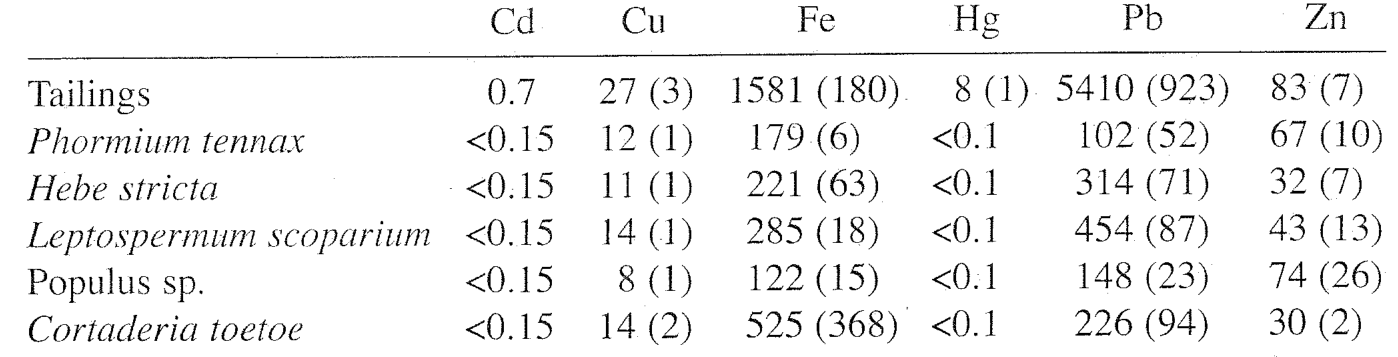
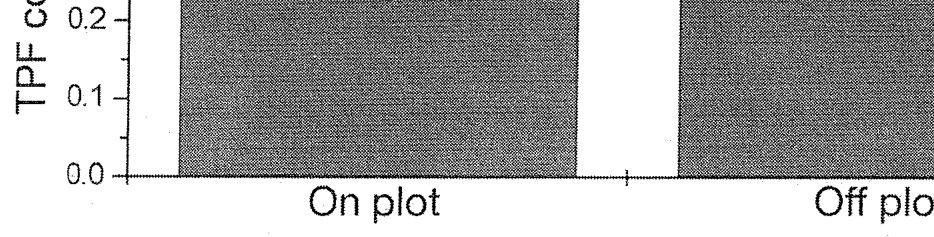
The plants established rapidly (Fig. 6), with other plants and animals colonizing the plot area over time. Chemical analyses of leaf material from the plants that were grown on the plot at the Tui mines indicated low levels of bioaccumulation (Table 1). Elevated lead levels may be the result of surface contamination of the leaves with dust from adjacent nonvegetated areas. Greenhouse experiments with the Tui tailings, where there is no risk of dust contamination, demonstrated that leaf lead levels never exceeded 50 mg/kg. Samples of surface material on and off the vegetated plot were analyzed for TPF, an indicator of microbial activity (Fig. 7). Microbial activity was significantly higher under the vegetated areas. The measurable TPF concentrations off the plot may be a result of the presence of Thiobacillus bacteria that are responsible for sulfide oxidation.
植物迅速定植(图6),随着时间推移,其他植物和动物也在试验区内定居。对Tui矿区试验区所种植物叶片的化学分析表明,其生物累积水平较低(表1)。铅含量偏高可能是由于邻近无植被区域的粉尘对叶片造成了表面污染。在不存在粉尘污染风险的Tui尾矿温室试验中,叶片铅含量从未超过50 mg/kg。对试验区内外的表层物料样品进行了TPF分析,以指示微生物活性(图7)。有植被区域下的微生物活性显著较高。试验区外可测得的TPF浓度可能源于负责硫化物氧化的硫杆菌(Thiobacillus)的存在。
Clearly, it is possible to establish vegetation on the Tui mine tailings. Fullscale phytoremediation would eliminate lead-laden dust, reduce the visual impact of the mine, and reduce leaching by re-evaporating some of the rainfall through transpiration. Phytoremediation of the Tui tailings can be considered a revegetation operation. Quantification of the environmental benefit afforded by phytoremediation can be made through analysis of the biological activity of the substrate.
显然,在Tui矿山尾矿上建立植被是可行的。全面实施植物修复将消除含铅粉尘,降低矿山的视觉影响,并通过蒸腾作用使部分降雨重新蒸发,从而减少淋溶。Tui尾矿的植物修复可视为一项植被重建工程。可通过分析基质的生物活性来量化植物修复所带来的环境效益。
3.4. Phytostabilization of Biosolids, Western Treatment Plant, Victoria, Australia3.4. 澳大利亚维多利亚州西部处理厂生物固体的植物稳定
The storage of biosolids, the solid fraction of sewerage waste, is a contentious subject for any developed area. Fresh biosolid or oxidation pond sludge waste has a water content of approx 70% by weight. When disposed of on land, natural drying will generate a crust of approx 15 cm; less than 15 cm minimal drying will occur. Mechanical drying of the fresh waste is possible, but is costly and is certainly not applicable to previously deposited volumes of waste. Every major populated area in New Zealand and Australia has large volumes of unstable, semiliquid waste stored on potentially valuable land.
生物固体(污泥)即污水废弃物中的固体部分,其储存在任何发达地区都是一个有争议的问题。新鲜生物固体或氧化塘污泥废弃物的含水量约为70%(按重量计)。在土地上处置时,自然干燥会形成约15 cm的结壳;15 cm以下则几乎不会干燥。对新鲜废弃物进行机械干燥是可行的,但成本高昂,且显然不适用于此前已堆放的废弃物。新西兰和澳大利亚的每个主要人口聚居区都有大量不稳定的半液态废弃物堆存在具有潜在价值的土地上。
Melbourne Water is the largest water utility in Melbourne, with a sewerage system of 380 km and two water treatment plants, the Western and Eastern Treatment Plants. Melbourne produces on average 900 million liters of sewage a day, 54% of which is treated by The Western Treatment Plant (WTP) situated on the western shore of Port Philip Bay near the city of Geelong (13). The WTP covers 11,000 ha of valuable land, and discharges approx 600 L of treated water daily into Port Philip Bay. Three treatment methods are used for incoming sewage. An extensive lagoon system is used for peak daily and year-round wet weather flow. Land filtration is used during periods of high evaporation between October and April. Grass filtration is used during periods of low evaporation between April and October. Extensive land contamination with organic and inorganic contaminants has occurred at the WTP as a result of sewage disposal practices over the past 100 yr. Commercial and governmental groups in Melbourne have developed a "Vision for Werribee," a long-term plan that aims to turn solid and liquid sewerage waste into valuable revenue streams, and that will release decontaminated land to capital development. The Vision for Werribee brings together several environmental technologies to achieve the desired objective. One of these technologies is phytoremediation.
Melbourne Water是墨尔本最大的水务公司,拥有380 km的污水管网以及西部和东部两座处理厂。墨尔本平均每天产生9亿升污水,其中54%由位于吉朗市附近菲利普港湾西岸的西部处理厂(WTP)处理(13)。WTP占地11,000 ha,均为宝贵土地,每天向菲利普港湾排放约600 L处理后的水。进厂污水采用三种处理方法:广泛的氧化塘系统用于处理每日峰值流量和全年雨季流量;10月至次年4月蒸发量较高期间采用土地过滤;4月至10月蒸发量较低期间采用草地过滤。过去100年的污水处置方式已导致WTP大面积土地受到有机和无机污染物的污染。墨尔本的商业和政府团体制定了“Werribee愿景”(Vision for Werribee),这是一项长期规划,旨在将固态和液态污水废弃物转化为有价值的收入来源,并将去除污染后的土地释放用于资本开发。Werribee愿景整合了多项环境技术以实现预期目标,植物修复即为其中之一。
3.4.1. Establishing the Field Trial3.4.1. 田间试验的建立
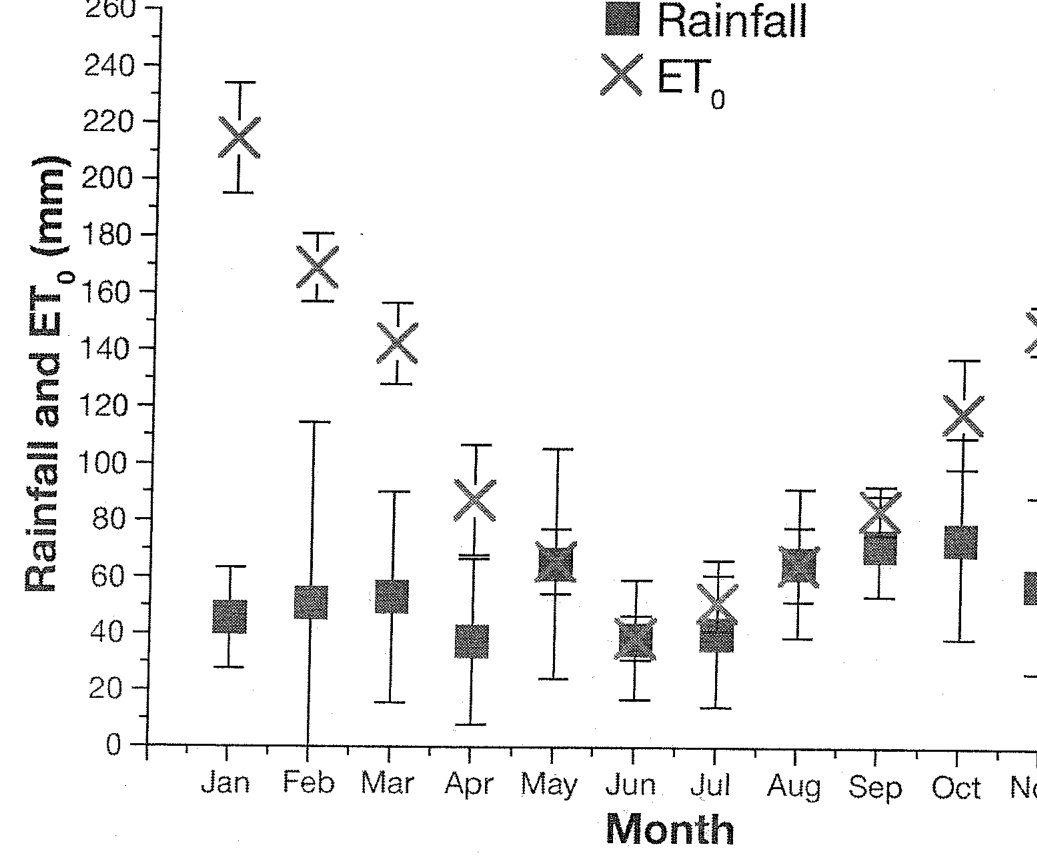
The concept of plants as biopumps has been field tested at Werribee to assess the dewatering potential that phytoremediation may have on stockpiled biosolids. Biosolids have potential use as a soil amendment or energy source (as a renewable "brown coal"), however, high water content limits this potential. For the period between 1973 and 1979 (the only period when climatic data was collected), average annual rainfall at Werribee was 641 mm, whereas average annual evaporation for this period was 1386 mm (Fig. 8). For no month did rainfall exceed evaporation and this indicates that if water can be removed using plants then no rainfall-induced recharge should occur. An experimentally derived biosolid water-retention curve shows that, in theory, the water content could be lowered to approx 20% (10 bars) by plant transpiration. Interpretation of this physical and climatic data suggests that plants should be able to dewater the Werribee biosolids. Chemical analysis of the biosolids indicated that elevated concentrations of Cu could possibly affect plant growth, however, no signs of phytotoxicity were observed during experimental work (Table 2).
在Werribee对植物作为生物泵的概念进行了田间试验,以评估植物修复对堆存生物固体的脱水潜力。生物固体有望用作土壤改良剂或能源(作为可再生的“褐煤”),但其高含水量限制了这一潜力。1973–1979年间(唯一有气候数据记录的时期),Werribee年平均降雨量为641 mm,而同期年平均蒸发量为1386 mm(图8)。没有任何月份的降雨量超过蒸发量,这表明如果能利用植物去除水分,则不会发生降雨引起的补给。试验得出的生物固体持水曲线表明,理论上通过植物蒸腾可将含水量降至约20%(10 bar)。对上述物理和气候数据的解释表明,植物应能使Werribee生物固体脱水。生物固体化学分析表明,较高的Cu浓度可能影响植物生长,但在试验过程中未观察到植物毒害迹象(表2)。
A 1-yr demonstration trial was initiated in May 2002 on a biosolids storage tank. The relative growth performance of 10 plant species was tested during the trial. Core samples (0-20 cm) collected from across the plot area at the time of trial setup and then again 1 yr later allowed for estimation of the level of dewatering.
2002年5月,在一个生物固体储存池上启动了为期1年的示范试验,试验期间测试了10种植物的相对生长表现。在试验建立时及1年后,从试验区各处采集土芯样品(0–20 cm),据此估算脱水程度。
3.4.2. Dewatering Potential of Eucalyptus sp. and Vetiver Grass3.4.2. 桉树与香根草的脱水潜力
Figure 9 summarizes the end of trial performance of two of the trialed species, Eucalyptus saligna and vetiver grass, in dewatering the biosolids.图9总结了两种试验物种——柳桉(Eucalyptus saligna)和香根草——在试验结束时对生物固体的脱水效果。
Select Geochemical Parameters of the Werribee Biosolids
Werribee生物固体部分地球化学参数
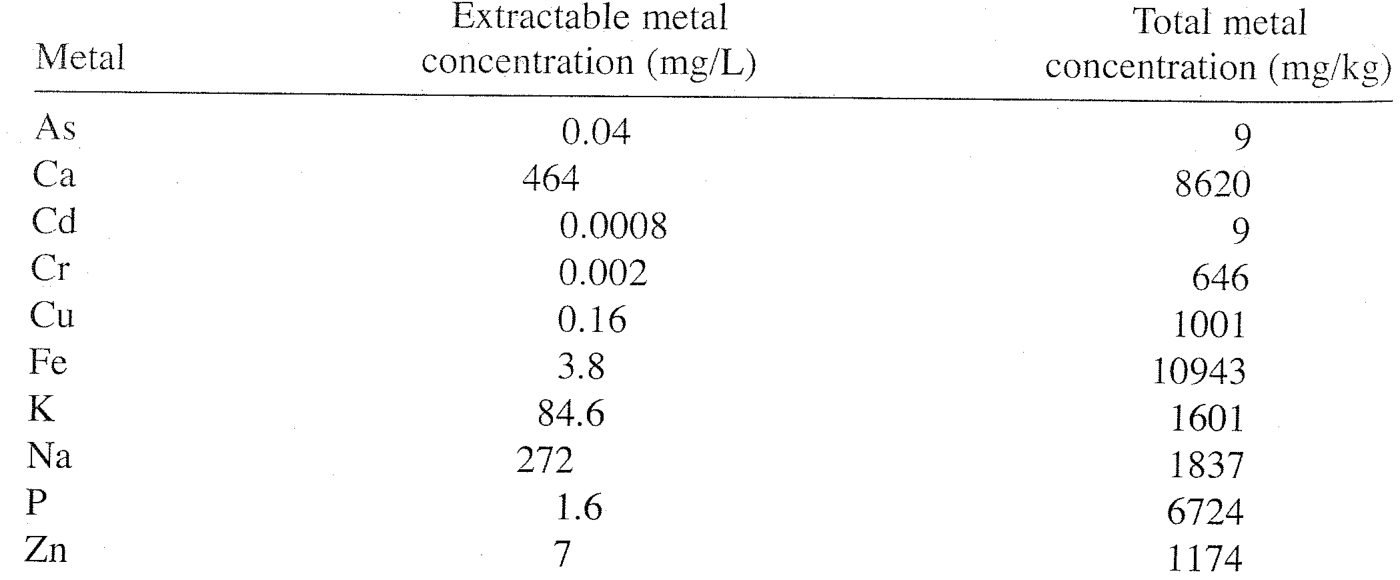
"Extractable concentrations determined by ICP analysis of 12,000g centrifuge soil solution extracts. Total concentrations determined by ICP analysis of aqua regia digest solutions.
a可提取态浓度采用ICP分析12,000g离心土壤溶液提取液测定。全量浓度采用ICP分析王水消解液测定。
Clearly, both species affected a significant decrease in the water content of the biosolids to 30-40% in the 5- to 10-cm sampled horizon. This is relative to a 55% water content for control sampling in May 2003 and a pretrial water content of 65% at May 2002. Dewatering was so effective that it was not possible to push the soil corer into biosolids below a 10-cm depth for all cores sampled in proximity to vegetation.
显然,两种物种均使5–10 cm采样层中生物固体的含水量显著降低至30%–40%。相比之下,2003年5月对照采样的含水量为55%,2002年5月试验前的含水量为65%。脱水效果极为显著,以致在植被附近采集的所有土芯中,均无法将土壤取样器压入10 cm深度以下的生物固体中。
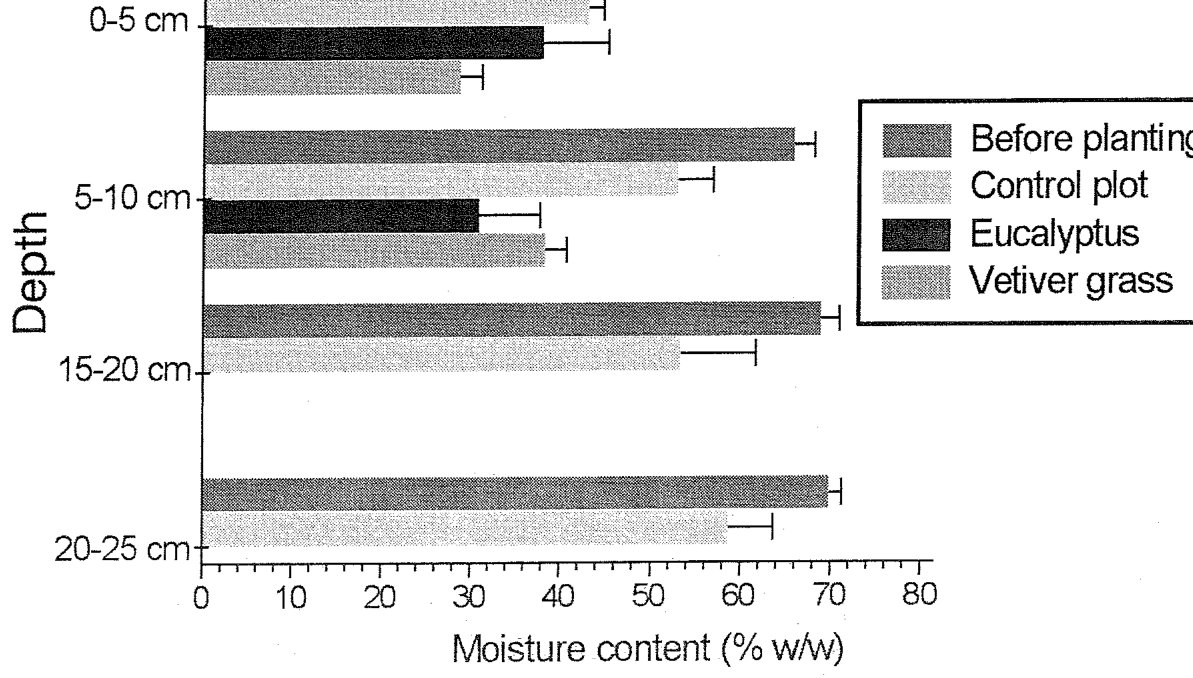
There was a decrease in water content for control cores, sampled away from areas of vegetation. However, we expect that this water will have recharged because of the rainfall of late winter 2003; the timeline of the trial (May 2002 to May 2003) was particularly dry. Dewatering results indicate that in a single growing season, either Eucalyptus or vetiver grass could be used to dewater the top 15 cm of sludge stabilizing the material and potentially allowing reuse of the substrate. A 15-cm dewatering scenario is conservative and based on observed results; the plants had not been able to reach their maximum biomass over the trial because of cattle and sheep grazing. The true dewatering depth may be much greater, as modeled using HortResearch's Phytoextraction Decision Support System.
远离植被区域采集的对照土芯含水量也有所下降。然而,我们预计这部分水分将因2003年冬末的降雨而得到补给;试验期间(2002年5月至2003年5月)特别干旱。脱水结果表明,在单个生长季内,桉树或香根草均可用于使表层15 cm污泥脱水,从而使物料稳定,并有可能实现基质的再利用。15 cm的脱水情景是保守的,基于观测结果;由于牛羊啃食,植物在试验期间未能达到其最大生物量。正如利用HortResearch的植物提取决策支持系统(Phytoextraction Decision Support System)所模拟的那样,实际脱水深度可能要大得多。
4Conclusion结论
Ongoing research and commercial activities in New Zealand and Australia continue to apply phytoremediation to contaminated and degraded land. Four examples have been presented in this chapter; wood waste, acid mine tailings, a disused sheep-dip site, and sewage sludge. In addition, phytoremediation to promote revegetation has been successfully tested on a cyanide heap-leach pad in Victoria, Australia, and at a serpentinite waste-rock pile in the Waikato, New Zealand. Quantification of the benefits of phytoremediation is possible through analysis of variables such as biological activity and species diversity, as well as by examining the reduction in contaminant values promoted by plants. Phytoremediation is likely to remain a fertile subject for research and commercial development in New Zealand. The technology is well suited to the clean up of low-level contamination and land degradation associated with the commoditydriven economies of Australasia.
新西兰和澳大利亚正在进行的研究和商业活动持续将植物修复应用于污染和退化土地。本章介绍了四个实例:木材废弃物、酸性矿山尾矿、废弃羊只药浴场地和污水污泥。此外,利用植物修复促进植被重建已在澳大利亚维多利亚州的一处氰化物堆浸场以及新西兰怀卡托的一处蛇纹岩废石堆上成功进行了试验。可通过分析生物活性和物种多样性等变量,以及考察植物所促成的污染物含量降低,来量化植物修复的效益。植物修复很可能继续成为新西兰研究和商业开发的沃土。该技术非常适合治理与澳大拉西亚以大宗商品为驱动的经济相关的低水平污染和土地退化。
References参考文献
1. Robinson, B. H., Green, S. R., Mills, T. M., et al. (2003) Phytoremediation: using plants as biopumps to improve degraded environments. Austr. J. Soil Res. 41, 599-611.
2. NZEFO (2003) New Zealand Economic and Financial Overview 2003. Treasury Report, Wellington, New Zealand.
3. Hamblin, A. (2001) Australia State of the Environment 2001. CSIRO Publishing, Collingwood, Vic. p. 42.
4. Schnoor, J. L. (2002) Phytoremediation of Soil and Groundwater. Technology Evaluation Report TE0201. Ground-water remediation technologies analysis centre, lowa.
5. Green, S. R., Clothier, B. E., Mills, T. M., and Millar, A. (1999) Risk assessment of irrigation requirements of field crops in a maritime climate. J. Crop Prod. 2, 353-377.
6. Bañuelos, G. S., Shannon, M. C., Ajwa, H., Draper, J. H., Jordahl, J., and Licht, L. (1999) Phytoextraction and accumulation of B and selenium by poplar (Populus) hybrid clones. Int. J. Phytorem. 1, 81-96.
7. Heath, A. (1994) Ectoparasites of livestock in New Zealand. New. Zea. J. Zool. 21, 23-38.
8. Robinson, P. (1995) The Fate of Vetrazin (cyromazine) During Wool Scouring and its Effects on the Aquatic Environment, PhD thesis. Lincoln University, Christchurch, New Zealand.
9. McLaughlin, M. J., Smolders, E., and Herckx, R. (1998) Soil: root interface: physicochemicl process. In: S., Chemistry and Ecosystem Health (P. M. Huang, ed.) Soil Science Society of America, Madison, WI, pp. 233-277.
10. Eriksson, M., Dalhammar, G., and Borg-Karlson, A. K. (2000) Biological degradation of selected hydrocarbons in an old PAH/creosote contaminated soil from a gas work site. App. Micro. Biotech. 53, 619-626.
11. Morrell, W. J., Gregg, P. E. H., Stewart, R. B., Bolan, N. S., and Horne, D. (1995) Potential for revegetating base-metal tailings at the Tui mine site, Te Aroha, New Zealand. Proceedings of the 1995 PACRIM Congress (Auckland), 95-400.
12. Sabti, H., Hossain, M., Brooks, R., and Stewart, R. (2000) The current environmental impact of base metal mining at the Tui Mine, Te Aroha, New Zealand. J. Royal Soc. N. Z. 30, 197-208.
13. Melbourne Water (2001) Infostream, public relations material. www.melbournewater.com.au.