Environmental Pollution 145 (2007) 700e707
He´ctor M. Conesa*, Brett H. Robinson, Rainer Schulin, Bernd Nowack
Institute of Terrestrial Ecosystems, ETH Zurich, Universitaetstrasse 16, 8092 Zurich, Switzerland
Received 24 March 2006; received in revised form 23 May 2006; accepted 15 June 2006
Lygeum spartum accumulated more metals when grown in the growth chamber from seeds than from rhizomes and much more than in the field.
Abstract摘要
Lygeum spartum is a native species in semiarid Mediterranean areas that grows spontaneously on acid mine tailings. We aimed to study the suitability of this plant for phytostabilization. L. spartum was grown from both seeds and rhizomes in acid mine tailings with various fertilizer and lime treatments. Untreated soils had a solution pH of 2.9 with high concentrations of dissolved salts (Electrical Conductivity 25 dS m�1) and Zn (3100 mg L�1). Plants grown on untreated soil had high shoot metal concentrations (>4000 mg kg�1 Zn). Liming increased the solution pH to 5.5 and reduced the dissolved salts by more than 75%, resulting in lower shoot metal accumulation. Plants grown from rhizomes accumulated less metal than those grown from seeds. Plants collected in the field had metal concentrations an order of magnitude less than plants raised in the growth chamber. These differences may be due to the higher moisture content and homogeneous nature of the soils used in the pot experiment. � 2006 Elsevier Ltd. All rights reserved.
Lygeum spartum 是地中海半干旱地区的本地物种,可在酸性矿山尾矿上自然生长。本研究旨在评估该植物用于植物稳定的适宜性。分别以种子和根茎在酸性矿山尾矿中种植 L. spartum,并施用不同的肥料和石灰处理。未处理土壤的溶液 pH 为 2.9,溶解性盐分(电导率 25 dS m�1)和 Zn(3100 mg L�1)浓度较高。生长于未处理土壤的植物地上部金属浓度较高(Zn >4000 mg kg�1)。施用石灰使溶液 pH 升至 5.5,溶解性盐分降低 75% 以上,从而降低了地上部金属累积。由根茎培育的植物比由种子培育的植物累积的金属更少。野外采集植物的金属浓度比生长箱中培育的植物低一个数量级。这些差异可能源于盆栽试验所用土壤含水量较高且性质均一。� 2006 Elsevier Ltd. 版权所有。
Keywords: Lygeum spartum; Acid soil; Mine tailings; Heavy metals; Phytostabilization
关键词:Lygeum spartum;酸性土壤;矿山尾矿;重金属;植物稳定
1Introduction引言
Mining can deleteriously affect the environment due to the deposition of high volumes of waste. Mine tailings that contain mobile contaminants present an ecological and human health risk to surrounding areas. Merrington and Alloway (1994) considered them ‘‘the most environmentally important components of historic mine sites’’. Mine tailings often have geochemical properties that inhibit plant establishment. These include low pH, toxic heavy metal concentrations and low organic matter content. Mine tailings soils usually have an undeveloped soil structure resulting in a low water retention capacity. Most tailings have steep and unstable slopes (Henriques and Fernandes, 1991). This facilitates wind and water erosion and the spreading of tailing materials into surroundings areas. This is especially important when the tailings are located near agricultural land or human settlements, since there may be a high risk of human exposure to contaminants, either directly via dust, or indirectly through the consumption of agricultural produce from polluted land.
由于大量废弃物的堆积,采矿活动可能对环境造成不利影响。含有可移动污染物的矿山尾矿对周边地区构成生态和人体健康风险。Merrington and Alloway (1994) 认为尾矿是“历史矿区中环境上最重要的组成部分”。矿山尾矿的地球化学性质往往会抑制植物定植,包括低 pH、有毒的重金属浓度以及低有机质含量。尾矿土壤通常土壤结构发育不良,导致持水能力较低。大多数尾矿坝坡度陡峭且不稳定(Henriques and Fernandes, 1991),易于发生风蚀和水蚀,使尾矿物质扩散至周边地区。当尾矿位于农田或人类居住区附近时,这一问题尤为突出,因为人体可能通过粉尘直接暴露于污染物,或通过食用污染土地上的农产品间接暴露,暴露风险较高。
* Corresponding author. Tel.: +41 44 632 8605; fax: +41 44 633 1123. E-mail address: hector.conesa@env.ethz.ch (H.M. Conesa).
Removal of tailings or covering them with non-polluted materials reduces the environmental risk. However, theses techniques are expensive and in some cases impractical due to the large volumes of tailings and the need for an adequate disposal area. Revegetation of mine tailings is an inexpensive long-term option to immobilize contaminants and minimize the environmental risks presented by theses sites (Tordoff et al., 2000). Plants stabilize the soil by root growth and water uptake. This reduces water and wind erosion. A vegetative cover also improves the aesthetic value of degraded sites (Tordoff et al., 2000). It is not possible to decontaminate these sites by phytoextraction since the large amounts of metals in mine tailing soils would take an unacceptably long time to remove, and plant metal uptake may provide an exposure pathway to herbivores.
清除尾矿或以未受污染的材料覆盖尾矿可降低环境风险。然而,这些技术成本高昂,且由于尾矿体量巨大并需要适当的处置场地,在某些情况下并不可行。矿山尾矿植被重建是一种低成本的长期方案,可固定污染物并将此类场地的环境风险降至最低(Tordoff et al., 2000)。植物通过根系生长和水分吸收稳定土壤,从而减少水蚀和风蚀。植被覆盖还能提升退化场地的景观价值(Tordoff et al., 2000)。通过植物提取对这些场地进行修复是不可行的,因为尾矿土壤中金属含量巨大,去除所需时间长得难以接受,而且植物对金属的吸收可能为食草动物提供暴露途径。
0269-7491/$ - see front matter � 2006 Elsevier Ltd. All rights reserved. doi:10.1016/j.envpol.2006.06.002
0269-7491/$ - see front matter � 2006 Elsevier Ltd. All rights reserved. doi:10.1016/j.envpol.2006.06.002
Phytostabilization, the use of plants to immobilize soil contaminations (Fitz and Wenzel, 2002), includes mechanical stabilization as well as chemical immobilization of pollutants, e.g. by precipitation. These processes reduce the risk of metal entry into the food chain (Wong, 2003). Plants also increase the nutrient levels of infertile soils (Cobb et al., 2000). A vegetative cover, once established, may be self-sustaining (Norland and Veith, 1995).
植物稳定是指利用植物固定土壤污染物(Fitz and Wenzel, 2002),包括机械稳定以及污染物的化学固定(如通过沉淀作用)。这些过程可降低金属进入食物链的风险(Wong, 2003)。植物还可提高贫瘠土壤的养分水平(Cobb et al., 2000)。植被覆盖一旦建立,即可实现自我维持(Norland and Veith, 1995)。
Successful revegetation of tailings in arid regions requires plants that are adapted to grow under dry conditions in low nutrient soils with high metal concentrations. Possible sources of such plants are old, abandoned tailings that tolerant species may have spontaneously colonized. Several authors have studied the naturally occurring vegetation that grows on and around mining zones in arid and semiarid regions (Henriques and Fernandes, 1991; Melendo et al., 2002; Flores-Tavizo´n et al., 2003; Garcı´a et al., 2003; Alvarenga et al., 2004; Alvarez-Rogel� et al., 2004; Conesa et al., in press).
在干旱地区成功实现尾矿植被重建,需要能够适应干旱条件、在低养分和高金属浓度土壤中生长的植物。此类植物的可能来源是耐性物种可能已自然定植的废弃老尾矿。已有多位学者研究了干旱和半干旱地区矿区及其周边自然生长的植被(Henriques and Fernandes, 1991; Melendo et al., 2002; Flores-Tavizo´n et al., 2003; Garcı´a et al., 2003; Alvarenga et al., 2004; Alvarez-Rogel� et al., 2004; Conesa et al., in press)。
One of these plant species is Lygeum spartum L. (Poaceae), a widespread rhizomatous grass in the Mediterranean zone. Previous studies in the field (Conesa et al., in press) found that this species accumulated less than 100 mg kg�1 Pb and Zn, while the acid (pH 3) mine tailing on which it grew contained 14 000 mg kg�1 Pb and 9500 mg kg�1 Zn. Lygeum spartum can tolerate extreme conditions of aridity, salinity and high temperatures (Diaz and Honrubia, 1993). It may thus be a suitable candidate for the phytostabilization of acid mine tailings in Southern Spain and other semiarid Mediterranean areas.
其中一种植物是 Lygeum spartum L.(禾本科),为地中海地区广泛分布的根茎型禾草。此前的野外研究(Conesa et al., in press)发现,该物种累积的 Pb 和 Zn 均低于 100 mg kg�1,而其生长的酸性(pH 3)矿山尾矿含 Pb 14 000 mg kg�1、Zn 9500 mg kg�1。Lygeum spartum 能够耐受极端干旱、盐渍和高温条件(Diaz and Honrubia, 1993),因此可能是西班牙南部及其他地中海半干旱地区酸性矿山尾矿植物稳定的合适候选植物。
Successful revegetation of mine soils requires preliminary studies to determine the optimal conditions for plant growth. Soil amendments may be necessaryto improve substrate fertility by increasing plant nutrients and organic matter content, and neutralizing acidity. Pot experiments may reveal the plant responses to various amendments. Treatments can be studied under identical growth conditions (light, humidity, water). However, it is important to relate these controlled conditions to those that occur in the field.
矿山土壤植被重建的成功需要开展前期研究,以确定植物生长的最佳条件。可能需要施用土壤改良剂,通过增加植物养分和有机质含量以及中和酸度来提高基质肥力。盆栽试验可以揭示植物对不同改良剂的响应,各处理可在相同的生长条件(光照、湿度、水分)下进行研究。然而,将这些受控条件与野外实际条件相联系十分重要。
We aimed to determine the effect of fertilizer and lime treatments on the growth and metal uptake of Lygeum spartum L. growing on acidic mine tailings soil. We also sought to compare metal uptake in pot experiments in a growth chamber with metal uptake by wild plants growing in field conditions in order to know the potential of this plant species in favorable growing conditions. We also investigated how plant metal uptake changes when plants are grown from seeds or from rhizomes in order to assess the best option to effect further remediation actions.
本研究旨在确定肥料和石灰处理对生长于酸性矿山尾矿土壤中的 Lygeum spartum L. 生长及金属吸收的影响。同时,比较生长箱盆栽试验中植物的金属吸收与野外条件下野生植物的金属吸收,以了解该物种在有利生长条件下的潜力。此外,还研究了以种子或根茎培育时植物金属吸收的变化,以评估后续修复行动的最佳方案。
2Materials and methods材料与方法
2.1. Sampling2.1. 采样
The Cartagena-La Union Mining District (0e392 m, a.s.l.; 37�37 02000 N, 0�50 05500 W- 37�40 00300 N, 0�48 01200 W) is located on the Southeast of the
Cartagena-La Union 矿区(海拔 0–392 m;37�37 02000 N, 0�50 05500 W - 37�40 00300 N, 0�48 01200 W)位于
Iberian Peninsula and covers an area of 50 km2, mostly belonging to the Sierra of Cartagena-La Unio´n, also called Sierra Minera. This region has a semiarid Mediterranean climate with an annual rainfall of 250e300 mm, occurring mostly during spring and autumn. The annual average temperature is 18 �C.
伊比利亚半岛东南部,面积 50 km2,大部分属于 Sierra of Cartagena-La Unio´n(又称 Sierra Minera)。该地区属地中海半干旱气候,年降水量 250–300 mm,主要集中在春季和秋季。年平均气温 18 �C。
Soil was taken at points homogeneously distributed from the upper 40 cm of the ‘‘Belleza’’ mine tailing, located in the La Unio´n’s town surroundings (U.T.M. X688 760 m; Y4165 700 m; Z190 m). The tailing had a length of 160e170 m, a width of 21 m, a height of 22 m, and a volume of 370 000 m3 (I.G.M.E., 1999). The soil samples were mixed to give a single homogeneous sample. The soil was air dried, sieved to <2 mm and stored in plastic bags. The pH of the soil was 3 and it contained high total metal concentrations (Table 1), especially Pb, As and Zn (Conesa, 2005; Conesa et al., in press).
在位于 La Unio´n 镇附近的“Belleza”尾矿上,于均匀分布的采样点采集表层 40 cm 土壤(U.T.M. X688 760 m; Y4165 700 m; Z190 m)。该尾矿长 160–170 m、宽 21 m、高 22 m,体积 370 000 m3(I.G.M.E., 1999)。将土壤样品混合为一个均匀样品,风干后过 <2 mm 筛,储存于塑料袋中。土壤 pH 为 3,金属总量较高(表1),尤其是 Pb、As 和 Zn(Conesa, 2005; Conesa et al., in press)。
Five plant samples (roots and shoots) of L. spartum were taken from various locations on the mine tailing. The plants were washed with deionised water, and dried at 65 �C for 72 h. Shoots and roots were separated prior to grinding (Janke & Kunkel IKA� Labortechnik A-10). The resulting samples were analyzed for the total element contents by X-ray fluorescence (Spectro X-Lab 2000). Seeds and rhizomes were collected in December 2003 and 2004 respectively for pot studies.
在尾矿不同位置采集 5 个 L. spartum 植物样品(根和地上部)。植物用去离子水洗净,于 65 �C 下烘干 72 h。粉碎前将地上部与根分开(Janke & Kunkel IKA� Labortechnik A-10)。所得样品采用 X 射线荧光法(Spectro X-Lab 2000)测定元素总量。用于盆栽研究的种子和根茎分别于 2003 年和 2004 年 12 月采集。
2.2. Pot experiment2.2. 盆栽试验
Plants were grown in plastic pots containing 1 kg of soil. Four treatments were used: untreated, fertilizer (80 N, 80 P, 110 K, 25 Mg, in mg kg�1 soil), lime (25 g CaCO3/kg soil), and fertilizer and lime together. KNO3, KH2PO4, NH4NO3, and Mg(NO3)2 6H2O were used like chemicals. The fertilizer was added with the irrigation water: 30% added in the first week, 20% in the second and 10% in each following week until 100% was reached.
植物种植于装有 1 kg 土壤的塑料盆中。设 4 个处理:未处理、施肥(80 N、80 P、110 K、25 Mg,单位 mg kg�1 土)、施石灰(25 g CaCO3/kg 土)以及施肥与石灰配施。所用化学试剂为 KNO3、KH2PO4、NH4NO3 和 Mg(NO3)2 6H2O。肥料随灌溉水施入:第一周施入 30%,第二周施入 20%,此后每周施入 10%,直至达到 100%。
The plants were grown for eight weeks in a growth chamber with a light cycle of 16 h light/8 h darkness, and controlled humidity (50e90%) and temperature (16/23 �C night/day). Seeds were germinated in sand and seedlings transferred to the pots. Rhizomes were maintained one week in sand after harvest from the field before being transplanted directly into the pots. Three seedlings or one rhizome were placed in each pot. Three replicates of all four treatments were made for the plants grown from seeds and four replicates for the two fertilizer treatments (with and without lime) in the plants grown from rhizomes.
植物在生长箱中培养 8 周,光周期为 16 h 光照/8 h 黑暗,湿度(50%–90%)和温度(夜/昼 16/23 �C)受控。种子在沙中萌发后将幼苗移栽至盆中。根茎从野外采回后在沙中保存一周,然后直接移栽入盆。每盆种植 3 株幼苗或 1 个根茎。种子培育植物的全部 4 个处理各设 3 个重复;根茎培育植物的两个施肥处理(施与不施石灰)各设 4 个重复。
2.3. Soil solution sampling and analysis2.3. 土壤溶液采样与分析
Soil solution samples were taken in the 4th week of the experiment using Rhizon Flex soil moisture samplers (Rhizosphere Research Products, Wageningen, Netherlands). Samples were stored in plastic tubes at 5 �C prior to analyses. We measured: pH using a 691 pH Meter (Metrohm), electrical conductivity using a conductivity meter WTW LF318/SET, anions (Cl�, NO�3, SO42�) using a IC20 Ion Chromatograph (Dionex), and cations using ICP- OES (Vista-MPX Varian) for Pb, Cu, Cd and As and Flame AAS (SpectraAA 220/FS, Varian) for Zn, Ca, Mg, Na and K.
在试验第 4 周使用 Rhizon Flex 土壤水分采样器(Rhizosphere Research Products, Wageningen, Netherlands)采集土壤溶液样品。样品在分析前于 5 �C 下保存于塑料管中。测定项目包括:采用 691 pH 计(Metrohm)测定 pH;采用 WTW LF318/SET 电导率仪测定电导率;采用 IC20 离子色谱仪(Dionex)测定阴离子(Cl�、NO�3、SO42�);阳离子中 Pb、Cu、Cd 和 As 采用 ICP-OES(Vista-MPX Varian)测定,Zn、Ca、Mg、Na 和 K 采用火焰原子吸收光谱法(SpectraAA 220/FS, Varian)测定。
2.4. Plant analyses2.4. 植物分析
Plant chlorosis was estimated visually by measuring the chlorotic part of the leaves compared to their total length since this plant species has long and narrow leaves. The plants were harvested in the 8th week of the experiment, washed with deionised water, and dried at 65 �C. Shoots and roots were separated prior to grinding (RETSCH Schieritz und Hauenstein AG). Dry weights were determined for individual plants (three in pots with seedlings and one in pots with rhizomes). For the metal content analyses, individual plant samples were bulked and mixed for each pot.
由于该物种叶片细长,通过目测叶片失绿部分占叶片总长度的比例来估计植物失绿程度。植物在试验第 8 周收获,用去离子水洗净后于 65 �C 下烘干。粉碎前将地上部与根分开(RETSCH Schieritz und Hauenstein AG)。测定单株植物干重(幼苗盆每盆 3 株,根茎盆每盆 1 株)。用于金属含量分析时,将每盆的单株样品合并混匀。
Samples were digested with 2 mL H2O2 (30%), 5 mL HNO3 (65%) and 2 mL H2O using a microwave digester (MLS-1200 MEGA ETHOS). The digests were diluted to 25 mL with water. Copper, Zn, As, Pb and Cd were measured by ICP-OES (Vista-MPX Varian). Quality control was carried out using the Certified Reference Material of the Community Bureau of Reference BCR No 62 (Olea europaea). We obtained recoveries of 85% for Pb, 100% for Zn and 80% for Cu.
样品用 2 mL H2O2(30%)、5 mL HNO3(65%)和 2 mL H2O 在微波消解仪(MLS-1200 MEGA ETHOS)中消解,消解液用水定容至 25 mL。采用 ICP-OES(Vista-MPX Varian)测定 Cu、Zn、As、Pb 和 Cd。采用欧共体参比局有证标准物质 BCR No 62(Olea europaea)进行质量控制,Pb、Zn 和 Cu 的回收率分别为 85%、100% 和 80%。
Soil properties of ‘‘Belleza’’ tailing according to Conesa (2005) and Conesa et al. (in press): pH; Electrical Conductivity of the saturated extract (ECe); Cation Exchange Capacity (C.E.C.); % Organic Carbon (O.C.); % Total Nitrogen (T.N.); % of clay, silt and sand; total and soluble metal concentrations n = 30. na: not available.
根据 Conesa (2005) 和 Conesa et al. (in press) 的“Belleza”尾矿土壤性质:pH;饱和浸提液电导率(ECe);阳离子交换量(C.E.C.);有机碳百分含量(O.C.);全氮百分含量(T.N.);黏粒、粉粒和砂粒百分含量;金属总量及可溶态浓度,n = 30。na:无数据。

All the statistical analyses (ANOVA and LSD test for comparison of means) were carried out with SPSS 14.0 (SPSS, 2005) with log transformed data. Differences at P < 0.05 level were considered significant.
所有统计分析(ANOVA 及用于均值比较的 LSD 检验)均使用 SPSS 14.0(SPSS, 2005)对经对数转换的数据进行。P < 0.05 水平的差异视为显著。
3Results结果
3.1. Soil solution3.1. 土壤溶液
Lime addition significantly increased pH and significantly decreased the electrical conductivity of the soil solution (Table 2). In the non-limed soils, high SO24� concentrations represented over 95% of total anions. The change of the pH in the lime-amended pots decreased SO42� to 3000 mg L�1. NO3� only occurred in high concentrations in the fertilized soils. It was the only anion that was significantly higher in the fertilized treatments compared to the non-fertilized treatments. NO3� in the non-fertilized soils was low, a finding consistent with the low fertility of mining soils (Tordoff et al., 2000).
施用石灰显著提高了土壤溶液的 pH,并显著降低了其电导率(表2)。在未施石灰的土壤中,高浓度的 SO24� 占阴离子总量的 95% 以上。施石灰盆中 pH 的变化使 SO42� 降至 3000 mg L�1。NO3� 仅在施肥土壤中浓度较高,是施肥处理中唯一显著高于未施肥处理的阴离子。未施肥土壤中 NO3� 含量较低,这与矿山土壤肥力低的特点相符(Tordoff et al., 2000)。
Soil solution Cl� concentrations were unaffected by the treatments.
土壤溶液中 Cl� 浓度不受各处理影响。
Potassium was significantly and positively correlated to NO3� (r = 0.74, P < 0.01). All other cations except Ca and Na were significantly and positively correlated with SO24� (r > 0.965, P < 0.01).
K 与 NO3� 呈显著正相关(r = 0.74, P < 0.01)。除 Ca 和 Na 外,其余阳离子均与 SO24� 呈显著正相关(r > 0.965, P < 0.01)。
As expected, Ca reached high levels when lime was added (400e500 mg L�1). Elevated K concentrations were due to the addition of fertilizer. The unfertilized soil had a dissolved K concentration below 2 mg L�1. Like Cl�, Na concentrations did not significantly differ (P > 0.05) between treatments.
正如预期,施用石灰后 Ca 达到较高水平(400–500 mg L�1)。K 浓度升高是施肥所致。未施肥土壤的溶解性 K 浓度低于 2 mg L�1。与 Cl� 相同,Na 浓度在各处理间无显著差异(P > 0.05)。
Dissolved metal concentrations were significantly higher in the untreated than in the limed soil. Dissolved Zn decreased by over 99% after addition of lime. For As, Cd, Pb and Cu the values in the limed soil were below or near the detection limit (0.1 mg L�1).
未处理土壤中溶解性金属浓度显著高于施石灰土壤。施用石灰后溶解性 Zn 降低了 99% 以上。施石灰土壤中 As、Cd、Pb 和 Cu 的值低于或接近检出限(0.1 mg L�1)。
3.2. Plants grown from seeds3.2. 种子培育的植物
Growth of Lygeum spartum was better on the limed soils. There were twice as many leaves per stalk on the limed soil as compared to the untreated pots (Table 3). The addition of nutrients did not cause significant increase in biomass (expressed as weigh per plant). In the treatments with lime, the fertilized plants had significantly less leaves per stalk (2.6) compared to non-fertilized plants (3.2), but the fertilized plants showed the highest percentage of leaves (77%) with less than 5% chlorosis. In the limed and non-fertilized pots this percentage was only 35%, but in both limed treatments the percentages of leaves with more than 95% chlorosis were similar with about 25%. In the treatments without lime, the
Lygeum spartum 在施石灰土壤中生长较好。施石灰土壤中每茎叶片数为未处理盆的两倍(表3)。添加养分并未显著增加生物量(以单株重量表示)。在施石灰处理中,施肥植物每茎叶片数(2.6)显著少于未施肥植物(3.2),但施肥植物中失绿程度低于 5% 的叶片比例最高(77%)。在施石灰未施肥的盆中,该比例仅为 35%,但在两个施石灰处理中,失绿程度超过 95% 的叶片比例相近,约为 25%。在未施石灰的处理中,
Anions and cations in soil solution from the pot experiment盆栽试验土壤溶液中的阴离子和阳离子
| Parameter参数 | No fertilizer未施肥 | Fertilizer施肥 | No fertilizer未施肥 | Fertilizer施肥 | |
|---|---|---|---|---|---|
| No CaCO3 n¼5 | No CaCO3 n¼5 | CaCO3 n¼3 | CaCO3 n¼5 | ||
| pH | 2.9 (<0.1)a | 2.9 (0.1)a | 5.6 (0.2)b | 5.4 (0.4)b | |
| E.C. (dS m�1) | 25 (3)a | 22 (2)a | 4 (1)b | 5 (1)b | |
| Anions (mg L�1) | Cl� | 130 (23)a | 120 (37)a | 140 (88)a | 120 (54)a |
| NO3 � | 51 (14)b | 1200 (560)a | 33 (41)b | 690 (240)a | |
| SO4 2� | 36 000 (6600)a | 30 000 (5900)a | 3100 (770)b | 3500 (680)b | |
| Metals (mg L�1) | Na | 7.5 (1.5)a | 7.1 (1.7)a | 9.0 (3.0)a | 8.0 (3.1)a |
| Mg | 3800 (850)a | 3300 (770)a | 600 (460)b | 660 (230)b | |
| K | 0.5 (0.3)a | 28 (8.9)b | 1.5 (1.0)c | 3.8 (1.5)d | |
| Ca | 71 (45)b | 170 (14)c | 460 (40)a | 500 (33)a | |
| Cu | 16 (1.1)a | 13 (2.0)b | <0.1 | <0.1 | |
| Zn | 3100 (1200)a | 2500 (640)a | 1.1 (0.6)b | 4.6 (4.0)c | |
| Cd | 17 (3.0)a | 13 (2.2)b | <0.1 | <0.1 | |
| Pb | 4.5 (0.2)a | 4.3 (0.3)a | <0.1 | <0.1 | |
| Metalloid (mg L�1) | As | 5.0 (0.8)a | 4.3 (0.7)a | <0.1 | 0.1 (<0.1)b |
E.C. is Electrical Conductivity of soil solution. Numbers in brackets are standard deviation. Different letters indicates significant differences between different treatments (P < 0.05) after LSD test.
E.C. 为土壤溶液电导率。括号内数值为标准差。不同字母表示经 LSD 检验各处理间差异显著(P < 0.05)。
Biomass and growth parameters of plants grown from seeds and rhizomes in the growth chamber and from plants sampled in the field
生长箱中由种子和根茎培育的植物及野外采集植物的生物量与生长参数
| Plants from植物来源 | Treatment处理 | Weight per plant (g)单株重量(g) | Leaves/stalk叶片数/茎 |
|---|---|---|---|
| Seeds | No fertilizer No CaCO3 | 0.09 (0.02) | 1.4 (0.6)a |
| Fertilizer No CaCO3 | 0.11 (0.02) | 1.4 (0.7)a | |
| No fertilizer CaCO3 | 0.19 (0.04) | 3.2 (0.4)b | |
| Fertilizer CaCO3 | 0.26 (0.05) | 2.6 (1.1)c | |
| Rhizomes | Fertilizer No CaCO3 | 1.4 (0.63) | e |
| Fertilizer CaCO3 | 1.8 (0.54) | e | |
| Field | e | 47 (15) | e |
Values in brackets are standard deviation. Blank cells mean not available data. Different letters indicates significant differences between different treatments (P < 0.05) after LSD test.
括号内数值为标准差。空白单元格表示无数据。不同字母表示经 LSD 检验各处理间差异显著(P < 0.05)。
number of leaves per stalk was the same for fertilized and non-fertilized soils. Chlorosis affected more than 75% of the leaves of the plants in both these treatments and the leaves with less than 5% chlorosis represented less than 10%.
施肥与未施肥土壤中每茎叶片数相同。这两个处理中植物超过 75% 的叶片受到失绿影响,失绿程度低于 5% 的叶片不足 10%。
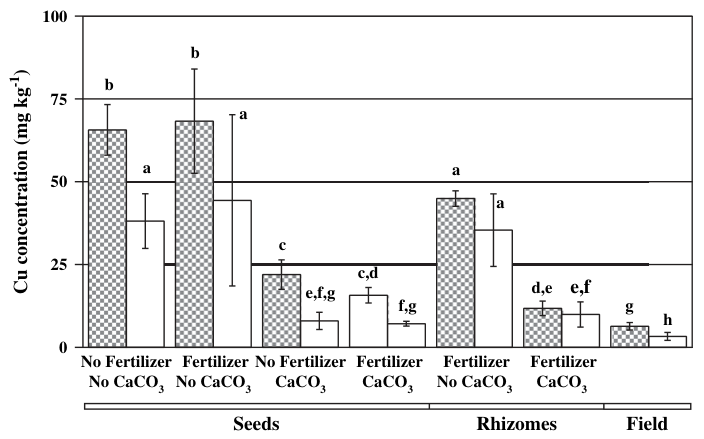
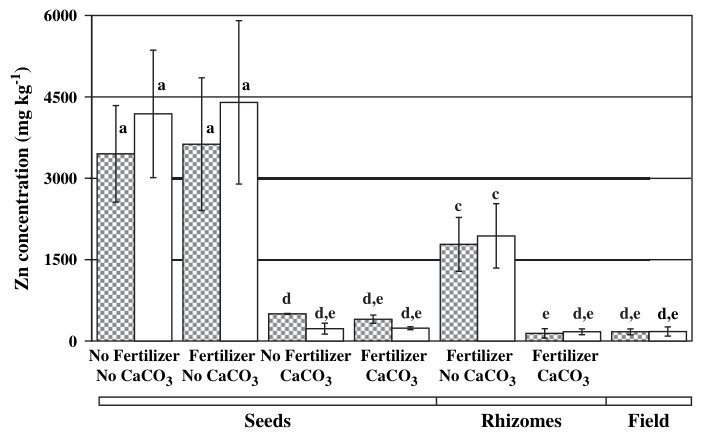
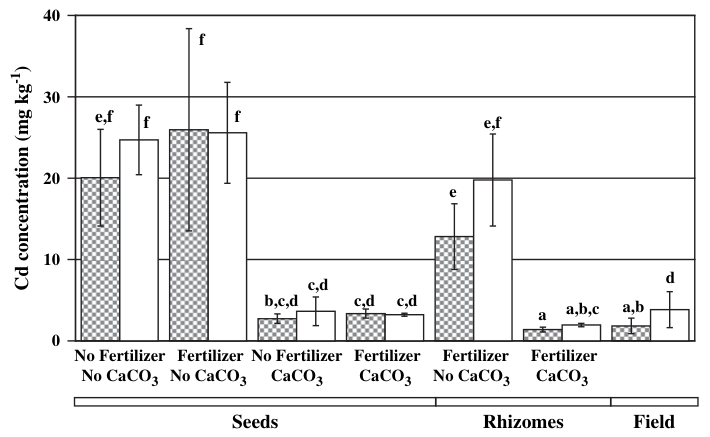
Except for Pb and As, the lime treatment significantly decreased the metal accumulation of shoots and roots (Figs. 1e5). Zn concentrations (Fig. 2) reached 4200 mg kg�1 in shoots and 3500e3600 mg kg�1 in roots in treatments without lime addition. When lime was added, the concentrations decreased by more than 80% in roots and by 90% in shoots.
除 Pb 和 As 外,石灰处理显著降低了地上部和根的金属累积(图1–5)。在未施石灰的处理中,Zn 浓度(图2)在地上部达 4200 mg kg�1,在根中达 3500–3600 mg kg�1。施用石灰后,根中浓度降低 80% 以上,地上部降低 90%。
Cadmium behaved similarly to Zn (Fig. 3), except that the concentrations were much lower. The plants from unlimed treatments accumulated around 20e25 mg kg�1 in shoots and roots. These values decreased by more than 80% with the lime amendment.
Cd 的表现与 Zn 相似(图3),只是浓度低得多。未施石灰处理的植物在地上部和根中累积约 20–25 mg kg�1。施用石灰后,这些值降低了 80% 以上。
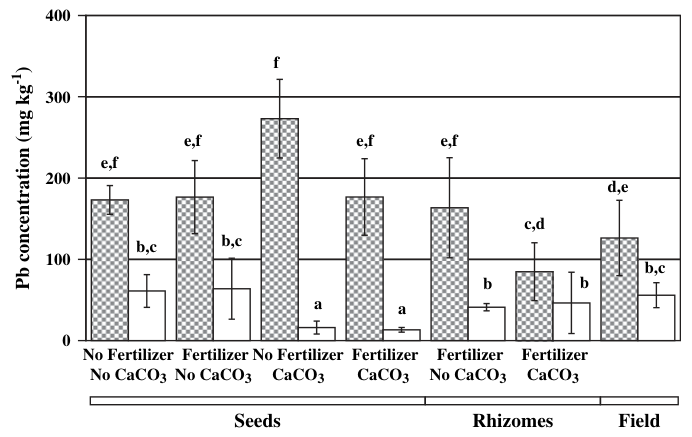
The treatment effects on Pb (Fig. 4) and As (Fig. 5) accumulation by roots were different from those on Cu, Zn, and Cd. Liming increased Pb concentrations in roots from 175 mg kg�1 in untreated pots to 273 mg kg�1 but these differences were not significant. Fertilization alone and liming in combination with fertilization had no significant effect. The increase in Pb accumulation by roots upon addition of lime did not correspond with an increase in the Pb concentration in soil solution, which remained below 0.1 mg L�1. In contrast to the effect on Pb accumulation by roots, shoot uptake of Pb responded in the same way to liming as in the case of the other metals.
各处理对根中 Pb(图4)和 As(图5)累积的影响不同于对 Cu、Zn 和 Cd 的影响。施用石灰使根中 Pb 浓度从未处理盆的 175 mg kg�1 增至 273 mg kg�1,但差异不显著。单独施肥以及石灰与肥料配施均无显著影响。施用石灰后根中 Pb 累积的增加与土壤溶液中 Pb 浓度的增加并不对应,后者始终低于 0.1 mg L�1。与对根中 Pb 累积的影响相反,地上部 Pb 吸收对施用石灰的响应与其他金属相同。
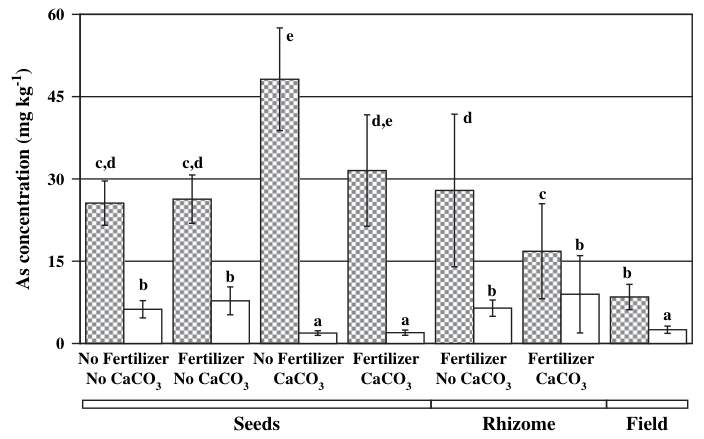
The behavior of As was similar to Pb, but the concentrations were lower. Shoot concentrations were around 6e8 mg kg�1 of plants that grew in the absence of lime. When lime was added, the concentration decreased to 2 mg kg�1. In roots, the concentration was 26 mg kg�1 for the untreated pots with and without fertilizer. However, adding lime increased the As in roots to 32 mg kg�1 in the presence of fertilizer and to 48 mg kg�1 in absence of fertilizer.
As 的表现与 Pb 相似,但浓度较低。在无石灰条件下生长的植物,地上部浓度约为 6–8 mg kg�1;施用石灰后降至 2 mg kg�1。在根中,施肥与未施肥的未施石灰盆浓度均为 26 mg kg�1。然而,施用石灰使根中 As 在施肥条件下增至 32 mg kg�1,在未施肥条件下增至 48 mg kg�1。
3.3. Plants grown from rhizomes3.3. 根茎培育的植物
In general, Zn, Cu, and Cd concentrations in plants grown from rhizomes were lower than in the plants that were grown from seeds for the same treatments (Figs. 1e3), although in most cases these differences were not significant. For Zn the decrease was approximately 50% and significant for the fertilizer and non-limed treatments. For Pb (Fig. 4) and As (Fig. 5) this effect only occurred in roots with the lime treatment. In contrast, shoot uptake of Pb and As was higher in rhizome than in seed-grown plants for the limed pots. Without liming, Pb and As contents were similar in relation to the same treatments in seed-grown plants.
总体而言,在相同处理下,根茎培育植物的 Zn、Cu 和 Cd 浓度低于种子培育植物(图1–3),但多数情况下差异不显著。对于 Zn,降幅约为 50%,且在施肥未施石灰处理中差异显著。对于 Pb(图4)和 As(图5),这一效应仅出现在石灰处理的根中。相反,在施石灰盆中,根茎培育植物地上部对 Pb 和 As 的吸收高于种子培育植物。未施石灰时,Pb 和 As 含量与相同处理下的种子培育植物相近。
3.4. Plants collected in the field3.4. 野外采集的植物
Plant samples from the field had metal concentrations in the same range as the plants grown from rhizomes and seeds in soils treated with lime, despite the fact that the wild plants were growing on untreated soil. Cadmium concentrations were higher in shoots of wild plants than in the roots. The Zn concentration averaged 174 mg kg�1 in the shoots. Cu,
尽管野生植物生长在未处理土壤上,野外植物样品的金属浓度却与施石灰土壤中由根茎和种子培育的植物处于同一范围。野生植物地上部 Cd 浓度高于根。地上部 Zn 浓度平均为 174 mg kg�1。Cu、
Ratios between shoot metal concentrations in plants from pots and from the field
盆栽植物与野外植物地上部金属浓度之比
| Treatment处理 | Cu | Zn | As | Cd | Pb | |
|---|---|---|---|---|---|---|
| Seeds | No fertilizer No CaCO3 | 12 | 24 | 2.5 | 13 | 1.1 |
| Fertilizer No CaCO3 | 14 | 25 | 3.1 | 13 | 1.1 | |
| No fertilizer CaCO3 | 2.4 | 1.3 | 0.8 | 1.9 | 0.3 | |
| Fertilizer CaCO3 | 2.2 | 1.3 | 0.8 | 1.6 | 0.2 | |
| Rhizomes | Fertilizer No CaCO3 | 11 | 11 | 2.6 | 10 | 0.7 |
| Fertilizer CaCO3 | 3.0 | 1.0 | 3.6 | 1.0 | 0.8 |
Values larger than 1 indicate higher metal uptake in pots compared to the field.
数值大于 1 表示盆栽植物的金属吸收高于野外植物。
Pb and As were accumulated mainly in the roots. Arsenic and Cu levels were both below 10 mg kg�1. Pb concentrations were around 100 mg kg�1 in roots.
Pb 和 As 主要累积在根中。As 和 Cu 含量均低于 10 mg kg�1。根中 Pb 浓度约为 100 mg kg�1。
3.5. Comparison metal accumulation field-growth chamber3.5. 野外与生长箱金属累积的比较
The ratio of the metal concentration in the plants from the growth chamber experiment compared to those collected in the field (Table 4) enables us to observe the effects of the controlled growth conditions on metal uptake. Ratios near one indicate that there was no effect of experimental conditions on metal uptake. The highest ratios occurred for Zn and plants grown from seeds in the untreated soils accumulated 20 times more Zn than those collected from the field. Cadmium and Cu uptake was significantly higher in the non-limed treatments (ratios around 10e14) than in the limed pots (0.8e3.0). Lead and As had the lowest ratios (between 0.2e3.6).
通过生长箱试验植物与野外采集植物金属浓度之比(表4),可以观察受控生长条件对金属吸收的影响。比值接近 1 表明试验条件对金属吸收没有影响。Zn 的比值最高,未处理土壤中种子培育植物累积的 Zn 是野外采集植物的 20 倍。未施石灰处理中 Cd 和 Cu 的吸收(比值约 10–14)显著高于施石灰盆(0.8–3.0)。Pb 和 As 的比值最低(0.2–3.6)。
4Discussion讨论
4.1. Soil solution4.1. 土壤溶液
The soil solution is in direct contact to the roots and therefore one of the most important soil compartments to investigate. SO42� concentrations in soil solution were higher than 30 meq L�1 (1440 mg L�1), a value considered detrimental to plant growth (Alarco´n-Vera, 2004); however Cl� values were lower than 5 meq L�1 (177 mg L�1), a value considered unlikely to affect plant growth. The high Zn concentrations in the unlimed soils (>2000 mg L�1) are clearly phytotoxic to most plant species. Based on these results we expected phytotoxicity on the unlimed soils, due primarily to the high concentrations of Zn and SO42�, and little or no phytotoxicity in the treatments with addition of lime.
土壤溶液与根系直接接触,因此是最需要研究的土壤组分之一。土壤溶液中 SO42� 浓度高于 30 meq L�1(1440 mg L�1),该值被认为对植物生长有害(Alarco´n-Vera, 2004);而 Cl� 值低于 5 meq L�1(177 mg L�1),该值被认为不太可能影响植物生长。未施石灰土壤中的高 Zn 浓度(>2000 mg L�1)显然对大多数植物物种具有植物毒性。基于这些结果,我们预期未施石灰土壤会出现植物毒性,主要由高浓度 Zn 和 SO42� 所致,而施石灰处理则几乎不出现植物毒性。
Although the tailings had low calcium content, the dissolution of the added CaCO3 increased the Ca2+ content of the solution, and gypsum was largely oversaturated under these conditions. SO42� was therefore precipitated in the limed treatments and the phytotoxicity was reduced.
尽管尾矿钙含量较低,所添加 CaCO3 的溶解提高了溶液中 Ca2+ 的含量,在此条件下石膏处于高度过饱和状态。因此,施石灰处理中 SO42� 发生沉淀,植物毒性降低。
The K: Mg and Ca: Mg ratios are important indicators for plant growth. Ratios of available Ca: Mg below 1 meq meq�1 and K: Mg below 0.2 meq meq�1 inhibit plant growth (Alarco´n-Vera, 2004). This was the case in all the pots in our experiment. The Ca:Mg ratio was an order of magnitude lower in the un-limed compared to limed soil. The K:Mg ratios were below 0.2 meq meq�1 in all treatments.
K:Mg 和 Ca:Mg 比值是植物生长的重要指标。有效态 Ca:Mg 比值低于 1 meq meq�1 以及 K:Mg 比值低于 0.2 meq meq�1 会抑制植物生长(Alarco´n-Vera, 2004)。本试验所有盆中均出现这种情况。未施石灰土壤的 Ca:Mg 比值比施石灰土壤低一个数量级。所有处理的 K:Mg 比值均低于 0.2 meq meq�1。
The beneficial effect of lime addition was therefore due to: i) the increased pH resulting in a decrease in the solubility of metals; and ii) the precipitation of SO42� as gypsum. The addition of Ca also increased the Ca: Mg ratio. However, this ratio was still below one, far from the ideal ratio of 5 (Alarco´n- Vera, 2004).
因此,施用石灰的有益作用源于:i)pH 升高导致金属溶解度降低;ii)SO42� 以石膏形式沉淀。添加 Ca 还提高了 Ca:Mg 比值,但该比值仍低于 1,远未达到理想比值 5(Alarco´n- Vera, 2004)。
4.2. Plant growth4.2. 植物生长
The toxicity symptoms in the untreated soils without lime resulted from the combination of low pH, high SO24� and metal concentrations, especially Zn. All three parameters affect the plant growth directly or indirectly. The effect of protons (H+) is mainly indirect by increasing salinity and the release of toxic metals (Salisbury and Ross, 1992). SO24� limits Ca uptake by plants more than having a direct toxic effect. It increases the uptake of Na and K and reduces the water potential of the soil solution (Alarco´n-Vera, 2004). Cl� and NO3� weakly sorbed to the soil matrix, and the retention of SO42� is also limited. These anions are readily available for roots uptake. High concentrations of metals in soil solution reduce plant growth by a variety of phytotoxic effects (Tordoff et al., 2000; Ye et al., 2000; Shu et al., 2001; Wong, 2003).
未施石灰的未处理土壤中出现的毒害症状是低 pH、高 SO24� 和高金属浓度(尤其是 Zn)共同作用的结果。这三个参数均直接或间接影响植物生长。质子(H+)的作用主要是间接的,即通过增加盐度和释放有毒金属(Salisbury and Ross, 1992)。SO24� 主要限制植物对 Ca 的吸收,而非直接产生毒害作用;它会增加 Na 和 K 的吸收,并降低土壤溶液的水势(Alarco´n-Vera, 2004)。Cl� 和 NO3� 在土壤基质上的吸附较弱,SO42� 的保持也有限,这些阴离子易被根系吸收。土壤溶液中高浓度的金属通过多种植物毒性效应抑制植物生长(Tordoff et al., 2000; Ye et al., 2000; Shu et al., 2001; Wong, 2003)。
Fertilizer did not improve the establishment of Lygeum spartum in this soil. This indicates that the availability of the applied nutrients was not a limiting factor for this plant during our experiment. Nevertheless, fertilization may be beneficial for vigorous growth over longer periods.
施肥并未改善 Lygeum spartum 在该土壤中的定植,表明在本试验期间所施养分的有效性并非该植物的限制因素。尽管如此,从较长时期看,施肥可能有利于植物旺盛生长。
Lygeum spartum is special compared to most other plants because its growth was only reduced in the untreated soils whereas most plant species would not be able to survive such harsh conditions of acidity, salinity and metal content. It is therefore a good candidate for phytostabilization of acid mine tailings, even without soil amendments.
与大多数其他植物相比,Lygeum spartum 较为特殊:其生长仅在未处理土壤中受到抑制,而大多数植物物种无法在如此严酷的酸度、盐度和金属含量条件下存活。因此,即使不施用土壤改良剂,它也是酸性矿山尾矿植物稳定的良好候选植物。
4.3. Comparison of metal accumulation between field and growth chamber4.3. 野外与生长箱金属累积的比较
The chemical characteristics of the field soil were close to the soil properties in the untreated soil (Conesa et al., in press). Nonetheless, Lygeum spartum accumulated significantly more metals in the growth chamber than in the field. The bioavailability of the metals was therefore higher in the pots than in the field. Air-drying of soil is known to modify the distribution of metal fractions (Nowack et al., 2004) resulting in an increase in the water soluble and exchangeable fractions (Wang et al., 2002). In the growth chamber the plants experienced optimal growing conditions. Mine tailings usually consist of fine-grained materials (<2 mm) (Tordoff et al., 2000), are dense and have compact layers. This results in poor water retention but also in restricted access of roots to the soil matrix (Ernst, 1996). The soil used in the pots was sieved and coarse fragments were broken up. The homogeneous mixture resulting from this preparation may have increased the contact between roots, soil water and the soil matrix. The breaking of aggregates also increased the reactive surface, enhancing oxidation processes that can facilitate the acidification of the soil.
野外土壤的化学特征与未处理土壤的性质相近(Conesa et al., in press)。然而,Lygeum spartum 在生长箱中累积的金属显著多于野外,因此盆栽中金属的生物有效性高于野外。已知土壤风干会改变金属形态分布(Nowack et al., 2004),导致水溶态和可交换态比例增加(Wang et al., 2002)。在生长箱中,植物处于最佳生长条件。矿山尾矿通常由细颗粒物质(<2 mm)组成(Tordoff et al., 2000),质地致密并具有紧实层,导致持水性差,同时限制根系接触土壤基质(Ernst, 1996)。盆栽所用土壤经过筛分并将粗颗粒破碎,由此制备的均匀混合物可能增加了根系、土壤水和土壤基质之间的接触。团聚体的破碎还增加了反应表面积,促进了可加速土壤酸化的氧化过程。
The plants in the field had a higher biomass and were older than the plants in the pot experiment. Plants may be more vulnerable to heavy metals in the early stages of their life cycle (Cheng, 2003). Lower metal concentrations in older plants can also be explained by the phytodilution process (Robinson et al., 1998). This effect may have been a reason for the lower metal accumulation observed in the plants grown from rhizomes. The starting biomass was higher in the plants grown from rhizomes, as they were already older than the plants grown from seeds, when the experiment began.
野外植物生物量更高,且比盆栽试验中的植物年龄更大。植物在生命周期早期可能更易受重金属影响(Cheng, 2003)。年龄较大植物中金属浓度较低也可用植物稀释过程解释(Robinson et al., 1998)。这一效应可能是根茎培育植物金属累积较低的原因之一:试验开始时,根茎培育的植物已比种子培育的植物年龄更大,因而初始生物量更高。
Differences in root exudates or other rhizosphere processes may have contributed to the lower accumulation in the field. Root exudates can modify the soil properties around the roots (Wang et al., 2002). Adult plants in the field do not only have a more developed root system and have more time to modify the rhizosphere, they can also invest more assimilates into exudation than rhizomes and seedlings.
根系分泌物或其他根际过程的差异可能是野外植物累积较低的原因之一。根系分泌物可改变根周围的土壤性质(Wang et al., 2002)。与根茎和幼苗相比,野外成年植物不仅根系更发达、有更长时间改变根际环境,而且能够将更多同化产物投入分泌作用。
Nevertheless, seedlings must be able to survive the hostile site conditions when they colonize the tailings. There are at least three possible ways: (i) seedlings may slowly modify soil properties by means root exudates; (ii) they gradually invade the soil from areas where soil conditions are less aggressive for initial plant establishment (better water retention, no compacted layers, etc.) and successively ‘‘ameliorate’’ the newly colonized soil; and (iii) the plant roots grow selectively into the soil, taking advantage of the high degree of heterogeneity in the distribution of metals, i.e. by avoiding the most contaminated parts of the mine tailings. In contrast, in the pot experiments there was only a short time available, seedlings had no ‘‘support’’ from already established plants and the soil was homogeneous.
然而,幼苗在定植尾矿时必须能够在恶劣的场地条件下存活。至少存在三种可能途径:(i)幼苗可通过根系分泌物缓慢改变土壤性质;(ii)幼苗从土壤条件对植物初始定植不太严酷的区域(持水性更好、无紧实层等)逐渐侵入土壤,并相继“改良”新定植的土壤;(iii)植物根系选择性地向土壤中生长,利用金属分布的高度异质性,即避开尾矿中污染最严重的部分。相比之下,盆栽试验时间较短,幼苗没有已定植植物的“支持”,且土壤是均一的。
Such long-term growth strategies limit the usefulness of pot experiments to determine optimal amendments and growth conditions for plants growing naturally on mine tailings in arid regions. In particular, liming may not have the same effect on plant growth and metal accumulation in the field. Liming is often considered necessary in these soils to supply better conditions to plant establishment. This is a common recommendation prior to the revegetation of acidic mine wastes (Monterroso et al., 1998; Tordoff et al., 2000; Shu et al., 2001).
此类长期生长策略限制了利用盆栽试验确定干旱地区尾矿上自然生长植物的最佳改良剂和生长条件的有效性。特别是,施用石灰在野外对植物生长和金属累积的影响可能不同。在这类土壤中,施用石灰通常被认为是为植物定植提供更好条件所必需的,这也是酸性矿山废弃物植被重建前的常见建议(Monterroso et al., 1998; Tordoff et al., 2000; Shu et al., 2001)。
4.4. Bioconcentration and bioaccumulation factor of4.4. 生物富集系数与生物累积系数:
Lygeum spartumLygeum spartum
Plant metal accumulation is often expressed as a bioconcentration factor (BF). It is calculated as the dry planttissue/soil metal concentration quotient (Mattina et al., 2003). In our study, the BF for all metals was below 1 with the exception of the Cd in the untreated soils, where it had a value of 2. Apart from Cd, only Zn accumulation reached values higher than 0.2. McGrath and Zhao (2003) considered <0.2 normal for plants growing on polluted materials. In the field plants, the BF was 0.4 for Cd accumulation by shoots and in all other cases below 0.2. This is consistent with an exclusion strategy for metal tolerance (McGrath et al., 2001).
植物金属累积常以生物富集系数(BF)表示,其计算方法为植物组织干重金属浓度与土壤金属浓度之商(Mattina et al., 2003)。本研究中,除未处理土壤中 Cd 的 BF 值为 2 外,所有金属的 BF 均低于 1。除 Cd 外,仅 Zn 的累积值高于 0.2。McGrath and Zhao (2003) 认为,对于生长在污染物料上的植物,<0.2 属正常范围。野外植物地上部 Cd 累积的 BF 为 0.4,其他情况均低于 0.2。这与金属耐性的排斥策略相一致(McGrath et al., 2001)。
Analogous to the BF, the accumulation factor (AF) indicates the efficacy of metal translocation from roots into shoots (Fitz and Wenzel, 2002). Also called translocation factor (Mattina et al., 2003), it is the shoot/root metal concentration quotient. Excluder plants have AF values �1, whereas for hyperaccumulators it is [1. In our study, the accumulation factor for Zn and Cd reached values between 1 and 2 for plants from the field and pot plants in the untreated soils. In all other cases, the values of the accumulation factor were below one.
与 BF 类似,累积系数(AF)表示金属从根向地上部转运的效率(Fitz and Wenzel, 2002),又称转运系数(Mattina et al., 2003),为地上部与根金属浓度之商。排斥型植物的 AF 值 �1,而超富集植物的 AF 值 [1。本研究中,野外植物以及未处理土壤中盆栽植物的 Zn 和 Cd 累积系数介于 1 至 2 之间,其他情况下累积系数均低于 1。
The reduction in soil solution concentration resulted in a significant decrease in shoot uptake of all metals and root uptake of Cu, Zn, and Cd. However, the soil solution concentration does not seem a good parameter to explain the increase of Pb and As uptake in roots in the limed soil since the levels of soluble metals extracted with suction cups are lower than in not limed pots. We did not distinguish between adsorption onto the root surface and uptake. Adsorption of Pb is strongly pH dependent and we would expect much more adsorption at pH 5.5 compared to pH 3.
土壤溶液浓度的降低导致地上部对所有金属的吸收以及根对 Cu、Zn 和 Cd 的吸收显著下降。然而,土壤溶液浓度似乎不能很好地解释施石灰土壤中根对 Pb 和 As 吸收的增加,因为用吸杯提取的可溶性金属水平低于未施石灰盆。本研究未区分根表面吸附与吸收。Pb 的吸附强烈依赖于 pH,预计 pH 5.5 时的吸附量远大于 pH 3 时。
5Conclusions结论
Lygeum spartum took up inordinate amounts of metals when raised in the growth chamber under controlled conditions. Lime increased soil pH and decreased soluble metals. This significantly reduced metal uptake. Growth under controlled conditions resulted in significantly higher metal uptake compared to plants sampled in the field. This may be attributed to homogenization of the soil and the free availability of water for a plant that normally grows in a semi-arid climate. Both factors may increase the availability and accessibility of soil metals for uptake by roots.
Lygeum spartum 在受控条件下于生长箱中培育时吸收了过量的金属。施用石灰提高了土壤 pH 并降低了可溶性金属,从而显著减少了金属吸收。与野外采集的植物相比,受控条件下生长的植物金属吸收显著更高。这可能归因于土壤均一化以及对通常生长于半干旱气候的植物而言水分供应充足。这两个因素均可能提高土壤金属对根系吸收的有效性和可及性。
Further studies could focus on elucidating survival strategies of these plants in situ. An investigation is warranted into how roots behave in mine tailings where the contaminants are heterogeneously distributed.
今后的研究可着重阐明这些植物在原位的生存策略。有必要研究根系在污染物分布不均的矿山尾矿中的行为。
Acknowledgements致谢
This work was supported by a grant from the ‘‘Fundacio´n Se´neca’’ of the Comunidad Auto´noma de la Regio´n de Murcia (Spain). We also thank Anna Gru¨nwald, Rene´ Saladin, Lu Zhao and Susan Tandy for their technical assistance.
本研究由西班牙 Comunidad Auto´noma de la Regio´n de Murcia 的“Fundacio´n Se´neca”资助。同时感谢 Anna Gru¨nwald、Rene´ Saladin、Lu Zhao 和 Susan Tandy 提供的技术帮助。
References参考文献
Alarco´n-Vera, A.L., 2004. Diagno´stico Agrı´cola, Escuela Te´cnica Superior de Ingenierı´a Agrono´mica de Cartagena, Cartagena, Spain.
Alvarenga, P.M., Arau´jo, M.F., Silva, J.A.L., 2004. Elemental uptake and root-leaves transfer in Cistus ladanifer L. growing in a contaminated pyrite mining area (Aljustrel-Portugal). Water, Air and Soil Pollution 152, 81e96.
Alvarez-Rogel,� J., Ramos-Aparicio, M.J., Delgado-Iniesta, M.J., Arnaldos- Lozano, R., 2004. Metals in soils and above-ground biomass of plants from a salt marsh polluted by mine wastes in the coast of the
Mar Menor Lagoon, SE Spain. Fresenius Environmental Bulletin 13, 274e278.
Cheng, Sh., 2003. Effects of heavy metals on plants and resistance mechanisms. Environmental Science and Pollution Research 10, 256e264.
Cobb, G.P., Sands, K., Waters, M., Wixson, B.G., Dorward-King, E., 2000.
Accumulation of heavy metals by vegetables grown in mine wastes. Environmental Toxicology and Chemistry 19, 600e607.
Conesa, H.M., 2005. Restoration/stabilization of heavy metal polluted soils due to mining activities in Cartagena-La Unio´n Mining District. Universidad Polite´cnica de Cartagena. Cartagena. Spain. PhD Thesis.
Conesa, H.M., Faz, A.,� Arnaldos, R. Heavy metal accumulation and tolerance in plants from mine tailings of the semiarid Cartagena-La Union mining district (SE Spain). The Science of the Total Environment, in press. doi:10.1016/j.scitotenv.2005.12.008.
Diaz, G., Honrubia, M., 1993. Respuestas de crecimiento del albardı´n (Lygeum spartum L.) a la inoculacio´n con hongos micorrı´cicos y a la fertilizacio´n fosforada. Cryptogamie Mycologie 14, 117e125.
Ernst, W.H.O., 1996. Bioavailability of heavy metals and decontamination of soil by plants. Applied Geochemistry 11, 163e167.
Fitz, W.J., Wenzel, W.W., 2002. As transformations in the soil-rhizosphereplant system: fundamentals and potential application to phytoremediation. Journal of Biotechnology 99, 259e278.
Flores-Tavizo´n, E., Alarco´n-Herrera, M.T., Gonza´lez-Elizondo, S., Olguı´n, E.J., 2003. As tolerating plants from mine sites and hot springs in the semi-arid Region of Chihuahua, Mexico. Acta Biotechnologica 23, 113e119.
Garcı´a, G., Faz, A., Conesa, H.M., 2003. Selection of autochthonous plant spe-� cies from SE Spain for soil Pb phytoremediation purposes. Water, Air and Soil Pollution: Focus 3, 243e250.
Henriques, F.S., Fernandes, J.C., 1991. Metal uptake and distribution in rush (Juncus conglomeratus L.) plants growing in pyrites mine tailings at Lousal, Portugal. The Science of the Total Environment 102, 253e260.
I.G.M.E. (Instituto Geolo´gico y Minero de Espan˜a), 1999. Inventario Nacional de Balsas y Escombreras. Comunidad Auto´noma de la Regio´n de Murcia. Instituto Geolo´gico y Minero de Espan˜a, Madrid, Spain. Technical Report.
Mattina, M.I., Lannucci-Berger, W., Musante, C., White, J.C., 2003. Concurrent plant uptake of heavy metals and persistent organic pollutants from soil. Environmental Pollution 124, 375e378.
McGrath, S.P., Zhao, F.J., 2003. Phytoextraction of metals and metalloids from contaminated soils. Current Opinion in Biotechnology 14, 277e282.
McGrath, S.P., Zhao, F.J., Lombi, E., 2001. Plant and rhizosphere processes involved in phytoremediation of metal-contaminated soils. Plant and Soil 232, 207e214.
Melendo, M., Benı´tez, E., Nogales, R., 2002. Assessment of the feasibility of endogenous Mediterranean species for phytoremediation of Pb-contaminated areas. Fresenius Environmental Bulletin 11, 1105e1109.
Merrington, G., Alloway, B.J., 1994. The transfer and fate of Cd, Cu, Pb and Zn from two historic metalliferous mine sites in the U.K. Applied Geochemistry 9, 677e687.
Monterroso, C., Macias, F., Gil Bueno, A., Val Caballero, C., 1998. Evaluation of the land reclamation project at the As Pontes Mine (NW Spain) in relation to the suitability of the soil for plant growth. Land Degradation and Development 9, 441e451.
Norland, M.R., Veith, D.L., 1995. Revegetation of coarse taconite iron ore tailing using municipal waste compost. Journal of Hazardous Materials 41, 123e134.
Nowack, B., Ko¨hler, S., Schulin, R., 2004. Use of diffusive gradients in thin films (DGT) in undisturbed field soils. Environmental Science and Technology 38, 1133e1138.
Robinson, B.H., Leblanc, M., Petit, D., Brooks, R.R., Kirkman, J.H., Gregg, P.E.H., 1998. The potential of Thlaspi caerulescens for phytoremediation of contaminated soils. Plant and Soil 203, 47e56.
Salisbury, F.B., Ross, C.W., 1992. Plant Physiology, fourth ed. Wadsworth Publishing Company, Belmont, California, United States.
Shu, W.S., Ye, Z.H., Lan, C.Y., Zhang, Z.Q., Wong, M.H., 2001. Acidification of Pb/Zn mine tailings and its effect on heavy metal mobility. Environment International 26, 389e394.
SPSS, 2005. SPSS 14.0 for Windows Software. SPSS Inc., USA.
Tordoff, G.M., Baker, A.J.M., Willis, A.J., 2000. Current approaches to the revegetation and reclamation of metalliferous mine wastes. Chemosphere 41, 219e228.
Wang, Z., Schan, X.Q., Zhang, S., 2002. Comparison between fractionation and bioavailability of trace elements in rhizosphere and bulk soils. Chemosphere 46, 1163e1171.
Wong, M.H., 2003. Ecological restoration of mine degraded soils, with emphasis on metal contaminated soils. Chemosphere 50, 775e780.
Ye, Z.H., Wong, J.W.C., Wong, M.H., 2000. Vegetation response to lime and manure compost amendments on acid Pb/Zn mine tailings: a greenhouse study. Restoration Ecology 8, 289e295.