Environmental Pollution 150 (2007) 225e233 www.elsevier.com/locate/envpol
B.H. Robinson a,*, S.R. Green b, B. Chancerel b, T.M. Mills b, B.E. Clothier b
a Institute of Terrestrial Ecosystems, Swiss Federal Institute of Technology (ETH), Universita¨tstrasse 16, CH-8092 Zu¨rich, Switzerland b HortResearch, Private Bag 11030, Palmerston North, New Zealand
Received 27 November 2006; received in revised form 12 January 2007; accepted 20 January 2007
Poplars reduce boron leaching from contaminated sites.
Abstract摘要
Boron (B) is a widespread environmental contaminant that is mobile relative to other trace elements. We investigated the potential of hybrid poplar (Populus sp.) for B phytomanagement using a lysimeter experiment and a field trial on B-contaminated wood-waste. In both studies, poplars enhanced evapotranspiration from the wood-waste, reduced B leaching, and accumulated B in the aerial portions of the tree. When grown in a substrate containing 30 mg/kg B, poplar leaves had an average B concentration of 845 mg/kg, while the stems contained 21 mg/kg B. Leaf B concentrations increased linearly with leaf age. A decomposition experiment revealed that abscised leaves released 14% of their B during the winter months. Fertiliser application enhanced tree growth without decreasing the leaf B concentrations. Harvesting alternate rows of trees on a contaminated site would reduce leaching from the site while removing B. Harvested plant material may provide bioenergy, stock fodder, or an amendment for B-deficient soils.
硼(B)是一种分布广泛的环境污染物,与其他微量元素相比具有较高的迁移性。本研究通过渗漏计试验和在受B污染木材废料上开展的田间试验,考察了杂交杨树(Populus sp.)用于B植物管理的潜力。两项研究均表明,杨树增强了木材废料的蒸散作用,减少了B的淋溶,并将B积累于树体地上部分。在B含量为30 mg/kg的基质中生长时,杨树叶片B平均浓度为845 mg/kg,而茎中B含量为21 mg/kg。叶片B浓度随叶龄呈线性增加。分解试验表明,脱落叶片在冬季释放了其所含B的14%。施肥促进了树木生长,但并未降低叶片B浓度。在污染场地隔行采伐树木,可在移除B的同时减少场地淋溶。采收的植物材料可用作生物能源、牲畜饲料或缺B土壤的改良剂。
� 2007 Elsevier Ltd. All rights reserved.
© 2007 Elsevier Ltd. 版权所有。
Keywords: Phyto-DSS; Phytoremediation; Boron; Biofuel
关键词:Phyto-DSS;植物修复;硼;生物燃料
1Introduction引言
Phytomanagement is the use of vegetation/soil amendment systems to reduce the environmental risk posed by contaminated sites (Ba~nuelos, 1995).
植物管理是指利用植被/土壤改良剂体系降低污染场地所带来的环境风险(Bañuelos, 1995)。
Poplars are often planted to reduce the water flux through contaminated sites because of their ease of propagation, rapid establishment, deep roots, and ability to coppice (Mills and Robinson, 2003). Poplars thrive in a wide range of soil and climatic conditions (McGee et al., 1981). Ba~nuelos et al. (1999) reported that when irrigated with water containing 3 mg/L B, some poplar clones accumulated up to 543 mg/kg of B in their aerial tissues. Subsequently, we found that when grown in soil containing just 40 mg/kg B, poplars accumulated up to 1200 mg/kg in the leaves, some 20 times more than other species grown in the same environment (Robinson et al., 2003a).
由于杨树易于繁殖、定植迅速、根系深且具有萌蘖(平茬)能力,常被种植以减少通过污染场地的水通量(Mills and Robinson, 2003)。杨树能在多种土壤和气候条件下旺盛生长(McGee et al., 1981)。Bañuelos et al.(1999)报道,用含3 mg/L B的水灌溉时,部分杨树无性系地上组织中B积累量高达543 mg/kg。随后我们发现,在B含量仅为40 mg/kg的土壤中生长时,杨树叶片中B积累量可达1200 mg/kg,约为同一环境中其他物种的20倍(Robinson et al., 2003a)。
* Corresponding author.
E-mail addresses: brett.robinson@env.ethz.ch (B.H. Robinson), bclothier@ hortresearch.co.nz (B.E. Clothier).
The high evapotranspiration of poplars combined with their high B uptake may reduce the environmental risk arising from B-contaminated sites. Poplars may reduce B leaching into ground and surface waters by returning rainfall to the atmosphere via evapotranspiration and by binding B in the plant tissue. Harvesting the trees would remove B from the site (Robinson et al., 2003a).
杨树的高蒸散量与高B吸收能力相结合,可能降低受B污染场地所带来的环境风险。杨树可通过蒸散作用将降雨返回大气,并将B固定于植物组织中,从而减少B向地下水和地表水的淋溶。采伐树木则可将B从场地中移除(Robinson et al., 2003a)。
1.1. Boron as an environmental contaminant1.1. 作为环境污染物的硼
Boron (B) generally occurs only in small concentrations in soils, but has a disproportionately large impact on plants, both as an essential element and as a toxin. High levels of B occur naturally in soils in arid areas.
硼(B)在土壤中通常仅以低浓度存在,但作为必需元素和毒性元素,其对植物的影响却不成比例地大。干旱地区土壤中天然存在高含量的B。
Boron contamination results from a wide range of anthropogenic activities. Although most B (76%) is used in the manufacture of glass (Parks and Edwards, 2005), B in borosilicate glass is essentially immobile and thus poses little environmental threat. However, other uses of B that depend on its bleaching or antiseptic properties may result in the release of mobile B into the environment (Nable et al., 1997). Boron timber treatment reduces flammability, prevents sap-stain, and protects against insect damage. Sites associated with the timberindustry may therefore have high B concentrations.
硼污染源于多种人为活动。尽管大部分B(76%)用于玻璃制造(Parks and Edwards, 2005),但硼硅酸盐玻璃中的B基本不迁移,因而几乎不构成环境威胁。然而,利用B漂白或防腐特性的其他用途可能导致可迁移态B释放到环境中(Nable et al., 1997)。硼木材处理可降低可燃性、防止蓝变(边材变色)并防护虫害。因此,与木材工业相关的场地可能具有较高的B浓度。
0269-7491/$ - see front matter � 2007 Elsevier Ltd. All rights reserved. doi:10.1016/j.envpol.2007.01.017
0269-7491/$ - see front matter © 2007 Elsevier Ltd. 版权所有。doi:10.1016/j.envpol.2007.01.017
High B concentrations occur in some industrial byproducts. Boron is one of the most important contaminants in most coal-ash materials (Adriano, 2001). It has been estimated that annually 11 800 t of B are released in coal fly ash from coal combustion (Bertine and Goldberg, 1971). Boron is the most mobile element when coal-ash is buried (Doak, 2003). Water-soluble B varies from 17 to 64% of the total B present in a range of fly ashes (James et al., 1982).
某些工业副产物中B浓度较高。硼是大多数煤灰材料中最重要的污染物之一(Adriano, 2001)。据估计,燃煤每年随粉煤灰释放的B达11 800 t(Bertine and Goldberg, 1971)。煤灰填埋后,硼是迁移性最强的元素(Doak, 2003)。在多种粉煤灰中,水溶性B占总B的17%~64%(James et al., 1982)。
1.2. Boron mobility in soil1.2. 硼在土壤中的迁移性
Boron is relatively mobile in soil when compared to metal contaminants. Boron binds to kaolinite and illite clays, as well as sewage sludge, with a maximum sorption density of just 31 mg/kg B (Banerji, 1969). Su and Suarez (1995) showed that B forms inner-sphere complexes with some minerals, including Al and Fe hydroxides, allophane, and kaolinite. However, quartz and calcite adsorbed negligible amounts of B from solution. Soil organic matter absorbs much of the total B. Microbial action can remobilize organic-bound B (Evans and Sparks, 1983).Goldberg (1997) showed that the Langmuir and Freundlich equations described the adsorption of B in soil.
与金属污染物相比,硼在土壤中的迁移性相对较强。硼可与高岭石和伊利石黏土以及污水污泥结合,但其最大吸附密度仅为31 mg/kg B(Banerji, 1969)。Su and Suarez(1995)表明,B可与部分矿物(包括Al和Fe氢氧化物、水铝英石和高岭石)形成内圈络合物。然而,石英和方解石从溶液中吸附的B可忽略不计。土壤有机质吸收了大部分总B。微生物作用可使有机结合态B重新活化(Evans and Sparks, 1983)。Goldberg(1997)表明,Langmuir和Freundlich方程可描述土壤对B的吸附。
1.3. The toxicity of B in soils and waters1.3. 土壤和水体中硼的毒性
In plants, the range between B deficiency and toxicity is smaller than for any other element (Goldberg, 1997). Boron has four modes of toxicity in higher plants: (1) disruption of cell wall development; (2) metabolic disruption by binding to ATP, NADH or NADPH; (3) disruption of cell division and development by binding to RNA; and (4) osmotic imbalances caused by high B concentrations in leaves (Reid et al., 2004). Species differ in their tolerance to B. Sensitive species succumb when irrigated with just 0.3 mg/L B, while tolerant species resist up to 4 mg/L B in irrigation water (Keren and Bingham, 1985).
在植物中,B缺乏与毒害之间的浓度范围比任何其他元素都窄(Goldberg, 1997)。硼对高等植物有四种毒害方式:(1)破坏细胞壁发育;(2)通过与ATP、NADH或NADPH结合干扰代谢;(3)通过与RNA结合干扰细胞分裂与发育;(4)叶片中高浓度B引起渗透失衡(Reid et al., 2004)。不同物种对B的耐受性不同。敏感物种在用仅含0.3 mg/L B的水灌溉时即受害死亡,而耐性物种可耐受灌溉水中高达4 mg/L的B(Keren and Bingham, 1985)。
Toxicity in animals occurs when intake exceeds the rate of excretion. A 2003 U.S. Environmental Protection Agency (EPA) Drinking Water Health Advisory for B recommends a maximum safe lifetime in drinking water of 0.6 mg/L B (US EPA, 2003).
当摄入量超过排泄速率时,动物即出现中毒。美国环境保护署(EPA)2003年发布的B饮用水健康建议推荐,终生饮用水中B的最大安全浓度为0.6 mg/L(US EPA, 2003)。
1.4. Mechanisms of B uptake by plants1.4. 植物吸收硼的机制
The neutral species B(OH)3 is taken up more readily than B(OH)4�. This is because B(OH)4� is more strongly bound to clay minerals (Hu and Brown, 1997) and because roots take up B(OH)3 more readily than B(OH)�4 from soil solution. Oertli and Grgurevic (1975) found that barley roots accumulated more B(OH)3 than B(OH)4� in solution culture. Soil pH is the most important factor in controlling B uptake (Gupta, 1979). Plant uptake is reduced at higher soil pH values because of the increasing ratio of B(OH)�4:B(OH)3. Therefore, liming reduces the availability of B to plants (Gupta and Macleod, 1981; Berger and Truog, 1945; Peterson and Newman, 1976). While there is unanimous agreement that B is translocated in xylem to sites of greatest water loss, there is controversy regarding the role of the phloem in providing B to sites that do not lose water readily (Brown and Shelp, 1997).
中性形态B(OH)3比B(OH)4−更易被吸收。这是因为B(OH)4−与黏土矿物结合更强(Hu and Brown, 1997),且根系从土壤溶液中吸收B(OH)3比B(OH)4−更容易。Oertli and Grgurevic(1975)发现,在溶液培养中大麦根系积累的B(OH)3多于B(OH)4−。土壤pH是控制B吸收的最重要因素(Gupta, 1979)。由于B(OH)4−:B(OH)3比值升高,土壤pH越高,植物吸收越少。因此,施用石灰会降低B对植物的有效性(Gupta and Macleod, 1981; Berger and Truog, 1945; Peterson and Newman, 1976)。虽然B经木质部转运至失水最多部位这一观点已得到一致认可,但关于韧皮部在向不易失水部位供应B中的作用仍存在争议(Brown and Shelp, 1997)。
1.5. The phytomanagement of B-contaminated sites: aims1.5. 受硼污染场地的植物管理:目标
Successful phytomanagement of B should reduce the negative effect of this element on the surrounding environment. Vegetation should be established that reduces water flux through the site or reduces the concentration of dissolved B in the leachate. Both these effects result in a lower B concentration in ground and surface waters. To achieve this, any phytomanagement strategy must increase evapotranspiration from the site and/or remove B from soil solution, either by plant uptake or by altering the speciation of B in the soil.
成功的B植物管理应降低该元素对周围环境的负面影响。所建立的植被应能减少通过场地的水通量,或降低淋溶液中溶解态B的浓度。这两种效应均可降低地下水和地表水中的B浓度。为此,任何植物管理策略都必须增加场地的蒸散量,和/或通过植物吸收或改变土壤中B的形态,将B从土壤溶液中移除。
The uptake of B into the aerial portions of poplar does not represent the same environmental risk as the uptake of some other trace elements, such as Cd. This is because B is not biomagnified through the food chain (Howe, 1998) since it is readily excreted by animals.
B被吸收进入杨树地上部分所带来的环境风险,与某些其他微量元素(如Cd)的吸收不同。这是因为B易被动物排出体外,不会沿食物链生物放大(Howe, 1998)。
We aimed to determine the suitability of poplar for the phytomanagement of a B-contaminated wood-waste site and investigate the effect of various management strategies on the leaching and plant uptake of B. Specifically, we sought to determine: (1) the B uptake characteristics of poplar, namely the extent and distribution of B in the aerial portions, and how B concentration changes as a function of time; (2) the effect of plant nutrients on B uptake; (3) the release of B from decomposing poplar leaves; and (4) model the effects of poplars on B leaching from a contaminated site.
本研究旨在确定杨树用于受B污染木材废料场地植物管理的适宜性,并考察不同管理策略对B淋溶和植物吸收的影响。具体而言,我们试图确定:(1)杨树对B的吸收特征,即B在地上部分的积累程度和分布,以及B浓度随时间的变化;(2)植物养分对B吸收的影响;(3)分解中的杨树叶片释放B的情况;(4)模拟杨树对污染场地B淋溶的影响。
2Materials and methods材料与方法
2.1. Site description2.1. 场地概况
The Kopu wood-waste site is located at the base of the Coromandel Peninsula, North Island, New Zealand (37.2� S, 175.6� E). The site has a surface area of 3.6 ha. Over a 30-year period, from 1966, timber-processing operations dumped wood-waste and yard-scrapings, resulting in a pile with an average depth of 15 m. Surrounding land was engineered so that no ground or surface water entered the pile, and leachate resulting from rainfall was collected in a small holding pond at the foot of the pile. Vegetation had failed to establish and evaporation from the surface of the pile was negligible, even in the summer months. There was saturated material at depths as shallow as 20 mm.
Kopu木材废料场地位于新西兰北岛科罗曼德尔半岛基部(37.2° S,175.6° E)。场地面积为3.6 ha。自1966年起的30年间,木材加工作业在此倾倒木材废料和堆场刮屑,形成平均深度为15 m的堆体。周边土地经过工程处理,使地下水和地表水不进入堆体,降雨产生的淋溶液则收集于堆体脚下的小型蓄水池中。植被未能定植,即使在夏季,堆体表面的蒸发也可忽略不计。在浅至20 mm的深度即有饱和物质。
Leachate resulting from the annual rainfall of 1135 mm, as measured at a nearby meteorological station at Thames, regularly caused the holding pond to overflow and enter a local stream. This overflow elevated B concentrations in the stream to levels that were in excess of 1.4 mg/L, the New Zealand Drinking Water Standard (NZDWS), especially in the summer months when stream flow was low. In response to these breaches, the local environmental authority placed an order on the forestry company responsible for the site that the problem be remedied (Robinson et al., 2003a).
年降雨量为1135 mm(据附近Thames气象站测定),由此产生的淋溶液经常导致蓄水池溢流并进入当地溪流。这种溢流使溪流中B浓度升高,超过新西兰饮用水标准(NZDWS)规定的1.4 mg/L,尤其是在溪流流量较低的夏季。针对这些超标情况,当地环境管理部门向负责该场地的林业公司下达了整改令,要求其解决该问题(Robinson et al., 2003a)。
2.2. Poplar plantings2.2. 杨树种植
In July 2000, a test planting was established on the Kopu site using clones of poplar and willow hybrids, namely Populus deltoides � nigra (‘Argyle’ & ‘Selwin’), P. deltoides � yunnanensis (‘Kawa’), Populus euramericana � yunnanensis (‘Toa’), Populus alba � glandulosa (‘Yeogi’), P. nigra � manimowic (‘Shinsei’), Salix matsudana � alba (‘Tangoio’), Salix kinuyanagi, and Salix purpurea. The planting also included Eucalyptus fastigata and Eucalyptus nitens. We planted at least three 100 m rows of each clone/species at an average spacing of approximately 1.5 m between the trees. We arranged the rows sequentially, forming three blocks each containing one row of each clone/ species. Additional rows and other plantings occurred along the margins, particularly at the foot of the pile.
2000年7月,在Kopu场地利用杨树和柳树杂交无性系建立了试验种植区,具体包括:Populus deltoides × nigra(‘Argyle’和‘Selwin’)、P. deltoides × yunnanensis(‘Kawa’)、Populus euramericana × yunnanensis(‘Toa’)、Populus alba × glandulosa(‘Yeogi’)、P. nigra × manimowic(‘Shinsei’)、Salix matsudana × alba(‘Tangoio’)、Salix kinuyanagi和Salix purpurea。种植区还包括Eucalyptus fastigata和Eucalyptus nitens。每个无性系/物种至少种植3行,每行100 m,株距平均约1.5 m。各行依次排列,形成3个区组,每个区组包含各无性系/物种各1行。另有额外的行及其他种植分布于边缘,尤其是堆体脚下。
The following year, the remainder of the site was planted with P. deltoides � yunnanensis (‘Kawa’) and P. alba � glandulosa (‘Yeogi’) in randomly arranged rows at a density of 7000 trees/ha. The trees were fertilised annually with Nitrophoska Blue (NePeK 12e5e14, Kali and Salz, Germany), applied either manually or using a helicopter at a rate of ca. 100 g/m2. A pump, installed near the holding pond at the foot of the pile, irrigated the trees during the summer months.
次年,场地其余部分以随机排列的行种植P. deltoides × yunnanensis(‘Kawa’)和P. alba × glandulosa(‘Yeogi’),密度为7000株/ha。树木每年施用Nitrophoska Blue复合肥(NPK 12–5–14,Kali and Salz,德国),通过人工或直升机施用,施用量约为100 g/m2。在堆体脚下蓄水池附近安装的水泵于夏季对树木进行灌溉。
In April of 2001, 2002 and 2003, we measured the heights of each individual tree of ‘Toa’, ‘Kawa’ and ‘Yeogi’ using a graduated height stick. For each poplar clone, we selected three specimens representing the 25th, 50th, and 75th percentile for tree height. Destructive harvesting of the trees permitted the determination of the dry biomass of the stems and leaves. At the end of the second growing season, in April 2002, we sampled seven Kawa, six Toa and eight Yeogi at regular locations over the pile for chemical analyses. For each tree, we abscised one lateral branch and separated the stems and leaves. We sampled the substrate from the root-zone of each tree at a depth of approximately 50 mm, after the removal of any surface leaf litter.
2001年、2002年和2003年的4月,我们使用刻度测高杆测量了‘Toa’、‘Kawa’和‘Yeogi’每株树的高度。对于每个杨树无性系,选取树高处于第25、50和75百分位的3个样株。通过破坏性采伐测定茎和叶的干生物量。在第二个生长季结束时(2002年4月),我们在堆体上的规则位置采集了7株Kawa、6株Toa和8株Yeogi用于化学分析。每株树剪取一根侧枝,将茎和叶分开。清除地表落叶后,在每株树根区约50 mm深处采集基质样品。
2.3. Parallel lysimeter experiment2.3. 平行渗漏计试验
A parallel lysimeter experiment was performed in a shade-house at HortResearch, Palmerston North, New Zealand. Fig. 1A shows the cumulative potential evapotranspiration for the duration of the experiment. Seven thousand litres of wood-waste from the aforementioned Kopu site were homogenised using an earth-moving machine. Initially, the wood-waste contained total B, Cu, Cr and As concentrations of 39.9, 140, 15 and 6.3 mg/kg, respectively. The bulk density of the wood-waste was 0.23 with a water-holding capacity of 420 mL/kg, and a pH of 4.7. In October 2000, we filled eight 800-L weighing lysimeters with the wood-waste, and planted a 1 m long poplar pole of the clone ‘Toa’ (P. euramericana � P. yunnanensis) in each. The lysimeters were fertilised with Hoagland’s solution (Hoagland and Arnon, 1950) at three concentrations: low (two lysimeters), medium (three lysimeters) and high (three lysimeters). Fertilisation occurred annually from March to September. The total NePeK applied to each lysimeter was (in grams, respectively): low 45e 7e50, medium 90e14e99, and high 135e20e149. Hoagland’s solution also contains B. Table 3 shows the B mass balance. We used these plant-nutrient treatments to determine the effect of substrate fertility on plant water use and foliar trace element concentrations.
在新西兰Palmerston North的HortResearch遮阴棚内开展了平行渗漏计试验。图1A显示了试验期间的累积潜在蒸散量。使用土方机械将7000 L取自上述Kopu场地的木材废料混匀。木材废料初始总B、Cu、Cr和As浓度分别为39.9、140、15和6.3 mg/kg。木材废料容重为0.23,持水量为420 mL/kg,pH为4.7。2000年10月,我们在8个800 L的称重式渗漏计中装入木材废料,并在每个渗漏计中种植1根1 m长的‘Toa’无性系(P. euramericana × P. yunnanensis)杨树插干。渗漏计以3种浓度的Hoagland营养液(Hoagland and Arnon, 1950)施肥:低(2个渗漏计)、中(3个渗漏计)和高(3个渗漏计)。每年3月至9月进行施肥。每个渗漏计施用的N、P、K总量(g)分别为:低45–7–50,中90–14–99,高135–20–149。Hoagland营养液中也含有B。表3给出了B的质量平衡。我们利用这些植物养分处理来确定基质肥力对植物耗水量和叶片微量元素浓度的影响。
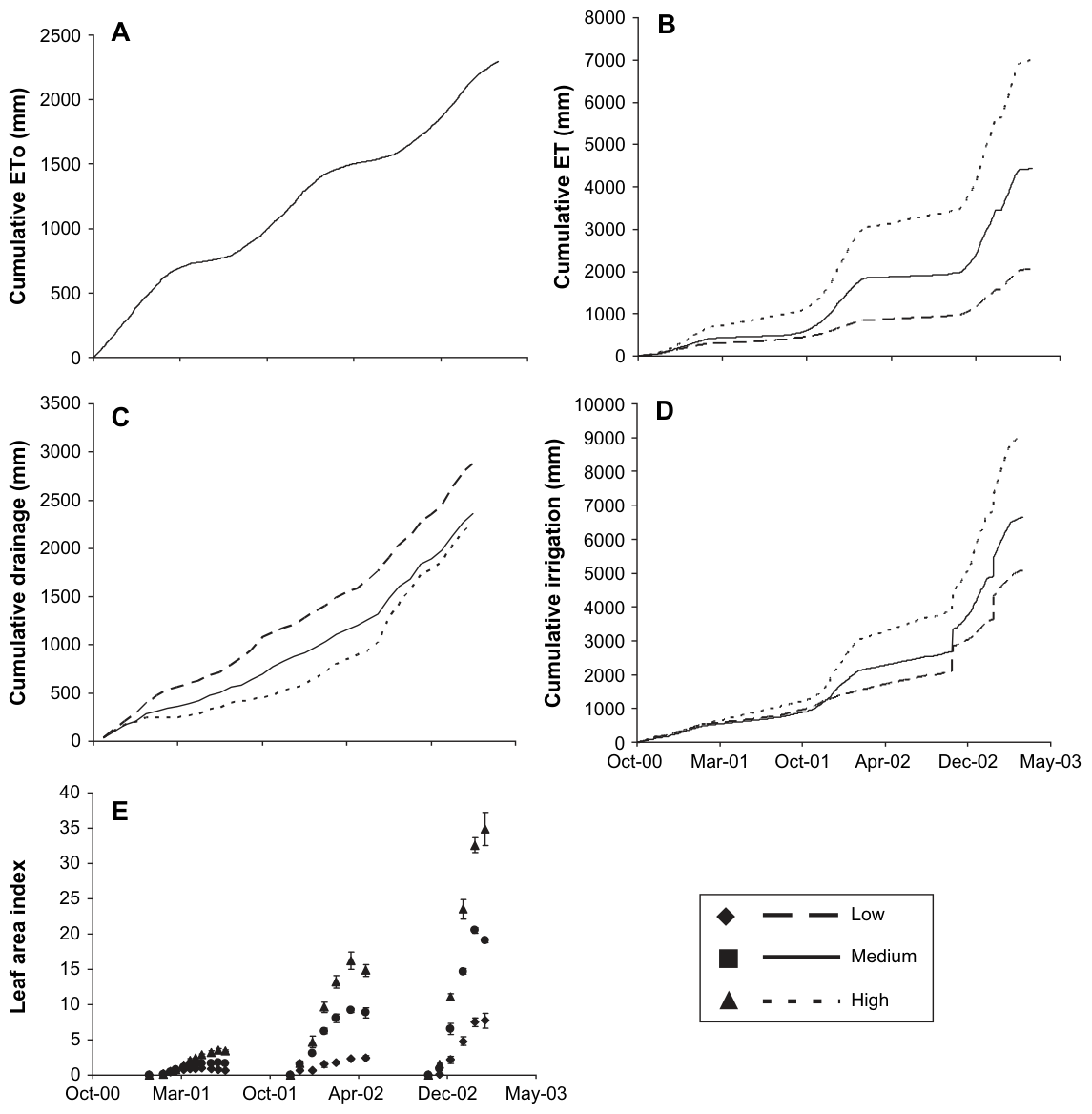
The lysimeters were given a measured amount of water daily to maintain their volumetric water content between 0.50 and 0.60 m3/m3. Fig. 1D shows the cumulative irrigation applied to the ‘low’, ‘medium’, and ‘high’ treatments. We collected the drainage weekly and weighed it. Every 2 weeks we removed every 10th leaf, counting from the oldest leaf on the first shoot, through to the youngest leaf before the apical bud. The leaves were then dried, ground and stored for analysis. In mid April of 2001, 2002 and 2003, we removed all the leaves from the trees and measured their total dry biomass. In May 2003, we divided the wood-waste in the lysimeters horizontally into 0.2 m portions, taking three samples from each depth portion, and ensuring each sample was free of roots. We did not sample the roots and stems of the poplars.
每天向渗漏计定量供水,使其体积含水量维持在0.50~0.60 m3/m3之间。图1D显示了“低”“中”“高”处理的累积灌溉量。每周收集排水并称重。每2周从第一根枝条上最老的叶片开始计数,至顶芽前最幼嫩的叶片,每隔10片摘取1片叶。叶片经烘干、研磨后储存待测。2001年、2002年和2003年的4月中旬,我们摘除树上全部叶片并测定其总干生物量。2003年5月,将渗漏计中的木材废料沿水平方向分为每层0.2 m,每个深度层取3个样品,并确保样品中无根系。未对杨树的根和茎进行采样。
2.4. Boron leaching from abscised leaves2.4. 脱落叶片中硼的淋溶
We conducted an experiment to determine the rate of B leaching from poplar leaves during the winter months, under controlled conditions. This experiment used leaves from the final harvest of the lysimeter experiment. In May 2003, we filled three cylinders, each 0.5 m long and 0.39 m in diameter, with 5 kg of fresh leaf material (1.6 kg dry matter). The initial height of the leaves was 0.3 m, decreasing to 0.13 m at the end of the experiment. We covered the bottoms of the cylinders with plastic gauze and placed the cylinder upon a collection bucket. The cylinders were irrigated daily with 0.1 L of water. We collected the drainage every week, which on average was 42% of the volume irrigated. After 14 weeks, the leaf material was dried, weighed, and analysed for B along with the acidified leachate samples.
我们开展了一项试验,在受控条件下测定冬季杨树叶片中B的淋溶速率。该试验使用渗漏计试验最后一次收获的叶片。2003年5月,我们在3个长0.5 m、直径0.39 m的圆筒中各装入5 kg新鲜叶片材料(1.6 kg干物质)。叶片初始高度为0.3 m,试验结束时降至0.13 m。圆筒底部覆盖塑料纱网,并置于收集桶上。每天向圆筒浇水0.1 L。每周收集排水,平均为灌水量的42%。14周后,将叶片材料烘干、称重,并与酸化后的淋溶液样品一同测定B。
provided any significant growth in the first year. These were P. euramericana � yunnanensis (‘Toa’), P. deltoides � yunnanensis (‘Kawa’), and P. alba � glandulosa (‘Yeogi’). By the second growing season, many of the other clones/species had perished. Table 1 shows the stem and leaf biomass production for the selected poplar clones during the first 3 years of growth. The biomass of all three species increased exponentially during the measurement period. By the end of the 2002e2003 growing season, the approximate dry biomass of the trees cover on the Kopu site was over 30 t/ha. This is comparable to the biomass production of poplars growing in a similar environment on non-contaminated soil (Pilar Ciria, 1999).
在第一年有明显生长。这3个无性系为P. euramericana × yunnanensis(‘Toa’)、P. deltoides × yunnanensis(‘Kawa’)和P. alba × glandulosa(‘Yeogi’)。到第二个生长季,许多其他无性系/物种已死亡。表1给出了所选杨树无性系在生长前3年的茎和叶生物量。在测定期间,3个无性系的生物量均呈指数增长。至2002–2003年生长季结束时,Kopu场地林木覆盖的干生物量约超过30 t/ha。这与在类似环境下未污染土壤上生长的杨树生物量相当(Pilar Ciria, 1999)。
Table 2 shows the B concentrations in the stems and leaves of 2-year-old poplars at Kopu, along with the B concentration of the wood-waste in which they were growing. All three clones accumulated B to concentrations greater than 700 mg/kg on a dry matter basis, some 25 times greater than the B concentration in the wood-waste where they were growing. There were no significant differences in B uptake between the three clones. For all clones, there were significant and positive correlations between the leaf and wood-waste B concentrations. In contrast to the leaves, the stems had lower B concentrations than the wood-waste in which the trees were growing.表2给出了Kopu场地2年生杨树茎和叶中的B浓度,以及其生长所在木材废料的B浓度。3个无性系的B积累浓度(以干物质计)均超过700 mg/kg,约为其生长所在木材废料B浓度的25倍。3个无性系之间B吸收量无显著差异。所有无性系的叶片B浓度与木材废料B浓度之间均呈显著正相关。与叶片不同,茎中B浓度低于树木生长所在木材废料的B浓度。
Poplar growth at the Kopu site changed the physical and biological properties of the wood-waste. After 3 years’ of growth, wood-waste in the root-zone became a dark humuslike material, which was colonised by worms and other organisms. We did not quantify these changes.
杨树在Kopu场地的生长改变了木材废料的物理和生物学性质。生长3年后,根区的木材废料变为深色的类腐殖质物质,并有蚯蚓及其他生物定殖。我们未对这些变化进行定量。
2.5. Sample preparation and elemental determination2.5. 样品制备与元素测定
3.2. Poplar growth and B uptake in lysimeters3.2. 渗漏计中杨树的生长与硼吸收
Samples were analysed for B at certified commercial laboratory (Hill Laboratories, Hamilton, New Zealand) using the US EPA Method 200.2 (US EPA, 1994) for total recoverable trace elements. The digestion uses nitric and hydrochloric acids to dissolve sieved or ground material. Digests were analysed using Inductively Coupled Plasma Atomic Emission Spectroscopy (ICPAES).
样品由经认证的商业实验室(Hill Laboratories,新西兰Hamilton)采用US EPA Method 200.2(US EPA, 1994)测定总可回收微量元素中的B。消解使用硝酸和盐酸溶解过筛或研磨后的材料。消解液采用电感耦合等离子体原子发射光谱法(ICP-AES)进行分析。
3Results and discussion结果与讨论
3.1. Poplar growth and B uptake at the Kopu site3.1. Kopu场地杨树的生长与硼吸收
A visual assessment in the autumn of 2002 revealed that only three of the 11 clones/species in the test planting high biomass production of the higher fertiliser treatments translated into a greater leaf area index (Fig. 1E). For the medium and high treatments, the leaf area index exceeded the value of six, at which maximum transpiration occurs in a poplar forest under high light conditions (Heilman et al., 1996). The cumulative evaporation increased upon fertiliser treatment (Fig. 1B). There was significantly less drainage from the ‘medium’ and ‘high’ fertiliser treatments compared to the ‘low’ treatment (Fig. 1C), despite the maintenance of all the lysimeters at similar water contents throughout the experiment.
2002年秋季的目测评估显示,试验种植区的11个无性系/物种中,只有3个较高施肥处理的高生物量产出转化为更大的叶面积指数(图1E)。在中、高处理中,叶面积指数超过6,而在强光条件下杨树林在该值时达到最大蒸腾(Heilman et al., 1996)。累积蒸发量随施肥处理而增加(图1B)。尽管在整个试验期间所有渗漏计均维持在相近的含水量,“中”和“高”施肥处理的排水量仍显著少于“低”处理(图1C)。
Table 1 shows the annual leaf biomass production of the poplars in the lysimeter experiment. Biomass significantly increased upon the addition of fertiliser. Compared to the trees in the lysimeter experiment, the growth of the trees at Kopu was between the ‘‘low’’ and ‘‘medium’’ fertiliser treatments. The trees grown in the ‘low’ fertilisation treatment showed visible signs of nutrient deficiency, namely stunting and chlorosis.表1给出了渗漏计试验中杨树的年叶片生物量。施肥后生物量显著增加。与渗漏计试验中的树木相比,Kopu场地树木的生长介于“低”和“中”施肥处理之间。“低”施肥处理的树木表现出明显的养分缺乏症状,即生长矮化和失绿。
Table 3 shows the water balance for the three treatments throughout the experiment. There was, at most, a 4% discrepancy between the water added to the system and the water lost from the system. Fig. 1(AeE) shows the data affecting the tree’s water use during the experiment. As expected, the表3给出了3个处理在整个试验期间的水分平衡。输入系统的水量与系统损失的水量之间的差异最多为4%。图1(A–E)显示了试验期间影响树木耗水的数据。正如预期,
Average biomass production (kg) of individual poplar trees from the field site at Kopu and from the parallel lysimeter experiment
Kopu田间场地及平行渗漏计试验中单株杨树的平均生物量(kg)
| 2000e2001 | 2001e2002 | 2002e2003 | ||||
|---|---|---|---|---|---|---|
| Leaf | Stem | Leaf | Stem | Leaf | Stem | |
| Kopu field site | Variety | |||||
| Kawa (n¼3) | 0.12 (0.01) | 0.10 (0.01) | 0.41 (0.12) | 1.03 (0.32) | 0.85 (0.18) | 3.40 (0.86) |
| Toa (n¼3) | 0.06 (0.00) | 0.11 (0.01) | 0.53 (0.07) | 1.31 (0.25) | 0.80 (0.12) | 3.52 (0.64) |
| Yeogi (n¼3) | 0.11 (0.00) | 0.12 (0.00) | 0.50 (0.03) | 2.69 (0.36) | 0.98 (0.22) | 5.27 (1.28) |
| Parallel lysimeter experiment | Treatment | |||||
| Low (n¼2) | 0.09 (0.01) | nd | 0.36 (0.00) | nd | 0.67 (0.06) | nd |
| Medium (n¼3) | 0.19 (0.00) | nd | 0.88 (0.03) | nd | 1.49 (0.08) | nd |
| High (n¼3) | 0.32 (0.03) | nd | 1.45 (0.12) | nd | 2.08 (0.01) | nd |
The variety used in the lysimeter experiment was Toa. Values in brackets are the standard error of the mean. nd, Not determined.
渗漏计试验所用品种为Toa。括号内数值为平均值的标准误。nd,未测定。
Average total B concentrations (mg/kg) in the wood-waste and in 2-year-old poplar trees at Kopu
Kopu场地木材废料及2年生杨树中的平均总B浓度(mg/kg)
| Clone无性系 | Wood-waste木材废料 | Stem茎 | Leaf叶片 | Gradient斜率 | Correlation r (p)相关系数r(p) |
|---|---|---|---|---|---|
| Kawa (n¼7) | 31 (7) | 20 (5) | 827 (166) | 25.6 | 0.76 (0.05>p>0.01) |
| Toa (n¼6) | 36 (9) | 22 (4) | 1012 (103) | 24.4 | 0.87 (0.05>p>0.01) |
| Yeogi (n¼8) | 28 (5) | 20 (1) | 776 (97) | 26.4 | 0.87 (0.01>p>0.001) |
| Average of all trees (n¼21) | 30 (4) | 21 (2) | 845 (71) | 25.4 | 0.74 (p<0.001) |
The gradient and correlation, respectively, describe the slope of the leaf [B]/wood-waste [B] regression line, and the fit of this line to the data. Values in brackets are the standard error of the mean.
斜率和相关系数分别描述叶片[B]/木材废料[B]回归直线的斜率以及该直线与数据的拟合程度。括号内数值为平均值的标准误。
The evapotranspiration in the lysimeter experiment does not correspond to the field situation. The trees in the lysimeters received significantly more light than those at Kopu because there were no adjacent trees that blocked sunlight. The average crop coefficient, defined as the actual evapotranspiration (Fig. 1B) divided by the potential evapotranspiration (Fig. 1A), during our lysimeter experiment was 0.9, 1.9 and 3.1 for the low, medium and high treatments. Poplars in the field have a maximum crop coefficient (Kc(max)) of 1.0 (AgriMet, 2006). Therefore, in the field situation, fertiliser addition will increase the speed of plant establishment and decrease the time from planting to Kc(max), but not significantly increase tree water use from the site under closedcanopy conditions.
渗漏计试验中的蒸散量与田间情况并不对应。由于没有相邻树木遮挡阳光,渗漏计中的树木比Kopu场地的树木接受的光照显著更多。平均作物系数定义为实际蒸散量(图1B)除以潜在蒸散量(图1A),在本渗漏计试验中低、中、高处理分别为0.9、1.9和3.1。田间杨树的最大作物系数(Kc(max))为1.0(AgriMet, 2006)。因此,在田间条件下,施肥可加快植物定植速度,缩短从种植到达到Kc(max)的时间,但在郁闭冠层条件下不会显著增加场地内树木的耗水量。
Table 3 shows the mass balance for B in the lysimeter experiment. The amount leached was four times more than the amount added with the Hoagland’s solution in the ‘high’ treatment. This indicates that the wood-waste B concentration decreased during the experiment and that the B in the Hoagland’s表3给出了渗漏计试验中B的质量平衡。在“高”处理中,淋溶量是随Hoagland营养液添加量的4倍。这表明试验期间木材废料B浓度有所下降,且Hoagland
solution was unlikely to have significantly enhanced plant B uptake. During the 3-year experiment, the poplars extracted into their leaves 21, 30, and 42% of the initial wood-waste B for the ‘low’, ‘medium’, and ‘high’ treatments, respectively. Although the drainage regimes were not comparable across the 3 years, the concentration of B in the drainage water in the last year was, on average 0.23 mg/L, a value lower than the Australia New Zealand Environmental Conservation Council’s (ANZECC, 2000) threshold for B’s Environmental Investigation Level. This third year level was just 10% of the initial leachate levels of 2.2 mg/L (Robinson et al., 2003a).
营养液中的B不太可能显著促进植物对B的吸收。在3年试验期间,“低”“中”“高”处理的杨树叶片分别提取了木材废料初始B的21%、30%和42%。尽管3年间的排水状况不可比,但最后一年排水中B浓度平均为0.23 mg/L,低于澳大利亚和新西兰环境保护委员会(ANZECC, 2000)规定的B环境调查水平阈值。第三年的水平仅为初始淋溶液水平2.2 mg/L的10%(Robinson et al., 2003a)。
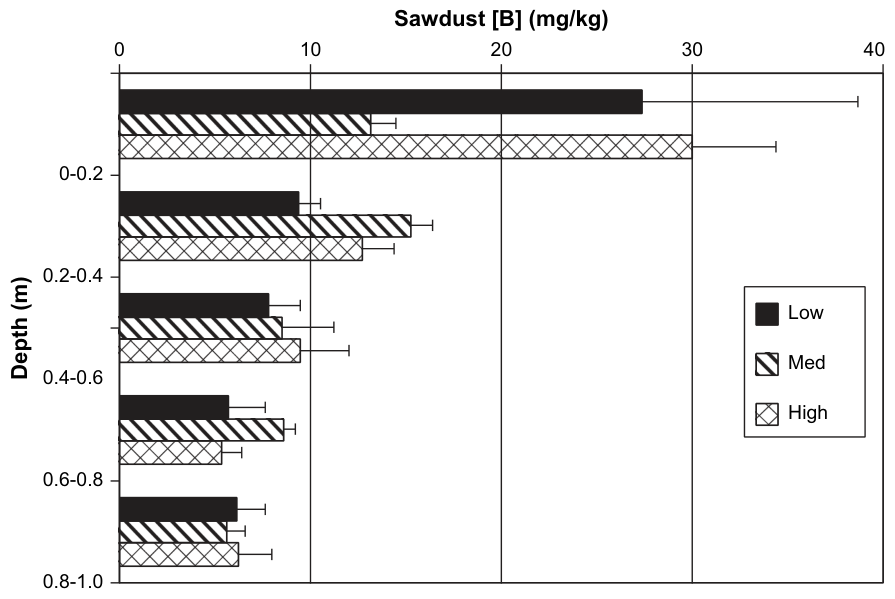
At the end of the experiment, there was a significant decrease in the wood-waste B concentration as a function of depth (Fig. 4). This is the opposite pattern of what one would expect if leaching occurred in a homogeneous lysimeter. Capillary rise could increase surface B concentrations. However, this is unlikely because we irrigated the lysimeters to excess to produce drainage. Another explanation may be that most of the roots occurred at depth and thus removed more B from the bottom of the wood-waste profile that the top. We observed, but did not quantify, that most of the roots were at the bottom of the lysimeters. Unfortunately, we had no lysimeters without trees, so the effect of the roots on the B distribution in the wood-waste remains unclear.
试验结束时,木材废料B浓度随深度增加显著降低(图4)。这与均质渗漏计中发生淋溶时的预期模式相反。毛管上升可能增加表层B浓度。然而,由于我们对渗漏计过量灌溉以产生排水,这种可能性不大。另一种解释可能是大部分根系分布于深层,因而从木材废料剖面底部移除的B多于顶部。我们观察到(但未定量)大部分根系位于渗漏计底部。遗憾的是,本试验未设无树渗漏计,因此根系对木材废料中B分布的影响尚不明确。
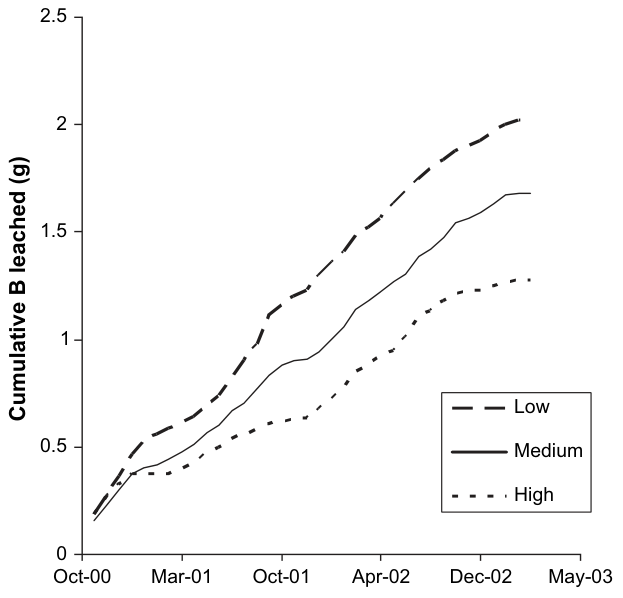
The amount of B that leached from the lysimeters significantly decreased as the rate of fertilisation increased (Fig. 2). Since the leaching volumes of the ‘medium’ and ‘high’ fertiliser treatments were not significantly different, the lower amount of B that leached from the ‘high’ treatment was due to a decrease in the B concentration in the leachate. Thus, fertilisation improved the quality of the drainage water.
随着施肥量增加,渗漏计中淋溶的B量显著减少(图2)。由于“中”和“高”施肥处理的淋溶体积无显著差异,“高”处理B淋溶量较低是由于淋溶液中B浓度降低所致。因此,施肥改善了排水水质。
Mass balance of B and water in the lysimeters, from the initial planting in October 2000 to the end of the experiment in May 2003
从2000年10月初始种植至2003年5月试验结束期间渗漏计中B和水分的质量平衡
| Low (n¼2) | Medium (n¼3)中(n = 3) | High (n¼3)高(n = 3) | ||||
|---|---|---|---|---|---|---|
| Boron (g) | Water (m3) | Boron (g) | Water (m3) | Boron (g) | Water (m3) | |
| Initial | ||||||
| Wood-waste | 4.438 (0.002) | 0.661 (0.000) | 4.252 (0.008) | 0.627 (0.007) | 4.268 (0.219) | 0.636 (0.019) |
| Added | 0.108 | 3.222 (0.251) | 0.216 | 4.220 (0.175) | 0.320 | 5.740 (0.330) |
| Total | 4.546 | 3.883 | 4.468 | 4.847 | 4.588 | 6.376 |
| Final | ||||||
| ET | e | 1.304 (0.133) | e | 2.809 (0.119) | e | 4.446 (0.414) |
| Leaves | 0.859 (0.042) | 0.002 | 1.173 (0.199) | 0.005 | 1.972 (0.092) | 0.007 |
| Wood-waste | 1.207 (0.301) | 0.622 (0.006) | 1.089 (0.076) | 0.594 (0.010) | 1.302 (0.011) | 0.556 (0.013) |
| Drainage | 2.019 (0.503) | 1.826 (0.366) | 1.596 (0.108) | 1.500 (0.215) | 1.329 (0.238) | 1.434 (0.078) |
| Total | 4.086 | 3.752 | 3.859 | 4.908 | 4.603 | 6.443 |
Values in brackets are the standard error of the mean. ET, Evapotranspiration.
括号内数值为平均值的标准误。ET,蒸散量。
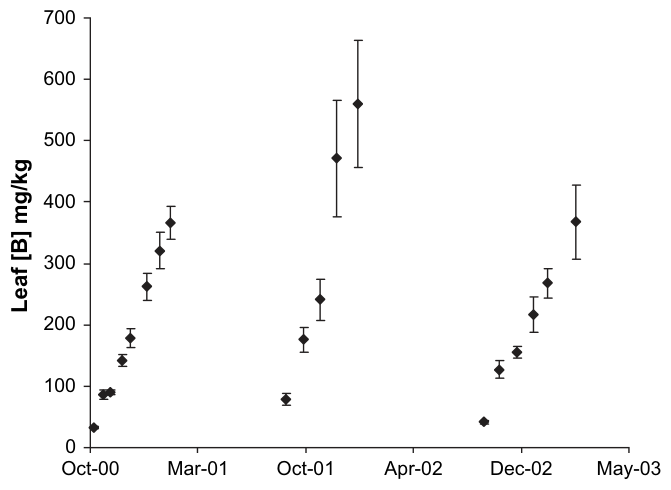
There were no significant differences in the leaf B concentrations between the different fertilisation regimes. This indicates that the macronutrient status of the tree did not affect the leaf B concentration. Nevertheless, the amount of B extracted per tree increased with increasing biomass production. Fig. 3 shows the average leaf B concentrations of all the trees throughout the experiment. Interestingly, there was no significant decrease in the leaf B concentration over the 3 years, despite a decrease in the substrate B concentration due to leaching and plant uptake. This may have been due to root development increasing the pool of plant-available B.
不同施肥方案之间叶片B浓度无显著差异。这表明树木的大量营养元素状况并不影响叶片B浓度。然而,单株树木提取的B量随生物量增加而增加。图3显示了试验期间所有树木的平均叶片B浓度。值得注意的是,尽管淋溶和植物吸收导致基质B浓度下降,3年间叶片B浓度并未显著降低。这可能是由于根系发育扩大了植物有效B库。
Within a single year, the leaf B concentrations were significantly and positively correlated with time. Thus, harvesting the trees at the end of the growing season before leaf fall would result in the highest rate of B removal from the site. This pattern of accumulation is consistent with the hypothesis that B transport occurs in the xylem and thus B accumulates in the leaves, which are a major water sink. Laureysens et al. (2004) observed a similar trend in the accumulation of other trace elements by European poplar varieties.
在同一年内,叶片B浓度与时间呈显著正相关。因此,在生长季末落叶前采伐树木可实现场地B的最高移除速率。这种积累模式与以下假说一致:B经木质部运输,因而积累于作为主要水分汇的叶片中。Laureysens et al.(2004)在欧洲杨树品种对其他微量元素的积累中观察到类似趋势。
3.3. Assessing the fate of B from abscised leaves3.3. 脱落叶片中硼的归趋评估
Most of the B taken up by the poplars is stored in the leaves (Table 1), and therefore returned to the soil each autumn following leaf abscission. The rate of B leaching from the decomposing leaves will affect the B concentration in any drainage from the site. The B that the leaves release during the winter months is likely to leach from the site, as evapotranspiration is minimal at this time.
杨树吸收的B大部分储存在叶片中(表1),因此每年秋季随叶片脱落返回土壤。分解叶片中B的淋溶速率将影响场地排水中的B浓度。由于冬季蒸散作用极弱,叶片在冬季释放的B很可能从场地淋溶流失。
After 14 weeks of decomposition, the leaves in our experiment had lost 45% of their initial mass, yet only 14% of their initial B content (Table 4). The leaves retain most of the B during the winter months. The rate of decomposition in our experiment is likely to be greater than would occur on the Kopu site because the experiment occurred in a shade-house where the temperatures were a few degrees higher than the Kopu site.
经过14周分解,本试验中叶片损失了其初始质量的45%,但仅损失了其初始B含量的14%(表4)。叶片在冬季保留了大部分B。由于试验在遮阴棚内进行,温度比Kopu场地高几摄氏度,本试验中的分解速率可能高于Kopu场地的实际情况。
These results indicate that during the winter months, the contribution of B from leaves to the B loading in leachate from the Kopu site is negligible. Presumably, the rate of decomposition and B release will increase in the following summer. At this time, the released B is less likely to leach because evapotranspiration rates are at a maximum. Nevertheless, unless trees are periodically removed from the site, the total B loading of the site will remain constant.
这些结果表明,在冬季,叶片中的B对Kopu场地淋溶液B负荷的贡献可忽略不计。可以推测,分解速率和B释放将在随后的夏季增加。此时,由于蒸散速率达到最大,释放的B不太可能被淋溶。然而,除非定期将树木从场地移除,否则场地的总B负荷将保持不变。
4The application of phytomanagement植物管理的应用
The most important factor in using poplar for phytomanagement is the successful establishment of trees on the site. Our experiments revealed that just three clones could tolerate the environmental conditions on the Kopu site. We cannot attribute this result to poplar B-tolerance alone, since wood-waste is an exotic medium for poplar growth and may have other growthlimiting factors. Every contaminated site has unique environmental conditions; therefore, a planting trial to determine the most suitable species/clones is an essential component of phytomanagement. Planting more species/clones reduces the risk of a single pest, such as rust (Melampsora spp.), damaging the entire site. Fertiliser application enhances tree establishment and does not reduce the leaf B concentration.
利用杨树进行植物管理最重要的因素是树木在场地上的成功定植。我们的试验表明,只有3个无性系能够耐受Kopu场地的环境条件。我们不能将这一结果仅归因于杨树的B耐性,因为木材废料对杨树生长而言是一种非常规基质,可能还存在其他生长限制因素。每个污染场地都有其独特的环境条件,因此,通过种植试验确定最适宜的物种/无性系是植物管理的必要组成部分。种植更多物种/无性系可降低单一病虫害(如锈病,Melampsora spp.)危害整个场地的风险。施肥可促进树木定植,且不会降低叶片B浓度。
Changes in average (n = 3) leaf B content and dry biomass after decomposition
分解后叶片B含量和干生物量平均值(n = 3)的变化
| Boron硼 | Mass (g)质量(g) | Percentage百分比 |
|---|---|---|
| Initial (leaves) | 0.560 | 100 |
| Final (leaves) | 0.485 (0.010) | 86 (1.7) |
| Final (leachate) | 0.075 (0.005) | 14 (0.9) |
| Leaf biomass | Mass (kg) | Percentage |
| Initial | 1.6 | 100 |
| Final | 0.889 (0.071) | 55 (5) |
Values in brackets are the standard error of the mean.
括号内数值为平均值的标准误。
The change in appearance in the wood-waste under the poplar trees and the increase in soil organisms such as worms may indicate increasing fertility. If so, then planting other species, such as the native grass Toetoe (Cortaderia toetoe Zotov.), would enhance the biodiversity of the site.
杨树下木材废料外观的变化以及蚯蚓等土壤生物的增加,可能表明肥力正在提高。若如此,种植其他物种,如本土禾草Toetoe(Cortaderia toetoe Zotov.),将提升场地的生物多样性。
The establishment of poplar on a B-contaminated site can reduce, or eliminate, B leaching via evapotranspiration alone. At Kopu, the collection and re-irrigation of drainage water further reduces leaching because it allows the trees to transpire at a maximum for the entire growing season by annulling the effect of droughts. Re-irrigation also reduces the importance of preferential flow processes. Normally, preferential flow permits water and solutes to traverse the vadose zone without interacting with roots, thus increasing leaching. However, this effect is less at the Kopu site because re-irrigation can occur ad infinitum. Re-irrigation also allows the tree roots to interact with B that has originated below the root-zone, which would otherwise be unavailable for plant uptake.
在受B污染场地种植杨树,仅通过蒸散作用即可减少甚至消除B的淋溶。在Kopu场地,收集排水并回灌可进一步减少淋溶,因为这可抵消干旱的影响,使树木在整个生长季保持最大蒸腾。回灌还降低了优先流过程的重要性。通常情况下,优先流使水分和溶质穿过包气带而不与根系相互作用,从而增加淋溶。然而,在Kopu场地这一效应较小,因为回灌可无限次进行。回灌还使树木根系能够与源自根区以下的B相互作用,否则这部分B无法被植物吸收。
In some cases, such as at Kopu, leaching is unavoidable because rainfall is greater than evapotranspiration. The holding pond at Kopu overflows at the end of winter and after exceptionally heavy rainfall. However, at these times the additional water carried in the local streams dilutes the B concentration in the leachate. Since at low concentrations, B is a beneficial micronutrient, dilution, in this case, is the solution to pollution.
在某些情况下,如Kopu场地,由于降雨量大于蒸散量,淋溶不可避免。Kopu场地的蓄水池在冬末和特大降雨后会发生溢流。然而,此时当地溪流中增加的水量会稀释淋溶液中的B浓度。由于低浓度的B是一种有益的微量营养元素,在这种情况下,稀释即是解决污染的办法。
4.1. Site maintenance4.1. 场地维护
In addition to hydraulic control of leaching from B-contaminated sites, the uptake of B into the leaves further reduces leaching because the abscised leaves release B only slowly. Nevertheless, equilibrium will occur when the decaying leaves release B as fast as the poplars take it up.
除了通过水力调控减少受B污染场地的淋溶外,由于脱落叶片释放B的速度很慢,B被吸收进入叶片也进一步减少了淋溶。然而,当腐解叶片释放B的速度与杨树吸收B的速度相当时,将达到平衡。
Boron could be removed from contaminated sites by removing the leaves after abscission or by periodically removing the above-ground biomass of the trees (coppicing). Leaf removal would be optimal, since transpiration would occur apace in the following growing season. However, this method may be prohibitively expensive.
可通过在叶片脱落后清除落叶或定期移除树木地上生物量(平茬)将B从污染场地移除。清除落叶是最佳方案,因为在随后的生长季中蒸腾作用可照常快速进行。然而,这种方法的成本可能过高。
Poplar trees re-grow from stumps, eliminating the need for replanting. Results from our lysimeter experiments indicate that the optimal time to coppice is at the end of the growing season, just before leaf fall because the B contained therein is maximised. However, coppicing may also increase the likelihood of leaching, because of the time needed for the trees to re-grow and establish the leaf area that is required to maintain high transpiration. An intermediate strategy, involving a partial coppice, may remove a fraction of the total biomass, thus removing B while contemporaneously limiting leaching. The amount of material removed and the frequency of removal are critical success factors for any coppicing strategy.
杨树可从伐桩重新萌发生长,无需重新种植。渗漏计试验结果表明,平茬的最佳时间是生长季末、落叶之前,因为此时叶片中所含的B达到最大。然而,平茬也可能增加淋溶的可能性,因为树木需要时间重新生长并形成维持高蒸腾所需的叶面积。一种折中策略是部分平茬,即移除总生物量的一部分,从而在移除B的同时限制淋溶。移除的材料量和移除频率是任何平茬策略成功的关键因素。
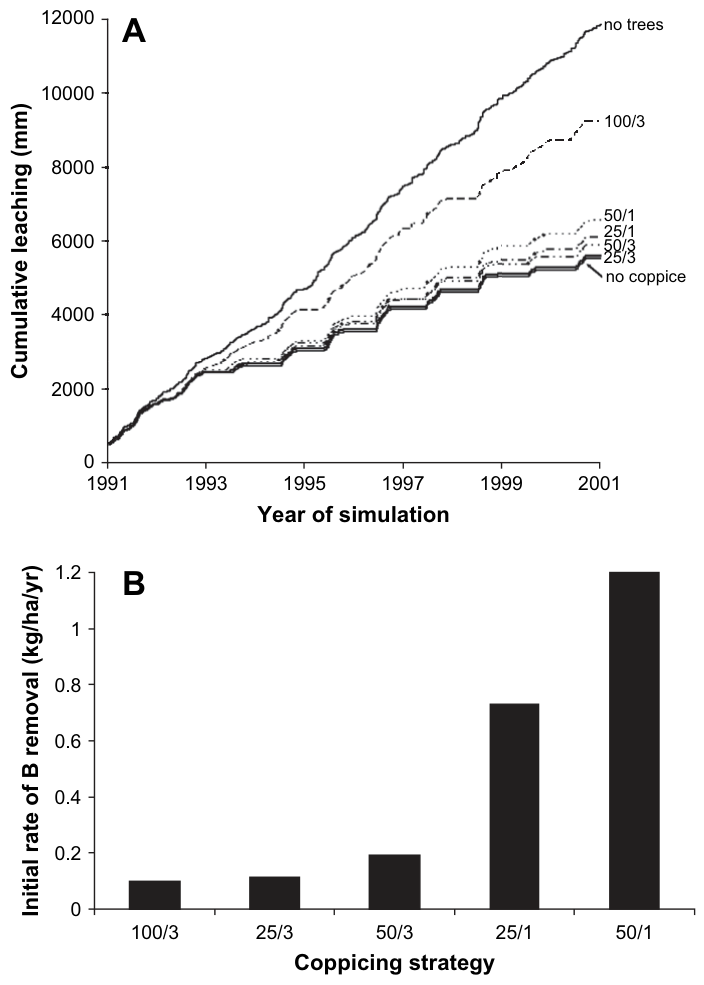
Here we discuss the effects of various management strategies using computer model, the Phyto-DSS (Robinson et al., 2003a,b), to simulate the effect that various coppicing strategies will have on B removal and leaching from the Kopu site. We parameterised the model using results from our experiments at Kopu, along with meteorological data from Thames during the period 1990e2000. We calculated leaching from the site (Fig. 5A), as well as the initial rate of B removal (Fig. 5B), namely the amount of B removed in the first harvest. The simulated coppicing strategies examined here all begin after 3 years of growth, i.e. when the trees have established an extensive root system and can rapidly re-grow after coppicing. Removing 100% of the above-ground biomass annually would allow too much leaching, so we examined removing 25% and 50% of the above-ground biomass annually, as well as removing 25%, 50%, and 100% every 3 years.
本文利用计算机模型Phyto-DSS(Robinson et al., 2003a,b)探讨了不同管理策略的效果,模拟不同平茬策略对Kopu场地B移除和淋溶的影响。我们利用Kopu场地的试验结果以及Thames气象站1990–2000年的气象数据对模型进行参数化。我们计算了场地的淋溶量(图5A)以及B的初始移除速率(图5B),即首次采收移除的B量。此处考察的模拟平茬策略均在生长3年后开始,即树木已形成发达的根系、平茬后能迅速再生之时。每年移除100%的地上生物量会导致过多淋溶,因此我们考察了每年移除25%和50%的地上生物量,以及每3年移除25%、50%和100%的地上生物量。
These calculations indicate that annually removing 50% of the biomass after an initial 3 years of growth would only slightly increase the leaching from the site, while initially removing over 1 kg of leachable B per hectare (Fig. 5A, B). Although it would take many years to remove all of the B from the root-zone, our lysimeter experiments demonstrated that coppicing could rapidly reduce the levels of B in root-zone leaching. These calculations assume that pathogens, such as ‘silver leaf’ (Chondrostereum purpureum), do not affect the growth of the potentially B-stressed trees.
这些计算表明,在初始生长3年后每年移除50%的生物量,只会略微增加场地的淋溶,同时初期每公顷可移除超过1 kg的可淋溶B(图5A、B)。尽管将根区的B全部移除需要很多年,但我们的渗漏计试验表明,平茬可迅速降低根区淋溶液中的B水平。这些计算假设病原菌(如引起“银叶病”的Chondrostereum purpureum)不影响可能受B胁迫树木的生长。
At the Kopu site, coppicing the trees may be essential to maintain a viable vegetative cover. Wood-waste is a low strength medium. Letting the trees grow beyond a certain height may increase the likelihood of them toppling over.
在Kopu场地,平茬可能是维持可持续植被覆盖的必要措施。木材废料是一种强度较低的基质。任树木生长超过一定高度可能增加其倒伏的可能性。
4.2. Use of B-rich biomass following B phytoextraction4.2. 硼植物提取后富硼生物质的利用
The poplars growing on the Kopu site had a high B concentration relative to pasture species (Underwood and Suttle, 1999). Provided the leaves do not contain excessive amounts of other environmental contaminants, the biomass may provide a source of this element to animal stock (Robinson et al., 2005), which depending on its concentration, may have beneficial effects such as increased growth and bone density (Mastromatteo and Sullivan, 1994). That B is an essential nutrient for mammals was unknown until recently, when researchers found that B plays a significant role as a cofactor for the hormones involved in mineral uptake into bone matrix structure, as well as the reproductive hormones oestrogen and testosterone (Nielsen et al., 1987).
与牧场植物相比,Kopu场地生长的杨树B浓度较高(Underwood and Suttle, 1999)。只要叶片不含过量的其他环境污染物,该生物质可为牲畜提供这一元素的来源(Robinson et al., 2005),视其浓度而定,可能产生有益效果,如促进生长和提高骨密度(Mastromatteo and Sullivan, 1994)。B是哺乳动物必需营养元素这一点直到最近才为人所知,研究人员发现,B作为辅因子,对参与矿物质进入骨基质结构的激素以及生殖激素雌激素和睾酮发挥着重要作用(Nielsen et al., 1987)。
Similarly, since B deficiencies are common in agricultural soils (Gupta, 1967), the harvested and mulched material may constitute an organic fertiliser on B-deficient soils. Here again, it is important that the leaves do not contain any additional contaminants that may have been present on the contaminated site.
同样,由于农业土壤中缺B现象普遍(Gupta, 1967),采收并覆盖(粉碎)的材料可作为缺B土壤的有机肥料。在此同样重要的是,叶片不应含有污染场地中可能存在的其他污染物。
Alternatively, the harvested material may provide biofuel. Here, the elemental composition of the trees is less important. Ash with a high B concentration could be stored in a sealed landfill or other place where it does not pose a risk to the environment. The use of poplar as biofuel relies on the presence of a nearby incinerator.
另外,采收的材料可用作生物燃料。在这种情况下,树木的元素组成不太重要。高B浓度的灰分可储存于封闭式填埋场或其他不会对环境构成风险的地点。将杨树用作生物燃料有赖于附近有焚烧设施。
5Conclusions结论
The phytomanagement of B using poplar is most effective when the trees are partially coppiced and where effluent from the site is re-irrigated onto the trees. Since each site has unique environmental conditions, whole-system mechanistic models are required to optimise the coppicing strategy. The high biomass production of the trees combined with their high leaf/soil concentration quotient may result in a significant decrease in the soil B in just a few years. Nevertheless, most polluted sites contain a suite of contaminants so removing the B will not result in site cleanup, just mitigate the effects of this highly mobile trace element.
当对树木进行部分平茬且将场地排水回灌至树木时,利用杨树对B进行植物管理最为有效。由于每个场地都有其独特的环境条件,需要采用全系统机理模型来优化平茬策略。树木的高生物量产出加上其较高的叶片/土壤浓度比,可能在短短几年内使土壤B显著降低。然而,大多数污染场地含有多种污染物,因此移除B并不能实现场地清洁,只能减轻这一高迁移性微量元素的影响。
A critical and unanswered question is the interaction of the roots with B-contaminated media. We do not know how much B is bound in the root system, nor do we understand how roots interact with B hotspots in heterogeneously contaminated media.
一个关键而尚未解决的问题是根系与受B污染介质之间的相互作用。我们尚不清楚有多少B结合在根系中,也不了解根系如何与非均质污染介质中的B热点相互作用。
Acknowledgements致谢
We thank the following contributors for their input and discussion: Ian McIvor, Sarah Hurst, Lindsay Fung, Iris Vogeler, Markus Deurer, Rafael Laplane, Marijn van der Velde, Siva Sivakumaran of, or formerly of, HortResearch, Palmerston North, New Zealand. We also thank Prof. M.B. Kirkham, Kansas State University, for a thorough and constructive review of the manuscript.
感谢以下现任或前任新西兰Palmerston North HortResearch人员的意见与讨论:Ian McIvor、Sarah Hurst、Lindsay Fung、Iris Vogeler、Markus Deurer、Rafael Laplane、Marijn van der Velde、Siva Sivakumaran。同时感谢堪萨斯州立大学M.B. Kirkham教授对本文稿进行了全面且建设性的评审。
Appendix A. Supplementary data附录A. 补充数据
Supplementary data associated with this article can be found, in the online version, at doi:10.1016/j.envpol.2007.01.017.
与本文相关的补充数据可在在线版本中获取,网址为doi:10.1016/j.envpol.2007.01.017。
References参考文献
Adriano, D.C., 2001. Trace Elements in Terrestrial Environments. Biogeochemistry, Bioavailability, and Risks of Metals, second ed. Springer, New York.
AgriMet, 2006. The Pacific Northwest Cooperative Agricultural Weather Network. Available from: <http://www.usbr.gov/pn/agrimet/cropcurves/ POP3cc.html> (accessed 14.7.06.).
ANZECC, 2000. Australian and New Zealand Guidelines for Fresh and Marine Water Quality, Volume 1, The Guidelines (Chapters 1e7). Australian and New Zealand Environment and Conservation Council (ANZECC) and Agriculture and Resource Management Council of Australia and New Zealand (ARMCANZ). Paper No. 4 e Volume 1 (Chapters 1e7), Wellington.
Banerji, S.K., May 1969. Boron adsorption on soils and biological sludges and its effects on endogenous respiration. In: 24th Industrial Waste Conference, Purdue University.
Ba~nuelos, G.S., 1995. Managing high levels of B and Se with trace element accumulator crops. Journal of Environmental Science and Health A31 (5), 1179e1196.
Ba~nuelos, G.S., Shannon, M.C., Ajwa, H., Draper, J.H., Jordahl, J., Licht, L., 1999. Phytoextraction and accumulation of boron and selenium by poplar (Populus) hybrid clones. International Journal of Phytoremediation 1 (1), 81e96.
Berger, K.C., Truog, E., 1945. Boron availability in relation to soil reaction and organic matter content. Soil Science Society of America Proceedings 9, 113e116.
Bertine, K.K., Goldberg, E.D., 1971. Fossil fuel combustion and the major sedimentary cycle. Science 173, 233e235.
Brown, P.H., Shelp, B.J., 1997. Boron mobility in plants. Plant and Soil 193, 85e101.
Doak, R., 2003. Pilot project e coal ash burial in saturated conditions. Solid Waste News & Notes 6 (1), 1e3.
Evans, C.M., Sparks, D.L., 1983. On the chemistry and mineralogy of boron in pure and in mixed systems. Communications in Soil Science and Plant Analysis 14 (9), 827e846.
Goldberg, S., 1997. Reactions of boron with soils. Plant and Soil 193, 35e48.
Gupta, U.C., 1967. A simplified method for determining hot-water-soluble boron in podzol soils. Soil Science 103 (6), 424e428.
Gupta, U.C., 1979. Boron nutrition of crops. Advances in Agronomy 31, 273e307.
Gupta, U.C., Macleod, J.A., 1981. Plant and soil boron as influenced by soil
pH and calcium sources on podzol soils. Soil Science 131 (1), 20e25.
Heilman, P.E., Hinckley, T.M., Roberts, D.A., Ceulemans, R., 1996. Production physiology. In: Stettler, R.F., Bradshaw Jr. H.D., Heilman, P.E., Hinckley, T.M. (Eds.), Biology of Populus and Its Implications for Management and Conservation. NRC Research Press, Ottawa, pp. 459e490.
Hoagland, D.R., Arnon, D.I., 1950. The Water Culture Method of Growing Plants Without Soil. California Agricultural Research Station. Circular 347. Cited from Salisbury, F.B., Ross, C.W., 1992. Plant Physiology, fourth ed. Wadsworth, Belmont, CA, p. 119.
Howe, P.D., 1998. A review of boron effects in the environment. Biological Trace Element Research 66, 153e166.
Hu, H., Brown, P.H., 1997. Absorption of boron by plant roots. Plant and Soil 193, 49e58.
James, W.D., Graham, C.C., Glascock, M.D., Hanna, A.G., 1982. Water-leachable boron from coal ashes. Environmental Science and Technology 16, 195e197.
Keren, R., Bingham, F.T., 1985. Boron in water, soils, and plants. Advances in Soil Science 1, 229e276.
Laureysens, I., Blust, R., de Temmerman, L., Lemmens, C., Ceulemans, R., 2004. Clonal variation in heavy metal accumulation and biomass production in a poplar coppice culture: I. Seasonal variation in leaf, wood and bark concentrations. Environmental Pollution 131 (3), 485e494.
Mastromatteo, E., Sullivan, F., 1994. Summary: international symposium on the health effects of boron and its compounds. Environmental Health Perspectives 102 (7), 139e141.
McGee, A.B., Schmierbach, M.R., Bazzaz, F.A., 1981. Photosynthesis and growth of populations of Populus deltoides from contrasting habitats. The American Midland Naturalist 105 (2), 305e311.
Mills, T., Robinson, B.H., 2003. Hydraulic management of contaminated sites using vegetation. In: Stewart, B.A., Howell, T.A. (Eds.), Encyclopedia of Water Science. Marcel Dekker Inc., New York, pp. 1e5.
Nable, R.O., Banuelos, G.S., Paull, J.G., 1997. Boron toxicity. Plant and Soil 198, 181e198.
Nielsen, F.H., Hunt, C.D., Mullen, L.M., Hunt, J.R., 1987. Effect of dietary boron on minerals, estrogen, and testosterone metabolism in post-menopausal women. Federation of American Societies for Experimental Biology Journal 1, 394e397.
Oertli, J., Grgurevic, J., 1975. Effect of pH on the absorption of boron by excised barley roots. Agronomy Journal 67, 278e280.
Parks, J.L., Edwards, M., 2005. Boron in the Environment. Critical Reviews in Environmental Science and Technology 35, 81e114.
Peterson, L.A., Newman, C.R., 1976. Influence of soil pH on the availability of added boron. Soil Science Society of America Journal 40, 280e282.
Pilar Ciria, M., 1999. Effect of Rotation Age and Plantation Density on the
Productivity of Several Poplar Clones on Short Rotation in Spain. Ph.D. thesis. Available from: <http://www.eeci.net/archive/biobase/B10512. html>. (accessed 18.7.06.).
Reid, R.J., Hayes, J.E., Post, A., Stangoulis, J.C.R., Graham, R.D., 2004. A critical analysis of the causes of boron toxicity in plants. Plant, Cell and Environment 25, 1405e1414.
Robinson, B.H., Green, S.R., Mills, T.M., Clothier, B.E., van der Velde, M., Laplane, R., Fung, L., Deurer, M., Hurst, S., Thayalakumaran, T., van den Dijssel, C., 2003a. Phytoremediation: using plants as biopumps to improve degraded environments. Australian Journal of Soil Research 41 (3), 599e611.
Robinson, B.H., Ferna´ndez, J.E., Madejo´n, P., Mara~no´n, T., Murillo, J.M., Green, S.R., Clothier, B.E., 2003b. Phytoextraction: an assessment of biogeochemical and economic viability. Plant and Soil 249 (1), 117e125.
Robinson, B.H., Mills, T.M., Green, S.R., Chancerel, B., Clothier, B.E., Fung, L., Hurst, S., McIvor, I., 2005. Trace element accumulation by poplars and willows used for stock fodder. New Zealand Journal of Agricultural Research 48, 489e497.
Su, C., Suarez, D.L., 1995. Coordination of adsorbed boron: a FTIR spectroscopic study. Environmental Science and Technology 29, 302e311.
Underwood, E.J., Suttle, N.F., 1999. The Mineral Nutrition of Livestock, third ed. CAB International, Wallingford, UK. 531e533.
U.S. Environmental Protection Agency, 1994. Methods for the Determination of Metals in Environmental Samples. Supplement 1, EPA 600-R-94e111. US EPA, Washington DC.
U.S. Environmental Protection Agency, 2003. Drinking Water Contaminant Candidate List. Available from: <http://www.epa.gov/safewater/ccl/cclfs. html> (accessed September 2005).