ORIGINAL PAPER
Martin Tschan Æ Brett Robinson Æ Rainer Schulin
Received: 13 October 2006 / Accepted: 2 June 2007 / Published online: 6 February 2008 � Springer Science+Business Media B.V. 2008
Abstract We investigated the extent of Sb uptake by maize (Zea mays) and sunflower (Helianthus annuus) from nutrient solutions containing concentrations from 3 to 24 mg/L of potassium antimonate, with the aim of determining the potential of Sb to enter the food chain. The maximum shoot Sb concentrations in Z. mays and H. annuus were 41 mg/kg and 77 mg/kg dry weight, respectively. There was no significant difference in Sb uptake between species. The average bioaccumulation coefficients (the plant/solution concentration quotients) were 1.02 and 1.93 for Z. mays and H. annuus, respectively. Phosphate addition did not affect plant growth or Sb uptake. Antimony uptake by both Z. mays and H. annuus is unlikely to pose a health risk to animals and humans.
摘要 本研究考察了玉米(Zea mays)和向日葵(Helianthus annuus)从含3~24 mg/L锑酸钾的营养液中吸收Sb的程度,旨在评估Sb进入食物链的潜力。Z. mays和H. annuus地上部Sb的最高浓度分别为41 mg/kg和77 mg/kg(干重)。两物种间Sb吸收量无显著差异。Z. mays和H. annuus的平均生物富集系数(植物/溶液浓度比)分别为1.02和1.93。添加磷酸盐对植物生长和Sb吸收均无影响。Z. mays和H. annuus对锑的吸收不太可能对动物和人类构成健康风险。
Keywords Antimony � Crop plants � Food chain � HG-AFS � Plant uptake � Phosphorous
关键词 锑;作物;食物链;HG-AFS;植物吸收;磷
1Introduction引言
Antimony (Sb) is a rare element in the Earth’s crust, occurring at 0.2–0.3 mg/kg (Rish 2004). Common minerals are sulfides (in particular stibnite Sb2S3) and oxides (valentinite Sb2O3 and cervantite Sb2O4). However, it has become widespread in the environment because of its industrial uses in fire retardants, semiconductors, and as an agent for metal hardening (Filella et al. 2002). Antimony consumption has increased with global economic growth, resulting in elevated Sb concentrations in soils and natural waters, where it may affect plants, animals, and humans.
锑(Sb)是地壳中的稀有元素,含量为0.2~0.3 mg/kg(Rish 2004)。常见矿物为硫化物(尤其是辉锑矿Sb2S3)和氧化物(锑华Sb2O3和黄锑矿Sb2O4)。然而,由于其在阻燃剂、半导体以及金属硬化剂等方面的工业用途,锑已在环境中广泛分布(Filella et al. 2002)。锑的消费量随全球经济增长而增加,导致土壤和天然水体中Sb浓度升高,并可能对植物、动物和人类产生影响。
M. Tschan (&) � B. Robinson � R. Schulin Institute of Terrestrial Ecosystems, Soil Protection, Swiss Federal Institute of Technology, Universitaetstrasse 16, 8092 Zurich, Switzerland
M. Tschan(&)� B. Robinson � R. Schulin 瑞士苏黎世联邦理工学院陆地生态系统研究所土壤保护组,Universitaetstrasse 16, 8092 Zurich, Switzerland
e-mail: martin.tschan@env.ethz.ch
In Switzerland, high levels of Sb occur in soils associated with the approximately 2,000 shooting ranges scattered throughout the country (Gresch and Wettstein 2002). On average, new bullets and pellets consist of over 90% Pb, 1–7% Sb,\2% arsenic (As), and\0.5% nickel (Ni) (Rooney et al. 1999). Johnson et al. (2005) reported that Sb was the most soluble and mobile of all the trace element contaminants in Swiss shooting ranges. Wersin et al. (2002) reported elevated Sb concentrations in receiving waters near a Swiss shooting range.
在瑞士,全国约2,000个射击场的土壤中存在高含量的Sb(Gresch and Wettstein 2002)。新子弹和弹丸平均含Pb 90%以上、Sb 1%~7%、砷(As)<2%、镍(Ni)<0.5%(Rooney et al. 1999)。Johnson et al.(2005)报道,在瑞士射击场的所有微量元素污染物中,Sb的溶解性和迁移性最强。Wersin et al.(2002)报道,瑞士某射击场附近受纳水体中Sb浓度升高。
Antimony is a nonessential element for both plants and animals. Antimony is toxic to humans at chronic uptake rates exceeding 100 mg/d (Bowen 1979); rats are susceptible to an intake of 11–75 mg/d. Due to its toxicity and potential carcinogenic nature, there are regulations regarding human exposure to Sb in the workplace (Rish 2004). The European Union (EU) limit for Sb in drinking water is 5 lg/L (Filella et al. 2002). The European Commission has set a threshold of 0.04 mg Sb/kg for plastic materials and articles intended to come into contact with food (EU 2005). To date, there are no Swiss limits for antimony in soil and food. The Dutch intervention values for Sb in soil and groundwater are 15 mg/kg and 20 lg/L, respectively (Swartjes 1999).
锑对植物和动物均为非必需元素。当长期摄入速率超过100 mg/d时,锑对人体有毒(Bowen 1979);大鼠在摄入量为11~75 mg/d时即易受影响。鉴于其毒性和潜在致癌性,已有针对工作场所人体Sb暴露的相关法规(Rish 2004)。欧盟(EU)饮用水中Sb的限值为5 μg/L(Filella et al. 2002)。欧盟委员会规定,拟与食品接触的塑料材料及制品中Sb的阈值为0.04 mg/kg(EU 2005)。迄今为止,瑞士尚未制定土壤和食品中锑的限值。荷兰土壤和地下水中Sb的干预值分别为15 mg/kg和20 μg/L(Swartjes 1999)。
The biogeochemical behavior of Sb is in similar to the other group VI elements arsenic (As) and phosphorous (P). It is a metalloid that exists in four oxidation states: -III, 0, +III, and +V. In the environment, Sb usually occurs as Sb(III) (antimonite) and Sb(V) (antimonate) in reducing and oxidizing conditions, respectively. In soils, Sb(III) is oxidized within hours to Sb(V) (Krachler et al. 2001).
Sb的生物地球化学行为与同族元素砷(As)和磷(P)相似。它是一种类金属,存在-III、0、+III和+V四种氧化态。在环境中,Sb通常在还原和氧化条件下分别以Sb(III)(亚锑酸盐)和Sb(V)(锑酸盐)形式存在。在土壤中,Sb(III)可在数小时内被氧化为Sb(V)(Krachler et al. 2001)。
Compared to other trace elements, Sb is relatively mobile in soils, increasing the likelihood of its entry into the food chain via plant uptake (Gresch and Wettstein 2002). Ainsworth et al. (1990a) measured Sb concentrations in the leaves of several grasses growing adjacent to an Sb smelter in Northeast England, where soil Sb concentrations reached 400 mg/kg. They found leaf Sb concentrations of over 300 mg/kg in some samples. Grasses grown near the smelter in pots that contained noncontaminated soil had similar Sb concentrations to plants growing in contaminated soil. This indicated that leaf Sb burden came from surface deposition, rather than plant uptake. Nevertheless, invertebrates and mammals that fed on these plants had elevated Sb concentrations in various tissues (Ainsworth et al. 1990b).
与其他微量元素相比,Sb在土壤中的迁移性相对较强,因而通过植物吸收进入食物链的可能性增大(Gresch and Wettstein 2002)。Ainsworth et al.(1990a)测定了英格兰东北部某锑冶炼厂附近生长的几种禾草叶片中的Sb浓度,该处土壤Sb浓度高达400 mg/kg。部分样品叶片Sb浓度超过300 mg/kg。在冶炼厂附近以未污染土壤盆栽种植的禾草,其Sb浓度与生长在污染土壤中的植物相近。这表明叶片中的Sb负荷来源于表面沉降,而非植物吸收。尽管如此,以这些植物为食的无脊椎动物和哺乳动物的多种组织中Sb浓度均有升高(Ainsworth et al. 1990b)。
Baroni et al. (2000) reported Sb levels of over 1,000 mg/kg in the basal leaves of Achillea ageratum growing in a mine soil containing 9,000 mg/kg Sb. Other species growing in the same soil also had foliar Sb concentrations greater than 100 mg/kg. Conversely, Pratas et al. (2005) reported maximum stem concentrations of less than 5 mg/kg Sb for species growing in a Portuguese mine soil with an average soil concentration of 663 mg/kg. There is a lack of information on possible mechanisms of Sb toxicity in plants.
Baroni et al.(2000)报道,生长于含Sb 9,000 mg/kg矿区土壤中的Achillea ageratum基生叶中Sb含量超过1,000 mg/kg。生长于同一土壤中的其他物种叶片Sb浓度也高于100 mg/kg。相反,Pratas et al.(2005)报道,在土壤平均Sb浓度为663 mg/kg的葡萄牙某矿区土壤中,生长的植物茎中Sb最高浓度低于5 mg/kg。目前关于Sb对植物毒性的可能机制尚缺乏资料。
The aforementioned studies indicate that there is large interspecific variability in plant uptake of Sb and that surface deposition can account for a large proportion of total Sb content of plant stems and foliage collected in the field.
上述研究表明,植物对Sb的吸收存在较大的种间差异,且在野外采集的植物茎叶中,表面沉降可占总Sb含量的很大比例。
Given that Sb has similar chemical properties to As and P, plants may take it up by the same mechanism. It has been shown that the addition of P to soil affects plant uptake of As by competing for binding sites in the soil, thus enhancing solubility, and competing for transporters into the plants, thus reducing uptake of the soluble As (Woolson et al. 1973). However, there are no comparable studies on the possible effects of P on plant Sb uptake.
鉴于Sb与As和P具有相似的化学性质,植物可能通过相同机制吸收Sb。已有研究表明,向土壤中添加P会影响植物对As的吸收:一方面P与As竞争土壤中的结合位点,从而提高As的溶解性;另一方面P与As竞争进入植物的转运蛋白,从而降低可溶性As的吸收(Woolson et al. 1973)。然而,关于P对植物吸收Sb可能影响的类似研究尚未见报道。
This study aimed to determine the extent of Sb translocation into the shoots of two crop plants, Zea mays (L.) and Helianthus annuus (L.) and to reveal whether phosphate addition affects plant uptake of Sb. Our experiments used antimonate (SbV), because it is the most common chemical species in water and soil solution (Filella et al. 2002). We chose a hydroponic system for our experiments to eliminate surface contamination and the influence of soil parameters.
本研究旨在确定Sb向两种作物Zea mays (L.)和Helianthus annuus (L.)地上部的转运程度,并揭示添加磷酸盐是否影响植物对Sb的吸收。试验采用锑酸盐(SbV),因为它是水体和土壤溶液中最常见的化学形态(Filella et al. 2002)。本研究选用水培体系,以排除表面污染和土壤参数的影响。
2Material and methods材料与方法
We grew maize (Z. mays (L.) cv. Magister, a monocotyledon) and sunflower (H. annuus (L.) cv. Iregi, a dicotyledon) in a climate chamber (photoperiod 16 h) with a temperature of 22�C/14�C (day/ night) and light intensity of 11,000 lux. Seeds were germinated in quartz sand. After 2 weeks, they were transferred to 30-L plastic boxes containing a modified Hoagland’s nutrient solution. The nutrient solution consisted of 0.4 mM Ca(NO3)2, 0.2 mM MgSO4, 0.1 mM KH2PO4, 0.5 mM KNO3, 0.01 mM NaFe(III)EDTA, 0.01 mM H3BO3, 2 lM MnSO4, 0.2 lM ZnSO4, 0.2 lM CuSO4, 0.1 lM Na2MoO4, and 0.02 mM NaCl (Kra¨mer et al. 1996).
将玉米(Z. mays (L.) cv. Magister,单子叶植物)和向日葵(H. annuus (L.) cv. Iregi,双子叶植物)种植于人工气候室中(光周期16 h),温度为22 °C/14 °C(昼/夜),光照强度为11,000 lux。种子在石英砂中萌发。2周后,将幼苗移入装有改良Hoagland营养液的30 L塑料箱中。营养液组成为:0.4 mM Ca(NO3)2、0.2 mM MgSO4、0.1 mM KH2PO4、0.5 mM KNO3、0.01 mM NaFe(III)EDTA、0.01 mM H3BO3、2 μM MnSO4、0.2 μM ZnSO4、0.2 μM CuSO4、0.1 μM Na2MoO4和0.02 mM NaCl(Krämer et al. 1996)。
Two weeks later, single plants were transferred to 1-L plastic vessels containing the treatment solutions. These comprised modified Hoagland’s solution and added Sb in the absence or presence of phosphate (PO43-) in the solution. Antimony was added as KSb(OH)6 to the nutrient solution at concentrations of 0, 3, 6, 12, 18, and 24 mg/L, in combination with either 0 or 3 mg/L P. Each treatment had two replicates. Solutions were adjusted to pH 6 with NaOH, continually aerated, and replaced weekly.
2周后,将单株植物移入装有处理溶液的1 L塑料容器中。处理溶液由改良Hoagland营养液及添加的Sb组成,溶液中不含或含有磷酸盐(PO43-)。锑以KSb(OH)6形式加入营养液,浓度分别为0、3、6、12、18和24 mg/L,并分别与0或3 mg/L P组合。每个处理设2个重复。溶液用NaOH调至pH 6,持续通气,每周更换一次。
After 1 week in the treatment solutions, plants were harvested and the roots and shoots were separated and dried at 65�C to constant weight. Dried shoots were digested with aqua regia in closed Teflon vessels in microwave (MLS) digestion system. The total Sb concentrations were measured using hydride generation atomic fluorescence spectroscopy (HG- AFS) (PSAnalytical). We analyzed a reference material (Virginia tobacco leaves IC-CTA-VTL2) and obtained a recovery of 94.5%. Statistical analyses (analysis of variance and regression) were performed with SPSS 13.0 (SPSS 2004).
在处理溶液中培养1周后收获植物,将根和地上部分开,于65 °C烘干至恒重。烘干的地上部在微波(MLS)消解系统中用王水于密闭Teflon消解罐内消解。采用氢化物发生-原子荧光光谱法(HG-AFS)(PSAnalytical)测定总Sb浓度。同时分析了标准参考物质(弗吉尼亚烟叶IC-CTA-VTL2),回收率为94.5%。采用SPSS 13.0进行统计分析(方差分析和回归分析)(SPSS 2004)。
L. There was no significant difference in Sb uptake between species. The average bioaccumulation coefficients, defined here as the plant/solution concentration quotients, were 0.93 and 1.33 for Z. mays and H. annuus, respectively, in absence of P. Phosphate addition had no significant effect on the uptake of Sb (Figs. 1 and 2). It neither increased growth nor induced phytotoxicity.
L。两物种间Sb吸收量无显著差异。在不加P的条件下,Z. mays和H. annuus的平均生物富集系数(此处定义为植物/溶液浓度比)分别为0.93和1.33。添加磷酸盐对Sb的吸收无显著影响(图1和图2),既未促进生长,也未引起植物毒性。
3Results结果
4Discussion讨论
Antimony produced no toxicity symptoms in the plants even at the highest Sb concentrations. There was no significant decrease in the biomass of plants treated with Sb compared to the untreated controls. The average dry biomass of the plants at the end of the experiment was 2.4 ± 0.11 g for maize and 1.8 ± 0.06 g for sunflowers. The water use during the 1-week treatment was 0.22 ± 0.01 L for maize and 0.22 ± 0.006 L for sunflowers. In previously identical experiments using As, short-term phytotoxicity appeared at concentrations of 3 mg/L (Tschan and Schulin 2006). The experiments indicate that Sb is less phytotoxic than As. However, the 1-week length of our treatment period precludes any conclusions regarding Sb toxicity over the lifecycle of the plant.
即使在最高Sb浓度下,锑也未使植物出现任何毒害症状。与未处理对照相比,Sb处理植物的生物量未显著降低。试验结束时,玉米和向日葵的平均干生物量分别为2.4 ± 0.11 g和1.8 ± 0.06 g。1周处理期间,玉米和向日葵的耗水量分别为0.22 ± 0.01 L和0.22 ± 0.006 L。在此前以As进行的完全相同的试验中,浓度为3 mg/L时即出现短期植物毒性(Tschan and Schulin 2006)。试验表明,Sb的植物毒性低于As。然而,由于本研究处理期仅为1周,无法就Sb在植物整个生命周期中的毒性得出结论。
Antimony uptake by both species was significantly and positively correlated with Sb concentration in the nutrient solution (Figs. 1 and 2). The maximum shoot Sb concentrations for Z. mays and H. annuus were 41 and 77 mg/kg dry wt., respectively. These occurred at respective solution concentrations of 18 and 30 mg/
两物种对锑的吸收均与营养液中Sb浓度呈显著正相关(图1和图2)。Z. mays和H. annuus地上部Sb最高浓度分别为41和77 mg/kg(干重),分别出现在溶液浓度为18和30 mg/
Zea mays and H. annuus took up Sb from nutrient solution, and transported some into shoots. The extent of Sb translocation, as indicated by the bioaccumulation coefficient, was lower than that found for some other common trace elements. Tandy et al. (2006) found in similar experiments using Cu, Zn, and Pb that the bioaccumulation coefficients for sunflowers in hydroponics were: 6.2, 123, and 0.02 for Cu, Zn, and Pb, respectively. Our experiments reveal the rate of Sb uptake over 1 week, rather than the total Sb accumulated over the lifetime of the plant. Therefore, the Sb concentration in mature plants may be different than we report here.
Zea mays和H. annuus均可从营养液中吸收Sb,并将部分Sb转运至地上部。以生物富集系数表征的Sb转运程度低于其他一些常见微量元素。Tandy et al.(2006)采用Cu、Zn和Pb进行的类似试验发现,水培向日葵对Cu、Zn和Pb的生物富集系数分别为6.2、123和0.02。本试验反映的是1周内的Sb吸收速率,而非植物整个生命周期内累积的总Sb量。因此,成熟植物中的Sb浓度可能与本文报道的不同。
Johnson et al. (2005) found concentrations of up to 6 mg/L Sb in leachates from shooting range soil samples with total Sb concentrations up to 10 g/kg. Based on this data and using our bioaccumulation coefficients, the predicted uptake, not allowing for any modifying soil factors, would be 5.6 mg/kg for maize and 8.0 mg/kg for sunflowers. Given that 100 mg/d is chronically toxic (Bowen 1979), an animal would have to consume more than 0.9 kg of maize or 1.3 kg of sunflower a day (assuming concentrations of 77 mg/kg in sunflowers) over a longer period. The direct consumption of soil (which contained up to 10,000 mg/kg Sb) by herbivores or children poses a greater threat.
Johnson et al.(2005)发现,总Sb浓度高达10 g/kg的射击场土壤样品淋溶液中Sb浓度可达6 mg/L。基于该数据并采用本研究的生物富集系数,在不考虑任何土壤调节因素的情况下,预测玉米和向日葵的吸收量分别为5.6 mg/kg和8.0 mg/kg。鉴于100 mg/d即可产生慢性毒性(Bowen 1979),动物须在较长时期内每天摄食0.9 kg以上的玉米或1.3 kg以上的向日葵(假设向日葵中浓度为77 mg/kg)。食草动物或儿童直接摄入土壤(Sb含量高达10,000 mg/kg)构成的威胁更大。
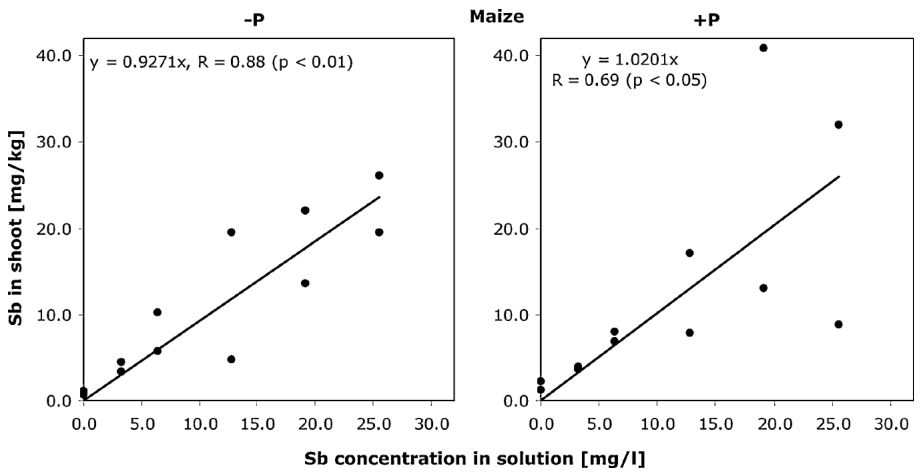
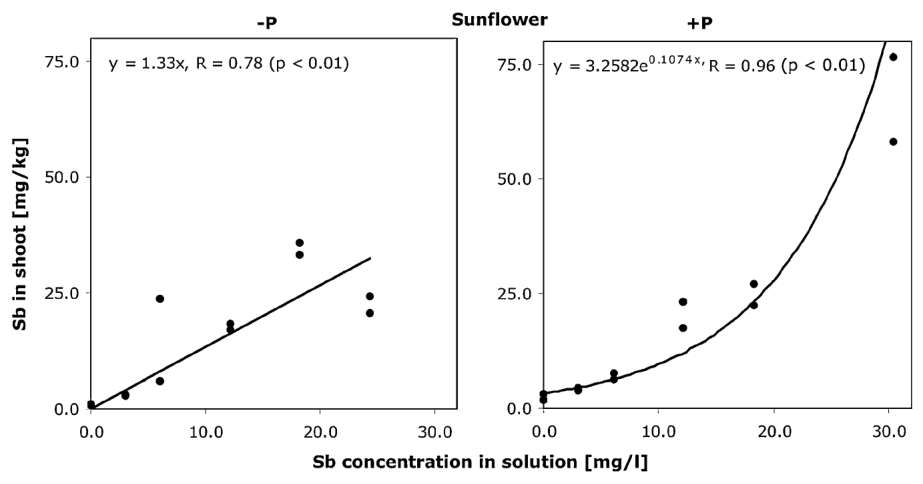
The observation that phosphate did not affect the uptake and toxicity of Sb indicates that Sb, unlike As, is not taken up via the phosphate pathway. This may be due to the different structures of their pentavalent oxyanions. Arsenate (AsO34-) is tetrahedral while Sb(OH)6- is octahedral (Baes and Mesmer 1986). The linear uptake of Sb by plants in these experiments indicates that plants either taken up Sb by another selective pathway, which was not at saturation in our experiment, or via a nonselective apoplastic pathway (Bell et al. 2003).
磷酸盐不影响Sb的吸收和毒性,这表明与As不同,Sb并非经由磷酸盐途径被吸收。这可能是由于二者五价含氧阴离子的结构不同:砷酸根(AsO34-)为四面体结构,而Sb(OH)6-为八面体结构(Baes and Mesmer 1986)。本试验中植物对Sb的吸收呈线性,表明植物或是通过另一条在本试验中未达饱和的选择性途径吸收Sb,或是经由非选择性质外体途径吸收Sb(Bell et al. 2003)。
Acknowledgements We gratefully acknowledge A. Gru¨nwald, R. Saladin, and Viktor Stadelmann for their continuous help and support in the laboratory. This project was financially supported by the Swiss National Science Foundation (Grants No. 200021-103768).
致谢 衷心感谢A. Grünwald、R. Saladin和Viktor Stadelmann在实验室工作中给予的持续帮助与支持。本项目由瑞士国家科学基金会资助(资助号200021-103768)。
5References参考文献
Ainsworth, N., Cooke, J. A., & Johnson, M. S. (1990a). Distribution of antimony in contaminated grassland. 1. Vegetation and soils. Environmental Pollution, 65, 65– 77.
Ainsworth, N., Cooke, J. A., & Johnson, M. S. (1990b). Distribution of antimony in contaminated grassland. 2. Small mammals and invertebrates. Environmental Pollution, 65, 79–87.
Baes C. F., & Mesmer, R. E. (1986). Arsenic, antimony, bismuth. The hydrolysis of cations (pp. 366–375). Malabar, Fl: Krieger.
Baroni, F., Boscagli, A., Protano, G., & Riccobono, F. (2000). Antimony accumulation in Achillea ageratum, Plantago lanceolata and Silene vulgaris growing in an old Sbmining area. Environmental Pollution, 109, 347–352.
Bell, P. F., McLaughlin, M. J., Cozens, G., Stevens, D. P., Owens, G., & South, H. (2003). Plant uptake of C-14- EDTA, C-14-citrate, and C-14-histidine from chelatorbuffered and conventional hydroponic solutions. Plant and Soil, 253, 311–319.
Bowen, H. J. M. (1979). Environmental chemistry of the elements. London: Academic Press.
EU (2005). Commission directive 2005/79/EC.
Filella, M., Belzile, N., & Chen, Y. W. (2002). Antimony in the environment: A review focused on natural waters. I. Occurence. Earth-Science Reviews, 57, 125–176.
Gresch, M., & Wettstein, B. (2002). Antimon- und Bleibelastung bei Schiessanlagen. Fallbeispiel Eschenbach (SG), Semesterarbeit. Zurich, ETH.
Johnson, C. A., Moench, H., Wersin, P., Kugler, P., & Wenger, C. (2005). Solubility of antimony and other elements in samples taken from shooting ranges. Journal of Environmental Quality, 34, 248–254.
Krachler, M., Emons, H., & Zheng, J. (2001). Speciation of antimony for the 21st century: Promises and pitfalls. Trac- Trends in Analytical Chemistry, 20, 79–90.
Kra¨mer, U., Cotter-Howells, J. D., Charnock, J. M., Baker, A. J. M., & Smith, J. A. C. (1996). Free histidine as a metal chelator in plants that accumulate nickel. Nature, 379, 635–638.
Pratas, J., Prasad, M. N. V., Freitas, H., & Conde, L. (2005). Plants growing in abandoned mines of Portugal are useful for biogeochemical exploration of arsenic, antimony, tungsten and mine reclamation. Journal of Geochemical Exploration, 85, 99–107.
Rish, M. A. (2004). Antimony. In: E. Merian, M. Anke, M. Ihnat, & M. Stoeppler (Eds.), Elements and their compounds in the environment (2nd ed., Vol. 2, pp. 659–670). Weinheim: Wiley-VHC.
Rooney, C. P., McLaren, R. G., & Cresswell, R. J. (1999). Distribution and phytoavailability of lead in a soil contaminated with lead shot. Water Air Soil Pollution, 116, 535–548.
Swartjes, F. A. (1999). Risk-based assessment of soil and groundwater quality in the Netherlands: Standards and remediation urgency. Risk Analysis, 19, 1235–1249.
Tandy, S., Schulin, R., & Nowack, B. (2006). The influence of EDDS on the uptake of heavy metals in hydroponically grown sunflowers. Chemosphere, 62, 1454–1463.
pollutants and soil remediation 2006, Sevilla, Spain, Programme and Abstracts, p. 118.
Wersin, P., Johnson, C. A., & Furrer, G. (2002). Antimony contamination in soil and ground water by shooting range activities. Geochimica et Cosmochimica Acta, 66, A829– A829.
Woolson, E. A., Axley, J. H., & Kearney, P. C. (1973). Chemistry and phytotoxicity of arsenic in soils. 2. Effects of time and phosphorus. Soil Science Society of America Journal, 37, 254–259.
Tschan, M., & Schulin, R. (2006). Poster: Phytoavailability and plant uptake of antimony, workshop: Bioavailability of