Available online at www.sciencedirect.com
Applied Geochemistry 23 (2008) 1232–1240
Applied Geochemistry
www.elsevier.com/locate/apgeochem
Metal extractability in acidic and neutral mine tailings from the Cartagena-La Unio´n Mining District (SE Spain) He´ctor M. Conesa a,*, Brett H. Robinson a, Rainer Schulin a, Bernd Nowack a,b
a Institute of Terrestrial Ecosystems, ETH Zurich, Universitaetstrasse 16, CH-8092 Zurich, Switzerland b Empa Materials Science and Technology, Lerchenfeldstrasse 5, CH-9014 St. Gallen, Switzerland
Received 17 May 2006; accepted 22 November 2007 Editorial handling by B. Kimball Available online 6 February 2008
Abstract摘要
Mine tailings are ubiquitous in the landscapes of mined areas. Metal solubilities were compared in two chemically distinct mine tailings from the old Mining District of Cartagena-La Unio´n (SE Spain). One of the tailings was acidic (pH 3.0) with 5400 mg/kg Zn, 1900 mg/kg As and 7000 mg/kg Pb. The other was neutral (pH 7.4) with 9100 mg/kg Zn, 5200 mg/kg Pb and 350 mg/kg As. In samples from the acidic tailings, more than 15% of the Zn and 55% of the Cd were extractable with 0.1 M NaNO3, and distilled water. In the neutral tailings, using the same reagents, less than 1% of the metals were extractable. A sequential extraction procedure revealed that the sum of the residual and the Fe oxide fractions of Cu, Zn and Pb comprised 80–95% in the acidic tailings and 70–90% in the neutral tailings. The acidic mine tailings had a higher metal solubility, resulting in more metal leaching in the short-term, but also a higher fraction of inert metal. In contrast, in the neutral tailings, the metals were evenly distributed between, oxides and the residual fraction. This implies lower metal mobility in the short-term, but that metal mobility may increase in the long-term. When applied to mine tailings, sequential extractions may provide misleading results because the strong cation exchange capacity of some extractants may induce pH changes and thereby significantly change metal solubility. � 2008 Elsevier Ltd. All rights reserved.
尾矿在矿区景观中普遍存在。本研究比较了西班牙东南部Cartagena-La Unión老矿区两种化学性质不同的尾矿中金属的溶解度。其中一种尾矿呈酸性(pH 3.0),含Zn 5400 mg/kg、As 1900 mg/kg和Pb 7000 mg/kg;另一种呈中性(pH 7.4),含Zn 9100 mg/kg、Pb 5200 mg/kg和As 350 mg/kg。在酸性尾矿样品中,0.1 M NaNO3和蒸馏水可提取的Zn超过15%,Cd超过55%。在中性尾矿中,使用相同试剂可提取的金属不足1%。连续提取程序表明,Cu、Zn和Pb的残渣态与Fe氧化物结合态之和在酸性尾矿中占80–95%,在中性尾矿中占70–90%。酸性尾矿的金属溶解度较高,短期内金属淋溶较多,但惰性金属所占比例也较高。相比之下,中性尾矿中的金属较均匀地分布于氧化物结合态和残渣态之间。这意味着其短期金属迁移性较低,但长期金属迁移性可能增加。将连续提取应用于尾矿时,由于某些提取剂具有较强的阳离子交换能力,可能引起pH变化,进而显著改变金属溶解度,因此连续提取可能得出误导性的结果。© 2008 Elsevier Ltd. 版权所有。
1Introduction引言
The Cartagena-La Union Mining District was an important mining area for more than 2500 a until mining activity ceased in 1991. Base metals were smelted from sulfide minerals that included galena and sphalerite. At present, more than 40 mine tailings piles cover approximately 160 ha in this area (Martı´nez-Orozco et al., 1993). These contain high concentrations of toxic metals and present a human and environmental health risk due to exposure of wind-borne dust.
Cartagena-La Union矿区在2500余年间一直是重要的采矿区,直至1991年采矿活动停止。当地从方铅矿和闪锌矿等硫化物矿物中冶炼贱金属。目前,该地区有40余座尾矿堆,覆盖面积约160 ha(Martı´nez-Orozco et al., 1993)。这些尾矿含有高浓度的有毒金属,由于风载粉尘暴露,对人类健康和环境健康构成风险。
* Corresponding author. Current address: BEFESA Gestio´n de Residuos Industriales S.L., Soil Management Department, Calle Benito Mas y Prat 5, planta 1, 41005-Sevilla, Spain.
* 通讯作者。现地址:BEFESA Gestión de Residuos Industriales S.L.,土壤管理部,Calle Benito Mas y Prat 5, planta 1, 41005-Sevilla, Spain。
E-mail address: hector.conesa@befesa.abengoa.com (H.M. Conesa).
The toxicity and plant uptake of metals depend on their speciation in soil (Zhang et al., 2001). Soil extractions with water, dilute salt solutions or chelating agents may approximate the fractions of soil metals that are available for uptake by plants (Ernst, 1996). Soil extraction schemes can be classified as single or sequential. Traditionally, single extractions have been used to assess the fertility of croplands (Rauret, 1998).
金属的毒性及植物对金属的吸收取决于其在土壤中的形态(Zhang et al., 2001)。用水、稀盐溶液或螯合剂进行土壤提取,可近似表征土壤中可被植物吸收的金属组分(Ernst, 1996)。土壤提取方案可分为单一提取和连续提取两类。传统上,单一提取被用于评价农田肥力(Rauret, 1998)。
0883-2927/$ - see front matter � 2008 Elsevier Ltd. All rights reserved. doi:10.1016/j.apgeochem.2007.11.013
0883-2927/$ - 见前言 © 2008 Elsevier Ltd. 版权所有。doi:10.1016/j.apgeochem.2007.11.013
Sequential extractions consist of a series of steps in which extractants with increasing solubilisation potential are applied successively to assess the proportions of metals that are associated with various soil components (Tessier et al., 1979; Zeien and Bru¨mmer, 1989). However, many studies have highlighted problems with extracting reagents, such as insufficient selectivity (La Force and Fendorf, 2000), or the redistribution of analytes during the procedure (Go´mez-Ariza et al., 1999; Calmano et al., 2001). Most sequential extraction procedures were developed for agricultural soils, usually with low to moderate metal concentrations (Calmano et al., 2001). Compounds that are highly soluble in a given extractant, but are not common in the soils for which the procedure was developed, may interfere with the extraction of metals from other soil types or highly polluted soils (Gleyzes et al., 2001). Sequential extraction procedures have also been applied to As (Me´ndez and Armienta, 2003; Ko et al., 2003; Wenzel et al., 2001). Unlike most metals, As in the environment occurs predominantly as an anion, rather than a cation, for which the sequential extractions were developed.
连续提取由一系列步骤组成,依次施加溶解能力逐渐增强的提取剂,以评估与各种土壤组分结合的金属比例(Tessier et al., 1979; Zeien and Bru¨mmer, 1989)。然而,许多研究指出了提取试剂存在的问题,如选择性不足(La Force and Fendorf, 2000)或分析物在提取过程中发生再分配(Go´mez-Ariza et al., 1999; Calmano et al., 2001)。大多数连续提取程序是针对农业土壤开发的,这些土壤的金属浓度通常为低至中等水平(Calmano et al., 2001)。某些化合物在特定提取剂中溶解度很高,但在该程序所针对的土壤中并不常见,可能干扰其他类型土壤或重度污染土壤中金属的提取(Gleyzes et al., 2001)。连续提取程序也已应用于As(Me´ndez and Armienta, 2003; Ko et al., 2003; Wenzel et al., 2001)。与大多数金属不同,环境中的As主要以阴离子而非阳离子形式存在,而连续提取正是针对阳离子开发的。
Numerous authors have applied sequential extractions to highly metal polluted soils. Some authors have modified the sequential extraction proposed by Tessier et al. (1979) to study metal partitioning in industrial sites (Li and Thornton, 2001), heavy metal polluted sediments (Go´mez-Ariza et al., 1999) or mine tailings (Fanfani et al., 1997). The sequential extraction scheme proposed by Zeien and Bru¨mmer (1989) has been applied to metal polluted agricultural soils (Fischer et al., 1998), soils affected by smelter dust deposition (Tandy et al., 2004), urban soils (Thuy et al., 2000) and mine tailings (Kim et al., 2002). Several authors have used conventional or slightly modified extraction schemes to investigate As speciation in highly polluted soils (Me´ndez and Armienta, 2003; Ko et al., 2003; Wenzel et al., 2001).
许多学者已将连续提取应用于金属重度污染土壤。一些学者对Tessier et al. (1979)提出的连续提取法进行了改进,用于研究工业场地(Li and Thornton, 2001)、重金属污染沉积物(Go´mez-Ariza et al., 1999)或尾矿(Fanfani et al., 1997)中金属的分配。Zeien and Bru¨mmer (1989)提出的连续提取方案已应用于金属污染的农业土壤(Fischer et al., 1998)、受冶炼厂粉尘沉降影响的土壤(Tandy et al., 2004)、城市土壤(Thuy et al., 2000)和尾矿(Kim et al., 2002)。还有一些学者采用常规或略加改进的提取方案研究重度污染土壤中As的形态(Me´ndez and Armienta, 2003; Ko et al., 2003; Wenzel et al., 2001)。
The aim of this work was to study the solubility and solid phase fractionation of metal(loid)s in two mine tailings with contrasting pH values from the Cartagena-La Union Mining District in southern Spain. Several single extractions were compared to the sequential extraction scheme of Zeien and Bru¨mmer (1989). The results of the extractions were examined with a view to determining the advantages and limitations of applying such extractions to mine tailing materials.
本研究旨在探讨西班牙南部Cartagena-La Union矿区两种pH值差异显著的尾矿中金属(类金属)的溶解度及固相分级。将几种单一提取方法与Zeien and Bru¨mmer (1989)的连续提取方案进行了比较,并对提取结果进行分析,以确定将此类提取方法应用于尾矿材料的优势与局限。
2Materials and methods材料与方法
2.1. Sampling site2.1. 采样地点
The Cartagena-La Union Mining District is located in the Murcia Region (SE Spain). The area of the Mining District is approximately 50 km2 and includes five cities with a total population of 20,000. The climate is typically Mediterranean with an average rainfall of 250–300 mm/year, concentrated in spring and autumn. The annual mean temperature is 18 �C. The topography and semi-arid climate result in a hydrology characterised by short streams (<20 km length) with intermittent flow and fast drainage that promotes erosion. The natural vegetation consists of thickets containing xerophitic species.
Cartagena-La Union矿区位于西班牙东南部的Murcia地区。矿区面积约50 km2,包括5个城镇,总人口20,000。该地区为典型的地中海气候,年均降雨量250–300 mm,集中于春季和秋季。年平均气温为18 °C。地形和半干旱气候使该地区水文特征表现为河流短(长度<20 km)、间歇性流动且排水迅速,从而加剧侵蚀。天然植被为含旱生物种的灌丛。
2.2. Soil sampling2.2. 土壤采样
Two mine tailings were studied. The ‘‘Belleza” mine tailings, are near the town La Unio´n. Erosion has already carried part of the tailings into two nearby creeks. Two schools are within 500 m of the base of the tailings. The surface of the tailings is covered with a hardpan, which contains visible salt crystals. The ‘‘El Gorguel” mine tailings are located along the dry ‘‘Gorguel” river. The surface horizons of the tailings consist of sandy sediments without structural aggregates. Conesa et al. (2006) gives more details of the sampling locations. Henceforth, the Belleza and El Gorguel tailings are referred to as the ‘‘acidic tailings” and ‘‘neutral tailings”, respectively.
本研究考察了两处尾矿。“Belleza”尾矿位于La Unión镇附近。侵蚀作用已将部分尾矿带入附近的两条小溪。在尾矿堆底部500 m范围内有两所学校。尾矿表面覆盖一层硬盘层,其中可见盐晶体。“El Gorguel”尾矿位于干涸的“Gorguel”河沿岸。该尾矿的表层由无结构性团聚体的砂质沉积物组成。采样地点的详细信息见Conesa et al. (2006)。下文将Belleza尾矿和El Gorguel尾矿分别称为“酸性尾矿”和“中性尾矿”。
Samples were taken from the upper 40 cm at 15 separate pits that were dug at regular intervals, at least 8 m apart, over each tailings pile. All samples were mixed to give one homogenised sample per zone. The samples were air dried, sieved to less than 2 mm and stored in plastic bags prior to laboratory analysis.
在每个尾矿堆上按规则间隔挖掘15个独立采样坑(间距至少8 m),采集上部40 cm的样品。将所有样品混合,每个区域得到一个均质化样品。样品经风干、过2 mm筛后,装入塑料袋中保存,待实验室分析。
2.3. Analytical methods2.3. 分析方法
The pH of a suspension in H2O with a tailings: water ratio of 1:2.5 (g:mL) was measured using a pH Meter (Omega) Metrohm. Total element concentrations were determined using X-ray fluorescence (Spectro X-Lab 2000). Soluble metal(loid)s were extracted with 0.1 M NaNO3 at a 1:2.5 tailings: solution ratio (g:mL) (FAL, RAC, FAW, 1996) and with H2O at a 1:5 tailings: water ratio (g:mL) (Ernst, 1996). There were three replicates per sample. For both extractions, the samples were shaken for 2 h, centrifuged for 10 min at 4000 rpm, and filtered through 0.45 lm cellulose acetate filters (Sartorius). The filtered extracts were analysed for Cu, Zn, Cd, Pb and As by flame atomic absorption spectrometry (SpectraAA 220/FS, Varian). The detection limits in these extracts were 0.1 mg/L for all the elements except As, where the detection limit was 0.5 mg/L. The high salt content of the extracts limited the sensitivity. To determine the mineral composition of the two tailings, sub-samples were ground and analysed by X-ray diffraction, using a D4 Endeavor spectrometer using the software DIFFRAC plus EVA V8.0 (Broker AXS. INC. United States).
采用pH计(Omega,Metrohm)测定尾矿与水之比为1:2.5(g:mL)的H2O悬浮液的pH。元素全量采用X射线荧光光谱法(Spectro X-Lab 2000)测定。可溶性金属(类金属)分别用0.1 M NaNO3按尾矿与溶液之比1:2.5(g:mL)提取(FAL, RAC, FAW, 1996),以及用H2O按尾矿与水之比1:5(g:mL)提取(Ernst, 1996)。每个样品设3次重复。两种提取均振荡2 h,以4000 rpm离心10 min,并经0.45 μm醋酸纤维素滤膜(Sartorius)过滤。滤液中的Cu、Zn、Cd、Pb和As采用火焰原子吸收光谱法(SpectraAA 220/FS,Varian)测定。除As的检出限为0.5 mg/L外,其余元素在这些提取液中的检出限均为0.1 mg/L。提取液的高盐含量限制了测定灵敏度。为确定两种尾矿的矿物组成,将子样品研磨后采用X射线衍射分析,所用仪器为D4 Endeavor衍射仪,软件为DIFFRAC plus EVA V8.0(Bruker AXS. INC.,美国)。
For the sequential extraction, the procedure of Zeien and Bru¨mmer (1989) was followed. Table 1 gives the definition of the fractions in this scheme as well as the components of the extracting solutions. All suspensions were centrifuged at 2500 rpm for 10 min and passed through Schleicher
连续提取按照Zeien and Bru¨mmer (1989)的程序进行。表1给出了该方案中各组分的定义以及提取溶液的组成。所有悬浮液均以2500 rpm离心10 min,并经Schleicher
Chemical interpretation and operational definition of the fractions within the sequential extraction scheme (following Zeien and Bru¨mmer, 1989)
连续提取方案中各组分的化学解释与操作定义(参照Zeien and Bru¨mmer, 1989)
| Fraction组分 | Chemical interpretation化学 解释 | Extractant提取剂 | Duration时间 |
|---|---|---|---|
| F1 | Mobile (water soluble and easily exchangeable metals) | 1 M NH4NO3 | 24 h, 20�C |
| F2 | Easily mobilizable (specifically adsorbed, bound to CaCO3) | 1 M NH4–acetate (pH 6) | 24 h, 20�C |
| F3 | Bound to Mn oxides | 0.1 M NH2OH– HCl + 1 M NH4– acetate (pH 6) | 30 min, 20�C |
| F4 | Bound to organic matter | 0.025 M NH4EDTA (pH 4.6) | 90 min, 20�C |
| F5 | Bound to amorphous Fe oxides | 0.2 M NH4– oxalate (pH 3.25) | 4 h in the dark, 20�C |
| F6 | Bound to crystalline Fe oxides | 0.1 M ascorbic acidic + 0.2 M NH4–oxalate (pH 3.25) | 30 min at 96�C |
| F7 | Residual fraction | X-ray fluorescence |
& Schu¨ll 790 1/2 filter paper. The elements (Cu, Zn, Cd, Pb and As) extracted in steps 1–6 were measured by flame atomic absorption spectrometry (SpectraAA 220/FS, Varian). The detection limits in these extracts were 0.01 mg/L for Cu, Pb, Zn and Cu, and 0.5 mg/L for As. The residual fraction (step 7) was analysed by X-ray fluorescence (Spectro X-Lab 2000). Six sub-samples of 2 g from each tailing sample were analysed.
& Schüll 790 1/2滤纸过滤。步骤1–6中提取的元素(Cu、Zn、Cd、Pb和As)采用火焰原子吸收光谱法(SpectraAA 220/FS,Varian)测定。这些提取液中Cu、Pb、Zn和Cd的检出限为0.01 mg/L,As为0.5 mg/L。残渣态(步骤7)采用X射线荧光光谱法(Spectro X-Lab 2000)分析。每个尾矿样品分析6个2 g的子样品。
3Results and discussion结果与讨论
3.1. Characterisation of the tailings3.1. 尾矿的特性
Table 2 shows the pH of the saturated extract and total elemental concentrations in the two mine tailings. The pH was 3.0 in the acidic tailings and 7.4 in the neutral tailings. Both tailings had high Fe concentrations, especially the acidic tailings (26%). Silicon occurred at concentrations around 10%. Aluminium and S exceeded 1% in both tailings, as did Ca in the neutral tailings. The Cu, Zn, Cd and Pb contents were high in both tailings. The highest values for Pb and As occurred the acidic tailings while the neutral tailings had the highest Zn and Cd concentrations.表2列出了两种尾矿饱和浸提液的pH和元素全量。酸性尾矿的pH为3.0,中性尾矿为7.4。两种尾矿的Fe含量均较高,尤其是酸性尾矿(26%)。Si含量约为10%。两种尾矿中Al和S均超过1%,中性尾矿中的Ca也超过1%。两种尾矿的Cu、Zn、Cd和Pb含量均较高。Pb和As的最高值出现在酸性尾矿中,而中性尾矿的Zn和Cd浓度最高。
3.2. Mineralogy3.2. 矿物学特征
The acidic mine tailings was composed of quartz (SiO2), magnetite (Fe3O4), goethite (a-FeOOH), beudantite (Pb(Fe2.54Al0.46)(As1.07O4)(S0.93O4)(OH)6), vermiculite 2 ITM RG (Mg3Si4O10(OH)2), sphalerite (ZnS), faujasite (H7.7Al42.56Si139O345.6) and gypsum
酸性尾矿由石英(SiO2)、磁铁矿(Fe3O4)、针铁矿(α-FeOOH)、砷铅铁矾(Pb(Fe2.54Al0.46)(As1.07O4)(S0.93O4)(OH)6)、蛭石2 ITM RG(Mg3Si4O10(OH)2)、闪锌矿(ZnS)、八面沸石(H7.7Al42.56Si139O345.6)和石膏
Concentration of major elements and metal(loid)s in the two mine tailings
两种尾矿中主量元素和金属(类金属)的浓度
| Element元素 | Unit单位 | Acidic tailings酸性尾矿 | Neutral tailings中性尾矿 |
|---|---|---|---|
| pHa | – | 3.0 | 7.4 |
| Al | % | 2.0(0.1) | 4.2(<0.1) |
| Si | % | 8.3(0.3) | 13(0.3) |
| S | % | 2.7(<0.1) | 3.0(<0.1) |
| Ca | % | 0.8(<0.1) | 3.0(0.1) |
| Fe | % | 26(0.8) | 11(<0.1) |
| As | mg/kg | 1900(33) | 350(7.2) |
| Cd | mg/kg | 8.8(0.4) | 34(0.7) |
| Cu | mg/kg | 380(14) | 84(4.5) |
| Pb | mg/kg | 7000(130) | 5200(50) |
| Zn | mg/kg | 5400(100) | 9100(34) |
Values in brackets are standard deviations (n = 3). a Geometric mean. The differences between the samples were <0.1, the detection limit of the apparatus.
括号内数值为标准差(n = 3)。a 几何平均值。样品间差异<0.1,即仪器检出限。
Metals extracted by 0.1 M NaNO3 and H2O0.1 M NaNO3和H2O提取的金属
| Reagent试剂 | Tailing尾矿 | Cu | Zn | Cd | Pb |
|---|---|---|---|---|---|
| 0.1 M | Acidic | 6.7(0.2) | 1000(72) | 5.3(0.1) | 9.4(0.2) |
| NaNO3 | Neutral | <0.3 | 1.9(0.1) | <0.3 | <0.3 |
| H2O | Acidic | 7.3(0.1) | 990(11) | 5.0(0.1) | 12(0.1) |
| Neutral | <0.5 | 2.3(0.2) | <0.5 | <0.5 |
Values in brackets are standard deviations (n = 3). All data are mg/kg. Arsenic was below the detection limit.
括号内数值为标准差(n = 3)。所有数据单位均为mg/kg。As低于检出限。
The water-extractable Cu, Zn, Cd and Pb concentrations were close to the respective NaNO3 extractable metal concentrations. This indicates that results from these extractants can be compared directly for these types of materials. Arsenic was below the detection limit in all the cases, with acidic and neutral tailings.
水提取态Cu、Zn、Cd和Pb的浓度与相应的NaNO3提取态金属浓度相近。这表明对于此类材料,这两种提取剂的结果可直接比较。在所有情况下,无论酸性还是中性尾矿,As均低于检出限。
3.4. Sequential extractions3.4. 连续提取
(CaSO4 � 2H2O). Beudantite is a typical mineral in gossans, which results from the intensive oxidation of surface sulfide deposits. It acts as a natural sink for Pb and As (Nieto et al., 2003).
(CaSO4·2H2O)组成。砷铅铁矾是铁帽中的典型矿物,铁帽由地表硫化物矿床强烈氧化形成。砷铅铁矾是Pb和As的天然汇(Nieto et al., 2003)。
In the neutral tailings, only three minerals were identified: quartz, gypsum (CaSO4 � 2H2O) and chlorite ((Mg,Al)6(Si,Al)4O10(OH)8). Despite a Fe concentration of 10%, no Fe mineral was detected. This indicates that the Fe was probably present as a finely dispersed amorphous oxide.
在中性尾矿中仅鉴定出3种矿物:石英、石膏(CaSO4·2H2O)和绿泥石((Mg,Al)6(Si,Al)4O10(OH)8)。尽管Fe含量达10%,但未检测到含Fe矿物。这表明Fe可能以细分散的无定形氧化物形式存在。
3.3. Single extractions with 0.1 M NaNO3 and H2O3.3. 0.1 M NaNO3和H2O单一提取
Table 3 summarises the results of the two single extractions using 0.1 M NaNO3 and H2O. In 0.1 M NaNO3 extracts of the acidic tailings, the highest concentrations were obtained for Zn (1000 mg/kg). However, Cu, Cd and Pb also had substantial soluble fractions. As expected, the NaNO3 and H2O extracts of the neutral tailing contained much lower metal concentrations, due to the higher pH of the material. Copper, Cd and Pb were below detection limits (<0.50 mg/kg).表3汇总了0.1 M NaNO3和H2O两种单一提取的结果。在酸性尾矿的0.1 M NaNO3提取液中,Zn的浓度最高(1000 mg/kg),但Cu、Cd和Pb也有相当数量的可溶组分。正如预期,由于中性尾矿pH较高,其NaNO3和H2O提取液中的金属浓度低得多。Cu、Cd和Pb均低于检出限(<0.50 mg/kg)。
In the acidic tailings, the average recovery for the sum of the seven fractions (Table 4) compared to the total analysis (Table 2) was 89.1% for Cu, 95.6% for Zn, 96.9% for Cd, 74.3% for Pb and 78.7% for As. In the neutral tailings, the recoveries were 101.3% for Cu, 111.4% for Zn, 92.8% for Cd, 87.0% for Pb and 128.1% for As. These values were similar to those reported by other authors (Widerlund et al., 2005). The high number of replicates (n = 6) resulted in a high reproducibility of the results. The highest relative standard deviations (calculated from Table 4) occurred in the 6th step, except for Zn (3rd and 4th steps) and Pb (1st and 2nd steps). These steps were coincidental with low concentrations and thus the high variability did not significantly affect the final results.
在酸性尾矿中,7个组分之和(表4)相对于全量分析结果(表2)的平均回收率分别为:Cu 89.1%、Zn 95.6%、Cd 96.9%、Pb 74.3%、As 78.7%。在中性尾矿中,回收率分别为:Cu 101.3%、Zn 111.4%、Cd 92.8%、Pb 87.0%、As 128.1%。这些数值与其他学者报道的结果相近(Widerlund et al., 2005)。较多的重复次数(n = 6)使结果具有较高的重现性。除Zn(第3和第4步)和Pb(第1和第2步)外,最高的相对标准偏差(根据表4计算)出现在第6步。这些步骤恰好对应较低的浓度,因此较高的变异性并未显著影响最终结果。
Most of the discussion is based on percentages because it is necessary to compare two materials with different total concentrations and investigate the mechanisms of solubilization, rather than individually evaluate the possible toxicity of each tailings. Except for As, the most soluble element fraction (F1) was higher in the acidic tailings (Fig. 1 and Table 5). The percentages of Cu and Cd extracted in step F1 (5% and 72%, respectively) were around 4 times higher in the acidic tailings than in the neutral tailings. These differences were even larger for Zn and Pb. However, in the following F2, F3 and F4 steps, the percentages of elements extracted were higher in the neutral tailings than in the acidic tailings.
由于需要比较两种全量浓度不同的材料并探究其溶解机制,而非单独评价每种尾矿可能的毒性,因此讨论主要基于百分比。除As外,最易溶的元素组分(F1)在酸性尾矿中较高(图1和表5)。在F1步骤中提取的Cu和Cd百分比(分别为5%和72%)在酸性尾矿中约为中性尾矿的4倍。Zn和Pb的差异更大。然而,在随后的F2、F3和F4步骤中,中性尾矿中元素的提取百分比高于酸性尾矿。
Concentration of metals extracted in each step of the sequential extraction and its total sum
连续提取各步骤中提取的金属浓度及其总和
| Tailings尾矿 | Element元素 | Step步骤 | Sum of all | ||||||
|---|---|---|---|---|---|---|---|---|---|
| Mobile (F1) | Easily exchangeable | Mn oxides | Org. matter | Amorphous Fe oxides (F5) | Crystalline Fe oxides (F6) | Residual (F7) | the steps | ||
| (F2) | (F3) | (F4) | |||||||
| Acidic | Cu | 16.9(0.62) | 0.53(0.06) | <0.01 | 3.62(0.13) | 26.9(0.66) | 12.4(0.98) | 278(27.0) | 339(27.2) |
| Zn | 1110(25.6) | 10.3(1.56) | 27.9(8.58) | 30.4(12.0) | 264(24.8) | 986(65.6) | 2740(205) | 5170(237) | |
| Cd | 6.14(0.25) | 0.21(0.04) | <0.01 | <0.01 | 0.65(0.07) | 0.54(0.11) | 0.99(0.32) | 8.53(0.33) | |
| Pb | 436(58.8) | 24.9(5.33) | 141(16.6) | 332(24.7) | 772(66.2) | 399(44.3) | 3090(314) | 5200(378) | |
| As | 25.8(2.15) | 37.4(1.02) | 34.6(1.47) | 27.2(2.69) | 124(7.30) | 620(55.9) | 627(50.4) | 1500(83.8) | |
| Neutral | Cu | 1.13(0.09) | 3.25(0.39) | <0.01 | 5.14(0.19) | 36.5(0.60) | 3.05(0.88) | 36.1(2.14) | 85.1(2.36) |
| Zn | 173(9.69) | 1300(28.5) | 355(5.71) | 1020(23.8) | 4290(133) | 970(216) | 2030(108) | 10100(141) | |
| Cd | 4.81(0.12) | 9.66(0.07) | 1.60(0.04) | 1.96(0.06) | 4.40(0.14) | 1.09(0.39) | 8.03(0.48) | 31.6(0.38) | |
| Pb | 3.23(0.39) | 302(16.3) | 351(16.3) | 315(16.2) | 572(56.2) | 350(19.5) | 2630(182) | 4520(215) | |
| As | 21.2(1.44) | 35.3(1.40) | 32.1(1.47) | 23.0(2.36) | 137(6.89) | 105(15.7) | 95.3(18.5) | 448(29.2) |
Values in brackets are standard deviations (n = 6). All data are mg/kg and have been rounded to three significant digits.
括号内数值为标准差(n = 6)。所有数据单位均为mg/kg,并已保留3位有效数字。
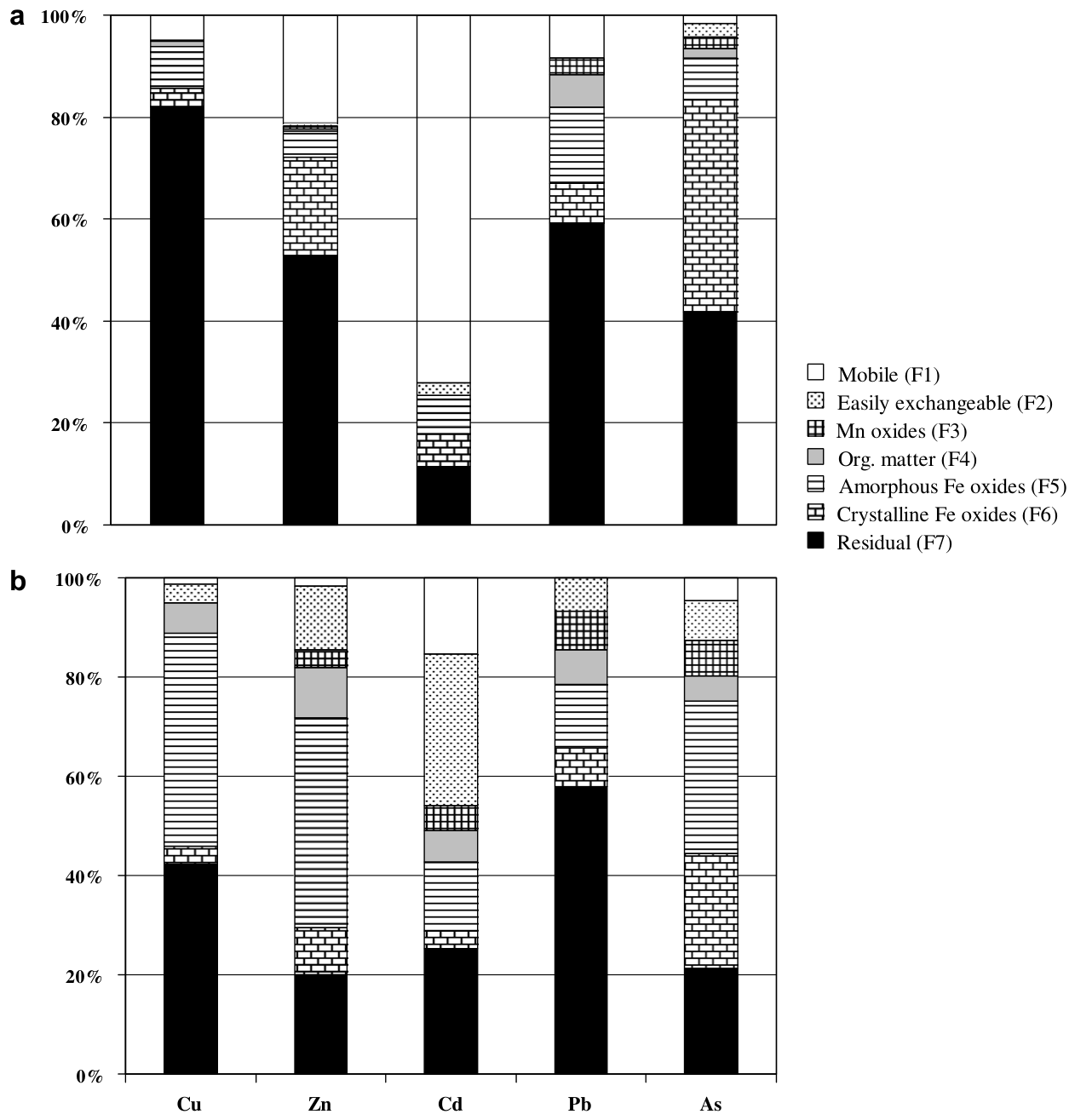
Around 80% Cu occurred in the residual fraction of the acidic tailings. In the neutral tailings this fraction was only 42%, but an additional 46% occurred in the two Fe oxide fractions (F5 + F6). A similar pattern was found for Zn with a high percentage (53%) in the residual fraction in the acidic tailings compared to the neutral one (20%) and a similar amount (52%) to Cu in the two Fe oxide phases (F5 + F6).
在酸性尾矿中,约80%的Cu存在于残渣态。在中性尾矿中,该组分仅占42%,但另有46%存在于两个Fe氧化物结合态(F5 + F6)中。Zn也呈现类似规律:酸性尾矿中残渣态所占比例较高(53%),而中性尾矿中为20%;中性尾矿两个Fe氧化物结合态(F5 + F6)中Zn的比例(52%)与Cu相近。
Most of the As was in the three most inert fractions (F5 + F6 + F7), around 90% in the acidic tailing and 70% in the neutral one. Arsenic was the only element with a higher percentage of the most soluble fraction (F1) in the neutral tailings (4.73%) than in the acidic tailings (1.73%). The prevalent forms of As in the environment are the inorganic oxyanions of As(III) and As(V) (Mahimairaja et al., 2005). The pH dependence of the solubility was therefore consistent with the expectation that the solubility of anions generally increases with increasing pH, whereas that of cations decreases.
大部分As存在于3个最惰性的组分(F5 + F6 + F7)中,在酸性尾矿中约占90%,在中性尾矿中约占70%。As是唯一一种最易溶组分(F1)百分比在中性尾矿(4.73%)高于酸性尾矿(1.73%)的元素。环境中As的主要存在形式是As(III)和As(V)的无机含氧阴离子(Mahimairaja et al., 2005)。因此,溶解度的pH依赖性与预期一致,即阴离子的溶解度通常随pH升高而增加,而阳离子的溶解度则随之降低。
Percentages of metal extracted in each step of the sequential extraction
连续提取各步骤中金属的提取百分比
| Tailings尾矿 | Element元素 | Step步骤 | ||||||
|---|---|---|---|---|---|---|---|---|
| Mobile (F1) | Easily exchangeable (F2) | Mn oxides (F3) | Org. matter (F4) | Amorphous Fe oxides (F5) | Crystalline Fe oxides (F6) | Residual (F7) | ||
| Acidic | Cu | 4.98 | 0.16 | <0.01 | 1.07 | 7.93 | 3.65 | 82.2 |
| Zn | 21.4 | 0.20 | 0.54 | 0.59 | 5.10 | 19.1 | 53.1 | |
| Cd | 72.0 | 2.48 | <0.01 | <0.01 | 7.59 | 6.35 | 11.6 | |
| Pb | 8.39 | 0.48 | 2.71 | 6.40 | 14.9 | 7.67 | 59.5 | |
| As | 1.73 | 2.50 | 2.31 | 1.82 | 8.26 | 41.5 | 41.9 | |
| Neutral | Cu | 1.33 | 3.81 | <0.01 | 6.04 | 42.9 | 3.59 | 42.4 |
| Zn | 1.71 | 12.8 | 3.51 | 10.1 | 42.3 | 9.57 | 20.1 | |
| Cd | 15.3 | 30.6 | 5.07 | 6.22 | 14.0 | 3.45 | 25.4 | |
| Pb | 0.07 | 6.68 | 7.77 | 6.96 | 12.7 | 7.73 | 58.1 | |
| As | 4.73 | 7.88 | 7.16 | 5.13 | 30.5 | 23.3 | 21.3 |
The numbers have been rounded to three significant digits.
数值已保留3位有效数字。
Results from sequential extractions should be evaluated with care. For example, the fraction extracted with EDTA in the 4th step of the Zeien and Bru¨mmer (1989) procedure is normally attributed to elements bound by organic matter. This interpretation is questionable in the case of mine tailings, because the organic matter content (<0.5%) is very low (Conesa et al., 2006). For Pb this fraction (F4) was 6–7%. This fraction probably corresponds to Pb adsorbed onto mineral surfaces because EDTA is an efficient extractant for Pb from polluted soils. Nowack et al. (2006) reported that EDTA extracts 40–100% of total Pb from soils, even at high Pb concentrations.
连续提取的结果应谨慎评价。例如,Zeien and Bru¨mmer (1989)程序第4步中用EDTA提取的组分通常被归为有机质结合态元素。对于尾矿而言,这一解释值得商榷,因为尾矿的有机质含量很低(<0.5%)(Conesa et al., 2006)。Pb在该组分(F4)中的比例为6–7%。由于EDTA是污染土壤中Pb的高效提取剂,该组分很可能对应吸附于矿物表面的Pb。Nowack et al. (2006)报道,即使在Pb浓度较高的情况下,EDTA也可提取土壤中40–100%的全Pb。
The sum of the percentages of the first two fractions (F1 + F2) was similar for Cu (5–6%) and Pb (7–9%) in both tailings, although the F1 was always much higher in the acidic tailings. This did not occur for Cd and Zn, although there was a higher fraction of the metals in the F2 step in the neutral tailings compared to the acidic tailing. This may have occurred because the first step was not pH buffered and therefore the extraction occurred at acidic pH for the acidic tailings and neutral pH for the neutral tailings. The second step was buffered at pH 6, resulting in a pH increase in the acidic tailings and a pH decrease in the neutral tailings. Garcı´a et al. (2005) also reported this effect using a different sequential extraction procedure on similar tailings from the Cartagena-La Union Mining District. They found that higher metal percentages occurred in the most soluble fraction of the neutral tailings compared to the acidic tailings. These authors hypothesised that in the acid tailings most of the soluble metal had already leached out. In the present study, the mobility was higher at pH 3 for all elements except As. These conflicting results may be due to the use of different reagents in the first step of the sequential extraction procedure. The NH4OAc (pH 5) used by Garcı´a et al. (2005) in this first step, would have acted as a buffer and the extraction took place at this pH. For the acidic tailings, this would have resulted in a pH increase and therefore reduced solubility of metals while for the neutral tailing this resulted in a decrease in pH of 2 units and therefore increased solubility. This demonstrates the need for caution when interpreting results from sequential extractions where the pH at which the extraction occurs is different from that of the native soil.
在两种尾矿中,前两个组分百分比之和(F1 + F2)对Cu(5–6%)和Pb(7–9%)而言相近,但F1在酸性尾矿中始终高得多。Cd和Zn则不然,尽管中性尾矿中F2步骤的金属比例高于酸性尾矿。其原因可能在于第一步未进行pH缓冲,因此酸性尾矿的提取在酸性pH下进行,而中性尾矿的提取在中性pH下进行。第二步缓冲至pH 6,导致酸性尾矿的pH升高而中性尾矿的pH降低。García et al. (2005)在对Cartagena-La Union矿区类似尾矿采用另一种连续提取程序时也报道了这一效应。他们发现,中性尾矿最易溶组分中的金属百分比高于酸性尾矿。这些作者推测,酸性尾矿中大部分可溶金属已被淋溶流失。而在本研究中,除As外,所有元素在pH 3时的迁移性均较高。这些相互矛盾的结果可能源于连续提取程序第一步所用试剂的不同。García et al. (2005)在第一步中使用的NH4OAc(pH 5)起到了缓冲作用,提取在该pH下进行。对于酸性尾矿,这会导致pH升高,从而降低金属溶解度;而对于中性尾矿,则导致pH降低2个单位,从而提高溶解度。这表明,当提取时的pH与原状土壤pH不同时,解释连续提取结果需要格外谨慎。
In the acidic tailings, both the most soluble (F1) and the residual fractions (F7) were higher for Cu and Zn compared to the neutral tailings. Lead was similarly distributed in both tailings. The sum of the three most environmental inert fractions (F5 + F6 + F7) was 70–95% for Cu, Zn, Pb and As in both mine tailings, indicating that large fractions of the metal(loid)s are strongly bound to the matrix. The acidic mine tailings are therefore characterised, paradoxically, by a high solubility and long-term persistence of Cu, Zn and Pb. Cadmium is soluble (more than 50% in F1 + F2 + F3) and present at low percentages in the F7 residual fraction (11% in the acidic and 25% in the neutral).
与中性尾矿相比,酸性尾矿中Cu和Zn的最易溶组分(F1)和残渣态(F7)均较高。Pb在两种尾矿中的分布相似。两种尾矿中Cu、Zn、Pb和As在3个环境最惰性组分之和(F5 + F6 + F7)中占70–95%,表明很大比例的金属(类金属)与基质牢固结合。因此,酸性尾矿的特点看似矛盾:Cu、Zn和Pb既具有高溶解度,又具有长期持久性。Cd可溶性较强(F1 + F2 + F3中超过50%),在F7残渣态中所占比例较低(酸性尾矿11%,中性尾矿25%)。
For most metal(loid)s and most soluble fractions, using concentrations (Table 4) instead of percentages gives the same result, however, some differences are observed especially for As and Cu. For these two elements, the largest difference in total concentrations is observed (the acidic tailings had 5 times more As and 4.5 times more Cu, but 4 times less Cd). For As, the concentration in F1 was higher in the acidic tailings although the percentage was lower. This shows that for an actual risk assessment of a specific site the concentrations should also be considered while for an understanding of the processes the percentages may be more meaningful.
对于大多数金属(类金属)和大多数易溶组分,用浓度(表4)代替百分比得到的结果相同,但也存在一些差异,尤其是As和Cu。这两种元素在两种尾矿间的全量浓度差异最大(酸性尾矿中As为中性尾矿的5倍,Cu为4.5倍,而Cd仅为其1/4)。对于As,尽管其在酸性尾矿F1中的百分比较低,但浓度较高。这表明,在对具体场地进行实际风险评估时也应考虑浓度,而在理解相关过程时,百分比可能更有意义。
3.5. Comparison between metals extracted with H2O, 0.1 M NaNO3, and 1 M NH4NO3
3.5. H2O、0.1 M NaNO3和1 M NH4NO3提取金属的比较
Table 6 gives a comparison of the metal extractability in the two tailings by the three extractants H2O, 0.1 M NaNO3, and 1 M NH4NO3. The latter is the extractant used in the first step of the sequential extraction. The three extractants solubilised approximately equal amounts of Zn from the acidic tailings. More Cu and Cd were extracted by 1 M NH4NO3 than by water and 0.1 M NaNO3. Only 1 M NH4NO3 extracted significant amounts of Pb. In the neutral tailing, 1 M NH4NO3 extracted 15% of the total Cd and 1.7% of the total Zn. The extractability of these metals in 0.1 M NaNO3 and H2O was below detection limits.表6比较了H2O、0.1 M NaNO3和1 M NH4NO3三种提取剂对两种尾矿中金属的提取能力。其中1 M NH4NO3是连续提取第一步所用的提取剂。三种提取剂从酸性尾矿中溶出的Zn量大致相同。1 M NH4NO3提取的Cu和Cd多于水和0.1 M NaNO3。只有1 M NH4NO3提取出了显著量的Pb。在中性尾矿中,1 M NH4NO3提取了全Cd的15%和全Zn的1.7%。0.1 M NaNO3和H2O对这些金属的提取量均低于检出限。
For recalcitrant metals (e.g. Pb) and other elements in pH-conditions that favour strong binding (high pH), only the strongest extractant for ‘‘mobile” elements, 1 M NH4NO3, yielded significant concentrations. This was the only extractant that solubilised Pb from the acidic tailings. The higher concentration in the extract with NH4 may indicate that the solubility was not limited by a mineral phase but by adsorptive processes. Ammonium is not able to complex metals. Its solubilising capacity is due to cation exchange with metals adsorbed on mineral surfaces or clays. Water and 0.1 M NaNO3 yielded similar amounts of extracted elements, indicative of the weak extraction power of 0.1 M NaNO3.
对于难溶金属(如Pb)以及在有利于强结合的pH条件下(高pH)的其他元素,只有针对“可移动态”元素的最强提取剂1 M NH4NO3才能提取出显著浓度。这也是唯一能从酸性尾矿中溶出Pb的提取剂。NH4提取液中浓度较高,可能表明溶解度并非受矿物相限制,而是受吸附过程控制。铵不能与金属络合,其溶解能力源于与吸附在矿物表面或黏土上的金属发生阳离子交换。水和0.1 M NaNO3提取的元素量相近,表明0.1 M NaNO3的提取能力较弱。
Comparison between the percentage of mobile metals extracted with the two single extractions applied (0.1 M NaNO3 and H2O) and the most mobile fraction from the sequential extraction (1 M NH4NO3)
两种单一提取(0.1 M NaNO3和H2O)提取的可移动态金属百分比与连续提取中最易移动组分(1 M NH4NO3)的比较
| Metal金属 | Acidic ta酸性 | ilings尾矿 | Neutral中性 | tailings尾矿 | ||
|---|---|---|---|---|---|---|
| 0.1 M | H2O | 1 M | 0.1 M | H2O | 1 M | |
| NaNO3 | NH4NO3 | NaNO3 | NH4NO3 | |||
| Cu | 1.8 | 1.9 | 5.0 | <1 | <1 | 1.3 |
| Zn | 19 | 18 | 21 | <1 | <1 | 1.7 |
| Cd | 61 | 56 | 72 | <1 | <1 | 15 |
| Pb | <1 | <1 | 8.4 | <1 | <1 | <1 |
Values are % of total metals.
数值为占金属全量的百分比(%)。
The risk assessment of mining areas requires an accurate characterisation of the wastes. This characterisation reveals situations where high concentrations of elements may leach or be taken up by the biota. In the present study, the acidic tailings pose a higher risk than the neutral tailings for ground and surface waters due to the higher metal solubility at low pH. This high solubility also implies high bioavailability. Nevertheless, the low pH of the tailings, or toxicity due to high metal(loid) concentrations, prevents the establishment of vegetation thereby reducing ingestion into the food chain via plant uptake. The neutral tailings provide a more favourable environment for plant colonisation. Therefore, despite having a lower metal(loid) leaching risk, vegetation may facilitate the entry of elements into the food chain. However, vegetation may prevent erosion and dust, and thus reduce the direct consumption of the tailings through air born particles. Conesa et al. (2007) studied the dynamics of plant communities in the same tailings and observed more stable plant populations in the neutral tailings compared to the acidic tailings. Previous studies of these plant communities have found low metal concentrations in plant tissues: <1000 mg kg�1 for Zn and <500 mg kg�1 for Pb, and <16 mg kg�1 for Cu (Conesa et al., 2006).
矿区风险评估需要对废弃物进行准确的表征。这种表征能够揭示高浓度元素可能发生淋溶或被生物吸收的情形。在本研究中,由于低pH下金属溶解度较高,酸性尾矿对地下水和地表水构成的风险高于中性尾矿。高溶解度也意味着高生物有效性。然而,尾矿的低pH或高浓度金属(类金属)造成的毒性阻碍了植被的定植,从而减少了经植物吸收进入食物链的途径。中性尾矿为植物定殖提供了更有利的环境。因此,尽管其金属(类金属)淋溶风险较低,植被却可能促进元素进入食物链。不过,植被可以防止侵蚀和扬尘,从而减少通过空气传播颗粒对尾矿的直接摄入。Conesa et al. (2007)研究了同一尾矿上植物群落的动态,发现与酸性尾矿相比,中性尾矿上的植物种群更为稳定。先前对这些植物群落的研究发现,植物组织中的金属浓度较低:Zn <1000 mg kg−1,Pb <500 mg kg−1,Cu <16 mg kg−1(Conesa et al., 2006)。
A short-term remediation program (e.g. lime amendments) would be suitable for the acidic materials to reduce the solubility of the metal(loid)s contained therein. The neutral tailings, in spite of the lower metal(loid) solubility, may pose a long-term risk of leaching if conditions change and through plant growth and uptake, which is more favourable on neutral tailings..
对于酸性材料,适宜采用短期修复方案(如施用石灰)以降低其中金属(类金属)的溶解度。中性尾矿尽管金属(类金属)溶解度较低,但若环境条件发生变化,以及通过植物生长和吸收(在中性尾矿上更易发生),仍可能构成长期的淋溶风险。
4Conclusions结论
The analyses revealed high concentrations of Cu, Zn, Cd and As in the two investigated types of mine tailings from the Cartagena-La Union Mining District. The extraction analyses showed that Cd and Zn were easily mobilized by the weakest extractants (the single extractions with dilute NaNO3 and pure H2O) in the acidic tailings, indicating that potentially, these metals may leach into receiving waters. However, under the natural site conditions with low rainfall and high potential evapotranspiration, drainage into groundwater is negligible. Exceptional cases would occur during the typical strong rainstorms in spring and autumn where preferential flow may cause drainage to ground and surface waters.
分析表明,Cartagena-La Union矿区所研究的两类尾矿中Cu、Zn、Cd和As浓度均较高。提取分析显示,在酸性尾矿中,Cd和Zn容易被最弱的提取剂(稀NaNO3和纯H2O单一提取)活化,表明这些金属有可能淋溶进入受纳水体。然而,在降雨量低、潜在蒸散量高的自然场地条件下,向地下水的排泄可以忽略不计。例外情况出现在春季和秋季典型的强暴雨期间,此时优先流可能导致向地下水和地表水排泄。
The work shows that the results from extraction procedures should be carefully interpreted, especially regarding the most soluble fractions in soil, because the choice of an extractant may compromise subsequent conclusions and therefore lead to an incorrect risk assessment. In materials such as mine tailings with high concentrations of soluble metal(loid)s, the choice of the extractant is therefore critical for accurate risk assessment.
本研究表明,应谨慎解释提取程序的结果,尤其是涉及土壤中最易溶组分时,因为提取剂的选择可能影响后续结论,从而导致风险评估失准。因此,对于尾矿等可溶性金属(类金属)浓度较高的材料,提取剂的选择对于准确的风险评估至关重要。
Future research could focus on immobilising the metal(loid)s in these sites to prevent ground- and surface waters contamination.
未来的研究可着重于固定这些场地中的金属(类金属),以防止地下水和地表水受到污染。
Acknowledgements致谢
This work was funded by the ‘‘Fundacio´n Se´neca” of Comunidad Auto´noma de la Regio´n de Murcia. We also thank Anna Gru¨nwald, Rene Saladin and Andreas Birkefeld for their technical assistance.
本研究由Comunidad Autónoma de la Región de Murcia的“Fundación Séneca”资助。同时感谢Anna Grünwald、Rene Saladin和Andreas Birkefeld提供的技术协助。
References参考文献
Calmano, W., Mangold, S., Welter, E., 2001. An XAFS investigation of the artefacts caused by sequential extraction analyses of Pb-contaminated soils. Fres. J. Anal. Chem. 371, 823–830.
Conesa, H.M., Faz, A´ ., Arnaldos, R., 2006. Heavy metal accumulation and tolerance in plants from mine tailings of the semiarid Cartagena-La Union mining district (SE Spain). Sci. Total Environ. 366, 1–11.
Conesa, H.M., Garcı´a, G., Faz, A´ ., Arnaldos, R., 2007. Dynamics of metal tolerant plant communities’ development in Mine Tailings from the Cartagena-La Unio´n Mining District (SE Spain) and their interest for further revegetation purposes. Chemosphere 68, 1180–1185.
Ernst, W.H.O., 1996. Bioavailability of heavy metals and decontamination of soil by plants. Appl. Geochem. 11, 163– 167.
FAL, RAC, FAW (Forschungsanstalt Agroscope Reckenholz- Ta¨nikon, Forschungsanstalt Agroscope Liebefeld-Posieux; Forschungsanstalt Agroscope Changins-Wa¨denswil), 1996. Methode NaNO3-Ex ‘‘Extraktion von Schwermetallen mit
Natriumnitrat (1:2.5)” Schweizerische Referenzmethoden der Eidgeno¨ssischen landwirtschaftlichen Forschungsanstalten.
Fanfani, L., Zuddas, P., Chessa, A., 1997. Heavy metals speciation analysis as a tool for studying mine tailings weathering. J. Geochem. Explor. 58, 241–248.
Fischer, K., Bipp, H.-P., Riemschneider, P., Leidmann, P., Bieniek, D., Kettrup, A., 1998. Utilization of biomass residues for the remediation of metal-polluted soils. Environ. Sci. Technol. 32, 2154–2161.
Garcı´a, G., Zanuzzi, A.L., Faz, A´ ., 2005. Evaluation of heavy metal availability prior to an in situ soil phytoremediation program. Biodegradation 16, 187–194.
Gleyzes, C., Tellier, S., Sabrier, R., Astruc, M., 2001. As characterisation in industrial soils by chemical extractions. Environ. Technol. 22, 27–38.
Go´mez-Ariza, J.L., Gira´ldez, I., Sa´nchez-Rodas, D., Morales, E., 1999. Metal readsorption and redistribution during the analytical fractionation of trace elements in oxic estuarine sediments. Anal. Chim. Acta. 399, 295–307.
Kim, S.-O., Kim, K.-W., Stu¨ben, D., 2002. Evaluation of electrokinetic removal of heavy metals from tailing soils. J. Environ. Eng.-ASCE 128, 705–715.
Ko, I., Ahn, J.S., Park, Y.S., Kim, K.-W., 2003. As contamination of soils and sediments from tailings in the vicinity of Myungbong Au mine, Korea. Chem. Spec. Bioavailab. 15, 67–74.
La Force, M.J., Fendorf, S., 2000. Solid-phase iron characterization during common selective sequential extractions. Soil Sci. Soc. Am. J. 64, 1608–1615.
Li, X., Thornton, I., 2001. Chemical partitioning of trace and major elements in soils contaminated by mining and smelting activities. Appl. Geochem. 16, 1693–1706.
Mahimairaja, S., Bolan, N.S., Adriano, D.C., Robinson, B., 2005. As contamination and its risk management in complex environmental settings. Adv. Agron. 86, 1–82.
Martı´nez-Orozco, J.M., Valero-Huete, F., Gonza´lez-Alonso, S., 1993. Environmental problems and proposals to reclaim the areas affected by mining exploitations in the Cartagena mountains (Southeast Spain). Landscape Urban Plan. 23, 195–207.
Me´ndez, M., Armienta, M.A., 2003. As phase distribution in Zimapa´n mine tailings, Me´xico. Geofı´sica Internacional 42, 131–140.
Nieto, J.M., Capitan, M.A., Saez, R., Almodovar, G.R., 2003. Beudantite: a natural sink for As and Pb in sulphide oxidation processes. Trans. Inst. Min. Metall. B 112, 293–296.
Nowack, B., Schulin, R., Robinson, B.H., 2006. A critical assessment of chelant-enhanced metal phytoextraction. Environ. Sci. Technol. 40, 5225–5232.
Rauret, G., 1998. Extraction procedures for the determination of heavy metals in contaminated soil and sediment. Talanta 46, 449–455.
Tandy, S., Bossart, K., Mueller, R., Ritschel, J., Hauser, L., Schulin, R., Nowack, B., 2004. Extraction of heavy metals from soils using biodegradable chelating agents. Environ. Sci. Technol. 38, 937–944.
Tessier, A., Campbell, P.G.C., Bisson, M., 1979. Sequential extraction procedure for the speciation of particulate trace elements. Anal. Chem. 51, 844–851.
Thuy, H.T.T., Tobschall, H.J., An, P.V., 2000. Distribution of heavy metals in urban soils-a case study of Danang-Hoian Area (Vietnam). Environ. Geol. 39, 603–610.
Wenzel, W.W., Kirchbaumer, N., Prohaska, T., Stingeder, G., Lombi, E., Adriano, D.C., 2001. As fractionation in soils using an improved sequential extraction procedure. Anal. Chim. Acta 436, 309–323.
Widerlund, A., Shcherbakova, E., Carlsson, E., Homstro¨m, H., O¨ hlander, B., 2005. Laboratory study of calcite–gypsum sludge–water interactions in a flooded tailings impoundment at the Kristineberg Zn–Cu mine, northern Sweden. Appl. Geochem. 20, 973–987.
Zeien, H., Bru¨mmer, G., 1989. Chemische Extraktionen zur Bestimmung von Schwermetallbindungsformen in Bo¨den. Mitteilgn. Dtsch. Bodenkundl. Gesellsch., 59/I, 505– 510.
Zhang, H., Zhao, F.-J., Sun, B., Davison, W., McGrath, S.P., 2001. A new method to measure effective soil solution concentration predicts Cu availability to plants. Environ. Sci. Technol. 35, 2602–2607.