No. of Pages 7
Environmental and Experimental Botany xxx (2008) xxx–xxx
Contents lists available at ScienceDirect
Environmental and Experimental Botany
journal homepage: www.elsevier.com/locate/envexpbot
a Institute of Terrestrial Ecosystems, ETH Zurich, Universitaetstrasse 16, 8092 Zürich, Switzerland b Paul Scherrer Institute (PSI), 5232 Villigen, Switzerland
a r t i c l e i n f o
a b s t r a c t
1Introduction引言
The disposal of mining wastes can have deleterious effects on the environment. Tailings often have low pH, high concentrations of heavy metals, lack of nutrients (Wong, 2003; Liu et al., 2006), low water retention capacity (Ernst, 1996), high electrical conductivity and steep slopes. These factors inhibit plant establishment and, consequently, their surfaces are exposed to wind and water erosion, which may result in the contamination of nearby waters and soils with toxic metals. Although natural revegetation of mine tailings is usually slow, a few species of metal- and salt-tolerant plants can survive in these extreme environments (Al-Farraj and Al-Wabel, 2007). Annual species adapt faster to these conditions than perennial plants because their shorter life cycles allow them to produce a larger variety of genotypes in a shorter time (Wei et al., 2005).
采矿废弃物的处置可能对环境产生有害影响。尾矿通常具有pH低、重金属浓度高、养分缺乏(Wong, 2003; Liu et al., 2006)、持水能力低(Ernst, 1996)、电导率高以及坡度陡峭等特征。这些因素抑制了植物定植,因而尾矿表面暴露于风蚀和水蚀之下,可能导致附近水体和土壤受到有毒金属污染。尽管尾矿的自然植被恢复通常较为缓慢,但仍有少数耐金属和耐盐植物能够在这些极端环境中存活(Al-Farraj and Al-Wabel, 2007)。一年生植物比多年生植物能更快地适应这些条件,因为其较短的生命周期使其能够在更短时间内产生更多样的基因型(Wei et al., 2005)。
∗ Corresponding author at: Befesa Gestión de Residuos Industriales S.L., Soil Management Department, Calle Benito Mas y Prat 5, 1a Planta, Oficinas 10-13, 41005 Seville, Spain. Tel.: +34 954980672; fax: +34 954980885.
∗ 通讯作者地址:Befesa Gestión de Residuos Industriales S.L., Soil Management Department, Calle Benito Mas y Prat 5, 1a Planta, Oficinas 10-13, 41005 Seville, Spain。电话:+34 954980672;传真:+34 954980885。
E-mail addresses: hector.conesa@befesa.abengoa.com, hectolines2001@yahoo.es (H.M. Conesa).
When grown in soil with elevated metal concentrations, some plants accumulate metals without showing visible signs of toxicity. This may facilitate the entry of heavy metals into the food chain via herbivory or the consumption of contaminated crops or livestock products by humans. Some heavy metals, such as Zn and Cu, are beneficial to human health at low to moderate concentrations. Here, in fact increased plant uptake may actually enhance the nutritive value of the crop. Phytotoxicity of crop plants may reduce the entry of these essential nutrients into human food at concentrations which could present a health risk (Murillo et al., 1999). However, despite physiological barriers that reduce plant metal uptake, plants may be contaminated by dust and rain splash deposition of metals on external surfaces. Moreover, non-essential metals such as Pb and Cd are toxic to humans at low concentrations. Plant uptake of these elements may pose a risk to humans and animals at soil concentration that do not cause phytotoxicity.
在金属浓度升高的土壤中生长时,一些植物会积累金属而不表现出可见的毒害症状。这可能通过草食作用,或人类食用受污染的作物或畜产品,促使重金属进入食物链。某些重金属(如Zn和Cu)在低至中等浓度下对人体健康有益。在这种情况下,植物吸收量的增加实际上可能提高作物的营养价值。作物的植物毒性可能会在这些必需养分达到可能构成健康风险的浓度时,减少其进入人类食物的量(Murillo et al., 1999)。然而,尽管存在降低植物金属吸收的生理屏障,植物仍可能因金属通过粉尘和雨水飞溅沉积于其外表面而受到污染。此外,Pb和Cd等非必需金属在低浓度下即对人体有毒。在尚不引起植物毒性的土壤浓度下,植物对这些元素的吸收即可能对人类和动物构成风险。
The Cartagena-La Union Mining District (0–400 m above sea level; 37◦37′20′′N, 0◦50′55′′W–37◦40′03′′N, 0◦48′12′′W) is at the Southeast of the Iberian Peninsula and covers an area of 50 km2.
Cartagena-La Union矿区(海拔0–400 m;37◦37′20′′N, 0◦50′55′′W–37◦40′03′′N, 0◦48′12′′W)位于伊比利亚半岛东南部,面积50 km2。
0098-8472/$ – see front matter © 2008 Elsevier B.V. All rights reserved. doi:10.1016/j.envexpbot.2008.09.004
0098-8472/$ – see front matter © 2008 Elsevier B.V. 版权所有。doi:10.1016/j.envexpbot.2008.09.004
H.M. Conesa et al. / Environmental and Experimental Botany xxx (2008) xxx–xxxH.M. Conesa et al. / Environmental and Experimental Botany xxx (2008) xxx–xxx
Mean values of pH, Electrical Conductivity (EC) and concentrations of Cu, Zn, Cd and Pb in the mine tailing/soil mixtures (treatments) at the beginning of the experiments. Values in brackets are standard deviation of three replicate treatments.
试验开始时各尾矿/土壤混合物(处理)的pH、电导率(EC)以及Cu、Zn、Cd和Pb浓度的平均值。括号内数值为三个重复处理的标准差。
| Treatment处理 | pHa | EC 1:5 | Total metals金属全量 | |||
|---|---|---|---|---|---|---|
| Cu | Zn | Cd | Pb | |||
| dS m−1 | mg kg−1 | |||||
| 100% neutraltailing | 7.4 | 3.25(0.05) | 81(1) | 9130(60) | 33(0.6) | 5310(90) |
| 75% neutral tailing | 7.2 | 2.91 (0.01) | 69 (3) | 6910 (100) | 25 (0.6) | 4130 (40) |
| 50% neutral tailing | 7.0 | 2.67 (0.02) | 45 (1) | 4550 (70) | 17 (0.6) | 2770 (30) |
| 25% neutral tailing | 7.0 | 2.42 (0.02) | 26 (2) | 2160 (10) | 7.7 (0.3) | 1310 (10) |
| Control soil | 7.0 | 0.12 (0.01) | 9 (1) | 35 (1) | <1.0 | 12 (1) |
a Geometric mean. The differences between the samples were <0.1, the detection limit of our apparatus.
a 几何平均值。样品间差异 <0.1,即本仪器的检出限。
Most of it lies in the region known as the Sierra of Cartagena-La Unión. The semiarid climate of the zone is typically Mediterranean with an annual rainfall of 250–300 mm, concentrated during spring and autumn. The annual average temperature is 18 ◦C. Mining occurred in this area for more than 2500 years until it ceased in 1991. Base metals were smelted from sulphide minerals that included galena and sphaelerite. Until 1955, mine wastes were dumped into local streams. Thereafter, the wastes were stockpiled into tailings. These tailings pose a risk to local ecosystems and human health, due to the dispersal of dust and sediments by erosion (Conesa et al., 2006). At present, there are 48 tailings dump sites that cover some 160 ha in this zone. Some are near urban and agricultural areas, increasing the risk of human exposure to metals via wind-borne dust or consumption of contaminated garden and agricultural crops.
该矿区大部分位于Sierra of Cartagena-La Unión地区。该区为典型的地中海半干旱气候,年降水量250–300 mm,集中于春季和秋季。年平均气温为18 ◦C。该地区的采矿活动持续了2500余年,直至1991年停止。贱金属由包括方铅矿和闪锌矿在内的硫化矿物冶炼而得。1955年以前,矿业废弃物被倾倒入当地河流;此后,废弃物被堆存为尾矿。由于侵蚀造成粉尘和沉积物扩散,这些尾矿对当地生态系统和人体健康构成风险(Conesa et al., 2006)。目前,该区共有48处尾矿堆放场,占地约160 ha。其中一些靠近城市和农业区,增加了人类通过风载粉尘或食用受污染的园地和农田作物而暴露于金属的风险。
Pérez-Chacón (2002) reported high metal concentrations in soils and lettuce in an agricultural area near mine tailings in La Unión. However, there is a lacuna of information on the risk of metal uptake by other crops and on metal transfer to livestock via pasture. Nor is it clear whether the high plant metal concentrations that previous studies measured in situ were the result of metal uptake through roots or through particle deposition onto leaves. This may have important implications for site management, since stabilisation of the tailings using vegetation or other means would reduce both wind and water erosion.
Pérez-Chacón(2002)报道了La Unión尾矿附近农业区土壤和莴苣中的高金属浓度。然而,关于其他作物吸收金属的风险以及金属经由牧草向家畜转移的风险,目前仍缺乏相关信息。此外,以往研究in situ测得的植物高金属浓度究竟源于根系吸收还是颗粒物在叶面的沉积,也尚不清楚。这可能对场地管理具有重要意义,因为利用植被或其他手段稳定尾矿可同时减少风蚀和水蚀。
The aims of this work were to investigate the effect of increasing tailings dosages on metal solubility in an agricultural soil as well as the growth and metal uptake by chickpea and two native pasture grasses from the Cartagena-La Unión mining District.
本研究旨在探讨尾矿添加量增加对农业土壤中金属溶解度的影响,以及对鹰嘴豆和两种来自Cartagena-La Unión矿区的本土牧草生长及金属吸收的影响。
2Materials and methods材料与方法
2.1. Soil samples2.1. 土壤样品
The “El Gorguel” mine tailing lies along the dry “Gorguel” river (U.T.M. X 687 480 m, Y 4 162 800 m, Z 135 m). Conesa et al. (2006, 2007a) describes the sampling locations and local vegetation. Tailing samples were taken from the upper 40 cm of 15 separate soil pits that were dug at regular intervals, at least 8 m apart, on each tailing pile. All samples of a tailing were mixed to give one homogenized composite sample per mine tailing. The composite samples were air dried, sieved to <2 mm and stored in plastic bags prior to laboratory analysis and the pot experiment. Control soil (pH 7; 87% sand; 12 cmol(+) kg−1; 3.2% Organic Carbon; <0.03% Total Nitrogen) was taken from a forest site near Zürich (Switzerland) (Menon et al. (2005). More information about tailing soil used in the experiment is given in Conesa et al. (2006) (pH 7.4; 73% sand; 9 cmol(+) kg−1; 0.4% Organic Carbon; <0.03% Total Nitrogen).
“El Gorguel”尾矿位于干涸的“Gorguel”河沿岸(U.T.M. X 687 480 m, Y 4 162 800 m, Z 135 m)。Conesa et al.(2006, 2007a)描述了采样位置和当地植被。在每个尾矿堆上以规则间隔(间距至少8 m)挖掘15个独立土坑,从其表层40 cm采集尾矿样品。将同一尾矿的所有样品混合,每个尾矿得到一个均匀的混合样品。混合样品经风干、过 <2 mm筛后贮存于塑料袋中,用于实验室分析和盆栽试验。对照土壤(pH 7;87%砂粒;12 cmol(+) kg−1;3.2%有机碳;<0.03%全氮)采自瑞士苏黎世附近的一处林地(Menon et al. (2005)。试验所用尾矿土壤的更多信息见Conesa et al.(2006)(pH 7.4;73%砂粒;9 cmol(+) kg−1;0.4%有机碳;<0.03%全氮)。
2.2. Metal extractability studies2.2. 金属可提取性研究
Tailings and agricultural soil were mixed at different proportions to give treatments of 0% (uncontaminated soil), 25%, 50%, 75% and 100% (pure mine tailings) (Table 1). For each mixture, we measured pH at a soil:water ratio of 1:2.5 using a Metrohm (Omega) pH Meter. Total metal concentrations were determined by X-ray fluorescence spectroscopy (Spectro X-Lab 2000). Soluble metals were extracted with H2O at a 1:5 soil:water ratio (Ernst, 1996). The samples were shaken for 2 h, centrifuged for 10 min at 4000 rpm, and filtered through Macherey-Nagel (MN 640d) paper. The filtered extracts were analyzed for Cu, Cd, Pb, Zn, K, Mg, Ca and Na by flame atomic absorption spectrometry (SpectraAA 220/FS, Varian). The detection limits in the extracts were 0.05 mg L−1 for all the elements except for Cd and Zn, where the detection limit was 0.01 mg L−1. Electrical conductivity was measured in the water extract (1:5 soil:water ratio) using a conductivity meter WTW LF318/SET.
将尾矿与农业土壤按不同比例混合,得到0%(未污染土壤)、25%、50%、75%和100%(纯尾矿)等处理(表1)。对每种混合物,以1:2.5的土水比使用Metrohm(Omega)pH计测定pH。金属全量采用X射线荧光光谱法(Spectro X-Lab 2000)测定。可溶性金属以1:5的土水比用H2O提取(Ernst, 1996)。样品振荡2 h,以4000 rpm离心10 min,并经Macherey-Nagel(MN 640d)滤纸过滤。滤液中的Cu、Cd、Pb、Zn、K、Mg、Ca和Na采用火焰原子吸收光谱法(SpectraAA 220/FS, Varian)测定。提取液中除Cd和Zn的检出限为0.01 mg L−1外,其余元素的检出限均为0.05 mg L−1。水提取液(土水比1:5)的电导率使用WTW LF318/SET电导率仪测定。
2.3. Pot experiment2.3. 盆栽试验
The pot experiment was performed with Piptatherum miliaceum, Lygeum Spartum and Cicer arietinum (chickpea). L. spartum L. (Family Poaceae) is a widespread grass in the Mediterranean zone that tolerates extreme conditions of aridity, salinity and high temperatures (Diaz and Honrubia, 1993). This species occurs on acid mine tailings (pH < 5) in Southern Spain (Conesa et al., 2006, 2007a), but does not colonise neutral mine tailings in the same zone. P. miliaceum (L.) (Cosson) (Family Poaceae) also occurs naturally in these polluted ecosystems (Conesa et al., 2006). It grows in pastures and open grassy places throughout the Mediterranean regionandyoung plants are eaten by cattle. Both, L. spartum and P. miliaceum, have a strong rhizomatic root system that binds soil, thus reducing erosion. C. arietinum L. (Family Fabaceae) is a traditional crop in this area.
盆栽试验采用Piptatherum miliaceum、Lygeum Spartum和Cicer arietinum(鹰嘴豆)。L. spartum L.(Poaceae科)是地中海地区广泛分布的一种禾草,能够耐受极端干旱、盐渍和高温条件(Diaz and Honrubia, 1993)。该物种生长于西班牙南部的酸性尾矿(pH < 5)上(Conesa et al., 2006, 2007a),但不在同一地区的中性尾矿上定植。P. miliaceum (L.) (Cosson)(Poaceae科)也天然分布于这些受污染的生态系统中(Conesa et al., 2006)。它生长于整个地中海地区的牧场和开阔草地,其幼株可被牛采食。L. spartum和P. miliaceum,均具有发达的根状茎根系,能够固持土壤,从而减少侵蚀。C. arietinum L.(Fabaceae科)是该地区的传统作物。
P. miliaceum, L. Spartum and C. arietinum were grown from seed in plastic pots containing approximately 0.4 kg of the aforementioned mine tailings–soil mixtures. We used seeds of L. spartum and P. miliaceum collected from the mining area of Cartagena-La Unión and commercial seeds (Gourmet BIOengagement) of C. arietinum. Two seeds of each species were planted in each pot. Dead plants were replaced within the first two weeks of the experiment. Pots were irrigated with nutrient solution containing 400 mM Ca(NO3)3·4H2O, 200 mM MgSO4·7H2O, 100 mM KH2PO4, 500 mM KNO3 (all reagents from Merck, Germany). Soils were maintained near field capacity by adding 100–150 mL of solution per week. The plants were grown for 10 weeks in a climate chamber with a light cycle of 16 h light/8 h darkness under controlled humidity (50%/90%) and temperature (16 ◦C/23 ◦C night/day).
P. miliaceum、L. Spartum和C. arietinum由种子播种于装有约0.4 kg上述尾矿–土壤混合物的塑料盆中。L. spartum和P. miliaceum的种子采自Cartagena-La Unión矿区,C. arietinum则使用商品种子(Gourmet BIOengagement)。每盆每种植物播种两粒种子。试验前两周内死亡的植株予以补种。盆栽以营养液灌溉,营养液含400 mM Ca(NO3)3·4H2O、200 mM MgSO4·7H2O、100 mM KH2PO4和500 mM KNO3(所有试剂均购自德国Merck公司)。每周添加100–150 mL营养液,使土壤保持在接近田间持水量的状态。植物在人工气候室中生长10周,光周期为16 h光照/8 h黑暗,湿度(50%/90%)和温度(夜/昼16 ◦C/23 ◦C)均受控。
The plants were harvested in the 11th week of the experiment, washed with deionised water, and dried at 65 ◦C for 72 h. Shoots, roots and seeds (in the case of C. arietinum) were separated. Dry weights were determined for individual plants. Samples (0.050–0.200 g) were digested in Teflon tubes with 15 mL HNO3 (65%) at 150 ◦C for 1 h in a heating block DigiPREP MS (SCP Science). The digests were diluted to 20 mL with nanopure water. Copper, Zn, Pb and Cd were measured by means of ICP-OES (Vista-
植物于试验第11周收获,用去离子水洗净,于65 ◦C下烘干72 h。分别分离地上部、根系和种子(仅C. arietinum)。测定单株干重。样品(0.050–0.200 g)置于Teflon消解管中,加入15 mL HNO3(65%),在DigiPREP MS加热块(SCP Science)中于150 ◦C消解1 h。消解液用超纯水定容至20 mL。铜、Zn、Pb和Cd采用ICP-OES(Vista-
MPX Varian). For quality assurance we analyzed Certified Reference Material from the Community Bureau of Reference BCR No. 62 (Olea europaea). We obtained recoveries of 80% for Pb and Cu and 90% for Zn. The detection limit in the extracts was 1 �g L−1. The Cd concentrations of the reference materials (0.1 mg kg−1) were under our detection limit.
MPX Varian)测定。为保证质量,分析了欧共体参考物质局BCR No. 62(Olea europaea)有证标准物质。Pb和Cu的回收率为80%,Zn为90%。提取液中的检出限为1 μg L−1。标准物质的Cd浓度(0.1 mg kg−1)低于本研究的检出限。
We used SPSS 14.0.0 (SPSS, Chicago, IL, USA) for all statistical analysis (ANOVA with LSD). Data that were log-normally distributed according to the Levene test were log-transformed before analysis. Differences at P < 0.05 level were considered significant.
所有统计分析均使用SPSS 14.0.0(SPSS, Chicago, IL, USA)完成(ANOVA结合LSD检验)。经Levene检验呈对数正态分布的数据在分析前进行对数转换。以P < 0.05水平的差异为显著。
2.4. Neutron Imaging2.4. 中子成像
Plant root growth patterns in the control and neutral tailings treatments were imaged with the Image with Cold Neutrons (ICON) facility (Kühne et al., 2005) at the Paul Scherrer Institute (PSI), Villigen, Switzerland. C. arietinum were grown in control soil and neutral tailings inside aluminium containers with inner dimensions of 170 mm × 150 mm × 13 mm as is described in Menon et al. (2007). Plants were kept under the same climatic conditions as the plants in the pot experiment and were given same irrigation and fertilization. Images were taken in the first, third and eighth weeks of the pot experiment. We used ImageJ 1.63b (Wayne Rasband National Institutes of Health, USA) for image processing.
利用瑞士Villigen的Paul Scherrer研究所(PSI)冷中子成像(ICON)装置(Kühne et al., 2005),对对照处理和中性尾矿处理中植物根系的生长格局进行成像。按照Menon et al.(2007)所述方法,将C. arietinum种植于内部尺寸为170 mm × 150 mm × 13 mm、分别装有对照土壤和中性尾矿的铝制容器中。植物所处气候条件与盆栽试验相同,并给予相同的灌溉和施肥。分别于盆栽试验的第1、3和8周拍摄图像。图像处理使用ImageJ 1.63b(Wayne Rasband National Institutes of Health, USA)。
3Results结果
3.1. Soil parameters3.1. 土壤参数
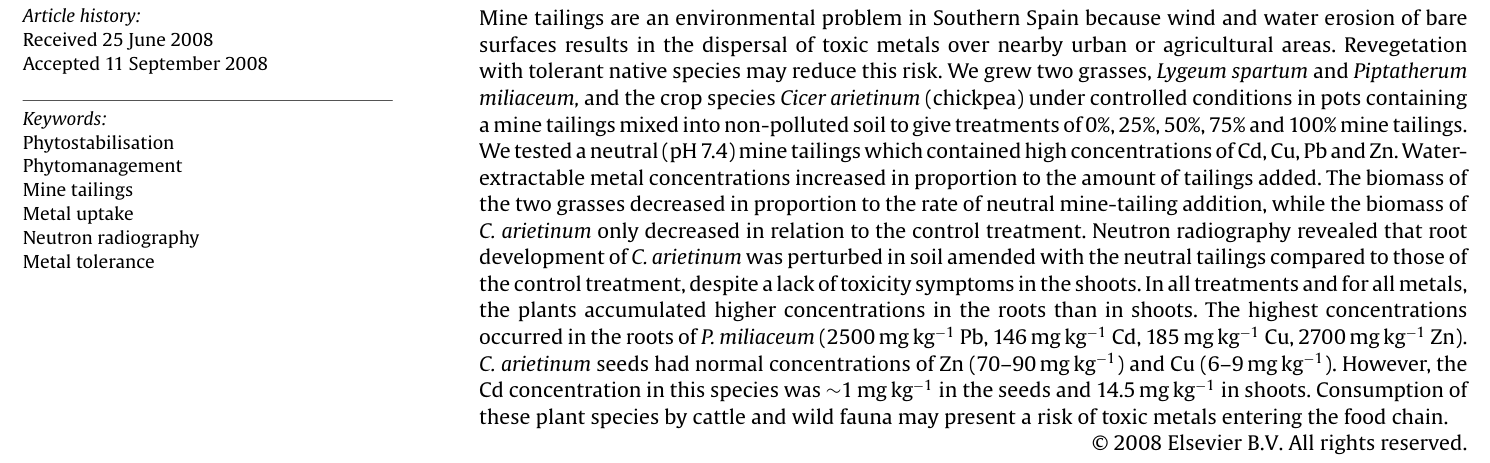
In all treatments with tailings, the water-extractable Cu concentrations were below the detection limits (<0.25 mg kg−1) (Fig. 1).
在所有添加尾矿的处理中,水提取态Cu浓度均低于检出限(<0.25 mg kg−1)(图1)。
The percentages of water-extractable Zn, Pb and Cd never exceeded 1% of the total concentration, but they were in all tailings treatments higher than in the control soil. Water-extractable Ca, Mg, K and Na (Fig. 1b) also increased with the neutral tailing addition.
水提取态Zn、Pb和Cd占全量的百分比均未超过1%,但在所有尾矿处理中均高于对照土壤。水提取态Ca、Mg、K和Na(图1b)亦随中性尾矿添加量增加而升高。
3.2. Plant growth and metal uptake3.2. 植物生长与金属吸收
Plants showed no chlorosis. Nevertheless, biomass production significantly decreased with increasing tailings addition (data not shown). Compared to the control, the presence of tailings material led to a decrease in the biomass of C. arietinum and P. miliaceum. However, in C. arietinum there were no significant differences between the 25%, 50% and 100% treatments. The biomass production of P. miliaceum, continued to decrease significantly with increasing percentage of tailing material indicating that the tailings were phytotoxic for this species. The biomass of the other grass, L. spartum did not show a clear trend.
植物未出现失绿现象。然而,生物量随尾矿添加量增加而显著降低(数据未列出)。与对照相比,尾矿材料的存在导致C. arietinum和P. miliaceum生物量下降。但C. arietinum在25%、50%和100%处理间无显著差异。P. miliaceum的生物量则随尾矿材料比例增加而持续显著下降,表明尾矿对该物种具有植物毒性。另一种禾草L. spartum的生物量未表现出明显趋势。
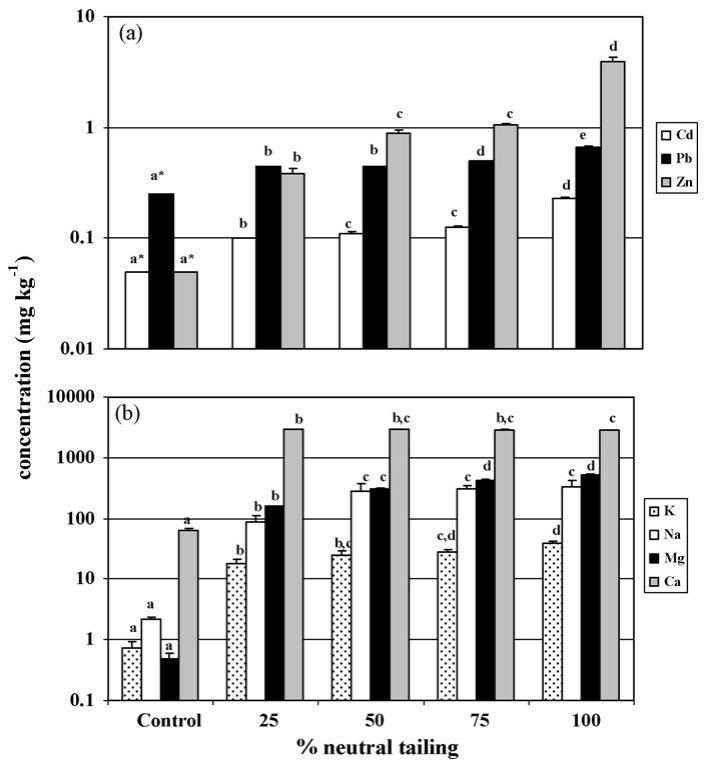
The roots of chickpeas growing in tailings were stunted (Fig. 2a1, 2a2 and 2a3) compared to the plants that grew in the control soil (Fig. 2b1, 2b2 and 2b3). However, despite of the perturbed root system in tailings treatments, there were no visible signs of toxicity in the above ground portions (apart of the aforementioned lower biomass). Flowering and fructification occurred at the same time in both control and tailings treatments.
与生长于对照土壤中的植株(图2b1、2b2和2b3)相比,生长于尾矿中的鹰嘴豆根系发育受阻(图2a1、2a2和2a3)。然而,尽管尾矿处理中根系受到干扰,其地上部分并未表现出可见的毒害症状(上述生物量降低除外)。对照和尾矿处理中的开花和结实时间相同。
Here, we use shoot:root biomass ratios to evaluate the health and vigor of plants and to determine the success of plant establishment. Often, shoot:root biomass ratios decrease under conditions of mineral nutrient deficiency and increase at toxic levels of mineral supply (Roosens et al., 2003). Tailings addition affected the shoot:root ratio of C. arietinum. The highest values for this plant were found in the 100% tailing treatment (0.85), followed by the control (0.80). The intermediate tailing treatments gave values around 0.6. In the two grasses species, the highest shoot:root ratios occurred in L. spartum s of the control treatments (1.31). For the other treatments, this ratio was between 0.83 and 1.03 but the decrease was not correlated with the amount of tailing addition. In P. miliaceum, this ratio was lowest in the control treatment (0.38) and increased in proportion to the tailing addition to 0.64 in the 100% treatment.
本研究采用地上部/根系生物量比来评价植物的健康状况与活力,并判断植物定植是否成功。通常,地上部/根系生物量比在矿质养分缺乏条件下降低,而在矿质供应达到毒害水平时升高(Roosens et al., 2003)。尾矿添加影响了C. arietinum的地上部/根系比。该植物的最高值出现在100%尾矿处理中(0.85),其次为对照(0.80)。中间尾矿处理的值约为0.6。在两种禾草中,最高的地上部/根系比出现在对照处理的L. spartum s中(1.31)。其他处理中该比值介于0.83至1.03之间,但其下降与尾矿添加量不相关。P. miliaceum,的该比值在对照处理中最低(0.38),并随尾矿添加量成比例升高,在100%处理中达到0.64。
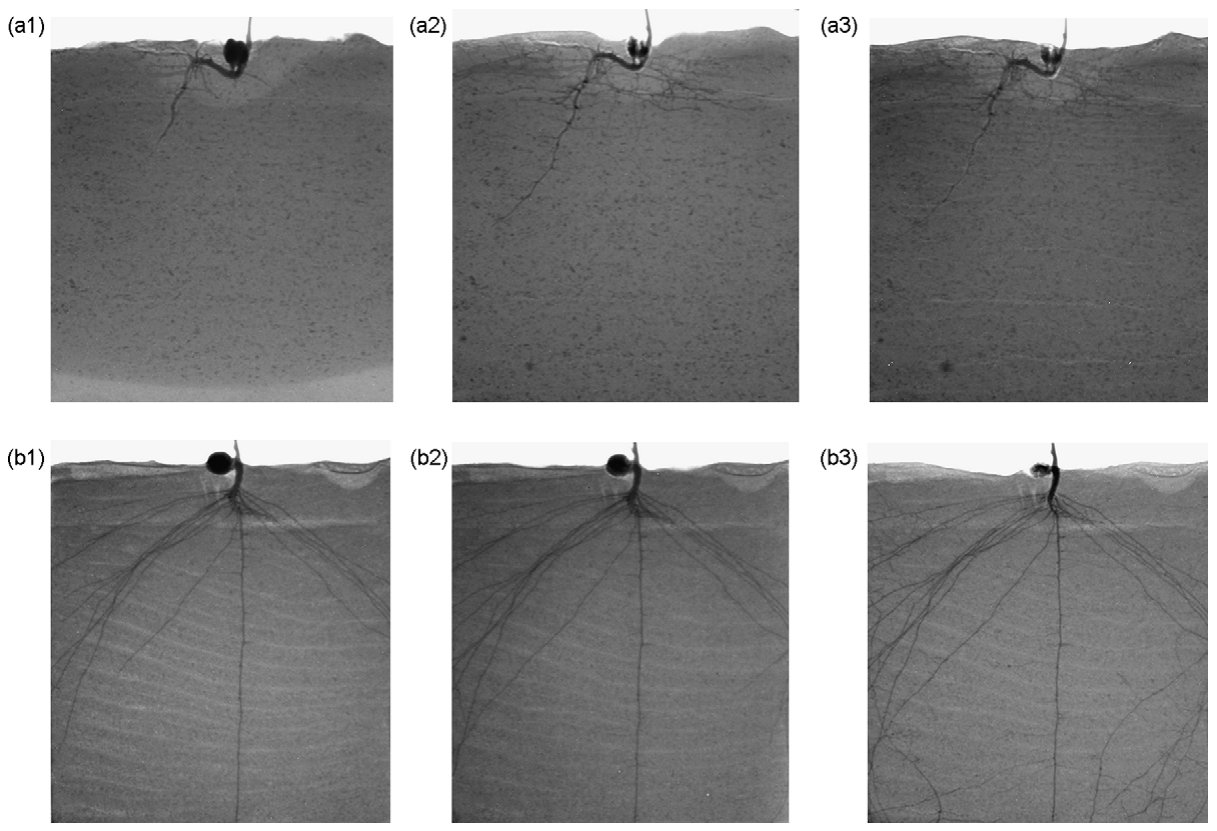
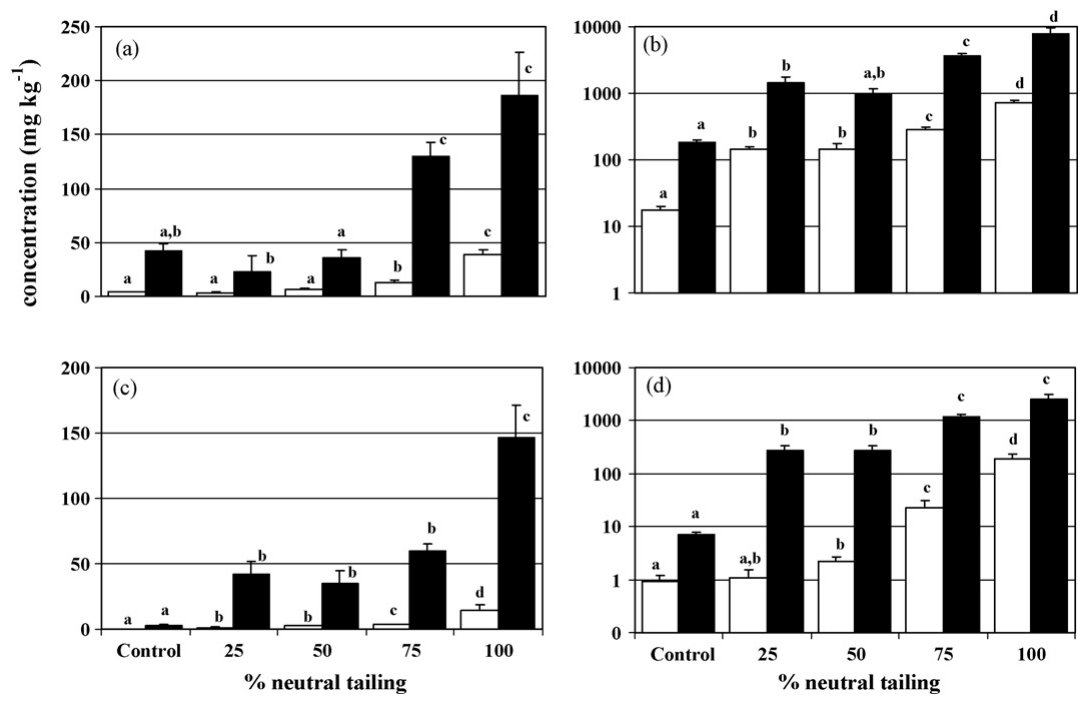
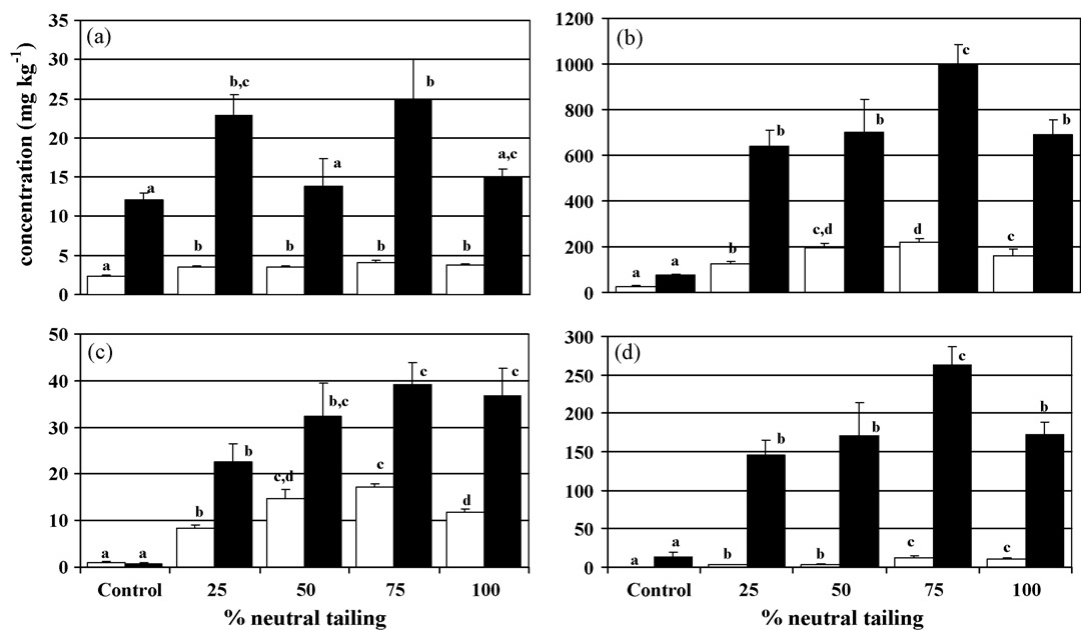
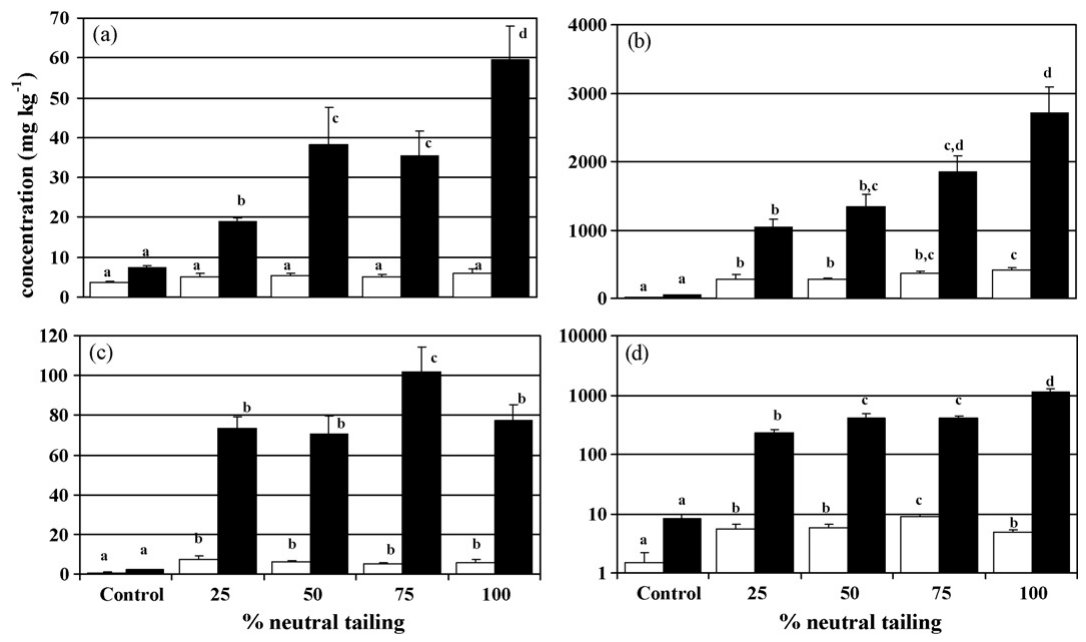
Plant metal concentrations increased in proportion to the amount of mine tailings added (Figs. 3, 4 and 5). In most cases, already the 25% neutral tailing treatment caused significant increases in plant metal uptake (Figs. 3, 4 and 5).
植物金属浓度随尾矿添加量成比例增加(图3、图4和图5)。在大多数情况下,25%中性尾矿处理即已导致植物金属吸收显著增加(图3、图4和图5)。
The shoot Zn concentrations (Figs. 3b, 4b and 5b) were below 500 mg kg−1 in all three species except in the 100% treatment where they reached 700 mg kg−1 in P. miliaceum. The differences between the control and the 25% treatment (P < 0.05) were higher in P. miliaceum (7 fold), than in L. spartum (5 fold) or C. arietinum (6 fold). The behaviour in roots was similar to that in the shoots but the Zn concentrations were higher: 8000 mg kg−1 in P. miliaceum, 700 mg kg−1 in L. spartum and 1700 mg kg−1 in C. arietinum.
三种植物地上部的Zn浓度(图3b、4b和5b)均低于500 mg kg−1,但100%处理中P. miliaceum的Zn浓度达到700 mg kg−1。对照与25%处理之间的差异(P < 0.05)在P. miliaceum中(7倍)大于L. spartum(5倍)和C. arietinum(6倍)。根系中的变化规律与地上部相似,但Zn浓度更高:P. miliaceum为8000 mg kg−1,L. spartum为700 mg kg−1,C. arietinum为1700 mg kg−1。
The highest Pb values occurred in P. miliaceum (190 mg kg−1 in shoots and 2500 mg kg−1 in roots) (Fig. 3d). Shoots of C. arietinum contained less than 10 mg Pb kg−1 while root Pb concentrations reached 1100 mg Pb kg−1 in the 100% treatment (Fig. 5d).
Pb的最高值出现在P. miliaceum中(地上部190 mg kg−1,根系2500 mg kg−1)(图3d)。C. arietinum地上部Pb含量低于10 mg Pb kg−1,而在100%处理中根系Pb浓度达到1100 mg Pb kg−1(图5d)。
Cadmium uptake by shoots (Figs. 3c, 4c and 5c) was in the range of 5–7 mg kg−1 for C. arietinum, 1–15 mg kg−1 for P. miliaceum and 8–17 mg kg−1 for L. spartum in treatment with mine tailings. In all cases, the treatments had significantly higher Cd concentrations compared to the controls.
在尾矿处理中,地上部对镉的吸收(图3c、4c和5c)范围为:C. arietinum 5–7 mg kg−1,P. miliaceum 1–15 mg kg−1,L. spartum 8–17 mg kg−1。在所有情况下,各处理的Cd浓度均显著高于对照。
The Cu concentrations in C. arietinum shoots did not differ significantly from the control treatment (Fig. 5a). Similarly, the Cu concentration in L. spartum roots (Fig. 4a) was 3.5–4.1 mg kg−1. All shoot Cu concentrations were below 15 mg kg−1, except in the case of P. miliaceum in the 100% treatment (38 mg kg−1). The roots of P.
C. arietinum地上部的Cu浓度与对照处理无显著差异(图5a)。同样,L. spartum根系中的Cu浓度(图4a)为3.5–4.1 mg kg−1。除100%处理中的P. miliaceum(38 mg kg−1)外,所有地上部Cu浓度均低于15 mg kg−1。P.
4
H.M. Conesa et al. / Environmental and Experimental Botany xxx (2008) xxx–xxx miliaceum had the highest Cu concentrations (185 mg kg−1 in 100% tailing treatment) (Fig. 3a).
H.M. Conesa et al. / Environmental and Experimental Botany xxx (2008) xxx–xxx miliaceum根系的Cu浓度最高(100%尾矿处理中为185 mg kg−1)(图3a)。
C. arietinum produced seeds in all treatments, although the number of seeds were higher in the control treatment (3.6 per plant) than in the tailing treatments (between 1 and 2 per plant). However, the seeds produced on control soil weighed less (on average of 0.017 g dry weight per seed) than seeds from the tailings treatments (between 0.1 and 0.2 g per seed). None of the treatments had a significant effect on the Cu concentrations (6–9 mg kg−1) of the seeds. However, Zn concentrations of seeds from treatments with tailings material were higher than in seeds from the control treatment (55 mg kg−1) but there were no significant differences among the four tailing treatments (values between 80 and 90 mg kg−1). The Cd concentrations were between 0.5 and
C. arietinum在所有处理中均结籽,但对照处理的种子数量(每株3.6粒)多于尾矿处理(每株1至2粒)。然而,对照土壤上产生的种子较轻(平均每粒干重0.017 g),而尾矿处理的种子为每粒0.1至0.2 g。各处理对种子Cu浓度(6–9 mg kg−1)均无显著影响。然而,添加尾矿材料处理的种子Zn浓度高于对照处理的种子(55 mg kg−1),但四个尾矿处理之间无显著差异(数值介于80至90 mg kg−1之间)。Cd浓度介于0.5至
H.M. Conesa et al. / Environmental and Experimental Botany xxx (2008) xxx–xxxH.M. Conesa et al. / Environmental and Experimental Botany xxx (2008) xxx–xxx
0.9 mg kg−1 except for the control treatment when the concentration in the extract was below the detection limit (1 �g L−1). Translated into concentration of metals in the seed biomass, the detection limit for Cd was 1.33 mg kg−1 for the highest deeds of the control treatment. Similarly, seed Pb concentrations were below the detection limit in all the treatments (<1.33 mg kg−1 for the control treatment and <0.6 mg kg−1 for the rest of treatments).
0.9 mg kg−1之间,但对照处理除外,其提取液浓度低于检出限(1 μg L−1)。换算为种子生物量中的金属浓度,对照处理最重种子的Cd检出限为1.33 mg kg−1。同样,所有处理的种子Pb浓度均低于检出限(对照处理 <1.33 mg kg−1,其余处理 <0.6 mg kg−1)。
4Discussion讨论
According to European and Spanish legislation (European Communities Council, 1986) the addition of the tailings materials used in this study to agricultural soils would be forbidden, because the metal concentrations exceeded limit values (>4000 mg kg−1 Zn; >1200 mg kg−1 Pb).
根据欧洲及西班牙法规(European Communities Council, 1986),本研究所用尾矿材料因金属浓度超过限值(Zn >4000 mg kg−1;Pb >1200 mg kg−1),将被禁止添加至农业土壤中。
All the C. arietinum plants showed significantly reduced biomass in treatments with neutral tailing in relation to the control, but were unaffected by the dosage of tailing (and the corresponding higher metal uptake). In this case, salinity may play a more important role in plant toxicity than heavy metal concentration since grain legumes are sensitive to salinity (Rao et al., 2002). This implies that the elevated metal concentration did not affect the biomass of this species. Thus, plants may have elevated concentrations of toxic heavy metals with showing visible signs of toxicity.
与对照相比,所有中性尾矿处理中的C. arietinum植株生物量均显著降低,但不受尾矿添加量(及相应较高的金属吸收)的影响。在此情况下,由于食用豆类对盐分敏感(Rao et al., 2002),盐分对植物毒害的作用可能比重金属浓度更为重要。这意味着金属浓度升高并未影响该物种的生物量。因此,植物体内有毒重金属浓度可能升高,却不表现出可见的毒害症状。
For most treatments, the metal concentrations in shoots were within the normal ranges for plants (Table 2). However, P. miliaceum had toxic levels of metals in the highest treatments. Most treatments reached phytotoxic concentrations of Cd. The metal concentrations in L. spartum in the acid tailings treatments were higher than those considered normal for Pb, Zn and Cd. Conesa et al. (2006), reported levels ∼150 mg kg−1 for Zn, ∼50 mg kg−1 for Pb and ∼5 mg kg−1 for Cu in P. miliaceum and L. spartum plants growing in situ in tailings from the Cartagena-La Unión mining area. These concentrations were lower than the values obtained in our study (even in relation to the lowest polluted treatment). Conesa et al. (2007b,c) showed how the growth of certain plant species under controlled conditions resulted in significantly higher metal uptake compared to plants sampled in the field due to the changes in growing conditions. These changes were especially important when plants from arid environments are oversupplied with water.
在大多数处理中,地上部金属浓度处于植物正常范围之内(表2)。然而,P. miliaceum在最高处理中的金属含量达到毒害水平。大多数处理的Cd浓度达到植物毒性水平。酸性尾矿处理中L. spartum的Pb、Zn和Cd浓度高于正常水平。Conesa et al.(2006)报道,在Cartagena-La Unión矿区尾矿上in situ生长的P. miliaceum和L. spartum植株中,Zn约为∼150 mg kg−1,Pb约为∼50 mg kg−1,Cu约为∼5 mg kg−1。这些浓度低于本研究所得数值(即使与污染最轻的处理相比亦是如此)。Conesa et al.(2007b,c)表明,由于生长条件的改变,某些植物在受控条件下生长时的金属吸收量显著高于野外采集的植物。当干旱环境中的植物被过量供水时,这些变化尤为显著。
H.M. Conesa et al. / Environmental and Experimental Botany xxx (2008) xxx–xxxH.M. Conesa et al. / Environmental and Experimental Botany xxx (2008) xxx–xxx
Normal ranges and phytotoxic metal concentrations in vegetables given by some authors. Cells in blank mean not available data.
部分作者给出的蔬菜中金属正常范围和植物毒性浓度。空白单元格表示无可用数据。
| Metal金属 | Normal levels正常水平 | Normal concentration正常浓度 | Phytotoxic levels植物毒性水平 | Phytotoxic levels植物毒性水平 | Hyperaccumulator超富集植物 | Maximum levels最高限量 |
|---|---|---|---|---|---|---|
| dry foliagea | in shootsb | dry foliagea | in shootsb | plantc | tolerated by live stocka | |
| mg kg−1 | mg kg−1 | mg kg−1 | mg kg−1 | mg kg−1 | mg kg−1 diet | |
| Cu | 3–20 | 5–20 | 25–40 | 20–100 | 5000 | 25–300 |
| Zn | 15–150 | 25–150 | 500–1500 | 100–400 | 10000 | 300–1000 |
| Cd | 0.1–1 | 0.05–0.7 | 5–700 | 5–30 | 100 | 0.5 |
| Pb | 2–5 | 5–10 | – | 30–300 | – | 30 |
a Values according to Chaney (1989). b Values according to Barceló and Poschenrieder (1992). c Values according to Brooks (1998).
a 数值引自Chaney (1989)。b 数值引自Barceló and Poschenrieder (1992)。c 数值引自Brooks (1998)。
The lower metal concentrations in the seeds compared to the shoots may be attributed to the physiological barrier to metal translocation during seed maturation (Ernst et al., 1992). We found relatively high concentrations of Cd (0.5–0.9 mg kg−1) in the seeds of C. arietinum compared to those reported by Murillo et al. (1999) in seeds of sunflower plants (0.241 mg kg−1) that grew in soils affected by the toxic spill of Aznalcollar. However, our values were in the same range as those that Cobb et al. (2000) obtained for beans (Phaseolus sp.) growing in mine tailings (1.06 mg kg−1). Cobb et al. (2000) obtained lower values for Zn in beans (Phaseolus sp.) (<42 mg kg−1) while Murillo et al. (1999) reported similar Zn (74 mg kg−1) and higher (27 mg kg−1) concentrations for sunflower seeds in relation to the seeds from our study. In our study, seed Pb concentrations were below the detection limits <1.33 mg kg−1 in control treatments and 0.60 mg kg−1 in the rest of the treatments. Murillo et al. (1999) reported that sunflower seeds contained 0.423 mg Pb kg−1. The European Union (European Communities Council, 2001) established a maximum of 0.2 mg Pb kg−1 fresh weight for legumes and 0.1–0.2 mg Cd kg−1 fresh weight for various cereals in order to safeguard human health. In our study area, Cd in C. arietinum seeds may be a human health hazard. If consumed as a major part of the diet (chickpeas is a traditional ingredient of the Mediterranean diet) the Provisional Tolerable Weekly Intake (PTWI) of 7 �g kg−1 of body weight that the World Health Organization proposed (WHO, 2004) could be potentially reached. However, the Zn:Cd concentration ratios in the seeds were between 100 and 150 in the four polluted treatments. This shows that Zn concentrations in the seeds were high in comparison to Cd and that their use as stock fodder would not present a risk for cattle. Underwood and Suttle (1999) showed that diets rich in Zn may be prevent adverse effects of Cd toxicity. Nevertheless, Cd accumulates in animal tissues and pose a risk to consumers of affected animal products. Moreover, using crops from polluted soils as source of cattle fodder may deter consumers.
种子中金属浓度低于地上部,可能归因于种子成熟过程中金属转运的生理屏障(Ernst et al., 1992)。与Murillo et al.(1999)报道的生长于受Aznalcollar有毒泄漏影响土壤中的向日葵种子(0.241 mg kg−1)相比,本研究C. arietinum种子中的Cd浓度相对较高(0.5–0.9 mg kg−1)。然而,本研究数值与Cobb et al.(2000)在生长于尾矿中的菜豆(Phaseolus sp.)中所得结果(1.06 mg kg−1)处于同一范围。Cobb et al.(2000)在菜豆(Phaseolus sp.)中测得的Zn值较低(<42 mg kg−1),而Murillo et al.(1999)报道的向日葵种子Zn浓度(74 mg kg−1)与本研究种子相近,另一浓度则较高(27 mg kg−1)。本研究中,种子Pb浓度低于检出限,对照处理为 <1.33 mg kg−1,其余处理为0.60 mg kg−1。Murillo et al.(1999)报道向日葵种子含0.423 mg Pb kg−1。为保障人体健康,欧盟(European Communities Council, 2001)规定豆类Pb的最高限量为0.2 mg Pb kg−1鲜重,多种谷物Cd的最高限量为0.1–0.2 mg Cd kg−1鲜重。在本研究区域,C. arietinum种子中的Cd可能对人体健康构成危害。若将其作为膳食的主要组成部分(鹰嘴豆是地中海饮食的传统食材),则可能达到世界卫生组织提出的暂定每周耐受摄入量(PTWI)7 μg kg−1体重(WHO, 2004)。然而,四个污染处理中种子的Zn:Cd浓度比介于100至150之间。这表明种子中Zn浓度相对于Cd较高,将其用作牲畜饲料不会对牛构成风险。Underwood and Suttle(1999)表明,富含Zn的日粮可预防Cd毒性的不良影响。尽管如此,Cd会在动物组织中积累,并对受影响畜产品的消费者构成风险。此外,使用污染土壤上生产的作物作为牛饲料来源也可能令消费者望而却步。
Although at first view a mixture of 25% or 50% tailing with the surrounding soil may appear unlikely, some previous studies in the area have found that due to deposition of wind-eroded material, more than 50% of tailing materials had been incorporated into soil profiles of lands surrounding the tailings (García-García, 2004). The fact that the deposition of these sediments occurred in times when there was less environmental conscience is the main reason why no remediation options or monitoring programs are discussed. Strong political initiatives are necessary to inform local populations. In addition, monitoring programs should be implemented in the agricultural areas near the tailings and other locations affected by the deposition of eroded mining wastes. Special emphasis should be given to such as potatoes and root vegetables, since they result in a particularly high metal exposure for humans. The establishment of vegetation is necessary to prevent the erosion and reduce the transport of polluted soils to nearby urban and agricultural areas.
尽管乍看之下,尾矿与周边土壤以25%或50%比例混合的情况似乎不太可能出现,但该地区以往的一些研究发现,由于风蚀物质的沉积,尾矿周边土地的土壤剖面中已混入超过50%的尾矿材料(García-García, 2004)。这些沉积物的堆积发生在环境意识较为淡薄的年代,这是至今未讨论任何修复方案或监测计划的主要原因。有必要采取强有力的政治举措以告知当地居民。此外,应在尾矿附近的农业区以及其他受侵蚀矿业废弃物沉积影响的地点实施监测计划。应特别关注马铃薯和根菜类蔬菜,因为它们会导致人类金属暴露水平尤其高。建立植被对于防止侵蚀、减少污染土壤向附近城市和农业区迁移是必要的。
Cattle should be prevented from grazing on C. arietinum, P. miliaceum and L. spartum growing on soils affected by deposition of mine tailings material. Although the concentrations of metals taken up through roots and accumulated in plant tissues are low, metalrich dust particles adhering to the surfaces of plants must also be taken into account. Furthermore, factors such as the direct ingestion of soil by cattle may play an important role for the transfer of the metals into the food chain.
应禁止牛在受尾矿材料沉积影响的土壤上采食生长的C. arietinum、P. miliaceum和L. spartum。尽管经根系吸收并积累于植物组织中的金属浓度较低,但还必须考虑附着于植物表面的富含金属的粉尘颗粒。此外,牛直接摄食土壤等因素可能在金属向食物链转移中发挥重要作用。
5Conclusions结论
Adding mine tailings to non-polluted soil affects soil properties, plant growth and metal accumulation by plants differed. Soils amended with the neutral mine tailings supported plant growth. Here, aboveground plant biomass was reduced, but did not show external symptoms of metal toxicity. However, high metal concentrations perturbed the root development of these plants. Metal accumulation by C. arietinum seeds may present a human health risk. The potential ingestion of these plant species by cattle and wild fauna may facilitate the entry of metals into the food chain.
向未污染土壤中添加尾矿会影响土壤性质、植物生长,并使植物的金属积累发生差异。添加中性尾矿的土壤能够支持植物生长。在此情况下,植物地上部生物量降低,但未表现出金属毒害的外部症状。然而,高金属浓度干扰了这些植物的根系发育。C. arietinum种子的金属积累可能对人体健康构成风险。牛和野生动物可能采食这些植物,从而促使金属进入食物链。
Our experiment indicates that some plants grow in polluted mine-tailing polluted soils and accumulate high concentrations of metals without being showing visible symptoms. Therefore, plant metal uptake may pass unnoticed by farmers and constitute risk for food chain. Revegetating bare mine tailings is important to stabilize the surfaces of these polluted soils and to reduce the migration of polluted materials to the adjacent fields. Future scientific studies could investigate soil amendments that decrease metal bioavailability in polluted areas near tailings.
本试验表明,一些植物能够在受尾矿污染的土壤中生长,并积累高浓度金属而不表现出可见症状。因此,植物对金属的吸收可能不为农民所察觉,并对食物链构成风险。对裸露尾矿进行植被恢复,对于稳定这些污染土壤表面、减少污染物质向邻近农田迁移具有重要意义。今后的科学研究可探讨能够降低尾矿附近污染区域金属生物有效性的土壤改良剂。
Acknowledgements致谢
We thank Anna Grünwald and René Saladin for their technical assistance. This work was supported by a postdoctoral grant from the “Fundación Séneca” of the Comunidad Autónoma de la Región de Murcia for Dr. Héctor M. Conesa.
感谢Anna Grünwald和René Saladin提供的技术协助。本研究得到Comunidad Autónoma de la Región de Murcia“Fundación Séneca”授予Héctor M. Conesa博士的博士后基金资助。
References参考文献
Al-Farraj, A.S., Al-Wabel, M.I., 2007. Heavy metals accumulation of some plant species grown on mining area at Mahad AD’Dahab, Saudi Arabia. J. Appl. Sci. 7, 1170–1175.
H.M. Conesa et al. / Environmental and Experimental Botany xxx (2008) xxx–xxx
Barceló, J., Poschenrieder, Ch., 1992. Respuestas de las plantas a la contaminación por metales pesados. Suelo y planta 2, 345–361.
Brooks, R.R., 1998. Geobotany and hyperaccumulators. In: Brooks, R.R. (Ed.), Plants that Hyperaccumulate Heavy Metals. CAB International, Wallingford, UK, pp. 55–94.
Chaney, R.L., 1989. Toxic element accumulation in soils and crops: protecting soil fertility and agricultural food-chains. In: Bar-Yosef, B., Barrow, N.J., Goldshmid, J. (Eds.), Inorganic Contaminants in the Vadose Zone. Springer-Verlag, Berlin, pp. 140–158.
Cobb, G.P., Sands, K., Waters, M., Wixson, B.G., Dorward-King, E., 2000. Accumulation of heavy metals ba vegetables grown in mine wastes. Environ. Toxicol. Chem. 19, 600–607.
Conesa, H.M., Faz, Á., Arnaldos, R., 2006. Heavy metal accumulation and tolerance in plants from mine tailings of the semiarid Cartagena-La Union mining district (SE Spain). Sci. Total Environ. 366, 1–11.
Conesa, H.M., García, G., Faz, Á., Arnaldos, R., 2007a. Dynamics of metal tolerant plant communities’ development in Mine Tailings from the Cartagena-La Unión Mining District (SE Spain) and their interest for further revegetation purposes. Chemosphere 68, 1180–1185.
Conesa, H.M., Nowack, B., Schulin, R., 2007b. A laboratory study on revegetation and metal uptake in native plant species from neutral mine tailings. Water Air Soil Pollut. 183, 201–212.
Conesa, H.M., Robinson, B.H., Schulin, R., Nowack, B., 2007c. Growth of Lygeum spartum in acid mine tailings: response of plants developed from seedlings, rhizomes and at field conditions. Environ. Pollut. 145, 700–707.
Diaz, G., Honrubia, M., 1993. Respuestas de crecimiento del albardín (Lygeum spartum L.) a la inoculación con hongos micorrícicos y a la fertilización fosforada. Cryptogamie Mycologie 14, 117–125.
Ernst, W.H.O., 1996. Bioavailability of heavy metals and decontamination of soils by plants. Appl. Geochem. 11, 163–167.
Ernst, W.H.O., Verkleij, J.A.C., Schat, H., 1992. Metal tolerance in plants. Acta Bot. Neerl. 41, 229–248.
European Communities Council. Commission Regulation 466/2001 setting maximum levels for certain contaminants in foodstuffs. Off. J. Eur. Commun, 2001. L77, 16/03/01, 1–13.
European Communities Council. Directive (86/278/EEC) on the Protection of the Environment, and in Particular of the Soil, when Sewage Sludge is used in Agriculture, 1986. Off. J. Eur. Commun. L181, 04/07/86, 6–12.
García-García, C., 2004. Impacto y riesgo medioambiental en los residuos minerometalúrgicos de la Sierra de Cartagena-La Unión. Tesis doctoral. Universidad Politécnica de Cartagena, Cartagena, Spain.
Kühne, G., Frei, G., Lehmann, E., Vontobel, P., 2005. CNR-the new beamline for cold neutron imaging at the Swiss spallation neutron source SINQ. Nucl. Instrum. Methods A 542, 264–270.
Liu, Y.-G., Zhang, H.-Z., Zeng, G.-M., Huang, B.-R., Li, X., 2006. Heavy metal accumulation in plants on Mn mine tailings. Pedosphere 16, 131–136.
Menon, M., Hermle, S., Abbaspour, K.C., Günthardt-Goerg, M.S., Oswald, S.E., Schulin, R., 2005. Water regime of metal-contaminated soil under juvenile forest vegetation. Plant Soil 271, 227–241.
Menon, M., Robinson, B., Oswald, S.E., Kaestner, A., Abbaspour, K.C., Lehmann, E., Schulin, R., 2007. Visualization of root growth in heterogeneously contaminated soil using neutron radiography. Eur. J. Soil Sci. 58, 802–810.
Murillo, J.M., Mara˜nón, T., Cabrera, F., López, R., 1999. Accumulation of heavy metals in sunflower and sorghum plants affected by the Guadiamar spill. Sci. Total Environ. 242, 281–292.
Pérez-Chacón, J.A., 2002. Presencia de Pb, Cu y Zn en suelos próximos a zonas mineras en Roche (Cartagena): Riesgos de bioacumulación en lechuga. Proyecto Fin de Carrera. Universidad Miguel Hernández de Elche, Orihuela, Spain.
Rao, D.L.N., Giller, K.E., Yeo, E.R., Flowers, T.J., 2002. The effect of salinity and sodicity upon nodulation and nitrogen fixation in chikpea (Cicer arietinum). Ann. Bot. 89, 563–570.
Roosens, N., Verbruggen, N., Meerts, P., Ximénez-Embún, P., Smith, J.A.C., 2003. Natural variation in cadmiun tolerante and its relationship to metal hyperaccumulation for seven populations of Thlaspi caerulescens from western Europe. Plant Cell Environ. 26, 1657–1672.
Underwood, E.J., Suttle, N.F., 1999. The mineral nutrition of livestock, 3rd edition. Cabi Publishing, New york, United States.
Wei, S., Zhou, Q., Wang, X., 2005. Identification of weed plants excluding the uptake of heavy metals. Environ. Int. 31, 829–834.
WHO (World Health Organization), 2004. Evaluation of Certain Food Additives and Contaminants. WHO Technical Series Report 922. Sixty-first report of the Joint FAO/WHO Expert Committee on Food Additives, Geneva, Helvetic Confederation.
Wong, M.H., 2003. Ecological restoration of mine degraded soils, with emphasis on metal contaminated soils. Chemosphere 50, 775–780.