ISSN: 0735-2689 (Print) 1549-7836 (Online) Journal homepage: https://www.tandfonline.com/loi/bpts20
Brett H. Robinson , Gary Bañuelos , Héctor M. Conesa , Michael W. H. Evangelou & Rainer Schulin
To link to this article: https://doi.org/10.1080/07352680903035424
Published online: 23 Jun 2009. Submit your article to this journal Article views: 1307 View related articles Citing articles: 157 View citing articles
1The Phytomanagement of Trace Elements in Soil土壤中微量元素的植物管理
2Brett H. Robinson,1 Gary Ba˜nuelos,2 H´ector M. Conesa,3 Michael W. H. Evangelou,3 and Rainer Schulin3Brett H. Robinson,1 Gary Ba˜nuelos,2 H´ector M. Conesa,3 Michael W. H. Evangelou,3 and Rainer Schulin3
1Agriculture and Life Sciences, Lincoln University, PO Box 84, Lincoln, Canterbury 7647, New Zealand 2USDA-ARS, Water Management Research Unit, Parlier, California, USA 3Institute of Terrestrial Ecosystems, Department of Environmental Sciences, ETH Z¨urich, Z¨urich, Switzerland
1林肯大学农业与生命科学学院,PO Box 84, Lincoln, 坎特伯雷 7647, 新西兰 2美国农业部农业研究局(USDA-ARS)水管理研究组,Parlier, 加利福尼亚州,美国 3苏黎世联邦理工学院(ETH Z¨urich)环境科学系陆地生态系统研究所,苏黎世,瑞士
Table of Contents目录
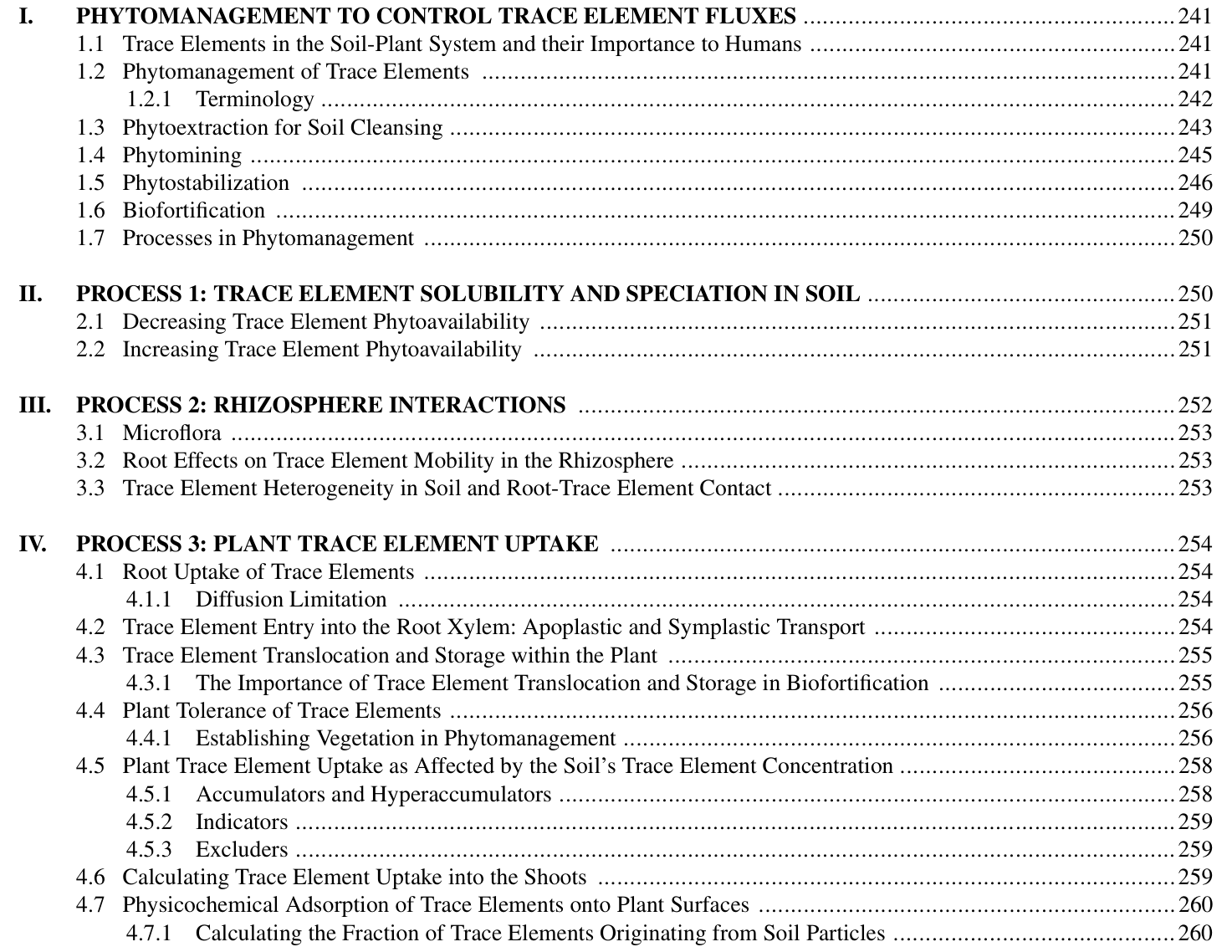
3V. FEASIBILITY OF PHYTOMANAGEMENT AND FERTILE AREAS FOR FUTURE RESEARCH .................261V. 植物管理的可行性及未来研究的重点领域 .................261
Address correspondence to Brett H. Robinson, Agriculture and Life Sciences, Lincoln University, P.O. Box 84, Lincoln, Canterbury 7647, New Zealand. E-mail: Brett.Robinson@lincoln.ac.nz
REFERENCES ..........................................................................................................................................................262
Trace elements (TEs) occur at low concentrations (<1000 mg kg−1) in organisms, yet they have a large biological effect, both as essential nutrients and environmental contaminants. Phytomanagement describes the manipulation of soil-plant systems to affect the fluxes of TEs in the environment with the goal of remediating contaminated soils, recovering valuable metals, or increasing micronutrient concentrations in crops. Phytomanagement includes all biological, chemical, and physical technologies employed on a vegetated site. Successful phytomanagement should either cost less than other remediation or fortification technologies, or be a profitable operation, by producing valuable plant biomass products. This may include bioenergy or timber production on contaminated land, a practice that does not reduce food production. We review the components of phytomanagement and the underlying biogeochemical processes, with a view to elucidating situations where this technology may be successfully applied and identifying future research needs. Many full-scale operations have proved the efficacy of plants to reduce contaminant mobility in soils (phytostabilization), particularly when used in combination with other technologies. As a stand-alone technology, the oft-touted use of plants to extract TEs from contaminated soils (phytoextraction) or low-grade ore bodies (phytomining) is unsuitable for most, if not all, sites due to low-extraction rates and problems caused by site heterogeneity, the limited rooting depth of plants and the presence of contaminant mixtures. Unsubstantiated claims about phytoextraction have tarnished the reputation of all “phyto” technologies. Nevertheless, phytoextraction, as part of a larger environmental toolkit, has a role in phytomanagement. The growth, or lack thereof, of profitable companies that provide phytomanagement will indicate its value. A critical knowledge gap in phytomanagement is the integration of the processes that affect plant–TE interactions and the biophysical processes affecting TE fluxes in the root zone, especially the effect of roots on contaminant fluxes.
微量元素(TEs)在生物体内含量很低(<1000 mg kg−1),但无论作为必需营养元素还是作为环境污染物,均具有显著的生物学效应。植物管理是指通过调控土壤–植物系统来影响微量元素在环境中的通量,其目标是修复污染土壤、回收有价金属或提高作物中微量营养元素的含量。植物管理涵盖在有植被场地上采用的所有生物、化学和物理技术。成功的植物管理应当比其他修复或营养强化技术成本更低,或者通过生产有价值的植物生物质产品而实现盈利。这可包括在污染土地上开展生物能源或木材生产,此类做法不会减少粮食产量。本文综述了植物管理的组成部分及其基本的生物地球化学过程,旨在阐明该技术能够成功应用的情形,并明确未来的研究需求。许多全尺度工程已证明植物能够降低污染物在土壤中的迁移性(植物稳定),尤其是与其他技术联合应用时。作为一项独立技术,常被鼓吹的利用植物从污染土壤(植物提取)或低品位矿体(植物采矿)中提取微量元素的做法,由于提取速率低,以及场地异质性、植物根系深度有限和多种污染物共存等问题,并不适用于大多数(甚至全部)场地。一些缺乏依据的关于植物提取的说法已损害了所有“植物”技术的声誉。尽管如此,作为更广泛的环境技术工具箱的一部分,植物提取在植物管理中仍有其作用。提供植物管理服务的盈利性企业能否发展壮大,将体现该技术的价值。植物管理中一个关键的知识空白在于如何将影响植物–微量元素相互作用的过程与影响根区微量元素通量的生物物理过程整合起来,特别是根系对污染物通量的影响。
Keywords bioenergy, biofortification, phytoextraction, phytomining, phytoremediation
关键词 生物能源,生物强化,植物提取,植物采矿,植物修复
4I. PHYTOMANAGEMENT TO CONTROL TRACE ELEMENT FLUXESI. 利用植物管理调控微量元素通量
1.1 Trace Elements in the Soil-Plant System and their Importance to Humans1.1 土壤–植物系统中的微量元素及其对人类的重要性
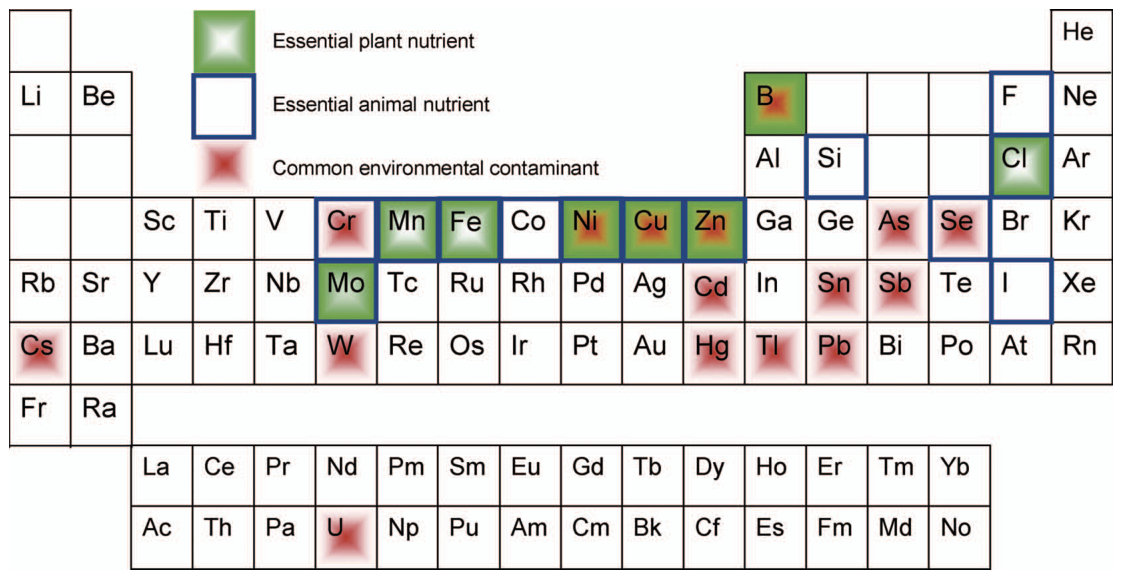
Biological trace elements (TEs) occur at minor concentrations (<1000 mg kg−1) in organisms, yet they may have a major effect on life, both as essential nutrients and environmental contaminants. Figure 1 shows the periodic table of TEs that may occur in organisms, highlighting those that are essential for animals and higher plants, and those that are common environmental contaminants.
生物微量元素(TEs)在生物体内含量很低(<1000 mg kg−1),但无论作为必需营养元素还是作为环境污染物,均可能对生命产生重大影响。图1为可能存在于生物体内的微量元素周期表,突出显示了动物和高等植物所必需的元素以及常见的环境污染元素。
Trace element deficiencies affect most of the world’s 6.5 billion human inhabitants. The World Health Organization (WHO) estimates that 3.7 billion people are Fe deficient, with 2 billion suffering from anaemia. Worldwide, some 35% of children between 0 and 5 years old suffer from Zn or Fe-deficiencies and 260 million suffer from iodine (I) or selenium (Se) deficiencies (2002). Most TEs that humans ingest come directly from plants or via animals, with a smaller fraction coming from geophagy (Oliver, 1997), the direct consumption of soil. Therefore, increasing the plant uptake of essential TEs, and rendering them in a form that can be absorbed by the human gut, would have a large beneficial effect on humanity in deficient areas (Yang et al., 2007).
微量元素缺乏影响着全球65亿人口中的大多数。世界卫生组织(WHO)估计,全球有37亿人缺铁,其中20亿人患有贫血。在世界范围内,约35%的0~5岁儿童存在Zn或Fe缺乏,2.6亿人存在碘(I)或硒(Se)缺乏(2002)。人类摄入的大部分微量元素直接来自植物或经由动物获得,较小部分来自食土行为(Oliver, 1997),即直接食用土壤。因此,提高植物对必需微量元素的吸收,并使其以可被人体肠道吸收的形态存在,将对缺乏地区的人类产生巨大的有益影响(Yang et al., 2007)。
However, in many cases, it is not a deficiency, but excess consumption of and exposure to TEs that has a detrimental effect on humans. Human activities such as mining, industrial production, transport and agriculture release ever-increasing amounts of bioavailable TEs into the environment. TEs are immutable and mostly have a low mobility in soil. Therefore, they accumulate over time under specific environmental conditions. At high concentrations, all TEs are toxic to organisms, even those essential for life. Plants grown on contaminated soils may have reduced productivity and plant TE uptake may facilitate the entry of toxic elements into the food chain, possibly affecting human nutrition. Worldwide, some 22 million hectares of land are contaminated with trace elements (GACGC, 1994).
然而,在许多情况下,对人类产生不利影响的并非缺乏,而是微量元素的过量摄入和暴露。采矿、工业生产、交通运输和农业等人类活动向环境中释放的生物有效态微量元素日益增多。微量元素不可降解,且在土壤中大多迁移性较低,因此在特定环境条件下会随时间不断累积。在高浓度下,所有微量元素(即使是生命必需元素)对生物均具有毒性。生长在污染土壤上的植物生产力可能下降,而植物对微量元素的吸收可能促使有毒元素进入食物链,进而可能影响人类营养。全球约有2200万公顷土地受到微量元素污染(GACGC, 1994)。
The increasing land area that is contaminated or otherwise degraded to the point where it can no longer be used for food production and the increase in the world’s population mean that more food must be produced on a decreasing area of suitable land. Contaminated agricultural land has three negative consequences. Firstly, its usage results in food products that pose a human health risk. Secondly, nonagricultural land, such as that under forests, may be cleared for agricultural production, decreasing biodiversity and removing a sink for greenhouse gasses. Thirdly, agriculture will be intensified on noncontaminated agricultural land. This requires increased fertilizer and pesticide application, which may lead to further soil contamination, since TEs are unwanted constituents in many fertilisers (McLaughlin et al., 1996) and key components in many pesticides (Mills et al., 2005). Intensification may also lead to other forms of land degradation such as compaction, erosion, and salinization.
受污染或因其他原因退化至无法再用于粮食生产的土地面积不断增加,加之世界人口持续增长,意味着必须在日益减少的适宜土地上生产更多粮食。受污染的农业用地会带来三方面的负面后果。第一,利用这些土地生产的食品会对人体健康构成风险。第二,森林等非农业用地可能被开垦用于农业生产,从而降低生物多样性并消除温室气体的汇。第三,未受污染的农业用地将被更加集约化地利用,这需要施用更多的化肥和农药,可能导致进一步的土壤污染,因为微量元素是许多化肥中的有害成分(McLaughlin et al., 1996),也是许多农药中的关键成分(Mills et al., 2005)。集约化还可能导致压实、侵蚀和盐渍化等其他形式的土地退化。
1.2 Phytomanagement of Trace Elements1.2 微量元素的植物管理
Phytomanagement describes the engineering or manipulation of soil-plant systems to control the fluxes of TEs in the environment. Thus, the goal of phytomanagement may be to alleviate deficiencies of essential TEs or to reduce the environmental risk posed by contaminating TEs. A key component of phytomanagement is that it should either cost less than other remediation or fortification technologies, or be a profitable operation, by producing valuable plant biomass products. The term phytomanagement relates to the best site-specific management option, rather than a single technology. Trace element phytomanagement technologies are connected in that they all effect a change in TE fluxes in the soil-plant system.
植物管理是指通过工程设计或调控土壤–植物系统来控制微量元素在环境中的通量。因此,植物管理的目标可以是缓解必需微量元素的缺乏,也可以是降低污染性微量元素带来的环境风险。植物管理的一个关键要素是:它应当比其他修复或营养强化技术成本更低,或者通过生产有价值的植物生物质产品而实现盈利。植物管理一词指的是针对具体场地的最佳管理方案,而非某一单项技术。各种微量元素植物管理技术之间相互关联,它们都会改变土壤–植物系统中的微量元素通量。
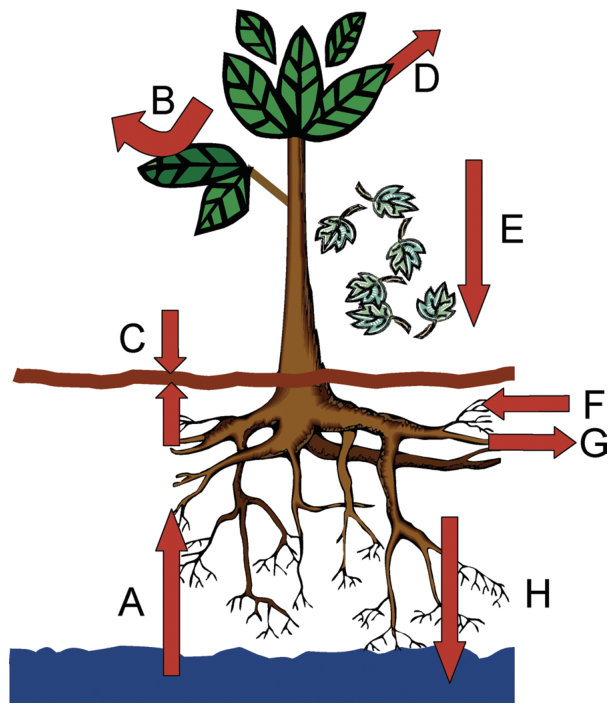
Although the goals of individual phytomanagement scenarios may differ, the underlying processes in the soil-plant system are identical. Phytomanagement exploits plants as bio-pumps that use the sun’s energy to remove water and perhaps TEs from the soil to the aboveground portions, while returning some of the products of photosynthesis back into the root-zone (Robinson et al., 2003b). Transpiration is the cornerstone of phytomanagement because water is the main vehicle for the transport of many TEs into the soil–plant system. Clothier and Green (1997) described roots as “the big movers of water and chemicals in soil.” Of the global average rainfall of 720 mm that falls on land each year (Sellers, 1965), some 410 mm is returned back to the atmosphere, to some degree directly by evaporation from the soil, but mostly by evapotranspiration from vegetation growing therein (Clothier and Green, 1997). Evapotranspiration reduces the average volume of soil solution than exits the root-zone and enters receiving waters by some 57%. In some cases, where evapotranspiration is greater than rainfall, leaching can be eliminated. TEs in soil may enhance or reduce plant growth and affect the quality of plant material as foodstuff both positively and negatively. Conversely, plants affect the movement and speciation of TEs in the environment. Figure 2 gives an overview of TE interactions with plants that are relevant to phytomanagement.
尽管各种植物管理方案的目标可能不同,但土壤–植物系统中的基本过程是相同的。植物管理将植物作为生物泵加以利用:植物利用太阳能将水分以及可能的微量元素从土壤输送至地上部分,同时将部分光合产物返回根区(Robinson et al., 2003b)。蒸腾作用是植物管理的基石,因为水是许多微量元素在土壤–植物系统中迁移的主要载体。Clothier and Green(1997)将根系描述为“土壤中水分和化学物质的主要搬运者”。全球陆地年均降雨量为720 mm(Sellers, 1965),其中约410 mm返回大气,部分直接通过土壤蒸发,但主要通过生长于其中的植被的蒸散作用(Clothier and Green, 1997)。蒸散作用使离开根区并进入受纳水体的土壤溶液平均体积减少约57%。在蒸散量大于降雨量的某些情况下,淋溶可被完全消除。土壤中的微量元素可能促进或抑制植物生长,并对植物作为食物的品质产生正面或负面的影响。反之,植物也会影响微量元素在环境中的迁移和形态。图2概述了与植物管理相关的微量元素与植物之间的相互作用。
1.2.1 Terminology1.2.1 术语
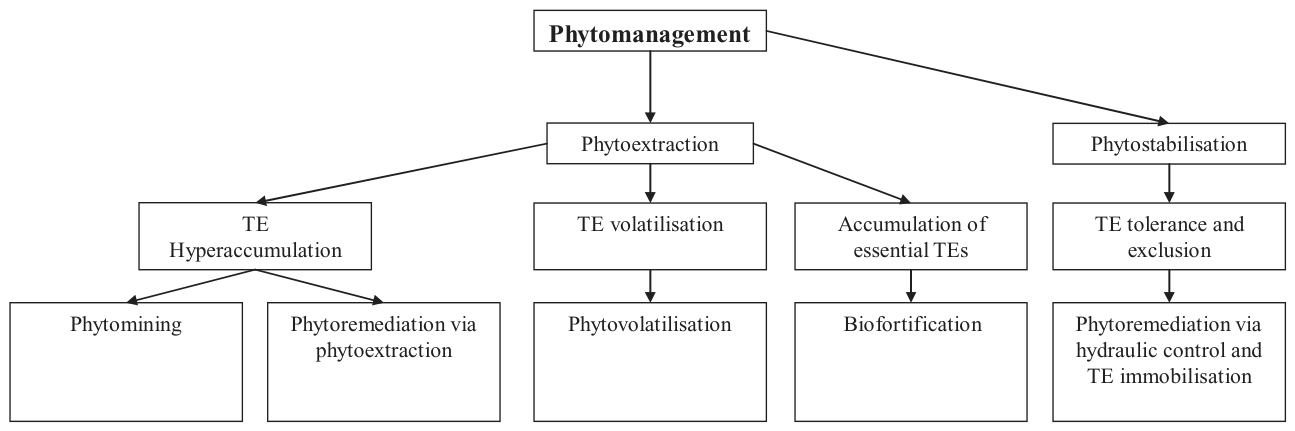
Phytomanagement describes an assemblage of related technologies that include phytomining (Nicks and Chambers, 1994), phytoremediation, which is divided into phytoextraction and phytostabilization (Salt et al., 1995), as well as biofortification (King, 2002). Phytomanagement of contaminated soils describes use of vegetation, possibly in combination with other technologies, to deliver the most cost-effective means of mitigating any environmental risks associated with the site. The role of vegetation in contaminated site phytomanagement is to add value to the land and possibly mitigate the negative effects associated with soil contamination. Phytoremediation may aim to immobilise the TEs in the soil, so that they neither leach nor enter the plant shoots (phytostabilization). Alternatively, one may engineer or manipulate the soil-plant system so that plants take up the contaminating TEs into the shoots, where they may be volatilised (phytovolatilization), or removed from the site when the plants are harvested (phytoextraction). Phytomining describes the phytoextraction of valuable TEs from ore bodies or metal-contaminated environments where the target metal concentration is too low for conventional mining. In soils that are deficient in essential TEs, the goal of phytomanagement is to increase the TE concentration in the edible plant organs (biofortification). The boundaries between these technologies are not distinct. Phytoextraction of TEs from a contaminated soil may produce biomass enhanced in essential TEs (biofortification) or saleable quantities of valuable TEs (phytomining), while reducing erosion and TE leaching from the site (phytostabilization). Figure 3 provides a schematic diagram connecting the phytomanagement technologies.
植物管理是一组相关技术的集合,包括植物采矿(Nicks and Chambers, 1994)、植物修复(又分为植物提取和植物稳定)(Salt et al., 1995)以及生物强化(King, 2002)。污染土壤的植物管理是指利用植被(可能与其他技术相结合),以最具成本效益的方式缓解与场地相关的环境风险。植被在污染场地植物管理中的作用是提升土地价值,并可能减轻与土壤污染相关的负面效应。植物修复的目标可以是将微量元素固定在土壤中,使其既不淋溶也不进入植物地上部(植物稳定)。另一种方式是通过工程设计或调控土壤–植物系统,使植物将污染性微量元素吸收至地上部,在那里微量元素可能被挥发(植物挥发),或在植物收获时被移出场地(植物提取)。植物采矿是指从矿体或金属污染环境中植物提取有价微量元素,而这些环境中目标金属浓度过低,不适合常规采矿。在缺乏必需微量元素的土壤中,植物管理的目标是提高植物可食用器官中的微量元素浓度(生物强化)。这些技术之间的界限并不分明。从污染土壤中植物提取微量元素可能产生富含必需微量元素的生物质(生物强化)或可出售数量的有价微量元素(植物采矿),同时减少场地的侵蚀和微量元素淋溶(植物稳定)。图3为各植物管理技术之间关系的示意图。
An important distinction in the TE distribution in soils is whether they are inert, able to interact with plants (phytoavailable) or able to interact with any biological organism, including humans (bioavailable). We use these terms to indicate a TE’s physicochemical potential but not its biological action. For example, phytoavailable TEs may be toxic to plants, or accumulated in the plant’s shoots, but they are not necessarily so. Toxicity and accumulation are dependent upon plant species.
土壤中微量元素分布的一个重要区别在于:它们是惰性的,能够与植物相互作用(植物有效性),还是能够与包括人类在内的任何生物相互作用(生物有效性)。我们用这些术语表示微量元素的物理化学潜力,而非其生物学作用。例如,植物有效态微量元素可能对植物有毒,或在植物地上部累积,但并非必然如此。毒性和累积取决于植物种类。
1.3 Phytoextraction for Soil Cleansing1.3 用于土壤净化的植物提取
Chaney (1983) suggested that hyperaccumulator plants, namely those that accumulate TEs to concentrations 10 to 100 times those found in ‘normal’ plants (Brooks et al., 1977), could cleanse polluted soil by extracting the contaminating metals. McGrath et al. (1993) and Baker et al. (1994) demonstrated that the phytoextraction of metals was possible with the Zn hyperaccumulator Thlaspi caerulescens (J. & C. Presl.).
Chaney(1983)提出,超富集植物,即累积微量元素浓度为“普通”植物10~100倍的植物(Brooks et al., 1977),可以通过提取污染金属来净化污染土壤。McGrath et al.(1993)和Baker et al.(1994)证明,利用Zn超富集植物Thlaspi caerulescens(J. & C. Presl.)进行金属的植物提取是可行的。
Repeated cropping of plants that accumulate contaminating TEs in soil should, in theory, lower the soil’s TE concentrations to acceptable levels, provided the harvested amounts of TEs exceed further inputs. Phytoextraction employs plants that accumulate large amounts of one or more target TEs into the above-ground biomass. Each cropping would remove TE from the area. The TE-rich biomass would be burned, fermented or used in gasification to reduce its volume. Residual material that is rich in the contaminating TE could be reprocessed to recover the TE or stored in an appropriate area, such as a contained landfill that does not pose a risk to the environment.
理论上,只要收获移除的微量元素量超过新的输入量,反复种植能够累积土壤中污染性微量元素的植物,就应能将土壤微量元素浓度降低至可接受水平。植物提取利用能在地上生物量中累积大量一种或多种目标微量元素的植物。每次收获都会从该区域移除微量元素。富含微量元素的生物质可通过焚烧、发酵或气化处理以减小体积。富含污染性微量元素的残余物可再加工以回收微量元素,或储存于适当区域,如不对环境构成风险的封闭式填埋场。
Some plants transform soil contaminants into volatile compounds that disperse in the atmosphere (phytovolatilization). Plant-microbial systems have been discovered that volatilise Hg, As and Se (Brooks, 1998a). Drawbacks of phytovolatilization include the limited number of plant-microbial systems that volatilise a limited number of TEs and, more importantly, that there is no control on the destination of the volatilised elements. For essential TEs such as Se, however, phytovolatilization offers the possibility of redistributing this element from areas where Se toxicity exists to downwind areas where there is Se deficiency (Zayed et al., 2000). Phytoextraction via volatilisation has the advantage over other forms of phytoextraction in that the vegetation does not require regular harvesting; the crop can be left onsite until the soil’s TE concentrations comply with environmental regulations.
一些植物能将土壤污染物转化为挥发性化合物并扩散到大气中(植物挥发)。目前已发现能够挥发Hg、As和Se的植物–微生物系统(Brooks, 1998a)。植物挥发的缺点包括:能够挥发微量元素的植物–微生物系统数量有限,可挥发的微量元素种类也有限;更重要的是,挥发出的元素去向无法控制。然而,对于Se等必需微量元素,植物挥发提供了将其从Se毒害地区重新分配到下风向Se缺乏地区的可能性(Zayed et al., 2000)。与其他形式的植物提取相比,通过挥发进行的植物提取的优势在于植被无需定期收获,作物可留在场地上,直至土壤微量元素浓度符合环境法规要求。
Phytoextraction is appealing because there are few technologies for economically removing contaminating TEs from soil, and many other strategies require harsh chemical or physical processes. Incineration, thermal desorption, and soil washing are expensive and leave the soil infertile. In contrast, phytoextraction would use the sun’s energy to cleanse the soil using normal agronomic processes. Because of this, it is often incorrectly touted as a low-cost means to cleanse contaminated soils.
植物提取之所以具有吸引力,是因为能够经济地从土壤中去除污染性微量元素的技术很少,而许多其他策略需要采用剧烈的化学或物理过程。焚烧、热脱附和土壤淋洗成本高昂,且会使土壤丧失肥力。相比之下,植物提取将利用太阳能,通过常规农艺过程净化土壤。正因如此,它常被错误地宣传为一种低成本的污染土壤净化手段。
Phytoextraction for soil remediation requires that the concentrations of the contaminating TEs be reduced to levels that complies with environmental regulations. There is a conspicuous absence of successful phytoextraction field trials or commercial operations. Selenium volatilisation using genetically engineered Brassica juncea (L.) is one of the few examples of the successful field application of phytoextraction (Ba˜nuelos et al., 2005). The factor determining the duration of phytoextraction is the mass of TEs removed by the crop per unit of time (years) compared to the mass of TE in the soil.
用于土壤修复的植物提取要求将污染性微量元素的浓度降低至符合环境法规的水平。成功的植物提取田间试验或商业运营明显缺乏。利用转基因Brassica juncea(L.)进行硒挥发,是植物提取成功应用于田间的少数实例之一(Ba˜nuelos et al., 2005)。决定植物提取所需时间的因素是作物单位时间(年)内移除的微量元素量与土壤中微量元素总量之比。
Phytoextraction requires ongoing site management, harvesting and processing of the TE-rich biomass. Burning may reduce the volume of the biomass. Although specialized incineration facilities may be required to prevent TE-loss in the smoke (Keller et al., 2005), Margni et al. (1997) reported most existing waste incinerators can safely process metal-enriched biomass. Alternatively, relatively volatile metals, such as Cd, could be removed from the biomass via pyrolysis, leaving uncontaminated bottom ash (Keller et al., 2005).
植物提取需要持续的场地管理以及对富含微量元素的生物质进行收获和处理。焚烧可减小生物质体积。尽管可能需要专门的焚烧设施以防止微量元素随烟气损失(Keller et al., 2005),但Margni et al.(1997)报道,大多数现有垃圾焚烧炉均可安全处理富含金属的生物质。另外,Cd等相对易挥发的金属可通过热解从生物质中去除,留下未受污染的底灰(Keller et al., 2005)。
Phytoextraction has fixed costs in the form of site assessment and geotechnical preparation for planting (Robinson et al., 2006). In its pure form, the cost of phytoextraction increases with the time needed to reduce the soil’s contaminant burden to below regulatory limits. This time is not simply the quotient of the soil’s TE burden and the crop’s TE content, since contaminant heterogeneity and the decline in plant uptake as soil TE concentrations decline invariably increase the time needed. Most studies on plant-TE interactions used homogeneous growth media in greenhouse environments. In the TE-contaminated sites where phytoextraction would be applied, the distribution of TEs is typically highly heterogeneous, both spatially and temporally, as TEs leach or are phytoextracted from the soil. Unlike pot trials, roots in the field may not be in intimate contact with the TE-rich material, thus resulting in lower-than-expected TE uptake (Section 3.3). A clear example of this “greenhouse vs field” difference was observed with Se uptake (Ba˜nuelos et al., 1998). More importantly, the likely different uptakes between pot and field trials underscores the importance of minimizing expectations of phytoextraction under field conditions based upon observations in a controlled contaminated environment. Successive crops reduce the pool of TE that is available for plant uptake (Section 2.5), resulting in small amounts being extracted. “Hot spots” of high TE concentrations may reduce or inhibit plant growth, rendering phytoextraction ineffective in these zones. The time needed for phytoextraction may be calculated using the following formulae (Robinson et al., 2006).
植物提取具有场地评估和种植前岩土准备等固定成本(Robinson et al., 2006)。就其单纯形式而言,植物提取的成本随将土壤污染负荷降至监管限值以下所需时间的延长而增加。该时间并非简单地等于土壤微量元素负荷与作物微量元素含量之商,因为污染物的异质性以及植物吸收量随土壤微量元素浓度降低而下降,必然会延长所需时间。大多数关于植物–微量元素相互作用的研究是在温室环境中使用均质生长介质进行的。而在将要应用植物提取的微量元素污染场地中,随着微量元素从土壤中淋溶或被植物提取,其分布通常在空间和时间上都具有高度异质性。与盆栽试验不同,田间根系可能无法与富含微量元素的物质紧密接触,从而导致微量元素吸收量低于预期(3.3节)。Se吸收研究清楚地体现了这种“温室与田间”的差异(Ba˜nuelos et al., 1998)。更重要的是,盆栽试验与田间试验之间可能存在的吸收差异表明,不应根据受控污染环境中的观察结果对田间条件下的植物提取抱有过高期望。连续种植会减少可供植物吸收的微量元素库(2.5节),导致提取量较少。高微量元素浓度的“热点”可能降低或抑制植物生长,使植物提取在这些区域失效。植物提取所需时间可用以下公式计算(Robinson et al., 2006)。

where t is the time in years, x is the spatial position (latitude, longitude) Mi(x)max is the maximum initial TE burden (g ha−1) in the affected area, Mf is the target TE soil burden (g ha−1), P is the average crop TE concentration (g t−1), and B is the biomass production (t ha−1 yr−1), both of which are a function of the root exposure to bioavailable TE, E (g t−1). E can be calculated thus:
式中,t为时间(年),x为空间位置(纬度、经度),Mi(x)max为受影响区域内的最大初始微量元素负荷(g ha−1),Mf为目标土壤微量元素负荷(g ha−1),P为作物平均微量元素浓度(g t−1),B为生物量产量(t ha−1 yr−1),后两者均为根系对生物有效态微量元素暴露量E(g t−1)的函数。E可按下式计算:

where z is depth (m), R is the root fraction (dimensionless) that is in contact with the phytoavailable TE, C (g t−1), which is a function of M.
式中,z为深度(m),R为与植物有效态微量元素接触的根系比例(无量纲),C(g t−1)为植物有效态微量元素浓度,是M的函数。
For practical purposes, Eq. 2 requires a numerical solution. The function R(t′,z) needs to be determined using existing data that describes the root development of the species. Similarly, C(M(t′z) is calculated using the TE’s absorption isotherm and an measurements of the TE in the soil profile. Calculations using Eq. 2 usually indicate that high spatial and temporal heterogeneity result in longer extraction times. This is because the maximum contaminant burden, Mi(z)max, is always greater in heterogeneous environments than in homogeneous ones. The response of plant roots to heterogeneous patches of TEs (Section 3.3) will greatly affect the value of t. Plants with roots that forage contaminant hotspots, such as Thlaspi caerulescens (Whiting et al., 2000), would remove TEs at a greater rate than those whose root systems are indifferent or avoid hotspots. Research into root behaviour may be as important for phytoextraction as the investigation of TE transporter systems and soil conditioners.
在实际应用中,式2需要数值求解。函数R(t′,z)需利用描述该物种根系发育的现有数据来确定。同样,C(M(t′z)利用该微量元素的吸附等温线和土壤剖面中该微量元素的测定值计算。利用式2进行的计算通常表明,高度的时空异质性会导致提取时间延长。这是因为在异质环境中,最大污染负荷Mi(z)max总是大于均质环境。植物根系对微量元素异质斑块的响应(3.3节)将极大地影响t值。根系能够觅取污染热点的植物,如Thlaspi caerulescens(Whiting et al., 2000),其去除微量元素的速率将高于根系对热点无反应或回避热点的植物。对于植物提取而言,根系行为的研究可能与微量元素转运系统和土壤调理剂的研究同等重要。
Equation 2 is applicable over a wide range of scales. The degree of heterogeneity, and therefore cleanup time, will increase as the scale decreases. Setting the scale for assessing soil concentrations, and therefore cleanup thresholds, is the domain of regulators.
式2适用于很宽的尺度范围。随着尺度减小,异质性程度以及相应的净化时间将会增加。确定评估土壤浓度的尺度,进而确定净化阈值,属于监管机构的职责范围。
Table 1 shows the time required to halve the soil concentration of a contaminating TE, at initial extraction rates of 5 and 50 kg TE ha−1 yr−1. Assuming a constant extraction rate of 50 kg ha−1 yr−1, soil concentrations of up to 200 mg kg−1 could be halved within a decade. However, incorporating temporal heterogeneity and a realistic root distribution (Eqs. 1 & 2), the calculated time quadruples.表1列出了在初始提取速率为5和50 kg TE ha−1 yr−1时,使污染性微量元素的土壤浓度减半所需的时间。假设提取速率恒定为50 kg ha−1 yr−1,则浓度最高达200 mg kg−1的土壤可在十年内实现浓度减半。然而,若考虑时间异质性和实际根系分布(式1和式2),计算所得时间将增至四倍。
Equation 1 calculates the time to cleanse a soil of only one TE. Many polluted soils contain more than one contaminant. Few plant species can extract high concentrations of more than one element. Consequently, remediation may require sequential crops of different species that target a range of contaminants. Additional TEs or other xenobiotic compounds in the soil may further reduce plant growth. Therefore, the time to cleanse soils with a suite of contaminants will be longer than that required for the removal of a single TE, and the time required for
式1计算的是仅净化土壤中一种微量元素所需的时间。许多污染土壤含有不止一种污染物。能够高浓度提取一种以上元素的植物种类很少。因此,修复可能需要依次种植针对不同污染物的不同物种。土壤中其他微量元素或其他外源化合物可能进一步抑制植物生长。因此,净化含有多种污染物的土壤所需的时间将长于去除单一微量元素所需的时间,并且所需时间
TABLE 1表1
Time Required for Phytoextraction to Reduce the Contaminant Burden in the Soil by Half, Calculated Using Both a Constant Extraction Rate and Incorporating Temporal Heterogeneity, and given an Initial Extraction Rate of 5 or 50 kg ha−1 yr−1 in the above-ground Biomass. The Soil Depth is 20 cm and the Bulk Density is 1.2. The Temporally Heterogeneous Calculations, with a Realistic Root Distribution were Made Using the Phyto-DSS (Robinson et al., 2003). φ = 1, K = 0.15 phytoextraction to cleanse even a moderately contaminated soil is, in the best case, in the order of decades.
在恒定提取速率和考虑时间异质性两种情况下,植物提取使土壤污染负荷减半所需的时间,地上生物量的初始提取速率为5或50 kg ha−1 yr−1。土壤深度为20 cm,容重为1.2。考虑时间异质性并采用实际根系分布的计算利用Phyto-DSS完成(Robinson et al., 2003)。φ = 1,K = 0.15 利用植物提取净化即便是中度污染的土壤,在最佳情况下也需要数十年。
| Con extract恒 提取 | stant ion rate定 速率 | Temp hetero时间 异质 | orally geneous上 性 | |
|---|---|---|---|---|
| Initial extraction rate (kg | 5 | 50 | 5 | 50 |
| ha−1 yr−1) | ||||
| Initial soil concentration | ||||
| (mg kg−1) | ||||
| 50 | 12 | 2 | 50 | 5 |
| 100 | 24 | 3 | 99 | 10 |
| 200 | 48 | 5 | 199 | 20 |
| 400 | 96 | 10 | 398 | 40 |
| 800 | 192 | 20 | 797 | 80 |
The application of phytoextraction in the field presents additional challenges. Commercial providers of seeds of hyperaccumulator species may find seed production unattractive because most hyperaccumulator species have a limited ecological range. Seed merchants would thus be required to produce small volumes of seeds of many hyperaccumulator species, each requiring specialised growing conditions. There are also ecological concerns that plant-TE uptake may provide an additional exposure pathway into food chains if local herbivores consume these plants (Wolfe and Bjornstad, 2002).
植物提取在田间的应用还面临其他挑战。由于大多数超富集植物的生态分布范围有限,超富集植物种子的商业供应商可能认为种子生产缺乏吸引力。种子商因此需要少量生产许多超富集植物物种的种子,而每个物种都需要特殊的生长条件。此外,还存在生态方面的担忧:如果当地食草动物取食这些植物,植物对微量元素的吸收可能为微量元素进入食物链提供额外的暴露途径(Wolfe and Bjornstad, 2002)。
Were phytoextraction combined with a profit-making operation that is unaffected by any elevated plant-TE loadings, then the time to decontaminate the soil becomes less important. Revenue-generating operations may include forestry (Pulford et al., 1995) and bioenergy production (Licht and Isebrands, 2005). Recent concern over global warming due to CO2 emissions may provide economic incentives to produce plant-based fuels because such systems do not result in net CO2 production. As neither humans nor animals consume biofuels, elevated TE concentrations in such fuel crops are of lower concern than they would be in food crops. Biofuel production may be an effective way for the land to be cleansed while providing a positive economic return (Ba˜nuelos, 2009). The use of contaminated or marginal soils for biofuel production is economically more prudent than using good quality soils. Food production must not suffer for biofuel production.
如果将植物提取与不受植物微量元素负荷升高影响的盈利性经营相结合,那么土壤去污所需的时间就不再那么重要。能够产生收益的经营活动包括林业(Pulford et al., 1995)和生物能源生产(Licht and Isebrands, 2005)。近年来对CO2排放导致全球变暖的关注,可能为生产植物源燃料提供经济激励,因为此类系统不会产生净CO2排放。由于人类和动物都不食用生物燃料,因此这类燃料作物中微量元素浓度升高的问题远不如粮食作物中那样值得关注。生物燃料生产可能是在净化土地的同时获得正经济回报的有效途径(Ba˜nuelos, 2009)。利用污染土壤或边际土壤生产生物燃料在经济上比利用优质土壤更为明智。粮食生产不应因生物燃料生产而受到影响。
1.4 Phytomining1.4 植物采矿
Nicks and Chambers (1994, 1995) reported that it might be possible to use plants to extract Ni from low-grade ores that would otherwise not be economic to mine, and were unsuitable for agriculture due to their high Ni concentration. Low-grade Ni ores cover large areas of the Earth’s surface, for example in Western Australia, Italy, Brazil, Canada, Russia, and many other countries and territories. Nicks and Chambers found that Streptanthus polygaloides (Gray) grown on ultramafic (serpentine) soils near Chinese Camp in California, could extract up to 100 kg ha−1 of Ni (worth $550 ha−1 at the prices at that time). A large-scale industry with continuous incineration of the crop would add an additional $219 ha−1 from the energy of combustion. They concluded that the return to a farmer growing a ‘crop of nickel’ (i.e., half the gross yield) would be roughly comparable, or superior to, that obtained for a crop of wheat. An obvious problem with the use of an incinerator to produce steam for power generation is that the crop harvesting would occur over a short period and therefore the power plant should be near an urban area where domestic waste might be used as a feedstock to keep the plant going the rest of the year. There is also the possibility of two crops a year that would not only increase Ni yield but would give more work to a nearby incineration plant.
Nicks and Chambers(1994, 1995)报道,利用植物从低品位矿石中提取Ni是可能的,这类矿石若采用常规开采则不经济,且因Ni浓度高而不适于农业利用。低品位Ni矿石覆盖了地球表面的大片区域,例如西澳大利亚、意大利、巴西、加拿大、俄罗斯以及许多其他国家和地区。Nicks and Chambers发现,在加利福尼亚州Chinese Camp附近超基性(蛇纹岩)土壤上生长的Streptanthus polygaloides(Gray)可提取多达100 kg ha−1的Ni(按当时价格计价值550美元 ha−1)。若建立连续焚烧作物的大规模产业,燃烧产生的能量还可额外带来219美元 ha−1的收益。他们得出结论,种植“镍作物”的农户所获回报(即总产值的一半)将大致相当于甚至优于种植小麦。利用焚烧炉产生蒸汽发电的一个明显问题是,作物收获集中在较短时期内,因此发电厂应靠近城市地区,以便在一年中其余时间利用生活垃圾作为原料维持运转。此外,还可能实现一年两熟,这不仅能提高Ni产量,还能为附近的焚烧厂提供更多原料。
Subsequent studies (Anderson et al., 1999; Leblanc et al., 1999; Robinson et al., 1997a, 1997b) have shown other species could produce even greater profits from the land, and that phytomining could extract other metals, especially Tl and Au. An American company, Viridian Environmental, subsequently patented the phytomining process (U.S. patent Nos. 5711784 & 5944872).
随后的研究(Anderson et al., 1999; Leblanc et al., 1999; Robinson et al., 1997a, 1997b)表明,其他物种可从土地上获得更高的利润,并且植物采矿还可提取其他金属,尤其是Tl和Au。美国公司Viridian Environmental随后为植物采矿工艺申请了专利(美国专利号5711784 & 5944872)。
Unlike phytoextraction for soil cleansing, the feasibility of phytoextraction for phytomining is based solely on the value of the TE that is extracted. Brooks et al. (1998) showed that, in principle, Ni should be feasible since there are many hyperaccumulator plants, such as Alyssum (Robinson et al. 1997b) spp. and Berkheya coddii (Robinson et al., 1997a), that fulfil the criterion of a high biomass production (>10 t ha−1year−1) with a high shoot Ni concentration (>10,000 mg kg−1). Chaney et al. (2007) reported that Ni phytomining using Alyssum could give a return of US$ 16,000 ha−1.
与用于土壤净化的植物提取不同,用于植物采矿的植物提取的可行性完全取决于所提取微量元素的价值。Brooks et al.(1998)表明,原则上Ni的植物采矿应当是可行的,因为有许多超富集植物,如Alyssum(Robinson et al. 1997b)属植物和Berkheya coddii(Robinson et al., 1997a),满足高生物量产量(>10 t ha−1year−1)和高地上部Ni浓度(>10,000 mg kg−1)的标准。Chaney et al.(2007)报道,利用Alyssum进行Ni植物采矿的收益可达16,000美元 ha−1。
Yet, as with phytoextraction for soil cleansing, there are no reports of successful commercial phytomining operations. So, given the potentially high economic returns, what is preventing the commercialisation of phytomining? Since removal of Ni from soil using phytomining has been demonstrated to be viable in principle, and in field trials (Brooks et al., 1998; Chaney et al., 2007; Chaney et al., 2005; Robinson et al., 1997a, 1997b), either unaccounted costs are preventing the commercialization of phytomining, or it is only a matter of time before phytomining becomes widespread. Here, we investigate potential limiting factors.
然而,与用于土壤净化的植物提取一样,目前尚无成功的商业化植物采矿运营的报道。那么,既然潜在经济回报很高,是什么阻碍了植物采矿的商业化?由于利用植物采矿从土壤中去除Ni已在原理上和田间试验中被证明是可行的(Brooks et al., 1998; Chaney et al., 2007; Chaney et al., 2005; Robinson et al., 1997a, 1997b),因此要么是一些未计入的成本阻碍了植物采矿的商业化,要么植物采矿的普及只是时间问题。本文对潜在的限制因素进行了探讨。
Li et al. (2003) demonstrated that feasibility of Ni recovery from the ash (bio-ore) of Alyssum spp. Bio-ore contains higher
Li et al.(2003)证明了从Alyssum属植物灰分(生物矿石)中回收Ni的可行性。生物矿石所含的
Ni concentrations (6–16%) (Koppolu et al., 2004) than normal Ni-ores (ca. 3%). Bio-ores are free of oxides of Mn, Fe and Si that normally hinder the recovery of Ni from conventional ores (Li et al. 2003). Boominathan et al. (2004) showed that bio-ore generated from Berkheya coddii contained 34% Ca, some fifteen times more than bio-ore generated from Alyssum bertolonii. The Ca, present as hydroxyapatite, may reduce the efficiency of Ni phytomining using Berkheya coddii. Nevertheless, it is unlikely that metal recovery from bio-ore is preventing the commercialization of phytomining.
Ni浓度(6%~16%)(Koppolu et al., 2004)高于普通Ni矿石(约3%)。生物矿石不含通常阻碍从常规矿石中回收Ni的Mn、Fe和Si氧化物(Li et al. 2003)。Boominathan et al.(2004)表明,由Berkheya coddii产生的生物矿石含34%的Ca,约为Alyssum bertolonii生物矿石的15倍。以羟基磷灰石形式存在的Ca可能会降低利用Berkheya coddii进行Ni植物采矿的效率。尽管如此,从生物矿石中回收金属不太可能是阻碍植物采矿商业化的原因。
Chaney et al. (2007) discuss the agronomic aspects of phytomining and report that although phytomining crops require special fertilisation regimes, these are not excessively expensive compared to normal agronomic practices. Furthermore, as discussed in Section 1.3, there are currently no commercial providers of seed from the specialized hyperaccumulator species. However, such providers would no doubt rapidly appear as soon as money were made from large-scale phytomining operations.
Chaney et al.(2007)讨论了植物采矿的农艺问题,并指出尽管植物采矿作物需要特殊的施肥方案,但与常规农艺措施相比其成本并不过高。此外,如1.3节所述,目前尚无专门超富集植物物种种子的商业供应商。然而,一旦大规模植物采矿运营实现盈利,此类供应商无疑会迅速出现。
More serious problems of phytomining are its inherently low efficiency with respect to land use and time, and, perhaps counter intuitively, its negative environmental effects. Compared to conventional mining, phytomining is inefficient because for every ton of metal produced, a much larger area of land is required. For example, 1 t of Ni, phytomined at an extraction rate of 0.4 t ha−1 year−1 (a theoretical maximum (Chaney et al., 2007)) requires the use 2.5 hectares for one year, followed by the processing of 37 t of dry biomass, assuming a Ni concentration of 2.7%. In contrast, conventionally mining 1 t of Ni from an ore containing 3% Ni requires the removal of 33 t of ore, which occupies just 22 m3 of space, assuming a density of 1.5 t m−3. Instead of taking a year, this process requires, at most, a few hours. Moreover, Ni-rich ultramafic soils can sustain between 3 and 18 phytomining crops before the Ni levels in the hyperaccumulator plants drop to sub-economic levels (Robinson et al., 1999b). Then, phytomining can only continue once the topsoil has been removed or its geochemical properties have been modified so that more Ni becomes phytoavailable. Both these treatments are expensive. Given its low rate of metal extraction, phytomining has poorer economics of scale than conventional mining, which would result in increased transport and production costs.
植物采矿更严重的问题在于其在土地利用和时间方面固有的低效率,以及其负面的环境影响(这一点或许有悖直觉)。与常规采矿相比,植物采矿效率低下,因为每生产1吨金属需要大得多的土地面积。例如,以0.4 t ha−1 year−1的提取速率(理论最大值(Chaney et al., 2007))通过植物采矿获得1 t Ni,需要使用2.5公顷土地一年,随后还需处理37 t干生物量(假设Ni浓度为2.7%)。相比之下,从含Ni 3%的矿石中以常规方式开采1 t Ni,需要移除33 t矿石,假设密度为1.5 t m−3,其所占空间仅为22 m3。该过程最多只需数小时,而不是一年。此外,富Ni超基性土壤可支持3~18茬植物采矿作物,此后超富集植物中的Ni含量将降至不具经济价值的水平(Robinson et al., 1999b)。届时,只有在移除表土或改变其地球化学性质以使更多Ni具有植物有效性之后,植物采矿才能继续进行,而这两种处理都十分昂贵。由于金属提取速率低,植物采矿的规模经济性比常规采矿差,这将导致运输和生产成本增加。
The low efficiency of phytomining indicates that it would result in much greater environmental disturbance compared to conventional mining. While there is no debate that conventional open cast mining destroys habitats, contaminates the surroundings and leaves an ugly scar on the landscape, the area of disturbed land is relatively low compared to the disturbance that phytomining would cause for the same rate of extraction. In the example above, phytomining requires that 2.5 ha of land be cleared of its native vegetation and put into a monoculture of hyperaccumulator plants. In contrast, conventionally mining the same amount of metal would disturb just 0.0022 ha of land, assuming the first metre of soil is removed. Ultramafic soils, where phytomining would occur, usually contain a distinct flora, which is often protected by law. It is unlikely that local environmentalists would appreciate the removal of native vegetation to make way for a monoculture of a (possibly exotic) hyperaccumulator species.
植物采矿的低效率表明,与常规采矿相比,它会造成大得多的环境扰动。毫无疑问,常规露天采矿会破坏生境、污染周边环境并在景观上留下难看的疤痕,但在相同提取速率下,其扰动的土地面积与植物采矿相比相对较小。在上述例子中,植物采矿需要清除2.5 ha土地上的本土植被,并改种超富集植物单一栽培作物。相比之下,假设移除表层1米土壤,以常规方式开采等量金属仅扰动0.0022 ha土地。将要开展植物采矿的超基性土壤通常具有独特的植物区系,并常受到法律保护。当地环保人士不太可能赞同清除本土植被,而代之以(可能为外来的)超富集植物物种的单一栽培。
When applied to a contaminated site, rather than a natural metalliferous soil, the economics of phytomining become more attractive, since any recovered TEs will offset the cost of site remediation. Phytomining might usefully be combined with conventional mining, where mine pits or tailings that contain a concentration of the target metal that is too low for conventional exploitation, but still elevated concentrations of TEs could be phytomined to reduce the risk of the residual TEs causing environmental harm, whilst producing an economic return.
当应用于污染场地而非天然含金属土壤时,植物采矿的经济性会更具吸引力,因为回收的任何微量元素都能抵消场地修复的成本。植物采矿或许可以有效地与常规采矿相结合:对于目标金属浓度过低而不适合常规开发、但微量元素浓度仍然偏高的矿坑或尾矿,可以进行植物采矿,在获得经济回报的同时降低残留微量元素造成环境危害的风险。
1.5 Phytostabilization1.5 植物稳定
The environmental and human heath risk posed by TEs in contaminated soil is lower if the TEs are immobile. Some regulators are now adopting a risk-based approach for assessing soil quality that incorporates the influence of TE solubility and mobility (Fernandez et al., 2005; Swartjes, 1999), as well as its total concentration in the soil.
如果污染土壤中的微量元素不具迁移性,其对环境和人体健康的风险就较低。一些监管机构现正采用基于风险的方法评估土壤质量,该方法除考虑土壤中微量元素的总浓度外,还纳入了其溶解性和迁移性的影响(Fernandez et al., 2005; Swartjes, 1999)。
Phytomanagement to reduce TE fluxes (phytostabilization) exploits plant transpiration and root growth to reduce leaching and control erosion. Roots help maintain an aerobic environment in the vadose zone, which helps prevent the formation of reduced TE species that are often more toxic and more mobile than oxidized species. Roots also add organic matter to the substrate that binds the TEs. Phytostabilization involves the establishment of vegetation on the contaminated site that enhances the value of the land. Value may come in the form of ecological benefits, or the production of nonedible commercial products such as bioenergy or timber.
用于降低微量元素通量的植物管理(植物稳定)利用植物蒸腾和根系生长来减少淋溶并控制侵蚀。根系有助于维持包气带的好氧环境,从而有助于防止形成还原态微量元素,而还原态通常比氧化态毒性更强、迁移性更高。根系还向基质中添加可结合微量元素的有机质。植物稳定包括在污染场地上建立能够提升土地价值的植被。价值可以体现为生态效益,也可以体现为生产生物能源或木材等非食用商业产品。
The effectiveness of the vegetation in controlling leaching is climate dependent. Meteorological conditions set an upper limit on evapotranspiration (ET). Biological and soil parameters determine the actual ET of various vegetation types, which may be much less than the theoretical upper limit. In dryer climates, evapotranspiration is usually greater from deep-rooted species because shallow rooted species have less access to water during periods of drought and are, therefore, more likely to suffer from dieback or reduced transpiration and growth (Vogeler et al., 2001). The aerial portions of trees canopies act as umbrellas, re-evaporating some 15% of rainfall before it reaches the ground (McNaughton and Jarvis, 1983). In addition to intercepting precipitation, canopies also reduce evaporation from below and thus keep the forest floor moist.
植被控制淋溶的效果取决于气候。气象条件决定了蒸散量(ET)的上限。生物和土壤参数决定了不同植被类型的实际蒸散量,其可能远低于理论上限。在较干旱的气候下,深根系物种的蒸散量通常更大,因为浅根系物种在干旱期获取水分的能力较弱,因而更易发生枯梢或蒸腾与生长减弱(Vogeler et al., 2001)。树冠的地上部分起到伞的作用,约15%的降雨在到达地面之前即被重新蒸发(McNaughton and Jarvis, 1983)。除截留降水外,冠层还能减少下方的蒸发,从而保持林地地表湿润。
Vegetated land is porous. During periods of high-intensity rainfall, leaching may occur through root-induced macropores. Similarly, high intensity rainfall is likely to induce surface runoff. Leaching is inevitable in climates where rainfall is greater than evapotranspiration. Figure 4 shows the modelled drainage from a (contaminated) site in the absence and presence of poplar trees in three climates (Table 2). In all three scenarios, drainage occurs throughout the year for the first 4–5 years as the trees establish. Thereafter, in all climates, drainage is eliminated during the summer months, but occurs during the winter. Trapping the leachate and circulating it back onto the vegetation would further reduce the drainage, with the drawback of increasing costs. Recirculating the leachate from the site would hydraulically isolate the site in the moderate and dry climates (Fig. 4) because potential evapotranspiration is greater than rainfall (Table 2). Leachate circulation may be a necessary requirement for complete hydraulic isolation, because the lack of transpiration during the winter months and preferential flow processes would always produce some drainage. Leachate recirculation could occur ad infinitum: each pass through the root zone further modifies the leachate. An increase in the level of solutes, especially Na+ and Cl−, may be of concern during leachate reapplication, resulting in soil impartibility or salt damage to the plants. However, depending on the composition of the leachate, reapplication may have beneficial effects on plant growth compared to un-irrigated vegetation (Nixon et al., 2001). Table 2 shows that the biomass production in the medium and dry climates is lower than in the wet climate, indicating the trees suffer from drought stress during the summer, and thus leachate circulation would improve growth. Leachate irrigation via overhead sprinklers increases total evaporation, but may reduce plant growth if the leachate contains high contaminant or salt concentrations. Surface irrigation may avoid this problem.
有植被的土地是多孔的。在高强度降雨期间,淋溶可能通过根系形成的大孔隙发生。同样,高强度降雨也可能引发地表径流。在降雨量大于蒸散量的气候条件下,淋溶不可避免。图4显示了三种气候条件下(表2),有无杨树时(污染)场地的模拟排水量。在所有三种情景下,在树木定植的最初4~5年中全年均有排水。此后,在所有气候条件下,夏季排水被消除,但冬季仍有排水。截留渗滤液并将其回灌到植被上可进一步减少排水,但缺点是会增加成本。在中等和干旱气候下,由于潜在蒸散量大于降雨量(表2),回灌场地渗滤液可实现场地的水力隔离(图4)。渗滤液回灌可能是实现完全水力隔离的必要条件,因为冬季缺乏蒸腾以及优先流过程总会产生一定的排水。渗滤液回灌可以无限进行:每次流经根区都会使渗滤液进一步发生变化。在渗滤液回灌过程中,溶质(特别是Na+和Cl−)水平的升高可能令人担忧,会导致土壤不透水或植物盐害。然而,根据渗滤液的组成,与未灌溉的植被相比,回灌可能对植物生长产生有益影响(Nixon et al., 2001)。表2显示,中等和干旱气候下的生物量产量低于湿润气候,表明树木在夏季遭受干旱胁迫,因此渗滤液回灌将改善其生长。通过顶部喷灌回灌渗滤液会增加总蒸发量,但若渗滤液含有高浓度的污染物或盐分,则可能降低植物生长。地面灌溉可避免这一问题。
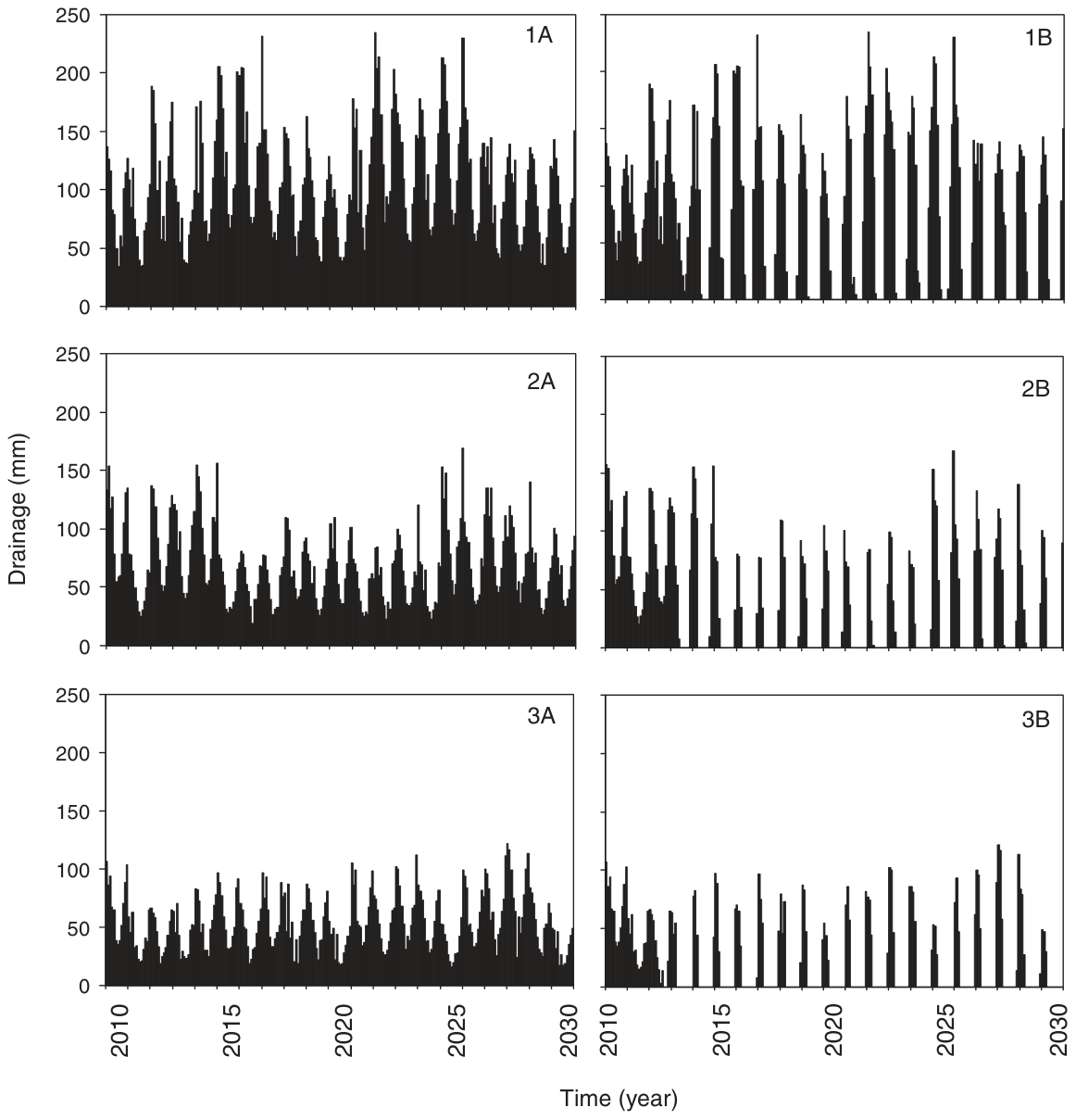
Climatic Conditions and Phyto-DSS (Robinson et al., 2003) Simulations of Average Potential Evapotranspiration (ETo), Actual Evapotranspiration (ET) and Biomass Production of a Stand of Poplars over a 20-year Period in Temperate Wet, Moderate and Dry Climates. Figure 4 shows the Drainage as a Function of Time
温带湿润、中等和干旱气候下的气候条件,以及利用Phyto-DSS(Robinson et al., 2003)模拟的杨树林分20年期间的平均潜在蒸散量(ETo)、实际蒸散量(ET)和生物量产量。排水量随时间的变化见图4
| Wet climate湿润 气候 | Moderate climate中等 气候 | Dry climate干旱 气候 | |
|---|---|---|---|
| Rainfall (mm yr−1) | 1271 | 835 | 653 |
| ETo (mm yr−1) | 759 | 1052 | 1227 |
| Average ET (mm) (% of rainfall) | 437 (33 %) | 390 (45 %) | 385 (56 %) |
| Average drainage (mm) | 899 | 486 | 391 |
| Wood production (t ha−1 20 yr−1) | 90 | 85 | 80 |
Drainage is inevitable when rainfall is greater than evapotranspiration. However, vegetative caps may eliminate drainage during low-rainfall periods. Depending on the TE, the high flow rates of receiving waters may dilute any leachate to the point that they do not pose an environmental risk, although such dilution-solutions to pollution are unacceptable in many regulatory environments.
当降雨量大于蒸散量时,排水不可避免。然而,植被覆盖层可在少雨期消除排水。根据微量元素种类的不同,受纳水体的高流量可能将渗滤液稀释到不构成环境风险的程度,尽管在许多监管环境下,这种以稀释解决污染的方式是不可接受的。
Irrigation may be necessary in the establishment or maintenance of vegetation in phytostabilization. Irrigation may increase macropore-facilitated leaching, particularly when high volumes of water are applied over a short time.
在植物稳定中,植被的建立或维持可能需要灌溉。灌溉可能会增加大孔隙促进的淋溶,特别是在短时间内大量灌水时。
Were net evapotranspiration the only criterion controlling TE leaching, then there would be more leaching under shallowrooted species, such as most grasses, than under deep-rooted species such as trees (Vogeler et al., 2001). However, deep roots may create macropores that facilitate the preferential transport of contaminants to groundwater (Roulier et al., 2008). A fundamental research question is the role of roots in the preferential transport of contaminants, especially in soils where the contaminants occur heterogeneously.
如果净蒸散量是控制微量元素淋溶的唯一标准,那么在大多数草类等浅根系物种下的淋溶将多于树木等深根系物种(Vogeler et al., 2001)。然而,深根可能形成大孔隙,促进污染物向地下水的优先迁移(Roulier et al., 2008)。一个基础性的研究问题是根系在污染物优先迁移中的作用,特别是在污染物呈异质性分布的土壤中。
The time required to implement phytostabilization, i.e., the time required for the roots to penetrate the contaminated material and evapotranspiration to reach a maximum, is dependent on the species composition of the vegetatation. Densely planted perennial trees require 2–5 years (Robinson et al., 2006). Mendez and Maier (2008a) concluded that phytostabilization of mine tailings requires the identification of regional and climatic specific plants which show low metal uptake in shoots and determination of the minimum requirements in amendments (compost, fertilizer, irrigation) required for plant growth. Importantly, phytostabilization requires that the site be permanently vegetated, thus limiting future land use options. Nevertheless, periodically harvesting the vegetation could produce non-food products, such as bioenergy or timber. The timing and nature of the harvest is critical, since it will necessarily decrease evapotranspiration from the site and potentially increase contaminant leaching. Removing biomass from the site will also gradually reduce the soil’s TE burden, because some TEs will be removed with the biomass. Partially harvesting alternate rows of trees may maintain hydraulic control while recovering valuable biomass and removing contaminating TEs (Robinson et al., 2007). Whole system models could calculate the likely effect of harvesting on TE fluxes.
实施植物稳定所需的时间,即根系穿透污染物料以及蒸散量达到最大值所需的时间,取决于植被的物种组成。密植的多年生树木需要2~5年(Robinson et al., 2006)。Mendez and Maier(2008a)得出结论,尾矿的植物稳定需要筛选适应特定区域和气候、地上部金属吸收量低的植物,并确定植物生长所需改良措施(堆肥、肥料、灌溉)的最低要求。重要的是,植物稳定要求场地永久保持植被覆盖,从而限制了未来土地利用的选择。尽管如此,定期收获植被可生产生物能源或木材等非食用产品。收获的时间和方式至关重要,因为收获必然会降低场地的蒸散量,并可能增加污染物淋溶。从场地移除生物质也会逐渐降低土壤中的微量元素负荷,因为部分微量元素会随生物质一起被移除。对隔行树木进行部分收获,可在回收有价值生物质和去除污染性微量元素的同时维持水力控制(Robinson et al., 2007)。全系统模型可以计算收获对微量元素通量的可能影响。
Vangronsveld et al. (1996) and Mendez and Maier (Mendez and Maier 2008a, 2008b) detailed how the use of vegetation and soil amendments could control erosion and leaching on metalliferous mine tailings. The vegetation reduces dust and leaching and improves the aesthetic and ecological value of the site. Phytomanagement to stabilize mine tailings may involve the establishment of vegetation directly in the tailings or it may follow capping, which can be costly as it may require reengineering of any tailings dam as well as a large earth-moving operation. Here, deep-rooted species may be less suitable as they may disrupt the integrity of the cap. Penetration of tree roots into the underlying tailings may not only provide a transport pathway for rainfall, but may also result in tree death, depending on the toxicity of the underlying material. The natural colonization of mine sites is slow since the physicochemical characteristics of these sites are not favourable to most plant species. Nevertheless, some of these tolerant plant species can spread easily in these environments due to the lack of competitors (Macnair, 1987). Weed species often have stress resistant properties, and can grow under poor fertilizer and drought conditions. Because of long-term natural selection, weed species have an extensive adaptive capacity (Wei et al., 2005).
Vangronsveld et al.(1996)以及Mendez and Maier(Mendez and Maier 2008a, 2008b)详细阐述了如何利用植被和土壤改良剂控制含金属尾矿的侵蚀和淋溶。植被可减少扬尘和淋溶,并提升场地的景观和生态价值。用于稳定尾矿的植物管理可以直接在尾矿上建立植被,也可以在覆盖层施工之后进行;覆盖的成本可能很高,因为可能需要对尾矿坝进行改造并开展大规模土方工程。此时,深根系物种可能不太适宜,因为它们可能破坏覆盖层的完整性。树根穿透到下层尾矿中,不仅可能为降雨提供迁移通道,还可能导致树木死亡,这取决于下层物料的毒性。由于矿区的物理化学特性不利于大多数植物物种生长,矿区的自然定植过程十分缓慢。尽管如此,由于缺乏竞争者,其中一些耐性植物物种能够在这些环境中轻易扩散(Macnair, 1987)。杂草物种通常具有抗逆特性,能够在贫瘠和干旱条件下生长。经过长期自然选择,杂草物种具有广泛的适应能力(Wei et al., 2005)。
On disused tips and landfill sites, phytomanagement can prevent contaminants leaching to groundwater or local waterways (Robinson et al., 2003b). Fast-growing and high-water use trees such as poplars (Populus spp.) and willows (Salix spp.) have been successfully employed in this role (Ferro et al., 1997). These species are effective because they establish rapidly, have a high water-use, tolerate a wide range of environmental conditions, are easily of propagated (Quinn et al., 2001), and take up high concentrations of some TEs, notably B, Cd and Zn (Robinson et al., 2005).
在废弃的渣堆和垃圾填埋场,植物管理可以防止污染物淋溶进入地下水或当地水道(Robinson et al., 2003b)。杨树(Populus spp.)和柳树(Salix spp.)等速生、高耗水树种已成功应用于这一领域(Ferro et al., 1997)。这些物种之所以有效,是因为它们定植迅速、耗水量大、能耐受广泛的环境条件、易于繁殖(Quinn et al., 2001),并能吸收高浓度的某些微量元素,尤其是B、Cd和Zn(Robinson et al., 2005)。
In arid conditions where salinity is a problem, deep-rooting evergreen trees, such as Eucalyptus spp., can lower a saline water table thus reducing salt toxicity to crops. Bell et al. (1999) reported the effectiveness of this technology on some Australian soils.
在盐渍化成为问题的干旱条件下,Eucalyptus spp.等深根系常绿树种可以降低含盐地下水位,从而减轻盐分对作物的毒害。Bell et al.(1999)报道了该技术在一些澳大利亚土壤上的有效性。
The vegetation used for phytostabilization may enhance the ecological value of the site, by increasing biodiversity and providing a habitat for rare species. An excellent example of such an operation is the Guadiamar Phytomanagement Programme (Dominguez et al., 2008). Here, a “green corridor” has been established on over 2000 ha of land that became contaminated with As, Cd, Pb, Zn, and other TEs following a mine tailings-dam failure at Aznalc´ollar, Southern Spain, in 1998. Following removal of the most contaminated topsoil, the establishment of vegetation, combined with soil conditioners, reduced dust and TE leaching from the site, while providing an ecological connection between the Dona˜na World Heritage Park in the South and the Sierra Morena mountains in the North.
用于植物稳定的植被可通过增加生物多样性和为珍稀物种提供生境来提升场地的生态价值。瓜迪亚马尔植物管理计划(Guadiamar Phytomanagement Programme)是此类工程的一个极好范例(Dominguez et al., 2008)。1998年,西班牙南部Aznalc´ollar的一座尾矿坝溃坝,致使2000多公顷土地受到As、Cd、Pb、Zn及其他微量元素的污染,该计划在这片土地上建立了一条“绿色廊道”。在移除污染最严重的表土后,植被的建立结合土壤调理剂的施用,减少了场地的扬尘和微量元素淋溶,同时在南部的Dona˜na世界遗产公园与北部的Sierra Morena山脉之间建立了生态连接。
Low plant TE uptake is critical to the success of using the vegetation in phytostabilization to enhance biodiversity. Elevated concentrations of TEs in the aboveground tissues not only increase the likelihood of their entry into the food chain, but may also result in an accumulation of TEs on the soil surface, as TE-rich leaf litter is deposited (Robinson et al., 2003a). Dominguez et al. (2008) showed that the TE concentrations in plants from the Guadiamar Phytomanagement Programme were within the normal range for plant tissues for all species except Populus alba (L.), which accumulated high concentrations of Cd and Zn. As a result, this species could be removed from the site or excluded from future plantings.
植物对微量元素的低吸收是利用植物稳定中的植被提升生物多样性取得成功的关键。地上组织中微量元素浓度升高不仅会增加其进入食物链的可能性,而且随着富含微量元素的凋落叶沉积,还可能导致微量元素在土壤表面累积(Robinson et al., 2003a)。Dominguez et al.(2008)表明,瓜迪亚马尔植物管理计划中各植物的微量元素浓度均在植物组织的正常范围内,唯有Populus alba(L.)累积了高浓度的Cd和Zn。因此,可将该物种从场地移除或在今后的种植中排除。
Phytostabilization is particularly suited for low value sites, where the land value is small compared to the cost of soil excavation and landfilling. Unlike phytoextraction, providers of phytostabilization technology can point to numerous examples of its successful application on areas as diverse as acidic mine tailings (Brown et al., 2005; Mendez and Maier, 2008b), woodwaste piles (Robinson et al., 2007) and disused sheep-dipping sites (Robinson and Anderson, 2007).
植物稳定尤其适用于低价值场地,即土地价值远低于土壤开挖和填埋成本的场地。与植物提取不同,植物稳定技术的提供者可以列举大量在不同类型区域成功应用的实例,包括酸性矿山尾矿(Brown et al., 2005; Mendez and Maier, 2008b)、木材废料堆(Robinson et al., 2007)以及废弃的羊只药浴场地(Robinson and Anderson, 2007)。
1.6 Biofortification1.6 生物强化
Biofortification aims to increase the concentration of essential TEs in crops to improve human health and agricultural productivity. The most commonly deficient elements in the diet of humans are Fe and Zn (Franca, 2002). Selenium and I are also deficient in many areas. Rice (Oryza spp.) and wheat (Triticum spp.) are the target crops for many biofortification programs, because they are the staple food for most of the earth’s population.
生物强化旨在提高作物中必需微量元素的含量,以改善人类健康和农业生产力。人类膳食中最常见的缺乏元素是Fe和Zn(Franca, 2002)。在许多地区,Se和I也存在缺乏。水稻(Oryza spp.)和小麦(Triticum spp.)是许多生物强化项目的目标作物,因为它们是世界大多数人口的主粮。
Biofortification has several advantages over simply adding essential TEs to the final product, for example fortifying flour by directly adding Zn compounds, or taking dietary supplements. TEs that have been taken up by the plant via the roots provide a constant source of the TE with less risk of toxicity due to an overdose, or deficiency caused by gaps in supply of the TEspiked product. Physiologically accumulated TEs in plant parts are also more bioavailable to humans (Storksdieck and Hurrell, 2007). However, biofortification may not provide source of TEs as reliably as traditional fortification or dietary supplements because the effectiveness of biofortification depends on soil properties, genotypes, agricultural management practices and climatic factors (Schulin et al., 2009).
与直接向最终产品中添加必需微量元素(例如直接添加Zn化合物以强化面粉)或服用膳食补充剂相比,生物强化具有若干优势。植物经根系吸收的微量元素可提供稳定的微量元素来源,因过量摄入而中毒的风险较低,也不易因添加微量元素产品供应中断而导致缺乏。经生理过程在植物器官中积累的微量元素对人体的生物有效性也更高(Storksdieck and Hurrell, 2007)。然而,生物强化提供微量元素的可靠性可能不及传统强化或膳食补充剂,因为生物强化的效果取决于土壤性质、基因型、农业管理措施和气候因素(Schulin et al., 2009)。
If the biofortification arises from genetic modification of the crop, via either traditional breeding or in vitro gene manipulation, then recurrent costs are low, and the germplasm could be shared internationally, reaching people with limited access to commercially fortified food or supplements (Nestel et al., 2006). A potential drawback of biofortification is that any process used to increase the concentration of an essential TE in plant tissue may also increase the uptake of nonessential TEs or xenobiotic compounts. Thus, biofortified crops should be screened carefully for contaminants.
若生物强化是通过传统育种或in vitro(离体)基因操作对作物进行遗传改良而实现的,则其经常性成本较低,且种质资源可在国际间共享,从而惠及难以获得商业强化食品或补充剂的人群(Nestel et al., 2006)。生物强化的一个潜在缺点是,任何用于提高植物组织中必需微量元素含量的方法,也可能同时增加非必需微量元素或外源化合物的吸收。因此,应对生物强化作物进行严格的污染物筛查。
Biofortification is not restricted to humans. Livestock commonly suffer from TE deficiencies, especially in those regions where the TEs occur at low concentrations in the soil. Pasture species tend to take up low concentrations of TEs from soil compared to trees and shrubs (Robinson et al., 2005). Robinson et al. (1999c) showed that the specimen trees Nyssa spp. accumulated Co from deficient soils to the extent where leaves from these trees could alleviate Co deficiency in livestock if it comprised just 2% of the animal’s diet. The trees accumulated circa 7 mg Co kg−1 (dry matter) in the leaves, some 40 times more than the average pasture. Similarly, poplars and willows accumulate high concentrations of Zn and Co relative to pasture species and this may be linked to observed health benefits in sheep and cattle when the clones are used as stock fodder (Robinson et al., 2005). A potential problem of using poplars and willows as stock fodder at some sites is their high ability to accumulate Cd (Granel et al., 2002); although varieties exist that accumulate high Zn and Co, but low Cd (Robinson et al., 2005).
生物强化并不仅限于人类。家畜常患微量元素缺乏症,尤其是在土壤微量元素含量较低的地区。与乔木和灌木相比,牧草从土壤中吸收的微量元素含量往往较低(Robinson et al., 2005)。Robinson et al.(1999c)的研究表明,观赏树种Nyssa spp.能够从缺Co土壤中积累Co,其叶片即使仅占家畜日粮的2%,也足以缓解家畜的Co缺乏症。这些树木叶片中Co的积累量约为7 mg Co kg−1(干物质),约为普通牧草的40倍。同样,与牧草相比,杨树和柳树积累的Zn和Co含量较高,这可能与将这些无性系用作家畜饲料时所观察到的羊和牛的健康改善有关(Robinson et al., 2005)。在某些场地将杨树和柳树用作家畜饲料的一个潜在问题是其积累Cd的能力较强(Granel et al., 2002);不过,也存在高积累Zn和Co而低积累Cd的品种(Robinson et al., 2005)。
On contaminated sites where the contaminant is also an essential nutrient, food or fodder crops can be produced that contain high concentrations of an essential nutrient. Ba˜nuelos (2006) demonstrated that broccoli and Brassica juncea (L.) could supplement Se to animal diets, when these plants were grown on Se-laden soil.
在污染物同时也是必需营养元素的污染场地上,可以生产富含该必需营养元素的粮食或饲料作物。Ba˜nuelos(2006)证明,在富Se土壤上种植的西兰花和Brassica juncea(L.)可为动物日粮补充Se。
Plants biofortified with TEs could be used as an organic mulch to fertilize crops that are deficient in TEs. Robinson et al. (2007) showed that poplars grown on a B-contaminated site accumulated inordinate amounts of B in the leaves, while taking up only limited amounts of the other concurrent contaminants. Boron, the element of concern at this site, could be removed from the site via its accumulation poplar leaves, and used in nearby orchards to alleviate a B deficiency. Thus, combining biofortification with other remediation technologies may offset the cost of site remediation.
经微量元素生物强化的植物可用作有机覆盖物,为缺乏微量元素的作物施肥。Robinson et al.(2007)的研究表明,在B污染场地上生长的杨树叶片中积累了大量B,而对其他共存污染物的吸收则十分有限。该场地所关注的元素B可通过杨树叶片的积累从场地中移除,并用于附近果园以缓解B缺乏。因此,将生物强化与其他修复技术相结合,可抵消部分场地修复成本。
Ba˜nuelos and Lin (2009) present some of the most recent research on the topic of biofortification. The feasibility of biofortification depends heavily on the concentrations of the target TE and any contaminants in the soil, as well as the cost of implementation. If the total concentration of the target TE is too low, it is ineffective to change the soil properties to increase the TE’s bioavailability or introduce plant varieties with a high uptake of the target TE. On soils where nonessential TEs occur at elevated concentrations, the plant or soil treatment that enhances crop uptake of the essential TE may also increase the crop’s contaminant uptake, thus endangering human health.
Ba˜nuelos and Lin(2009)介绍了生物强化领域的一些最新研究。生物强化的可行性在很大程度上取决于土壤中目标微量元素及各类污染物的含量以及实施成本。若目标微量元素的总含量过低,则通过改变土壤性质来提高其生物有效性或引入对目标微量元素吸收能力强的植物品种均难以奏效。在非必需微量元素含量较高的土壤上,提高作物对必需微量元素吸收的植物或土壤处理措施,也可能增加作物对污染物的吸收,从而危害人体健康。
Since poor countries could achieve the greatest health benefit from biofortified foods, the cost of biofortification is of paramount importance. If the implementation costs are high, it may be cheaper to use other methods of supplying essential TEs to humans, such as TEs in tablet form. The development of genotypes that accumulate the target TE would cost little compared to shipping the already fortified food. This advantage would be greater if the crops produced seeds of the same genotype, thus rendering subsequent seed shipments unnecessary. However, political problems, including patent protection on plant varieties and public opposition to genetically modified food, may hinder the widespread use of such genetically modified organisms (Fox, 2001).
由于贫困国家可从生物强化食品中获得最大的健康效益,生物强化的成本至关重要。若实施成本较高,则采用其他方式为人类提供必需微量元素(如片剂形式的微量元素)可能更为经济。与运输已强化的食品相比,培育能够积累目标微量元素的基因型成本很低。若作物所产种子具有相同的基因型,从而无需后续再运送种子,则这一优势将更为明显。然而,包括植物品种专利保护和公众对转基因食品的反对在内的政治问题,可能阻碍此类转基因生物的广泛应用(Fox, 2001)。
The idea of increasing essential TEs in crop plants through selective breeding and genetic modification is sound in principle, since there is a genetic variation among species and varieties that result in a range of TE concentrations in the edible parts (White and Broadley, 2005). Recent work has shown that Barley (Hordeum vulgare L.), modified to overexpress an Arabidopsis sp. Zn transporter, took up significantly more Zn than the unmodified variety (Ramesh et al., 2004). To date, there are no full-scale field operations using this approach. In contrast, there are numerous field trials showing that on deficient soils, the addition of Zn to crops, via either soil or foliar application, enhances plant health and results in a higher shoot Zn concentration (Cakmak, 2008). A fertile area for future research is to investigate whether these methods result in increased grain Zn concentrations, or the extent to which any supplementary Zn, perhaps added as a chelate, is bioavailable to humans. Schulin et al. (2009) review the agronomic aspects of Zn biofortification.
通过选择育种和遗传改良提高作物中必需微量元素含量的设想在原理上是合理的,因为物种和品种之间存在遗传变异,导致其可食部分的微量元素含量存在差异(White and Broadley, 2005)。最近的研究表明,经改造而过量表达Arabidopsis sp. Zn转运蛋白的大麦(Hordeum vulgare L.)吸收的Zn显著多于未改造品种(Ramesh et al., 2004)。迄今为止,尚无采用该方法的大规模田间应用。相比之下,大量田间试验表明,在缺Zn土壤上通过土壤施用或叶面喷施为作物补充Zn,可改善植物健康状况并提高地上部Zn含量(Cakmak, 2008)。未来一个富有前景的研究方向是探究这些方法能否提高籽粒Zn含量,以及所补充的Zn(可能以螯合物形式添加)对人体的生物有效性程度。Schulin et al.(2009)综述了Zn生物强化的农艺学问题。
A major disadvantage of agronomic measures to improve the concentrations of essential TEs in crop plants is that bad application practices result in reduced crop productivity or environmental pollution. Experience has shown that the inappropriate use of pesticides and fertilizers, especially in poor countries, has resulted in soil and water contamination and negative human health effects. Since essential TEs such as Zn and Se are toxic to both plants and animals at higher concentrations, overzealous or inhomogeneous application of the TE may lead to soil infertility or even present a human health risk. Similar environmental damage may occur if soil conditioners such as chelants are overapplied (Nowack et al., 2006). These problems may be circumvented if the TE or other agent could be supplied as a seed coating. For example, seeds could be coated with a rhizobacteria that enhances plant uptake of the essential TE. There is a dearth of research demonstrating the feasibility of these possibilities.
采用农艺措施提高作物必需微量元素含量的一个主要缺点是,不当的施用方式会导致作物生产力下降或环境污染。经验表明,农药和化肥的不当使用(尤其是在贫困国家)已造成土壤和水体污染以及对人体健康的不利影响。由于Zn和Se等必需微量元素在较高浓度下对植物和动物均有毒性,过量或不均匀地施用微量元素可能导致土壤肥力丧失,甚至构成人体健康风险。若过量施用螯合剂等土壤调理剂,也可能造成类似的环境破坏(Nowack et al., 2006)。若能以种子包衣的形式提供微量元素或其他试剂,则可规避上述问题。例如,可用能够增强植物对必需微量元素吸收的根际细菌对种子进行包衣。目前证明这些方法可行性的研究十分匮乏。
Environmental conditions will affect agronomic and to a lesser extent genetic measures to biofortify food crops with essential TEs. Suitable soil conditioners and their application rates may vary greatly between sites. This increases the risk of inappropriate use and subsequent environmental degradation. Development of whole system phytomanagement models would alleviate problems arising from environmental heterogeneity.
环境条件会影响以必需微量元素对粮食作物进行生物强化的农艺措施,对遗传措施的影响则相对较小。适宜的土壤调理剂及其施用量在不同场地之间可能差异很大,这增加了不当使用及随之而来的环境退化风险。建立全系统植物管理模型将有助于缓解由环境异质性引起的问题。
1.7 Processes in Phytomanagement1.7 植物管理中的过程
The solubility and speciation of TEs in soil, as well as their tolerance and uptake by plants is critical for all forms of phytomanagement. Plants should tolerate soilborne TEs to produce maximal growth. In phytoextraction-related technologies (Fig. 3) high uptake of specific trace elements into the shoots is desirable, while successful phytostabilization requires that TEs be excluded from the aerial portions. In all phytomanagement applications, high uptake may present an environmental risk of toxic TEs entering the food chain.
土壤中微量元素的溶解度和形态,以及植物对其的耐受性和吸收,对各种形式的植物管理都至关重要。植物应能耐受土壤中的微量元素,以实现最大生长量。在与植物提取相关的技术中(图3),希望特定微量元素大量吸收进入地上部;而成功的植物稳定则要求将微量元素排除在地上部之外。在所有植物管理应用中,高吸收都可能带来有毒微量元素进入食物链的环境风险。
We summarize the key process in TE interactions with plants as they relate to phytomanagement. We have divided these processes, arbitrarily, into three sections that describe (1) the phytoavailability of TEs in the soil, (2) the interactions in the soil: root interface, i.e., the rhizosphere, and (3) the uptake and tolerance of soluble TEs by plants. Finally, using processes 1–3, we describe the feasibility of phytomanagement and explore fertile areas of future research.
本文概述了与植物管理相关的微量元素与植物相互作用的关键过程。我们将这些过程人为地划分为三部分,分别描述:(1)土壤中微量元素的植物有效性;(2)土壤—根系界面(即根际)中的相互作用;(3)植物对可溶性微量元素的吸收与耐受。最后,基于过程1–3,我们阐述了植物管理的可行性,并探讨了未来富有前景的研究方向。
5II. PROCESS 1: TRACE ELEMENT SOLUBILITY AND SPECIATION IN SOILII. 过程1:土壤中微量元素的溶解度与形态
The solubility and speciation of TEs in soil determines their toxicity, availability for plant uptake, and their downward mobility. These soil processes are thus critical for phytomanagement. Understanding the factors controlling TE solubility and speciation allows the selection of soil amendments that promote or reduce TE bioavailability and the selection plant species that are optimal for the desired goal of managing the TE flux in the soil – plant system.
土壤中微量元素的溶解度和形态决定了其毒性、对植物吸收的有效性以及向下迁移能力。因此,这些土壤过程对植物管理至关重要。了解控制微量元素溶解度和形态的因素,有助于选择能够提高或降低微量元素生物有效性的土壤改良剂,并选择最适合于调控土壤—植物系统中微量元素通量这一目标的植物种类。
The provenance of TEs in the environment may be natural, such as high concentrations of Ni and other siderophiles in ultramafic (serpentine) soils, or anthropogenic, such as high concentrations in base metals in lands surrounding industrial sites. The concentrations of TEs can vary considerably. In soil, the TE loading is a function of the parent material plus subsequent atmospheric or waterborne deposition.
环境中微量元素的来源可能是自然的,如超基性(蛇纹岩)土壤中高含量的Ni及其他亲铁元素;也可能是人为的,如工业场地周边土地中高含量的贱金属。微量元素的含量差异可能很大。在土壤中,微量元素负荷取决于成土母质以及随后的大气沉降或水体沉积。
Not all TEs in the environment interact with plants. Solubility is a prerequisite for plant uptake or toxicity. The interaction of the soluble TE with the plant is dependent on individual properties of the element, its chemical speciation, and the species of plant with which it is interacting. The solubility and speciation of TEs depend on a plethora of physical (e.g., water retention capacity) , chemical (e.g., pH), microbial (e.g., micorrhiza), and plant factors, as well as the properties of the TE.
并非环境中所有的微量元素都会与植物发生相互作用。可溶性是植物吸收或产生毒性的前提条件。可溶性微量元素与植物之间的相互作用取决于元素自身的性质、其化学形态以及与之相互作用的植物种类。微量元素的溶解度和形态取决于众多物理因素(如持水能力)、化学因素(如pH)、微生物因素(如菌根)和植物因素,以及微量元素本身的性质。
The re-supply of TEs into the soluble phase is critical for phytomining, where high crop TE concentrations are required for as long as possible. Robinson et al. (1999b) showed, using sequential extractions that in ultramafic soils, between 13% and 80% of the total Ni could become soluble. The potentially available Ni was inversely proportional to the soil’s Si concentration. The replenishment of Ni in soil solution occurred within 24 hours and cumulative extractions produced Langmuir-type curves, with the asymptote equal to the pool of potentially available Ni.
微量元素向可溶相的再补给对植物采矿至关重要,因为植物采矿要求作物尽可能长时间地保持较高的微量元素含量。Robinson et al.(1999b)采用连续提取法表明,在超基性土壤中,总Ni的13%至80%可转化为可溶态。潜在有效Ni与土壤Si含量呈反比。土壤溶液中Ni的补充在24小时内完成,累积提取曲线呈Langmuir型,其渐近线等于潜在有效Ni库。
Such re-supply processes are, by definition, kinetically limited and may be slow. However, this slowness may not always be a disadvantage because it allows the plant time to absorb the mobile TE. Hamon and McLaughlin (1999) introduced the concept of “bioavailable contaminant stripping” for a phytoextraction procedure that aims to keep the bioavailable fraction of soil TEs low enough to be harmless.
此类再补给过程从定义上讲受动力学限制,可能较为缓慢。然而,这种缓慢并不总是不利的,因为它使植物有时间吸收可移动的微量元素。Hamon and McLaughlin(1999)针对一种植物提取方法提出了“生物有效性污染物剥离”的概念,该方法旨在使土壤微量元素的生物有效部分保持在足够低的无害水平。
2.1 Decreasing Trace Element Phytoavailability2.1 降低微量元素的植物有效性
In the phytostabilization of a contaminated site, naturally occurring or artificial soil amendments such as liming material, phosphate, zeolite, bentonite, clay, Fe metal, Fe and Mn oxides, and organic matter, may reduce the solubility of TEs (Cheng and Hseu, 2002). These amendments reduce TE solubility by promoting the formation of insoluble precipitates or by enhancing the soil’s capacity to bind the TE. The latter can be achieved directly through the addition of adsorbent material or indirectly by adjusting the soil’s pH–Eh conditions to promote TE absorption onto the soil’s matrix. The effectiveness of these amendments in reducing TE phytoavailability has to be balanced with their potential negative effects on plant growth resulting from immobilization of essential nutrients, increases in salinity and any possible changes in the soils physical that inhibit root penetration, oxygenation, and water uptake.
在污染场地的植物稳定中,天然或人工土壤改良剂,如石灰物料、磷酸盐、沸石、膨润土、黏土、金属Fe、Fe和Mn氧化物以及有机质,均可降低微量元素的溶解度(Cheng and Hseu, 2002)。这些改良剂通过促进形成难溶性沉淀或增强土壤对微量元素的结合能力来降低其溶解度。后者既可通过添加吸附材料直接实现,也可通过调节土壤pH–Eh条件以促进微量元素在土壤基质上的吸附而间接实现。这些改良剂在降低微量元素植物有效性方面的效果,必须与其对植物生长的潜在负面影响相权衡,这些负面影响源于必需养分的固定、盐分的增加,以及土壤物理性质可能发生的、阻碍根系穿插、通气和水分吸收的任何变化。
Chemical immobilization using phosphate amendments, such as mineral apatite, synthetic hydroxyapatite, and phosphate salts, reduce cationic TE solubility by the formation of TE–phosphate precipitates (McGowen et al., 2001) and by increasing the number of negatively charged exchange sites (Bolan et al., 1999). The solubility of Pb in soil can be greatly reduced by the formation of chloropyromorphite [Pb5(PO4)3Cl]. Several microcosm studies have shown that chloropyromorphite can be formed through the addition of hydroxyapatite [Ca10(PO4)6(OH)2] (Ma et al., 1993; Ryan et al., 2001). Brown et al. (2004) demonstrated that phosphate fertilizers could be combined with organic matter and Fe-rich material, as soil amendments to reduce the solubility of Cd, Zn, and Pb. Phosphate amendments such as hydroxyapatite are effective in reducing the solubility of Pb, Cd, Zn, Al, Ba, Co, Mn, Ni, and U. However, phosphate has been shown to promote the solubility of As and Cr (Seaman et al., 2001), possibly through reduced sorption of the oxyanions due to an increase in pH and competition from PO34–, HPO24–, and H2PO–4 .
采用矿物磷灰石、合成羟基磷灰石和磷酸盐等磷酸盐类改良剂进行化学固定,可通过形成微量元素—磷酸盐沉淀(McGowen et al., 2001)以及增加带负电荷的交换位点数量(Bolan et al., 1999)来降低阳离子型微量元素的溶解度。形成氯磷铅矿[Pb5(PO4)3Cl]可大幅降低土壤中Pb的溶解度。多项微宇宙研究表明,添加羟基磷灰石[Ca10(PO4)6(OH)2]可促成氯磷铅矿的形成(Ma et al., 1993; Ryan et al., 2001)。Brown et al.(2004)证明,磷肥可与有机质及富Fe物料配合用作土壤改良剂,以降低Cd、Zn和Pb的溶解度。羟基磷灰石等磷酸盐类改良剂可有效降低Pb、Cd、Zn、Al、Ba、Co、Mn、Ni和U的溶解度。然而,已有研究表明磷酸盐会提高As和Cr的溶解度(Seaman et al., 2001),其原因可能是pH升高以及PO34–、HPO24–和H2PO–4的竞争作用导致含氧阴离子的吸附减少。
A variety of inorganic and organic amendments have been used to reduce Cr(VI) to the less soluble, less toxic Cr(III) species. Fe(II)-bearing minerals and surface-bound organic matter form effective reductants. The latter is catalyzed by soil mineral surfaces, and Cr(III) binds tightly to surface species or is precipitated as Cr(OH)3 (Jardine et al., 1999). Similarly, Bolan and Duraisamy (2003) showed that organic amendments, such as animal and poultry manures rich in dissolved organic carbon, are effective in reducing Cr(VI) to Cr(III).
多种无机和有机改良剂已被用于将Cr(VI)还原为溶解度更低、毒性更小的Cr(III)形态。含Fe(II)矿物和表面结合的有机质是有效的还原剂。后者的还原作用受土壤矿物表面催化,Cr(III)与表面物种紧密结合或以Cr(OH)3形式沉淀(Jardine et al., 1999)。同样,Bolan and Duraisamy(2003)表明,富含溶解性有机碳的有机改良剂(如畜禽粪便)可有效地将Cr(VI)还原为Cr(III)。
Lombi et al. (2002) added 2% of the bauxite residue, “red mud” (ca. 60% Fe2O3,40% Al2O3) to various soils contaminated with heavy metals from smelter emissions and sewage sludge deposition. Red mud reduced the solubility of Cd, Pb, Ni, and Zn, but not Cu. The remedial action of this material was attributed to a rise in soil pH and adsorption of the metals onto oxides of Fe and Mn.
Lombi et al.(2002)向受冶炼厂排放物和污水污泥施用污染的多种土壤中添加了2%的铝土矿残渣“赤泥”(约60% Fe2O3,40% Al2O3)。赤泥降低了Cd、Pb、Ni和Zn的溶解度,但对Cu无效。该材料的修复作用归因于土壤pH升高以及金属在Fe和Mn氧化物上的吸附。
Liming has been demonstrated to be effective in reducing the solubility of TE cations in variable-charge soils by increasing the negative charge on oxides, clays, and organic matter (Kirkham, 2006). The effectiveness of raising the pH on metal immobilization also depends on the liming agent. Bolan and Duraisamy (2003) found that Ca(OH)2 was less effective than KOH in immobilizing Cd2+ due to competition between Ca2+ and Cd2+ for adsorption sites.
已有研究证明,施用石灰可通过增加氧化物、黏土和有机质上的负电荷,有效降低可变电荷土壤中微量元素阳离子的溶解度(Kirkham, 2006)。提高pH对金属固定的效果还取决于所用石灰物料。Bolan and Duraisamy(2003)发现,由于Ca2+与Cd2+竞争吸附位点,Ca(OH)2固定Cd2+的效果不如KOH。
2.2 Increasing Trace Element Phytoavailability2.2 提高微量元素的植物有效性
The simplest way of producing TE-biofortified plant products is to increase the TE concentration in the soil (Lyons et al., 2004). However, this strategy does not guarantee success and carries risks. Simply increasing the total concentration of the TE in the soil does not necessarily enhance crop uptake, since the solubility and speciation of the TE in soil may render it unavailable to plants.
生产微量元素生物强化植物产品最简单的方法是提高土壤中该微量元素的含量(Lyons et al., 2004)。然而,该策略并不能保证成功,且存在风险。单纯提高土壤中微量元素的总含量并不一定能增加作物吸收,因为该微量元素在土壤中的溶解度和形态可能使其无法被植物利用。
Phytoextraction requires plants, such as hyperaccumulators, that accumulate inordinate concentrations of TEs in their aerial portions. However, for some of the most common TE contaminants, such as Pb, there are no reliable reports of any hyperaccumulator species. Many authors (e.g., Huang and Cunningham, 1996)) have suggested that that high concentrations of the target TE(s) be brought into soil solution to increase plant uptake.
植物提取需要超富集植物等能够在地上部积累异常高含量微量元素的植物。然而,对于Pb等一些最常见的微量元素污染物,目前尚无任何超富集植物的可靠报道。许多作者(如Huang and Cunningham, 1996)建议使高浓度的目标微量元素进入土壤溶液,以增加植物吸收。
Chelants, such as ethylenediaminetetraacetic acid (EDTA), ethylenediamine-N,N′-disuccinic acid (EDDS), and nitrilotriacetic acid (NTA) effectively increase the solubility of Pb, Cd, Cu, Zn and other TE cations in soils (Blaylock et al., 1997; Huang and Cunningham, 1996; Robinson et al., 1999a; Tandyet al., 2004; Thayalakumaran et al., 2003). Thiosulphate and thiocyanate salts may be added to mine spoil to induce plants to accumulate Hg (Moreno et al., 2005) and Au (Anderson et al., 1998). High concentrations of chloride anions in soil solubilise Cd because of the formation of soluble and stable complexes [CdCl+ & CdCl2]. While chelants, lixivants, and soil acidification agents are effective in bringing many TEs into soil solution, the speciation of the dissolved TE may be such that the TEs are not phytoavailable and they may simply leach down the soil profile (Fig. 5).
乙二胺四乙酸(EDTA)、乙二胺-N,N′-二琥珀酸(EDDS)和氮川三乙酸(NTA)等螯合剂可有效提高土壤中Pb、Cd、Cu、Zn及其他微量元素阳离子的溶解度(Blaylock et al., 1997; Huang and Cunningham, 1996; Robinson et al., 1999a; Tandyet al., 2004; Thayalakumaran et al., 2003)。可向矿山废石中添加硫代硫酸盐和硫氰酸盐,以诱导植物积累Hg(Moreno et al., 2005)和Au(Anderson et al., 1998)。土壤中高浓度的氯离子由于形成可溶且稳定的络合物[CdCl+ & CdCl2]而使Cd溶解。尽管螯合剂、浸出剂和土壤酸化剂可有效地使许多微量元素进入土壤溶液,但溶解态微量元素的形态可能使其不具有植物有效性,而仅是沿土壤剖面向下淋溶(图5)。
The addition of EDTA to the Ni hyperaccumulator Berkheya coddii (Roessler) resulted in decreased Ni uptake, despite increasing the Ni solubility in the soil (Robinson et al., 1999a). Chelants have also ben shown to decrease plant uptake of Cu and Zn uptake from hydroponic solution (Tandy et al., 2004). The addition of chelants reduces plant accumulation of many biologically essential TEs because the TEs are rendered unavailable to the plant’s TE transporters (see Section 4.2).
向Ni超富集植物Berkheya coddii(Roessler)添加EDTA后,尽管土壤中Ni的溶解度提高,但植物对Ni的吸收反而下降(Robinson et al., 1999a)。研究还表明,螯合剂会降低植物从水培溶液中对Cu和Zn的吸收(Tandy et al., 2004)。添加螯合剂会降低植物对许多生物必需微量元素的积累,因为这些微量元素无法被植物的微量元素转运蛋白利用(见4.2节)。
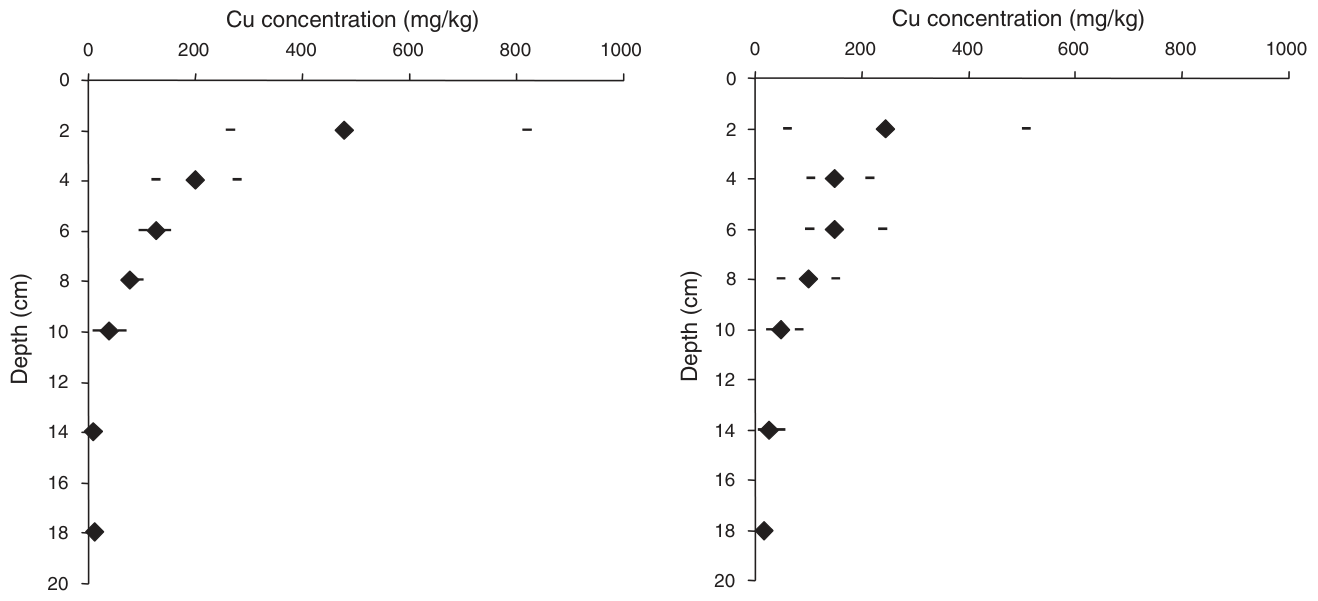
The use of chelants and other lixivants exacerbate the leaching of TEs through the soil profile (Lombi et al., 2001; Nowack et al., 2006). Preferential flow pathways in the soil exacerbate TE leaching to groundwater (Bundt et al., 2000). The use of EDTA to induce plant TE accumulation is unacceptable because it persists in the environment as well as presenting a severe risk of leaching high concentrations of mobile TE-complexes to groundwater (Nowack, 2002). Thayalakumaran et al. (2003) demonstrated that, in an undisturbed soil profile containing 300 mg kg−1 Cu, plants removed just 5% of the Cu solubilized by EDTA. The remaining 95% leached below the root zone (Fig. 5). An alternative may be the use of NTA or EDDS, which degrade more rapidly than EDTA. However, rapid degradation may not prevent the complexed metal from leaching to groundwater via preferential flow processes, which occur in a matter of hours.
螯合剂及其他浸出剂的使用会加剧微量元素沿土壤剖面的淋溶(Lombi et al., 2001; Nowack et al., 2006)。土壤中的优先流路径会加剧微量元素向地下水的淋溶(Bundt et al., 2000)。使用EDTA诱导植物积累微量元素是不可接受的,因为EDTA在环境中持久存在,并且存在高浓度可移动微量元素络合物淋溶至地下水的严重风险(Nowack, 2002)。Thayalakumaran et al.(2003)证明,在含300 mg kg−1 Cu的原状土壤剖面中,植物仅移除了被EDTA溶解的Cu的5%,其余95%淋溶至根区以下(图5)。一种替代方案是使用比EDTA降解更快的NTA或EDDS。然而,快速降解未必能阻止络合态金属通过数小时内即可发生的优先流过程淋溶至地下水。
Chelants are usually added as Na salts because the free-acids are only sparingly soluble. Increased Na concentrations in soil can reduce plant growth and causes the dispersion of clay minerals, clogging pores and possibly resulting in increased preferential flow. Most chelants solubilize TEs other than the target element and these may be toxic to plants. Chelants redistribute surface contamination down the soil profile. This has the benefit of reducing the TE concentration near the soil surface, thereby reducing exposure pathways, however, this benefit is more than offset by the risk of TE leaching to groundwater.
螯合剂通常以Na盐形式添加,因为其游离酸的溶解度很低。土壤中Na浓度升高会抑制植物生长,并导致黏土矿物分散、堵塞孔隙,并可能加剧优先流。大多数螯合剂还会溶解目标元素以外的其他微量元素,这些元素可能对植物有毒。螯合剂会使表层污染物沿土壤剖面向下重新分布。这虽有利于降低土壤表层附近的微量元素含量,从而减少暴露途径,但该益处远不足以抵消微量元素淋溶至地下水的风险。
Chelant-induced phytoextraction may therefore be limited to applications where the connection to receiving waters has been broken, or where leaching is unimportant (Nowack et al., 2006). Phytoextraction could be conducted ex situ, where the
因此,螯合剂诱导的植物提取可能仅限于与受纳水体的联系已被切断或淋溶影响不大的情形(Nowack et al., 2006)。植物提取也可在异位(ex situ,)进行,即
TE-contaminated material would be placed on a liner whereby any leachate could be collected and recycled (Kos and Lestan, 2003). Such systems already exist for soil washing and the recovery of Au from low-grade ores. Potentially, phytomanagement could enhance this process by concentrating the target TE in their biomass. Anderson et al. ( 2005) demonstrated the economic feasibility of lixiviant-induced Au phytoextraction.
将受微量元素污染的物料置于防渗衬层上,从而收集并循环利用渗滤液(Kos and Lestan, 2003)。此类系统已应用于土壤淋洗以及从低品位矿石中回收Au。植物管理有望通过将目标微量元素富集于植物生物量中来强化这一过程。Anderson et al.(2005)证明了浸出剂诱导的Au植物提取在经济上的可行性。
6III. PROCESS 2: RHIZOSPHERE INTERACTIONSIII. 过程2:根际相互作用
Plant roots influence soil in their immediate vicinity, a zone known as the rhizosphere. The solubility and speciation of TEs in this zone may be distinct from the bulk soil. Roots improve soil aeration by extracting soil moisture and forming continuous channels for drainage and air exchange. However, increased metabolic activity can result in anaerobic conditions if more oxygen is consumed than can be re-supplied. Plant roots excrete H+ ions that exchange with nutrient base cations (Salisbury and Ross, 1992). Grass species exude chelants, phytosiderophores, which mobilise Fe and perhaps other essential nutrients of low availability. These organic acids solubilize TEs by competing for cation binding sites. Root exudations may acidify the rhizosphere by up to 2 pH units (Salisbury and Ross, 1992). Such acidification invariably increases the solubility of nonessential TE cations such as Cd2+ (Naidu et al., 1994). Root exudates may also render TEs unavailable for plant uptake, and thus enhance plant tolerance to high concentrations of TEs. Kramer et al. (2000) reported that Ni-citrate and Ni-histidine complexes accumulated in the roots of Ni-tolerant, but non-accumulator, species ofThlaspi spp. growing in an Ni-rich substrate. Wenzel et al. (2003) reported higher concentrations of DOC in the rhizosphere of the Ni-hyperaccumulator Thlaspi goesingense Halacsy compared to adjacent non-hyperaccumulator species.
植物根系会影响其紧邻区域的土壤,该区域称为根际。该区域中微量元素的溶解度和形态可能不同于土体土壤。根系通过吸取土壤水分并形成连续的排水和气体交换通道来改善土壤通气性。然而,若耗氧量超过氧的补给量,代谢活动的增强可能导致厌氧条件。植物根系分泌H+离子,与营养性盐基阳离子发生交换(Salisbury and Ross, 1992)。禾本科植物分泌螯合剂——植物铁载体,可活化Fe以及其他有效性较低的必需养分。这些有机酸通过竞争阳离子结合位点使微量元素溶解。根系分泌物可使根际pH降低多达2个单位(Salisbury and Ross, 1992)。这种酸化必然会提高Cd2+等非必需微量元素阳离子的溶解度(Naidu et al., 1994)。根系分泌物也可能使微量元素无法被植物吸收,从而增强植物对高浓度微量元素的耐受性。Kramer et al.(2000)报道,在富Ni基质中生长的耐Ni但非超富集的Thlaspi spp.物种根系中积累了Ni-柠檬酸和Ni-组氨酸络合物。Wenzel et al.(2003)报道,Ni超富集植物Thlaspi goesingense Halacsy根际中的溶解性有机碳(DOC)浓度高于相邻的非超富集植物。
The plants may be inoculated directly with mycorrhizae or PG- PRs, or their growth may be promoted using conditioners (Khan, 2005). As yet, it is unclear what role these PGPRs have on plant TE uptake or tolerance. This is a fertile area for future research.
可直接用菌根真菌或PGPR接种植物,也可使用调理剂促进其生长(Khan, 2005)。目前,这些PGPR对植物吸收或耐受微量元素的作用尚不清楚。这是一个富有前景的未来研究领域。
3.1 Microflora3.1 微生物区系
Plant root exudates and detritus provide a growth substrate for soil microflora, increasing microbial biomass in the rootzone. The stimulation of soil biological activity affects the speciation, and therefore mobility, of TEs (Pedersen and Albinsson, 1992). Some soil bacteria reduce Cr(VI) to Cr(III) (Pal and Paul, 2004). Soil fauna and microorganisms behave similarly to soil organic matter in that they possess binding sites for some TEs. Robinson et al. (2001) found that rhizobacteria such as Pseudomonas fluorescens (Fl¨ugge) from New Zealand pasturelands accumulated Cd to levels about 100 times that of the ambient solution in which they were grown. As with soil organic matter, the adsorption of Cd by these microorganisms decreased at lower solution pHs. The metabolites produced by root-promoted soil organisms may further change the solubility and speciation of TEs in the rhizosphere. The soil’s microbiota plays a crucial role in plant TE tolerance and uptake (Whiting et al., 2001).
植物根系分泌物和残体为土壤微生物区系提供了生长基质,使根区微生物量增加。土壤生物活性的增强会影响微量元素的形态,进而影响其迁移性(Pedersen and Albinsson, 1992)。一些土壤细菌可将Cr(VI)还原为Cr(III)(Pal and Paul, 2004)。土壤动物和微生物与土壤有机质类似,具有针对某些微量元素的结合位点。Robinson et al.(2001)发现,来自新西兰牧场的Pseudomonas fluorescens(Fl¨ugge)等根际细菌积累的Cd约为其培养溶液浓度的100倍。与土壤有机质一样,这些微生物对Cd的吸附随溶液pH降低而减少。受根系促进的土壤生物所产生的代谢产物可能进一步改变根际中微量元素的溶解度和形态。土壤微生物群在植物对微量元素的耐受和吸收中起着关键作用(Whiting et al., 2001)。
With the notable exception of the Brassicaceae, the roots of most plants form symbiotic relationships with mycorrhizal fungi. These fungi solubilise and sequester nutrients and possibly TEs in the rhizosphere, and transport them toward, possibly into the root (Salisbury and Ross, 1992). Many authors have demonstrated that mycorrhizal fungi enhance plant metal tolerance (Marschner, 1995; Schutzendubel and Polle, 2002). Mycorrhizas may absorb TEs in their hyphal sheath and external mycelium. The fungal sheath may reduce access to the apoplast due to hydrophobicity and fungal chelants may complex toxic metals rendering then unavailable for plant uptake (Jentschke and Godbold, 2000). The mechanisms of TE uptake in the fungi and translocation subsequent into the root may be more specific than the corresponding plant uptake mechanisms, and thereby reducing the amount of analogous toxic TEs that enter the symplast. Some microorgaisms increase plant TE uptake. Chopra et al.(2007) showed that rhizosphere microbes from an As-contaminated cattle dip site increased the shoot As concentration of Agrostis tenuis (L.) by 45%.
除十字花科(Brassicaceae)这一显著例外,大多数植物的根系都与菌根真菌形成共生关系。这些真菌在根际中溶解并螯合养分(可能也包括微量元素),并将其运向根系,甚至可能运入根内(Salisbury and Ross, 1992)。许多作者证明菌根真菌可增强植物的金属耐受性(Marschner, 1995; Schutzendubel and Polle, 2002)。菌根可在其菌丝鞘和外生菌丝体中吸收微量元素。真菌菌鞘因其疏水性可能减少微量元素进入质外体,而真菌螯合剂可络合有毒金属,使其无法被植物吸收(Jentschke and Godbold, 2000)。真菌对微量元素的吸收及随后向根内转运的机制可能比相应的植物吸收机制更具特异性,从而减少进入共质体的类似有毒微量元素的数量。一些微生物会增加植物对微量元素的吸收。Chopra et al.(2007)表明,来自As污染的牛只药浴场地的根际微生物使Agrostis tenuis(L.)地上部As含量提高了45%。
Engineering the rhizobiota could be a tool to enhance or reduce plant TE uptake (Nie et al., 2002). Establishing a healthy substrate microflora, especially mycorrhizal symbiots, can greatly enhance plant tolerance to TEs on contaminated sites (Vosatka, 2001). This may be particularly important in the phytostabilization of contaminated sites with tree species, where mycorhizae play a key role in the protection against TE toxicity (Schutzendubel and Polle, 2002). Ma et al. (2006) showed that earthworms and mycorrhizal fungi enhanced plant growth and foliar concentrations of N, P, and K. Certain strains of bacteria, known as Plant Growth Promoting Rhizobacteria (PGPR) enhance plant growth and metal tolerance by fixing atmospheric N, producing phytohormones, and protecting the roots against pathogens (Burd et al., 2000; Kamnev and van der Lelie, 2000).
调控根际生物群可作为增强或降低植物吸收微量元素的手段(Nie et al., 2002)。建立健康的基质微生物区系,特别是菌根共生体,可大大增强植物在污染场地上对微量元素的耐受性(Vosatka, 2001)。这在利用树种对污染场地进行植物稳定时可能尤为重要,因为菌根在抵御微量元素毒害方面起着关键作用(Schutzendubel and Polle, 2002)。Ma et al.(2006)表明,蚯蚓和菌根真菌可促进植物生长,并提高叶片中N、P和K的含量。某些被称为植物促生根际细菌(PGPR)的菌株可通过固定大气N、产生植物激素以及保护根系免受病原菌侵害来促进植物生长并增强其金属耐受性(Burd et al., 2000; Kamnev and van der Lelie, 2000)。
3.2 Root Effects on Trace Element Mobility in the Rhizosphere3.2 根系对根际微量元素迁移性的影响
Plants affect TE fluxes via the extraction of contaminating TEs into the aboveground biomass, or changing their mobility in the soil profile. The formation of root channels not only affects water flux via enhanced soil drainage and aeration, but also provides pathways for the rapid transport of solutes and suspended particles and colloids (Lesturgez et al., 2004). These transport pathways can exacerbate the risk of groundwater contamination by reducing the contact time of the soil solution with the soil matrix and soil organisms that could otherwise retard the movement by sorption and transformation processes (Bundt et al., 2000).
植物通过将污染性微量元素提取至地上生物量中,或改变其在土壤剖面中的迁移性来影响微量元素通量。根孔通道的形成不仅通过增强土壤排水和通气影响水分通量,还为溶质、悬浮颗粒和胶体的快速迁移提供了通道(Lesturgez et al., 2004)。这些迁移通道减少了土壤溶液与土壤基质及土壤生物的接触时间,而后者原本可通过吸附和转化过程阻滞迁移,因此可能加剧地下水污染风险(Bundt et al., 2000)。
TE fluxes in soil are dependent on spatial concentration gradients driving diffusion and dispersion, and the mass flow of water (Vogeler et al., 2001). Few studies have investigated the influence of plants on TE leaching from contaminated soils under controlled conditions. Banks et al. (1994) found that the Zn leaching from a mine-tailing contaminated soil increased in the order no plants < plants with microbes < plants without microbes. In a further study using contaminated mine tailings and clean subsoil and topsoil covering, the presence of plants increased Cu and Cd leaching in all columns, while Pb was unaffected (Zhu et al., 1999). Turpeinen et al. (2000) demonstrated that pine seedlings reduced Pb solubility by up to 93%. Romkens et al. (1999) compared Cu speciation in soils with and without plants. Copper solubility was higher in planted pots, but the calculated free Cu2+ ion concentration was orders of magnitude lower than in soils without plants.
土壤中的微量元素通量取决于驱动扩散和弥散的空间浓度梯度以及水分的质流(Vogeler et al., 2001)。在受控条件下研究植物对污染土壤微量元素淋溶影响的研究很少。Banks et al.(1994)发现,矿山尾矿污染土壤中Zn的淋溶量按以下顺序递增:无植物 < 有植物且有微生物 < 有植物但无微生物。在另一项采用受污染矿山尾矿并覆盖清洁底土和表土的研究中,植物的存在增加了所有土柱中Cu和Cd的淋溶,而Pb不受影响(Zhu et al., 1999)。Turpeinen et al.(2000)证明,松树幼苗可使Pb溶解度降低多达93%。Romkens et al.(1999)比较了有植物和无植物土壤中Cu的形态。种植植物的盆中Cu溶解度较高,但计算得到的游离Cu2+离子浓度比无植物土壤低几个数量级。
3.3 Trace Element Heterogeneity in Soil and Root-Trace Element Contact3.3 土壤中微量元素的异质性及根系与微量元素的接触
Regardless of TE solubility and speciation, TEs are only phytoavailable if they come into physical contact with the plant roots. TEs occur heterogeneously in soil, both spatially and temporally. Their concentrations can vary at many scales, from the individual soil particle to the entire catchment. However, only heterogeneity that occurs on the scale of the plant’s root zone affects root growth, plant uptake and TE leaching. There are three possible responses of plant roots to a patch of soil where TEs are enriched or depleted: inhibition or avoidance, indifference, and proliferation or foraging (Fig. 6).
无论微量元素的溶解度和形态如何,只有与植物根系发生物理接触时,微量元素才具有植物有效性。微量元素在土壤中的分布在空间和时间上均具有异质性。其含量可在从单个土壤颗粒到整个流域的多种尺度上发生变化。然而,只有发生在植物根区尺度上的异质性才会影响根系生长、植物吸收和微量元素淋溶。植物根系对微量元素富集或贫化的土壤斑块可能有三种响应:抑制或回避、无差别响应,以及增生或觅取(图6)。
Patches where the TE’s concentration is not greatly different from the surrounding soil is unlikely to affect root development and hence response (B) in Figure 6 is likely. Unlike macronutrients, there are few studies on the response of roots to TE hotspots. The roots of some tree species such as (Fagus sylvatica L.) avoid TE-contaminated hotspots (Breckle and Kahle, 1992; Dickinson et al., 1991). Roots of Lupinus albus (L.), are inhibited by, or avoid, patches of high B concentration in soil (Menon et al., 2007). Conversely, roots of the Zn hyperaccumulator plant Thlaspi caerulescens (J. & C. Presl.) actively forage Zn-rich hotspots in soils (Schwartz et al., 1999; Whiting et al., 2000).
若斑块中微量元素含量与周围土壤差异不大,则不太可能影响根系发育,因此很可能出现图6中的响应(B)。与大量营养元素不同,关于根系对微量元素热点响应的研究很少。一些树种(如Fagus sylvatica L.)的根系会回避微量元素污染热点(Breckle and Kahle, 1992; Dickinson et al., 1991)。Lupinus albus(L.)的根系会受到土壤中高B含量斑块的抑制或对其进行回避(Menon et al., 2007)。相反,Zn超富集植物Thlaspi caerulescens(J. & C. Presl.)的根系会主动觅取土壤中富Zn的热点(Schwartz et al., 1999; Whiting et al., 2000)。
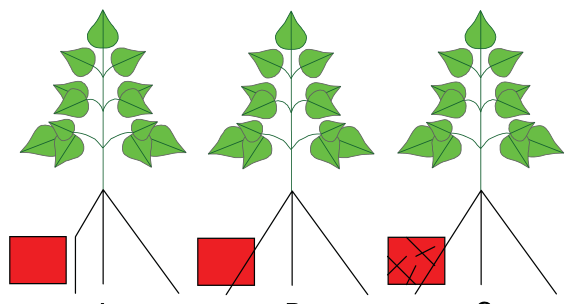
It is unclear whether the promotion or reduction of growth in a TE patch arises from simple simulation or inhibition due to toxicity, or whether there is a root growth strategy. Any growth strategy would need a signalling mechanism, whereby roots near or in the TE patch communicate the location of the patch to the remainder of the root system. When the roots penetrate a patch that contains a high concentration of the TE(s), both plant uptake and leaching of the TE(s) should increase. As discussed above, root-induced changes in the rhizosphere tend to increase the solubility of TEs, making them more available for plant uptake and leaching. The physical structure of the roots may create macropores and provide a direct conduit for the TE to leach into groundwater, either in soil solution, or attached to mobile soil particles (Roulier et al., 2007).
目前尚不清楚微量元素斑块中生长的促进或抑制是源于单纯的刺激作用或毒性抑制,还是存在某种根系生长策略。任何生长策略都需要一种信号机制,使位于斑块附近或斑块内的根系能将斑块位置传递给根系的其余部分。当根系穿入含高浓度微量元素的斑块时,植物对微量元素的吸收和微量元素的淋溶均应增加。如上所述,根系引起的根际变化往往会提高微量元素的溶解度,使其更易被植物吸收和发生淋溶。根系的物理结构可能形成大孔隙,为微量元素以土壤溶液形式或附着于可移动土壤颗粒上淋溶至地下水提供直接通道(Roulier et al., 2007)。
Ploughing may decrease TE heterogeneity by homogenising the soil. It may also bring TE-contaminated soil at depth to the surface, thus increasing the volume of material that can be treated using phytoextraction. However, ploughing may increase TE mobility by creating dust and enhancing TE solubility due to an increase in organic ligands caused by oxidation of the soil’s organic matter.
翻耕可通过使土壤均质化来降低微量元素的异质性。翻耕还可将深层受微量元素污染的土壤翻至地表,从而增加可采用植物提取处理的物料体积。然而,翻耕会产生扬尘,并因土壤有机质氧化导致有机配体增加而提高微量元素的溶解度,从而可能增加微量元素的迁移性。
7IV. PROCESS 3: PLANT TRACE ELEMENT UPTAKEIV. 过程3:植物对微量元素的吸收
All plants remove TEs from their surroundings. Some elements are essential for the plant to complete its life cycle. Plants take up others TEs incidentally, and at high concentrations, these elements may deleteriously affect growth. TEs in plant tissue have an enzyme-activation role, rather than a structural role (Salisbury and Ross, 1992). Depending on their concentration in plant tissue, essential TEs may occur at deficient, optimal or phytotoxic concentrations. Plants tolerate nonessential elements low concentrations, but higher concentrations these elements are invariably phytotoxic.
所有植物都会从其周围环境中吸取微量元素。某些元素是植物完成其生命周期所必需的。植物还会附带吸收其他微量元素,这些元素在高浓度下可能对生长产生不利影响。植物组织中的微量元素起酶激活作用,而非结构作用(Salisbury and Ross, 1992)。根据其在植物组织中的含量,必需微量元素可能处于缺乏、适宜或植物毒性水平。植物可耐受低浓度的非必需元素,但这些元素在较高浓度下必然具有植物毒性。
4.1 Root Uptake of Trace Elements4.1 根系对微量元素的吸收
Plant roots are a sink for soil water. Roots draw soil solution from the rhizosphere to the plants root tissues and then via the stems to the leaves, where it is lost to the atmosphere via transpiration. Any TE in the soil solution that enters the roots will accumulate in either the roots or the shoots of the plant. High TE concentrations in the roots can result from the migration of the TEs, via transpiration-induced mass flow, to the root surface where they are precipitated (Zhao et al., 2000).
植物根系是土壤水分的汇。根系将土壤溶液从根际吸入植物根组织,再经茎运输至叶片,最终通过蒸腾作用散失到大气中。进入根系的土壤溶液中的任何微量元素都会在植物的根部或地上部积累。根部微量元素含量较高,可能是由于微量元素经蒸腾驱动的质流迁移至根表并在此沉淀所致(Zhao et al., 2000)。
The total amount of a TE that accumulates in the plant does not necessarily equal the cumulative product of the soil-solution TE concentration times the volume of water transpired by the plant, as one might predict for non diffusion-limited passive uptake. Deviations may arise where diffusion limits the root’s TE supply, or when the rate of TE transport into the root occurs at a different rate from the root’s water uptake.
植物中积累的微量元素总量并不一定等于土壤溶液微量元素浓度与植物蒸腾水量乘积的累积值,而这正是对非扩散限制的被动吸收所预测的结果。当扩散限制了根系的微量元素供应,或微量元素进入根系的速率与根系吸水速率不同时,就可能出现偏差。
4.1.1 Diffusion Limitation4.1.1 扩散限制
For a sparingly soluble TE, and under conditions of low transpiration, the plant roots may remove the TE from soil solution at a greater rate than rate at which mass flow transports the element towards the root. Here the rate of diffusion of the TE from the soil matrix towards the root limits the plant’s TE uptake (Chapin, 1980). Diffusion out of the soil matrix into the stagnant and mobile water phases may limit plant uptake in high transpiration conditions. Similarly, if the TE absorption and water uptake occur in different regions of the root, then mass flow caused by root water uptake may not transport TE to the zone where they are absorbed.
对于难溶性微量元素,在低蒸腾条件下,植物根系从土壤溶液中移除该微量元素的速率可能大于质流将该元素运向根系的速率。此时,微量元素从土壤基质向根系扩散的速率限制了植物对微量元素的吸收(Chapin, 1980)。在高蒸腾条件下,从土壤基质向滞留水相和流动水相的扩散可能会限制植物吸收。同样,若微量元素吸收与水分吸收发生在根系的不同区域,则由根系吸水引起的质流可能无法将微量元素运输至其被吸收的区域。
4.2 Trace Element Entry into the Root Xylem: Apoplastic and Symplastic Transport4.2 微量元素进入根木质部:质外体运输与共质体运输
The translocation of a TE to the aerial parts of a plant requires its entry into the root xylem, via either the apoplastic or the symplastic pathways (Marschner, 1995). The apoplastic pathway is discontinuous, being interrupted by the endodermis, where the cell walls contain hydrophobic incrustations of suberin, (Casparian strips). This obstructs the passive transfer of solutes into the stele and thence into the root xylem. There are small discontinuities in the Casparian strips at the junctions of lateral root branches (Crowdy and Tanton, 1970). Soil organisms, pathogens, or mechanical disturbance may create disruptions in the endodermis. The application of selected pesticides can disrupt root-membranes allowing chelated TEs to pass directly into the root xylem via the apoplastic pathway (Blaylock, 2000). Small amounts of some TEs may enter the root xylem directly via the apoplastic pathway at the root apices (Harrison-Murray and Clarkson, 1973).
微量元素向植物地上部的转运需要其经质外体或共质体途径进入根木质部(Marschner, 1995)。质外体途径是不连续的,被内皮层阻断,内皮层细胞壁含有木栓质的疏水性沉积物(凯氏带)。这阻碍了溶质被动进入中柱并进而进入根木质部。在侧根分枝的连接处,凯氏带存在微小的不连续(Crowdy and Tanton, 1970)。土壤生物、病原菌或机械扰动可能导致内皮层破损。施用某些农药可破坏根细胞膜,使螯合态微量元素经质外体途径直接进入根木质部(Blaylock, 2000)。少量某些微量元素可能在根尖处经质外体途径直接进入根木质部(Harrison-Murray and Clarkson, 1973)。
Most TEs that enter the root xylem must, at some point, penetrate a cell membrane and move through the cytoplasm of the endodermis (Steudle and Peterson, 1998). Boron (B), in the form of boric acid (H3BO3), can pass directly through membranes (Dordas and Brown, 2000; Stangoulis et al., 2001).
大多数进入根木质部的微量元素在某一阶段必须穿过细胞膜,并在内皮层细胞质中移动(Steudle and Peterson, 1998)。硼(B)以硼酸(H3BO3)形式可直接穿过细胞膜(Dordas and Brown, 2000; Stangoulis et al., 2001)。
However, other TEs can only traverse the plasma membrane via embedded protein transporters. There are numerous transporters. For example, in Arabidopsis thaliana (L.), 4589 genes code for membrane-spanning proteins, representing some 18% of the protein-coding genome (Ward, 2001).
然而,其他微量元素只能通过嵌入质膜的蛋白转运体穿过质膜。转运体种类繁多。例如,在Arabidopsis thaliana(L.)中,有4589个基因编码跨膜蛋白,约占蛋白编码基因组的18%(Ward, 2001)。
Passive transporters, or ion channels, permit ions with a specific size and charge to move across the cell membrane down their concentration gradient. Passive plant uptake requires that the target ion concentration in the cytoplasm be lower than the surroundings (Marschner, 1995). Active transporters, requiring metabolic energy, move TEs across membranes against their concentration gradient (Salisbury and Ross, 1992). There are multiple transporters for essential elements, being either constitutive or inducible (Reid and Hayes, 2003). Constitutive transporters are always operational, while a nutrient deficiency may induce the plant to activate additional transporters. Antiporters eject toxic elements from the cytoplasm. These may decrease plant trace uptake and increase the plant’s tolerance to high concentrations of TEs in the environment (Martinoia et al., 2002).
被动转运体(即离子通道)允许具有特定大小和电荷的离子顺浓度梯度跨细胞膜移动。植物被动吸收要求细胞质中目标离子浓度低于周围环境(Marschner, 1995)。主动转运体需要消耗代谢能量,逆浓度梯度将微量元素跨膜转运(Salisbury and Ross, 1992)。必需元素存在多种转运体,或为组成型,或为诱导型(Reid and Hayes, 2003)。组成型转运体始终处于工作状态,而养分缺乏可诱导植物激活额外的转运体。反向转运体将有毒元素排出细胞质。它们可能减少植物对微量元素的吸收,并提高植物对环境中高浓度微量元素的耐受性(Martinoia et al., 2002)。
There are many known transporters for plant macronutrients, namely N, P, K, S, Mg, and Ca. However, less is known about TE transport across membranes, due to the difficulty of measuring their low concentrations. Transporters are known for Mn, Zn, Cu, Fe, Ni, Co, and Cd (Reid and Hayes, 2003; Reid et al., 1996; Salt and Wagner, 1993). Most is known about the acquisition of Fe, which may be growth limiting at high soil pHs. Except for the Poaceae, roots reduce soluble, possibly chelated, Fe(III) to Fe(II) via ferric chelate-reductase enzymes. The reduced Fe(II) enters the cell via a ferrous transporter (strategy I). Members of the Poaceae (strategy II), release phytosiderophores that solubilize Fe(III), and the chelate enters the cell via a specialized transport system (Reid and Hayes, 2003). Similar phytometallophore transporter systems may exist for other TEs, notably Cu (Gries et al., 1998) and Zn (Hopkins et al., 1998). These systems become more active when the essential TE is deficient. This increased activity may also result in the transport of high amounts of nonessential TEs (Cohen et al., 1998).
植物大量营养元素(即N、P、K、S、Mg和Ca)的已知转运体很多。然而,由于微量元素浓度低、难以测定,人们对其跨膜转运了解较少。目前已知的转运体涉及Mn、Zn、Cu、Fe、Ni、Co和Cd(Reid and Hayes, 2003; Reid et al., 1996; Salt and Wagner, 1993)。对Fe的获取了解最多,Fe在土壤pH较高时可能成为生长限制因子。除禾本科(Poaceae)外,植物根系通过高铁螯合物还原酶将可溶性的(可能为螯合态的)Fe(III)还原为Fe(II)。还原后的Fe(II)经亚铁转运体进入细胞(机理I)。禾本科植物(机理II)则释放植物铁载体溶解Fe(III),其螯合物通过专门的转运系统进入细胞(Reid and Hayes, 2003)。其他微量元素,特别是Cu(Gries et al., 1998)和Zn(Hopkins et al., 1998),可能也存在类似的植物金属载体转运系统。当必需微量元素缺乏时,这些系统的活性会增强。这种活性增强也可能导致大量非必需微量元素被转运(Cohen et al., 1998)。
In their review of nutrient uptake by plants, Reid and Hayes (2003) concluded that most membrane-transport proteins, which mediate nutrient influx or efflux, lack specificity. Therefore, nonessential TE ions with a similar size to nutrients may be taken up into the symplast and ultimately be translocated to the shoots. Khattak et al. (1991) demonstrated that plants take up arsenate (AsO43−) via the same physiological mechanism as phosphate (PO43−). Similarly, Tl+ may enter via the K+ ion channel (Skulsky 1991), Cd2+ may enter via either Ca2+ or Zn2+ transport system, and Ni2+ may enter along with Mg2+. Similarly, selenate (SeO42−) and sulphate (SO42−) may use the carrier-mediated process to enter the plant. Sulphate and selenate compete for common uptake in the roots and thus selenate uptake can be strongly decreased by high sulphur supply (Zayed and Terry, 1992) Small, uncharged, TE moieties, for example H3BO3, may also pass through aquaporins, which are passive protein gateways that permit the passage of water through cell membranes (Maurel, 1997).
Reid and Hayes(2003)在其关于植物养分吸收的综述中得出结论:介导养分内流或外流的大多数膜转运蛋白缺乏特异性。因此,与养分离子大小相近的非必需微量元素离子可能被吸收进入共质体,并最终转运至地上部。Khattak et al.(1991)证明,植物通过与磷酸盐(PO43−)相同的生理机制吸收砷酸盐(AsO43−)。同样,Tl+可能经K+离子通道进入(Skulsky 1991),Cd2+可能经Ca2+或Zn2+转运系统进入,Ni2+则可能随Mg2+一同进入。同样,硒酸盐(SeO42−)和硫酸盐(SO42−)可能利用载体介导过程进入植物。硫酸盐和硒酸盐在根系中竞争共同的吸收途径,因此高硫供应可显著降低硒酸盐的吸收(Zayed and Terry, 1992)。体积小且不带电荷的微量元素基团(如H3BO3)也可能通过水通道蛋白,水通道蛋白是允许水分穿过细胞膜的被动蛋白通道(Maurel, 1997)。
Chaney et al. (2007) identified up regulation of transmembrane TE transport as the most fertile area of research to increase plant TE uptake. High biomass plants can be genetically altered to extract larger amounts of TE from soils (Rugh et al., 1998). Dhankher et al. (2002) engineered Arabidopsis thaliana (L.) to accumulate As by inserting two bacterial genes that imparted tolerance and the ability to translocate As to the aerial portions. There are potential dangers in using this approach for phytomanagement. Increasing the uptake of TEs in high-biomass plants may facilitate the entry of toxic elements into the food chain via herbivore consumption. Worse, if the modified plant is also used in agriculture, then cross-pollination may create hybrids that result in food crops that are rich in unwanted TEs. Future research in this area should include producing such plants with sterile pollen granules and/or with reduced flower production.
Chaney et al.(2007)认为,上调微量元素的跨膜转运是提高植物微量元素吸收最具前景的研究领域。可通过遗传改造使高生物量植物从土壤中提取更多的微量元素(Rugh et al., 1998)。Dhankher et al.(2002)通过插入两个细菌基因改造Arabidopsis thaliana(L.)使其积累As,这两个基因赋予植物对As的耐受性以及将As转运至地上部的能力。在植物管理中采用该方法存在潜在危险。提高高生物量植物对微量元素的吸收,可能促使有毒元素经植食动物取食进入食物链。更糟糕的是,若改造植物同时用于农业,异花授粉可能产生杂交种,导致粮食作物富含不需要的微量元素。该领域未来的研究应包括培育花粉不育和/或开花减少的此类植物。
4.3 Trace Element Translocation and Storage within the Plant4.3 微量元素在植物体内的转运与储存
Plant water uptake drives TE translocation from the roots to the shoots via the xylem (Salt et al., 1995). In the above-ground portions, the highest concentrations are often found in the leaves as they are the major water sink prior to evaporation of the water. However, phloem transport may redistribute some TEs within the plant, notably Fe, Mn, Zn, Cu (Pate et al., 1975), Ni, Co, and Cd (Riesen and Feller, 2005). Boron, Sr, and Ba are generally phloem immobile (Kochian, 1991). Nicotianamine, which is ubiquitous in vascular plants, transports Fe in the phloem (Stephan and Scholz, 1993). The authors noted that most other divalent cations have higher constants of complex formation with nicotianamine than does Fe. This indicates that the same process may translocate other, possible nonessential, TEs. Essential TEs that are phloem mobile are translocated to developing tissues, a phenomenon that may be controlled by the phytohormones, especially cytokines (Salisbury and Ross, 1992). Phloem transport of TEs increases when the TEs are deficient in plant tissue (Gupta and Gupta, 2005).
植物吸水驱动微量元素经木质部从根部向地上部转运(Salt et al., 1995)。在地上部分中,微量元素含量最高的部位通常是叶片,因为叶片是水分蒸发前的主要水汇。然而,韧皮部运输可能使某些微量元素在植物体内重新分配,特别是Fe、Mn、Zn、Cu(Pate et al., 1975)、Ni、Co和Cd(Riesen and Feller, 2005)。B、Sr和Ba通常在韧皮部中不移动(Kochian, 1991)。维管植物中普遍存在的烟酰胺在韧皮部中运输Fe(Stephan and Scholz, 1993)。这些作者指出,大多数其他二价阳离子与烟酰胺的络合形成常数均高于Fe。这表明同一过程也可能转运其他(可能是非必需的)微量元素。可在韧皮部中移动的必需微量元素会被转运至发育中的组织,这一现象可能受植物激素(特别是细胞分裂素)调控(Salisbury and Ross, 1992)。当植物组织中微量元素缺乏时,微量元素的韧皮部运输会增加(Gupta and Gupta, 2005)。
The Ni hyperaccumulator Berkheya coddii (Roessler) translocates Ni to areas of new growth after tissue is excised (Robinson et al., 1997a). This is consistent with the hypothesis that the Ni affords herbivore protection to the plant, and it is therefore translocated to organs that are vulnerable to herbivory. Other studies have shown that hyperaccumulator plants store TEs in the epidermis (Kupper et al., 2000), the tissue first encountered by herbivores.
Ni超富集植物Berkheya coddii(Roessler)在组织被切除后会将Ni转运至新生长部位(Robinson et al., 1997a)。这与Ni为植物提供抵御植食动物保护的假说相一致,因此Ni被转运至易受植食动物取食的器官。其他研究表明,超富集植物将微量元素储存在表皮中(Kupper et al., 2000),而表皮正是植食动物最先接触的组织。
4.3.1 The Importance of Trace Element Translocation and Storage in Biofortification4.3.1 微量元素转运与贮存在生物强化中的重要性
Phloem transport is of particular importance when the goal of phytomanagement is to biofortify desirable TEs, such as Se, in food crops, especially when the edible part is the seed. There is a physiological barrier to TE translocation into the seed during maturation (Ernst et al., 1992). Seeds and fruits generally have low transpiration rates. Therefore, xylem transport delivers only minimal amounts of TEs. Soil amendments that solubilize TEs in the soil and increase root uptake may not necessarily result in an increased TE concentration in the seeds. Synthetic chelants, such as EDTA, may bind TEs so strongly, that they become unavailable for complexation with plant transporter chelants, such as nicotianamine, which may be required for phloem transport into the seeds.
当植物管理的目标是在粮食作物中对Se等有益微量元素进行生物强化,尤其是当可食部分为种子时,韧皮部运输尤为重要。在种子成熟过程中,微量元素向种子的转运存在生理屏障(Ernst et al., 1992)。种子和果实的蒸腾速率通常较低,因此木质部运输仅能输送极少量的微量元素。能够使土壤中微量元素溶解并提高根系吸收的土壤改良剂,未必会提高种子中的微量元素浓度。EDTA等人工合成螯合剂可能与微量元素结合过于牢固,使其无法与烟草胺等植物转运螯合物络合,而后者可能是微量元素经韧皮部运输进入种子所必需的。
The speciation of TEs and the presence of phytoligands in the edible portions of the plant are critical for biofortification, because this affects the TE’s absorption by humans or animals. Seeds store much of there phosphate as phytate (C6H18O24P6), a polydentate chelate that can complex essential TE cations, notably Fe and Zn, rendering them unavailable for absorption by the human gut (Zhou and Erdman, 1995). The effect of phytate on ruminants is smaller due to the presence of the phytatedegrading enzyme phytase in the gut (Lei et al., 1993). Therefore, phytomanagement with the goal of biofortification, should limit plants’ supply of phosphate. Polyphenolys, another phytochemical, may also reduce TE bioavailability to humans. A possible solution to the phytate problem is the genetic engineering of plants that overproduce phytase, and enzyme that degrades phytate when the food is prepared (Storksdieck and Hurrell, 2007). The benefits of phytate degradation for trace element nutrition need to be balanced against the beneficial effects, namely antioxidant activity (Vucenik and Shamsuddin, 2003), of phytate itself.
植物可食部分中微量元素的形态以及植物配体的存在对生物强化至关重要,因为这会影响人类或动物对微量元素的吸收。种子中的大部分磷以植酸(C6H18O24P6)的形式贮存,植酸是一种多齿螯合物,能够络合必需的微量元素阳离子,尤其是Fe和Zn,使其无法被人体肠道吸收(Zhou and Erdman, 1995)。由于反刍动物肠道中存在降解植酸的植酸酶,植酸对反刍动物的影响较小(Lei et al., 1993)。因此,以生物强化为目标的植物管理应限制植物的磷供应。多酚是另一类植物化学物质,也可能降低微量元素对人体的生物有效性。解决植酸问题的一种可能途径是通过基因工程培育过量表达植酸酶的植物,植酸酶可在食物加工过程中降解植酸(Storksdieck and Hurrell, 2007)。然而,植酸降解对微量元素营养的益处需要与植酸本身的有益作用(即抗氧化活性)(Vucenik and Shamsuddin, 2003)相权衡。
Plants also contain “promoter” compounds, such as inuline, palmitic acid, riboflavin and ascorbate, that stimulate the absorption of essential TEs by the gut (White and Broadley, 2005). Enhancing plant production of these compounds may be as important as increasing the concentration of the target TE in the plant.
植物中还含有菊糖、棕榈酸、核黄素和抗坏血酸等“促进”化合物,可促进肠道对必需微量元素的吸收(White and Broadley, 2005)。提高植物中这些化合物的产量,可能与提高植物中目标微量元素的浓度同样重要。
4.4 Plant Tolerance of Trace Elements4.4 植物对微量元素的耐性
In plant tissues, nonessential TEs, and essential TEs that occur at concentrations above there metabolic requirement, are potentially toxic. High concentrations of TEs may damage plant tissues via oxidative stress, which causes damage to biomolecules and depletion of adenosine triphosphate (ATP). High TEs also block essential functional groups in biomolecules and displace essential nutrients in biomolecules (Schutzendubel and Polle, 2002). Autooxidation of variable charge ions, such as Fe2+ (Fenton’s reaction) and Cu+ can produce free radicals and free radical precursors (H2O2) that damage cellular structures. Many TEs, especially Pb, Cd, and Hg, bind irreversibly to S, N, or O in biomolecules, possibly displacing essential TE ions, resulting in a loss of function.
在植物组织中,非必需微量元素以及浓度超过代谢需求的必需微量元素均具有潜在毒性。高浓度微量元素可通过氧化胁迫损伤植物组织,导致生物分子受损和三磷酸腺苷(ATP)耗竭。高浓度微量元素还会封闭生物分子中的必需功能基团,并置换生物分子中的必需养分(Schutzendubel and Polle, 2002)。Fe2+(Fenton反应)和Cu+等可变价离子的自氧化可产生自由基及自由基前体(H2O2),进而损伤细胞结构。许多微量元素,尤其是Pb、Cd和Hg,可与生物分子中的S、N或O不可逆地结合,并可能置换必需微量元素离子,导致其功能丧失。
All plants have basic TE tolerance mechanisms. Some species and varieties can survive in soil with inordinately high concentrations of TEs. Mostly, such plants are only tolerant to the TEs that occur in the soil in which they grow (Schat and Vooijs, 1997), indicating that there tolerance mechanisms are element specific. There are nine groups of tolerance mechanisms:
所有植物都具有基本的微量元素耐性机制。一些物种和品种能够在微量元素浓度极高的土壤中存活。此类植物大多只耐受其生长土壤中存在的微量元素(Schat and Vooijs, 1997),表明其耐性机制具有元素特异性。耐性机制可分为以下九类:
- Root avoidance
- External sequestration by bacteria, mycorrhizal fungi细菌、菌根真菌的外部固持
- Exuding chelants that render the TEs unavailable for plant uptake分泌螯合剂,使微量元素无法被植物吸收
- Restriction of transport across plasmalemma into the cell限制微量元素跨质膜进入细胞
- Active effluex into the apoplast (pumping)主动外排至质外体(泵出)
- Chelation of the TEs in the cytosol by phytochelatins, metallothioneins or organic acids通过植物螯合肽、金属硫蛋白或有机酸在细胞质中螯合微量元素
- Production of heat-shock proteins that repair cellular damage产生修复细胞损伤的热激蛋白
- Storage of chelated TEs in the vacuole将螯合态微量元素贮存于液泡中
- Abscission of organs, such as leaves, with a high TE load.脱落微量元素负荷较高的器官(如叶片)。
The toxic effects of TEs are larger when they are present as free ions. Therefore, most TEs found in plant tissues are complexed with organic ligands (Hall, 2002). In addition to low molecular weight organic acids, plants produce two classes of metal binding proteins, phytochelatins and metallothioneins (Cobbett and Goldsbrough, 2002). Metallothioneins are low molecular weight, cystine-rich, metal binding proteins (Kagi, 1991). Phytochelatins have the general structure (γ -Glu Cys)n- Gly where n = 2–11 and are rapidly induced in plants that become exposed to high TE concentrations (Rauser, 1995; Zenk, 1996). TE cations that enter the cytoplasm are immediately chelated by “chaperone” ligands (Clemens, 2001) and transported to TE requiring cytosolic proteins or to organelles. The chaperone ligands are then freed to complex other TE cations. TEs that are in excess to metabolic requirements are usually transported to the vacuole, where they are often complexed with phytochelatins and stored (Hall, 2002). Hyperaccumulator plants often have the highest TE concentrations in the vacuoles of the epidermis (Frey et al., 2000; Kupper et al., 1999). Toxic concentrations of TEs in cells may induce the production of heat-shock proteins (Lewis et al., 1999). Heat-shock proteins function in the production and repair of proteins under stress conditions (Hall, 2002).
微量元素以游离离子形式存在时毒性更大。因此,植物组织中的大多数微量元素与有机配体络合(Hall, 2002)。除低分子量有机酸外,植物还产生两类金属结合蛋白,即植物螯合肽和金属硫蛋白(Cobbett and Goldsbrough, 2002)。金属硫蛋白是低分子量、富含半胱氨酸的金属结合蛋白(Kagi, 1991)。植物螯合肽的一般结构为(γ -Glu Cys)n- Gly,其中n = 2–11,在暴露于高浓度微量元素的植物中可被迅速诱导产生(Rauser, 1995; Zenk, 1996)。进入细胞质的微量元素阳离子立即被“伴侣”配体螯合(Clemens, 2001),并被转运至需要微量元素的胞质蛋白或细胞器。随后伴侣配体被释放,可再络合其他微量元素阳离子。超出代谢需求的微量元素通常被转运至液泡,并在液泡中常与植物螯合肽络合而贮存(Hall, 2002)。超富集植物中微量元素浓度最高的部位通常是表皮细胞的液泡(Frey et al., 2000; Kupper et al., 1999)。细胞中微量元素达到毒性浓度时可诱导热激蛋白的产生(Lewis et al., 1999)。热激蛋白在胁迫条件下参与蛋白质的合成与修复(Hall, 2002)。
4.4.1 Establishing Vegetation in Phytomanagement4.4.1 植物管理中植被的建立
Plant tolerance to TEs is an essential component of the phytomanagement of contaminated sites. When planting on a contaminated site, species or varieties are required that tolerate the contaminants and any nutrient imbalances in the substrate. Caution is required when introducing exotic species or geneticallymodified organisms that they do not establish themselves as weeds (Wolfe and Bjornstad, 2002). However, exotic species have the advantage that they are less likely to suffer from native herbivores, thus increasing growth and reducing the amount of TE that enters, uncontrolled, into the food chain.
植物对微量元素的耐性是污染场地植物管理的重要组成部分。在污染场地种植时,需要选用能够耐受污染物以及基质中任何养分失衡的物种或品种。引入外来物种或转基因生物时须谨慎,以防其定植成为杂草(Wolfe and Bjornstad, 2002)。然而,外来物种的优势在于较少受到本地食草动物的危害,从而有利于生长,并减少不受控制地进入食物链的微量元素量。

The soil contaminants may not be the main cause of infertility. Dickinson (2000) pointed out that on many contaminated sites weed competition and inadequate soils were more significant to plant growth than soil contaminants.
土壤污染物未必是土壤贫瘠的主要原因。Dickinson(2000)指出,在许多污染场地上,杂草竞争和土壤条件不良对植物生长的影响比土壤污染物更为显著。
Since no contaminated sites are alike, choosing the most suitable species requires a short planting trial that tests several varieties on a small area of the site, particularly for non-soil media such as sewage sludge or mine tailings. Figures 7 and 8 show planting trials on both a B-contaminated sawdust pile and a B and salty saleniferous soil.
由于不存在完全相同的污染场地,选择最适宜的物种需要在场地的小块区域内开展短期种植试验,对多个品种进行测试,尤其是对于污水污泥或尾矿等非土壤介质。图7和图8分别展示了在受B污染的锯末堆以及含B、含盐的富硒土壤上开展的种植试验。
Substrate amendments and a succession of plant species may be required to establish the desired climax vegetation (Fig. 9). Phytomanagement systems that use several species or varieties overcome the risk that a new pest or climatic event destroys all the plants. Low-growing species may be combined with deciduous tree species to provide a transpiring green surface during the winter months. Legumes enhance fertility in nitrogen-deficient substrates.
建立目标顶极植被可能需要施用基质改良剂并进行植物物种演替(图9)。采用多个物种或品种的植物管理系统可避免新的病虫害或气候事件毁灭全部植物的风险。低矮物种可与落叶乔木物种搭配,以在冬季提供进行蒸腾作用的绿色覆盖。豆科植物可提高缺氮基质的肥力。
Before planting, capping contaminated sites with fertile soil provides a better substrate for plant growth and a buffer zone that stores water from heavy rainfall events. Although more expensive, such capping systems reduce leaching by providing a deeper root zone, thus providing more time for the vegetation to extract and transpire the infiltrated rain water. The cost of earthmoving and reengineering the site offsets the advantages of a soil cap.
在种植之前,用肥沃土壤覆盖污染场地可为植物生长提供更好的基质,并形成可储存强降雨水分的缓冲层。此类覆盖系统虽然成本较高,但通过提供更深的根区而减少淋溶,从而使植被有更多时间吸收并蒸腾入渗的雨水。然而,土方作业和场地改造的成本抵消了土壤覆盖层的优势。
Given the large genetic variability of tolerance between varieties and ecotypes of a species, there is scope for improving plant tolerance by selective breeding or genetic engineering. Genetic engineering for plant tolerance does not face the same potential problem as engineering for accumulation, namely facilitating the entry of toxic TEs into the food chain, since tolerance may be achieved by exclusion of contaminants in the root zone. Local ecotypes that are adapted to the climatic and edaphic conditions of the site would be the best candidates for such genetic manipulation.
鉴于同一物种的不同品种和生态型之间耐性存在很大的遗传变异,可通过选择育种或基因工程提高植物耐性。以提高植物耐性为目标的基因工程不存在以提高积累为目标的基因工程可能面临的问题,即促进有毒微量元素进入食物链,因为耐性可以通过在根区排斥污染物来实现。适应场地气候和土壤条件的本地生态型是进行此类遗传改良的最佳候选材料。
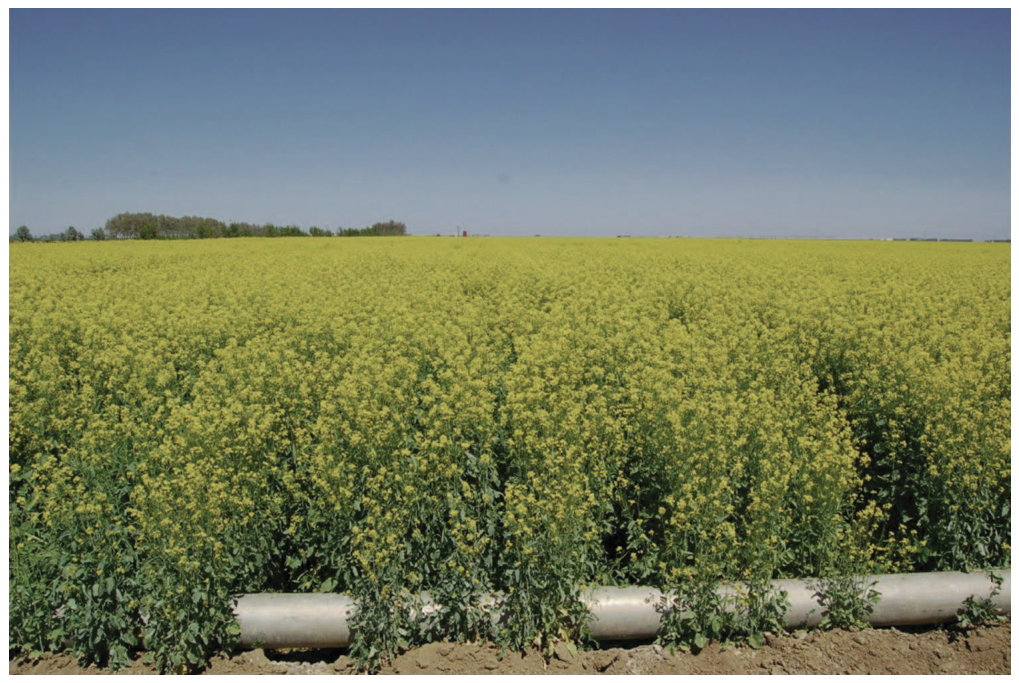
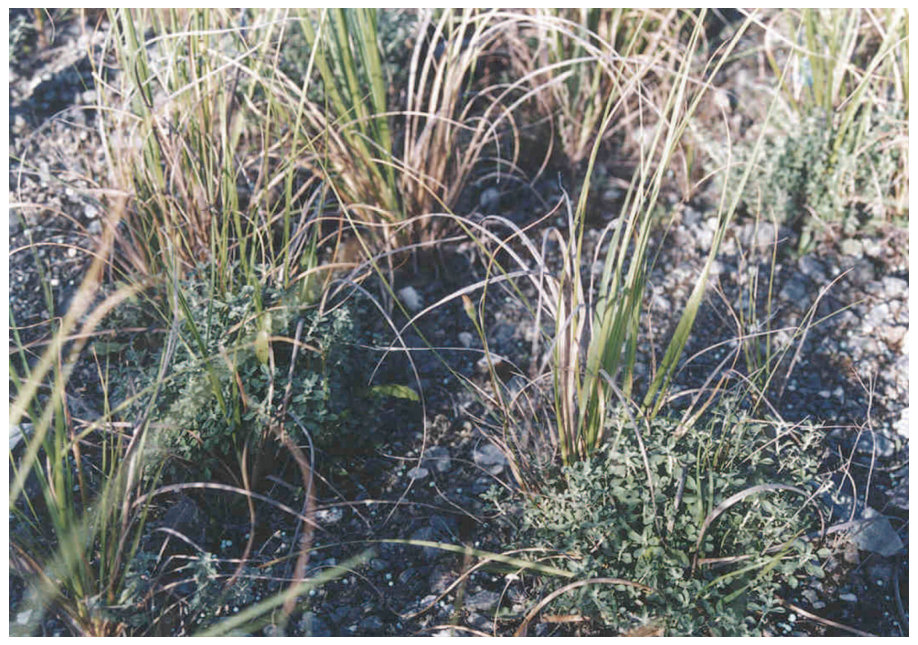
4.5 Plant Trace Element Uptake as Affected by the Soil’s Trace Element Concentration4.5 土壤微量元素浓度对植物吸收微量元素的影响
Baker (1981) divided plant species into “hyperaccumulators”, “indicators” and “excluders” according to their above-ground TE concentrations in relation to the TE concentration in the soil. Figure 10 shows an adaptation of Baker’s original version of how plants respond to the soluble concentration of TEs in soil.
Baker(1981)根据植物地上部微量元素浓度与土壤微量元素浓度的关系,将植物物种分为“超富集植物”、“指示植物”和“排斥植物”。图10展示了在Baker原始版本基础上改编的植物对土壤中可溶性微量元素浓度的响应。
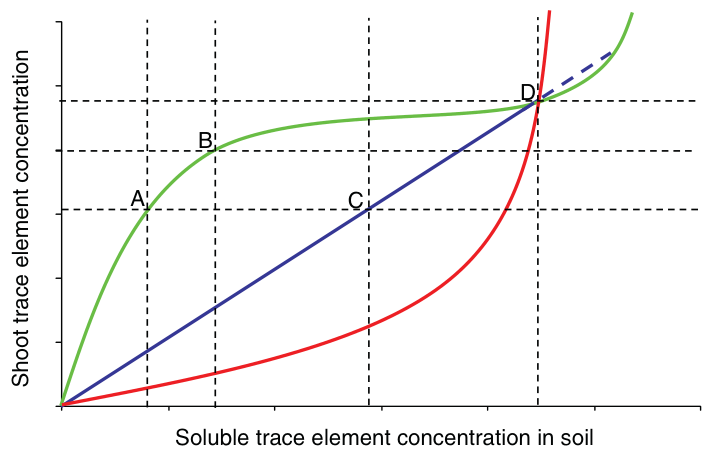
4.5.1 Accumulators and Hyperaccumulators4.5.1 富集植物与超富集植物
Accumulator and hyperaccumulator plants (Fig. 10, green line), actively accumulate TEs into the shoots when the shoots are below a sufficient concentration (Fig. 10, point A). Above this concentration, luxury uptake (Salisbury and Ross, 1992) occurs until the shoot concentration reaches an optimal level (Fig. 10, point B). At higher concentrations, roots may restrict TE uptake until the threshold concentration (Fig. 10, point D) is reached, where the mechanisms of homeostasis break down and phytotoxicity symptoms appear.
当地上部浓度低于充足浓度(图10,A点)时,富集植物和超富集植物(图10,绿线)主动将微量元素积累至地上部。高于该浓度时,发生奢侈吸收(Salisbury and Ross, 1992),直至地上部浓度达到最适水平(图10,B点)。在更高浓度下,根系可能限制微量元素的吸收,直至达到阈值浓度(图10,D点),此时稳态机制失效,出现植物毒性症状。
Hyperaccumulator plants (Brooks et al., 1977) take up TEs, even those that are non-essential, to similar concentrations as macronutrients. Brooks et al. (1977) used hyperaccumulation to describe plants that take up Ni to concentrations greater than 1000 mg kg−1 on a dry matter basis on Ni-rich ultramafic (serpentine) soil. This concentration is at least an order of magnitude greater than concentrations found in other plants growing in the same environment. There are 440 species of known hyperaccumulator species, 75% of which hyperaccumulate Ni (Reeves, 2006). The remainder hyperaccumulate As, Cd, Mn, Na, Tl, and Zn (Brooks, 1998b). This list is growing as new hyperaccumulator species are discovered.
超富集植物(Brooks et al., 1977)对微量元素(甚至是非必需元素)的吸收可达到与大量营养元素相近的浓度。Brooks et al.(1977)用“超富集”一词描述在富Ni超基性(蛇纹岩)土壤上吸收Ni至干物质浓度大于1000 mg kg−1的植物。该浓度比同一环境中生长的其他植物的浓度至少高一个数量级。目前已知的超富集植物有440种,其中75%超富集Ni(Reeves, 2006),其余超富集As、Cd、Mn、Na、Tl和Zn(Brooks, 1998b)。随着新的超富集植物物种被发现,这一名单仍在不断增加。
While hyperaccumulator plants can achieve a high TE concentration in their shoots, their biomass production is usually inferior to non-hyperaccumulator plants. Notable exceptions are Ni hyperaccumulators of the genera Alyssum (Robinson et al., 1997b) and Berkheya (Robinson et al., 1997a) (Fig. 11). These plants can achieve shoot Ni concentrations of >10000 mg kg−1 (1%) on a dry matter basis, while producing more than fifteen tonnes of dry matter per hectare per year. Improved agronomic practices and genetic modification can increase the biomass production of smaller varieties of hyperaccumulator plants (Ow et al., 1998).
尽管超富集植物地上部可达到很高的微量元素浓度,但其生物量通常低于非超富集植物。值得注意的例外是Alyssum属(Robinson et al., 1997b)和Berkheya属(Robinson et al., 1997a)的Ni超富集植物(图11)。这些植物地上部Ni浓度(以干物质计)可达>10000 mg kg−1(1%),同时每公顷每年可产生超过15吨干物质。改进农艺措施和遗传改良可提高较小型超富集植物品种的生物量(Ow et al., 1998)。
4.5.2 Indicators4.5.2 指示植物
Indicator plants (Fig. 10, blue line) take up TEs in proportion to their soluble concentration in the soil, thus the shoot concentration indicates the soil concentration. Such an uptake response implies there is no specific mechanism for homeostasis in the plant. Many plants follow the “indicator” pattern of accumulation for non essential TEs. However, some essential TEs, notably B, are taken up in this manner. Here passive uptake occurs both above and below the sufficient tissue concentration (Fig. 10, point C). Plants that do not occur naturally on metalliferous soils usually behave as ‘indicators’ when grown in the presence of nonessential elements. Madejon et al. (2004) showed that the leaves of Populus alba (L.) indicated the soluble Cd and Zn concentration in soils of the Guadiamar floodplain that became contaminated following a mine tailings dam collapse at Aznalc´ollar in 1998. Cadmium uptake by this species may facilitate the entry of this toxic element into the food chain (Dominguez et al., 2008).
指示植物(图10,蓝线)按土壤中微量元素可溶性浓度的比例吸收微量元素,因此地上部浓度可指示土壤浓度。这种吸收响应意味着植物体内不存在特定的稳态调节机制。许多植物对非必需微量元素的积累遵循“指示”模式。然而,一些必需微量元素,尤其是B,也以这种方式被吸收。在这种情况下,无论组织浓度高于还是低于充足浓度(图10,C点),均发生被动吸收。非天然生长于富金属土壤的植物在存在非必需元素的条件下生长时,通常表现为“指示植物”。Madejon et al.(2004)研究表明,Populus alba(L.)的叶片可指示Guadiamar河漫滩土壤中可溶性Cd和Zn的浓度,该河漫滩因1998年Aznalc´ollar尾矿坝溃坝而受到污染。该物种对镉的吸收可能促进这一有毒元素进入食物链(Dominguez et al., 2008)。
4.5.3 Excluders4.5.3 排斥植物
For nonessential elements, such as Cd, Ni, and As, as well as essential elements that occur at high concentrations in soil, some plants have active exclusion mechanisms (Fig. 10, red line). Most plants that occur naturally on metalliferous soils are recognised as being “excluders.” Here, the nonessential, possibly toxic, TE are maintained at a low tissue concentration, until the regulatory mechanisms are overloaded, or there is a disruption of the plasma membrane at the apoplast/symplast interface (Fig. 10, point D). When this occurs, TEs flood into the plant resulting in reduced growth accompanied by chlorosis or necrosis.
对于Cd、Ni和As等非必需元素,以及在土壤中浓度较高的必需元素,一些植物具有主动排斥机制(图10,红线)。大多数天然生长于富金属土壤的植物被认为是“排斥植物”。在这种情况下,非必需且可能有毒的微量元素在组织中维持较低浓度,直至调节机制超负荷,或质外体/共质体界面处的质膜遭到破坏(图10,D点)。此时,微量元素大量涌入植物体内,导致生长受抑,并伴有失绿或坏死。
Excluder plants are ideal candidates for the phytostabilization of mine wastes or soils with a TE concentration so high that they are phytotoxic for other species. Excluders can stabilize the soil surface, reducing erosion and leaching, while minimizing the risk that the contaminating TEs enter the food chain via herbivores.
排斥植物是尾矿废弃物或微量元素浓度高至对其他物种产生植物毒性的土壤进行植物稳定的理想候选植物。排斥植物能够稳定土壤表面,减少侵蚀和淋溶,同时将污染性微量元素经食草动物进入食物链的风险降至最低。
4.6 Calculating Trace Element Uptake into the Shoots4.6 植物地上部微量元素吸收量的计算
As discussed previously, the amount of TE accumulated in the shoots of the plant is a function of the soluble concentration of TE in the soil that is in contact with the plant’s roots, the transpiration of the plant, and the rate of TE transfer between the soil solution and the root xylem. Thus where M is plant metal uptake in the time interval (0, t; days). R is the fraction of the total root water uptake at depth z (meters), T is the transpiration rate (L day−1), C is the TE concentration (mg L−1) in the soil solution, and φ is the root absorption factor.
如前所述,植物地上部积累的微量元素量是与植物根系接触的土壤中微量元素的可溶性浓度、植物蒸腾作用以及微量元素在土壤溶液与根木质部之间的转移速率的函数。因此,式中M为时间区间(0, t;d)内植物对金属的吸收量,R为深度z(m)处根系吸水量占根系总吸水量的比例,T为蒸腾速率(L day−1),C为土壤溶液中微量元素浓度(mg L−1),φ为根系吸收因子。

R is dependent on the plant species and the soil in which it is growing; R can be estimated for most species. T can be calculated using environmental variables and a crop coefficient (Allen et al., 1998). C can be measured using soil extractions, or direct measurements of soil solution (Ernst, 1996).
R取决于植物物种及其生长的土壤;大多数物种的R均可估算。T可利用环境变量和作物系数计算(Allen et al., 1998)。C可通过土壤浸提或直接测定土壤溶液获得(Ernst, 1996)。
The root absorption factor (φ) is a dimensionless parameter that represents the root xylem / soil solution metal concentration quotient (Robinson et al., 2003a).
根系吸收因子(φ)是一个无量纲参数,表示根木质部与土壤溶液中金属浓度之比(Robinson et al., 2003a)。

where Cr is the soluble metal concentration (mg L−1) in the root xylem and C is the soluble metal concentration (mg L−1) in the soil solution.
式中Cr为根木质部中可溶性金属浓度(mg L−1),C为土壤溶液中可溶性金属浓度(mg L−1)。
The parameter φ is a simple lumped parameter intended to remove the need to measure the aforementioned complex and often poorly understood factors that influence the passage of TEs from the soil into the roots.
参数φ是一个简单的集总参数,旨在免除测定上述影响微量元素从土壤进入根系的复杂且往往尚不清楚的各种因素。
The value of φ can be approximated using the plant’s total water use, above-ground dry biomass, and the metal concentration in soil solution thus:
φ值可利用植物总耗水量、地上部干生物量以及土壤溶液中的金属浓度近似计算如下:

φ equals the Root Absorption Factor for the TE species (dimensionless), P equals the TE concentration in the above-ground dry biomass (mg kg−1), W equals the plant’s water use efficiency (kg t−1), and C equals the concentration of metal in soil solution (mg L−1).
φ为该微量元素形态的根系吸收因子(无量纲),P为地上部干生物量中微量元素浓度(mg kg−1),W为植物水分利用效率(kg t−1),C为土壤溶液中金属浓度(mg L−1)。
The issue is further complicated by the fact that φ changes depending on C. Therefore, several measurements are needed to determine the plant’s response over a range of soil concentrations. For non-phytotoxic concentrations of C, the change in φ over a soil concentration range can be modelled by adding a constant K,that describes the decrease in φ, as Cincreases, thus:
问题的复杂性还在于φ随C而变化。因此,需要进行多次测定,以确定植物在一定土壤浓度范围内的响应。对于无植物毒性的C浓度,可通过引入一个常数K,来模拟φ在土壤浓度范围内的变化,该常数描述φ随C增大而减小的程度,公式如下:

where φ (C) equals root adsorption factor at soil solution concentration C (mg L−1), φ1 equals the measured root adsorption factor at concentration C1 (mg L−1), and K (0 ≤ K <1) is the decay constant.
式中φ(C)为土壤溶液浓度为C(mg L−1)时的根系吸收因子,φ1为在浓度C1(mg L−1)下测得的根系吸收因子,K(0 ≤ K <1)为衰减常数。
This model has been validated using a lysimeter experiment, where measured values were compared with those calculated using independent parameters (Robinson et al., 2003b). The model performs well for predominately xylem-transported TEs, such as B, Cd, Mn, and Zn (Fig. 12), but poorly for Cu. The poor performance of the model to predict leaf Cu concentrations may be due to redistribution of this element in the plant via phloem transport.
该模型已通过渗漏计试验得到验证,即将实测值与利用独立参数计算的值进行比较(Robinson et al., 2003b)。对于主要经木质部运输的微量元素,如B、Cd、Mn和Zn,该模型表现良好(图12),但对Cu的模拟效果较差。该模型对叶片Cu浓度预测效果不佳,可能是由于该元素在植物体内经韧皮部运输发生了再分配。
4.7 Physicochemical Adsorption of Trace Elements onto Plant Surfaces4.7 微量元素在植物表面的物理化学吸附
Plant cell walls carry a negative charge and thus effectively adsorb cationic TEs. Cation adsorption is important in the roots, where the plant’s apoplast may adsorb both essential and nonessential TEs. Plant roots may accumulate Pb to concentrations many times higher than that of the soil solution (Huang and Cunningham, 1996) or even the bulk soil (Kahle, 1993). Deposition of TEs onto plant shoots may occur via dust, soil particles contained within rain splash, and industrial emissions such as smoke. Such surface-borne TEs may simply settle on the plant’s surface and be removed in the next rainfall. Some may entangle themselves in structures such as leaf hairs, or they may become incorporated into waxy layer or stomata. There, some fraction of the TEs may dissolve and adhere to plant tissue.
植物细胞壁带负电荷,因而能有效吸附阳离子型微量元素。阳离子吸附在根系中十分重要,植物质外体可吸附必需和非必需微量元素。植物根系中Pb的积累浓度可比土壤溶液(Huang and Cunningham, 1996)甚至整体土壤(Kahle, 1993)高出许多倍。微量元素可通过粉尘、雨滴飞溅携带的土壤颗粒以及烟尘等工业排放物沉积在植物地上部。此类表面附着的微量元素可能仅停留在植物表面,并在下一次降雨时被冲走。部分微量元素可能缠附于叶毛等结构中,或进入蜡质层或气孔。在这些部位,部分微量元素可能溶解并附着于植物组织。
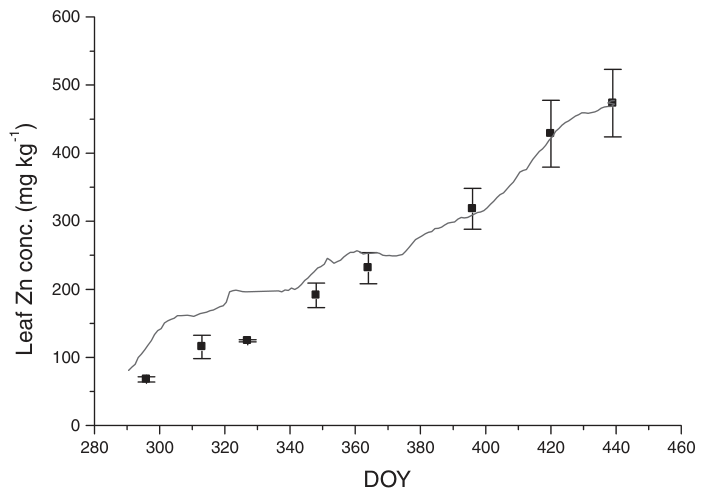
4.7.1 Calculating the Fraction of Trace Elements Originating from Soil Particles4.7.1 源自土壤颗粒的微量元素比例的计算
Distinguishing between surface-deposited TEs in plant shoots and those that the plant has translocated from the roots is important for the assessment and design of phytomanagement systems. TE adsorption affects the fate of TEs in the environment. Even careful washing does not remove all surface-deposited TEs. Therefore, some fraction of a plant sample may actually consist of soil particles or dissolved TEs that have adhered to the leaves and stems. To determine the mass of soil and dust deposition on leaf samples, one can measure an indicator element that is indicative of the level of soil deposition (Hinton et al., 1995). The indicator element should not be of interest in the study and should occur at high concentrations in the soil. Its physiological uptake by the plant via the roots should be either negligible or maintained at a constant tissue concentration over a wide range of soil concentrations. It is advantageous if it correlates with the TEs of interest. This is because the calculation uses the indicator element concentration in the soil where the plant is growing; however, wind may have deposited soil from some distance onto the plant shoots. Titanium, Ba, and Cr(III) make good indicator elements, since the plants do not take up significant concentrations of these elements (Brooks, 1998b). Therefore, the measured concentrations are directly proportional to surface deposited dust. However, these elements may not occur at high concentrations in the soil, leading to measurement difficulties and calculation errors. By contrast, Fe occurs at concentrations >1% in many soils, and is easy to measure. Iron is an essential nutrient that plants take up to concentrations of around 100 mg kg−1 (Marschner, 1995). Therefore, when using Fe to calculate surface deposition, one must first subtract a baseline value, namely the Fe that the plants have accumulated through root uptake. The mass fraction of soil on the plant sample, F (kg kg−1) is therefore where Imeasured is the measured indicator element concentration in the plant tissue (mg kg−1), Ibaseline is the baseline concentration of the indicator element that the plant has accumulated through the roots and translocated to the shoots (mg kg−1), and SI is the concentration of the indicator element in the soil (mg kg−1). The corrected plant concentration of the target element, P ∗ (mg kg−1), is:
区分植物地上部表面沉积的微量元素与植物从根系转运而来的微量元素,对于植物管理系统的评估和设计十分重要。微量元素的吸附影响其在环境中的归趋。即使仔细清洗也无法去除全部表面沉积的微量元素。因此,植物样品中可能有一部分实际上是附着在叶片和茎上的土壤颗粒或溶解态微量元素。为确定叶片样品上土壤和粉尘的沉积量,可测定一种能够指示土壤沉积水平的指示元素(Hinton et al., 1995)。该指示元素不应是研究所关注的元素,且应在土壤中以高浓度存在。植物经根系对其的生理吸收应可忽略不计,或在较宽的土壤浓度范围内维持恒定的组织浓度。若其与所关注的微量元素相关则更为有利。这是因为计算中使用的是植物生长处土壤中的指示元素浓度,而风可能将一定距离以外的土壤沉积到植物地上部。钛、Ba和Cr(III)是良好的指示元素,因为植物对这些元素的吸收浓度不显著(Brooks, 1998b),因此其测定浓度与表面沉积的粉尘量成正比。然而,这些元素在土壤中的浓度可能不高,从而导致测定困难和计算误差。相比之下,Fe在许多土壤中的浓度>1%,且易于测定。铁是一种必需养分,植物对其吸收浓度约为100 mg kg−1(Marschner, 1995)。因此,利用Fe计算表面沉积时,必须首先扣除基线值,即植物经根系吸收积累的Fe。植物样品中土壤的质量分数F(kg kg−1)因此为:式中Imeasured为植物组织中指示元素的实测浓度(mg kg−1),Ibaseline为植物经根系积累并转运至地上部的指示元素基线浓度(mg kg−1),SI为土壤中指示元素的浓度(mg kg−1)。目标元素经校正的植物浓度P ∗(mg kg−1)为:


where P and S are the measured concentrations (mg kg−1) of the target element in the plant and soil.
式中P和S分别为目标元素在植物和土壤中的实测浓度(mg kg−1)。
Errors will arise in the corrected values using Fe as an indicator element when the amount of Fe that the plant has taken up through the roots differs from the baseline value used in the calculation. Similarly, surface-deposited dust from soil that is chemically distinct from the soil used in Eq. [8] soil will result in errors.
当植物经根系吸收的Fe量与计算中所用的基线值不同时,以Fe为指示元素得到的校正值将产生误差。同样,若表面沉积的粉尘来源于与式8所用土壤化学性质不同的土壤,也会导致误差。
The quality of the calculations can be validated by comparing independent tracers on the same sample set. Following the calculation, the plant macronutrient concentrations usually do not change greatly, whereas immobile, non-essential elements, such as Pb and Sb usually decrease. Robinson et al. (2008) used Eq. [7] with Fe (baseline value = 27.3 mg kg−1) to calculate the dust deposition on the surface of plants collected from a shooting range. Separate calculations using Cu (baseline value = 2.3 mg kg−1) and Al (baseline value = 22 mg kg−1) were in reasonable agreement (r = 0.96 and r = 0.92) with the values calculated using Fe. Upon correction of the plant concentrations using Fe as an indicator element, the concentrations of the plant macronutrients, namely K, Ca, Mg, and P, stayed within 98% of their original value. However, the concentrations of Pb and Sb, the major soil contaminants, dropped to 45% and <20% of their original values.
可通过在同一样品集上比较不同的独立示踪元素来验证计算的质量。经计算校正后,植物大量营养元素的浓度通常变化不大,而Pb和Sb等非必需的难移动元素的浓度通常下降。Robinson et al.(2008)利用式7,以Fe(基线值 = 27.3 mg kg−1)计算了射击场采集植物表面的粉尘沉积量。分别以Cu(基线值 = 2.3 mg kg−1)和Al(基线值 = 22 mg kg−1)进行的计算与以Fe计算的值具有较好的一致性(r = 0.96和r = 0.92)。以Fe为指示元素对植物浓度进行校正后,植物大量营养元素K、Ca、Mg和P的浓度仍保持在其原始值的98%以内;而主要土壤污染物Pb和Sb的浓度则分别降至其原始值的45%和<20%。
8V. FEASIBILITY OF PHYTOMANAGEMENT AND FERTILE AREAS FOR FUTURE RESEARCH五、植物管理的可行性及未来研究的重点领域
Phytomanagement is only feasible if it satisfies environmental regulation and either returns a profit or costs less than alternative technologies or inaction (Robinson et al., 2003a). This is challenging, because unlike other systems to manage TE fluxes, such as capping and soil removal, phytomanagement systems are site dependent.
只有在满足环境法规要求,并且能够盈利或成本低于替代技术或不采取行动的情况下,植物管理才具有可行性(Robinson et al., 2003a)。这具有挑战性,因为与覆盖封顶和土壤移除等其他管理微量元素通量的系统不同,植物管理系统具有场地依赖性。
It is impractical to conduct long-term field trials to optimize the phytomanagement for every site. Therefore, whole system models that calculate TE flux are an essential component to test the feasibility of phytomanagement and design phytomanagement systems. Such models would remove the need for field trials by revealing where phytoextraction or phytostabilization will not meet regulations under a risk-based regime. Potentially, validated models could be used to gain regulatory approval for phytomanagement without the need for lengthy demonstration trials. Such models could also be used to determine the best management practices for each site.
为每个场地开展长期田间试验以优化植物管理是不现实的。因此,计算微量元素通量的全系统模型是检验植物管理可行性和设计植物管理系统的重要组成部分。此类模型可揭示在基于风险的管理体系下植物提取或植物稳定在何处无法满足法规要求,从而免除田间试验的需要。经验证的模型有可能用于获得植物管理的监管批准,而无需开展冗长的示范试验。此类模型还可用于确定每个场地的最佳管理措施。
A suite of ‘whole system’ have been developed to calculate the leaching of agrichemicals. These include the Soil Plant Atmosphere System Model (SPASMO), Leaching Estimation and Chemistry Model (LEACHM), HYDRUS – 1D, Water and Agrochemicals in soil, crop and Vadose Environment (WAVE) (Sarmah et al., 2005). These models calculate water and solute transport in the root-zone using Richards’ and the Convection – Dispersion Equations, or simplified ‘tipping bucket’ algorithms (Green et al., 1999). Evapotranspiration from the planted soil is usually calculated using the Penman-Monteith equation combined with a crop coefficient (Allen et al., 1998). These models could be adapted to calculate TE movement in the soil-plant system. This would necessitate the incorporation of specific root- TE interactions and the changes in TE mobility over the long term induced by the vegetation. A fertile area for future phytomanagement research is the integration of the biogeochemical and economic factors that affect phytomanagement into existing whole system models that calculate water and solute transport.
目前已开发出一系列用于计算农用化学品淋溶的“全系统”模型,包括土壤-植物-大气系统模型(SPASMO)、淋溶估算与化学模型(LEACHM)、HYDRUS – 1D以及土壤、作物与包气带环境中的水分与农用化学品模型(WAVE)(Sarmah et al., 2005)。这些模型利用Richards方程和对流-弥散方程,或简化的“翻斗式”算法计算根区的水分和溶质运移(Green et al., 1999)。种植土壤的蒸散量通常采用Penman-Monteith方程结合作物系数进行计算(Allen et al., 1998)。这些模型可经改进用于计算微量元素在土壤-植物系统中的迁移。这需要纳入特定的根系-微量元素相互作用,以及植被长期引起的微量元素迁移性变化。将影响植物管理的生物地球化学因素和经济因素整合到现有的计算水分和溶质运移的全系统模型中,是未来植物管理研究中一个极具潜力的领域。
5.1 Concluding Summary5.1 总结
Phytomanagement is a long-term technology. To compete successfully with alternative remediation technologies, contaminated site phytomanagement requires the production of valuable biomass as well as reducing environmental risk. Similarly, valuable biomass production is the most important criterion for biofortification and phytomining.
植物管理是一项长期技术。要在与其他修复技术的竞争中取得成功,污染场地植物管理不仅需要降低环境风险,还需要生产有价值的生物量。同样,生产有价值的生物量也是生物强化和植物采矿最重要的标准。
In this light, contaminated land is an undervalued resource. Bioenergy and timber production on contaminated land has several advantages over production on non-contaminated fertile soils. Most importantly, productive agricultural land will not be taken out of food production, which, in the case of bioenergy production, has led to increased food costs (Economist, 2007). Since the biomass produced either fixes carbon (timber) or produces CO2-neutral energy (bioenergy), carbon credits may add further value to the operation. In addition to timber or bioenergy, the biomass of vegetation from a phytomanagement program may have other uses, where the possibly elevated concentrations of TEs in the plant tissues are either unimportant (because they will not be consumed) or beneficial essential nutrients (such as Se or Zn). This may include cut flowers, cotton, and stock fodder. In the latter case, the biomass should be carefully monitored for excessive concentrations or the presence of other contaminants.
从这个角度看,污染土地是一种被低估的资源。与在未受污染的肥沃土壤上生产相比,在污染土地上生产生物能源和木材具有若干优势。最重要的是,高产农田不会因此退出粮食生产,而在生物能源生产中,农田退出粮食生产已导致粮食成本上升(Economist, 2007)。由于所产生的生物量或固定碳(木材),或产生CO2中性的能源(生物能源),碳信用额可进一步增加其经营价值。除木材或生物能源外,植物管理项目中植被的生物量还可有其他用途,在这些用途中,植物组织中可能升高的微量元素浓度或无关紧要(因为不会被食用),或属于有益的必需养分(如Se或Zn)。这些用途可包括切花、棉花和牲畜饲料。在用作饲料的情况下,应对生物量进行仔细监测,以防浓度过高或存在其他污染物。
Hitherto, narrow definitions have handicapped phytomanagement. For example, phytoextraction as a stand-alone technology is unlikely to find widespread use for the cleanup of contaminated sites and thus less likely to receive positive attention from scientists and regulators. In contrast, phytomanagement that combines phytoextraction, phytostabilization and the production of valuable biomass could be used extensively worldwide. Phytomanagement does not proscribe the use of other remediation technologies, but can form part of an environmental toolkit to achieve the best outcome. In particular, sequestration agents that immobilise toxic TEs (Smith et al., 2008), clay liners, geotextiles, capping with uncontaminated topsoil, and reactive barriers will enhance the effectiveness of phytomanagement to reduce the risks posed by contaminating TEs.
迄今为止,狭隘的定义阻碍了植物管理的发展。例如,植物提取作为一项独立技术,不太可能在污染场地修复中得到广泛应用,因而也不太可能获得科学家和监管者的积极关注。相比之下,将植物提取、植物稳定与有价值生物量生产相结合的植物管理可在全世界广泛应用。植物管理并不排斥其他修复技术的使用,而是可以作为环境工具箱的一部分,以实现最佳效果。尤其是,固定有毒微量元素的钝化剂(Smith et al., 2008)、黏土衬层、土工织物、用未污染表土覆盖以及反应性屏障,均可提高植物管理在降低污染性微量元素风险方面的效果。
Given the penchant for producing valuable crops on contaminated land, how does TE phytomanagement differ from simply growing normal crops of maize or trees? Firstly, soil conditioners may be used, if needed, to alter TE mobility. Secondly, the plants may be genetically distinct from standard crop or forestry species, particularly concerning TE tolerance and accumulation. Thirdly, a thorough assessment of the TE fluxes in the system and the need for a crop management program that minimizes the risk posed by the contaminating TEs. This final point exposes, yet again, a critical knowledge gap in phytomanagement research, namely the need for basic research on the integration of the many, individually well understood, processes that affect plant–TE interactions, including good agronomic practices.
既然倾向于在污染土地上生产有价值的作物,那么微量元素植物管理与单纯种植玉米或树木等普通作物有何不同?首先,必要时可使用土壤调理剂改变微量元素的迁移性。其次,所用植物在遗传上可能不同于标准的农作物或林木物种,尤其是在微量元素耐性和积累方面。第三,需要对系统中的微量元素通量进行全面评估,并需要制定将污染性微量元素风险降至最低的作物管理方案。最后一点再次暴露出植物管理研究中的一个关键知识空白,即需要开展基础研究,将影响植物-微量元素相互作用的诸多各自已被充分认识的过程(包括良好的农艺措施)加以整合。
Successful phytomanagement requires a multidisciplinary approach. Much work has focused, at the microcosm scale, on TE chemistry in soil, and molecular mechanisms of TE uptake plants. There is a lacuna of information on the biophysical processes affecting TE fluxes in the vadose zone. In particular, the role of roots on contaminant fluxes is poorly understood. Roots absorb water and TEs, and release organic matter, promoting the growth of microflora, and creating channels down through which soil particles, with TEs attached, can travel. Roots occur heterogeneously in soil, as do TEs. Can we model their interactions? Innovative techniques for rhizosphere research such as the specialized rhizobox described by Wenzel et al. (2001) can be used to measure chemical and microbiological processes with minimal disturbance to roots. Neutron radiography can reveal dynamic rhizosphere processes, including root development and water flux, with minimal disturbance to the system (Menon et al., 2007; Tullis and Wright, 2007).
成功的植物管理需要多学科的方法。大量研究集中于微宇宙尺度上土壤中微量元素的化学行为以及植物吸收微量元素的分子机制,而关于影响包气带中微量元素通量的生物物理过程的信息则较为缺乏。尤其是,根系对污染物通量的作用尚不清楚。根系吸收水分和微量元素,并释放有机质,促进微生物区系的生长,同时形成通道,使附着微量元素的土壤颗粒可沿通道向下迁移。根系在土壤中呈非均质分布,微量元素亦然。我们能否模拟二者之间的相互作用?根际研究的创新技术,如Wenzel et al.(2001)所描述的专用根箱,可在对根系干扰最小的情况下测定化学和微生物过程。中子成像技术可在对系统干扰最小的情况下揭示根系发育和水分通量等动态根际过程(Menon et al., 2007; Tullis and Wright, 2007)。
The potential application of phytomanagement is large, given the number of people affected by soilborne TEs. The growth, or lack thereof, of profitable private companies that provide this technology will indicate the true value of phytomanagement.
鉴于受土源性微量元素影响的人数众多,植物管理的潜在应用空间很大。提供该技术的盈利性私营企业的发展与否,将体现植物管理的真正价值。
9REFERENCES参考文献
Allen, R. G., Pererira, L. S., Raes, D., and Smith, M. 1998. Crop Evapotranspiration. Guidelines for Computing Crop Water Requirements. In: FAO Irrigation and Drainage Paper No. 56. FAO, Rome.
Anderson, C., Moreno, F. N., and Meech, J. A. 2005. A field demonstration of gold phytoextraction technology. Mineral Engineering 18: 385–392.
Anderson, C. W. N., Brooks, R. R., Chiarucci, A., LaCoste, C. J., Leblanc, M., Robinson, B. H., Simcock, R. and Stewart, R. B. 1999. Phytomining for nickel, thallium and gold. J.Geochem. Explor. 67: 407–415.
Anderson, C. W. N., Brooks, R. R., Stewart, R. B,. and Simcock, R. 1998. Harvesting a crop of gold in plants. Nature 395: 553–554.
Baker, A. J. M. 1981. Accumulators and excluders—strategies in the response of plants to heavy-metals. J. Plant Nutr. 3: 643–654.
Baker, A. J. M., McGrath, S. P., Sidoli, C. M. D., and Reeves, R. D. 1994. The possibility of in-situ heavy-metal decontamination of polluted soils using crops of metal-accumulating plants. Resour. Conserv. Recy. 11: 41–49.
Banks, M. K., Schwab, A. P., Fleming, G. R., and Hetrick, B. A. 1994. Effects of plants and soil microflora on leaching of zinc from mine tailings. Chemosphere. 29: 1691–1699.
Ba˜nuelos, G., Terry, N., Leduc, D. L., Pilon-Smits, E. A. H., and Mackey, B. 2005. Field trial of transgenic Indian mustard plants shows enhanced phytoremediation of selenium-contaminated sediment. Environ. Sci. Technol. 39: 1771–1777.
Ba˜nuelos, G. S. 2006. Phyto-products may be essential for sustainability and implementation of phytoremediation. Environ. Pollut. 144: 19–23.
Ba˜nuelos, G. S. 2009. Phytoremediation of selenium contaminated soil and water produces biofortified products and new agricultural byproducts. CRC Press, Boca Raton, Fl.
Ba˜nuelos, G. S., Ajwa, H. A., Wu, L., and Zambrzuski, S. 1998. Selenium accumulation by Brassica napus grown in Se-laden soil from different depths of Kesterson Reservoir. J. Soil Contamination 7: 481–494.
Ba˜nuelos, G. S., and Lin, Z. Q. 2009. Development and Uses of Biofortified Agricultural Products. CRC Press, Boca Raton, FL.
Bell, D. T. 1999. Australian trees for the rehabilitation of waterlogged and salinity-damaged landscapes. Aust. J. Bot. 47: 697–716.
Blaylock, M. J. 2000. Field demonstrations of phytoremediation of Pb contaminated soils. In Phytoremediation of contaminated soil and water. Edited by Terry, N. and Ba˜nuelos, G. pp. 1–12. Lewis Publishers, Boca Raton, FL.
Blaylock, M. J., Salt, D. E., Dushenkov, S., Zakharova, O., Gussman, C., Kapulnik, Y., Ensley, B. D., and Raskin, I. 1997. Enhanced accumulation of Pb in Indian mustard by soil-applied chelating agents. Environ. Sci. Technol. 31: 860–865.
Bolan, N. S. and Duraisamy, V. P. 2003. Role of inorganic and organic soil amendments on immobilisation and phytoavailability of heavy metals: a review involving specific case studies. Aust. J. Plant Res. 41: 533– 555.
Bolan, N. S., Naidu, R., Syers, J. K., and Tillman, R. W. 1999. Surface charge and solute interactions in soils. Adv. Agron, 67: 87–140.
Boominathan, R., Saha-Chaudhury, N. M., Sahajwalla, V., and Doran, P. M. 2004. Production of nickel bio-ore from hyperaccumulator plant biomass: Applications in phytomining. Biotechnol. Bioeng. 86: 243–250.
Breckle, S. W., and Kahle, H. 1992. Effects of toxic heavy-metals (Cd, Pb) on growth and mineral-nutrition of beech (FAGUS-SYLVATICA L). Vegetation 101: 43–53.
Brooks, R. R. 1998a. Phytoremediation by volatilisation. In: Plants That Hyperaccumulate Heavy Metals: Their Role in Phytoremediation, Microbiology, Archaeology, Mineral Exploration and Phytomining. Brooks, R. R. , Ed., pp. 289–312. CAB International, Wallingford, UK.
Brooks, R. R. 1998b. Plants That Hyperaccumulate Heavy Metals: Their Role in Phytoremediation, Microbiology, Archaeology, Mineral Exploration and Phytomining. CAB International, Wallingford, UK.
Brooks, R. R., Chambers, M. F., Nicks, L. J., and Robinson, B. H. 1998. Phytomining. Trends Plant Sci. 3: 359–362.
Brooks, R. R., Lee, J., Reeves, R. D., and Jaffre, T. 1977. Detection of nickeliferous rocks by analysis of herbarium specimens of indicator plants. J. Geochem. Explor. 7: 49–57.
Brown, S., Chaney, R., Hallfrisch, J., Ryan, J. A., and Berti, W. R. 2004. In situ soil treatments to reduce the phyto- and bioavailability of lead, zinc, and cadmium. J. Environ. Qual. 33: 522–531.
Brown, S., Sprenger, M., Maxemchuk, A., and Compton, H. 2005. Ecosystem function in alluvial tailings after biosolids and lime addition. J. Environ. Qual. 34: 139–148.
Bundt, M., Albrecht, A., Froidevaux, P., Blaser, P., and Fluhler, H. 2000. Impact of preferential flow on radionuclide distribution in soil. Environ. Sci. Technol. 34: 3895–3899.
Burd, G. I., Dixon, D. G., and Glick, B. R. 2000. Plant growth-promoting bacteria that decrease heavy metal toxicity in plants. Can. J. Microbiol. 46: 237–245.
Cakmak, I. 2008. Enrichment of cereal grains with zinc: Agronomic or genetic biofortification? Plant Soil 302: 1–17.
Chaney, R. L. 1983. Plant uptake of inorganic waste constituents. In: Land Treatment of Hazardous Wastes. J. F. Parr, P. B. Marsh and J. M. Kla Eds., pp. 50–76. Noyes Data Corps, Park Ridge, NJ.
Chaney, R. L., Angle, J. S., Broadhurst, C. L., Peters, C. A., Tappero, R. V., and Sparks, D. L. 2007. Improved understanding of hyperaccumulation yields commercial phytoextraction and phytomining technologies. J. Environ. Qual. 36: 1429–1443.
Chaney, R. L., Angle, J. S., McLntosh, M. S., Reeves, R. D., Li, Y. M., et al. 2005. Using hyperaccumulator plants to phytoextract soil Ni and Cd. Zeitschrift Fur Naturforschung C-a J. Biosciences 60: 190–198.
Chapin, F. S. 1980. The mineral-nutrition of wild plants. Annu. Rev. Ecol. Syst. 11: 233–260.
Cheng, S. F., and Hseu, Z. Y. 2002. In-situ immobilization of cadmium and lead by different amendments in two contaminated soils. Water Air Soil Pollut. 140: 73–84.
Chopra, B. K., Bhat, S., Mikheenko, I. P., Xu, Z., Yang, Y., Luo, X., Chen, H., van Zwieten, L., Lilley, R. M., and Zhang, R. 2007. The characteristics of rhizosphere microbes associated with plants in arsenic-contaminated soils from cattle dip sites. Sci. Total. Environ. 378: 331–342.
Clemens, S. 2001. Molecular mechanisms of plant metal tolerance and homeostasis. Planta 212: 475–486.
Clothier, B. E., and Green, S. R. 1997. Roots: The big movers or water and chemical in soil. Soil Sci. 162: 534–543.
Cobbett, C., and Goldsbrough, P. 2002. Phytochelatins and metallothioneins: Roles in heavy metal detoxification and homeostasis. Ann. Rev. Plant Biol. 53: 159–182.
Cohen, C. K., Fox, T. C., Garvin, D. F., and Kochian, L. V. 1998. The role of iron-deficiency stress responses in stimulating heavy-metal transport in plants. Physiol. 116: 1063–1072.
Crowdy, S. H., and Tanton, T. W. 1970. Water pathways in higher plants. 1. Free space in wheat leaves. J. Exp. Bot. 21: 102–111.
Dhankher, O. P., Li, Y. J., Rosen, B. P., Shi, J., Salt, D., Senecoff, J. F., Sashti, N. A., and Meagher, R. B. 2002. Engineering tolerance and hyperaccumulation of arsenic in plants by combining arsenate reductase and gamma-
glutamylcysteine synthetase expression. Nature Biotechnol. 20: 1140–1145. Dickinson, N. M. 2000. Strategies for sustainable woodland on contaminated soils. Chemosphere. 41: 259–263.
Dickinson, N. M., Turner, A. P., and Lepp, N. W. 1991. How do trees and other
long-lived plants survive in polluted environments? Funct. Ecol. 5: 5–11.
Dominguez, M. T., Maranon, T., Murillo, J. M., Schulin, R., and Robinson, B. H. 2008. Trace element accumulation in woody plants of the Guadiamar Valley, SW Spain: A large-scale phytomanagement case study. Environ. Pollut. 152: 50–59.
Dordas, C. and Brown, P. H. 2000. Permeability of boric acid across lipid bilayers and factors affecting it. J. Membr. Biol. 175: 95–105.
Economist, April 4, 2007. Castro was right. In The Economist.
Ernst, W. H. O. 1996. Bioavailability of heavy metals and decontamination of soils by plants. Appl. Geochem. 11: 163–167.
Ernst, W. H. O., Verkleij, J. A. C., and Schat, H. 1992. Metal tolerance in plants. Acta Bot. Neerl. 41: 229–248.
Fernandez, M. D., Cagigal, E., Vega, M. M., Urzelai, A., Babin, M., Pro, J., and Tarazona, J. V. 2005. Ecological risk assessment of contaminated soils through direct toxicity assessment. Ecotoxicol. Environ. Saf. 62: 174–184.
Ferro, A. M., Rieder, J. P., Kennedy, J., and Kjelgren, R. 1997. Phytoremediation
of groundwater using poplar trees. In: Phytoremediation. Thibeault, C. A. and Savage, L. M., Eds., pp. 201–212. International Business Communications Inc., Southborough, MA.
Fox, J. L. 2001. Canadian farmer found guilty of Monsanto canola patent infringement. Nature Biotechnol. 19: 396–397.
Franca, F., and Ferrari, M. 2002. Impact of micronutrient deficiencies on growth: The stunting syndrome. Ann. Nut. Metab. 46: 8–17.
Frey, B., Keller, C., Zierold, K,. and Schulin, R. 2000. Distribution of Zn in functionally different leaf epidermal cells of the hyperaccumulator Thlaspi caerulescens. Plant Cell Environ. 23: 675–687.
GACGC 1994. World in Transition: The Threat to Soils. In: Annual Report. German Advisory Council on Global Change, Bonn.
Granel, T., Robinson, B., Mills, T., Clothier, B., Green, S., and Fung, L. 2002. Cadmium accumulation by willow clones used for soil conservation, stock fodder, and phytoremediation. Aust. J. Plant Res. 40: 1331–1337.
Green, S. R., Clothier, B. E., Mills, T. M,. and Millar, A. 1999. Risk assessment of irrigation requirements of field crops in a maritime climate. J. Crop Prod. 2: 353–377.
Gries, D., Klatt, S., and Runge, M. 1998. Copper-deficiency-induced phytosiderophore release in the calcicole grass Hordelymus europaeus. New Phytol. 140: 95–101.
Gupta, U. C., and Gupta, S. C. 2005. Future trends and requirements in micronutrient research. Commun. Soil Sci. Plant Anal. 36: 33–45.
Hall, J. L. 2002. Cellular mechanisms for heavy metal detoxification and tolerance. J. Exp. Bot. 53: 1–11.
Hamon, R. E., and McLaughlin, M. J. 1999. Use of the hyperaccumulator Thlaspi cearulescens for bioavailable contaminant stripping. In: 5th International Conference on the Biogeochemistry of Trace Elements. Wenzel, W. W., Adriano, D. C., Alloway, B., Doner, H., Keller, C., Lepp, N. W., Mench, M., Naidu, R., and Pierzynski, G. M., Eds., pp. 908–909, Vienna.
Harrison-Murray, R. and Clarkson, D. 1973. Relationships between structural development and absorption of ions by the root system of Cucurbita pepo. Planta 114: 1–16.
Hinton, T .G., Kopp, P., Ibrahim, S., Bubryak, I., Syomov, A., Tobler, L, and Bell, C. 1995. A Comparison of techniques used to estimate the amount of resuspended soil on plant-surfaces. Health Phys. 68: 523–531.
Hopkins, B. G., Whitney, D. A., Lamond, R. E., and Jolley, V. D. 1998. Phytosiderophore release by sorghum, wheat, and corn under zinc deficiency. J. Plant Nutr. 21: 2623–2637.
Huang, J. W., and Cunningham, S. D. 1996. Lead phytoextraction: Species variation in lead uptake and translocation. New Phytol. 134: 75–84.
Jardine, P. M., Fendorf, S. E., Mayes, M. A., Larsen, I. L., Brooks, S. C,. and Bailey, W. B. 1999. Fate and transport of hexavalent chromium in undisturbed heterogeneous soil. Environ. Sci. Technol. 33: 2939–2944.
Jentschke, G. and Godbold, D. L. 2000. Metal toxicity and ectomycorrhizas. Physiol. Plant. 109(2): 107–116.
Kagi, J. H. R. 1991. Overview of metallothionein. Methods. Enzymol. 205: 613–626.
Kahle, H. 1993. Response of roots of trees to heavy-metals. Environ. Exper. Bot. 33: 99–119.
Kamnev, A. A., and van der Lelie, D. 2000. Chemical and biological parameters as tools to evaluate and improve heavy metal phytoremediation. Biosci. Rep. 20: 239–258.
Keller, C., Ludwig, C., Davoli, F., and Wochele, J. 2005. Thermal treatment of metal-enriched biomass produced from heavy metal phytoextraction.Environ. Sci. Technol. 39: 3359–3367.
Khan, A. G. 2005. Rote of soil microbes in the rhizospheres of plants growing on trace metal contaminated soils in phytoremediation. J. Trace Elem. Med. Biol. 18: 355–364.
Khattak, R. A., Page, A. L., Parker, D. R. and Bakhtar, D. 1991. Accumulation and interactions of arsenic, selenium, molybedenium and phosphrous in alfalfa. J. Environ. Qual. 20: 165–168.
King, J. C. 2002. Evaluating the impact of plant biofortification on human nutrition. J. Nutr. 132: 511S–513S.
Kirkham, M. B. 2006. Cadmium in plants on polluted soils: Effects of soil factors, hyperaccumulation, and amendments. Geoderma 137: 19–32.
Kochian, L. V. 1991. Mechanisms of micronutrient uptake and translocation in plants. In: Micronutrients in Agriculture. Mortvedt, J. J., Cox, F. R., Schumin, L. M., and Welch, R. M., Eds., pp. 229–296. Soil Science Society of America, Madison, WI.
Koppolu, L., Prasad, R., and Clements, L. D. 2004. Pyrolysis as a technique for separating heavy metals from hyperaccumulators. Part III: pilot-scale pyrolysis of synthetic hyperaccumulator biomass. Biomass Bioenerg. 26: 463–472.
Kos, B., and Lestan, D. 2003. Induced phytoextraction/soil washing of lead using biodegradahle chelate and permeahle barriers. Environ. Sci. Technol. 37: 624–629.
Kramer, U., Pickering, I. J., Prince, R. C., Raskin, I., and Salt, D. E. 2000. Subcellular localization and speciation of nickel in hyperaccumulator and non-accumulator Thlaspi species. Physiol. 122: 1343–1353.
Kupper, H., Lombi, E., Zhao, F. J., and McGrath, S. P. 2000. Cellular compartmentation of cadmium and zinc in relation to other elements in the hyperaccumulator Arabidopsis halleri. Planta 212: 75–84.
Kupper, H., Zhao, F. J., and McGrath, S. P. 1999. Cellular compartmentation of zinc in leaves of the hyperaccumulator Thlaspi caerulescens. Physiol. 119: 305–311.
Leblanc, M., Petit, D., Deram, A., Robinson, B. H., and Brooks, R. R. 1999. The phytomining and environmental significance of hyperaccumulation of thallium by Iberis intermedia from Southern France. Econ. Geol. Bull. Soc. 94: 109–113.
Lei, X. G., Ku, P. K., Miller, E. R., Ullrey, D. E., and Yokoyama, M. T. 1993. Supplemental microbial phytase improves bioavailability of dietary zinc to weanling pigs. J. Nutr. 123: 1117–1123.
Lesturgez, G., Poss, R., Hartmann, C., Bourdon, E., Noble, A., and Ratana- Anupap, S. 2004. Roots of Stylosanthes hamata create macropores in the compact layer of a sandy soil. Plant Soil 260: 101–109.
Lewis, S., Handy, R. D., Cordi, B., Billinghurst, Z., and Depledge, M. H. 1999. Stress proteins (HSP’s): Methods of detection and their use as an environmental biomarker. Ecotoxicol. 8: 351–368.
Li, Y. M., Chaney, R., Brewer, E., Roseberg, R., Angle, J. S., Baker, A., Reeves, R., and Nelkin, J. 2003. Development of a technology for commercial phytoextraction of nickel: economic and technical considerations. Plant Soil 249: 107–115.
Licht, L. A. and Isebrands, J .G. 2005. Linking phytoremediated pollutant removal to biomass economic opportunities. Biomass Bioenerg. 28: 203– 218.
Lombi, E., Zhao, F. J., Dunham, S. J. and McGrath, S. P. 2001. Phytoremediation of heavy metal-contaminated soils: Natural hyperaccumulation versus chemically enhanced phytoextraction. J. Environ. Qual. 30: 1919-1926.
Lombi, E., Zhao, F. J., Zhang, G. Y., Sun, B., Fitz, W., Zhang, H., and McGrath, S. P. 2002. In situ fixation of metals in soils using bauxite residue: chemical assessment. Environ. Pollut. 118: 435–443.
Lyons, G. H., Stangoulis, J. C. R., and Graham, R. D. 2004. Exploiting micronutrient interaction to optimize biofortification programs: The case for inclusion of selenium and iodine in the HarvestPlus program. Nutr. Rev 62: 247–252. Ma, Q. Y., Traina, S .J., Logan, T. J., and Ryan, J. A. 1993. In-situ lead immobilization by apatite. Environ. Sci. Technol. 27: 1803–1810.
Ma, Y., Dickinson, N. M., and Wong, M. H. 2006. Beneficial effects of earthworms and arbuscular mycorrhizal fungi on establishment of leguminous trees on Pb/Zn mine tailings. Plant Biol. Biochem. 38: 1403– 412.
Macnair, M. R. 1987. Heavy-Metal Tolerance in Plants - a Model Evolutionary System. Trends Ecol. Evol. 2: 354–359.
Madejon, P., Maranon, T., Murillo, J. M., and Robinson, B. 2004. White poplar (Populus alba) as a biomonitor of trace elements in contaminated riparian forests. Environ. Pollut. 132: 145–155.
Margni, M. B., Lothenbach, B., and Schulin, R. 1997. Entsorgungsverfahren f¨ur schwermetall-belastetes Pflanzenmaterial. TerraTech 2: 53–57.
Marschner, H. 1995. Mineral nutrition of higher plants. Mineral nutrition of higher plants, Academic Press, London.
Martinoia, E., Klein, M., Geisler, M., Bovet, L., Forestier, C., Kolukisaoglu, U., Muller-Rober, B., and Schulz, B. 2002. Multifunctionality of plant ABC transporters - more than just detoxifiers. Planta 214: 345– 355.
Maurel, C. 1997. Aquaporins and water permeability of plant membranes. Annual Rev. Physiol. Plant Molecul. Biol. 48: 399–429.
McGowen, S. L., Basta, N. T., and Brown, G. O. 2001. Use of diammonium phosphate to reduce heavy metal solubility and transport in smelter-contaminated soil. J. Environ. Qual. 30: 493–500.
McGrath, S. P., Sidoli, C. M. D., Baker, A. J. M., and Reeves, R. D. 1993. The potential for the use of metal-accumulating plants for the in situ decontamination of metal-polluted soils. In: Integrated Soil and Sediment Research: A Basis for Proper Protection. Eijsackers, H. J. P. and Hamers, T., Eds., pp. 673–676. Kluwer Academic Publishers, Dordrecht.
McLaughlin, M. J., Tiller, K. G., Naidu, R., and Stevens, D. P. 1996. Review: The behaviour and environmental impact of contaminants in fertilizers. Aust. J. Plant Res. 34: 1–54.
McNaughton, K. G., and Jarvis, P .G. 1983. Effects of vegetation on transpiration and evaporation. In: Water Deficits and Plant Growth. Kozlowski, T. T., Ed., pp. 1–47. Academic Press, New York.
Mendez, M. O., and Maier, R. M. 2008a. Phytoremediation of mine tailings in temperate and arid environments. Rev. Environ. Sci. Bio/Technol. 7: 47–59.
Mendez, M. O., and Maier, R. M. 2008b. Phytostabilization of mine tailings in arid and semiarid environments - An emerging remediation technology. Environ. Health. Perspect. 116: 278–283.
Menon, M., Robinson, B., Oswald, S. E., Kaestner, A., Abbaspour, K. C., Lehmann, E., and Schulin, R. 2007. Visualization of root growth in heterogeneously contaminated soil using neutron radiography. Euro. J. Soil Sci. 58: 802–810.
Mills, T. M., Robinson, B. H., Sivakumaran, S., Arnold, B., Clothier, B. E., and Kim, N. 2005. Current practice and future land-use: the sustainability of productive sector environments. Acta Hort. (ISHS) 694: 159–164.
Moreno, F. N., Anderson, C. W. N., Stewart, R. B., Robinson, B. H., Nomura, R., Ghomshei, M., and Meech, J. A. 2005. Effect of thioligands on plant-Hg accumulation and volatilisation from mercury-contaminated mine tailings. Plant Soil 275: 233–246.
Naidu, R., Bolan, N. S., Kookana, R. S., and Tiller, K. G. 1994. Ionic-strength and pH effects on the sorption of cadmium and the surface-charge of soils. Euro. J. Soil Sci. 45: 419–429.
Nestel, P., Bouis, H. E., Meenakshi, J. V., and Pfeiffer, W. 2006. Biofortification of staple food crops. J. Nutr. 136: 1064–1067.
Nicks, L. J., and Chambers, M. F. 1994. Nickel farming. Discover, Mag. 19 September.
Nicks, L. J., and Chambers, M. F. 1995. Farming for metals. Mining Environ. Mgt. 15–18 September.
Nie, L., Shah, S., Rashid, A., Burd, G. I., Dixon, D. G. and Glick, B. R. 2002. Phytoremediation of arsenate contaminated soil by transgenic canola and the plant growth-promoting bacterium Enterobacter cloacae CAL2. Physiol. Biochem. 40: 355–361.
Nixon, D. J., Stephens, W., Tyrrel, S. F., and Brierley, E. D. R. 2001. The potential for short rotation energy forestry on restored landfill caps. Bioresour. Technol. 77: 237–245.
Nowack, B. 2002. Environmental chemistry of aminopolycarboxylate chelating agents. Environ. Sci. Technol. 36: 4009–4016.
Nowack, B., Schulin, R., and Robinson, B. H. 2006. Critical assessment of chelant-enhanced metal phytoextraction. Environ. Sci. Technol. 40: 5225– 5232.
Oliver, M. A. 1997. Soil and human health: a review. Euro. J Soil Sci. 48: 573–592.
Ow, D. W., Shewry, P. R., Napier, J. A., and Davis, P .J. 1998. Prospects of engineering heavy metal detoxification genes in plants. In: Symposium of the Industrial Biochemistry and Biotechnology Group of the Biochemical Society, pp. 111–124, IACR-Long Ashton Research Station, Long Ashton, Bristol, UK.
Pal, A., and Paul, A. K. 2004. Aerobic chromate reduction by chromiumresistant bacteria isolated from serpentine soil. Microbiol. Res. 159: 347– 354.
Pate, J. S., Sharkey, P. J., and Lewis, O. A. M. 1975. Xylem to phloem transfer of solutes in fruiting shoots of legumes, studied by a phloem bleeding technique. Planta 122: 11–26.
Pedersen, K., and Albinsson, Y. 1992. Possible effects of bacteria on traceelement migration in crystalline bed-rock. Radiochim. Acta 58-9: 365– 369.
Pulford, I. D., McGregor, S. D., Duncan, H. J, and Wheeler, C. T. 1995. Uptake of Heavy Metals From Contaminated Soil by Trees. In: Fourteenth Annual Symposium. Current Topics in Plant Biochemistry, Physiology and Molecular Biology. Will Plants have a role in Bioremediation? pp. 49–50, Interdisciplinary Plant Group, University of Missouri, Columbia, MO.
Quinn, J. J., Negri, C. M., Hinchman, R. R., Moos, L. P., Wozniak, J. B., and Gatliff, E. 2001. Predicting the effect of deep-rooted hybrid poplars on the groundwater flow system at a large scale phytoremediation site. Int J. Phytoremediation 3: 41–60.
Ramesh, S. A., Choimes, S., and Schachtman, D. P. 2004. Over-expression of an Arabidopsis zinc transporter in Hordeum vulgare increases short-term zinc uptake after zinc deprivation and seed zinc content. Plant Mol. Biol. 54: 373–385.
Rauser, W. E. 1995. Phytochelatins and related peptides - structure, biosynthesis, and function. Physiol. 109: 1141–1149.
Reeves, R. 2006. Hyperaccumulation of trace elements by plants. In: Phytoremediation of Metal-Contaminated Soils. Morel, J. L., Echevarria, G., and Goncharova, N., Eds., pp. 25–52.
Reid, R., and Hayes, J. 2003. Mechanisms and control of nutrient uptake in plants. In: International Review of Cytology - a Survey of Cell Biology, Vol 229, pp. 73–114.
Reid, R. J., Brookes, J. D., Tester, M. A., and Smith, F. A. 1996. The mechanism of zinc uptake in plants—Characterisation of the low-affinity system. Planta 198: 39–45.
Riesen, O., and Feller, U. 2005. Redistribution of nickel, cobalt, manganese, zinc, and cadmium via the phloem in young and maturing wheat. J. Plant Nutr. 28: 421–430.
Robinson, B., and Anderson, C. W. N. 2007. Phytoremediation in New Zealand / Australia. In: Phytoremediation Methods and Reviews. Willey, N., Ed., pp. 455–468. Humana Press, Totowa, NJ.
Robinson, B., Fernandez, J. E., Madejon, P., Maranon, T., Murillo, J. M., Green, S., and Clothier, B. 2003a. Phytoextraction: an assessment of biogeochemical and economic viability. Plant Soil 249: 117–125.
Robinson, B., Green, S., Mills, T., Clothier, B., van der Velde, M., Laplane, R., Fung, L., Deurer, M., Hurst, S., Thayalakumaran, T., and van den Dijssel, C. 2003b. Phytoremediation: using plants as biopumps to improve degraded environments. Aust. J. PlantRes. 41: 599–611.
Robinson, B., Mills, T., Green, S., Chancerel, B., Clothier, B., Fung, L., Hurst, S., and McIvor, I. 2005. Trace element accumulation by poplars and willows used for stock fodder. N. Z. J. Agric. Res. 48: 489–497.
Robinson, B., Russell, C., Hedley, M., and Clothier, B. 2001. Cadmium adsorption by rhizobacteria: implications for New Zealand pastureland. Agric. Ecosyst. Environ. 87: 315–321.
Robinson, B. H., Bischofberger, S., Stoll, A., Schroer, D., Furrer, G., Roulier, S., Gruenwald, A., Attinger, W., and Schulin, R. 2008. Plant uptake of trace elements on a Swiss military shooting range: Uptake pathways and land management implications. Environ. Pollut. 153: 668–676.
Robinson, B. H., Brooks, R. R., and Clothier, B. E. 1999a. Soil amendments affecting nickel and cobalt uptake by Berkheya coddii: Potential use for phytomining and phytoremediation. Ann. Bot. 84: 689–694.
Robinson, B. H., Brooks, R. R., Gregg, P. E. H., and Kirkman, J. H. 1999b. The nickel phytoextraction potential of some ultramafic soils as determined by sequential extraction. Geoderma 87: 293–304. Robinson, B. H., Brooks, R. R., and Hedley, M. J. 1999c. Cobalt and nickel accumulation in Nyssa (tupelo) species and its significance for New Zealand agriculture. N. Z. J. Agric. Res. 42: 235–240.
Robinson, B. H., Brooks, R. R., Howes, A. W., Kirkman, J. H., and Gregg, P. E. H. 1997a. The potential of the high-biomass nickel hyperaccumulator Berkheya coddii for phytoremediation and phytomining. J. Geochem. Explor. 60: 115–126.
Robinson, B. H., Chiarucci, A., Brooks, R. R., Petit, D., Kirkman, J. H., Gregg, P. E. H., and DeDominicis, V. 1997b. The nickel hyperaccumulator plant Alyssum bertolonii as a potential agent for phytoremediation and phytomining of nickel. J. Geochem. Explor. 59: 75–86.
Robinson, B. H., Green, S. R., Chancerel, B., Mills, T. M., and Clothier, B. 2007. Poplar for the phytomanagement of boron contaminated sites. Environ. Pollut. 150: 225–233.
Robinson, B. H., Schulin, R., Nowack, B., Roulier, S., Menon, M., Clothier, B. E., Green, S. R., and Mills, T. M. 2006. Phytoremediation for the management of metal flux in contaminated sites. Forest Snow Landscape Res. 80: 221–234.
Romkens, P., Bouwman, L. A., and Boon, G. T. 1999. Effect of plant growth on copper solubility and speciation in soil solution samples. Environ. Pollut. 106: 315–321.
Roulier, S., Robinson, B., Kuster, E., and Schulin, R. 2008. Analysing the preferential transport of lead in a vegetated roadside soil using lysimeter experiments and a dual-porosity model. Eur. J. Soil Sci. 59: 61–70.
Rugh, C. L., Senecoff, J. F., Meagher, R. B., and Merkle, S. A. 1998. Development of transgenic yellow poplar for mercury phytoremediation. Natur. Biotechnol. 16: 925–928.
Ryan, J. A., Zhang, P. C., Hesterberg, D., Chou, J., and Sayers, D. E. 2001. Formation of chloropyromorphite in a lead-contaminated soil amended with hydroxyapatite. Environ. Sci. Technol. 35: 3798–3803.
Salisbury, F. B. and Ross, C. W. 1992. Physiol. Wadsworth, Belmont, CA.
Salt, D. E., Blaylock, M., Kumar, N., Dushenkov, V., Ensley, B. D., Chet, I., and Raskin, I. 1995. Phytoremediation—a novel strategy for the removal of toxic metals from the environment using plants. Bio-Technol. 13: 468–474.
Salt, D. E., and Wagner, G. J. 1993. Cadmium transport across tonoplast of vesicles from oat roots - evidence for a Cd2+/H+ antiport activity. J. Biol. Chem. 268: 12297–12302.
Sarmah, A. K., Close, M. E., Pang, L. P., Lee, R., and Green, S. R. 2005. Field study of pesticide leaching in a Himatangi sand (Manawatu) and a Kiripaka bouldery clay loam (Northland). 2. Simulation using LEACHM, HYDRUS- 1D, GLEAMS, and SPASMO models. Aust. J. Plant Res. 43: 471–489.
Schat, H., and Vooijs, R. 1997. Multiple tolerance and co-tolerance to heavy metals in Silene vulgaris: a co-segregation analysis. New. Phytol. 136: 489– 496.
Schulin, R., Khoschgoftarmanesh, A., Afyuni, M., Nowack, B., and Frossard, E. 2009. Effects of soil management on zinc uptake and its bioavailability in plants. In: Development and Use of Biofortified Agricultural Products. Ba˜nuelos, G. S. and Lin, Z. Q., Eds., pp. 95–114. CRC Press, Boca Raton, FL.
Schutzendubel, A., and Polle, A. 2002. Plant responses to abiotic stresses: heavy metal-induced oxidative stress and protection by mycorrhization. J. Exp. Bot. 53: 1351–1365.
Schwartz, C., Morel, J. L., Saumier, S., Whiting, S. N., and Baker, A. J. M. 1999. Root development of the Zinc-hyperaccumulator plant Thlaspi caerulescens as affected by metal origin, content and localization in soil. Plant Soil 208: 103–115.
Seaman, J. C., Arey, J. S., and Bertsch, P. M. 2001. Immobilization of nickel and other metals in contaminated sediments by hydroxyapatite addition. J. Environ. Qual. 30: 460–469.
Sellers, W. D. 1965. Physical Climatology. University of Chicago Press, Chicago.
Skulsky, I. A. 1991. Isomorphism of Tl+ and K+ in membrane-transport processes. Tsitologiya. 33: 118–129.
Smith, E., Naidu, R., Weber, J., and Juhasz, A. L. 2008. The impact of sequestration on the bioaccessibility of arsenic in long-term contaminated soils. Chemosphere. 71: 773–780.
Stangoulis, J. C. R., Reid, R. J., Brown, P. H., and Graham, R. D. 2001. Kinetic analysis of boron transport in Chara. Planta 213: 142–146.
Stephan, U. W., and Scholz, G. 1993. Nicotinamine - mediator of transport of iron and heavy-metals in the phloem. Physiol. Plant 88: 522–529.
Steudle, E., and Peterson, C. A. 1998. How does water get through roots? J. Exp. Bot. 49: 775–788.
Storksdieck, D., and Hurrell, R. 2007. The impact of trace elements from plants on human nutrition: a case study for biofortification. In: 9th International Conference on the Biogeochemistry of Trace Elements (ICOBTE), Bejing, China.
Swartjes, F. A. 1999. Risk-based assessment of soil and groundwater quality in the Netherlands: Standards and remediation urgency. Risk Anal. 19: 1235– 1249.
Tandy, S., Bossart, K., Mueller, R., Ritschel, J., Hauser, L., Schulin, R., and Nowack, B. 2004. Extraction of heavy metals from soils using biodegradable chelating agents. Environ. Sci. Technol. 38: 937–944.
Thayalakumaran, T., Robinson, B. H., Vogeler, I., Scotter, D. R., Clothier, B. E., and Percival, H. J. 2003. Plant uptake and leaching of copper during EDTAenhanced phytoremediation of repacked and undisturbed soil. Plant Soil 254: 415–423.
Tullis, B. P., and Wright, S. J. 2007. Wetting front instabilities: a threedimensional experimental investigation. Transport Porous Med. 70: 335– 353.
Turpeinen, R., Salminen, J., and Kairesalo, T. 2000. Mobility and bioavailability of lead in contaminated boreal forest soil. Environ. Sci. Technol. 34: 5152– 5156.
Vangronsveld, J., Colpaert, J. V., and VanTichelen, K. K. 1996. Reclamation of a bare industrial area contaminated by non-ferrous metals: Physicochemical and biological evaluation of the durability of soil treatment and revegetation. Environ. Pollut. 94: 131–140.
Vogeler, I., Green, S. R., Clothier, B. E., Kirkham, M. B., and Robinson, B. H. 2001. Contaminant transport in the root zone. In: Trace Elements in the Soil, Bioavailability, Flux and Transfer. Iskandar, I. K. and Kirkham, M. B., Eds., pp. 175–198. Lewis Publishers, Boca Raton, FL.
Vosatka, M. 2001. A future role for the use of arbuscular mycorrhizal fungi in soil remediation: a chance for small-medium enterprises? Minerva Biotecnol. 13: 69–72.
Vucenik, I., and Shamsuddin, A. M. 2003. Cancer inhibition by inositol hexaphosphate (IP6) and inositol: From laboratory to clinic. J. Nutr. 133: 3778S–3784S.
Ward, J. M. 2001. Identification of novel families of membrane proteins from the model plant Arabidopsis thaliana. Bioinformat. 17: 560–563.
Wei, S. H., Zhou, Q. X., and Wang, X. 2005. Identification of weed plants excluding the uptake of heavy metals. Environ. Int. 31: 829–834.
Wenzel, W. W., Bunkowski, M., Puschenreiter, M., and Horak, O. 2003. Rhizosphere characteristics of indigenously growing nickel hyperaccumulator and excluder plants on serpentine soil. Environ. Pollut. 123: 131– 138.
Wenzel, W. W., Wieshammer, G., Fitz, W. J., and Puschenreiter, M. 2001. Novel rhizobox design to assess rhizosphere characteristics at high spatial resolution. Plant Soil 237: 37–45.
White, P. J. and Broadley, M. R. 2005. Biofortifying crops with essential mineral elements. Trends Plant Sci. 10: 586–593.
Whiting, S. N., De Souza, M. P., and Terry, N. 2001. Rhizosphere bacteria mobilize Zn for hyperaccumulation by Thlaspi caerulescens. Environ. Sci. Technol. 35: 3144–3150.
Whiting, S. N., Leake, J. R., McGrath, S. P., and Baker, A. J. M. 2000. Positive responses to Zn and Cd by roots of the Zn and Cd hyperaccumulator Thlaspi caerulescens. New. Phytol. 145: 199–210.
Wolfe, A. K., and Bjornstad, D. J. 2002. Why would anyone object? An exploration of social aspects of phytoremediation acceptability. Crit. Rev. Plant Sci. 21: 429–438.
Yang, X. E., Chen, W. R., and Feng, Y. 2007. Improving human micronutrient nutrition through biofortification in the soil-plant system: China as a case study. Environ. Geochem. Health. 29: 413–428.
Zayed, A., Pilon-Smits, E., Desouza, M., Lin, Z. Q., and Terry, N. 2000. Remediation of selenium polluted soils and waters by phytovolatalisation. In: Phytoremediation of Contaminated Soil and Water. Terry, N. and Ba˜nuelos, G., Eds., pp. 1–12. Lewis Publishers, Boca Raton, FL.
Zayed, A. M., and Terry, N. 1992. Selenium volatilisation in broccoli as influenced by sulphate supply J. Plant Physiol. 140: 646–652.
Zenk, M. H. 1996. Heavy metal detoxification in higher plants—A review. Gene 179: 21–30.
Zhao, F. J., Lombi, E., Breedon, T., and McGrath, S. P. 2000. Zinc hyperaccumulation and cellular distribution in Arabidopsis halleri. Plant Cell Environ. 23: 507–514.
Zhou, J. R., and Erdman, J. W. 1995. Phytic acid in health and disease. Crit. Rev Food Sci. Nutr. 35: 495–508.
Zhu, D., Schwab, A. P., and Banks, M. K. 1999. Heavy metal leaching from mine tailings as affected by plants. J. Environ. Qual. 28: 1727– 1732.