Vol.52, n. 4: pp. 953-960, July-August 2009 ISSN 1516-8913 Printed in Brazil
BRAZILIAN ARCHIVES OF BIOLOGY AND TECHNOLOGY
A N I N T E R N A T I O N A L J O U R N A L
Fábio Netto Moreno1*, Christopher Anderson2, Robert Stewart2 and Brett Robinson3 1 Setor de Águas Subterrâneas e do Solo; Companhia de Tecnologia de Saneamento Ambiental do Estado de São Paulo; Av. Prof. Frederico Hermann Jr., 345; 05459-900; São Paulo - SP – Brasil. 2Soil and Earth Science; Institute of Natural Resources; Massey University; Palmerston North - New Zealand. 3Agriculture and Life Sciences Division; Lincoln University; Lincoln 7647, Canterbury - New Zealand
Fábio Netto Moreno1*, Christopher Anderson2, Robert Stewart2 and Brett Robinson3 1 Setor de Águas Subterrâneas e do Solo; Companhia de Tecnologia de Saneamento Ambiental do Estado de São Paulo; Av. Prof. Frederico Hermann Jr., 345; 05459-900; São Paulo - SP – Brasil. 2Soil and Earth Science; Institute of Natural Resources; Massey University; Palmerston North - New Zealand. 3Agriculture and Life Sciences Division; Lincoln University; Lincoln 7647, Canterbury - New Zealand
1ABSTRACT摘要
A hydride-generation atomic absorption spectroscopy (AAS) method was developed for the analysis of total Hg in liquid matrices of mercury-rich plants and mine tailings samples. The detection limit for this method was as low as 11.4 ng/mL. The reproducibility of the mercury signals (in terms of relative standard deviation) was 4.6%. Accuracy of the method was verified by analyses of deionised water samples spiked with HgCl2 and HgNO3. Recovery values for total mercury ranged from 88.5 to 94.3% for both mercury species added. An external certified laboratory validated the analytical method with a maximum discrepancy of 15 %. Optimal analytical response of the equipment for Hg analysis of plant samples was achieved when the sample volume added to the reaction vessel was 0.25 mL.
本研究建立了一种氢化物发生原子吸收光谱(AAS)法,用于测定富汞植物及矿山尾矿样品液体基质中的总Hg。该方法的检出限低至11.4 ng/mL,汞信号的重现性(以相对标准偏差计)为4.6%。通过分析加标HgCl2和HgNO3的去离子水样品验证了方法的准确度,两种加入汞形态的总汞回收率为88.5%~94.3%。外部认证实验室对该分析方法进行了验证,最大偏差为15 %。当加入反应容器的样品体积为0.25 mL时,仪器对植物样品Hg分析的响应最佳。
Key words: hydride-generation, mercury, plant and mine tailings, sodium borohydride (NaBH4), phytoextraction
关键词:氢化物发生;汞;植物与矿山尾矿;硼氢化钠(NaBH4);植物提取
2INTRODUCTION引言
The discharge of mercury (Hg) into soils and aquatic systems from anthropogenic activities is of great environmental concern due to the potential transformation of inorganic Hg forms into methylmercury. In many countries of the developing world, Hg is still used in artisanal and small-scale gold mining operations. It is estimated that around 160,000 artisanal mine sites are spread in South America, Russia and Asia, releasing between 450 to 800 tonnes per year of metallic Hg into the environment (Lacerda, 2003; Veiga, 2004). In the Brazilian Amazon, for instance, the figures point for around 2000 abandoned artisanal gold mine sites (Veiga and Hinton, 2002). Phytoextraction removes metals from the soil subsurface through repeated cropping and safety storage of the harvested plant biomass following its accumulation in the aerial tissues (Brooks, 1998). Plant species can be an economic alternative to conventional remediation technologies because they rely uniquely on the sun’s energy to perform the remediation job. Research was carried out to investigate the feasibility of ligand-induced phytoextraction for the removal of Hg from contaminated mine wastes (Moreno, 2005). Plant species were able to accumulate up to 100 mg/kg of Hg following treatment of the contaminated soil with Scontaining ligands (Moreno et al, 2004; Moreno et al, 2005).
人类活动向土壤和水体排放汞(Hg)的问题备受环境关注,因为无机态Hg可能转化为甲基汞。在许多发展中国家,Hg仍被用于手工和小规模金矿开采。据估计,南美洲、俄罗斯和亚洲分布着约160,000处手工采矿点,每年向环境释放450~800吨金属Hg(Lacerda, 2003; Veiga, 2004)。例如,在巴西亚马孙地区,废弃的手工金矿点约有2000处(Veiga and Hinton, 2002)。植物提取是指植物将金属积累于地上组织后,通过反复种植收获并安全贮存所收获的植物生物量,从而去除土壤表层以下的金属(Brooks, 1998)。由于植物仅依靠太阳能完成修复工作,因而可作为传统修复技术的一种经济替代方案。已有研究探讨了配体诱导植物提取去除污染矿山废弃物中Hg的可行性(Moreno, 2005)。在用含S配体处理污染土壤后,植物可积累高达100 mg/kg的Hg(Moreno et al, 2004; Moreno et al, 2005)。
One of the requirements for this study was the development of a protocol for the determination of
本研究的要求之一是建立一套测定
* Author for correspondence: fabionm@cetesbnet.sp.gov.br
Hg in plant and soil matrices. Hydride generation is a technique developed for the determination of hydride-forming metals and metalloids (Atkins and Jones, 1997). Mercury can be converted in the gaseous form upon reaction with either stannous chloride (SnCl2) or sodium borohydride (NaBH4). However, SnCl2 reduces only inorganic mercury. Total mercury determinations with this reducing agent will be possible only after all organomercury species have been decomposed into inorganic Hg. On the other hand, NaBH4 has the ability to reduce both inorganic and organic Hg in the same sample solution, thus making this reducing agent potentially advantageous over SnCl2 in the case of total Hg determinations (Oda and Ingle, Jr, 1981). In this work, we describe the hydride generation method for the determination of total Hg in Hg-rich plant and soil samples. The performance of the method was evaluated using the following criteria: 1) the generation of linear calibration graphs; 2) the detection limit; 3) the recovery of Hg in Hg spiked deionized water and plant samples; 4) the determination of total Hg concentration in a tailings reference materials of known Hg concentration; 5) a comparative analysis of total Hg concentrations in solutions and Hg-rich plant samples by an external certified laboratory.
植物和土壤基质中Hg的方法。氢化物发生是为测定可形成氢化物的金属和类金属而开发的技术(Atkins and Jones, 1997)。汞可与氯化亚锡(SnCl2)或硼氢化钠(NaBH4)反应转化为气态。然而,SnCl2仅能还原无机汞,使用该还原剂测定总汞时,须先将所有有机汞形态分解为无机Hg。另一方面,NaBH4能够在同一样品溶液中同时还原无机和有机Hg,因此在测定总Hg时,该还原剂可能优于SnCl2(Oda and Ingle, Jr, 1981)。本文介绍了测定富汞植物和土壤样品中总Hg的氢化物发生法。采用以下标准评价方法性能:1)线性校准曲线的建立;2)检出限;3)加标去离子水和植物样品中Hg的回收率;4)已知Hg浓度的尾矿参考物质中总Hg浓度的测定;5)由外部认证实验室对溶液和富汞植物样品中总Hg浓度进行比对分析。
3MATERIAL AND METHODS材料与方法
Standards and reagents标准物质与试剂
All the solutions were prepared using reverse osmosis (RO) water and the chemicals used were of analytical reagent grade. A Spectrosol Atomic Absorption (AA) solution of mercury nitrate HgNO3 (1000 mg/L) was used as the primary standard (May and Baker, AAS standard reagent solution, England). Four working standard solutions were prepared during each analysis by appropriately diluting a 10 mg/L Hg solution in RO water. Liquid samples containing Hg were added to the Hg vapour-generation flask along with 10 mL of 0.5 M hydrochloric acid (HCl). Sodium borohydride (NABH4) was used as a reducing agent to generate elemental Hg in a 5% NaBH4 + 1% potassium hydroxide (KOH) w/v solution.
所有溶液均用反渗透(RO)水配制,所用化学试剂均为分析纯。以Spectrosol原子吸收(AA)硝酸汞HgNO3溶液(1000 mg/L)作为一级标准(May and Baker,AAS标准试剂溶液,英国)。每次分析时,用RO水适当稀释10 mg/L的Hg溶液,配制4个工作标准溶液。将含Hg的液体样品与10 mL 0.5 M盐酸(HCl)一同加入汞蒸气发生瓶中。以硼氢化钠(NABH4)作为还原剂,在5% NaBH4 + 1%氢氧化钾(KOH)(w/v)溶液中生成单质Hg。
The instrument仪器
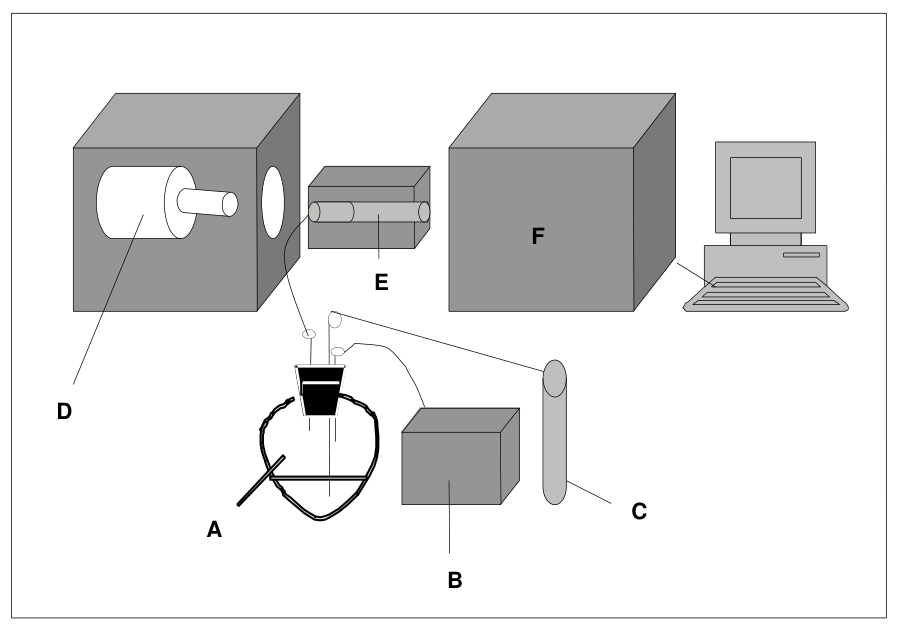
The apparatus consisted of a nitrogen source, a peristaltic pump, a sodium borohydride container, a mercury-vapour generation flask (reaction vessel), an absorption tube and a GBC900 atomic absorption spectrophotometer (Victoria, Australia) (Figure 1). A peristaltic pump was used to inject a single burst of NaBH4 into the reaction vessel at a flow rate of 15 mL/min. Nitrogen gas was used as a carrier to transport the mercury vapour to the atomic absorption tube.
该装置由氮气源、蠕动泵、硼氢化钠容器、汞蒸气发生瓶(反应容器)、吸收管和GBC900原子吸收分光光度计(Victoria,澳大利亚)组成(图1)。采用蠕动泵以15 mL/min的流速向反应容器中一次性注入NaBH4。以氮气为载气,将汞蒸气输送至原子吸收管。
The reaction vessel was a 75 mL pear-shaped glass flask mounted on a chassis. A Teflon bung with three inserted glass tubes sealed the vessel. Of the tubes, the first injected sodium borohydride, the second tube carried a continuous flow of lowpressure nitrogen gas into the sample. The last tube connected the reaction vessel to the absorption tube. The absorption tube was a silica tube with an input tube at one end and an exit at the other. The tube was located at the path of the GBC 900 AAS. An ICI mercury hollow cathode lamp operating at a wavelength of 253.7 nm and a lamp current of 3 mA emitted light according to the spectral line for Hg.
反应容器为安装在支架上的75 mL梨形玻璃烧瓶,以插有三根玻璃管的Teflon塞密封。其中,第一根管用于注入硼氢化钠,第二根管向样品中连续通入低压氮气,最后一根管将反应容器与吸收管相连。吸收管为一端设有进气管、另一端设有出口的石英管,位于GBC 900 AAS的光路上。采用ICI汞空心阴极灯,工作波长253.7 nm,灯电流3 mA,发射对应Hg谱线的光。
The GBC 900 instrument was set in the flame mode and quantification of mercury concentration was achieved by recording the peak height of the Hg signal over a period of 30 seconds. Interference by non-atomic absorption was minimised by a background correction system that measures absorbance from a broad-band output deuterium lamp (D2).
GBC 900仪器设置为火焰模式,通过记录30秒内Hg信号的峰高对汞浓度进行定量。采用测量宽带输出氘灯(D2)吸光度的背景校正系统,将非原子吸收干扰降至最低。
Mercury-rich plant samples富汞植物样品
Mercury-rich plant samples were obtained in the field. A plot with a dimension of 5 x 5 m was established on sulfide-rich tailings of the abandoned Tui base-metal mine, Te Aroha, NZ. The total Hg content of the substrate was 2.82 ± 0.31 mg/kg (Moreno et al., 2004). Seeding of the plot with B.juncea occurred after the substrate was fertilised with 5 g/L of Osmocote® (slow release fertiliser) at a rate recommended by the manufacturer. The pH was adjusted to 5.5 by the addition of lime. Organic matter in the form of compost was also added at 3.2 L/m2. Six weeks after seed germination, the plot was treated with sodium cyanide (NaCN) at 0.2 g/kg of substrate to induce Hg accumulation into shoot tissues. The plant biomass was harvested one month after treatment.
富汞植物样品采自野外。在新西兰Te Aroha废弃的Tui贱金属矿富硫化物尾矿上设置了一个5 x 5 m的样地。基质总Hg含量为2.82 ± 0.31 mg/kg(Moreno et al., 2004)。按照生产商推荐用量向基质施用5 g/L的Osmocote®(缓释肥)后,在样地中播种B.juncea。通过添加石灰将pH调至5.5,并以3.2 L/m2的用量添加堆肥形式的有机质。种子萌发6周后,以0.2 g/kg基质的用量对样地施用氰化钠(NaCN),以诱导Hg向地上部组织积累。处理1个月后收获植物生物量。
Extraction procedure提取方法
The ammonium thiosulphate extraction method was used to extract Hg bound to the solid-phase of a talings reference substrate (Moreno et al., 2004). One gram samples of substrate were weighed into 50 mL polypropylene centrifuge tubes in triplicate. After the addition of the (NH4)2S2O3 solution (20 mL at 2 g/L), the tubes were rotated in a shaker overnight at 45 rotations per minute (RPM) and the supernatant separated via centrifugation at 3000 RPM for three minutes.
采用硫代硫酸铵提取法提取尾矿参考基质固相结合态Hg(Moreno et al., 2004)。称取1 g基质样品置于50 mL聚丙烯离心管中,设3个重复。加入(NH4)2S2O3溶液(20 mL,2 g/L)后,将离心管置于振荡器中以45转/分钟(RPM)旋转过夜,然后以3000 RPM离心3分钟分离上清液。
Plant digestion植物消解
Harvested shoot tissues were washed in tap water and placed in a drying oven at 70 oC until a constant weight was obtained. After grinding, subsamples (0.5 g) were accurately weighed into 50 mL plastic pots before 15 mL of HNO3 was added. The plant samples were left overnight then heated in a water bath at 80 oC for 1 h. Subsequently, the digest solutions were transferred to 10 mL polythene tubes and diluted with RO water to make a final volume of 10 mL.
收获的地上部组织用自来水洗净,置于70 oC烘箱中烘干至恒重。粉碎后,准确称取0.5 g子样品置于50 mL塑料杯中,加入15 mL HNO3。植物样品静置过夜后,在80 oC水浴中加热1 h。随后将消解液转移至10 mL聚乙烯管中,用RO水定容至10 mL。
Substrate digestion基质消解
Total Hg from tailings reference substrate was measured using aqua regia digestion. For this purpose, one-gram substrate-samples were weighed into 50 mL polypropylene pots in triplicate and a 15 mL solution of HNO3 and HCl at 1:3 ratio was added. The samples were digested in a water bath at 80oC for 1 h and the filtrates diluted to a final volume of 50 mL by adding RO water.
尾矿参考基质中的总Hg采用王水消解法测定。为此,称取1 g基质样品置于50 mL聚丙烯杯中,设3个重复,加入15 mL体积比为1:3的HNO3和HCl混合溶液。样品在80oC水浴中消解1 h,滤液用RO水定容至50 mL。
Accuracy of the method方法准确度
The accuracy of the proposed method was assessed through Hg analysis of: 1) deionized water samples spiked with either HgNO3 or HgCl2 solutions to give a final Hg concentration of 125, 250, 500 and 1000 ng/mL and; 2) B.juncea plant digests spiked with HgNO3 solution to give a final Hg concentration of 500 ng/mL.
通过对以下样品进行Hg分析评价所建方法的准确度:1)加标HgNO3或HgCl2溶液、最终Hg浓度为125、250、500和1000 ng/mL的去离子水样品;2)加标HgNO3溶液、最终Hg浓度为500 ng/mL的B.juncea植物消解液。
Quality control assessment质量控制评价
The quality assessment of the hydride generation method was obtained by: 1) analysis of a tailings reference material obtained from the Department of Mining and Mineral Process Engineering (UBC, Vancouver, Canada) with a known concentration of 100 mg of Hg /kg of substrate; 2) ICP-MS analysis of total mercury concentrations in Hg-spiked solutions and Hg-rich plant samples by a external certified laboratory (Hill Laboratories, Hamilton, NZ).
氢化物发生法的质量评价通过以下方式进行:1)分析由Department of Mining and Mineral Process Engineering(UBC,温哥华,加拿大)提供的已知浓度为100 mg Hg/kg基质的尾矿参考物质;2)由外部认证实验室(Hill Laboratories,汉密尔顿,新西兰)采用ICP-MS分析加标溶液和富汞植物样品中的总汞浓度。
Statistical analysis统计分析
A copy of SAS PC version 8e was used for statistical analyses (SAS Inst, 1988). The t-test was used to compare two treatment means assuming equality of variances. Simple linear and polynomial regression models were used to interpret the relationships between the two variables. The significance of the fitted regression was assessed through the ANOVA and the coefficient of determination (r2).
采用SAS PC 8e版进行统计分析(SAS Inst, 1988)。在假设方差齐性的条件下,采用t检验比较两个处理的均值。采用简单线性回归和多项式回归模型解释两个变量之间的关系,并通过ANOVA和决定系数(r2)评价拟合回归的显著性。
4RESULTS AND DISCUSSION结果与讨论
Formation of Hg0Hg0的生成
There are several methods for hydride generation and collection and all have the following features in common: 1) a strong reducing agent to generate the hydride; 2) a heating device that decomposes the hydride, and 3) an atomic absorption measuring device which quantifies the amount of hydride produced (Robinson, 1994). Elemental Hg (Hg0) can be generated by reaction of Hg2+with NaBH4 according to the following equation:
氢化物的发生与收集方法有多种,但均具有以下共同特征:1)用于生成氢化物的强还原剂;2)分解氢化物的加热装置;3)对所生成氢化物进行定量的原子吸收测量装置(Robinson, 1994)。单质Hg(Hg0)可由Hg2+与NaBH4按下式反应生成:

System Calibration系统校准
The hydride generation system utilised a flow rate of 280 to 320 mL/min for nitrogen and 15 mL/min for NaBH4. Under these conditions, linear calibration curves were obtained over the range of 125 to 1000 ng/mL of Hg (Fig. 2).
氢化物发生系统的氮气流速为280~320 mL/min,NaBH4流速为15 mL/min。在此条件下,Hg在125~1000 ng/mL范围内获得了线性校准曲线(图2)。
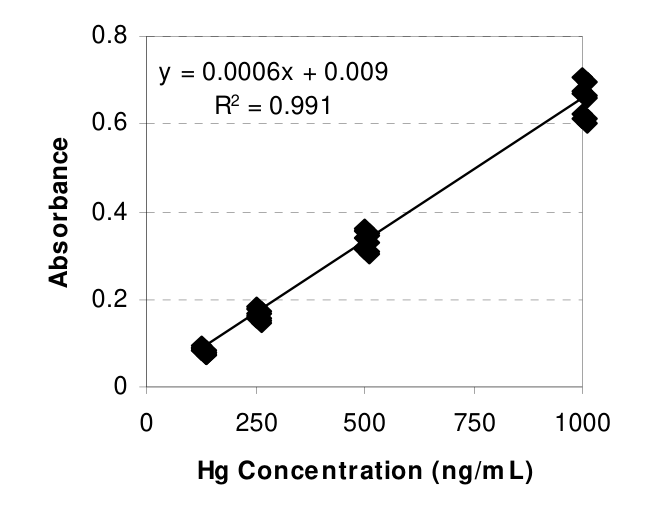
The limit of detection (LOD) for mercury was calculated using the general definition proposed by Harris (1986). The LOD should correspond to the concentration of an element necessary to yield a net signal equal to two times the standard deviation of 10 blank measurements. For the Hg hydride generation method in this study the LOD found was 11.4 ng/mL. The reproducibility of the mercury signals (in terms of relative standard deviation) was 4.6%. This was determined by analysing 10 standards containing 1 mg/L of Hg.
汞的检出限(LOD)采用Harris(1986)提出的通用定义计算,即LOD对应于产生等于10次空白测定标准偏差2倍的净信号所需的元素浓度。本研究中Hg氢化物发生法的LOD为11.4 ng/mL。汞信号的重现性(以相对标准偏差计)为4.6%,该值通过分析10个含1 mg/L Hg的标准溶液测得。
Accuracy准确度
The accuracy of the hydride-generation method for the analysis of water samples was investigated by spiking deionized water with two mercury species (HgCl2 and HNO3) at four different concentrations (125, 250, 500 and 1000 ng/mL). Table 1 showed that the recovery values for total mercury ranged from 88.5 to 94.3% for both Hg species added.
通过在去离子水中加入两种汞形态(HgCl2和HNO3),设4个浓度(125、250、500和1000 ng/mL),考察氢化物发生法分析水样的准确度。表1表明,两种加入Hg形态的总汞回收率为88.5%~94.3%。
| Hg FormHg形态 | Hg added (ng/mL)Hg加入量(ng/mL) | Hg found (ng/mL)Hg测得量(ng/mL) | Recovery %回收率 % |
|---|---|---|---|
| 125 | 116 | 92.8 | |
| HgCl2 | 250 | 224 | 89.6 |
| 500 | 460 | 92.1 | |
| 1000 | 900 | 90.0 | |
| 125 | 110 | 88.5 | |
| HgNO3 | 250 | 224 | 89.7 |
| 500 | 452 | 90.4 | |
| 1000 | 943 | 94.3 |
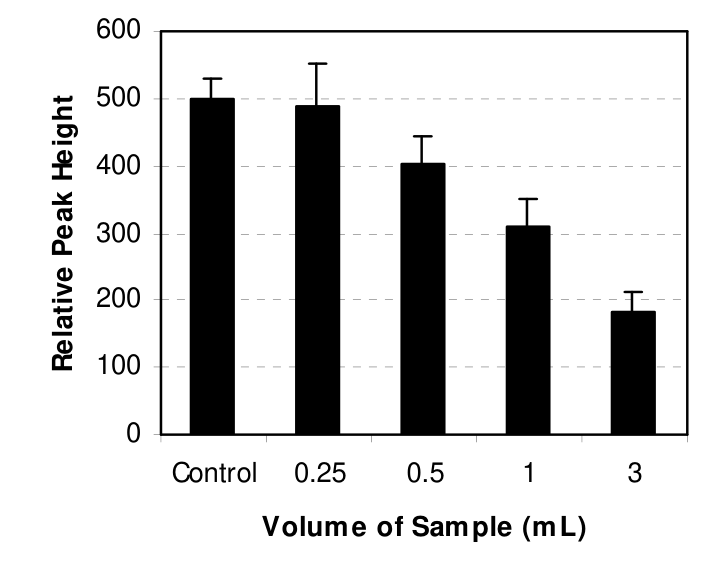
Analysis of plant sample digests spiked with Hg at 500 ng/mL were also examined for accuracy at different sample volumes added to the reaction vessel. This was performed because Hg determination by cold vapour methods could present errors if oxides of nitrogen, incompletely oxidized organic vapours, or smoke, having absorption lines at 253.7 nm, were present in the liquid matrix (Mitra, 1986). In the presence of such substances, a significant fraction of light emitted from the hollow cathode lamp is scattered and the absorbance can be substantially reduced. Figure 3 shows a strong negative correlation between the volume of the sample added to the reaction vessel and the relative peak heights for Hg in the AAS (r2 = 0.99, p < 0.0001). For instance, at 0.25 mL of sample volume, the relative peak for Hg was not significantly different from the control (488 ± 67 and 500 ± 29, respectively, p > 0.05). However, as the volume increased from 0.5 to 3 mL, the relative peak height for Hg in plant tissue sharply reduced from 403 ± 38 to 182 ± 31).
还考察了加入反应容器的样品体积不同时,加标500 ng/mL Hg的植物样品消解液分析的准确度。这是因为,若液体基质中存在在253.7 nm处有吸收线的氮氧化物、未完全氧化的有机蒸气或烟雾,冷蒸气法测定Hg可能产生误差(Mitra, 1986)。在此类物质存在时,空心阴极灯发射的光有相当一部分被散射,吸光度可能显著降低。图3表明,加入反应容器的样品体积与AAS中Hg的相对峰高之间呈强负相关(r2 = 0.99,p < 0.0001)。例如,样品体积为0.25 mL时,Hg的相对峰与对照无显著差异(分别为488 ± 67和500 ± 29,p > 0.05)。然而,当体积由0.5 mL增至3 mL时,植物组织中Hg的相对峰高由403 ± 38急剧降至182 ± 31。
Quality control assessment质量控制评价
The hydride generation method was validated by the analysis of total mercury concentrations in a reference tailings substrate, in Hg-spiked solutions and Hg-rich plant samples. The samples were analysed in triplicate and the results were compared with the total Hg analysis performed by an external certified laboratory.
通过分析参考尾矿基质、加标溶液和富汞植物样品中的总汞浓度,对氢化物发生法进行了验证。样品均设3个重复进行分析,并将结果与外部认证实验室的总Hg分析结果进行比较。
generation method and ICP-MS analysis for the total Hg contents in spiked solutions and Hg-rich plant samples is shown in Table 2.
发生法与ICP-MS分析对加标溶液和富汞植物样品总Hg含量的比较见表2。
Total Hg concentrations determined in solutions using the hydride generation AAS method were in good agreement with the Hg values found by the certified laboratory. Mercury recoveries ranged between 88 to 103%. Table 2 showed that Hg concentration found in the Hg-rich biomass agreed reasonably well with the Hg concentration detected by the ICP-MS method. Analysis by the hydride generation method reported 84 % of the Hg reported by analysis using ICP-MS. This difference was shown to be statistically significant (t-test, p = 0.0069).
采用氢化物发生AAS法测得的溶液总Hg浓度与认证实验室的测定值吻合良好,汞回收率为88%~103%。表2表明,富汞生物量中测得的Hg浓度与ICP-MS法检测的Hg浓度较为一致。氢化物发生法测得的Hg为ICP-MS分析结果的84 %,该差异具有统计学显著性(t检验,p = 0.0069)。
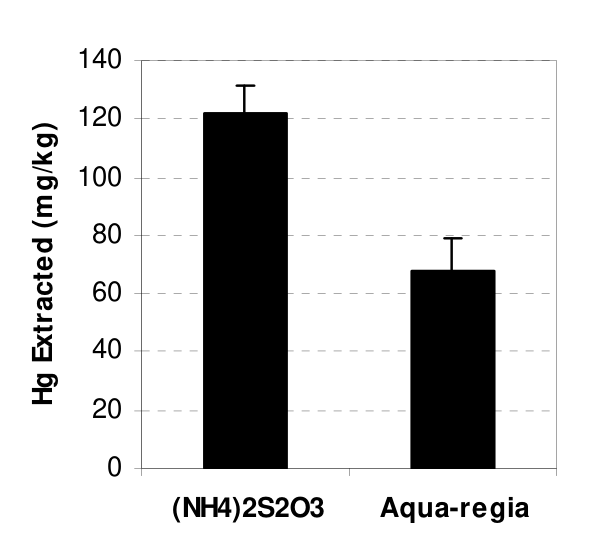
Figure 4 - Comparison between Aqua regia and (NH4)2S2O3 to extract Hg from a tailings reference substrate containing 100 mg/kg of Hg. Bars denote ± 1 standard deviation from the mean of three replicates.图4 - Aqua regia与(NH4)2S2O3从含100 mg/kg Hg的尾矿参考基质中提取Hg的比较。误差线表示3个重复均值的± 1个标准偏差。
| Method方法 | Hg added (ng/mL)Hg加入量(ng/mL) | Hg Found (ng/mL)Hg测得量(ng/mL) | Plant samplesa(mg/kg)b 植物样品a(mg/kg)b |
|---|---|---|---|
| 125 | 110 | ||
| Hydride | 250 | 224 | 4.95±0.29c |
| 500 | 452 | ||
| 1000 | 943 | ||
| 125 | 107 | ||
| ICP-MS | 250 | 248 | 5.87±0.10 |
| 500 | 474 | ||
| 1000 | 1060 |
aMean and standard deviation of three replicates. bConcentration values for dry weight plant samples. cValue achieved at 0.25 mL of sample volume added to the reaction vessel.
a3个重复的均值和标准偏差。b植物样品干重浓度值。c加入反应容器的样品体积为0.25 mL时获得的值。
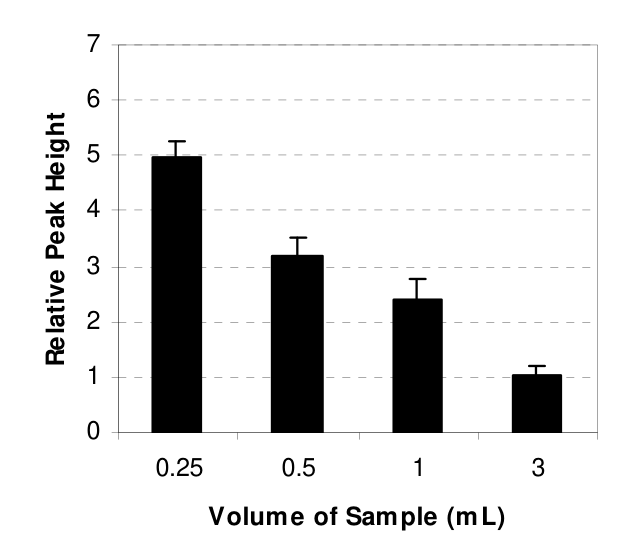
Figure 5 shows the relative peak heights for the Hg concentration in the Hg-rich biomass of B.juncea as a function of the volume of sample added to the reaction vessel. On average, the relative peak height Hg decreased significantly from 4.95 ± 0.29 to 1.02 ± 0.17 as the sample volume increased from 0.25 to 3 mL (r2= 0.979, p = 0.0002). As demonstrated previously, the presence of oxidized plant tissues in the liquid matrix significantly interfered with the analytical response of the hydride-generation method.图5显示了B.juncea富汞生物量中Hg浓度的相对峰高随加入反应容器样品体积的变化。平均而言,当样品体积由0.25 mL增至3 mL时,Hg的相对峰高由4.95 ± 0.29显著降至1.02 ± 0.17(r2= 0.979,p = 0.0002)。如前所述,液体基质中氧化植物组织的存在显著干扰了氢化物发生法的分析响应。
In conclusion, the hydride generation method has been proven to be accurate for the determination of Hg in an acid matrix of soil and plant samples with a limit of detection as low as 11.4 ng/mL. In the presence of oxidised plant tissues in the liquid matrix, however, analytical precision of the equipment decreased significantly as the volume of the sample added to the reaction vessel increased. In order to improve the analytical precision of the equipment for Hg analysis in plant samples, not more than 0.25 mL volume of this sample type should be added to the reaction vessel. Because Hg determination was done on plant samples with high Hg content, detection of Hg could be achieved at 0.25 mL of sample volume. However, for plant samples with low Hg content, the Hg signal could be within the limit of detection of the machine. Concentrating the Hg mass in the liquid matrix (increasing the amount of plant tissue to be digested or reducing the dilution factor of the sample) could solve this problem.
综上所述,氢化物发生法已被证明可准确测定土壤和植物样品酸性基质中的Hg,检出限低至11.4 ng/mL。然而,当液体基质中存在氧化植物组织时,随着加入反应容器的样品体积增加,仪器的分析精密度显著下降。为提高仪器分析植物样品中Hg的精密度,此类样品加入反应容器的体积不应超过0.25 mL。由于所测植物样品的Hg含量较高,在0.25 mL样品体积下即可检出Hg。但对于Hg含量较低的植物样品,Hg信号可能处于仪器的检出限范围内。浓缩液体基质中的Hg量(增加消解的植物组织量或降低样品稀释倍数)可解决这一问题。
5ACKNOWLEDGEMENTS致谢
We are thankful to the National Council for Scientific and Technological Development (CNPq/Brazil) for providing a post-doctoral scholarship to the first author.
感谢巴西国家科学技术发展委员会(CNPq/Brazil)为第一作者提供博士后奖学金。
6RESUMO葡文摘要
Um protocolo para análise do mercúrio (Hg) em amostras líquidas de solo e tecidos vegetais enriquecidos com Hg foi desenvolvido com base na técnica de geração de hidretos. O limite de detecção para este método foi de 11.4 ng/mL. A reproducibilidade do método (calculado com base no desvio padrão relativo) foi de 4.6%. A precisão do método foi verificada pela análise de amostras de água deionizada contendo HgCl2 and HgNO3. Os valores de mercúrio total recuperados variaram de 88.5 a 94.3% para ambas as espécies testadas. O método analítico foi validado por um laboratório externo certificado com discrepância máxima de 15 %. O desempenho analítico do equipamento para análise do mercúrio em tecidos vegetais foi considerado ótimo para volumes de amostra de até 0.25 mL.
基于氢化物发生技术,建立了一种分析富汞土壤和植物组织液体样品中汞(Hg)的方法。该方法的检出限为11.4 ng/mL。方法的重现性(以相对标准偏差计)为4.6%。通过分析含HgCl2和HgNO3的去离子水样品验证了方法的准确度,两种受试形态的总汞回收率为88.5%~94.3%。外部认证实验室对该分析方法进行了验证,最大偏差为15 %。当样品体积不超过0.25 mL时,仪器对植物组织中汞的分析性能最佳。
7REFERENCES参考文献
Atkins, P. and Jones, L. (1997), Chemistry, 3rd Ed. W.H.Freeman and Company, USA, 886 pp.
Brooks, R. R. Ed. (1998), Plants that Hyperaccumulate Heavy Metals, CAB International, Cambridge, United Kingdom.
Cursino, L., Mattos, S. V. M., Silva, N. O., Chartone- Souza, E., and Nascimento, A. M. A. (2003) Measurement of volatilised mercury by a minisystem: a simple, reliable and reproducible technique. Brazilian Arch. Biol. Technol. 46 (4):731-734
Glass, D. J. (1999), Current market trends in Phytoremediation. Int. J. Phytoremediation 1(1),1-8. Harris, D.C. (1986), Quantitative Chemical Analysis. W.H. Freeman and Company, USA.
Lacerda, L. D. (2003), Updating global Hg emissions from small-scale gold mining and assessing its environmental impacts. Environ. Geol. 43 (3), 308- 314.
Meagher, R. B., Rugh, C. L., Kandasamy, M. K., Gragson, G. and Wang, N. J. (2000), Engineering phytoremediation of mercury pollution in soil and water using bacterial genes. In- Phytoremediation of Contaminated Soil and Water. Ed. N. Terry and G. Bañuelos, Eds. Lewis Publisher, USA, pp 201-219.
Moreno, F. N. (2005), Phytoremediation of mercury-contaminated mine wastes. PhD Thesis, Massey University, Palmerston North, New Zealand.
Moreno, F. N., Anderson, C. W. N., Robinson, B.H. and Stewart, R.B. (2004), Phytoremediation of mercury-contaminated mine tailings by induced
plant-Hg accumulation. Environ. Practice 6 (2),165- 175.
Moreno, F. N., Anderson, C. W. N., Stewart, R. B. Robinson, B. H., Ghomshei, M. and Meech, J. A. (2005), Induced plant uptake and transport of mercury in the presence of sulphur-containing ligands and humic acid. New Phytol. 166, 445-454.
Mitra, S. (1986), Mercury in the Ecossystem. TransTech Publications, USA.
Oda, C. E. and Ingle, Jr., J. D. (1981), Speciation of mercury by cold vapor atomic absorption spectrometry with selective reduction. Anal. Chem. 53 (14), 2305-2309.
Robinson, B. H. (1994), Pollution of the Aquatic Biosphere by Arsenic Elements in the Taupo Volcanic Zone, Master Thesis, Massey University, New Zealand.
Veiga, M. M. and Hinton, J. J. (2002), Abandoned artisanal gold mines in the Brazilian Amazon: a legacy of mercury pollution. Nat. Res. Forum 26, 15- 26.
Veiga, M. M. (2004), Mercury pollution: revealing sources and suggesting solutions. Environ. Practice 6 (2), 97-98.
Wilkinson, G., Gillard, R. D. and McCleverty, J. A., eds. (1987), Comprehensive Coordination Chemistry, Vol. 2. Pergamon Press, UK.
Received: March 14, 2007; Revised: March 20, 2008; Accepted: December 23, 2008.