REGULAR ARTICLE
Martin Tschan & Brett Robinson &
C. Annette Johnson & Annina Bürgi & Rainer Schulin
Received: 23 November 2009 /Accepted: 31 March 2010 /Published online: 16 April 2010 # Springer Science+Business Media B.V. 2010
Abstract Using pot experiments, we investigated the uptake of antimony (Sb) by sunflower (Helianthus annuus L. cv. Iregi), and maize (Zea mays L. cv. Magister) in two different soils, a potting mix and an agricultural soil. In one treatment Sb was added to the experimental soils as KSb(OH)6 (“SbV-treatment”) and in the other as Sb2O3 (“SbIII-treatment”). Soluble soil Sb concentrations were linearly related to the applied Sb rates, ranging from 0.02 (controls) to 175 mg L−1 soil solution. Accumulation of Sb tended to be slightly higher in the SbV treatment in sunflower, while no difference in Sb uptake between the two Sb treatments was found in maize. The half maximal effective concentration (EC50) values derived from the dose-response curves were higher for the SbV than for the SbIII treatment when they were related to soluble soil Sb concentrations, but differences became insignificant when they were related to shoot Sb concentrations. Maize was substantially more sensitive to Sb toxicity than sunflower, indicating physiological differences in Sb tolerance between the two plant species. Our results show that on soils with high Sb contamination, as often found in shooting ranges, plants may suffer from Sb toxicity.
摘要 本研究通过盆栽试验,考察了向日葵(Helianthus annuus L. cv. Iregi)和玉米(Zea mays L. cv. Magister)在两种不同土壤(盆栽基质和农业土壤)中对锑(Sb)的吸收。一个处理以KSb(OH)6形式向供试土壤添加Sb(“SbV处理”),另一个处理以Sb2O3形式添加(“SbIII处理”)。土壤可溶性Sb浓度与Sb施加量呈线性关系,范围为0.02(对照)至175 mg L−1土壤溶液。向日葵在SbV处理中的Sb累积量略高,而玉米在两种Sb处理间的Sb吸收无差异。当以土壤可溶性Sb浓度表示时,由剂量–效应曲线得出的半数最大效应浓度(EC50)在SbV处理中高于SbIII处理;但当以地上部Sb浓度表示时,两者差异不显著。玉米对Sb毒性的敏感性明显高于向日葵,表明两种植物在Sb耐受性方面存在生理差异。研究结果表明,在Sb污染严重的土壤上(如射击场中常见的情况),植物可能遭受Sb毒害。
Keywords Antimony uptake . Antimony speciation . Sunflower. Maize . Soil contamination
关键词 锑吸收 · 锑形态 · 向日葵 · 玉米 · 土壤污染
1Introduction引言
Responsible Editor: Fangjie Zhao.
M. Tschan (*) : A. Bürgi : R. Schulin Eidgenössische Technische Hochschule (ETH) Zurich, Institute of Terrestrial Ecosystems ITES, Universitaetstrasse 16, CH-8092 Zurich, Switzerland e-mail: martin.tschan@alumni.ethz.ch
B. Robinson Agricultural and Life Sciences Division, Lincoln University, PO Box 84, Canterbury, New Zealand
B. Robinson 林肯大学农业与生命科学学部,PO Box 84,坎特伯雷,新西兰
C. A. Johnson Swiss Federal Institute for Environmental Science and Technology (EAWAG), CH-8600 Dübendorf, Switzerland
C. A. Johnson 瑞士联邦环境科学与技术研究所(EAWAG),CH-8600 Dübendorf,瑞士
The concentration of antimony (Sb) in soils is generally below 10 mg kg−1, with most soils having <1 mg kg−1 Sb (Johnson et al. 2005; Kabata-Pendias and Pendias 1984). Higher concentrations of Sb in soil are usually a result of human activities. Due to its many industrial uses, e.g. in fire retardants, semiconductors, and as an agent for metal hardening, Sb is released into the environment in increasing amounts (Filella et al. 2002). High soil Sb concentrations are often found in areas affected by Sb-mining activities (210 to 360 mg kg−1 in Ainsworth et al. 1990; 192 to 15,112 mg kg−1 in Baroni et al. 2000; 31 to 5,986 mg kg−1 in Pratas et al. 2005), along roadsides (1.2 to 8.7 mg kg−1 in Amereih et al. 2005) and particularly in shooting ranges (Johnson et al. 2005). The latter is due to the fact that
土壤中锑(Sb)的浓度一般低于10 mg kg−1,大多数土壤的Sb含量 <1 mg kg−1(Johnson et al. 2005; Kabata-Pendias and Pendias 1984)。土壤中较高的Sb浓度通常源于人类活动。由于Sb具有多种工业用途,例如用于阻燃剂、半导体以及作为金属硬化剂,其向环境中的释放量日益增加(Filella et al. 2002)。在受锑矿开采活动影响的地区(Ainsworth et al. 1990报道为210~360 mg kg−1;Baroni et al. 2000报道为192~15,112 mg kg−1;Pratas et al. 2005报道为31~5,986 mg kg−1)、道路两侧(Amereih et al. 2005报道为1.2~8.7 mg kg−1),尤其是射击场(Johnson et al. 2005),常可发现较高的土壤Sb浓度。后者是由于
Sb is used to harden lead bullets, making up 1–7% of their weight (Rooney et al. 1999). Soil contamination by Sb in shooting ranges is an important environmental problem in Switzerland, where more than 2,000 shooting ranges are scattered over the country (total area of only 41‚000 km2). Concentrations of up to 2,400 mg kg−1 have been found in stop butt soils (Gresch and Wettstein 2002).
Sb被用于硬化铅弹,占弹头质量的1%~7%(Rooney et al. 1999)。射击场土壤Sb污染是瑞士的一个重要环境问题,该国面积仅41,000 km2,却分布着2,000多个射击场。在挡弹墙土壤中已检出高达2,400 mg kg−1的Sb浓度(Gresch and Wettstein 2002)。
While lead (Pb) is the main contaminant in shooting range soils on a mass basis, soil contamination by Sb may be of greater concern, given that Sb is much more soluble than Pb in the near-neutral pH range characteristic of many Swiss soils (Blaser et al. 2008) and that the toxicity of Sb to humans and animals is considered comparable to its sister element arsenic (Belzile et al. 2001; Bowen 1979). Similar to As, inorganic forms of Sb are generally more toxic than organic Sb compounds (Gebel 1997). Likewise, Sb toxicity also depends on its oxidation state, with SbIII being much more toxic than SbV (Gurnani et al. 1994). In mammal cells SbIII compounds were found to be ten times more toxic than SbV compounds (Krachler et al. 2001).
尽管按质量计,铅(Pb)是射击场土壤中的主要污染物,但土壤Sb污染可能更值得关注:在许多瑞士土壤所特有的近中性pH范围内,Sb的溶解度远高于Pb(Blaser et al. 2008),且Sb对人类和动物的毒性被认为与其同族元素砷相当(Belzile et al. 2001; Bowen 1979)。与As类似,无机态Sb的毒性通常高于有机Sb化合物(Gebel 1997)。同样,Sb的毒性还取决于其氧化态,SbIII的毒性远高于SbV(Gurnani et al. 1994)。在哺乳动物细胞中,SbIII化合物的毒性被发现是SbV化合物的十倍(Krachler et al. 2001)。
In soils Sb is usually present as SbIII and SbV. Antimony entering soil as elemental Sb, for example as part of the lead amalgam of bullets in the case of shooting range soils, is rapidly oxidized to SbIII and SbV, depending on soil pH and redox conditions (Johnson et al. 2005). Trivalent antimony is present in soil solution as antimonite, i.e. as the neutral species Sb (OH)3 between pH 2.5 and pH 10.8, the soil pH range relevant under normal environmental conditions (Baes and Mesmer 1986). Apart from the oxidation of elemental Sb entering soil in the form of metal alloys, SbIII in soil can originate from flame retardants, which contain Sb2O3, or by reduction of SbV. Pentavalent antimony occurs in soil solution as antimonate, i.e. as the oxyanion Sb(OH)6- between pH 2.7 and pH 14 (Baes and Mesmer 1986). Iron plays an important role in the redox chemistry of Sb. In alkaline conditions FeII can reduce SbV, while in acidic to neutral conditions the oxidation of FeII with oxygen can produce intermediate products that oxidise SbIII to SbV (Leuz 2002; Leuz et al. 2006a). The oxidation of SbIII is also catalyzed when sorbed to amorphous Fe- and Mnoxyhydroxides, for which SbIII has a strong affinity (Belzile et al. 2001; Blay 2000; Leuz et al. 2006b). Oorts et al. (2008) found that more than 70% of the Sb added in solution as dissolved antimony trioxide to a soil was oxidized to antimonate within 2 days.
土壤中的Sb通常以SbIII和SbV形式存在。以单质Sb形式进入土壤的锑(例如在射击场土壤中作为弹头铅合金的组成部分),会根据土壤pH和氧化还原条件迅速被氧化为SbIII和SbV(Johnson et al. 2005)。三价锑在土壤溶液中以亚锑酸盐形式存在,即在pH 2.5至pH 10.8之间(正常环境条件下相关的土壤pH范围)以中性物种Sb(OH)3存在(Baes and Mesmer 1986)。除了以金属合金形式进入土壤的单质Sb的氧化外,土壤中的SbIII还可来源于含Sb2O3的阻燃剂,或来自SbV的还原。五价锑在土壤溶液中以锑酸盐形式存在,即在pH 2.7至pH 14之间以含氧阴离子Sb(OH)6-存在(Baes and Mesmer 1986)。铁在Sb的氧化还原化学中起着重要作用。在碱性条件下,FeII可还原SbV;而在酸性至中性条件下,FeII被氧气氧化可产生中间产物,将SbIII氧化为SbV(Leuz 2002; Leuz et al. 2006a)。当SbIII吸附于无定形Fe、Mn羟基氧化物上时(SbIII对其具有很强的亲和力),其氧化也会受到催化(Belzile et al. 2001; Blay 2000; Leuz et al. 2006b)。Oorts et al.(2008)发现,以溶解态三氧化二锑形式加入土壤溶液中的Sb,有70%以上在2天内被氧化为锑酸盐。
The neutral molecule Sb(OH)3 was found to be taken up by bacteria (Escherichia coli), yeast (Saccharomyces cerevisiae) and protozoa (Leishmania major and Leishmania tarentolae) through aquaglyceroporins. Thus, it is likely that aquaglyceroporins can also mediate the uptake of Sb(OH)3 by plants. Conversely, although the mechanisms of SbV uptake by plants are unclear (Filella et al. 2007), it is unlikely that antimonate can pass through aquaporins, because of its negative charge. Furthermore, the observation by Tschan et al. (2008) that phosphate did not affect antimonate uptake by sunflower and maize in hydroponic experiments indicates that antimonate is not taken up by plants via phosphate transporters like arsenate (Asher and Reay 1979; Gulz et al. 2005; Woolson et al. 1973). Tschan et al. (2009a) found that antimonate is accumulated by plants approximately in proportion to soil soluble Sb over a concentrations range of several orders of magnitude, suggesting that antimonate uptake is dominated by a non-selective pathway, possibly an apoplastic bypass of the endodermis barrier separating the outer parts of a plant root from the central root cylinder with the vascular bundles. This latter pathway would also be available for antimonite.
研究发现,中性分子Sb(OH)3可通过水甘油通道蛋白被细菌(大肠杆菌Escherichia coli)、酵母(酿酒酵母Saccharomyces cerevisiae)和原生动物(Leishmania major和Leishmania tarentolae)吸收。因此,水甘油通道蛋白很可能也介导植物对Sb(OH)3的吸收。相反,尽管植物吸收SbV的机制尚不清楚(Filella et al. 2007),但由于锑酸盐带负电荷,其不太可能通过水通道蛋白。此外,Tschan et al.(2008)在水培试验中观察到磷酸盐并不影响向日葵和玉米对锑酸盐的吸收,这表明锑酸盐并不像砷酸盐那样经由磷酸盐转运蛋白被植物吸收(Asher and Reay 1979; Gulz et al. 2005; Woolson et al. 1973)。Tschan et al.(2009a)发现,在跨越数个数量级的浓度范围内,植物对锑酸盐的累积量与土壤可溶性Sb大致成正比,表明锑酸盐的吸收以非选择性途径为主,可能是绕过内皮层屏障的质外体旁路途径——内皮层屏障将植物根系外部与含有维管束的中央根柱分隔开来。后一途径对亚锑酸盐同样适用。
Given the likelihood that Sb is taken up by plants from soil solution both as antimonate and also as antimonite, the influence of oxidation state on uptake rate and phytotoxicity needs further examination. Considering that even under oxidizing conditions substantial fractions of soil Sb may be present as SbIII (Belzile et al. 2001), this question is particularly relevant for Sbcontaminated shooting range soils, where bullet weathering and oxidation of Sb(0) first lead to SbIII before it is further converted to SbV. Thus, the objective of this study was to investigate how the form in which Sb was added to soil would affect its uptake by plants and its phytotoxicity. For this purpose we performed pot experiments in which two crop plant species, maize and sunflower, were grown on two different soil substrates, an agricultural topsoil and a commercial potting mix, to which Sb was added either as antimonite or as antimonate at various concentrations.
鉴于植物很可能以锑酸盐和亚锑酸盐两种形式从土壤溶液中吸收Sb,氧化态对吸收速率和植物毒性的影响有待进一步研究。考虑到即使在氧化条件下,土壤Sb中仍可能有相当比例以SbIII形式存在(Belzile et al. 2001),这一问题对于Sb污染的射击场土壤尤为重要,因为在此类土壤中,弹头风化和Sb(0)氧化首先生成SbIII,随后才进一步转化为SbV。因此,本研究旨在探讨Sb加入土壤的形态如何影响其植物吸收及植物毒性。为此,我们开展了盆栽试验,将玉米和向日葵两种作物种植于两种不同的土壤基质(农业表土和商品盆栽基质)中,并以不同浓度向其中添加亚锑酸盐或锑酸盐形式的Sb。
2Material and methods材料与方法
Sunflower (Helianthus annuus L. cv. Iregi) and maize (Zea mays L. cv. Magister) in 250-mL pots were grown in a climate chamber (photoperiod 16 h, day/night temperature 22/14°C, light intensity 11,000 lux). Two soils were used: a standard potting mix (obtained from Migros Co-operative, Zürich), consisting of garden soil enriched with compost (organic carbon content: 229± 27 g kg−1, pH in CaCl2 extract: 7.0±0.1) and soil from the plough layer of an agricultural field at Birr (Canton Aargau) on the Swiss plateau (organic carbon content: 15±1.4 gkg−1, pH in CaCl2 extract: 6.6±0.1). Either antimonite (“SbIII treatment”) or antimonate (“SbV treatment”) was added by mixing granular Sb2O3 or KSb(OH)6, respectively, with the sieved and dried soil substrates. Apart from the control (no Sb added), the applied total Sb concentration levels were 156, 313, 625, 1,250, 2,500, 5,000, and 10,000 mg kg−1 for the potting mix and 20, 39, 78, 156, 313, 625, 1,250, 2,500, and 5,000 mg kg−1 for the agricultural soil. (Note: In order to avoid confusion, we will never use the term “Sb treatment” to denote the application of specific Sb concentration levels in the following. This term will only be used to refer to the application of Sb in the two different chemical forms of antimonite and antimonate.) In a preliminary experiment we tested for eventual phytotoxic effects of the high amounts of potassium (K) added with the Sb applications to the soil. However, even at a rate of 3,780 mg kg−1K applied either as K2SO4 or KH2PO4 to the soil, we found no negative effect on plant growth.
向日葵(Helianthus annuus L. cv. Iregi)和玉米(Zea mays L. cv. Magister)种植于250 mL花盆中,置于人工气候室内培养(光周期16 h,昼/夜温度22/14°C,光照强度11,000 lux)。试验采用两种土壤:一种为标准盆栽基质(购自苏黎世Migros Co-operative),由添加堆肥的园土组成(有机碳含量:229± 27 g kg−1,CaCl2浸提液pH:7.0±0.1);另一种为采自瑞士高原Birr(Aargau州)一块农田耕作层的土壤(有机碳含量:15±1.4 gkg−1,CaCl2浸提液pH:6.6±0.1)。将颗粒状Sb2O3或KSb(OH)6分别与过筛风干的土壤基质混合,以添加亚锑酸盐(“SbIII处理”)或锑酸盐(“SbV处理”)。除对照(不添加Sb)外,盆栽基质的总Sb施加浓度水平为156、313、625、1,250、2,500、5,000和10,000 mg kg−1,农业土壤为20、39、78、156、313、625、1,250、2,500和5,000 mg kg−1。(注:为避免混淆,下文中“Sb处理”一词绝不用于指施加特定浓度水平的Sb,仅用于指以亚锑酸盐和锑酸盐两种不同化学形态施加Sb。)在预备试验中,我们检验了随Sb施加而添加到土壤中的大量钾(K)是否可能产生植物毒性效应。然而,即使以K2SO4或KH2PO4形式向土壤施加3,780 mg kg−1K,也未发现对植物生长有负面影响。
Regularly watered, the mixtures were left to equilibrate for 2 weeks and then, after taking samples for chemical analysis (one composite sample per batch), filled into the pots. Three replicates were prepared for each concentration. Three seeds of either maize or sunflower were planted in each pot, of which only one was left to grow after a week. Plants were harvested after 4 weeks of growth, separated into roots and shoots, carefully washed with de-ionized water, oven-dried for 48 h at 65°C, weighed and then digested for chemical analysis using aqua regia (Sample weight for digestion was 0.2 g which was digested in 2 ml HNO3, 6 ml HCl, 2 ml H2O2 and 8 ml H2O) in closed Teflon vessels (2 h at room temperature and then for 30 min in a microwave oven (EM-2, Lavis ETHOS, MLS Microwave Laboratory Systems GmbH, Leutkirch i. A., Germany) at 100°C).
混合物定期浇水,平衡2周后,采集化学分析样品(每批一个混合样),然后装入花盆。每个浓度设3个重复。每盆播种3粒玉米或向日葵种子,一周后仅保留1株继续生长。植株生长4周后收获,分为根和地上部,用去离子水仔细清洗,于65°C烘干48 h,称重后在密闭Teflon消解罐中用王水消解进行化学分析(消解样品质量为0.2 g,用2 ml HNO3、6 ml HCl、2 ml H2O2和8 ml H2O消解;先在室温下放置2 h,然后在微波炉(EM-2, Lavis ETHOS, MLS Microwave Laboratory Systems GmbH, Leutkirch i. A., 德国)中于100°C消解30 min)。
Soil samples were oven-dried at 65°C for 1 week, weighed and then stored at 4°C until they were analysed. Soluble soil Sb concentrations relating to soil solution were determined by extraction with potassium nitrate as described by Tschan et al. (2009a): Subsamples of 5 g were mixed with 12.5-mL aliquots of a 0.1 mol L−1 potassium nitrate solution in polypropylene bottles. The bottles were tightly closed and longitudinally shaken for 2 h with a frequency of 120 min−1 and an amplitude of 55 mm (KS 250, Janke & Kunkel IKA Labortechnik GmbH, Staufen i. Br., Germany). The resulting slurries were left for 10 min to settle, before the supernatants were collected using 60-mL single-use syringes and filtered through 45-µm membrane filters. The filtrates were collected in 20-mL volumetric flasks containing 0.8 mL of 65% nitric acid.
土壤样品于65°C烘干1周,称重后在4°C下保存直至分析。按照Tschan et al.(2009a)所述方法,采用硝酸钾浸提测定对应于土壤溶液的土壤可溶性Sb浓度:在聚丙烯瓶中将5 g子样品与12.5 mL 0.1 mol L−1硝酸钾溶液混合。将瓶子密封,以120 min−1的频率和55 mm的振幅纵向振荡2 h(KS 250, Janke & Kunkel IKA Labortechnik GmbH, Staufen i. Br., 德国)。所得泥浆静置10 min沉降后,用60 mL一次性注射器收集上清液,并经45 µm滤膜过滤。滤液收集于预先加入0.8 mL 65%硝酸的20 mL容量瓶中。
The plant and soil extracts from the potting mix experiments were analysed for Sb by means of hydride generation atomic fluorescence spectroscopy (HG-AFS) (10.055 Excalibur Millenium System, PSAnalytical, Orpington, Kent, UK) and those from the experiments with agricultural soil by means of stripping voltametry with a mercury anode (797 VA Computrace, Metrohm, Herisau, Switzerland). Total soil Sb concentrations were measured by means of XRF (X-Ray fluorescence spectrometry) (Spectro). As reference material for the analysis of plant samples, we used Virginia tobacco leaves (CTA-VTL-2) obtained from LGC Standards (Wesel, Germany). The mean ± standard error of our measurements was 0.295±0.006 mg kg−1 for HG-AFS and 0.316±0.030 for stripping voltametry, which agreed well with the certified values (0.312±0.025 mg kg−1) of the standards. Statistical analyses (ANOVA and regression) were performed using SPSS 17.0 (SPSS 2008). Slopes of regression lines were compared by means of t-tests (Sachs 2004).
盆栽基质试验的植物和土壤提取液采用氢化物发生–原子荧光光谱法(HG-AFS)(10.055 Excalibur Millenium System, PSAnalytical, Orpington, Kent, 英国)测定Sb,农业土壤试验的提取液则采用汞电极溶出伏安法(797 VA Computrace, Metrohm, Herisau, 瑞士)测定。土壤总Sb浓度采用X射线荧光光谱法(XRF)(Spectro)测定。植物样品分析的参考物质为购自LGC Standards(Wesel, 德国)的弗吉尼亚烟草叶片(CTA-VTL-2)。测定结果的平均值±标准误,HG-AFS为0.295±0.006 mg kg−1,溶出伏安法为0.316±0.030,均与标准物质的认证值(0.312±0.025 mg kg−1)吻合良好。统计分析(ANOVA和回归分析)采用SPSS 17.0(SPSS 2008)进行。回归线斜率采用t检验进行比较(Sachs 2004)。
3Results结果
4Soluble soil antimony concentrations土壤可溶性锑浓度
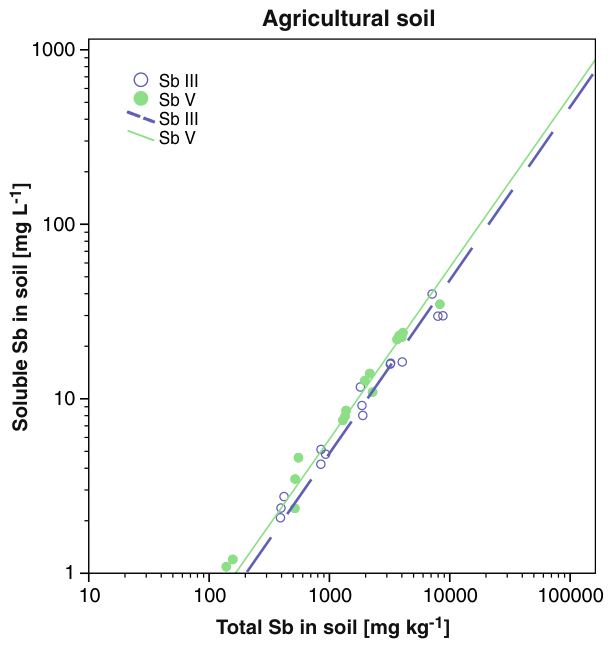
The soluble Sb concentrations determined after the initial equilibration phase prior to planting were significantly correlated to the total Sb concentrations for both treatments and soil substrates, showing linear relationships on log-log scales (Figs. 1 and 2). The form in which Sb had been added showed no effect on this relationship in the agricultural soil, but there was a clear treatment effect in the case of the potting mix. Sb was more soluble in the SbV than in the SbIII treatment with potting mix, suggesting that a substantial fraction of the added SbIII was still present in that form, bound to the soil matrix. Interestingly, the relationships between total and soluble soil Sb was very similar for the two substrates in the SbIII treatment, meaning that Sb solubility was about the same in the two substrates where Sb had been added as SbIII, whereas there was a pronounced difference in Sb solubility between the two substrates where Sb had been added as SbV. Given that there was no solubility difference between the two Sb treatments in the agricultural soil, the main difference is the elevated Sb solubility in the potting mix in the SbV treatment as compared to the other treatments.
在种植前初始平衡阶段结束后测得的可溶性Sb浓度,在两种处理和两种土壤基质中均与总Sb浓度显著相关,在双对数坐标下呈线性关系(图1和图2)。在农业土壤中,Sb的添加形态对该关系无影响;但在盆栽基质中,处理效应明显。在盆栽基质中,SbV处理的Sb溶解度高于SbIII处理,表明所添加的SbIII中有相当部分仍以该形态结合于土壤基质中。值得注意的是,在SbIII处理中,两种基质的总Sb与可溶性Sb之间的关系非常相似,即以SbIII形式添加Sb时两种基质中的Sb溶解度大致相同;而以SbV形式添加Sb时,两种基质间的Sb溶解度则存在显著差异。鉴于农业土壤中两种Sb处理间不存在溶解度差异,主要差异在于盆栽基质SbV处理中的Sb溶解度较其他处理有所升高。
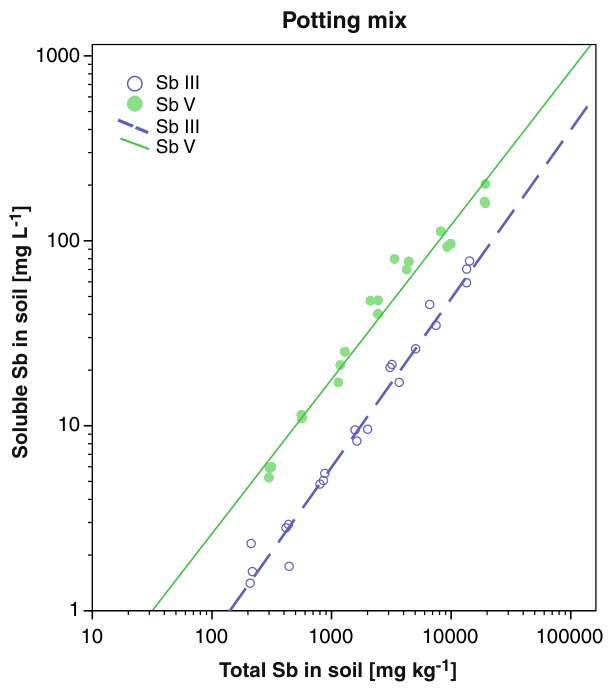
The slopes of the log-log relationships did not differ significantly from 1 for both soils and both treatments, which means that soluble Sb concentrations were approximately proportional to total soil Sb concentrations in all cases. Thus, the partitioning of Sb between soil matrix and soil solution could be expressed by a constant distribution coefficient KD (KD = concentration sorbed / concentration dissolved). The KD values found here were 195.0±13.2 Lkg−1 for the SbIII treatment and 169.8±9.9 Lkg−1 for the SbV treatment in the case of the agricultural soil, and 144.5±12.5 Lkg−1 for the SbIII treatment and 33.9±6.2 Lkg−1 for the SbV treatment in the case of the potting mix.
对于两种土壤和两种处理,双对数关系的斜率均与1无显著差异,这意味着在所有情况下可溶性Sb浓度均与土壤总Sb浓度大致成正比。因此,Sb在土壤基质与土壤溶液之间的分配可用恒定的分配系数KD表示(KD = 吸附态浓度 / 溶解态浓度)。本研究中,农业土壤SbIII处理的KD值为195.0±13.2 Lkg−1,SbV处理为169.8±9.9 Lkg−1;盆栽基质SbIII处理为144.5±12.5 Lkg−1,SbV处理为33.9±6.2 Lkg−1。
5Phytotoxicity and uptake of antimony锑的植物毒性与吸收
At the highest Sb concentrations applied in this study, toxicity symptoms such as reduced growth, chlorosis and leaf necrosis were observed in the two plants. Maize also showed anthocyane coloring of the stem base. Based on the shoot biomass data shown in Figs. 3 and 4, maize appeared to be more sensitive to Sb in soil than sunflower. To quantify Sb toxicity on growth, we fitted the following 2-parameter empirical model commonly used in toxicology to the recorded dose-response curves:
在本研究施加的最高Sb浓度下,两种植物均出现了生长减缓、失绿和叶片坏死等毒害症状。玉米还表现出茎基部花青素着色。根据图3和图4所示的地上部生物量数据,玉米对土壤Sb的敏感性似乎高于向日葵。为定量评估Sb对生长的毒性,我们将毒理学中常用的以下双参数经验模型拟合于所记录的剂量–效应曲线:

where DW is the dry weight of the aboveground biomass, c denotes the soluble Sb concentration of the soil, and a and b are fitting parameters. For comparison, because of its higher flexibility, we also fitted the following 3-parameter logistic model to the data:
式中,DW为地上部生物量干重,c为土壤可溶性Sb浓度,a和b为拟合参数。为便于比较,鉴于其灵活性更高,我们还将以下三参数logistic模型拟合于数据:

where u, v and w are the fitting parameters. The parameter u corresponds to exp(b) in the 2-parameter model: both represent the dry mass DWo produced in absence of Sb, i.e. at c=0. The fitted models were used to calculate EC50 values, i.e. the values of the soluble soil Sb concentrations at which growth was reduced to 50% of DWo. Both models gave very similar results (Tables 1 and 2). The results, which are listed in Table 1, indicate that both plants were more sensitive to soluble soil Sb in the SbV than in the SbIII treatment, although the difference was only significant for sunflower on the agricultural soil. Furthermore they reveal that soluble soil Sb was approximately 5 times more effective in reducing growth in the agricultural soil than in the potting mix. In the potting mix experiment, no toxicity was observed in sunflower even at the highest rate of SbIII application. Table 2 shows that the Sb treatment effect on EC50 became insignificant, when DW was analysed as a function of shoot Sb concentrations, indicating that there were little or no substantial differences between the two Sb treatments in the oxidation state of the Sb that had been taken up by the plants and translocated into the shoots. In the case of maize, the disappearance of a significant difference between the two Sb treatments was primarily due to a larger scatter in the latter dose-response curves compared to the curves relating to soluble soil Sb. In contrast to the reduction in the difference between Sb treatments effect, the differences in growth response to Sb between the two plant species became more pronounced when their shoot biomass was related to the concentration of Sb in the shoots (Fig. 4). This finding shows that maize is physiologically more sensitive to Sb than sunflower, and that the difference between the two plant species is not due to different accumulation rates.
式中,u、v和w为拟合参数。参数u对应于双参数模型中的exp(b):二者均表示无Sb条件下(即c=0时)的干物质产量DWo。利用拟合模型计算EC50值,即生长降至DWo的50%时所对应的土壤可溶性Sb浓度。两种模型给出的结果非常相近(表1和表2)。表1所列结果表明,两种植物在SbV处理中对土壤可溶性Sb的敏感性均高于SbIII处理,但仅农业土壤上向日葵的差异达到显著水平。此外,结果显示土壤可溶性Sb在农业土壤中抑制生长的效力约为盆栽基质中的5倍。在盆栽基质试验中,即使在最高SbIII施加量下,向日葵也未表现出毒性。表2显示,当以地上部Sb浓度为自变量分析DW时,Sb处理对EC50的影响变得不显著,表明被植物吸收并转运至地上部的Sb,其氧化态在两种Sb处理之间几乎或完全没有实质性差异。就玉米而言,两种Sb处理间显著差异的消失主要是由于后一类剂量–效应曲线的离散程度大于以土壤可溶性Sb为自变量的曲线。与Sb处理间效应差异的减小相反,当以地上部Sb浓度表示时,两种植物对Sb的生长响应差异更加明显(图4)。这一结果表明,玉米在生理上对Sb比向日葵更为敏感,且两种植物之间的差异并非源于累积速率的不同。
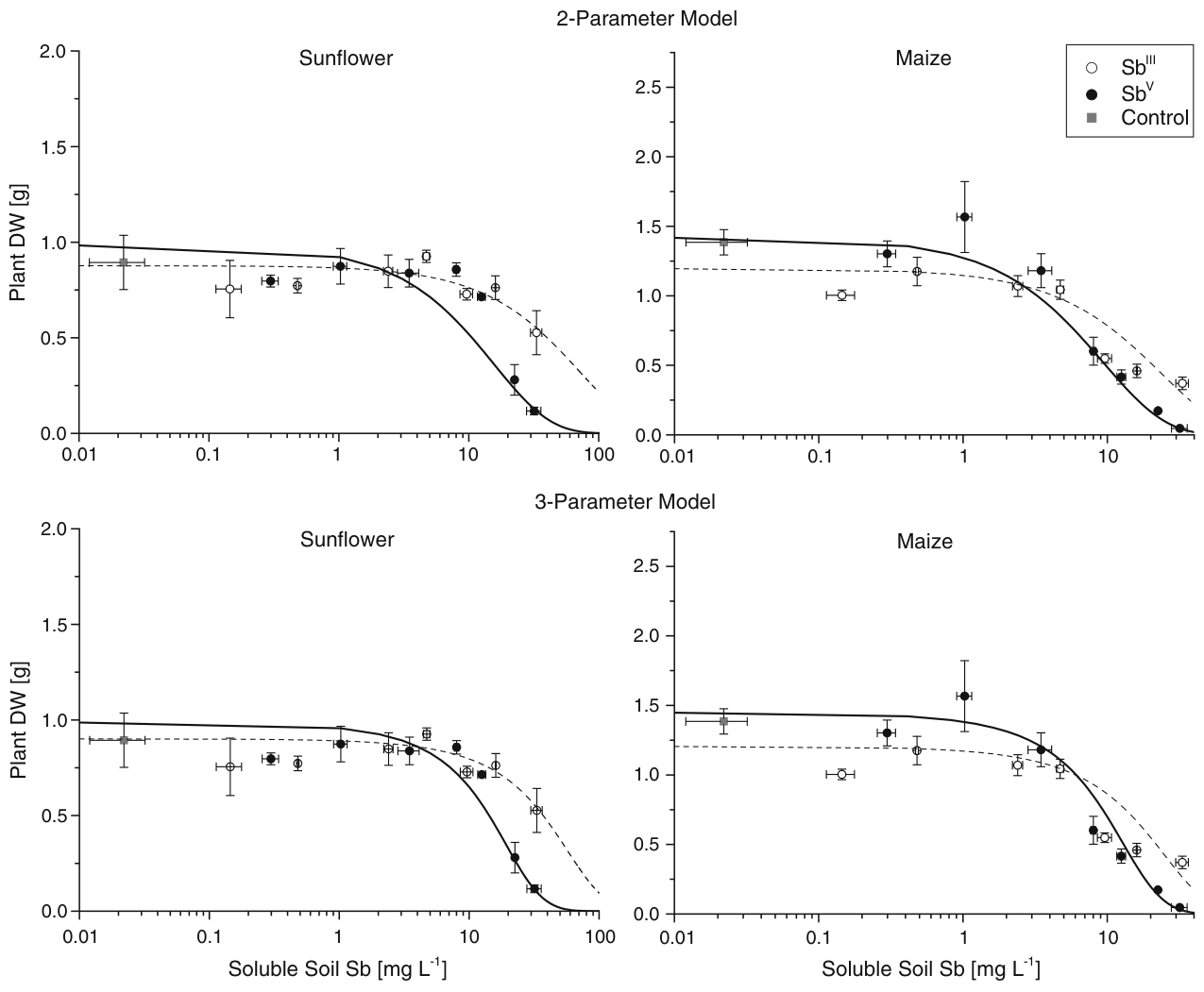
3–4 replicates each. Error bars represent standard errors. Lines are model curves fitted to the experimental data using the 2- parameter model given by Eq. 1 and the 3-parameter model given by Eq. 2 in the text
每组3~4个重复的平均值。误差线表示标准误。曲线为采用正文式1所示双参数模型和式2所示三参数模型对实验数据拟合所得的模型曲线
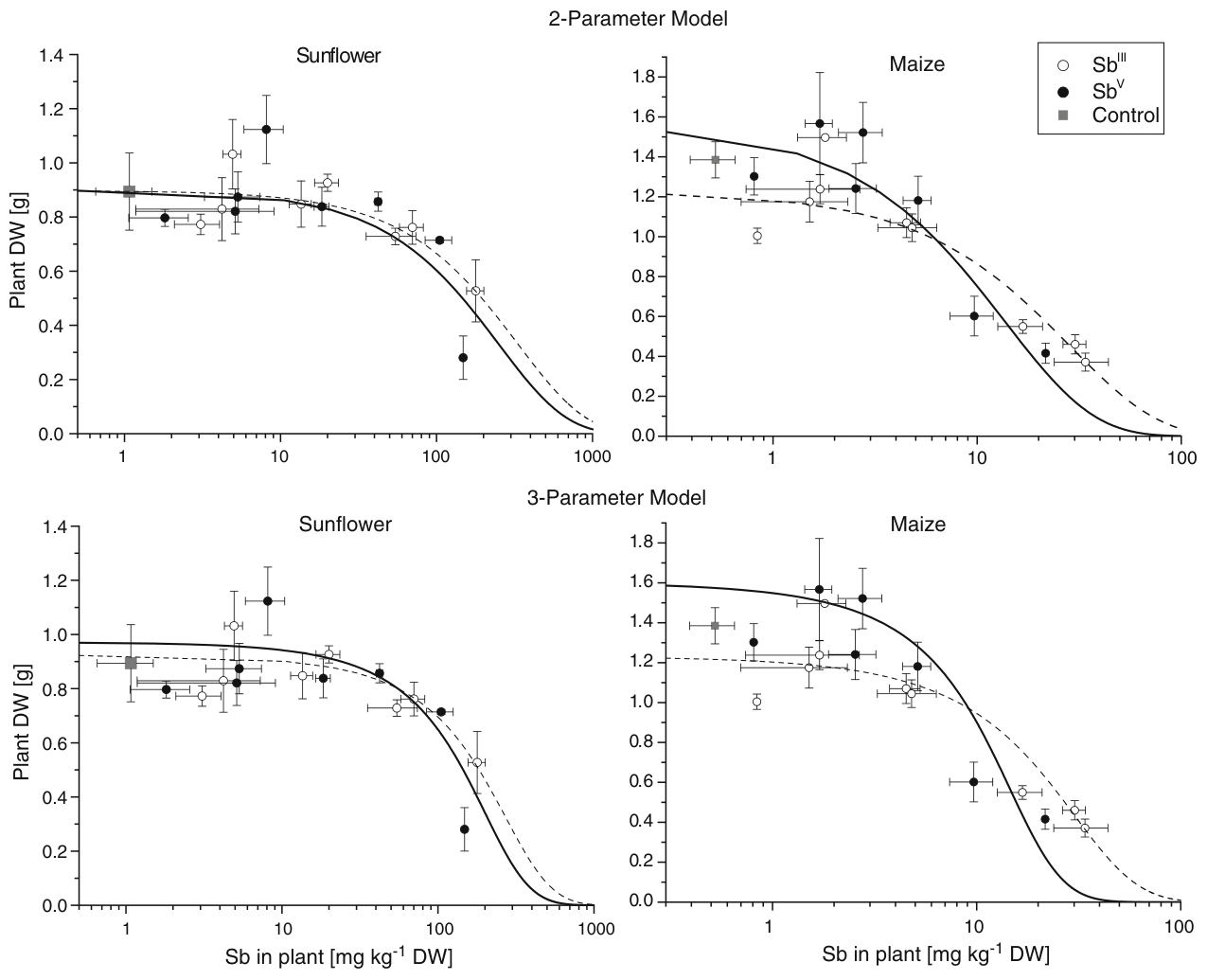
3–4 replicates each. Error bars represent standard errors. Lines are model curves fitted to the experimental data using the 2- parameter model given by Eq. 1 and the 3-parameter model given by Eq. 2 in the text
每组3~4个重复的平均值。误差线表示标准误。曲线为采用正文式1所示双参数模型和式2所示三参数模型对实验数据拟合所得的模型曲线
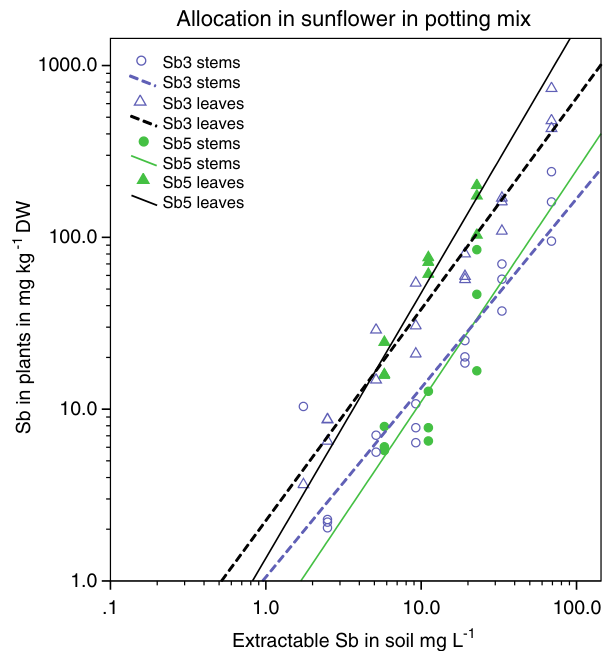
Figures 5, 6 and 7 show that Sb accumulation in the shoots was linearly related to the soluble soil Sb concentration on a log-log scale. The parameter values given in Table 3, which were determined by linear regression on the logarithms of the respective concentration values, excluding plants that showed图5、图6和图7表明,在双对数坐标下,地上部Sb累积量与土壤可溶性Sb浓度呈线性关系。表3中给出的参数值是对相应浓度值的对数进行线性回归确定的,其中排除了表现出
clear toxicity symptoms, reveal that the slopes of the lines were close to 1 for sunflower on the agricultural soil in both Sb treatments (Table 3). This means that Sb accumulation by sunflower was approximately proportional to the soluble soil Sb concentration. The relationship was similar in both Sb treatments, with a tendency for higher Sb accumulation by sunflower in the SbV treatment. Also, we found no significant difference in Sb uptake between the two Sb treatments in maize, although here a treatment effect may have been masked by the larger scatter in the data compared to sunflower. The slopes of the log-log regression line between shoot and soluble soil Sb concentrations, however, were smaller for maize than for sunflower. For both Sb treatments they were clearly less than 1 for maize on the agricultural soil, which means that the accumulation efficiency decreased with increasing concentration of Sb. As a result maize also accumulated less Sb than sunflower at high soil Sb concentrations, while there was no difference at low soil Sb concentrations.
明显毒害症状的植株。结果显示,在两种Sb处理中,农业土壤上向日葵的回归线斜率均接近1(表3)。这意味着向日葵的Sb累积量与土壤可溶性Sb浓度大致成正比。两种Sb处理中的关系相似,但向日葵在SbV处理中有Sb累积量较高的趋势。同样,玉米在两种Sb处理间的Sb吸收也无显著差异,但与向日葵相比,玉米数据的离散程度较大,可能掩盖了处理效应。然而,玉米地上部Sb浓度与土壤可溶性Sb浓度之间双对数回归线的斜率小于向日葵。在农业土壤上,玉米在两种Sb处理中的斜率均明显小于1,这意味着累积效率随Sb浓度的升高而降低。因此,在土壤Sb浓度较高时,玉米的Sb累积量也低于向日葵,而在土壤Sb浓度较低时则无差异。
| Substrate基质 | Model模型 | Treatment处理 | H. annuusH. annuus | Z. maysZ. mays | ||
|---|---|---|---|---|---|---|
| EC50 | SE | EC50 | SE | |||
| Potting mix | 2-parameter model | Sb III | a | a | 85.8 | 57.8 |
| Sb V | 52.6 | 10.4 | 35.9 | 3.2 | ||
| 3-parameter model | Sb III | a | a | 83.0 | 63.5 | |
| Sb V | 62.0 | 24.7 | 46.8 | 17.1 | ||
| Agricultural soil | 2-parameter model | Sb III | 48.3 | 14.2 | 16.6 | 1.5 |
| Sb V | 10.8 | 0.9 | 6.5 | 0.2 | ||
| 3-parameter model | Sb III | 42.7 | 17.9 | 18.1 | 2.7 | |
| Sb V | 14.4 | 3.8 | 9.7 | 2.2 |
a no toxicity effect even at the highest treatment level
a 即使在最高处理水平下也无毒性效应
Similar linear relationships between plant and soluble soil Sb as for the agricultural soil were also obtained for the potting mix. Although Sb was more soluble in the SbV than in the SbIII treatment (Fig. 1), this difference did not clearly translate into Sb uptake by the plants. Uptake of Sb by sunflower was less at low soil Sb concentrations from the potting mix than from the agricultural soil. However, as Sb accumulation increased slightly more than proportional with soluble soil Sb concentration, this difference disappeared at high soil Sb concentrations in potting mix while Sb accumulation was proportional to soluble soil Sb on agricultural soil. Figure 7 shows that uptake in leaves and stems was similar to the uptake in the whole shoot. While there was no significant difference between SbIII and SbV treatments, Sb accumulation was two- to threefold higher in leaves than in stems. Unfortunately, the data for the maize plants grown in the potting mix were much more scattered than for the maize plants grown in the agricultural soil.
盆栽基质中也得到了与农业土壤相似的植株Sb与土壤可溶性Sb之间的线性关系。尽管SbV处理中的Sb溶解度高于SbIII处理(图1),但这一差异并未明显体现在植物对Sb的吸收上。在土壤Sb浓度较低时,向日葵从盆栽基质中吸收的Sb少于从农业土壤中吸收的Sb。然而,由于盆栽基质中Sb累积量随土壤可溶性Sb浓度的增加略快于正比例增长,这一差异在高土壤Sb浓度下消失,而在农业土壤上Sb累积量与土壤可溶性Sb成正比。图7显示,叶片和茎中的吸收与整个地上部的吸收相似。尽管SbIII和SbV处理间无显著差异,但叶片中的Sb累积量是茎中的2~3倍。遗憾的是,盆栽基质中玉米植株的数据比农业土壤中玉米植株的数据离散得多。
| Model模型 | Treatment处理 | H. ann | uus | Z. may | s |
|---|---|---|---|---|---|
| EC50 | SE | EC50 | SE | ||
| 2-parameter model | Sb III | 231.3 | 61.1 | 19.9 | 2.2 |
| Sb V | 193.2 | 64.1 | 9.5 | 1.5 | |
| 3-parameter model | Sb III | 205.0 | 77.0 | 21.9 | 4.1 |
| Sb V | 150.7 | 56.2 | 11.3 | 7.8 |
6Discussion讨论
As mentioned in the introduction a number of authors have reported rapid oxidation of SbIII to SbV in soil or soil mineral suspension, in particular Fe and Mn oxyhydroxides (Belzile et al. 2001; Oorts et al. 2008). Belzile et al. (2001) found that the oxidation of dissolved SbIII to SbV followed a pseudo-first order rate kinetics and was complete within a few days in presence of suspended amorphous Fe and Mn oxyhydroxides at neutral to weakly alkaline pH, while the rate was reduced at lower pH, which they attributed to a decreased stability of the oxyhydroxides. Oxidation was also slower in presence of natural Fe oxhydroxides than with synthetic Fe oxyhydroxides, which can be explained by the increased crystallinity and lower purity of the natural compounds. Oorts et al. (2008) added Sb2O3 in suspension to topsoil collected from an uncontaminated agricultural Haplic Luvisol and found that 70% of the Sb in solution was present as SbV after 2 days. Similarly, we found in a preliminary experiment, in which we added crystalline Sb2O3 to the agricultural soil used in our experiments here, that up to 80% of the Sb obtained by KNO3-extraction was SbV after 6 h incubation.
如引言所述,许多研究者报道了土壤或土壤矿物悬浮液(特别是Fe和Mn羟基氧化物)中SbIII向SbV的快速氧化(Belzile et al. 2001; Oorts et al. 2008)。Belzile et al.(2001)发现,在中性至弱碱性pH条件下,存在悬浮的无定形Fe和Mn羟基氧化物时,溶解态SbIII向SbV的氧化遵循准一级反应动力学,并在数天内完成;而在较低pH下反应速率降低,他们将其归因于羟基氧化物稳定性的下降。与合成Fe羟基氧化物相比,存在天然Fe羟基氧化物时氧化也较慢,这可由天然化合物结晶度更高、纯度更低来解释。Oorts et al.(2008)将Sb2O3以悬浮液形式加入采自一块未受污染农田(Haplic Luvisol)的表土中,发现2天后溶液中70%的Sb以SbV形式存在。与此类似,我们在一项预备试验中将结晶态Sb2O3加入本研究所用的农业土壤,发现培养6 h后,KNO3浸提所得Sb中高达80%为SbV。
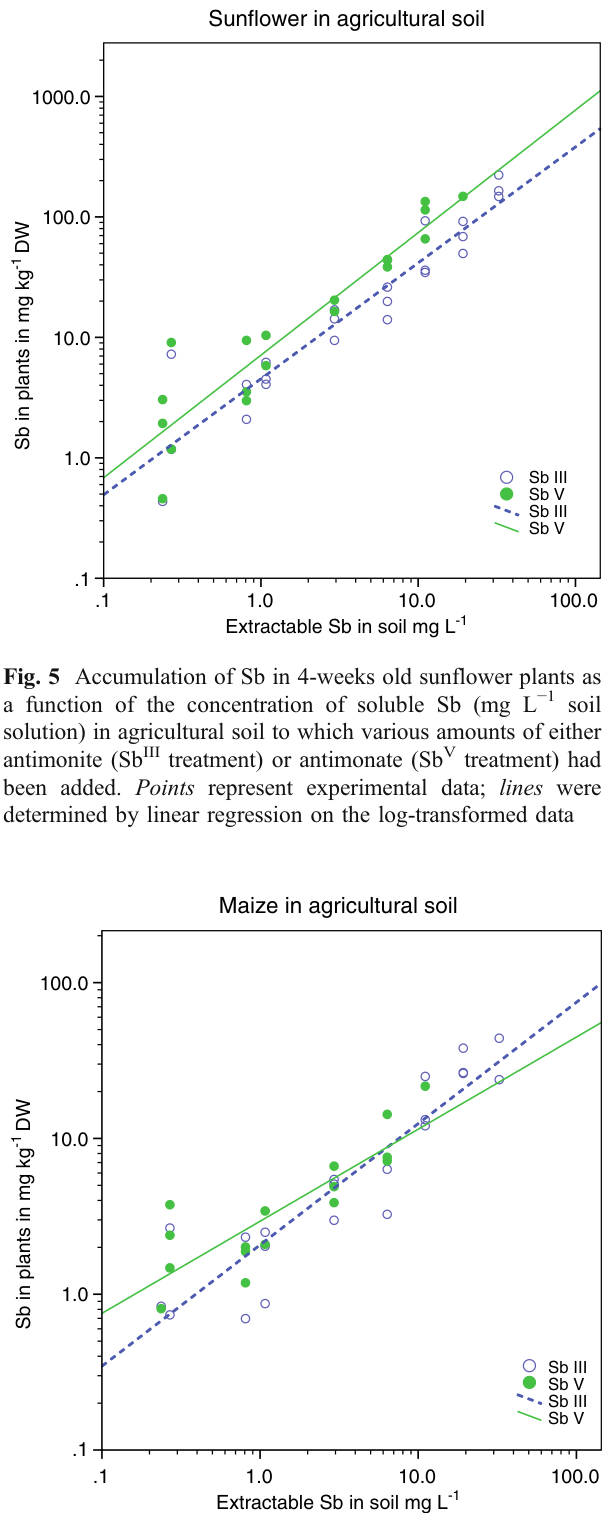
Fig. 5 Accumulation of Sb in 4-weeks old sunflower plants as a function of the concentration of soluble Sb (mg L−11 soil solution) in agricultural soil to which various amounts of either antimonite (SbIII treatment) or antimonate (SbV treatment) had been added. Points represent experimental data; lines were determined by linear regression on the log-transformed data图5 在添加不同量亚锑酸盐(SbIII处理)或锑酸盐(SbV处理)的农业土壤中,4周龄向日葵植株Sb累积量随可溶性Sb浓度(mg L−11土壤溶液)的变化。点表示实验数据;线由对数转换数据的线性回归确定
Based on the high oxidation rates reported in the literature, almost complete SbIII oxidation was expected in our experiments. However, Sb solubility differed between the two Sb treatments for the potting mix. This difference may be attributed to kinetic limitations in the dissolution of the added Sb2O3. In the aforementioned preliminary experiment, we observed that dissolution was the limiting process in the conversion of the added Sb2O3 to SbV in solution. This observation agrees well with the results of Oorts et al. (2008) who found that the concentration of Sb in solution continued to increase linearly with time over 5 weeks after addition of Sb2O3, while the final concentration at this time represented only 25% of the added amount of Sb. Thus, it seems likely that also in our experiment dissolution may not have been complete after the 2 weeks of equilibration, and that calculated KD values thus only represent apparent partition coefficients, which would continue to decrease over time. Oorts et al. (2008) reported KD values averaging 38 Lkg−1 for Sb in soil amended with Sb2O3 soil and aged for 5 years. The solubility in the aged soil was similar to that of Sb that had been freshly added to the same soil as SbCl3, indicating that dissolution kinetics was the limiting factor, while sorption occurred rapidly. The (apparent) KD values calculated in our study are four to six times higher than the average KD value reported by Oorts et al. (2008) for aged Sb contamination. While these values are still within the range of KD values reported for Sb in the literature (Cornelis et al. 2006; Tighe et al. 2005), the discrepancy indicates that thermodynamic equilibrium conditions had not been reached. Furthermore, Oorts et al. (2008) observed that the dissolution rate coefficient increased almost three-fold (from 0.005 to 0.014 day−1) when the applied dose of Sb2O3 was increased from 0.41 to 81 mmol Sb kg−1 soil. The proportionality between soluble Sb concentration and applied Sb dose, however, indicates that the dissolution rate coefficient did not substantially increase with total (nominal) soil Sb concentration in our case.
根据文献报道的较高氧化速率,本试验中SbIII预期几乎完全被氧化。然而,盆栽基质中两种Sb处理的Sb溶解度存在差异。这一差异可能归因于所添加Sb2O3溶解过程的动力学限制。在上述预备试验中,我们观察到溶解是所添加Sb2O3转化为溶液中SbV的限速过程。这一观察结果与Oorts et al.(2008)的结果高度一致,他们发现添加Sb2O3后5周内溶液中Sb浓度随时间持续线性增加,而此时的最终浓度仅占Sb添加量的25%。因此,本试验中经过2周平衡后溶解很可能也未完成,所计算的KD值仅代表表观分配系数,并会随时间继续降低。Oorts et al.(2008)报道,添加Sb2O3并老化5年的土壤中Sb的KD平均值为38 Lkg−1。老化土壤中Sb的溶解度与以SbCl3形式新近加入同一土壤的Sb相近,表明溶解动力学是限制因素,而吸附过程则迅速发生。本研究计算的(表观)KD值是Oorts et al.(2008)报道的老化Sb污染平均KD值的4~6倍。尽管这些数值仍在文献报道的Sb的KD值范围之内(Cornelis et al. 2006; Tighe et al. 2005),但这一差异表明尚未达到热力学平衡状态。此外,Oorts et al.(2008)观察到,当Sb2O3施加剂量由0.41增加至81 mmol Sb kg−1土壤时,溶解速率系数增加了近3倍(由0.005增至0.014 day−1)。然而,本研究中可溶性Sb浓度与Sb施加剂量成正比,表明溶解速率系数并未随土壤总(名义)Sb浓度的增加而显著增大。
= Table 33 Parameter values for the regression equationParametervalues for the regression equation log�clogplant��cplant� =(cplantA»log, mg kgðcsolÞ þ−1 DW) for the two soil substrates and Sb treatments. logðBÞfitted to the experimental relationships Abetween the log-transformed c»logðcsolÞ þ logðBÞ fitted toncentrations of solubltheexperimental re solat onshipsil Sb (csol, mg LThe−numbers1) and Sb accumulated in sunflower and maize shoots (cinparentheses give the standard errors for A (slopeplant, betweenmgkg−1 DW)thelog-transformedforthe two soilconcentrationssubstratesandofSbsolubletreatments.soil TheSb numbersofthe inregressionparenthesesline)giveandtheforstandardtheanti-logarithmserrorsfor Aof(slopethestandardofthe regression(csol,mg L−line)1) and Sb accumulatedandfor the anti-logarithmsinsunfloweroftheand maize shootsstandarderrors oferrorslog(B),ofrespectivelylog(B),respectively表3 针对两种土壤基质和两种Sb处理,拟合回归方程log(cplant) = A·log(csol) + log(B)(cplant,mg kg−1 DW;csol,mg L−1)所得的参数值。该方程拟合的是土壤可溶性Sb浓度(csol,mg L−1)与向日葵和玉米地上部累积Sb浓度(cplant,mg kg−1 DW)的对数转换值之间的实验关系。括号内数字分别为A(回归线斜率)的标准误以及log(B)标准误的反对数
| Substrate基质 | Treatment处理 | H. annuusH. annuus | Z. maysZ. mays | ||||
|---|---|---|---|---|---|---|---|
| B | A | R2 | B | A | R2 | ||
| Potting mix | Sb III | 1.77 (1.26) | 1.17 (0.08) | 0.93a | 4.60 (1.36) | 0.53 (0.14) | 0.50a |
| Sb V | 0.93 (1.40) | 1.52 (0.14) | 0.95a | 0.44 (3.58) | 0.93 (0.61) | 0.37ns | |
| Agricultural soil | Sb III | 4.53 (1.16) | 0.96 (0.07) | 0.89a | 2.07 (1.17) | 0.78 (0.08) | 0.84a |
| Sb V | 7.12 (1.16) | 0.85 (0.06) | 0.88a | 2.94 (1.14) | 0.59 (0.10) | 0.73a |
ns: not significant a : significant at P<0.01
ns:不显著 a:在P<0.01水平显著
The fact that the Sb treatment effect on Sb solubility was particularly pronounced for the potting mix can be entirely attributed to higher solubility of antimonate in this substrate, because the soluble soil Sb concentrations did not differ between the two substrates for a given level of Sb2O3 application in the SbIII treatments. Buschmann and Sigg (2004) found that oxidation of SbIII can be prevented by complexation with humic matter. However, such an effect cannot explain why there was a difference in Sb solubility between the two substrates in the SbV, but not in the SbIII treatment. Higher solubility of antimonate may have been due to the higher organic matter content of the potting mix compared to the agricultural soil, in which the effect of the Sb treatment on Sb solubility was low. Complexation with soluble organic ligands possibly enhanced the solubility of antimonate in the potting mix more than in the agricultural soil. Oorts et al. (2008) found a plateau in Sb solubility at high concentrations of Sb in solution and suggested that this was due to Caantimonate precipitation. Here, we found no such plateau and, thus, conclude that such precipitates did not limit SbV solubility in our substrates.
Sb处理对Sb溶解度的影响在盆栽基质中尤为明显,这完全可归因于锑酸盐在该基质中的溶解度较高,因为在SbIII处理中,对于给定的Sb2O3施加水平,两种基质的土壤可溶性Sb浓度并无差异。Buschmann and Sigg(2004)发现,与腐殖质络合可阻止SbIII的氧化。然而,这一效应无法解释为何两种基质间的Sb溶解度差异出现在SbV处理中,而不出现在SbIII处理中。锑酸盐溶解度较高可能是由于盆栽基质的有机质含量高于农业土壤,而在农业土壤中Sb处理对Sb溶解度的影响较小。与可溶性有机配体的络合可能使盆栽基质中锑酸盐溶解度的提高幅度大于农业土壤。Oorts et al.(2008)发现,在溶液中Sb浓度较高时Sb溶解度出现平台,并认为这是由于锑酸钙沉淀所致。本研究未发现此类平台,因此可以推断,在本研究的基质中此类沉淀并未限制SbV的溶解度。
While Sb solubility differed little, especially in the agricultural soil, between the SbIII and SbV treatments, a clear tendency for higher Sb uptake was observed in the SbV treatment in the case of sunflower suggesting that different Sb species were present in solution with different availability for plant uptake and that the concentrations of these Sb species were different in the two Sb treatments. The approximate proportionality between soluble soil Sb and accumulated plant Sb concentrations, extending over two orders of magnitude for sunflower on the agricultural soil, agrees well with previous findings as reviewed by Tschan et al. (2009b), indicating that uptake was dominated by non-selective transport with the transpiration water stream, passing through leaks in the endodermis or in the case of antimonite also through aquaporins as mentioned already in the introduction. The decrease in Sb accumulation efficiency with increasing Sb concentration that was observed in maize on agricultural soil, but to a slight degree also in sunflower in the SbV treatment may reflect to some degree a trend of concentration-dependent Sb speciation; but the differences in these trends between the two plant species show that plant factors also played a role. Unfortunately, the data from the potting mix experiment were too scattered to establish similarly clear trends as for the agricultural soil.
尽管SbIII与SbV处理间的Sb溶解度差异很小(尤其是在农业土壤中),但向日葵在SbV处理中表现出明显较高的Sb吸收趋势,这表明溶液中存在植物有效性不同的多种Sb形态,且这些Sb形态的浓度在两种Sb处理中有所不同。在农业土壤上,向日葵的土壤可溶性Sb与植株累积Sb浓度之间的近似正比关系跨越两个数量级,这与Tschan et al.(2009b)综述的前人研究结果高度一致,表明吸收以随蒸腾水流的非选择性转运为主,即通过内皮层的渗漏处,或者就亚锑酸盐而言,也可如引言所述通过水通道蛋白。玉米在农业土壤上、以及在较小程度上向日葵在SbV处理中所观察到的Sb累积效率随Sb浓度升高而降低的现象,可能在一定程度上反映了Sb形态随浓度变化的趋势;但两种植物在这些趋势上的差异表明植物因素也起了作用。遗憾的是,盆栽基质试验的数据过于离散,无法建立与农业土壤类似的明确趋势。
Given that SbIII is generally considered more toxic than SbV the lower tolerance of both plants to soluble soil Sb in the SbV treatments may be surprising. However, for sunflower, at least, the difference between the two treatments can be explained by the greater Sb accumulation in the SbV treatment. For maize, relating toxicity to accumulation did not fully explain the difference in toxicity between the two Sb treatments; it only made it less significant due to increased uncertainty in dose-response curve fitting. A difference in toxicity between the two Sb treatments would mean that Sb speciation in maize could not have been exactly the same or that the toxicity effects on shoot growth were due to interactions between soil Sb and plant roots. In any case, contrary to expectation, the SbV treatment was more toxic than or at least as toxic as the SbIII treatment in maize. In sunflower the observed toxicity effects on shoot growth appeared to be related solely to the accumulation of Sb in the shoot tissue. In this case, there either was no difference in toxicity between different Sb species accumulated by the plants or all accumulated Sb was rapidly converted to species of similar toxicity.
鉴于SbIII通常被认为比SbV毒性更强,两种植物在SbV处理中对土壤可溶性Sb的耐受性较低这一结果可能令人意外。然而,至少对于向日葵而言,两种处理间的差异可由SbV处理中较高的Sb累积量来解释。对于玉米,将毒性与累积量相关联并不能完全解释两种Sb处理间的毒性差异,只是由于剂量–效应曲线拟合的不确定性增加而使差异的显著性降低。两种Sb处理间存在毒性差异,意味着玉米体内的Sb形态不可能完全相同,或者对地上部生长的毒性效应源于土壤Sb与植物根系之间的相互作用。无论如何,与预期相反,在玉米中SbV处理的毒性高于或至少等同于SbIII处理。在向日葵中,所观察到的对地上部生长的毒性效应似乎仅与地上部组织中的Sb累积有关。在这种情况下,要么植物所累积的不同Sb形态之间不存在毒性差异,要么所累积的全部Sb迅速转化为毒性相近的形态。
The EC50 values estimated here from the reponse of shoot growth to soluble Sb in the agricultural soil amended with SbIII ranged between 40 and 50 mg L−1 for sunflower and between 16 and 18 mg L−1 for maize, depending on the model used to fit the experimental curves. These values are comparable to the EC50 values varying around 40 mg L−1 (0.34 mmol L−1) that were obtained by Oorts et al. (2008) for lettuce shoot yield. The good agreement between the EC50 values obtained with the two models indicates that the estimates were robust.
根据添加SbIII的农业土壤中地上部生长对可溶性Sb的响应,本研究估算的EC50值因拟合实验曲线所用模型的不同,向日葵为40~50 mg L−1,玉米为16~18 mg L−1。这些数值与Oorts et al.(2008)针对莴苣地上部产量所得的约40 mg L−1(0.34 mmol L−1)的EC50值相当。两种模型所得EC50值吻合良好,表明估算结果是稳健的。
The dose-response curves obtained here confirm the findings of Oorts et al. (2008) that background soil Sb concentrations are two orders of magnitude lower than typical phytotoxic levels. However, Sb may well occur at phytotoxic concentrations in Sb contaminated soils, in particular in shooting range soils. Our results suggest that even when the predominate form of Sb is antimonate Sb toxicity may still remain a serious risk in Sb contaminated soil.
本研究获得的剂量–效应曲线证实了Oorts et al.(2008)的发现,即土壤Sb背景浓度比典型的植物毒性水平低两个数量级。然而,在Sb污染土壤中,尤其是射击场土壤中,Sb很可能达到植物毒性浓度。我们的结果表明,即使Sb的主要形态为锑酸盐,Sb毒性在Sb污染土壤中仍可能构成严重风险。
Acknowledgements We gratefully acknowledge Anna Grünwald, Björn Studer, René Saladin and Viktor Stadelmann for their generous help and support in the laboratory. This project was financially supported by the Swiss National Science Foundation (Grants No. 200021-103768).
致谢 衷心感谢Anna Grünwald、Björn Studer、René Saladin和Viktor Stadelmann在实验室工作中给予的慷慨帮助和支持。本项目由瑞士国家科学基金会资助(项目编号200021-103768)。
7References参考文献
Ainsworth N, Cooke JA, Johnson MS (1990) Distribution of antimony in contaminated grassland 1 vegetation and soils. Environ Pollut 65:65–77
Amereih S, Meisel T, Scholger R, Wegscheider W (2005) Antimony speciation in soil samples along two Austrian motorways by HPLC-ID-ICP-MS. J Environ Monit 7: 1200–1206
Asher CJ, Reay PF (1979) Arsenic uptake by barley seedlings. Aust J Plant Physiol 6:459–466
Baes CF, Mesmer RE (eds) (1986) Arsenic, Antimony, Bismuth. In The hydrolysis of cations. pp 366–375. Krieger, Malabar, FL
Baroni F, Boscagli A, Protano G, Riccobono F (2000) Antimony accumulation in Achillea ageratum, Plantago lanceolata and Silene vulgaris growing in an old Sb-mining area. Environ Pollut 109:347–352
Belzile N, Chen YW, Wang ZJ (2001) Oxidation of antimony (III) by amorphous iron and manganese oxyhydroxides. Chem Geol 174:379–387
Blaser P, Pannatier EG, Walthert L (2008) The base saturation in acidified Swiss forest soils on calcareous and noncalcareous parent material. A pH-base saturation anomaly. J Plant Nutr Soil Sci 171:155–162
Blay K (2000) Sorption wässriger Antimon-Spezies an bodenbildende Festphasen und Remobilisierung durch natürliche Komplexbildner. PhD Thesis, Technische Universität München Bowen HJM (1979) Environmental chemistry of the elements. Academic, London
Buschmann J, Sigg L (2004) Antimony(III) binding to humic substances: influence of pH and type of humic acid. Environ Sci Technol 38:4535
Cornelis G, Van Gerven T, Vandecasteele C (2006) Antimony leaching from uncarbonated and carbonated MSWI bottom ash. J Hazard Mater 137:1284–1292
Filella M, Belzile N, Chen YW (2002) Antimony in the environment: a review focused on natural waters I. Occurence. Earth-Sci Rev 57:125–176
Filella M, Belzile N, Lett MC (2007) Antimony in the environment: a review focused on natural waters. III. Microbiota relevant interactions. Earth-Sci Rev 80:195–217
Gebel T (1997) Arsenic and antimony: comparative approach on mechanistic toxicology. Chem Biol Interact 107:131–144
Gresch M, Wettstein B (2002) Antimon- und Bleibelastung bei Schiessanlagen, Fallbeispiel Eschenbach (SG). Semester Thesis, ETH Zurich
Gulz PA, Gupta SK, Schulin R (2005) Arsenic accumulation of common plants from contaminated soils. Plant Soil 272: 337–347
Gurnani N, Sharma A, Talukder G (1994) Effects of antimony on cellular systems in animals—a review. Nucleus 37:71– 96
Johnson CA, Moench H, Wersin P, Kugler P, Wenger C (2005) Solubility of antimony and other elements in samples taken from shooting ranges. J Environ Qual 34:248–254 Kabata-Pendias A, Pendias H (1984) Trace elements in soils and plants. CRC Press, Boca Raton
Krachler M, Emons H, Zheng J (2001) Speciation of antimony for the 21st century: promises and pitfalls. Trac-Trends Anal Chem 20:79–90
Leuz AK (2002) Redox chemistry of antimony in aquatic systems: e.g. Lakes. Diploma
Leuz AK, Hug SJ, Wehrli B, Johnson CA (2006a) Ironmediated oxidation of antimony(III) by oxygen and hydrogen peroxide compared to arsenic(III) oxidation. Environ Sci Technol 40:2565–2571
Leuz AK, Monch H, Johnson CA (2006b) Sorption of Sb(III) and Sb(V) to goethite: influence on Sb(III) oxidation and mobilization. Environ Sci Technol 40:7277–7282
Oorts K, Smolders E, Degryse F, Buekers J, Gasco G, Cornelis G, Mertens J (2008) Solubility and toxicity of antimony trioxide (Sb2O3) in soil. Environ Sci Technol 42:4378–4383
Pratas J, Prasad MNV, Freitas H, Conde L (2005) Plants growing in abandoned mines of Portugal are useful for biogeochemical exploration of arsenic, antimony, tungsten and mine reclamation. J Geochem Explor 85:99–107
Rooney CP, McLaren RG, Cresswell RJ (1999) Distribution and phytoavailability of lead in a soil contaminated with lead shot. Water Air Soil Pollut 116:535–548
Sachs L (2004) Angewandte Statistik. Springer, Berlin SPSS for Windows, Rel. 17.0.0. (2008) Chicago: SPSS Inc
Tighe M, Lockwood P, Wilson S (2005) Adsorption of antimony(v) by floodplain soils, amorphous iron(III) hydroxide and humic acid. J Environ Monit 7:1177–1185
Tschan M, Robinson B, Schulin R (2008) Antimony uptake by Zea mays (L.) and Helianthus annuus (L.) from nutrient solution. Environ Geochem Health 30:187–191
Tschan M, Robinson BH, Nodari M, Schulin R (2009a) Antimony uptake by different plant species from nutrient solution, agar and soil. Environ Chem 6:144–152
Tschan M, Robinson BH, Schulin R (2009b) Antimony in the soil-plant system—a review. Environ Chem 6:106–115
Woolson EA, Axley JH, Kearney PC (1973) Chemistry and phytotoxicity of arsenic in soils. 2. Effects of time and phosphorus. Soil Sci Soc Am J 37:254–259