Contents lists available at ScienceDirect journal homepage: www.elsevier.com/locate/chemosphere
Erika Fässler a,*, Michael W. Evangelou a, Brett H. Robinson b, Rainer Schulin a
a Institute of Terrestrial Ecosystems, ETH Zurich, Universitätstr. 16, 8092 Zurich, Switzerland b Agriculture and Life Sciences Division, Lincoln University, Lincoln 7647, Canterbury, New Zealand
1Introduction引言
Phytoextraction potentially is an attractive strategy to clean up metal-polluted agricultural soils, provided that sufficiently high extraction rates can be achieved. Restrictions on phytoextraction are given by the plant’s ability to grow in the polluted soil, to take up the target metals and by the availability of the target metals in the soil for plant uptake. Only metals that are in the soil solution can be taken up by plants. The uptake takes place at the interface between soil solution and root tissue. The larger the contact area between roots and soil solution, the higher the potential uptake. Due to the formation of special tissue layers with suberin incrustations in their cell walls, in particular the epidermis layer with the well-known casparian strips between root cortex and stele, there is a gradient in the uptake of water and solutes along the root axis, declining from the apex to the basal zones. These layers act as an efficient barrier against the uptake of aqueous solutes via the apoplast (Marschner, 1995). These barriers are not fully developed at the root tips and also become disrupted in the basal zones where emerging lateral roots penetrate the cortex, forming leaks for uncontrolled apoplastic uptake of solutes into the xylem of the roots (Haynes, 1980; Clarkson, 1996; Tandy et al., 2006a).
如果能够达到足够高的提取速率,植物提取有望成为修复金属污染农业土壤的一种有吸引力的策略。植物提取的限制因素包括植物在污染土壤中生长的能力、吸收目标金属的能力,以及土壤中目标金属对植物吸收的有效性。只有存在于土壤溶液中的金属才能被植物吸收。吸收发生在土壤溶液与根组织的界面上。根系与土壤溶液的接触面积越大,潜在吸收量就越高。由于根中形成了细胞壁具有木栓质沉积的特殊组织层,尤其是位于根皮层与中柱之间、具有众所周知的凯氏带的表皮层,水分和溶质的吸收沿根轴存在梯度,由根尖向基部区域递减。这些组织层可有效阻挡水溶性溶质经质外体途径的吸收(Marschner, 1995)。这些屏障在根尖处尚未发育完全,而在基部区域,新生侧根穿透皮层时也会使其遭到破坏,形成溶质经质外体不受控制地进入根木质部的渗漏通道(Haynes, 1980; Clarkson, 1996; Tandy et al., 2006a)。
* Corresponding author. Tel.: +41 44 633 61 43; fax: +41 44 633 11 23.
* 通讯作者。电话:+41 44 633 61 43;传真:+41 44 633 11 23。
E-mail addresses: erika.faessler@env.ethz.ch (E. Fässler), michael.evangelou@ env.ethz.ch (M.W. Evangelou), Brett.Robinson@lincoln.ac.nz (B.H. Robinson), rainer.schulin@env.ethz.ch (R. Schulin).
Increasing root surface area, in particular of those zones with incomplete or leaky endo- and exodermis layers, may be helpful to increase metal uptake in phytoextraction. The growth-promoting phytohormone auxin is known to induce root growth by enhancing cell division, cell extension and inducing lateral root growth (Taiz and Zeiger, 2000). Rhizosphere bacteria, such as some strains of Pseudomonas and Acinetobacter, were found to produce indole-3-acetic acid (IAA), the most common auxin in plants, and thereby stimulate root elongation and lateral root production (Lippmann et al., 1995). Root inoculation with rhizosphere bacteria strains had similar effects on root morphology as exogenous IAA application (Lippmann et al., 1995). In particular IAA increased root and sometimes also shoot growth of plants that were stressed by salinity or heavy metals (Chaudhry and Rasheed, 2003; Sheng and Xia, 2006; Egamberdieva, 2009). Leinhos and Bergmann (1995) found that IAA alleviated drought stress and suggested that exogenously applied IAA may serve in mediating morphological reactions of plants in response to stresses, in particular by increasing root growth. The growth-promoting effect of auxin on stressed plants may be used for phytoextraction purposes.
增加根系表面积,尤其是内皮层和外皮层不完整或存在渗漏的区域的表面积,可能有助于提高植物提取中的金属吸收量。已知促进生长的植物激素生长素可通过促进细胞分裂、细胞伸长以及诱导侧根生长来促进根系生长(Taiz and Zeiger, 2000)。研究发现,某些根际细菌,如部分Pseudomonas和Acinetobacter菌株,能够产生植物中最常见的生长素吲哚-3-乙酸(IAA),从而刺激根伸长和侧根形成(Lippmann et al., 1995)。接种根际细菌菌株对根形态的影响与外源施加IAA相似(Lippmann et al., 1995)。特别是,IAA能够增加受盐分或重金属胁迫植物的根系生长,有时也能增加地上部生长(Chaudhry and Rasheed, 2003; Sheng and Xia, 2006; Egamberdieva, 2009)。Leinhos and Bergmann (1995)发现IAA可缓解干旱胁迫,并提出外源施加的IAA可能介导植物对胁迫的形态学响应,尤其是通过促进根系生长。生长素对胁迫植物的促生长作用可用于植物提取。
0045-6535/$ - see front matter � 2010 Elsevier Ltd. All rights reserved. doi:10.1016/j.chemosphere.2010.04.077
0045-6535/$ - 见前页 © 2010 Elsevier Ltd. 版权所有。doi:10.1016/j.chemosphere.2010.04.077
In order to enhance phytoextraction it has been proposed to increase limited availability of polluting soil metals for plant uptake by adding chelating agents such as ethylene diamine tetraacetic acid (EDTA), nitrilotriacetic acid (NTA) or ethylene diamine disuccinic acid (EDDS) to the soil (Blaylock et al., 1997; Huang et al., 1997; Kulli et al., 1999; Tandy et al., 2006b). Increased metal availability may, however, also increase metal stress to plants. Tandy et al. (2006b) showed that the application of EDDS to soil, while increasing the uptake of Cu and Pb by sunflowers, decreased plant dry weight in pot experiments. Liu et al. (2007) found that the adverse effect of chelating agents on plant growth could be reduced by the application of IAA. López et al. (2005) furthermore found that the addition of IAA together with EDTA increased Pb uptake by alfalfa.
为强化植物提取,有研究提出向土壤中添加螯合剂,如乙二胺四乙酸(EDTA)、次氮基三乙酸(NTA)或乙二胺二琥珀酸(EDDS),以提高土壤中污染金属对植物吸收的有限有效性(Blaylock et al., 1997; Huang et al., 1997; Kulli et al., 1999; Tandy et al., 2006b)。然而,金属有效性的提高也可能加剧金属对植物的胁迫。Tandy et al. (2006b)的盆栽试验表明,向土壤中施加EDDS虽然提高了向日葵对Cu和Pb的吸收,但降低了植物干重。Liu et al. (2007)发现,施加IAA可减轻螯合剂对植物生长的不利影响。López et al. (2005)还发现,IAA与EDTA配合添加可提高紫花苜蓿对Pb的吸收。
Based on these findings, the aim of this study was to test the hypotheses that: (1) auxin is capable of alleviating metal stress on plants, and (2) to test the potential of auxin to increase metal phytoextraction in combination with a chelant. As experimental system we chose sunflowers grown in hydroponic solution, treated with the heavy metals Pb and Zn, the auxin IAA and the chelating agent EDDS. Hydroponics were chosen because we were interested in the effects of these chemicals in solution on plant growth and metal uptake, separating them from effects of the treatments on metal partitioning between soil solution and solid phases.
基于上述发现,本研究旨在检验以下假设:(1)生长素能够缓解金属对植物的胁迫;(2)检验生长素与螯合剂配合使用提高金属植物提取效果的潜力。我们选用水培溶液中生长的向日葵作为试验体系,并以重金属Pb和Zn、生长素IAA和螯合剂EDDS进行处理。之所以选择水培,是因为我们关注的是这些化学物质在溶液中对植物生长和金属吸收的影响,以将其与处理对金属在土壤溶液和固相之间分配的影响区分开来。
2Materials and methods材料与方法
plant growth without killing them. On the basis of these experiments we chose treatments with 2.5 lM Pb and 15 lM Zn for this study.
植物生长,但不致其死亡。根据这些试验,本研究选择了2.5 μM Pb和15 μM Zn的处理。
We performed two sets of experiments (Table 1). In the first set of experiments we applied IAA concentrations between 10�9 and 10�12 M as well as no IAA (control), with and without metal stress (15 lM Zn, 2.5 lM Pb or no metal). The treatments were replicated four times. In the second set of experiments we grew seedlings in solutions with Zn, Pb or no metal, and applied IAA (0 or 10�10 M) and EDDS (0 or 500 lM) in four combinations to each metal treatment. Each treatment was replicated five times.
我们进行了两组试验(表1)。在第一组试验中,在有或无金属胁迫(15 μM Zn、2.5 μM Pb或不加金属)的条件下,施加浓度为10−9至10−12 M的IAA,并设不加IAA的对照。各处理重复4次。在第二组试验中,幼苗分别生长于含Zn、Pb或不含金属的溶液中,对每种金属处理以4种组合施加IAA(0或10−10 M)和EDDS(0或500 μM)。各处理重复5次。
All experiments were carried out in a climate chamber at a 16 h (22 �C)/7 h (15 �C) day/night cycle with 0.5 h transition times between day and night phases. Seeds of Helianthus annuus L. (cv. Sanluca) were germinated in silica sand. Six days old seedlings were transferred into aerated brown 1-L bottles (one seedling per bottle) containing nutrient solution. Two different nutrient solutions were prepared. The first was a modified 10% Hoagland nutrient solution in which NaFe(II)EDTA was replaced by FeS- O4�7H2O to avoid interference between EDTA and EDDS. The other solution was the treatment solution containing metal contaminant, auxin and chelant according to the before-mentioned treatments. Here, all micronutrients and KH2PO4 were omitted to avoid competition between metals and metal precipitation, in particular of Pb phosphate. To maintain a solution pH of 6, 2 mM 2-(N-morpholino)ethanesulfonic acid was added as buffer to both solutions. The solutions were always freshly prepared before application and alternately applied for periods of 3 d for a total of 18 d, starting with the Hoagland solution, so that the two solutions were each applied three times during the experiment. This alternation maximized the treatment time while avoiding P and micronutrient deficiency stress.
所有试验均在人工气候室中进行,昼/夜周期为16 h(22 °C)/7 h(15 °C),昼夜阶段之间有0.5 h的过渡时间。向日葵(Helianthus annuus L.,品种Sanluca)种子在石英砂中萌发。6日龄幼苗移栽至装有营养液的通气棕色1 L瓶中(每瓶1株)。共配制两种营养液。第一种为改良的10% Hoagland营养液,其中以FeSO4·7H2O替代NaFe(II)EDTA,以避免EDTA与EDDS之间的干扰。另一种为处理溶液,按上述处理含有金属污染物、生长素和螯合剂。该溶液中省去了所有微量营养元素和KH2PO4,以避免金属之间的竞争以及金属沉淀,尤其是磷酸铅沉淀。为使溶液pH保持在6,两种溶液中均加入2 mM 2-(N-吗啉代)乙磺酸作为缓冲剂。溶液均在使用前新鲜配制,每3 d交替施用一次,共18 d,从Hoagland溶液开始,使两种溶液在试验期间各施用3次。这种交替方式在避免P和微量营养元素缺乏胁迫的同时,最大限度地延长了处理时间。
2.1. Experimental setup2.1. 试验设计
In preliminary experiments we screened sunflower growth at Pb concentrations of 125, 62.5, 31, 15.5, 7.8, 3.9, 2.5 and 1 lM and Zn concentrations of 122, 61, 30.5 and 15 lM in nutrient solution to determine at which concentrations the metals stunted
在预试验中,我们考察了营养液中Pb浓度为125、62.5、31、15.5、7.8、3.9、2.5和1 μM以及Zn浓度为122、61、30.5和15 μM时向日葵的生长情况,以确定金属在何种浓度下会抑制
2.2. Root morphometry2.2. 根系形态测定
At harvest, plants were immediately separated into roots and shoots and weighed.
收获时,立即将植株分为根和地上部并称重。
Table 1表1
Root growth parameters. Mean values of root growth parameters (dry weight, volume, surface area, length, diameter and density) of sunflowers grown in the IAA screening experiment with Pb or Zn (set 1) and in the IAA + EDDS with Pb or Zn (set 2). Standard errors of the means are in parentheses (set 1: n = 4, set 2: n = 5). Different letters indicate significant differences between the treatments (p < 0.05).
根系生长参数。IAA筛选试验中添加Pb或Zn(第1组)以及IAA + EDDS试验中添加Pb或Zn(第2组)条件下生长的向日葵根系生长参数(干重、体积、表面积、长度、直径和密度)的平均值。括号内为平均值的标准误(第1组:n = 4,第2组:n = 5)。不同字母表示处理间差异显著(p < 0.05)。
| Experiment试验 | Treatment处理 | Volume (cm3)体积(cm3) | Surface area (cm2)表面积(cm2) | Length (m)长度(m) | Diameter (mm)直径(mm) | Density (mg cm�3)密度(mg cm−3) |
|---|---|---|---|---|---|---|
| 1, Pb | Control | 3.26 (0.15) a | 303 (18) a | 2.27 (0.19) a | 0.45 (0.01) a | 35 (1) a |
| 2.5lM Pb | 1.92 (0.16) b | 188 (15) b | 1.48 (0.11) b | 0.42 (0.00) b | 40 (4) ab | |
| 10�10 M IAA | 5.03 (0.19) d | 530 (30) c | 4.49 (0.36) c | 0.39 (0.01) b | 35 (0) a | |
| 2.5lM Pb + 10�10 M IAA | 2.58 (0.24) c | 245 (26) a | 1.87 (0.24) ab | 0.44 (0.02) a | 42 (1) b | |
| 1, Zn | Control | 2.46 (0.16) ab | 394 (24) a | 5.08 (0.39) a | 0.26 (0.01) a | 76 (3) a |
| 15lM Zn | 1.63 (0.27) c | 260 (39) b | 3.32 (0.49) b | 0.25 (0.01) a | 63 (5) b | |
| 10�10 M IAA | 2.80 (0.34) a | 419 (63) a | 5.04 (0.91) a | 0.27 (0.01) a | 70 (0) ab | |
| 15lM Zn + 10�10 M IAA | 1.75 (0.13) bc | 265 (17) b | 3.22 (0.19) b | 0.27 (0.00) a | 78 (2) a | |
| 2, Pb | Control | 2.83 (0.30) ac | 283 (33) a | 2.27 (0.29) a | 0.41 (0.01) ad | 35 (1) abc |
| 2.5lM Pb | 2.35 (0.23) a | 230 (26) a | 1.79 (0.23) a | 0.41 (0.01) a | 38 (1) c | |
10�10 M IAA | 3.08 (0.27) ab | 300 (26) ac | 2.34 (0.21) a | 0.41 (0.00) a | 33 (1) a | |
| 2.5lM Pb + 10�10 M IAA | 3.92 (0.48) bc | 414 (54) bc | 3.50 (0.50) b | 0.39 (0.01) cd | 37 (0) cb | |
| 500lM EDDS | 4.13 (0.41) b | 492 (40) b | 4.70 (0.34) b | 0.34 (0.01) be | 35 (1) abc | |
| 500lM EDDS + 2.5lM Pb | 3.97 (0.48) b | 437 (42) b | 3.84 (0.27) b | 0.36 (0.01) cf | 33 (2) ab | |
| 500lM EDDS + 10�10 M IAA | 3.61 (0.35) bc | 411 (34) b | 3.75 (0.25) b | 0.35 (0.01) ef | 36 (1) abc | |
| 500lM EDDS + 2.5lM Pb + 10�10 M IAA | 4.12 (0.56) b | 458 (58) b | 4.07 (0.48) b | 0.36 (0.01) c | 34 (1) abc | |
| 2, Zn | Control | 3.78 (0.43) ac | 397 (48) ae | 3.34 (0.44) ad | 0.39 (0.00) a | 37 (1) ac |
| 15lM Zn | 2.78 (0.29) b | 286 (27) bd | 2.36 (0.19) b | 0.36 (0.03) a | 40 (1) c | |
| 10�10 M IAA | 2.52 (0.29) b | 255 (29) bd | 2.06 (0.24) b | 0.40 (0.00) a | 35 (1) ad | |
| 15lM Zn + 10�10 M IAA | 2.85 (0.24) bc | 306 (28) ad | 2.62 (0.26) bd | 0.38 (0.00) a | 41 (1) c | |
| 500lM EDDS | 4.34 (0.32) a | 535 (33) c | 5.26 (0.27) c | 0.33 (0.00) a | 34 (1) ad | |
500lM EDDS + 15lM Zn | 3.69 (0.41) ac | 411 (40) ae | 3.66 (0.32) a | 0.36 (0.01) a | 34 (1) ad | |
500lM EDDS + 10�10 M IAA | 3.44 (0.35) ab | 399 (43) a | 3.69 (0.42) a | 0.35 (0.00) a | 35 (1) ad | |
| 500lM EDDS + 15lM Zn + 10�10 M IAA | 4.31 (0.27) a | 514 (25) ce | 4.88 (0.17) c | 0.24 (0.06) b | 33 (1) bd |
All roots were scanned with a desktop scanner (Epson expression 10000XL, Epson, Nagano, Japan) equipped with a water tray, into which the roots were placed, and a positioning system. The water was needed to properly separate the roots from each other during the scanning process. Root morphology parameters (length, volume, diameter and surface area) were determined by means of the image analysis software WinRhizo (version Pro 2007d, Régents Instruments, Quebec, Canada). Root mass density was calculated dividing dry weight (see below) by volume.
所有根系均使用配有水槽(根系置于其中)和定位系统的台式扫描仪(Epson expression 10000XL, Epson, Nagano, Japan)进行扫描。水的作用是在扫描过程中使根系彼此充分分开。根系形态参数(长度、体积、直径和表面积)采用图像分析软件WinRhizo(版本Pro 2007d, Régents Instruments, Quebec, Canada)测定。根质量密度由干重(见下文)除以体积计算得出。
anode (Metrohm 797 VA Computrace, Herisau, Switzerland), according to Metrohm’s ‘‘VA Application Note” No. V-28.
电极(Metrohm 797 VA Computrace, Herisau, Switzerland),按照Metrohm公司“VA Application Note” No. V-28进行测定。
2.4. Statistics2.4. 统计分析
Treatment differences were determined by analysis of variance followed by Fisher’s least significant difference post hoc analysis (pair-wise multiple comparisons between each pair of means). The data were log-transformed in order to normalize frequency distributions. Differences were judged significant if the error probability was below 5% (p < 0.05).
处理间差异采用方差分析确定,随后进行Fisher最小显著差数事后检验(对每对平均值进行两两多重比较)。为使频率分布正态化,数据经对数转换。当误差概率低于5%(p < 0.05)时判定差异显著。
2.3. Dry weight and metal concentrations of plant samples2.3. 植物样品干重与金属浓度
After examination of root growth, the samples were dried at 60 �C for 3 d and weighed again to determine root and shoot biomass. Samples of about 0.25 g dry root and shoot of each plant (or less in cases where this amount of material was not available) were microwave-digested (lavis ETHOS, MLS GmbH, Leutkirch, Germany) in mixtures of 6 mL HNO3 (65%), 2 mL H2O2 (30%), and 2 mL H2O for chemical analysis. The digested samples were filtered and diluted by adding Millipore water until an extract volume of 25 mL was obtained. The elements Ca, Cu, Fe, K, Mg, P and Zn were analysed by means of inductively coupled plasma optical emission spectrometry using a Varian, Vista MPX spectrometer (Palo Alto, USA) and Pb by means of stripping voltammetry using a mercury
根系生长测定完成后,样品于60 °C下烘干3 d并再次称重,以确定根和地上部生物量。取每株植物约0.25 g干根和干地上部样品(在样品量不足时取更少),用6 mL HNO3(65%)、2 mL H2O2(30%)和2 mL H2O的混合液进行微波消解(lavis ETHOS, MLS GmbH, Leutkirch, Germany),用于化学分析。消解样品经过滤后加入Millipore水稀释至25 mL提取液体积。Ca、Cu、Fe、K、Mg、P和Zn采用电感耦合等离子体发射光谱法(Varian, Vista MPX光谱仪,Palo Alto, USA)测定,Pb采用溶出伏安法测定,使用汞
3Results and discussion结果与讨论
3.1. Effect of IAA on sunflowers grown without metal stress3.1. 无金属胁迫条件下IAA对向日葵的影响
In both sets of experiments we included treatments with IAA in the absence of metal stress. The IAA effects in absence of metals were quite variable (data not shown). In some cases IAA substantially increased, in others it decreased biomass production, independently of the applied IAA level. It is known that the range between beneficial and toxic effects of auxin can be quite narrow (Salisbury and Ross, 1992). Generally auxin is reported to increase plant root growth when applied at low concentrations, i.e. between 10�7 and 10�13 M, and to inhibit growth at higher concentrations (Jagnow et al., 1991; Salisbury and Ross, 1992; Gaspar et al., 2002).
两组试验中均设置了无金属胁迫条件下的IAA处理。无金属时IAA的效应变异较大(数据未列出)。在某些情况下IAA显著增加了生物量,而在另一些情况下则降低了生物量,且与施加的IAA水平无关。已知生长素的有益效应与毒害效应之间的浓度范围可能相当窄(Salisbury and Ross, 1992)。一般认为,生长素在低浓度(即10−7至10−13 M之间)施加时可促进植物根系生长,而在较高浓度下则抑制生长(Jagnow et al., 1991; Salisbury and Ross, 1992; Gaspar et al., 2002)。
3.2. Effects of Pb and Zn on plant growth
3.2. Pb和Zn对植物生长的影响
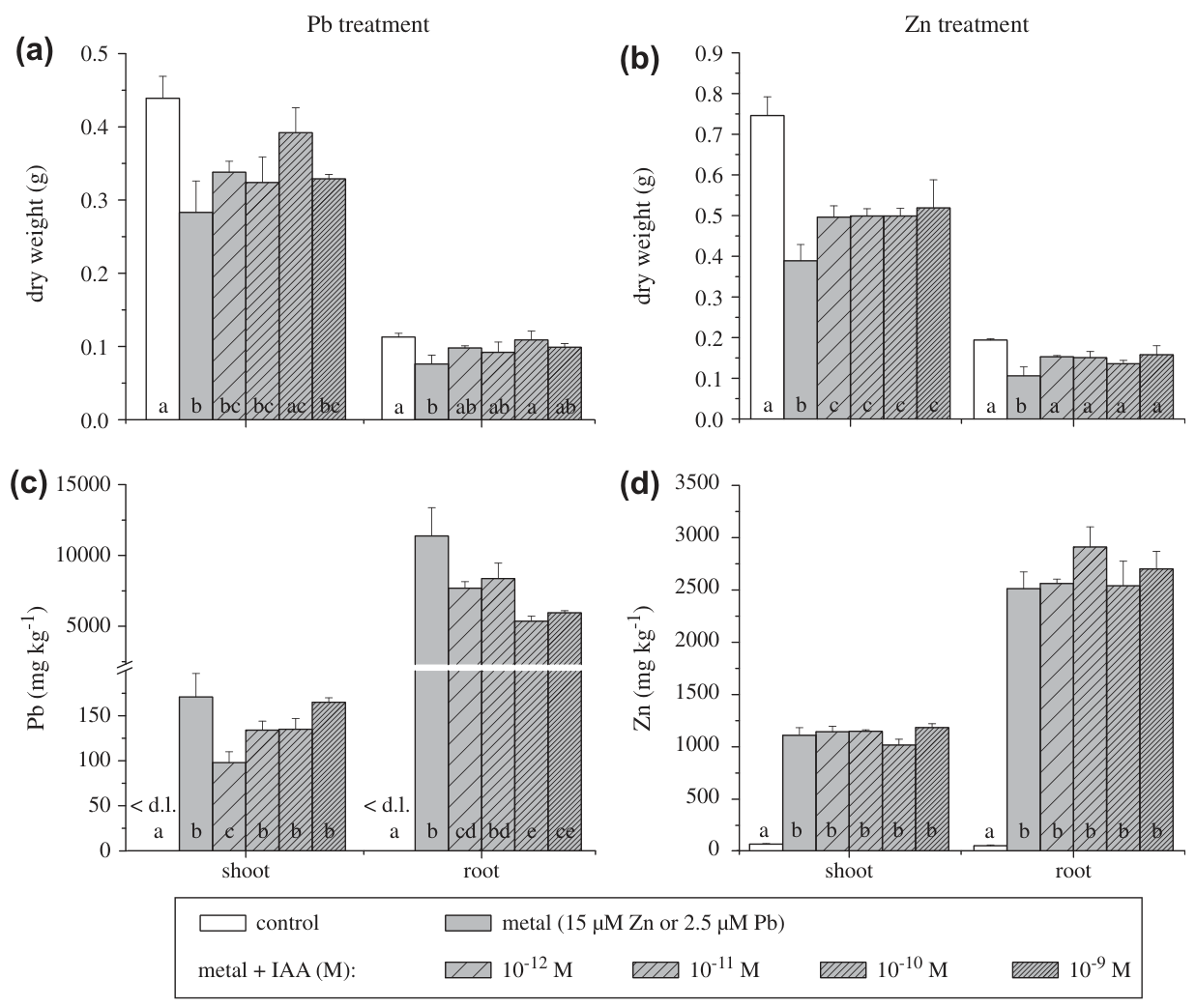
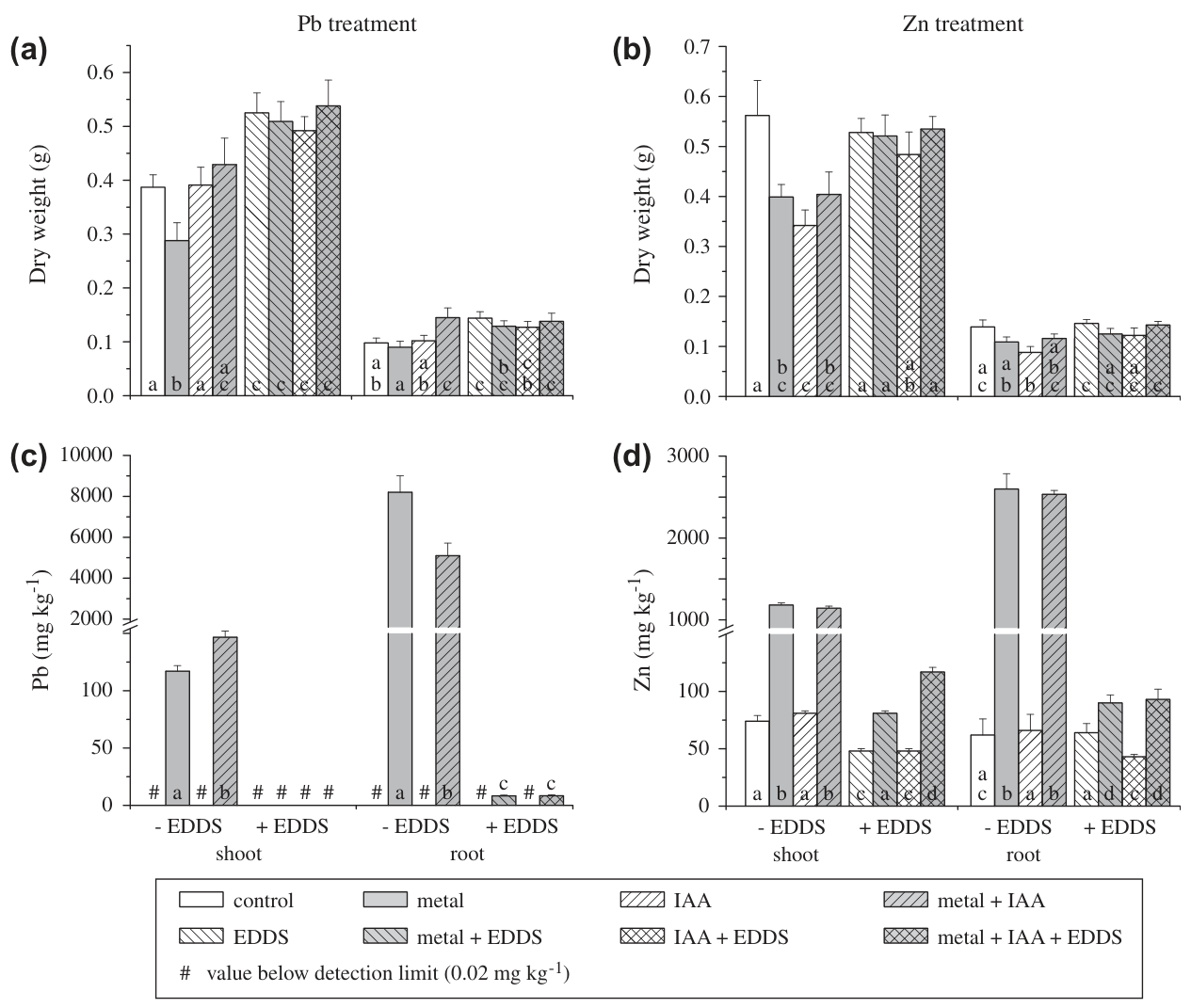
The application of Zn decreased shoot dry weight by 30–50% in absence of IAA and EDDS (Figs. 1b and 2b). The application of Pb led to a similar but smaller effect (Figs. 1a and 2a). Also root dry weight was decreased by the metals, but the effect was only significant in the first set of experiments (Fig. 1a and b). The metal-induced decreases in root dry weight were associated with decreases in root volume, surface area and length (Table 1). 3.3. Effect of different IAA concentrations on growth and metal uptake of Pb or Zn stressed sunflowers
在不施加IAA和EDDS的条件下,施加Zn使地上部干重降低30–50%(图1b和图2b)。施加Pb产生了类似但较小的效应(图1a和图2a)。金属也降低了根干重,但该效应仅在第一组试验中显著(图1a和b)。金属引起的根干重降低与根体积、表面积和长度的降低相关(表1)。3.3. 不同IAA浓度对Pb或Zn胁迫向日葵生长和金属吸收的影响
3.3. Effect of different IAA concentrations on growth and metal uptake3.3. 不同IAA浓度对生长和金属吸收的影响
Toxic effects of Pb on shoot and root growth (dry weight) were alleviated by the addition of 10�10 M IAA in both experimental sets (Figs. 1a and 2a). Plant growth also increased at the other levels of applied IAA concentrations, but not significantly. Parallel to increasing root dry weight, the application of 10�10 M IAA to Pb-stressed plants also increased root volume, surface area and diameter in both experiments. Root length was not affected by IAA under Pb stress in the first experiment, but significantly increased in the second experiment. Root density of Pb-stressed plants remained unchanged in both experiments.
在两组试验中,添加10−10 M IAA均缓解了Pb对地上部和根系生长(干重)的毒害效应(图1a和图2a)。在其他IAA施加浓度下植物生长也有所增加,但不显著。在根干重增加的同时,对Pb胁迫植物施加10−10 M IAA在两组试验中还增加了根体积、表面积和直径。在Pb胁迫下,第一组试验中根长度未受IAA影响,但在第二组试验中显著增加。两组试验中Pb胁迫植物的根密度均保持不变。
In the first experiment, the shoot Pb concentration of plants exposed to Pb was lower in combination with 10�12 M IAA than without IAA application (Fig. 1c). All other IAA concentrations had no significant effect on shoot Pb accumulation, although there was a trend for the lower IAA concentrations to decrease Pb accumulation. In contrast, shoot Pb concentration was increased by the application of 10�10 M IAA in the second experiment. Root Pb concentrations were decreased by IAA in both experiments. In the first experiment this effect was strongest at the two highest IAA concentrations (Fig. 1c). In the second experiment Pb concentrations of Pb-exposed roots were around 40% lower in the presence than in the absence of 10�10 M IAA. In contrast to our findings, López et al. (2005) had observed the opposite effect in hydroponically grown Medicago sativa L. treated with 200 lM Pb and 1, 10 and 100 lM IAA. In their study Pb concentrations increased in the roots with increasing IAA concentrations in the nutrient solution, while there was no trend in the shoots. They did not show data on plant growth, however, so that it is not clear whether the high Pb concentration applied may have been already in the phytotoxic range. Liu et al. (2007) on the other hand found that 100 lM IAA increased shoot Pb accumulation of Sedum alfredii Hance plants exposed to 200 lM Pb in nutrient solution. As in our experiment, they observed increased dry weight, root surface area, root volume as well as root length by the application of IAA.
在第一组试验中,暴露于Pb的植物在配合施加10−12 M IAA时地上部Pb浓度低于未施加IAA时(图1c)。其他IAA浓度对地上部Pb积累均无显著影响,但较低IAA浓度有降低Pb积累的趋势。相反,在第二组试验中,施加10−10 M IAA提高了地上部Pb浓度。两组试验中IAA均降低了根中Pb浓度。在第一组试验中,该效应在两个最高IAA浓度下最强(图1c)。在第二组试验中,存在10−10 M IAA时,暴露于Pb的根中Pb浓度比不存在时低约40%。与我们的结果相反,López et al. (2005)在以200 μM Pb和1、10和100 μM IAA处理的水培紫花苜蓿(Medicago sativa L.)中观察到了相反的效应。在其研究中,根中Pb浓度随营养液中IAA浓度的增加而升高,而地上部则无明显趋势。但他们未给出植物生长数据,因此尚不清楚所施加的高浓度Pb是否已处于植物毒性范围。另一方面,Liu et al. (2007)发现,100 μM IAA增加了营养液中暴露于200 μM Pb的Sedum alfredii Hance植株的地上部Pb积累。与我们的试验一样,他们也观察到施加IAA增加了干重、根表面积、根体积以及根长度。
General trend of metal and IAA effects. Effects on root growth, derived from both sets of experiments (treatments: control, metal only, metal + 10�10 M IAA).
金属和IAA效应的总体趋势。基于两组试验得出的对根系生长的影响(处理:对照、仅金属、金属 + 10−10 M IAA)。
| Treatment处理 | Dry we | ight干重 | Volum体积 | e | Surface area表面积 | Length长度 | Diame直径 | ter | Densit密度 | y |
|---|---|---|---|---|---|---|---|---|---|---|
| M | A + M | M | A + M | M A + M | M A + M | M | A + M | M | A + M | |
| IAA + Pb | ; | " | ; | " | ; " | ; % | ; | " | ? | % |
| IAA + Pb + EDDS | ? | " | ? | " | ? " | ? " | ? | ; | ? | ? |
| IAA + Zn | ; | " | ; | % | ; % | ; ? | ? | ? | ; | " |
| IAA + Zn + EDDS | ? | ? | ; | % | ; % | ; % | ? | ? | ? | ? |
| General trend | ; | " | ; | " | ; " | ; " | ? | s | ? | " |
", Increased; ;, decreased; ?, unchanged; %, trend to increase; &, trend to decrease; s, ambiguous; M: metal vs. control treatment; A + M: IAA + metal vs. metal treatment. The combination ‘‘; %” means that there was neither a significant difference between A + M and M, nor between A + M and control, while there was a significant M effect (vs. control). The combination ‘‘? %”means that there was a significant difference between A + M and control, but no significant M effect.
", 增加;;,降低;?,不变;%,有增加趋势;&,有降低趋势;s,不明确;M:金属处理 vs. 对照处理;A + M:IAA + 金属处理 vs. 金属处理。组合“; %”表示A + M与M之间以及A + M与对照之间均无显著差异,而M效应(相对于对照)显著。组合“? %”表示A + M与对照之间存在显著差异,但M效应不显著。
Similarly as in the case of Pb stress, IAA reduced the phytotoxic effects of Zn at all applied concentrations in the first experiment (Fig. 1b). Root dry weight was even fully restored at all IAA concentrations (Fig. 1b). Also root density was restored, whereas IAA had no effect on the other root parameters of Zn-stressed plants in the first experiment (Table 1). In the second experiment Zn toxicity effects were not alleviated by IAA addition. In contrast, IAA appeared to have a negative growth effect that was not observed in the Pb experiment, although the applied treatments were the same when no metal was added (Fig. 2b). Indole-3-acetic acid had no influence on Zn uptake in both experiments in the absence of EDDS.
与Pb胁迫的情况类似,在第一组试验中,所有施加浓度的IAA均减轻了Zn的植物毒性效应(图1b)。在所有IAA浓度下,根干重甚至完全恢复(图1b)。根密度也得以恢复,而在第一组试验中IAA对Zn胁迫植物的其他根系参数无影响(表1)。在第二组试验中,添加IAA未能缓解Zn的毒性效应。相反,IAA似乎产生了在Pb试验中未观察到的负面生长效应,尽管在不添加金属时所施加的处理是相同的(图2b)。在不存在EDDS的条件下,吲哚-3-乙酸在两组试验中对Zn吸收均无影响。
Table 2 summarizes the observed effects of IAA (10�10 M), Pb and Zn (derived from the histograms in Figs. 1 and 2 and from Table 1) on root growth in the two sets of experiments. It clearly表2总结了两组试验中观察到的IAA(10−10 M)、Pb和Zn对根系生长的影响(依据图1和图2的柱状图以及表1得出)。该表清楚地
shows that IAA has considerable potential to alleviate metal stress, although this did not become manifest in all cases in our experiments. The findings confirm a general role of IAA in stress alleviation also found by other authors (Chaudhry and Rasheed, 2003; Liu et al., 2007). In the presence of metals IAA generally had a positive effect on those root growth parameters that were negatively affected by the metals. In particular it compensated the metal-induced decreases in root dry weight, volume, surface area and length, which were reduced by both metals. Root diameter and density were much less sensitive to metal stress.
表明,IAA具有相当大的缓解金属胁迫的潜力,尽管在我们的试验中并非在所有情况下均得以体现。这些发现证实了其他作者同样发现的IAA在缓解胁迫中的普遍作用(Chaudhry and Rasheed, 2003; Liu et al., 2007)。在存在金属时,IAA通常对受金属负面影响的根系生长参数具有正面作用。特别是,它补偿了由两种金属共同引起的根干重、体积、表面积和长度的降低。根直径和密度对金属胁迫的敏感性则低得多。
The fact that IAA-induced increases in shoot dry matter were not accompanied by decreased shoot Pb or Zn concentrations, but rather by increased metal accumulation, means that also total metal extraction was increased, indicating that IAA has some potential to enhance phytoextraction of polluting metals. However, one has to be aware that the stress-mitigating effect of IAA cannot be expected to work at high levels of phytotoxicity. Liphadzi et al. (2006) grew sunflowers on a moderately and a highly contaminated soil. Adding IAA increased the biomass of the roots and stems in the moderately contaminated soil, but did not change growth on the highly contaminated soil, indicating an upper limit of metal stress that can be alleviated by IAA.
IAA引起的地上部干物质增加并未伴随地上部Pb或Zn浓度的降低,反而伴随金属积累量的增加,这意味着金属提取总量也有所增加,表明IAA在强化污染金属植物提取方面具有一定潜力。然而须注意,在植物毒性水平较高时,不能期望IAA的胁迫缓解效应发挥作用。Liphadzi et al. (2006)在中度和重度污染土壤上种植向日葵。添加IAA增加了中度污染土壤中根和茎的生物量,但未改变重度污染土壤上的生长,表明IAA所能缓解的金属胁迫存在上限。
3.4. Effect of EDDS3.4. EDDS的影响
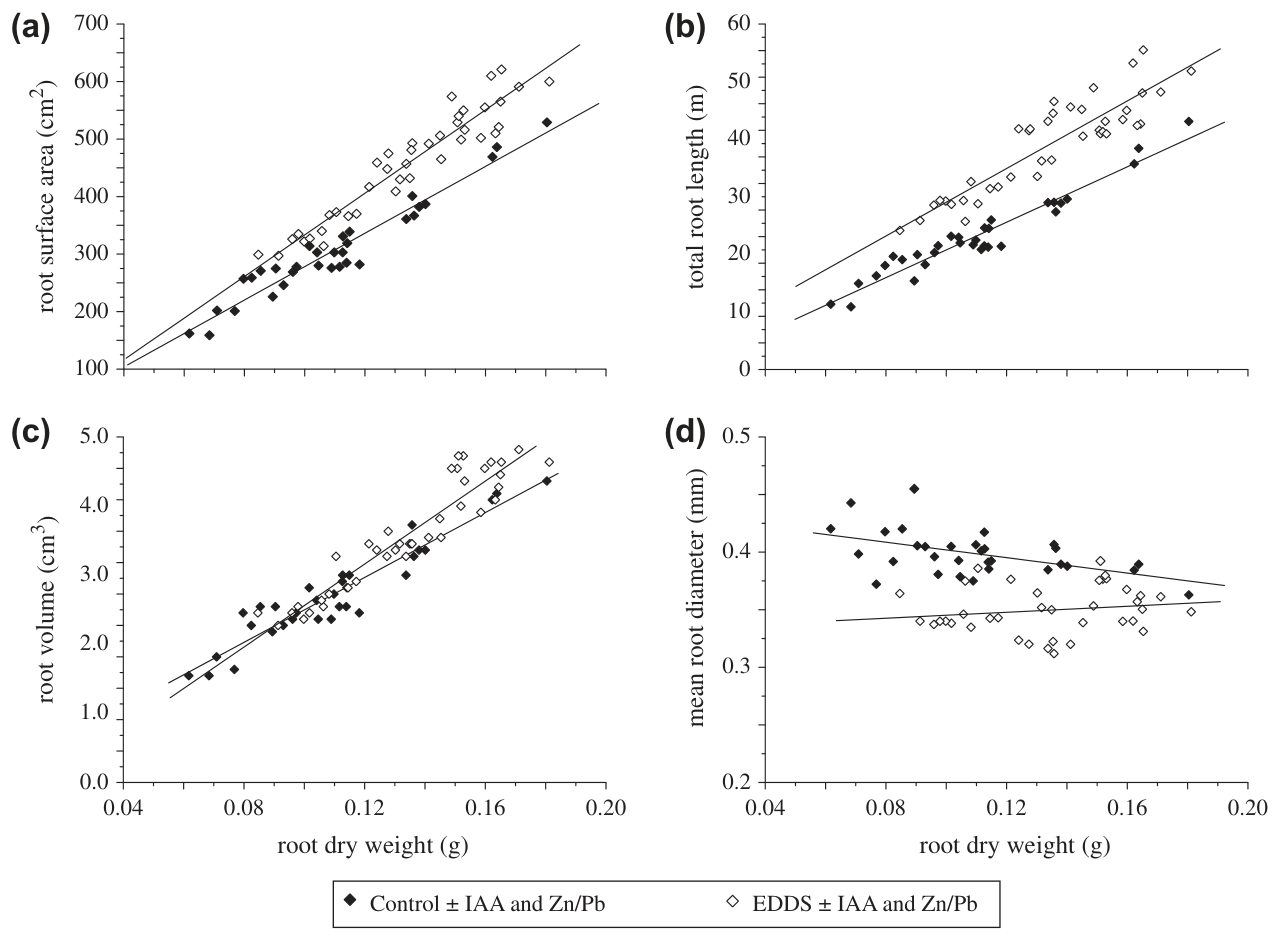
The application of EDDS had a positive effect on plant growth independent of metal stress and IAA application (Fig. 2). The EDDS-treated plants generally (with or without IAA and heavy metals) looked healthier than the plants that were not exposed to EDDS. Plants treated with EDDS in general developed root systems of larger dry weight, volume, length and surface area than plants grown in solution without EDDS. They also showed a higher ratio between root surface area and root dry weight (Fig. 3a) and between root length and root dry weight (Fig. 3b), whereas the ratio between mean root diameter and root dry weight was decreased and root mass density was not affected (Fig. 3d). EDDS thus induced growth of longer and thinner roots, leading to an increased outer surface, per unit mass (and volume) of root tissue (Fig. 3c).
无论是否存在金属胁迫和施加IAA,施加EDDS均对植物生长具有正面作用(图2)。经EDDS处理的植物(无论是否施加IAA和重金属)总体上比未接触EDDS的植物看起来更为健康。总体而言,经EDDS处理的植物所形成的根系在干重、体积、长度和表面积上均大于在不含EDDS溶液中生长的植物。它们还表现出更高的根表面积与根干重之比(图3a)以及根长度与根干重之比(图3b),而平均根直径与根干重之比降低,根质量密度则未受影响(图3d)。因此,EDDS诱导形成了更长、更细的根,使单位质量(及体积)根组织的外表面积增加(图3c)。
Metal uptake was strongly decreased by EDDS. Zinc accumulation by the roots of Zn-stressed plants was decreased by approximately a factor of 29 and shoot Zn by a factor of 15. Root Pb was decreased by three orders of magnitude and shoot Pb to a value below the detection limit (0.02 mg kg�1). This decrease can be attributed to the formation of stable metal-EDDS complexes, reducing the free ion concentrations of the metals and thus their availability to be taken up by and to react with the roots. Alleviation of metal toxicity through the addition of EDDS was also found in Custressed hydroponically grown Chrysanthemum coronarium L. by Wei et al. (2007), where the addition of EDDS increased biomass and decreased Cu concentration of roots and shoots. Tandy et al. (2006a) observed that EDDS alleviated metal stress on sunflowers grown in hydroponic solution with high concentrations of Cu, Zn and Pb.
EDDS显著降低了金属吸收。Zn胁迫植物根中的Zn积累量降低了约29倍,地上部Zn降低了15倍。根中Pb降低了3个数量级,地上部Pb降至检出限(0.02 mg kg−1)以下。这种降低可归因于稳定的金属-EDDS络合物的形成,从而降低了金属的自由离子浓度,进而降低了其被根系吸收以及与根系发生反应的有效性。Wei et al. (2007)在Cu胁迫的水培茼蒿(Chrysanthemum coronarium L.)中也发现添加EDDS可缓解金属毒性,添加EDDS增加了生物量并降低了根和地上部的Cu浓度。Tandy et al. (2006a)观察到,EDDS缓解了在含高浓度Cu、Zn和Pb的水培溶液中生长的向日葵所受的金属胁迫。
The EDDS effects on plants that were not exposed to Pb or Zn contamination show that reduction of toxicity and plant uptake of these metals was not the only way in which EDDS had a positive effect on plant growth. The additional growth-promoting EDDS effect may have been due to enhanced Fe translocation to the shoots. Plants grown in absence of EDDS had a mean shoot Fe concentration of 75 ± 8 mg kg�1, which is at the lower end of the range of sufficient Fe nutrition (50–250 mg kg�1) of sunflowers (Bergmann, 1993). In the presence of EDDS the shoot Fe concentration increased to 119 ± 6 mg kg�1. Root Fe concentration was decreased by the EDDS application from 6609 ± 308 to 143 ± 8 mg kg�1. Whereas in the roots the metal mobilization effect of EDDS was the same for Fe as for the other metals, the EDDS effect on root– shoot translocation of Fe (i.e. increase) was opposite to that observed for Pb and Zn (i.e. decrease). The same contrast was also found between Fe and Cu. EDDS reduced the Cu concentration in the roots from 174 ± 6 to 35.4 ± 2.1 mg kg�1 and in the shoots from 21.4 ± 0.5 to 12.6 ± 0.3 mg kg�1.
EDDS对未暴露于Pb或Zn污染的植物的影响表明,降低这些金属的毒性及植物对其的吸收并非EDDS对植物生长产生正面作用的唯一途径。EDDS额外的促生长效应可能源于Fe向地上部转运的增强。在不存在EDDS时生长的植物,地上部平均Fe浓度为75 ± 8 mg kg−1,处于向日葵Fe营养充足范围(50–250 mg kg−1)的下限(Bergmann, 1993)。在存在EDDS时,地上部Fe浓度增至119 ± 6 mg kg−1。施加EDDS使根中Fe浓度由6609 ± 308降至143 ± 8 mg kg−1。在根中,EDDS对Fe的金属活化效应与对其他金属相同,但EDDS对Fe由根向地上部转运的影响(即增加)与对Pb和Zn观察到的影响(即降低)相反。Fe与Cu之间也存在同样的差异。EDDS使根中Cu浓度由174 ± 6降至35.4 ± 2.1 mg kg−1,地上部由21.4 ± 0.5降至12.6 ± 0.3 mg kg−1。
3.5. Combination effect of EDDS and IAA3.5. EDDS与IAA的联合效应
In absence of contaminating heavy metals, the application of IAA decreased root surface area and root length of EDDS-treated plants. In the presence of Zn IAA increased root length and decreased root diameter of EDDS-treated plants (Table 1). All other plant growth parameters remained unchanged. Growth of plants treated with Pb and EDDS remained unaffected by the application of IAA (Fig. 2 and Table 1). We did not find contradictions between the IAA effects on the growth of metal-treated plants between treatments with and without EDDS. The effects were just smaller or not significant in the presence of EDDS. The small impact of IAA on the growth of metal-treated plants in the presence of EDDS was probably due to the fact that the metal stress was already alleviated by the EDDS application. Thus there was little or nothing to alleviate anymore.
在不存在污染重金属时,施加IAA降低了EDDS处理植物的根表面积和根长度。在存在Zn时,IAA增加了EDDS处理植物的根长度并降低了根直径(表1)。其他植物生长参数均保持不变。经Pb和EDDS处理的植物生长未受施加IAA的影响(图2和表1)。在有无EDDS的处理之间,IAA对金属处理植物生长的影响并无矛盾,只是在存在EDDS时效应较小或不显著。在存在EDDS时IAA对金属处理植物生长的影响较小,可能是由于金属胁迫已被施加的EDDS所缓解,因此已几乎没有或完全没有需要缓解的胁迫。
Shoot Zn concentration, however, was increased by IAA in EDDS-treated plants with Zn applications (Fig. 2d). As root length was the only root growth parameter found to increase after IAA application in the combined EDDS and Zn treatment, root length may be an important factor for Zn uptake. This is in line with the results of a modeling study carried out by Gardner (1960), suggesting that root length was more important than root diameter in determining uptake of water and elements. Lead concentrations were below the detection limit. Thus, it is unclear whether IAA also had an impact on Pb uptake by EDDS-treated plants. An increased plant metal accumulation induced by auxin added to the nutrient solution of metal-stressed plants in the presence of a chelating agent was also found by Israr and Sahi (2008). Moreover, Zhou et al. (2007) observed a similar effect also in corn (Zea mays L.) grown on metal-polluted soil. Treating the soil with IAA in combination with EDTA or NTA increased metal uptake in comparison to treatments with the chelating agents alone.
然而,在施加Zn的EDDS处理植物中,IAA提高了地上部Zn浓度(图2d)。由于在EDDS与Zn联合处理中,根长度是施加IAA后唯一增加的根系生长参数,根长度可能是影响Zn吸收的重要因素。这与Gardner (1960)开展的模型研究结果一致,该研究表明在决定水分和元素吸收方面,根长度比根直径更为重要。Pb浓度低于检出限,因此尚不清楚IAA是否也影响了EDDS处理植物对Pb的吸收。Israr and Sahi (2008)也发现,在存在螯合剂时,向金属胁迫植物的营养液中添加生长素可提高植物的金属积累。此外,Zhou et al. (2007)在金属污染土壤上生长的玉米(Zea mays L.)中也观察到了类似效应:与单独施用螯合剂的处理相比,IAA与EDTA或NTA配合处理土壤提高了金属吸收。
4Conclusion结论
The experiments showed that the addition of IAA (10�10 M) to nutrient solution can alleviate Zn and Pb stress in sunflowers by promoting root growth. In particular, IAA reduced negative metal effects on root and shoot dry weight, root length, root volume and root surface area. The application of EDDS promoted plant growth and alleviated the stress of the applied metals to a degree that no substantial stress remained to be alleviated by additional IAA application. No conclusion concerning IAA effects on Pb uptake in the presence of EDDS is possible, because plant Pb concentrations were below the detection limit in all EDDS treatments. Zinc uptake of plants exposed to Zn contamination of the hydroponic solution, however, was increased by IAA in the presence of EDDS. The combination of IAA with EDDS thus showed potential to enhance phytoextraction and should be further tested with contaminated soil.
试验表明,向营养液中添加IAA(10−10 M)可通过促进根系生长缓解向日葵所受的Zn和Pb胁迫。特别是,IAA减轻了金属对根和地上部干重、根长度、根体积和根表面积的负面影响。施加EDDS促进了植物生长,并将所施加金属的胁迫缓解至不再有明显胁迫需要额外施加IAA来缓解的程度。由于所有EDDS处理中植物Pb浓度均低于检出限,因此无法就存在EDDS时IAA对Pb吸收的影响得出结论。然而,在存在EDDS时,IAA提高了暴露于水培溶液Zn污染的植物对Zn的吸收。因此,IAA与EDDS的联合使用显示出强化植物提取的潜力,应在污染土壤中进一步检验。
Acknowledgements致谢
We are grateful to Björn Studer, Viktor Stadelmann, Annina Bürgi and Alexander Pirochta for their great help in the laboratory, and to Nelson Marmiroli and Marta Marmiroli for giving good and helpful advices.
感谢Björn Studer、Viktor Stadelmann、Annina Bürgi和Alexander Pirochta在实验室工作中给予的大力帮助,感谢Nelson Marmiroli和Marta Marmiroli提出的宝贵且有益的建议。
References参考文献
Bergmann, W., 1993. Ernährungsstörungen bei Kulturpflanzen. Gustav Fischer Verlag, Stuttgart, Jena.
Blaylock, M.J., Salt, D.E., Dushenkov, S., Zakharova, O., Gussman, C., Kapulnik, Y., Ensley, B.D., Raskin, I., 1997. Enhanced accumulation of Pb in indian mustard by soil-applied chelating agents. Environ. Sci. Technol. 31, 860–865.
Chaudhry, N.Y., Rasheed, S., 2003. Study of the external and internal morphology of Pisum sativum L., with growth hormones i.e., indole-3-acetic acid and kinetin and heavy metal i.e., lead nitrate. Pak. J. Biol. Sci. 6, 407–412.
Clarkson, D.T., 1996. Root structure and sites of ion uptake. In: Waisel, Y., Eshel, A., Kafkafi, U. (Eds.), Plant Roots: The Hidden Half. Marcel Dekker, New York, USA, pp. 483–510.
Egamberdieva, D., 2009. Alleviation of salt stress by plant growth regulators and IAA producing bacteria in wheat. Acta Physiol. Plant 31, 861–864.
Gardner, W.R., 1960. Dynamic aspects of water availability to plants. Soil Sci. 89, 63–73.
Gaspar, T., Faivre-Rampant, O., Kevers, C., Dommes, J., Hausman, J.-F., 2002. Auxins in the biology of roots. In: Waisel, Y., Eshel, A., Kafkafi, U. (Eds.), Plant Roots the Hidden Half. Marcel Dekker, New York, Basel, pp. 383–403.
Haynes, R.J., 1980. Ion exchange properties of roots and ionic interactions within the root apoplasm: their role in ion accumulation by plants. Bot. Rev. 46, 75–99. Huang, J.W.W., Chen, J.J., Berti, W.R., Cunningham, S.D., 1997. Phytoremediation of lead-contaminated soils: role of synthetic chelates in lead phytoextraction. Environ. Sci. Technol. 31, 800–805.
Israr, M., Sahi, S.V., 2008. Promising role of plant hormones in translocation of lead in Sesbania drummondii shoots. Environ. Pollut. 153, 29–36.
Jagnow, G., Höflich, G., Hoffmann, K.H., 1991. Inoculation of non-symbiotic rhizosphere bacteria – possibilities of increasing and stabilizing yields. Angew. Bot. 65, 97–126.
Kulli, B., Balmer, M., Krebs, R., Lothenbach, B., Geiger, G., Schulin, R., 1999. The influence of nitrilotriacetate on heavy metal uptake of lettuce and ryegrass. J. Environ. Qual. 28, 1699–1705.
Leinhos, V., Bergmann, H., 1995. Influence of auxin producing rhizobacteria on root morphology and nutrient accumulation of crops. II. Root growth promotion and nutrient accumulation of maize (Zea mays L.) by inoculation with indole-3- acetic-acid (IAA) producing pseudomonas strains and by exogenously applied IAA under different water supply conditions. Angew. Bot. 69, 37–41.
Liphadzi, M.S., Kirkham, M.B., Paulsen, G.M., 2006. Auxin-enhanced root growth for phytoremediation of sewage–sludge amended soil. Environ. Technol. 27, 695– 704.
Lippmann, B., Leinhos, V., Bergmann, H., 1995. Influence of auxin producing rhizobacteria on root morphology and nutrient accumulation of crops. I. Changes in root morphology and nutrient accumulation in maize (Zea mays L.) caused by inoculation with indole-3-acetic-acid (IAA) producing Pseudomonas and Acinetobacter strains or IAA applied exogenously. Angew. Bot. 69, 31–36.
Liu, D., Li, T., Yang, X., Islam, E., Jin, X., Mahmood, Q., 2007. Enhancement of lead uptake by hyperaccumulator plant species Sedum alfredii Hance using EDTA and IAA. Bull. Environ. Contamin. Toxicol. 78, 280–283.
López, M.L., Peralta-Videa, J.R., Benitez, T., Gardea-Torresdey, J.L., 2005. Enhancement of lead uptake by alfalfa (Medicago sativa) using EDTA and a plant growth promotor. Chemosphere 61, 595–598.
Marschner, H., 1995. Mineral Nutrition of Higher Plants. Academic Press, London. Salisbury, F.B., Ross, C.W., 1992. Plant Physiology. Wadsworth Publishing Company, Belmont, California.
Sheng, X.F., Xia, J.J., 2006. Improvement of rape (Brassica napus) plant growth and cadmium uptake by cadmium-resistant bacteria. Chemosphere 64, 1036–1042. Taiz, L., Zeiger, E., 2000. Physiologie der Pflanzen. Spektrum Akademischer Verlag, Heidelberg, Berlin.
Tandy, S., Schulin, R., Nowack, B., 2006a. The influence of EDDS on the uptake of heavy metals in hydroponically grown sunflowers. Chemosphere 62, 1454– 1463.
Tandy, S., Schulin, R., Nowack, B., 2006b. Uptake of metals during chelant-assisted phytoextraction with EDDS related to the solubilized metal concentration. Environ. Sci. Technol. 40, 2753–2758.
Wei, L., Luo, C.L., Wang, C.C., Li, X.D., Shen, Z.G., 2007. Biodegradable chelating agent ethylene diaminedisuccinic acid reduces uptake of copper through alleviation of copper toxicity in hydroponically grown Chrysanthemum coronarium L. Environ. Toxicol. Chem. 26, 749–754. Zhou, J.-M., Dang, Z., Chen, N.-C., Xu, S.-G., Xie, Z.-Y., 2007. Enhanced phytoextraction of heavy metal contaminated soil by chelating agents and auxin indole-3-acetic acid. Environ. Sci. 28, 2085–2088.