Contents lists available at ScienceDirect journal homepage: www.elsevier.com/locate/jhazmat
Omar Cano-Reséndiz a, Guadalupe de la Rosa a,∗, Gustavo Cruz-Jiménez b, Jorge L. Gardea-Torresdey c, Brett H. Robinson d
a Departamento de Ingeniería Química, Universidad de Guanajuato, Noria Alta s/n, CP 36050 Guanajuato, Mexico b Departamento de Farmacia, Universidad de Guanajuato, Noria Alta s/n, CP 36050 Guanajuato, Mexico c Chemistry Department and Environmental Science and Engineering, Ph.D. Program, The University of Texas at El Paso, 500 W. University Ave., 79968 El Paso, TX, USA d Agriculture and Life Sciences, Lincoln University, P.O. Box 84 Lincoln, Canterbury 7646, New Zealand
a Departamento de Ingeniería Química, Universidad de Guanajuato, Noria Alta s/n, CP 36050 Guanajuato, Mexico b Departamento de Farmacia, Universidad de Guanajuato, Noria Alta s/n, CP 36050 Guanajuato, Mexico c Chemistry Department and Environmental Science and Engineering, Ph.D. Program, The University of Texas at El Paso, 500 W. University Ave., 79968 El Paso, TX, USA d Agriculture and Life Sciences, Lincoln University, P.O. Box 84 Lincoln, Canterbury 7646, New Zealand
a r t i c l e i n f o
a b s t r a c t
Article history: Received 18 November 2010 Received in revised form 16 February 2011 Accepted 18 February 2011 Available online 24 February 2011
Keywords: Phyto-DSS Phytomanagement Phytoremediation Boron Aloe vera Poplar
关键词:Phyto-DSS 植物管理 植物修复 硼 Aloe vera 杨树
We identified contaminants associated with the Cata mine tailing depot located in the outskirts of the city of Guanajuato, Mexico. We also investigated strategies for their phytomanagement. Silver and antimony were present at 39 and 31 mg kg−1, respectively, some twofold higher than the Dutch Intervention Values. Total and extractable boron (B) occurred at concentrations of 301 and 6.3 mg L−1, respectively. Concentrations of B in soil solution above 1.9 mg L−1 have been shown to be toxic to plants. Plant growth may also be inhibited by the low concentrations of extractable plant nutrients. Analysis of the aerial portions of Aloe vera (L. Burm.f.) revealed that this plant accumulates negligible concentrations of the identified contaminants. Calculations using a whole system model (Phyto-DSS) showed that establishing a crop of A. vera would have little effect on the drainage or leaching from the site. However, this plant would reduce wind and water erosion and potentially produce valuable cosmetic products. In contrast, crops of poplar, a species that is tolerant to high soil B concentrations, would mitigate leaching from this site. Alternate rows of trees could be periodically harvested and be used for timber or bioenergy.
本研究鉴定了墨西哥瓜纳华托市郊Cata尾矿库中的污染物,并探讨了其植物管理策略。银和锑的含量分别为39和31 mg kg−1,约为荷兰干预值的两倍。全量硼(B)和可提取态硼的浓度分别为301和6.3 mg L−1。已有研究表明,土壤溶液中B浓度超过1.9 mg L−1即对植物产生毒害。可提取态植物养分浓度较低也可能抑制植物生长。对芦荟(Aloe vera (L. Burm.f.))地上部分的分析表明,该植物对所鉴定污染物的累积量可忽略不计。利用整体系统模型(Phyto-DSS)的计算结果表明,种植A. vera对该场地的排水或淋溶影响甚微;但该植物可减少风蚀和水蚀,并有望产出有价值的化妆品原料。相比之下,杨树这一耐受高土壤B浓度的树种可减轻该场地的淋溶。可对隔行种植的树木定期采伐,用作木材或生物能源。
© 2011 Elsevier B.V. All rights reserved.
1Introduction引言
Historically, mining activities have resulted in the production of large volumes of tailings that detrimentally affect nearby zones due to wind and water transportation of contaminated material [1,2]. Tailings may have properties that make them unsuitable for plant growth. These include high concentrations of metals, low concentrations of plant nutrients and unusual pH values [3–5]. Commonly, mine tailings have a low water retention capacity [6], high electrical conductivity and steep slopes [7].
历史上,采矿活动产生了大量尾矿,受污染物质经风力和水力迁移,对周边区域造成不利影响[1,2]。尾矿的某些性质可能使其不适宜植物生长,包括高浓度金属、低浓度植物养分以及异常的pH值[3–5]。尾矿通常持水能力低[6]、电导率高且坡度陡[7]。
The Cata silver and gold mine has been active since the 18th century. From 1944 to 1948, some 320,000 t of tailings were deposited at a site that has become known as the Cata tailings on the outskirts of the town of Guanajuato and above the Guanajuato River. The site has an inclination of 18◦. In the 60 years following the tailings deposition, dust has affected nearby houses and locals have complained of respiratory problems. During periods of high rainfall, tailings material is usually washed into a small waterway that flows into the Guanajuato river which flows into the La Purisima dam that provides water to irrigate 4500 ha in the region that receives just 650 mm of rainfall annually [8,9]. Therefore, contaminants in the mine tailings may be transferred to agricultural soils and crops.
Cata银金矿自18世纪起即已开采。1944—1948年间,约320,000 t尾矿堆存于瓜纳华托镇郊、瓜纳华托河上方的一处场地,该场地后被称为Cata尾矿库。场地坡度为18◦。尾矿堆存后的60年间,扬尘影响了附近房屋,当地居民反映出现呼吸道问题。在强降雨期间,尾矿物质通常被冲入一条小水道,该水道汇入瓜纳华托河,后者又流入La Purisima水坝;该水坝为区域内4500 ha农田提供灌溉用水,而该区域年降雨量仅为650 mm[8,9]。因此,尾矿中的污染物可能向农业土壤和作物转移。
∗ Corresponding author. Tel.: +52 473 7320006x1406; fax: +52 473 7320006x8139.
∗ 通讯作者。电话:+52 473 7320006x1406;传真:+52 473 7320006x8139。
E-mail addresses: delarosa@quijote.ugto.mx,
g dela rosa@hotmail.com (G. de la Rosa).
In the 60 years since the tailings were deposited, plants have sporadically colonised the tailings. The most important with respect to biomass and abundance is Aloe vera (L. Burm.f.). This plant is native to Africa. However, nowadays it is widely spread on arid Mexican soils and is used as a medicinal plant.
尾矿堆存后的60年间,植物零星地在尾矿上定植。就生物量和多度而言,最重要的是芦荟(Aloe vera (L. Burm.f.))。该植物原产于非洲,但如今已广泛分布于墨西哥干旱土壤上,并被用作药用植物。
Apart from anecdotal reports of respiratory complaints from the local population, the environmental and human health risks associated with these tailings are unknown. There is no available information on the chemical composition or physical properties of the tailings. Observation indicates that the tailings are mobile, so any contaminants contained therein may pose a threat to human health or ecosystem functioning.
除当地居民关于呼吸道不适的零星报道外,这些尾矿带来的环境和人体健康风险尚不清楚,也缺乏有关尾矿化学组成或物理性质的资料。观察表明,尾矿具有移动性,因此其中所含的任何污染物都可能对人体健康或生态系统功能构成威胁。
We hypothesise that these tailings contain elevated concentrations of heavy metals, since other mine tailings in the area contain elevated concentrations of As (168 mg kg−1), Zn (1129 mg kg−1), Pb (308 mg kg−1), and Cu (429 mg kg−1) [10,11].
鉴于该地区其他尾矿中As(168 mg kg−1)、Zn(1129 mg kg−1)、Pb(308 mg kg−1)和Cu(429 mg kg−1)浓度较高[10,11],本研究假设这些尾矿含有较高浓度的重金属。
Establishment of continuous vegetation cover on the Cata mine tailings could reduce environmental and human health risks [12]. The goal of such a phytomanagement programme would be to minimise the environmental risk associated with the tailings, while producing valuable biomass or enhancing the aesthetic or ecological value of the site. Evapotranspiration would reduce the water flux through the site and therefore reduce the leaching of any toxic heavy metals that may be present [13]. Establishment of vegetation would require the identification of regional and climatic specific plants which show low metal uptake in shoots and determination of the minimum requirements in amendments (compost, fertilizer, irrigation) required for plant growth [14].
在Cata尾矿上建立连续植被覆盖可降低环境和人体健康风险[12]。此类植物管理方案的目标是在生产有价值的生物量或提升场地美学或生态价值的同时,将尾矿相关的环境风险降至最低。蒸散作用可减少通过场地的水通量,从而减少可能存在的有毒重金属的淋溶[13]。建立植被需要筛选适应当地区域和气候条件、地上部金属吸收量低的植物,并确定植物生长所需改良措施(堆肥、施肥、灌溉)的最低要求[14]。
0304-3894/$ – see front matter © 2011 Elsevier B.V. All rights reserved. doi:10.1016/j.jhazmat.2011.02.059
0304-3894/$ – see front matter © 2011 Elsevier B.V. All rights reserved. doi:10.1016/j.jhazmat.2011.02.059
We also hypothesise that A. vera would be a suitable candidate for revegetation, since it has naturally colonised part of the tailings. The objectives of this research were to determine the chemical and physical characteristics of the tailings as well as elemental uptake by A. vera to determine the key factors limiting the establishment of vegetation and identify any elements that may pose an environmental or human health risk. Secondly, using these data to parameterise a whole-system model, we aimed to determine the effect of revegetation on contaminant fluxes in the Cata mine tailings by using the Phyto-DSS (Phyto Decission Support System).
本研究还假设,由于A. vera已在部分尾矿上自然定植,因此其可作为植被恢复的适宜候选植物。本研究的目的是:首先,测定尾矿的化学和物理特性以及A. vera对元素的吸收,以确定限制植被建立的关键因素,并识别可能构成环境或人体健康风险的元素;其次,利用这些数据对整体系统模型进行参数化,借助Phyto-DSS(植物修复决策支持系统)确定植被恢复对Cata尾矿污染物通量的影响。
2.2. Determination of extractable elements2.2. 可提取态元素的测定
Extractable element concentrations in soils were determined using water (0.4 g soil, 10 mL water) DTPA (1 g soil, 2 mL DTPA 0.005 M) and CaCl2 (1 g soil, 10 mL CaCl2 0.01 M), [17]. The concentration of elements in soil solution, C (mg L−1), was calculated from the concentration in the water extract W (mg kg−1) using the following formula [1]:
土壤中可提取态元素浓度分别采用水(0.4 g土壤,10 mL水)、DTPA(1 g土壤,2 mL 0.005 M DTPA)和CaCl2(1 g土壤,10 mL 0.01 M CaCl2)提取测定[17]。土壤溶液中元素浓度C(mg L−1)由水提取液中的浓度W(mg kg−1)按下式计算[1]:
C = W�F (1)
where W is the element concentration in the water extract (mg kg−1); F is the maximum content water in the soil (L L−1); � is the bulk density of the soil (kg L−1).
式中,W为水提取液中的元素浓度(mg kg−1);F为土壤最大含水量(L L−1);ρ为土壤容重(kg L−1)。
After centrifugation and filtration, concentrations of As, Ni, Pb, Zn, Cu, Cr, Ag, Cd, Mo, Se, B, Mn, S, Si, Fe, Ca, Mg were determined using inductively Coupled Plasma Optical Emission Spectroscopy (ICP-OES). For quality assurance reference materials from the US National Institute of Standards and Technology were also analysed. The recoveries of the aforementioned elements were (96% B, 98% Cd, 94% Mn, 98% Fe, 88% Cu in plants).
经离心和过滤后,采用电感耦合等离子体发射光谱法(ICP-OES)测定As、Ni、Pb、Zn、Cu、Cr、Ag、Cd、Mo、Se、B、Mn、S、Si、Fe、Ca、Mg的浓度。为保证质量,同时分析了美国国家标准与技术研究院(NIST)的标准参考物质。上述元素的回收率为(植物中B 96%、Cd 98%、Mn 94%、Fe 98%、Cu 88%)。
2Experimental实验部分
2.3. X-ray fluorescence analyses2.3. X射线荧光分析
2.1. Sampling procedure2.1. 采样方法
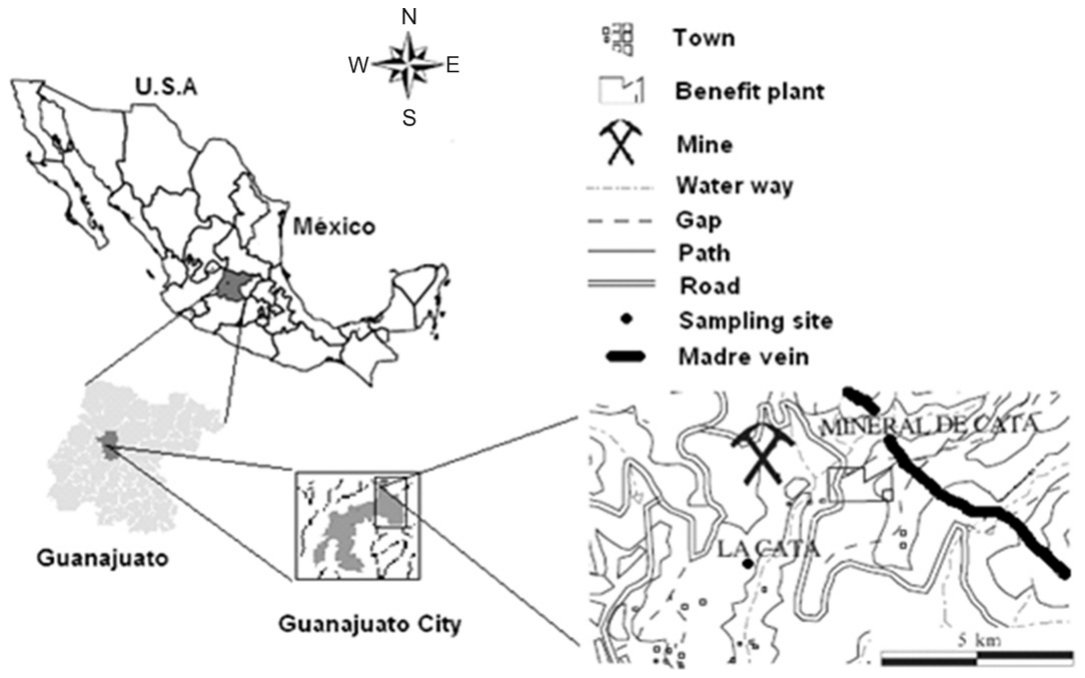
Between June and August of 2008, seven sites were selected for sampling on the Cata tailings (Fig. 1). At each site, 5 sub-samples of the tailings were sampled in a one meter radius. After removing surface litter, approximately 2 kg tailings were taken from a depth of 0–30 cm and mixed [15]. The tailings were air-dried, sieved to <2 mm and stored for analysis. We sampled roots and leaves of A. vera plants from three of the five sub-sampling locations per site. Plant samples were first washed with running tap water to remove debris, later with distilled water and finally with 0.01 M HNO3. Plants were separated into roots and stems and ovendried at 70 ◦C for 72 h. After drying, samples were ground using a mortar and pestle. For elemental analysis, approximately 0.2 g of plant tissue were microwave-oven digested using 3 mL plasma pure HNO3 [16]. Soils were digested in a similar manner using aqua regia.
2008年6—8月,在Cata尾矿上选取7个采样点(图1)。在每个采样点半径1 m范围内采集5个尾矿子样。去除表面凋落物后,在0–30 cm深度采集约2 kg尾矿并混合[15]。尾矿经风干、过<2 mm筛后保存待分析。在每个采样点5个子样位置中的3个采集A. vera植株的根和叶。植物样品先用自来水冲洗去除杂物,再用蒸馏水冲洗,最后用0.01 M HNO3冲洗。植物分为根和茎两部分,于70 ◦C烘干72 h。干燥后用研钵和研杵研磨样品。元素分析时,取约0.2 g植物组织,用3 mL等离子体级纯HNO3进行微波消解[16]。土壤样品采用王水以类似方法消解。
Soil samples were ground using a Retsch RS1 grinder with a tungsten carbide ball and ring. Plant samples were ground using a Retsch ZM200 titanium mill. Ground material (4 g) was mixed with 0.9 g of wax and pressed into tablets under a pressure of 15 t. The total element concentrations (Mg, Si, S, Ca, Cr, Mn, Fe, Co, Ni, Cu, Zn, As, Se, Mo, Cd, Sb, Hg) of the tablets were determined using a Spectro X-lab 2000 X-ray fluorescence (XRF) spectrometer. For quality assurance, we analysed 4 Wageningen soil standards, 958, 998, 989, and 951 as well as a certified plant reference material (poplar leaves NCS DC73350, China National Analysis Center for Iron and Steel, Beijing, China). The average recoveries for soils were: Ca 113%, Cu 117%, Fe 106%, Pb 115%, Mg 89%, Mn 112%, Ni 125%, Sb 121%, and Zn 101%. For the plant standard, the recoveries were: Ca 96%, Cu 101%, Fe 98%, Mg 67%, Mn 126%, Ni 89%, and Zn 99%. In the plant reference, Pb and Sb were below the detection limits of our method for plant samples (<2 mg kg−1).
土壤样品使用配有碳化钨球和环的Retsch RS1研磨机研磨,植物样品使用Retsch ZM200钛磨研磨。取研磨后的样品4 g与0.9 g蜡混合,在15 t压力下压制成片。采用Spectro X-lab 2000 X射线荧光(XRF)光谱仪测定压片中的元素全量(Mg、Si、S、Ca、Cr、Mn、Fe、Co、Ni、Cu、Zn、As、Se、Mo、Cd、Sb、Hg)。为保证质量,分析了4个Wageningen土壤标准样品(958、998、989和951)以及一种植物有证参考物质(杨树叶NCS DC73350,中国钢铁分析测试中心,中国北京)。土壤的平均回收率为:Ca 113%、Cu 117%、Fe 106%、Pb 115%、Mg 89%、Mn 112%、Ni 125%、Sb 121%、Zn 101%。植物标准样品的回收率为:Ca 96%、Cu 101%、Fe 98%、Mg 67%、Mn 126%、Ni 89%、Zn 99%。植物参考物质中Pb和Sb低于本方法对植物样品的检出限(<2 mg kg−1)。
2.4. Determination of soil agronomic properties2.4. 土壤农学性质的测定
The soil was sand silt clay [18] containing 0.59% organic matter [19]. The field capacity and permanent wilting point were determined by plate and membrane technical, the P content by the Olsen technique [20]. The NO3–N was determined using cadmium column [21]. Extractable K and cationic exchange capacity (CEC) were measured using ammonium acetate [22]. Soil pH was measured at a soil: solution ratio of 1:2 (soil: deionised water) and electrical conductivity determined using a conductivity meter [23]. All values of soil properties are shown in Table 2.
该土壤为砂质粉砂黏土[18],有机质含量为0.59%[19]。田间持水量和永久萎蔫点采用压力板和压力膜法测定,P含量采用Olsen法测定[20]。NO3–N采用镉柱法测定[21]。可提取态K和阳离子交换量(CEC)采用乙酸铵法测定[22]。土壤pH按土液比1:2(土壤:去离子水)测定,电导率采用电导率仪测定[23]。所有土壤性质数值见表2。
2.5. Statistical treatment of data2.5. 数据统计处理
MINITAB (Minitab Inc., Pennsylvania State University, University Park, Pennsylvania) was used for ANOVA (at the 5% level) and correlation analyses. Data that were log-normally distributed were log-transformed for statistical analyses. For log-normal data, we report geometric means and standard deviation ranges rather than means and standard deviations. With log-normal data, the geometric mean is a better measure of central tendency than the arithmetic mean. Use of geometric means reduces distortions caused by a few anomalous values and produces a value of better centrality.
采用MINITAB(Minitab Inc., Pennsylvania State University, University Park, Pennsylvania)进行ANOVA(5%显著性水平)和相关性分析。呈对数正态分布的数据经对数转换后进行统计分析。对于对数正态数据,报告几何均值和标准差范围,而非算术均值和标准差。对于对数正态数据,几何均值比算术均值更能反映集中趋势。采用几何均值可减少少数异常值造成的偏差,得到集中性更好的数值。
2.6. Modelling the effect of vegetation regime on drainage and contaminant leaching2.6. 植被模式对排水和污染物淋溶影响的模拟
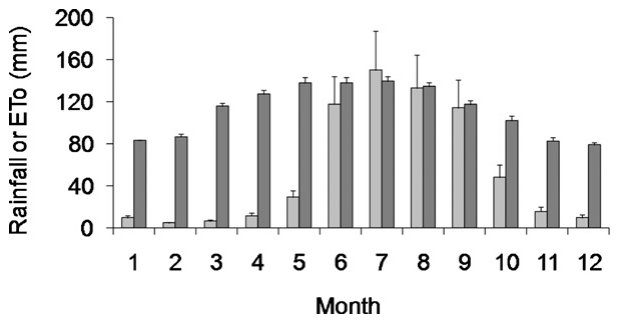
Long-term monthly averages for rainfall and potential evapotranspiration were obtained from Centro de Ciencias Atmosféricas de la Universidad de Guanajuato and Comisión Nacional del Agua [8,9]. Daily values were simulated for a 20-year period (2010–2030) using a climate simulator [24]. These data are shown in Fig. 2.
降雨量和潜在蒸散量的长期月平均值来自Centro de Ciencias Atmosféricas de la Universidad de Guanajuato和Comisión Nacional del Agua[8,9]。采用气候模拟器模拟了20年(2010—2030年)的日值[24]。相关数据见图2。
Simulations were run using the Phyto-DSS [13] to calculate the leaching from the mine tailings without vegetation and with hypothetical crops of A. vera (L.) and poplar species. Plant metal uptake was calculated using Eq. (2):
利用Phyto-DSS[13]进行模拟,计算尾矿在无植被以及假设种植A. vera (L.)和杨树物种条件下的淋溶量。植物金属吸收量按式2计算:

where M is plant metal uptake in the time interval (0, t; days). R is the fraction of the total root water uptake at depth z (m), T is the transpiration rate (L day−1), C is the TE concentration (mg L−1) in the soil solution, and � is the root absorption factor. Table 1 shows the plant parameters used in the Phyto-DSS.
式中,M为时间区间(0, t;d)内植物的金属吸收量;R为深度z(m)处根系吸水量占总根系吸水量的比例;T为蒸腾速率(L day−1);C为土壤溶液中微量元素(TE)的浓度(mg L−1);α为根系吸收系数。Phyto-DSS所用的植物参数见表1。
The movement of water and solutes in the substrate is calculated using a tipping-bucket approach similar to that described in [25]. These calculations used soil parameters shown in Table 1.
基质中水分和溶质的运移采用与文献[25]类似的“翻斗”(tipping-bucket)方法计算。计算所用土壤参数见表1。
Parameters used in the Phyto-DSS for Aloe vera and Populus spp.
Phyto-DSS中Aloe vera和Populus spp.所用参数。
| Aloe veraAloe vera | PopulusaPopulusa | |
|---|---|---|
| Root depth (m) | 0.8b | 1 |
| Water use efficiency (kg m−3) | 18c | 2 |
| Kc (max) | 0.20b | 1.00 |
| Root absorption factor for boron | 0.15 | 0.20 |
| a [45]. | ||
| b [46]. | ||
| c [47]. |
Physical and chemical properties of tailings from the Cata mine.
Cata尾矿的物理和化学性质。
| Cata tailingsCata尾矿 | Normal range正常范围 | |
|---|---|---|
| pH | 8.13 (<0.01) | 5–8.5a |
| Organic matter (%) | 0.59 (0.02) | 1–10a |
| Electrical conductivity (dS m−1) | 0.931 (0.01) | <2a |
| Cation exchange capacity (Cmol(+)kg−1) | 19.60 (0.15) | 5–40a |
| P (mg kg−1)–Olsen | 1.68 (<0.01) | 10–20a |
| N–NO3 (mg kg−1) | 2.93 (0.03) | 10–30b |
| K(ammonium acetate) (mg kg−1) | 39 (0.4) | 90–130c |
| Texture | ||
| Sand (%) | 63 (1) | – |
| Silt (%) | 26 (<0.01) | – |
| Clay (%) | 11 (1) | – |
| Saturation point (%) | 41 (0.6) | – |
| Field capacity (%) | 31 (0.4) | – |
| Permanent wilting point (%) | 20.5 (0.2) | – |
| Density (gr cm−3) | 1.15 (0.015) | – |
| Moisture (%) | 20.5 (0.02) | – |
| Data in brackets are standards deviation. a [15]. b [48]. | ||
| c [49]. |
3Results and discussion结果与讨论
3.1. Fertility of the Cata mine tailings3.1. Cata尾矿的肥力
Table 2 gives some chemical and physical soil properties affecting the potential of the Cata mine tailings for plant growth. The soil is moderately alkaline, indicating that excessive leaching or plant uptake of cationic trace elements is unlikely. However, anionforming trace elements may be more mobile at these pH values. The electrical conductivity of the tailings indicates that salinity is unlikely to negatively affect plant growth at this site.表2列出了影响Cata尾矿植物生长潜力的部分土壤化学和物理性质。该土壤呈中度碱性,表明阳离子型微量元素发生过量淋溶或被植物过量吸收的可能性不大;但在此pH条件下,形成阴离子的微量元素迁移性可能较强。尾矿的电导率表明,盐分不太可能对该场地的植物生长产生不利影响。
Concentrations of organic matter, nitrate-N and Olsen-P and exchangeable K are well below ranges that occur in fertile soils. This indicates that plant growth on this site is probably reduced due to the lack of nutrients.
有机质、硝态氮、Olsen-P和交换性K的浓度均远低于肥沃土壤的范围,表明该场地植物生长可能因养分缺乏而受到抑制。
The optimal available water content is in the range of 60–90% at field capacity [26]; however, the maximum available water content of these soils was low (10%) indicating that any plants used for revegetation should necessarily be drought tolerant.
最适有效水含量为田间持水量的60–90%[26];然而,这些土壤的最大有效水含量较低(10%),表明用于植被恢复的植物必须具有耐旱性。
3.2. Elemental contaminants in the Cata mine tailings3.2. Cata尾矿中的元素污染物
Table 3 shows the total and extractable concentrations of potential elemental contaminants in the Cata mine tailings as well as the Dutch Intervention Values, which are internationally recognised standards for assessing soil and groundwater quality [27]. Total concentrations of Ag and Sb exceed the respective Intervention Values for these elements in soils, indicating that they may pose a danger to humans or ecosystems. Although below detection limits in the extracts, the alkali nature of the tailings may favour the mobility of Sb, which is usually present in the environment as the oxy-anion Sb(OH)6− [28].表3列出了Cata尾矿中潜在元素污染物的全量和可提取态浓度,以及荷兰干预值——国际公认的土壤和地下水质量评价标准[27]。Ag和Sb的全量浓度超过了这些元素在土壤中的相应干预值,表明其可能对人类或生态系统构成危害。尽管提取液中Sb低于检出限,但尾矿的碱性可能有利于Sb的迁移,Sb在环境中通常以含氧阴离子Sb(OH)6−形式存在[28]。
Total concentration (mg kg−1) of main trace elements in the Cata mine tailings in various extracts. “Total” represents a pseudo-total obtained via an aqua regia digest. Values represent the geometric mean and standard deviation ranges in brackets unless otherwise indicated.
Cata尾矿中主要微量元素在不同提取剂中的浓度(mg kg−1)。“全量”表示经王水消解获得的准全量。除另有说明外,数值为几何平均值,括号内为标准差范围。
| Concentration in soil solution (mg L−1)土壤溶液中浓度(mg L−1) | Water (mg kg−1)水(mg kg−1) | CaCl2 (0.01 M) (mg kg−1)CaCl2(0.01 M)(mg kg−1) | DTPA (mg kg−1)DTPA(mg kg−1) | Total (mg kg−1)全量(mg kg−1) | DIV (mg kg−1) | |
|---|---|---|---|---|---|---|
| Ag | <0.01 | <0.01 | <0.005 | 0.003 (0.03)a | 39 (32–47) | 15 |
| Cr | 0.098 (0.049)a | 0.04 (0.02)a | 0.0007 (0.00024–0.002) | 0.009 (0.007–0.01) | 19 (16–21) | 380 |
| Cu | 0.78 (0.54–1.2) | 0.32 (0.22–0.48) | 0.06 (0.04–0.09) | 1.7 (1–3) | 25 (15–42) | 190 |
| Zn | 0.63 (0.27)a | 0.26 (0.11)a | 0.3 (0.2–0.4) | 1.9 (1.4–2.5) | 46 (34–63) | 720 |
| Pb | 0.49 (0.24–0.73) | 0.2 (0.1–0.3) | 0.0058 (0.002–0.014) | 1.43 (0.52–3.95) | 10 (5–20) | 530 |
| Ni | 0.049 (0.024)a | 0.02 (0.01)a | 0.065 (0.06–0.07) | 0.12 (0.02)a | 9 (7–11) | 210 |
| As | 0.27 (0.19–0.39) | 0.11 (0.08–0.16) | 0.79 (0.03)a | 0.39 (0.37–0.42) | 7 (5–9) | 55 |
| Cd | <0.007 | <0.007 | 0.006 (0.004–0.008) | 0.04 (0.03–0.06) | 0.17 (0.13–0.22) | 12 |
| Mo | 0.073 (0.024–0.19) | 0.03 (0.01–0.08) | <0.008 | <0.007 | 1.1 (1.03–1.1) | 200 |
| Se | 0.17 (0.073)a | 0.07 (0.03)a | 0.54 (0.51–0.59) | 0.53 (0.04)a | 2.3 (0,4)a | 100 |
| Hg | ND | ND | <0.02 | 0.46 (0.003)a | 2 (1.5–2.5) | 10 |
| Sb | ND | ND | <0.02 | <0.02 | 31 (4)a | 15 |
| B | 6.3 (0.49)a | 2.6 (0.2)a | 6.3 (0.6)a | 5.7 (1)a | 301 (34)a | – |
| Mn | 5.8 (2.3)a | 2.4 (0.94)a | 2.7 (1.9–3.9) | 23 (19–29) | 751 (716–788) | – |
| S | 17.3 (2–148) | 7.1 (0.8–60.6) | 109 (52–230) | 35 (13–94) | 507 (345–745) | – |
| Si | 349 (159)a | 143 (65)a | 15 (2)a | 6.5 (1.3)a | 151 (87–260) | – |
| Fe | 98 (45)a | 40.2 (18.4)a | 0.37 (0.09)a | 9.4 (7.9–11.2) | 9675 (7748–12082) | – |
| Ca | 703 (442–1117) | 288 (181–458) | 3953 (3751–4166) | 881 (725–1071) | 22369 (19823–25242) | – |
| Mg | 85 (68–105) | 35 (28–43) | 41 (9)a | 23 (18–31) | 6954 (6111–7915) | – |
Dutch Intervention values (DIV). Not determined (ND). a Arithmetic mean and standard deviation.
荷兰干预值(DIV)。未测定(ND)。a 算术平均值和标准差。
Table 4表4
Elemental concentrations (mg kg−1 dry matter) in seven samples of the Cata tailings and three samples of Aloe vera from the Cata mine tailings. Values in brackets are standard deviations. The MTIs for Sb and Hg are 0.86 and 2 ug kg−1 bodymass day−1. The TDI for silver was taken at 20 ug per person per day.
Cata尾矿7个样品及Cata尾矿上3个Aloe vera样品的元素浓度(mg kg−1干物质)。括号内数值为标准差。Sb和Hg的最大耐受摄入量(MTI)分别为0.86和2 μg kg−1体重 day−1。银的每日耐受摄入量(TDI)取每人每天20 μg。
| Element元素 | Concentration (mg kg−1)浓度(mg kg−1) | Maximum intake (g) (15 kg child)最大摄入量(g)(15 kg儿童) | Maximum intake (g) (70 kg adult)最大摄入量(g)(70 kg成人) |
|---|---|---|---|
| Tailings | |||
| Ag | 39 (32–47) | 0.5 | |
| Sb | 31 (4)a | 0.42 | 1.9 |
| Hg | 2 (1.5–2.5) | 15 | 70 |
| Aloe vera | |||
| Ag | 1 (0.6)a | 20 | |
| Sb | <0.3–0.7 | 18 | 86 |
| Hg | <0.4 | >75 | >350 |
MTIs references: Ag [29], Sb [50], Hg [51]. a Arithmetic mean and standard deviation.
MTI参考文献:Ag [29],Sb [50],Hg [51]。a 算术平均值和标准差。
Inhalation or consumption of dust particles may result in the ingestion of dangerous levels of some contaminants. Table 4 shows the amount of tailings that a child (15 kg) and adult (70 kg) would need to consume to exceed the Maximum Tolerable Intakes for the elements identified as contaminants in Table 4. Consumption of just 0.4 g of tailings per day would result in Sb intake above the MTIs of 0.86 �g kg−1 body mass day−1. This level of dust ingestion would also result in a total Ag intake of 20 �g day−1. In the stomach, where the low pH is due to the presence of hydrochloric acid, silver is precipitated as silver chloride. The low solubility of silver in the presence of chloride is consistent with its low bioavailability since oral administration of radio-labelled silver to mice, rats, monkeys and dogs has shown that 90% or more of oral doses were not absorbed [29].
吸入或摄入扬尘颗粒可能导致某些污染物的摄入量达到危险水平。表4列出了儿童(15 kg)和成人(70 kg)摄入多少尾矿会超过表4中所列污染元素的最大耐受摄入量。每天仅摄入0.4 g尾矿即可使Sb摄入量超过0.86 μg kg−1体重 day−1的MTI。该扬尘摄入水平还将导致Ag总摄入量达到20 μg day−1。在胃中,由于盐酸的存在pH较低,银以氯化银形式沉淀。银在氯离子存在下溶解度低,这与其低生物有效性相一致:对小鼠、大鼠、猴和犬经口给予放射性标记银的研究表明,90%或以上的口服剂量未被吸收[29]。
Inhalation of the tailings may also result in irritation of the respiratory tract due to the size and shape of the dust particles, which were not measured in this study. Data from NIOSH and OSHA [30,31] indicate that the inhalation of particles from mining tailings that are <5 � in diameter containing particles of silica (SiO2) can cause respiratory diseases such as silicosis and fibrosis which are progressive. Non-occupational exposure from dust may affect people living near mine tailings [32]. The physical characteristics of dust particles from the Cata mine tailings should be the focus of future research.
由于扬尘颗粒的粒径和形状(本研究未测定),吸入尾矿还可能刺激呼吸道。NIOSH和OSHA的资料[30,31]表明,吸入直径<5 μm、含二氧化硅(SiO2)颗粒的尾矿颗粒可引起矽肺和纤维化等进行性呼吸系统疾病。扬尘的非职业暴露可能影响居住在尾矿附近的人群[32]。Cata尾矿扬尘颗粒的物理特性应作为今后研究的重点。
The total concentration of B is in the range found in soils where plant growth is inhibited by B toxicity and the concentration of B in soil solution (1.9 mg L−1) will result in toxicity in all but the most tolerant plants [33–35]. It is likely that vegetation is being inhibited by B toxicity in addition to nutrient deficiencies.
B的全量浓度处于植物生长受B毒害抑制的土壤浓度范围内,且土壤溶液中B浓度(1.9 mg L−1)将对除耐受性最强的植物以外的所有植物产生毒害[33–35]。除养分缺乏外,植被很可能还受到B毒害的抑制。
The high concentrations of B in soil solution indicated that leaching from the Cata mine tailings may result in B concentrations in receiving waters above the threshold for B in drinking water (1.3 mg L−1) or the threshold for ecological effects in aquatic systems (0.37 mg L−1) [36]. Sources about data on B aquatic organisms toxicity reveal that the most sensitive species in laboratory tests was determined to be the embryo–larval rainbow with a lowest observed effect concentration of 0.1 mg L−1 [37], however subsequent studies suggested B risk to freshwater environments effect concentrations between 0.75 and 1.0 mg L−1 [38,39], though some microoganisms have toxicity thresholds between 0.16 and 0.28 mg L−1 [40].
土壤溶液中B浓度较高,表明Cata尾矿的淋溶可能使受纳水体中的B浓度超过饮用水B阈值(1.3 mg L−1)或水生系统生态效应阈值(0.37 mg L−1)[36]。关于B对水生生物毒性的数据显示,实验室测试中最敏感的物种为虹鳟胚胎—幼体,其最低可观察效应浓度为0.1 mg L−1[37];但后续研究表明,B对淡水环境产生风险的效应浓度为0.75~1.0 mg L−1[38,39],而某些微生物的毒性阈值为0.16~0.28 mg L−1[40]。
3.3. Reducing the negative environmental effects of the Cata mine tailings
3.3. 减轻Cata尾矿的负面环境影响
Our results indicated that the primary risks associated with the Cata mine tailings are the transport of Sb and Ag offsite via dust, which may be inhaled or consumed, and by the leaching of B into receiving water to produce concentrations sufficient to damage aquatic ecosystems. Establishing a total vegetation cover on the site could eliminate wind-borne erosion and reduce leaching. However, plant growth is likely inhibited by low concentrations of plant nutrients and high concentrations of B.
研究结果表明,Cata尾矿的主要风险在于:Sb和Ag经扬尘向场外迁移,可能被吸入或摄入;以及B淋溶进入受纳水体,其浓度足以损害水生生态系统。在场地上建立全面植被覆盖可消除风蚀并减少淋溶。然而,植物生长可能受到植物养分浓度低和B浓度高的抑制。
The fertility of the mine tailings could be augmented by fertilisation. The addition of compost with a low C:N ratio may make the most suitable soil amendment as this would improve soil structure by adding organic matter to the soil. With this, wind-borne erosion is reduced and the water holding capacity is increased providing plant-available N and P through oxidation, [41]. Sewage sludge (or biosolids) may be a suitable low-cost organic amendment that contains high concentrations of plant nutrients, particularly N and P. The elevated concentrations of some heavy metals in the sludge are less important as the site is in any case contaminated.
可通过施肥提高尾矿肥力。添加低C:N比的堆肥可能是最适宜的土壤改良措施,因为其可向土壤中添加有机质从而改善土壤结构。由此可减少风蚀、提高持水能力,并通过氧化作用提供植物可利用的N和P[41]。污水污泥(即生物固体(污泥))可能是一种合适的低成本有机改良剂,其植物养分(尤其是N和P)含量高。由于该场地本身已受污染,污泥中某些重金属浓度较高的问题并不那么重要。
Candidates for revegetation must necessarily tolerate the local conditions. Ideally, they should stabilise the soil surface and preferably produce some form of valuable biomass. A. vera is an obvious candidate since it is growing spontaneously on the tailings, indicating that it tolerates local conditions. Species of Populus are widely used for phytoremediation [42] because various clones are tolerant to a wide range of environmental conditions. Poplar establishes rapidly from cuttings and the biomass can be removed via coppicing without the need for replanting. Poplar is tolerant to high B concentrations [24] and some species, such as Populus tristis are tolerant to periods of drought [43], which occur during November–April in Guanajuato (Fig. 1).
植被恢复候选植物必须能够耐受当地条件。理想情况下,它们应能稳定土壤表面,并最好能产出某种有价值的生物量。A. vera是显而易见的候选植物,因为它在尾矿上自发生长,表明其能耐受当地条件。Populus物种被广泛用于植物修复[42],因为其不同无性系能耐受多种环境条件。杨树可通过插条快速建植,且可通过平茬收获生物量而无需重新种植。杨树耐受高B浓度[24],且某些物种(如Populus tristis)能耐受干旱期[43],而瓜纳华托11月至次年4月为干旱期(图1)。
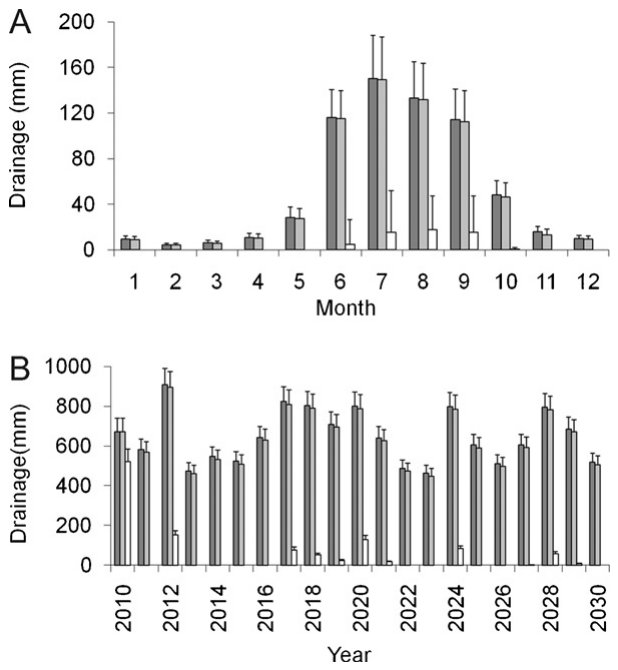
We calculated the effects of a crop of A. vera and Populus species on the drainage from the site as well as the drainage from the site without vegetation (Fig. 3). In all scenarios, most drainage occurs from June to September (Fig. 3A), coinciding with the high rainfall during this period (Fig. 2). There was no significant difference (P = 0.75 NS) in drainage between the bare site and the site vegetated in A. vera. This is because of the relatively low crop coefficient of A. vera (Table 1). In contrast to A. vera, planting the site with poplars would cause a significant decrease (P = 0.00 S**) and result in just 8% of the drainage that would occur from the bare site or under A. vera.
本研究计算了种植A. vera和Populus物种对场地排水的影响,以及无植被条件下的场地排水(图3)。在所有情景下,大部分排水发生在6—9月(图3A),与该时期降雨量高相吻合(图2)。裸地与种植A. vera的场地之间排水量无显著差异(P = 0.75 NS),这是由于A. vera的作物系数相对较低(表1)。与A. vera不同,在场地种植杨树将使排水量显著降低(P = 0.00 S**),仅为裸地或A. vera条件下排水量的8%。
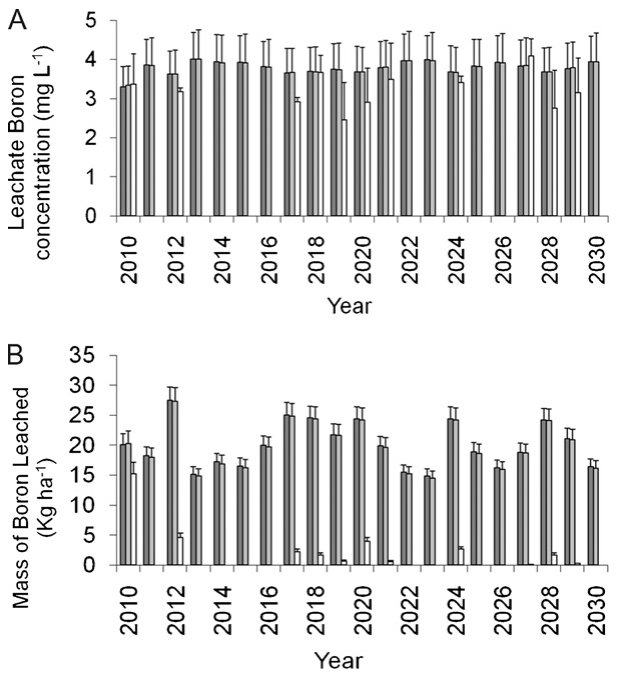
Calculations of the mass of B as well as the concentration of B that would leach from the mine tailings with a cover of A. vera, Populus spp. and with no vegetation are shown in Fig. 4. Over the 20-year simulation, a correlation analysis revealed that there was no significant change in either the concentration of B in the leachate (r = 0.262 P = 0.25 NS) or the total mass of B (r = −0.08 P = 0.726) leaching from the pile on a yearly average basis. This is because the mass of B leached from the tailings is negligible compared to the total concentration present and variations caused by annual differences in rainfall are more important. Concentrations of Ag, Hg and Sb were below detection limits in the CaCl2 extractant (<0.02 mg kg−1). We have therefore calculated a “worst case” scenario in the mass and concentrations of these elements that may leach from the pile on an annual basis (Table 5).
图4给出了在A. vera、Populus spp.覆盖及无植被条件下尾矿B淋溶质量和淋溶液B浓度的计算结果。在20年模拟期内,相关分析表明,以年平均计,淋溶液中B浓度(r = 0.262 P = 0.25 NS)和从尾矿堆淋出的B总质量(r = −0.08 P = 0.726)均无显著变化。这是因为从尾矿中淋出的B质量与其全量相比可忽略不计,而年际降雨差异引起的变化更为重要。CaCl2提取液中Ag、Hg和Sb浓度均低于检出限(<0.02 mg kg−1)。因此,本研究计算了这些元素每年可能从尾矿堆淋出的质量和浓度的“最坏情景”(表5)。
For all the elements calculated, planting the site in A. vera would have no significant effect on the concentrations (P = 0.93 NS) or total masses (P = 0.86 NS) of these elements that are leached. This is because A. vera would cause no significant reduction in the volume of draining from the site (Fig. 3A and B) and because of the relatively low uptake of these contaminants (Table 4). Leaves of A. vera could be harvested to provide skin products and other types of snake oils that could be sold and thus provide an economic return from the site. Analysis of A. vera leaves revealed that these plants do not accumulate sufficient quantities of the soil contaminants to pose a human health risk. For example, the obtained information in the leaves for mercury and antimony show concentrations <0.4 and <0.3–0.7 mg kg−1, respectively, while heavy metals concentrations in cosmetic products are seen to be technically avoidable when they exceed 3 and 5 mg kg−1, respectively [44].
对于所计算的全部元素,在场地种植A. vera对这些元素的淋出浓度(P = 0.93 NS)或总质量(P = 0.86 NS)均无显著影响。这是因为A. vera不会显著减少场地排水量(图3A和B),且对这些污染物的吸收量相对较低(表4)。可收获A. vera叶片用于制作护肤品及其他各类油膏产品出售,从而为该场地带来经济收益。对A. vera叶片的分析表明,这些植物对土壤污染物的累积量不足以构成人体健康风险。例如,叶片中汞和锑的浓度分别为<0.4和<0.3–0.7 mg kg−1,而化妆品中这两种重金属浓度分别超过3和5 mg kg−1时才被视为技术上可避免[44]。
In contrast to A. vera, poplars would cause a significant decrease in the mass (P = 0.00 S**) and concentration (P = 0.00 S**), of these B leaching from the tailings. This might result from the reduction in drainage caused by the high evapotranspiration from a crop of poplars (Fig. 3A and B) as well as by the hyperaccumulation of B in the leaves of poplar. Using parameters from [45], we would expect the leaves of poplar at this site to contain some 900 mg kg−1 B on a dry matter basis. Calculations were performed with poplar, since previous work [45] has shown that this is extraordinarily tolerant to boron, while Eucalyptus succumbed to boron concentrations just one fifth of the values found in the present study. In addition, the Phyto-DSS requires parameterisation with values for water use efficiency, maximum crop coefficient, and root adsorption factors for various elements. These data is available for poplar [45] but not for others such as Leucaena and Robinia. Therefore, we cannot yet make accurate calculations of growth, transpiration and boron uptake by these plants.
与A. vera不同,杨树将使尾矿中B的淋出质量(P = 0.00 S**)和浓度(P = 0.00 S**)显著降低。这可能是由于杨树的高蒸散量减少了排水(图3A和B),以及杨树叶片对B的超富集作用。采用文献[45]中的参数,预计该场地杨树叶片中B含量约为900 mg kg−1(以干物质计)。之所以以杨树进行计算,是因为已有研究[45]表明杨树对硼具有极强的耐受性,而桉树(Eucalyptus)在硼浓度仅为本研究测得值五分之一时即已死亡。此外,Phyto-DSS需要以水分利用效率、最大作物系数和各元素的根系吸收系数进行参数化。杨树已有这些数据[45],而Leucaena和Robinia等其他植物尚无此类数据。因此,目前尚无法准确计算这些植物的生长、蒸腾和硼吸收。
Calculations of the annual mass (M) (kg ha−1) and concentration (C) (mg L−1) of contaminant leaching from the Cata mine tailings mean annual kg and mg L−1, respectively. The mass and concentration values are the mean annual when there was contaminant leaching. Values represent the geometric mean and standard deviation ranges in brackets unless otherwise indicated.
Cata尾矿污染物年淋出质量(M)(kg ha−1)和浓度(C)(mg L−1)的计算结果,分别以年均kg和mg L−1表示。质量和浓度数值为发生污染物淋溶时的年平均值。除另有说明外,数值为几何平均值,括号内为标准差范围。
| Without crop无作物 | Aloe veraAloe vera | Poplar杨树 | ||||
|---|---|---|---|---|---|---|
| M | C | M | C | M | C | |
| B | 20.2 (4)a | 3.8 (0.2)a | 19.8 (16–24) | 3.9 (0.2)a | 1.6 (0.3–6.4) | 3.6 (0.4)a |
| Ag | <0.018 | <0.01 | <0.017 | <0.01 | <0.001 | <0.01 |
| Sb | <0.072 | <0.014 | <0.071 | <0.014 | <0.006 | <0.013 |
| Hg | <0.072 | <0.013 | <0.071 | <0.014 | <0.006 | <0.011 |
a Arithmetic mean and standard deviation.
a 算术平均值和标准差。
Unless the trees were harvested, B would be returned to the tailings annually when the leaves are abscised. Boron could be removed via partially coppicing the trees to produce non-food crops such as timber or bioenergy.
若不采伐树木,B将随每年落叶返回尾矿。可通过对树木进行部分平茬以生产木材或生物能源等非食用产品,从而移除硼。
4Conclusions结论
Dust from the Cata mine tailings may present a human health risk in nearby areas due to the concentrations of Sb and Ag that are above Dutch Intervention Values for soils. The dust may also have physical properties that have detrimental effects on health, a topic worthy of further investigation. Low concentrations of plant macronutrients and excessive concentrations of B may inhibit plant growth and result in high concentrations of B leaching from the site and damaging aquatic systems. Dust could be greatly reduced or eliminated by revegetating the site with B-tolerant species such as A. vera or poplar. Revegetation would require soil conditioners to improve the tailings nutrient status and water retention properties. A. vera would have little effect on B leaching; however, poplar would significantly reduce both the volume of drainage from the site and the concentration of B in the drainage water. Testing is required to determine which poplar species or clone (if any) would thrive on these mine tailings.
由于Sb和Ag浓度超过荷兰土壤干预值,Cata尾矿扬尘可能对周边地区构成人体健康风险。扬尘还可能具有对健康有害的物理性质,这一问题值得进一步研究。植物大量养分浓度低和B浓度过高可能抑制植物生长,并导致高浓度B从场地淋出、损害水生系统。采用A. vera或杨树等耐B物种对场地进行植被恢复,可大幅减少或消除扬尘。植被恢复需要施用土壤调理剂以改善尾矿的养分状况和持水性能。A. vera对B淋溶影响甚微;而杨树可显著减少场地排水量及排水中的B浓度。尚需试验确定哪种杨树物种或无性系(如有)能在该尾矿上良好生长。
Acknowledgements致谢
We acknowledge CONACYT (National Council for Science and Technology of Mexico) (CB 61649) and CONCyTEG (Council for Science and Technology of Guanajuato) (08-16-k662-127) for research funding. We also thank Universidad de Guanajuato, The University of Texas at El Paso, and Lincoln University. Jorge Gardea-Torresdey acknowledges the Dudley family for the Endowed Research Professorship in Chemistry and the LERR and STARs programs of the University of Texas System. We also would like to acknowledge Marcos Esquivel from CCAUG (Centro de Ciencias Atmosféricas de la Universidad de Guanajuato) for providing climate data.
感谢CONACYT(墨西哥国家科学技术委员会)(CB 61649)和CONCyTEG(瓜纳华托科学技术委员会)(08-16-k662-127)提供研究经费。同时感谢Universidad de Guanajuato、The University of Texas at El Paso和Lincoln University。Jorge Gardea-Torresdey感谢Dudley家族设立的化学捐赠研究教授席位,以及University of Texas System的LERR和STARs项目。感谢CCAUG(Centro de Ciencias Atmosféricas de la Universidad de Guanajuato)的Marcos Esquivel提供气候数据。
References参考文献
[1] Kabata-Pendias, H. Pendias, Trace Elements in Soil and Plants, 2nd ed., CRC Press, Boca raton, London, 1992, pp. 124–350.
[2] W. Krzaklewski, J. Barszcz, S. Malek, K. Koziol, M. Pietrzykowski, Contamination of forest soils in the vicinity of the sedimentation pond after zinc and lead ore flotation (in the region of Olkusz, Southern Poland), Water Air Soil Pollut. 159 (2004) 151–164.
[3] Y.G. Liu, H.Z. Zhang, G.M. Zeng, B.R. Huang, X. Li, Heavy metal accumulation in plants on Mn mine tailings, Pedosphere 16 (2006) 131–136.
[4] W.S. Shu, Z.H. Ye, C.Y. Lan, Z.Q. Zhang, M.H. Wong, Acidification of Pb/Zn mine tailings and its effect on heavy metal mobility, Environ. Int. 26 (2001) 389–394.
[5] M.H. Wong, Ecological restoration of mine degraded soils, with emphasis on metal contaminated soils, Chemosphere 50 (2003) 775–780.
[6] W.H.O. Ernst, Bioavailability of heavy metals and decontamination of soils by plants, Appl. Geochem. 11 (1996) 163–167.
[7] M. Conesa, B. Ahmad, B.H. Robinson, G. Kühne, E. Lehmann, R. Schulin, Response of native grasses and Cicer arietinum to soil polluted with mining wastes: implications for the management of land adjacent to mine sites, Environ. Exp. Bot. 65 (2009) 198–204.
[8] CCAUG, Centro de Ciencias Atmosféricas de la Universidad de Guanajuato, Variables climatológicas diarias, Departamentos de meteorología, climatología e hidrología, 2009, consulta: 15 de Mayo, reportes: 2000–2009. www.ccaug.ugto.mx.
[9] CONAGUA, Comisión Nacional del Agua, Lamina de Lluvia Estatal y Anomalía, Subdirección General Técnica, Coordinación del Servicio Meteorológico Nacional, 2009, consulta: 15 Mayo, reportes: 1922–2009. http://smn.cna.gob.mx/climatologia/climatologia.html. [10] Y.R. Ramos-Arroyo, C.D. Siebe-Grabach, Estrategia para identificar jales con potencial de riesgo ambiental en un distrito minero: estudio de caso en el Distrito de Guanajuato, México, Rev. Mex. Cienc. Geol. 23 (2006) 54–74.
[11] Y.R. Ramos-Arroyo, C.D. Siebe-Grabach, Weathering of sulphide minerals and trace element speciation in tailings of various ages in the Guanajuato mining district, Mexico, Catena 71 (2007) 497–506.
[12] M. Conesa, A.G. García, A. Faz, R. Arnaldos, Dynamics of metal tolerant plant communities’ development in mine tailings from the Cartagena-La Unión Mining District (SE Spain) and their interest for further revegetation purposes, Chemosphere 68 (2007) 1180–1185.
[13] B.H. Robinson, J.E. Fernández, P. Madejón, T. Mara˜nón, J.M. Murillo, S.R. Green, B.E. Clothier, Phytoextraction: an assessment of biogeochemical and economic viability, Plant Soil 249 (2003) 117–125.
[14] M.O. Mendez, M. Maier, Phytostabilization of mine tailings in arid and semiarid environments an emerging remediation technology, Environ. Health. Perspect. 116 (2008) 278–283.
[15] NOM-021-RECNAT-2000, Especificaciones de Fertilidad, Salinidad y Clasificación de Suelos, Estudios, Muestreo y Análisis, Secretaria de Medio Ambiente y Recursos Naturales, México, 2000, pp. 1–85.
[16] US EPA 3051 Method, Microwave Assisted Acid Digestion of Sediments, Sludge, and Oils, US Environmental Protection Agency, Washington, DC, 1994, pp. 1–14.
[17] J.B. Jones Jr., Laboratory Guide for Conducting Soil Tests and Plant Analysis, CRC Press, 2001, pp. 115–118.
[18] G.J. Bouyoucos, Hydrometer method improved for making particle size analysis of soils, Agron. J. 43 (1962) 434–438.
[19] A. Walkley, I. Armstrong Black, An examination of the Degtjareff method for determining soil organic matter and proposed modification of the chromic acid titration method, Soil Sci. 37 (1934) 29–38. [20] S.R. Olsen, L.E. Sommers, Phosphorus, in: A.L. Page (Eds.), Methods of Soil Analysis: Part 2 – Chemical and Microbiological Properties, ASA Monograph 9, Madison, WI, 1982, pp. 403–430. [21] D.R. Keeney, D.W. Nelson, Nitrogen inorganic forms, in: A.L. Page (Eds.), Methods of Soil Analysis: Part 2 – Chemical and Microbiological Properties, ASA Monograph 9, Madison, WI, 1982, pp. 403–430.
[22] Soil Survey Laboratory Staff, Soil survey laboratory methods manual, in: Soil Survey Investigations, U.S. Govt. Print. Office, Washington, DC, 1992, Rep. No. 42.
[23] J.D. Rhoades, Soluble salts, in: A.L. Page (Eds.), Methods of Soil Analysis: Part 2 – Chemical and Microbiological Properties, ASA Monograph 9, Madison, WI, 1982, pp. 167–179. [24] B.H. Robinson, G. Ba˜nuelos, M. Conesa, W.H.M. Evangelou, R. Schullin, The phytomanagement of trace elements in soil, CRC Crit. Rev. Plant Sci. 28 (2009) 240–266. [25] J.L. Hutson, R.J. Wagenet, A pragmatic field-scale approach for modelling pesticides, J. Environ. Qual. 22 (1993) 494–499.
[26] A. Baille, Overview of greenhouse climate control in the Mediterranean regions, in: R. Choukr-Allah (Ed.), Protected Cultivation in the Mediterranean region = Cultures protégées dans la région méditerranéenne, CIHEAM – Institut Agronomique et Vétérinaire Hassan II, Paris, 31, Cahiers Options Méditerranéennes, 1999, pp. 59–76.
[27] Dutch Environment Ministry, Circular on Target Values and Intervention Values for Soil Remediation, Dutch National Institute of Public Health & the Environment, Netherland, 2000.
[28] M. Tschan, B.H. Robinson, R. Schulin, Antimony in the soil–plant system: a review, Environ. Chem. 6 (2009) 106–115.
[29] WHO, World Health Organization, Silver Evaluation for Acceptable Daily Intake, Summary of Toxicological data of certain food additives, FAO/WHO, Series No. 12, WHO, Geneva Switzerland, 1977, report 21, pp. 1–8 http://www.inchem.org/documents/jecfa/jecmono/v12je19.htm. [30] NIOSH, National Institute for Accupational Safety Health, Silica, http://www.cdc.gov./niosh/topics/silica/, (accessed 28 July 2009).
[31] OSHA, Occupational Safety and Health Administration, Special Emphasis Program for Silicosis, http://www.osha.gov/SLTC/etools/silica/spec emph prog/spec emph prog.html, (accessed 28 July 2009).
[32] L.J. Bhagia, Non-occupational exposure to silica dust in vicinity of slate pencil industry, India, Environ. Monit. Assess. 151 (2009) 477–482.
[33] R.L. Aitken, E.L. McCallum, Boron toxicity in soil solution, Aust. J. Soil Res. 26 (1988) 605–610.
[34] C. Koc¸ , Effects on environment and agriculture of geothermal wastewater and boron pollution in Great Menderes Basin, Environ. Monit. Assess. 125 (2007) 377–388.
[35] R.O. Nable, G.S. Ba˜nuelos, J.G. Paull, Boron toxicity, Plant Soil 193 (1997) 181–198.
[36] ANZECC and ARMCANZ, Australian and New Zealand Guidelines for Fresh and Marine Water Quality, National Water Quality Management Strategy 4a (online), 1, Australian Government, Department of the Environment and Heritage, Canberra, Australia, 2000, last updated: 23 October 2007, (accessed: 15 August 2009), pp. 1–106 http://www.ea.gov.au/.
[37] W.J. Birge, J.A. Black, Sensitivity of Vertebrate Embryos to Boron Compounds, US Environmental Protection Agency, Washington, DC, 1977, Report 560/1-76- 008.
[38] J.A. Black, J.B. Barnum, W.J. Birge, An integrated assessment of the biological effects of boron to the rainbow trout, Chemosphere 26 (1993) 1383–1413.
[39] Water Quality Standards, Establishment of Numeric Criteria for Priority Toxic Pollutants, States’ Compliance Final Rule, Environmental Protection Agency, Office of Science and Technology, Washington, DC, U.S.A., 1992, Federal Register 57:60848. [40] L. Jeffrey, M. Parks, Edwards, Boron in the environment, Crit. Rev. Environ. Sci. Technol. 35 (2) (2005) 81–114.
[41] G.M. Pierzynsky, J.T. Sims, G.F. Vance, Soils and Environmental Quality, 3rd ed., Taylor & Francis, 2005.
[42] M. Ferro, J.P. Rieder, J. Kennedy, R. Kjelgren, Phytoremediation of groundwater using poplar trees, in: C.A. Thibeault, L.M. Savage (Eds.), Phytoremediation, International Business Communications Inc., Southborough, MA, 1997, pp. 201–212.
[43] S. Silim, R. Nash, D. Reynard, B. White, W. Schroeder, Leaf gas exchange and water potential responses to drought in nine poplar (Populus spp) clones with constrasting drought tolerance, Trees 23 (2009) 959–969.
[44] HC, Health Canada, Draft Guidance on Heavy Metal Impurities in Cosmetics, Consumer Products Safety, Legislation & Guidelines, http://www.hc-sc.gc.ca/ cps-spc/legislation/consultation/ cosmet/metal-metaux-consult-eng.php, (accessed: 01 August 2009).
[45] B.H. Robinson, S.R. Green, B. Chancerel, T.M. Mills, B.E. Clothier, Poplar for the phytomanagement of boron contaminated sites, Environ. Pollut. 150 (2007) 225–233.
[46] B.M.W. Genet, C.A.M. Sehooten, Water requirement of Aloe vera in a dry caribbean climate, Irrigation Sci. 13 (1992) 81–85.
[47] K. Winter, J. Aranda, A.M.J. Holtum, Carbon isotope composition and water-use efficiency in plants with crassulacean acid metabolism, Funct. Plant Biol. 32 (2005) 381–388.
[48] E. Herrera, Soil Test Interpretations, College of Agricultural, Consumer and Environmental Sciences, New Mexico State University, 2000, Guide A-122, pp. 1–4.
[49] A.P. Mallarino, D.J. Wittry, P.A. Barbagelata, New soil test interpretation classes for potassium, Better Crops Plant Food 87 (2003) 12–14.
[50] W. Slooff, P.F.H. Bont, J.M. Hesse and B. Loos, Exploratory Report Antimony and Antimony Compounds, National Institute Of Public Health and Environmental Protection Bilthoven the Netherlands, report no. 710401020 (1992) 1–40.
[51] WHO, World Health Organization, Exposure mercury, Public Health and Environment, Guideline values, WHO, Geneva Switzerland, 2007, pp. 1–4.