Contents lists available at ScienceDirect journal homepage: www.elsevier.com/locate/scitotenv
O.A. Knowles a, B.H. Robinson a,⁎, A. Contangelo a,b, L. Clucas a
a Soil and Physical Sciences Department, Faculty of Agricultural and Life Sciences, Lincoln University, PO Box 7647, Lincoln 7647, New Zealand b University of Basilicata, Potenza, Italy a r t i c l e i n f o
a b s t r a c t
Article history: Received 6 April 2011 Received in revised form 3 May 2011 Accepted 7 May 2011 Available online 31 May 2011 Keywords: Biochar Biosolids Charcoal Pasture Lysimeter
Countries with sewage treatment plants produce on average 27 kg of dried biosolids/person/yr. Concerns about nitrate leaching limit the rate at which biosolids are added to soil. We sought to determine whether biochar, a form of charcoal that is added to soil, could reduce nitrate leaching from biosolids amended soil. We set up 24 (0.5 m×0.75 m) lysimeters, filled with two soil types (Templeton Silt Loam and Ashley Dene silt loam) and amended with combinations of biochar (102 t/ha equivalent) and biosolids (600 and 1200 kg N/ha equivalent). Pasture and leachates were sampled over 5 months. Nitrate leaching from biochar plus biosolids amended soils were reduced to levels at or below the control treatments. Pasture N concentrations were similarly affected by biochar addition. Future research should focus on unravelling the mechanism responsible for the change in the nitrogen cycle in soils amended with biosolids and biochar.
拥有污水处理厂的国家平均每人每年产生27 kg干生物固体(污泥)。对硝酸盐淋溶的担忧限制了生物固体施入土壤的用量。本研究旨在探明生物炭(一种施入土壤的木炭)能否减少施用生物固体土壤中的硝酸盐淋溶。我们设置了24个(0.5 m×0.75 m)渗漏计,装填两种土壤(Templeton粉砂壤土和Ashley Dene粉砂壤土),并施加不同组合的生物炭(相当于102 t/ha)和生物固体(相当于600和1200 kg N/ha)。在5个月内对牧草和淋出液进行了采样。施加生物炭与生物固体的土壤中,硝酸盐淋溶量降低至对照处理水平或更低。生物炭的施加对牧草氮浓度也产生了类似影响。今后的研究应着重揭示施加生物固体和生物炭的土壤中氮循环发生变化的作用机制。
© 2011 Elsevier B.V. All rights reserved.
1Introduction引言
Countries with sewage treatment plants produce some 27 kg of dry biosolids per person per year, with global output exceeding 10 M t/yr (Bradley, 2008). Biosolids disposal is a global environmental issue, with many developed countries incinerating their biosolids or disposing of them in landfills. Land application of biosolids can improve soil fertility and reduce the need for mineral fertilisers (Obi and Ebo, 1995). Depending on their provenance and level of treatment, biosolids may contain high concentrations of macro and micro-nutrients, organic compounds, heavy metals, endocrine disrupting compounds, pesticides, herbicides, surfactants, and pathogenic helminths, bacteria, viruses and fungi (Krogmann et al., 1999; Singh and Agrawal, 2008). Therefore, depending on their quality, biosolids addition to soil can result in contaminant accumulation (Stoven and Schnug, 2009), human exposure to pathogens, and leaching of plant nutrients, particularly nitrates, into groundwater (Agopsowicz et al., 2008). Stricter regulations and improved treatment technology have resulted in reduced pathogen burdens and decreased concentrations of heavy metals and organic contaminants (Chaney, 1990), leaving N loading as the rate limiting factor of the addition of high-quality biosolids in some countries (Gibbs, 2003). Nitrate leaching is also an issue, when biosolids (either high or low quality) are used to rebuild degraded soils, since higher application rates are required (Kowaljow et al., 2010).
拥有污水处理厂的国家每人每年产生约27 kg干生物固体(污泥),全球产量超过10 M t/yr(Bradley, 2008)。生物固体处置是一个全球性环境问题,许多发达国家将生物固体焚烧或填埋处置。生物固体土地利用可改善土壤肥力,并减少对矿质肥料的需求(Obi and Ebo, 1995)。取决于其来源和处理程度,生物固体可能含有高浓度的大量和微量营养元素、有机化合物、重金属、内分泌干扰物、杀虫剂、除草剂、表面活性剂以及致病性蠕虫、细菌、病毒和真菌(Krogmann et al., 1999; Singh and Agrawal, 2008)。因此,视其质量而定,向土壤施加生物固体可能导致污染物积累(Stoven and Schnug, 2009)、人体暴露于病原体,以及植物养分(尤其是硝酸盐)淋溶进入地下水(Agopsowicz et al., 2008)。更严格的法规和改进的处理技术已使病原体负荷降低,重金属和有机污染物浓度下降(Chaney, 1990),使得在一些国家氮负荷成为限制高质量生物固体施用量的因素(Gibbs, 2003)。当生物固体(无论质量高低)用于重建退化土壤时,由于需要更高的施用量,硝酸盐淋溶同样是一个问题(Kowaljow et al., 2010)。
⁎ Corresponding author. Tel.: +64 3 325 3838x8471; fax: +64 3 325 3607. E-mail address: brett.robinson@lincoln.ac.nz (B.H. Robinson). URL: http://www.kiwiscience.com (B.H. Robinson).
Biochar, a form of charcoal that is added to soil (Lehmann et al., 2003), may be a potential solution. Biochar addition to soil is currently generating much interest due to its perceived potential to offset humaninduced global climate change emissions (Clough and Condron, 2010; Gaunt and Lehmann, 2008; Laird, 2008; Lehmann et al., 2006; Rondon et al., 2005). However, there may be additional agronomic benefits. Biochar improves soil porosity (Steiner et al., 2007; Yanai et al., 2007), surface area (Laird et al., 2010a, 2010b), and decreases tensile strength thus improving root penetration (Chan et al., 2007). Chemically, biochar may increase cation and anion exchange capacity (CEC & AEC) (Liang et al., 2006; Singh et al., 2010), and soil pH (Cheng et al., 2006). Biochar additions in combination with nutrient applications containing available N in the form of bovine urine, swine manure and green-waste compost has interfered with the N cycle (Beesley et al., 2010; Clough et al., 2010; Laird et al., 2010b). Biochar derived from pecan shells has been demonstrated to reduce nitrate leaching from soil over 25 and 67 days (Novak et al., 2010). Deenik et al. (2010) proposed that volatile matter in biochar may stimulate soil microbial activity, which consumes nitrogen, rendering it unavailable for plant uptake. However, other authors (Beesley and Dickinson, 2011; Beesley et al., 2010) have shown that biochar may contain agents such as polycyclic aromatic hydrocarbons, that can be detrimental to microbial growth.
生物炭是一种施入土壤的木炭(Lehmann et al., 2003),可能是一种潜在的解决方案。由于被认为具有抵消人为导致的全球气候变化排放的潜力,向土壤施加生物炭目前受到广泛关注(Clough and Condron, 2010; Gaunt and Lehmann, 2008; Laird, 2008; Lehmann et al., 2006; Rondon et al., 2005)。然而,生物炭还可能带来额外的农学效益。生物炭可改善土壤孔隙度(Steiner et al., 2007; Yanai et al., 2007)和比表面积(Laird et al., 2010a, 2010b),并降低土壤抗张强度,从而改善根系穿透(Chan et al., 2007)。在化学性质方面,生物炭可提高阳离子和阴离子交换量(CEC & AEC)(Liang et al., 2006; Singh et al., 2010)以及土壤pH(Cheng et al., 2006)。生物炭与含有效氮的养分(如牛尿、猪粪和绿色废弃物堆肥)共同施用时会干扰氮循环(Beesley et al., 2010; Clough et al., 2010; Laird et al., 2010b)。研究表明,由山核桃壳制备的生物炭可在25天和67天内减少土壤硝酸盐淋溶(Novak et al., 2010)。Deenik et al.(2010)提出,生物炭中的挥发性物质可能刺激土壤微生物活性,从而消耗氮,使其无法被植物吸收。然而,其他作者(Beesley and Dickinson, 2011; Beesley et al., 2010)的研究表明,生物炭可能含有多环芳烃等对微生物生长有害的物质。
A potential source material for biochar is the Monterey Pine (Pinus radiata D. Don), which has been introduced as a timber tree in vast areas of New Zealand (where it is the most common tree), Australia, Chile, South Western Europe and South Africa (Earle, 2010). Waste wood from timber operations is ether burned or stored in large wood-waste piles than can leach tannins into local waterways (Robinson et al., 2007). We do not propound the use of treated timber for biochar production as this could result soils becoming contaminated with Cu,
辐射松(Monterey Pine,Pinus radiata D. Don)是一种潜在的生物炭原料,已作为用材树种被大面积引种于新西兰(为当地最常见的树种)、澳大利亚、智利、西南欧和南非(Earle, 2010)。木材作业产生的废木材或被焚烧,或堆存于大型木材废弃物堆中,这些废弃物堆可能向当地水体淋出单宁(Robinson et al., 2007)。我们不主张使用经防腐处理的木材生产生物炭,因为这可能导致土壤受到Cu、
0048-9697/$ – see front matter © 2011 Elsevier B.V. All rights reserved. doi:10.1016/j.scitotenv.2011.05.011
0048-9697/$ – see front matter © 2011 Elsevier B.V. All rights reserved. doi:10.1016/j.scitotenv.2011.05.011
Cr, As or B. Producing bicohar from the Monterey Pine rather than biosolids themselves has the advantage that the wood waste has a lower moisture content, thus producing more energy and a higher yield than moist biosolids. The C: N ratio of Monterey Pine wood is 400 (Robinson et al., 2003), some 20 times higher than biosolids. Therefore, the Monterey Pine biochar will not add significant amounts of nitrogen to the biosolids-amended soil, which may already have a high nitrogen load. Taghizadeh-Toosi et al. (2011) demonstrated that biochar made from Monterey pine interfered with the nitrogen cycle and reduced nitrous oxide emissions from bovine urine patches.
Cr、As或B的污染。以辐射松而非生物固体本身生产生物炭的优势在于,木材废弃物含水率较低,因此与潮湿的生物固体相比,可产生更多能量且产率更高。辐射松木材的C:N比为400(Robinson et al., 2003),约为生物固体的20倍。因此,辐射松生物炭不会向本已可能具有较高氮负荷的施用生物固体土壤中添加大量氮。Taghizadeh-Toosi et al.(2011)证明,辐射松制备的生物炭会干扰氮循环,并减少牛尿斑块的氧化亚氮排放。
Soils under Monterey Pine forestry can become depleted in nutrients and harvesting may remove topsoil and organic matter (Merino and Edeso, 1999). Therefore, such soils are ideal candidates for biosolids and biochar application, which would increase both soil carbon and plant nutrients. The costs of transporting the biochar would be minimal since the wood-waste is produced on site.
辐射松林下土壤可能出现养分耗竭,采伐还可能带走表土和有机质(Merino and Edeso, 1999)。因此,此类土壤是施用生物固体和生物炭的理想对象,施用后可同时增加土壤碳和植物养分。由于木材废弃物就地产生,生物炭的运输成本极低。
We aimed to determine the effect of biochar made from Monterey Pine on the leaching and plant uptake of N from biosolids amended soils, using two biosolids application rates (600 kg N/ha and 1200 kg N/ha) and two soil types.
本研究采用两种生物固体施用量(600 kg N/ha和1200 kg N/ha)和两种土壤类型,旨在确定辐射松生物炭对施用生物固体土壤中氮的淋溶及植物吸收的影响。
There were eight treatments, each replicated three times. For both the TSL and ASL lysimeters, there was a control (no bisolids, no biochar), fresh biosolids applied at a rate equivalent to 600 kg N per hectare (0.9 kg biosolids, no biochar), and biosolids with biochar at a rate equivalent to 100 t per hectare (0.9 kg biosolids, 2 kg biochar). The TSL lysimeters had two additional treatments of biosolids applied a rate equivalent to 1200 kg N per hectare (1.8 kg biosolids, no biochar) and biosolids with biochar (1.8 kg biosolids, 2 kg biochar). Our rate of biochar addition was at the top end of rates reported by other authors (Chan et al., 2007). The rational for this was that this biochar – biosolids mixture would be added to rebuild low-fertility soils, where increasing soil carbon and soil nutrients is paramount.
试验共设8个处理,每个处理重复3次。TSL和ASL渗漏计均设有对照(不加生物固体,不加生物炭)、按相当于每公顷600 kg N的用量施加新鲜生物固体(0.9 kg生物固体,不加生物炭),以及生物固体与相当于每公顷100 t用量的生物炭配施(0.9 kg生物固体,2 kg生物炭)。TSL渗漏计另设两个处理:按相当于每公顷1200 kg N的用量施加生物固体(1.8 kg生物固体,不加生物炭),以及生物固体与生物炭配施(1.8 kg生物固体,2 kg生物炭)。本研究的生物炭施用量处于其他作者所报道用量的上限(Chan et al., 2007)。其依据是,这种生物炭–生物固体混合物将被用于重建低肥力土壤,而此类土壤中提高土壤碳和土壤养分至关重要。
The top 0.1 m of the soil profile was removed from all lysimeters. Treatments were applied by mixing the soil with the biosolids & biochar in a concrete mixer and refilling the top 0.1 m of the lysimeter. The controls were handled in an identical manner, without any treatment. Before refilling, a soil sample was taken for analyses. Refilling occurred on the 5 May 2010. Immediately after the application of each treatment, pasture ryegrass (Lolium perenne Bronsyn) was broadcast over each lysimeter to give a density of ca. 200 seeds per dm2. A small amount of soil from each treatment was applied over the top of the seed and lightly pressed down by hand.
移除所有渗漏计土壤剖面顶部0.1 m的土层。在混凝土搅拌机中将土壤与生物固体和生物炭混合以施加处理,然后回填至渗漏计顶部0.1 m。对照以完全相同的方式处理,但不施加任何处理物。回填前采集土样供分析。回填于2010年5月5日进行。每个处理施加后立即在各渗漏计上撒播牧草黑麦草(Lolium perenne Bronsyn),播种密度约为每dm2 200粒。将各处理的少量土壤覆盖于种子上,并用手轻轻压实。
2Materials and methods材料与方法
2.1. Lysimeter setup2.1. 渗漏计设置
Fifteen undisturbed soil monolith lysimeters were collected from a pasture soil, the Templeton Silt Loam (TSL), on the Lincoln University Dairy Farm (43°38´40.89˝ S 172°26´24.01˝ E) and nine were collected from a former Monterey Pine forestry plantation soil, the Ashley Dene Silt Loam (ASL), on the Ashley Dene Sheep Farm (43°39´05.82˝ S 172°19´ 41.47˝ E). Table 1 gives the properties for each soil. Each lysimeter was 0.5 m in diameter and 0.7 m deep. The design of the lysimeter casings and the method of soil sampling are described in detail by Cameron et al. (1992). The lysimeters were installed at the Field Service Centre, Lincoln University (43°38´53.48˝S 172°28´07.58˝ E) in a block design beside a trench used for drainage collection.
从林肯大学奶牛场(43°38´40.89˝ S 172°26´24.01˝ E)的牧场土壤Templeton粉砂壤土(TSL)中采集15个原状土柱渗漏计,并从Ashley Dene绵羊场(43°39´05.82˝ S 172°19´ 41.47˝ E)的原辐射松人工林土壤Ashley Dene粉砂壤土(ASL)中采集9个。表1列出了各土壤的性质。每个渗漏计直径0.5 m、深0.7 m。渗漏计外壳的设计和土壤采样方法详见Cameron et al.(1992)。渗漏计按区组设计安装于林肯大学野外服务中心(43°38´53.48˝S 172°28´07.58˝ E),位于用于收集排水的沟渠旁。
Biosolids were obtained from the Kaikoura Regional treatment works, New Zealand. Some 160 kg of biosolids were homogenised using a concrete mixer and passed through a 20 mm sieve. The moisture content of the fresh biosolids was 53%. Table 1 gives the properties of the biosolids. The biochar was manufactured from Pinus radiata D. Don as described in Clough et al. (2010) and Taghizadeh-Toosi et al. (2011). The biochar was crushed to give particles with a maximum diameter of 10 mm. Table 1 gives the properties of the biochar.
生物固体取自新西兰Kaikoura区域处理厂。约160 kg生物固体经混凝土搅拌机均质化后过20 mm筛。新鲜生物固体的含水率为53%。表1列出了生物固体的性质。生物炭以Pinus radiata D. Don为原料,按Clough et al.(2010)和Taghizadeh-Toosi et al.(2011)所述方法制备。生物炭经粉碎,最大粒径为10 mm。表1列出了生物炭的性质。
Soil chemical properties for the Templeton and Ashley Dene silt loams, the biosolids and biochar. Values in brackets represent the standard error of the mean (n=3 unless otherwise indicated).
Templeton和Ashley Dene粉砂壤土、生物固体及生物炭的化学性质。括号内数值为平均值的标准误(除另有说明外,n=3)。
| Ashley DeneAshley Dene | TempletonTempleton | Biosolids生物固体 | Biochar生物炭 | |
|---|---|---|---|---|
| pH | 5.6 | 5.6 | 4.1 | 7.8 |
| CEC (cmol(+)/kg) | 11.9 (0.2) | 12.4 (0.5) | n.d. | 8.0ǂ⁎ |
| C (%) | 2.4 (0.1) | 2.0 (0.1) | 28.0 (0.2) | 70.6ǂ |
| N (%) | 0.28 (0.01) | 0.18 (0.01) | 2.7 (0.03) | 0.2ǂ |
| P (mg/kg) | 784 (39) | 518 (25) | 4683 (2) | 412 (2) |
| S (mg/kg) | 266 (18) | 193 (15) | 6972 (43) | 288 (12) |
| Ca (mg/kg) | 3037 (242) | 3005 (101) | 9818 (176) | 7758 (160) |
| Mg (mg/kg) | 802 (2) | 855 (11) | 2204 (17) | 605 (11) |
| K (mg/kg) | 1438 (152) | 1401 (119) | 4330 (67) | 1713 (17) |
| Na (mg/kg) | 113 (10) | 136 (4) | 428 (3) | 10000 (29) |
| Cd (mg/kg) | 0.2 (0.0) | 0.4 (0.1) | 2.8 (0.0) | 0.1 (0.01) |
| Cr (mg/kg) | 8.5 (0.6) | 11.6 (0.4) | 32 (1.4) | 2.8 (0.6) |
| Cu (mg/kg) | 5.7 (0.3) | 4.5 (0.1) | 561(33) | 14 (5) |
| Pb (mg/kg) | 7.7 (0.0) | 12.0 (0.1) | 96 (3) | 1.0 (0.2) |
| Zn (mg/kg) | 35 (1) | 43 (1) | 878 (13) | 16 (1.3) |
ǂSingle analysis on homogenised material. ⁎Taghizadeh-Toosi et al. (2011).
ǂ对均质化材料的单次分析。⁎Taghizadeh-Toosi et al.(2011)。
2.2. Climatic conditions and irrigation2.2. 气候条件与灌溉
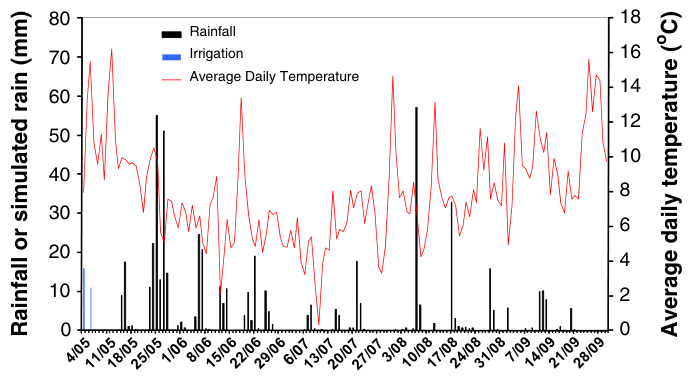
Irrigation was applied during the initial two weeks to initiate drainage. Thereafter the only influent was natural rainfall. Total water inputs during the trial period were equivalent to 574 mm over five months (Fig. 1). This comprised of 547 mm of natural rainfall and 27 mm of irrigation.
在最初两周进行灌溉以启动排水。此后唯一的水分输入为自然降雨。试验期间的总水分输入在五个月内相当于574 mm(图1),其中自然降雨547 mm,灌溉27 mm。
2.3. Sample collection and chemical analyses2.3. 样品采集与化学分析
Drainage was collected fortnightly from the base of each lysimeter. The volume of drainage was measured and recorded during each sampling. A 100 mL subsample was taken for analysis. Pasture was harvested on the 31st of August and the 24th of September 2010. The timing of harvest occurred upon the emergence and full development of the 3rd leaf. This corresponds to maximal pasture quality, with no leaf death and fully developed leaves. The pasture was harvested to a height of 20 mm above the soil level.
每两周从各渗漏计底部收集一次排水。每次采样时测定并记录排水量,并取100 mL子样用于分析。牧草于2010年8月31日和9月24日收割。收割时间为第3片叶出现并完全展开之时,此时牧草品质最佳,无叶片死亡且叶片发育完全。牧草收割至距土壤表面20 mm高度。
Each drainage sample was vacuum filtered with a water aspiration apparatus through 0.45 μm cellulose acetate filter membrane. Nitrates and nitrites were measured using ion chromatography. Organic C was analysed using a Shimadzu TOC 5000A organic carbon analyser.
每个排水样品用水抽气装置经0.45 μm醋酸纤维素滤膜真空过滤。硝酸盐和亚硝酸盐采用离子色谱法测定。有机C采用Shimadzu TOC 5000A有机碳分析仪测定。
Soil and pasture samples were dried at 105 °C until a constant weight was obtained. Large soil aggregates were broken up using a mortar and pestle and the soil passed through a 2 mm Nylon sieve.
土壤和牧草样品于105 °C烘干至恒重。用研钵和研杵将较大的土壤团聚体碾碎,并过2 mm尼龙筛。
Soil pH was measured at a water: soil ratio of 2.5:1 with deionised water using a Metler Toledo pH meter.
土壤pH用去离子水按水土比2.5:1浸提,使用Metler Toledo pH计测定。
Dried pastures were ground and stored in an airtight vial. Soil and Pasture C and N concentrations were measured using an Elementar Vario MAX CN analyser. Pseudo-total elemental analysis was carried out using microwave digestion in 8 ml of Aristar nitric acid (±69%), filtered using Whatman 52 filter paper (pore site 7 μm), and diluted with milliQ water to a volume of 25 ml, followed by analysis by inductively coupled plasma optical emission spectrometry (ICP-OES Varian 720 ES). Wageningen reference soil (ISE 921) and plant (IPE 100) material were analysed for quality assurance (Houba et al., 1998). Concentrations were within 9% of the certified values.
干燥的牧草经研磨后储存于密封小瓶中。土壤和牧草的C、N浓度采用Elementar Vario MAX CN分析仪测定。准全量元素分析采用8 ml Aristar硝酸(±69%)微波消解,经Whatman 52滤纸(孔径7 μm)过滤,用milliQ水定容至25 ml,随后用电感耦合等离子体发射光谱仪(ICP-OES Varian 720 ES)测定。分析Wageningen参考土壤(ISE 921)和植物(IPE 100)标准物质以进行质量控制(Houba et al., 1998)。测定浓度与认证值的偏差在9%以内。
Data was analysed using Minitab® 16. Data sets were analysed using ANOVA with Fisher's Lest-Significant-Difference post-hoc test to compare means. The level of significance was 0.05.
数据采用Minitab® 16进行分析。数据集采用ANOVA分析,并用Fisher最小显著差数法进行事后检验以比较均值。显著性水平为0.05。
3Results and discussion结果与讨论
3.1. Pasture growth and nitrogen uptake3.1. 牧草生长与氮吸收
Pasture established full cover on all the lysimeters (Table 2), with biomass productions of the ASL and TSL controls being equivalent to 1.4 tonnes of dry matter per hectare. There were significant differences in pasture growth between treatments (Table 2). The addition of biosolids, without biochar, resulted in a significant biomass increase in both the ASL and TSL treatments. This result is consistent with the fertilising effect of the biosolids, which contain high concentrations of N and P. In the ASL, there were no significant differences in the N concentration (Table 2) of the pasture. However, in the TSL, the 1200 N treatment resulted in a significant increase in the pasture N concentration.
所有渗漏计上的牧草均形成完全覆盖(表2),ASL和TSL对照的生物量相当于每公顷1.4 t干物质。不同处理间牧草生长存在显著差异(表2)。单独施加生物固体(不加生物炭)使ASL和TSL处理的生物量均显著增加。这一结果与生物固体含有高浓度N和P所产生的施肥效应一致。在ASL中,牧草N浓度(表2)无显著差异。然而,在TSL中,1200 N处理使牧草N浓度显著增加。
The addition of biochar lessened or negated the biomass increases resulting from biosolids addition. In the 600 N treatment with biochar, the biomass was not significantly different to the control, while in the TSL, the addition of biosolids at 1200 kg/ha with biochar produced a significant increase that was less than the biosolids treatment alone. The effect of the biochar in lessening the biomass increase may be attributed to either a toxic factor in the biochar that reduced growth, or that the biochar absorbed some of the nutrients provided by the biosolids, thereby lessening their effect. We cannot definitively rule out the possibility that the biochar treatments inhibited growth through some toxic factor because we did not have a treatment where biochar was added in the absence of biosolids.
生物炭的施加减弱或抵消了施加生物固体所带来的生物量增加。在配施生物炭的600 N处理中,生物量与对照无显著差异;而在TSL中,以1200 kg/ha施加生物固体并配施生物炭虽使生物量显著增加,但增幅小于单施生物固体处理。生物炭减弱生物量增加的作用,可能归因于生物炭中存在抑制生长的毒性因子,或生物炭吸附了生物固体提供的部分养分从而削弱其效果。由于本研究未设置不施生物固体而单施生物炭的处理,因此不能完全排除生物炭处理通过某种毒性因子抑制生长的可能性。
3.2. Drainage and nitrogen leaching3.2. 排水与氮淋溶
The volume of drainage was equivalent to 426 mm and 412 mm for the TSL and ASL controls respectively, indicating that the pasture evapotranspiration was 148 mm and 162 mm respectively. Despite the significant differences in biomass (Table 2), none of the treatments had significantly different drainage volumes compared to the control. This is unsurprising given the relatively low evaporative demand during the winter months and that the grass had established a complete cover on all thelysimeters,providingsimilar surface areas forevapotranspiration.
TSL和ASL对照的排水量分别相当于426 mm和412 mm,表明牧草蒸散量分别为148 mm和162 mm。尽管生物量存在显著差异(表2),但与对照相比,各处理的排水量均无显著差异。考虑到冬季蒸发需求相对较低,且牧草已在所有渗漏计上形成完全覆盖,提供了相近的蒸散表面积,这一结果并不意外。
The above-ground biomass production of the pasture and its average N concentration during the lysimeter (0.2 m2) experiment. Values in brackets are the standard error of the mean. Values in a column with the same letter are not significantly different.
渗漏计(0.2 m2)试验期间牧草地上部生物量及其平均N浓度。括号内数值为平均值的标准误。同列中标有相同字母的数值无显著差异。
| Treatment处理 | Dry biomass (g)干生物量(g) | Average N concentration (%)平均N浓度(%) |
|---|---|---|
| ASL control | 24.7 (3.2)d | 2.44 (0.08)d |
| ASL 600 N | 32.5 (1.5)bc | 2.52 (0.10)cd |
| ASL 600 N char | 21.5 (0.7)d | 2.57 (0.07)bcd |
| TSL control | 27.1 (0.6)cd | 2.55 (0.03)cd |
| TSL 600 N | 36.1 (0.6)b | 2.86 (0.03)abc |
| TSL 600 N char | 27.3 (1.8)cd | 3.04 (0.26)c |
| TSL 1200 N | 42.3 (3.0)a | 2.95 (0.07)ab |
| TSL1200N char | 35.2 (2.2)b | 2.89 (0.09)ab |
The N leached from the lysimeters was predominantly in the form of nitrate, with concentrations in the drainage ranging from 9 to 35 mg/L. Concentrations of nitrite and ammonium were b0.3 mg/L. Dissolved organic carbon concentrations in the leachate were b35 mg/L. The concentration of dissolved organic nitrogen (not determined) depends on a number of factors including land use and vegetation (Bolan et al., 2011). Using a C:N ratio in dissolved organic matter of 25 (Wu et al., 2010) the concentrations of dissolved organic N in our study are likely to be b1.5 mg/L.
渗漏计淋出的N主要为硝酸盐形态,排水中浓度范围为9~35 mg/L。亚硝酸盐和铵的浓度<0.3 mg/L。淋出液中溶解性有机碳浓度<35 mg/L。溶解性有机氮(未测定)的浓度取决于土地利用和植被等多种因素(Bolan et al., 2011)。按溶解性有机质C:N比为25计算(Wu et al., 2010),本研究中溶解性有机N的浓度可能<1.5 mg/L。
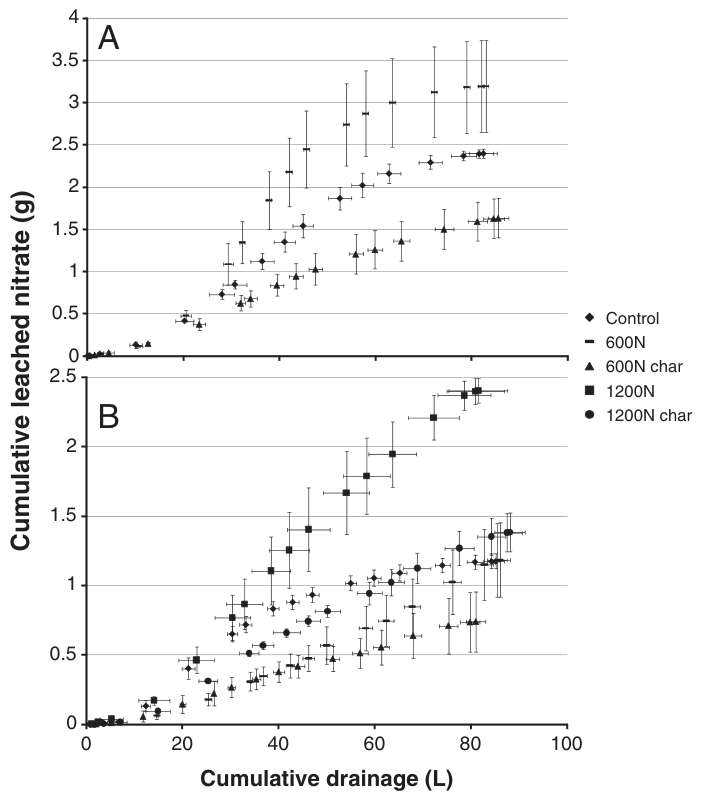
Fig. 2(A and B) shows the nitrate leaching from the ASL and TSL lysimeters as a function of the cumulative leachate volume. For all lysimeters, the cumulative nitrate leaching vs cumulative drainage produced sinusoidal curves, with points of inflection around 10 L and 50 L of cumulative drainage. This is consistent with a breakthrough of a pulse of nitrate, resulting from the application of disturbed soil and treatment mixtures. There were significant differences between the treatments. Nitrogen losses from the ASL treatments were significantly higher than the corresponding treatments in the TSL treatments. This is probably due to the higher N concentration in the ASL soil (Table 1). The addition of biosolids resulted in a significant increase in nitrate leaching in all treatments, except the TSL 600 N. This is consistent with the high N concentration in the biosolids. In the field situation, this could lead to groundwater contamination, hence the environmental legislation limiting the rate of biosolids application to soil.
图2(A和B)显示了ASL和TSL渗漏计的硝酸盐淋溶量随累积淋出液体积的变化。所有渗漏计的累积硝酸盐淋溶量与累积排水量关系均呈S形曲线,拐点出现在累积排水量约10 L和50 L处。这与扰动土壤及处理混合物施加后硝酸盐脉冲的穿透过程一致。各处理间存在显著差异。ASL处理的氮损失显著高于TSL中的相应处理,这可能是由于ASL土壤N浓度较高(表1)。除TSL 600 N外,施加生物固体使所有处理的硝酸盐淋溶均显著增加,这与生物固体的高N浓度一致。在田间条件下,这可能导致地下水污染,因此环境法规对生物固体的土壤施用量作出了限制。
The addition of biosolids and biochar together resulted in nitrate leaching that was significantly lower than the biosolids alone treatment, and the 600 N char treatment leached significantly less nitrate than the control. This indicates that by including biochar in a biosolids soil amendment can mitigate nitrate leaching from over the short term.
生物固体与生物炭配施的硝酸盐淋溶量显著低于单施生物固体处理,且600 N配施生物炭处理的硝酸盐淋溶量显著低于对照。这表明在生物固体土壤改良剂中加入生物炭可在短期内缓解硝酸盐淋溶。
Mass (g) of N present initially in lysimeters (0.2 m2), N removed via plant uptake and nitrate removed via leaching. Values in brackets are the standard error of the mean. Values in a column with the same letter are not significantly different.
渗漏计(0.2 m2)中初始N的质量(g)、经植物吸收移除的N以及经淋溶移除的硝酸盐。括号内数值为平均值的标准误。同列中标有相同字母的数值无显著差异。
| Nitrogen prese初始存在 | nt initially的氮 | Nitrogen re移除 | moved的氮 | % removed移除百分比 | |
|---|---|---|---|---|---|
| Soil (top 100 mm) | Added in biosolids | Plant uptake | Leached | ||
| ASL control | 42.0 | 0.0 | 0.6 (0.1)e | 2.4 (0.1)b | 7.1 |
| ASL 600 N | 42.0 | 11.8 | 0.8 (0.1)cd | 3.2 (0.5)a | 7.4 |
| ASL 600 N char | 42.0 | 11.8 | 0.6 (0.0)e | 1.6 (0.2)c | 4.1 |
| TSL control | 27.0 | 0.0 | 0.7 (0.0)de | 1.2 (0.1)cd | 4.4 |
| TSL 600 N | 27.0 | 11.8 | 1.0 (0.0)ab | 1.2 (0.1)cd | 5.7 |
| TSL 600 N char | 27.0 | 11.8 | 0.8 (0.1)bcd | 0.7 (0.2)d | 3.9 |
| TSL 1200 N | 27.0 | 23.6 | 1.2 (0.1)a | 2.4 (0.1)b | 7.1 |
| TSL 1200 N char | 27.0 | 23.6 | 1.0 (0.1)bc | 1.4 (0.1)cd | 4.7 |
3.3. Nitrogen losses from the system3.3. 系统的氮损失
Table 3 shows the mass of N initially present in each lysimeter as well as N removed from the system via plant uptake and via nitrate leaching. The amount of nitrogen lost from the system via leaching will be slightly higher because this figure does not include other nitrogen species, which as discussed above, are insignificant compared to nitrate. Significantly more N was removed via plant uptake and leaching in the biosolids treatments compared to the control, while N removed from the biosolids+biochar treatments was not significantly different from, or significantly less than the control. The total N removed as a percentage of that initially present in the top 100 mm ranged from 3.9% (TSL 600 char) to 7.4% (ASL 600). On a perhectare basis, the N leached during the experiment ranged from 36 kg/ha (TSL600 char) to 163 kg/ha (ASL600). The values from the ASL and TSL controls, 122 and 61 kg/ha are similar to those reported by Cameron and Wild (1984) for a ploughed pastureland (up to 200 kg/ha), but significantly higher than non-ploughed pastureland (Di and Cameron, 2002). Since we homogenised the top 100 mm of the soil, we expected our lysimeters to behave similarly to a ploughed field. That there was no significant difference in the N leached between the TSL control and TSL 600 treatment may be due to the increased N uptake by pasture on the latter (Table 3).
表3列出了各渗漏计中初始存在的N质量,以及经植物吸收和硝酸盐淋溶从系统中移除的N。经淋溶从系统中损失的氮量实际上会略高,因为该数值未包括其他形态的氮,但如上所述,这些形态的氮与硝酸盐相比可忽略不计。与对照相比,生物固体处理经植物吸收和淋溶移除的N显著增加,而生物固体+生物炭处理移除的N与对照无显著差异或显著低于对照。移除的总N占顶部100 mm初始N量的百分比范围为3.9%(TSL 600 char)至7.4%(ASL 600)。按每公顷计,试验期间N淋溶量范围为36 kg/ha(TSL600 char)至163 kg/ha(ASL600)。ASL和TSL对照的数值分别为122和61 kg/ha,与Cameron and Wild(1984)报道的翻耕牧场(最高200 kg/ha)相近,但显著高于未翻耕牧场(Di and Cameron, 2002)。由于我们对顶部100 mm土壤进行了均质化处理,预计渗漏计的表现与翻耕农田相似。TSL对照与TSL 600处理之间N淋溶量无显著差异,可能是由于后者牧草N吸收量增加所致(表3)。
We did not quantify N losses through volatilisation, which may have occurred as NH3, N2, or N2O. Given the low pH of the soil (5.7), we would expect NH3 losses to be negligible. Losses of N2 are environmentally benign, while N2O is a potent greenhouse gas. Previous studies have shown that biochar decreases N2O emissions from urine patches in pasture (Taghizadeh-Toosi et al., 2011) and soil amended with poultry manure (Singh et al., 2010).
本研究未定量通过挥发途径(可能以NH3、N2或N2O形式)损失的N。鉴于土壤pH较低(5.7),预计NH3损失可忽略不计。N2损失对环境无害,而N2O是一种强效温室气体。已有研究表明,生物炭可减少牧场尿斑(Taghizadeh-Toosi et al., 2011)以及施用禽粪土壤(Singh et al., 2010)的N2O排放。
Biochar could mitigate nitrate leaching from biosolids by inhibiting the mineralisation of organic N to ammonia and thence to nitrate or by sorbing ammonium or nitrate, thus rendering it less available for leaching and plant uptake. If sorbtion was occurring, the mechanisms for this are unclear. The CEC of the biochar (Table 1) was less than that either the ASL or TSL soils, indicating that retention of ammonium via this mechanism will not be significant. The AEC of the biochar was just 4.0 cmol(+)/kg (Taghizadeh-Toosi et al., 2011), ruling out significant electrostatic binding of nitrate. Potentially, soil solution containing ammonium and nitrate could have been incorporated into pores on the surface of the biochar, which had a porosity of 0.64 (Taghizadeh- Toosi et al., 2011). However, such pores would have rapidly become saturated (Fig. 2) shows no significant differences in leachate volume and further mineralised N would have leached. Alternatively, the biochar may have inhibited the growth of soil flora that normally mineralises and nitrifies N. This could have occurred through some toxic agent on the surface of the biochar (Kim et al., 2003), or by providing refugia (Warnock et al., 2007) for competing microorganisms or denitrifying bacteria. It is interesting to note that the needles of Monterey Pine contain toxic polyphenols and flavonoids (Adams et al., 1992). These compounds may have also been present in the wood from which the biochar was manufactured.
生物炭可能通过抑制有机N矿化为氨进而转化为硝酸盐,或通过吸附铵或硝酸盐使其更难被淋溶和植物吸收,从而缓解生物固体引起的硝酸盐淋溶。若确实发生了吸附,其机制尚不清楚。生物炭的CEC(表1)低于ASL和TSL土壤,表明通过该机制保持铵的作用并不显著。生物炭的AEC仅为4.0 cmol(+)/kg(Taghizadeh-Toosi et al., 2011),排除了硝酸盐显著静电结合的可能。含铵和硝酸盐的土壤溶液有可能进入生物炭表面的孔隙中,该生物炭的孔隙度为0.64(Taghizadeh- Toosi et al., 2011)。然而,这些孔隙会很快达到饱和(图2显示淋出液体积无显著差异),此后进一步矿化的N将被淋溶。另一种可能是,生物炭抑制了通常负责N矿化和硝化的土壤微生物区系的生长。这可能是通过生物炭表面的某种毒性物质(Kim et al., 2003),或通过为竞争性微生物或反硝化细菌提供避难所(Warnock et al., 2007)而实现的。值得注意的是,辐射松针叶含有有毒的多酚和黄酮类化合物(Adams et al., 1992)。这些化合物也可能存在于用于制备生物炭的木材中。
4Conclusions结论
The incorporation of biochar into biosolids-amended soil mitigates nitrate leaching over the short term. This delay should be beneficial both to the environment, which receives lower nitrate loadings, and to plants, which have N held in the rootzone for longer periods. Biosolid/biochar mixtures could be added to soils at a much higher rate than biosolids alone, thereby increasing the efficacy of using biosolids to rebuild degraded soils, where organic matter is limiting. There are several unknowns resulting from this study that warrant further research. The mechanisms for the inhibition of nitrate leaching are unclear. Elucidating these may enable optimisation of bisolids: biochar ratio and allow the manufacture of biochars with the best properties for the reduction of nitrate leaching.
在施用生物固体的土壤中加入生物炭可在短期内缓解硝酸盐淋溶。这种延迟对环境(硝酸盐负荷降低)和植物(N在根区保持更长时间)均有益。生物固体/生物炭混合物的土壤施用量可远高于单施生物固体,从而提高利用生物固体重建有机质匮乏的退化土壤的效率。本研究还留下若干未知问题,值得进一步研究。硝酸盐淋溶受抑制的机制尚不清楚。阐明这些机制有助于优化生物固体与生物炭的配比,并制备出最有利于减少硝酸盐淋溶的生物炭。
Acknowledgements致谢
We thank Environmental Science and Research (ESR) and the Foundation for Research, Science and Technology (FRST), for their funding on this project of ‘Closing the loop — rebuilding our soils with biowastes’. We would also like to thank the reviewers of this manuscript for their constructive comments.
感谢Environmental Science and Research(ESR)和Foundation for Research, Science and Technology(FRST)对“Closing the loop — rebuilding our soils with biowastes”项目的资助。同时感谢本文审稿人提出的建设性意见。
References参考文献
Adams DC, Pfister JA, Short RE, Cates RG, Knapp BW, Wiedmeier RD. Pine needle effects on in vivo and in vitro digestibility of crested wheatgrass. J Range Manage 1992;45: 249–53.
Agopsowicz M, Bialowiec A, Pijarczyk P. Sewage sludge land disposal effects on groundwater. Arch Environ Prot 2008;34:73–82.
Beesley L, Dickinson N. Carbon and trace element fluxes in the pore water of an urban soil following greenwaste compost, woody and biochar amendments, inoculated with the earthworm Lumbricus terrestris. Soil Biol Biochem 2011;43(1):188–96.
Beesley L, Moreno-Jimenez E, Gomez-Eyles JL. Effects of biochar and greenwaste compost amendments on mobility, bioavailability and toxicity of inorganic and organic contaminants in a multi-element polluted soil. Environ Pollut 2010;158: 2282–7.
Bolan NS, Adriano D, Kunhikrishnan A, James T, McDowell R, Senesi N. Dissolved organic carbon: biogeochemistry, dynamics and agro-environmental significance in soils. Adv Agron 2011;110:1-75.
Bradley J. New Zealand. In: LeBlanc RJ, Matthews P, Richard RP, editors. Global Atlas of Excreta, Wastewater Sludge, and Biosolids Management: Moving Forward The Sustainable and Welcome Uses of a Global Resource. Nairobi: United Nations Human Settlements Programme (UN-HABITAT); 2008. p. 447–54.
Cameron KC, Wild A. Potential aquifer pollution from nitrate leaching following the plowing of temporary grassland. J Environ Qual 1984;13:274–8.
Cameron KC, Smith NP, McLay CDA, Fraser PM, McPherson RJ, Harrison DF, et al. Lysimeters without edge flow - an improved design and sampling procedure. Soil Sci Soc Am J 1992;56:1625–8.
Chan KY, Van Zwieten L, Meszaros I, Downie A, Joseph S. Agronomic values of greenwaste biochar as a soil amendment. Aust J Soil Res 2007;45:629–34.
Chaney RL. 20 Years of Land Application Research 1. BioCycle 1990;31:54–9.
Cheng CH, Lehmann J, Thies JE, Burton SD, Engelhard MH. Oxidation of black carbon by biotic and abiotic processes. Org Geochem 2006;37:1477–88.
Clough TJ, Condron LM. Biochar and the nitrogen cycle: Introduction. J Environ Qual 2010;39:1218–23.
Clough TJ, Bertram JE, Ray JL, Condron LM, O'Callaghan M, Sherlock RR, et al. Unweathered wood biochar impact on nitrous oxide emissions from a bovineurine-amended pasture soil. Soil Sci Soc Am J 2010;74:852–60.
Deenik JL, McClellan T, Uehara G, Antal MJ, Campbell S. Charcoal Volatile Matter Content Influences Plant Growth and Soil Nitrogen Transformations. Soil Sci Soc Am J 2010;74:1259–70.
Di HJ, Cameron KC. Nitrate leaching in temperate agroecosystems: sources, factors and mitigating strategies. Nutr Cycl Agroecosys 2002;64:237–56.
Earle J. The gymnosperm database. http://www.conifers.org/pi/pin/radiata.htm 2010. Gaunt JL, Lehmann J. Energy balance and emissions associated with biochar sequestration and pyrolysis bioenergy production. Environ Sci Technol 2008;42: 4152–8.
Gibbs T. Guidelines for the Safe Application of Biosolids to Land in New Zealand. Wellington N.Z: New Zealand Water Ministry for the Environment; 2003. pp. vi, 177. Houba VJG, Uittenbogaard J, Pellen P, Brader A. Wageningen evaulating programmes for analytical laboratories. Wageningen: Department of Environmental Sciences, Wageningen Agricultural University; 1998.
Kim EJ, Oh JE, Chang YS. Effects of forest fire on the level and distribution of PCDD/Fs and PAHs in soil. Sci Total Environ 2003;311:177–89.
Kowaljow E, Mazzarino MJ, Satti P, Jimenez-Rodriguez C. Organic and inorganic fertilizer effects on a degraded Patagonian rangeland. Plant Soil 2010;332:135–45. Krogmann U, Boyles LS, Bamka WJ, Chaiprapat S, Martel CJ. Biosolids and sludge management. Water Environ Res 1999;71:692–714.
Laird DA. The charcoal vision: a win-win-win scenario for simultaneously producing bioenergy, improving soil and water quality. Agron J 2008;100:178–81.
Laird DA, Fleming P, Davis DD, Horton R, Wang BQ, Karlen DL. Impact of biochar amendments on the quality of a typical Midwestern agricultural soil. Geoderma 2010a;158:443–9.
Laird DA, Fleming P, Wang BQ, Horton R, Karlen D. Biochar impact on nutrient leaching from a Midwestern agricultural soil. Geoderma 2010b;158:436–42.
Lehmann J, da Silva JP, Steiner C, Nehls T, Zech W, Glaser B. Nutrient availability and leaching in an archaeological anthrosol and a ferralsol of the central Amazon basin: Fertilizer, manure and charcoal amendments. Plant Soil 2003;249:343–57.
Lehmann J, Gaunt JL, Rondon M. Bio-char sequestration in terrestrial rcosystems – A review. Mitig Adapt Strat Glob Change 2006;11:395–419.
Liang B, Lehmann J, Solomon D, Kinyangi J, Grossman J, O'Neill B, et al. Black Carbon increases cation exchange capacity in soils. Soil Sci Soc Am J 2006;70:1719–30.
Merino A, Edeso JM. Soil fertility rehabilitation in young Pinus radiata D. Don. plantations from northern Spain after intensive site preparation. Forest Ecol Manage 1999;116:83–91.
Novak JM, Busscher WJ, Watts DW, Laird DA, Ahmedna MA, Niandou MAS. Short-term CO2 mineralization after additions of biochar and switchgrass to a Typic Kandiudult. Geoderma 2010;154:281–8.
Obi ME, Ebo PO. The effects of organic and inorganic amendments on soil physical properties and maize production in severly degraded sandy soil in Southern Nigeria. Bioresour Technol 1995;51:117–23.
Robinson B, Green S, Mills T, Clothier B, van der Velde M, Laplane R, et al. Phytoremediation: using plants as biopumps to improve degraded environments. Aust J Soil Res 2003;41:599–611.
Robinson BH, Green SR, Chancerel B, Mills TM, Clothier BE. Poplar for the phytomanagement of boron contaminated sites. Environ Pollut 2007;150:225–33.
Rondon MA, Ramirez J, Lehmann J. Charcoal additions reduce net emissions of greenhouse gases to the atmosphere. Proceedings of the 3 rd USDA Symposium on Greenhouse Gases and Carbon Sequestration, Baltimore, MD; 2005. p. 208.
Singh BP, Agrawal M. Potential benefits and risks of land application of sewage sludge. Waste Manage 2008;28:347–58.
Singh BP, Hatton BJ, Singh B, Cowie AL, Kathuria A. Influence of Biochars on Nitrous Oxide Emission and Nitrogen Leaching from Two Contrasting Soils. J Environ Qual 2010;39:1224–35.
Steiner C, Teixeira WG, Lehmann J, Nehls T, de Macedo JLV, Blum WEH, et al. Long term effects of manure, charcoal and mineral fertilization on crop production and fertility on a highly weathered Central Amazonian upland soil. Plant Soil 2007;291: 275–90.
Stoven K, Schnug E. Long term effects of heavy metal enriched sewage sludge disposal in agriculture on soil biota. Landbauforsch Volk 2009;59:131–8.
Taghizadeh-Toosi A, Clough TJ, Condron LM, Sherlock RR, Anderson CR, Cragie RA. Biochar incorporation into pasture soil suppresses in situ N2O emissions from ruminant urine patches. J Environ Qual 2011;40(2):468–76.
Warnock DD, Lehmann J, Kuyper TW, Rillig MC. Mycorrhizal responses to biochar in soil - concepts and mechanisms. Plant Soil 2007;300:9-20.
Wu YJ, Clarke N, Mulder J. Dissolved Organic Nitrogen Concentrations and Ratios of Dissolved Organic Carbon to Dissolved Organic Nitrogen in Throughfall and Soil Waters in Norway Spruce and Scots Pine Forest Stands Throughout Norway. Water Air Soil Pollut 2010;210:171–86.
Yanai Y, Toyota K, Okazaki M. Effects of charcoal addition on N2O emissions from soil resulting from rewetting air-dried soil in short-term laboratory experiments. Soil Sci Plant Nutr 2007;53:181–8.