Rainer Rees,†,* Brett H. Robinson,‡ Manoj Menon,†,^ Eberhard Lehmann,§ Madeleine S. G€unthardt-Goerg, and Rainer Schulin†
||
†Institute of Terrestrial Ecosystems, ETH Z€urich, Universit€atstrasse 16, 8092 Z€urich, Switzerland
‡Soil and Physical Sciences, Lincoln University, Burns 222, P.O. Box 84, Lincoln 7647, Christchurch, New Zealand §Spallation Neutron Source Division, Paul-Scherrer-Institut, 5232 Villigen PSI, Switzerland Swiss Federal Institute for Forest, Snow, and Landscape Research WSL, Z€urcherstrasse 111, 8903 Birmensdorf, Switzerland
‡林肯大学土壤与自然科学系,Burns 222, P.O. Box 84, Lincoln 7647, 基督城,新西兰 §保罗谢勒研究所散裂中子源部,5232 Villigen PSI,瑞士 瑞士联邦森林、雪与景观研究所(WSL),Zürcherstrasse 111, 8903 Birmensdorf,瑞士
bSSupporting Information
ABSTRACT: Poplars accumulate high B concentrations and are thus used for the phytomanagement of B contaminated soils. Here, we performed pot experiments in which Populus nigra � euramericana were grown on a substrate with B concentrations ranging from 13 to 280 mg kg�1 as H3BO3. Salix viminalis, Brassica juncea, and Lupinus albus were grown under some growing conditions for comparison. Poplar growth was unaffected at soil B treatment levels up to 93 mg kg�1. Growth was progressively reduced at levels of 168 and 280 mg kg�1. None of the other species survived at these substrate B levels. At leaf B concentrations <900 mg kg�1 only <10% of the poplar leaf area showed signs of toxicity. Neutron radiography revealed that chlorotic leaf tissues had B concentrations of 1000�2000 mg kg�1, while necrotic tissues had >2000 mg kg�1. Average B concentrations of up to 3500 mg kg�1 were found in leaves, while spots within leaves had concentrations >7000 mg kg�1, showing that B accumulation in leaf tissue continued even after the onset of necrosis. The B accumulation ability of P. nigra � euramericana is associated with B hypertolerance in the living tissue and storage of B in dead leaf tissue.
摘要:杨树能够积累高浓度的B,因而被用于B污染土壤的植物管理。本研究开展了盆栽试验,将 Populus nigra × euramericana 种植于以H3BO3形式添加B、B浓度为13~280 mg kg−1的基质上。为作比较,在部分生长条件下同时种植了 Salix viminalis、Brassica juncea 和 Lupinus albus。土壤B处理水平不超过93 mg kg−1时,杨树生长未受影响;在168和280 mg kg−1处理水平下,生长逐渐受到抑制。其他物种在上述基质B水平下均未能存活。叶片B浓度<900 mg kg−1时,仅<10%的杨树叶面积表现出毒害症状。中子照相结果显示,失绿叶组织的B浓度为1000~2000 mg kg−1,而坏死组织的B浓度>2000 mg kg−1。叶片平均B浓度最高可达3500 mg kg−1,而叶片内局部斑点的浓度>7000 mg kg−1,表明即使在坏死发生后,叶组织中的B积累仍在继续。P. nigra × euramericana 的B积累能力与其活组织对B的超耐受性以及B在死亡叶组织中的储存有关。
’ INTRODUCTION
At low concentrations, boron (B) is an essential plant and animal micronutrient.1 Recent studies suggest that B is also essential for humans.2 Boron deficiencies in plants have been reported in over 80 countries for a total of 132 crops.3 Like other trace elements, B becomes toxic for plants at elevated concentrations. The concentration range between B deficiency and toxicity is smaller than that for any other nutrient element.4 Boron is transported from soil into roots and thence into stems and leaves primarily by convection, with the stream of transpiration water.5 However, active metabolic-driven uptake has been shown to occur under B deficiency conditions.6 High levels of B occur naturally in many soils of arid regions.7 In addition, human activities can lead to high soil B concentrations, such as the irrigation of agricultural fields with B-laden water, coal mining, or fly ash deposition onto agricultural land.7,8
在低浓度下,硼(B)是植物和动物必需的微量营养元素。1近期研究表明,B对人体同样必不可少。2已有80多个国家报道了共计132种作物的植物缺硼现象。3与其他微量元素一样,B在浓度升高时会对植物产生毒害。B缺乏与B毒害之间的浓度范围比其他任何营养元素都窄。4B主要随蒸腾水流以对流方式由土壤进入根系,继而运输至茎和叶。5不过,已有研究表明在缺B条件下存在由代谢驱动的主动吸收。6干旱地区的许多土壤天然含有高水平的B。7此外,人类活动也可导致土壤B浓度升高,例如用含B水灌溉农田、煤炭开采或粉煤灰在农田上的沉积。7,8
Poplars (Populus spp.) are used for wood production, supplementary stock fodder during times of drought, and for the phytomanagement of contaminated sites.9,10 Due to their high transpiration rates and B accumulation, poplars have been employed in B phytoremediation to reduce B leaching from contaminated sites into receiving waters.10 Removal of B from contaminated sites can be achieved by harvesting the aboveground biomass.10 Boronenriched poplar twigs and leaves from contaminated sites could be used as livestock forage, providing a supplementary source of this essential trace element.11
杨树(Populus spp.)被用于木材生产、干旱期间的补充饲料以及污染场地的植物管理。9,10由于杨树蒸腾速率高且能积累B,已被用于B的植物修复,以减少污染场地中B向受纳水体的淋溶。10通过收获地上生物量可将B从污染场地中移除。10来自污染场地的富B杨树枝条和叶片可用作牲畜饲料,为这一必需微量元素提供补充来源。11
Depending on growth conditions, poplar clone, B application form and salinity, B accumulation in poplar leaves ranges between 500 and 1200 mg kg�1, greatly exceeding the B concentrations of the growing substrate and the poplar stems.10,12,13 In comparison to other species, the B accumulation of poplars was much higher in these studies. Apart from field surveys where B accumulation in poplars was found,14 there have been no studies following the original report by Ba~nuelos et al.,12 investigating the B accumulation of poplars in more detail, including bioaccumulation factors and B threshold concentrations compared to other species.
根据生长条件、杨树无性系、B施用形态和盐度的不同,杨树叶片中的B积累量为500~1200 mg kg−1,远高于生长基质和杨树茎中的B浓度。10,12,13在这些研究中,杨树的B积累量远高于其他物种。除发现杨树积累B的野外调查外,14自Bañuelos et al.12的最初报道以来,尚无研究对杨树的B积累进行更深入的探讨,包括生物富集系数以及与其他物种相比的B阈值浓度。
Various Salix species have been shown to accumulate leaf B concentrations >800 mg kg�1, exceeding those of poplars grown on the same fly ash disposal site, rendering also Salix interesting for the purpose of B extraction from contaminated soil.15 The phytoextraction efficiency of a plant species for a trace element depends on the respective accumulated concentration of the element and the amount of harvestable biomass.16 Brassica juncea is widely touted for use in phytoremediation and was reported to exhibit a high B tolerance.17 Despite its lower biomass production compared to poplars or willows, the phytoextraction efficiency of B. juncea may be similar if its B accumulation were higher.
已有研究表明,多种 Salix 属植物的叶片B积累浓度>800 mg kg−1,超过生长于同一粉煤灰处置场的杨树,因而 Salix 同样可用于从污染土壤中提取B。15某一植物物种对某种微量元素的植物提取效率取决于该元素的积累浓度和可收获生物量。16Brassica juncea 被广泛推荐用于植物修复,并据报道具有较高的B耐受性。17尽管其生物量低于杨树或柳树,但若其B积累量更高,B. juncea 的植物提取效率可能与之相当。
Received: May 4, 2011 Accepted: November 3, 2011 Revised: September 28, 2011 Published: November 03, 2011
Boron accumulation varies widely among different parts of a plant, necessitating the analyses of all plant parts for their B concentration in order to elucidate the total B accumulation.18 The increase of leaf B concentration during the growing period makes it difficult to determine toxicity thresholds for leaf B concentrations by foliar analysis, as B concentrations can vary considerably between old and young leaves. Moreover, when toxicity symptoms become visible in leaves, B concentrations can vary over several orders of magnitude even within single leaves.18,19 Therefore, the distribution of B not only among but also within leaves needs to be analyzed for the determination of B toxicity thresholds in leaf tissue. Various techniques have been applied to measure the spatial B concentration in leaves.19�21 However, these methods are either time-consuming, produce an incomplete picture of the B distribution within the leaves, or their suitability for high B concentrations has not been shown. In this study, neutron radiography (NR) was applied for the first time to analyze the spatial distribution of 10B in leaves. While the transfer of B from soil into the shoots of poplars is of great interest with respect to potential phytomanagement of contaminated sites, there is little knowledge on B accumulation by poplars. Therefore, the objectives of this study were to determine (1) the aboveground accumulation of B by Populus nigra � euramericana in comparison to Salix viminalis, B. juncea, and Lupinus albus and their tolerance to B in soil under controlled growing conditions, (2) the accumulation of B in roots, shoots and leaves of poplars, and (3) the distribution of B within individual poplar leaves in order to identify B threshold concentrations at which the tissue becomes chlorotic or necrotic.
B的积累在植物不同部位之间差异很大,因此需要分析植物所有部位的B浓度,才能阐明B的总积累量。18由于叶片B浓度在生长期内不断升高,且老叶与幼叶之间的B浓度差异可能很大,因此难以通过叶片分析确定叶片B浓度的毒性阈值。此外,当叶片出现可见的毒害症状时,即使在单个叶片内,B浓度也可相差数个数量级。18,19因此,为确定叶组织中的B毒性阈值,不仅需要分析B在叶片之间的分布,还需要分析其在叶片内部的分布。已有多种技术被用于测定叶片中B浓度的空间分布。19−21然而,这些方法或耗时较长,或只能提供叶片内B分布的不完整图像,或其对高B浓度的适用性尚未得到验证。本研究首次采用中子照相(NR)分析叶片中10B的空间分布。尽管B由土壤向杨树地上部的转移对污染场地的潜在植物管理具有重要意义,但目前对杨树B积累的认识仍十分有限。因此,本研究的目的是在受控生长条件下确定:(1)与 Salix viminalis、B. juncea 和 Lupinus albus 相比,Populus nigra × euramericana 地上部对B的积累及其对土壤B的耐受性;(2)杨树根、茎和叶中B的积累;(3)B在单个杨树叶片内的分布,以确定组织发生失绿或坏死的B阈值浓度。
1’ MATERIALS AND METHODS材料与方法
PlantGrowth.Populusnigra� euramericana,(clone“Dorskamp”), S. viminalis (spp.), B. juncea (spp.), and L. albus (L.) plants were grown on a potting mix (PM) under greenhouse conditions with natural lighting at the Swiss Federal Research Institute, WSL (Birmensdorf, 47� 210 1600 N, 8� 260 1600 O), Switzerland. Populus was chosen because of its known B accumulation and phytoremediation potential of B contaminated sites.10 Salix viminalis and B. juncea werechosenasalternativephytoremediationplantsthatareoftenused or proposed for the phytoremediation of contaminated sites,22,23 and L. albus was selected because of the phloem mobility of B in this species.24 ApartfromthecontroltreatmentwithnoaddedB,threesoil B treatments were initially established by spiking the PM substrate with different amounts of 10B-enriched H3BO3 (10B > 96%, Eagle- Picher Technologies, Quapaw, USA). The resulting HNO3- and CaCl2-extractable B concentrations of the substrates, which showed a linear relationship (r2 = 0.88; y = 0.50x � 13.1; p < 0.001), are given in Table S1 (Supporting Information (SI)). The chosen B treatments represent the range of soil B concentrations reported in previous studies on B uptake by poplars from contaminated soils.10,13,15 NitricacidandCaCl2-extractableconcentrationsofmacroandmicronutrientsinthePMsubstratearegiveninTableS2oftheSI. The pH (CaCl2, substrate: 0.01 mol CaCl2 ratio: 1: 2.5) of the substratewas5.0,thetotalcarbonconcentrationwas270.6gkg�1 and the nitrogen concentration was 6.78 g kg�1.
植物培养。Populus nigra × euramericana(无性系“Dorskamp”)、S. viminalis(spp.)、B. juncea(spp.)和 L. albus(L.)种植于瑞士联邦研究所WSL(Birmensdorf,47° 21′ 16″ N,8° 26′ 16″ E,瑞士)温室内的盆栽基质(PM)中,采用自然光照。选择 Populus 是因为其已知的B积累能力及对B污染场地的植物修复潜力。10选择 Salix viminalis 和 B. juncea 作为替代植物修复植物,因其常被用于或被推荐用于污染场地的植物修复,22,23选择 L. albus 则是因为B在该物种韧皮部中具有移动性。24除未添加B的对照处理外,最初通过向PM基质中添加不同量的10B富集H3BO3(10B > 96%,Eagle-Picher Technologies,Quapaw,美国)设置了3个土壤B处理。基质中HNO3和CaCl2可提取态B浓度呈线性关系(r2 = 0.88;y = 0.50x − 13.1;p < 0.001),见表S1(支持信息(SI))。所选B处理涵盖了以往关于杨树从污染土壤中吸收B的研究所报道的土壤B浓度范围。10,13,15PM基质中大量和微量营养元素的硝酸及CaCl2可提取态浓度见SI表S2。基质pH(CaCl2,基质与0.01 mol CaCl2之比为1:2.5)为5.0,总碳浓度为270.6 g kg−1,氮浓度为6.78 g kg−1。
In April 2005, we prepared three replicate pots (5.5 L) for each treatment and plant species and planted 3 plants in each pot. Planting occurred immediately after the pots were filled with ca. 4 kg of substrate. P. nigra � euramericana and S. viminalis were planted as cuttings (20 cm in length and 1 cm diameter), L. albus and B. juncea as seeds. Two weeks after planting, all plants were thinned to one plant per pot. Because S. viminalis, L. albus, and B. juncea did not grow at substrate B concentrations of 168 and 280 mg kg�1 two intermediate treatments were set up on the same occasion with B concentrations of 22 and 45 mg kg�1. P. nigra � euramericana was not planted in these two additional B treatments. The control treatment and the five B treatments are denoted as T13, T22, T45, T93, T168 and T280 according to the total initial B concentration of the respective substrate. Pots were irrigated with tap water 3�4 times per week to about field capacity, e.g., to the point where water started to drain into the trays. The leachates were collected and reapplied to the pots. All plants were harvested after four months of growth. The aboveground biomass was separated into leaves, stems, and in the case of B. juncea, also into pods. For P. nigra � euramericana and S. viminalis, only the new shoot growth and not the originally planted cuttings were used for analysis. Roots were separated from the substrate by washing with tap water, followed by rewashing with deionized water to remove small particles. Fine roots were collected using a 2 mm Nylon sieve. Plant biomass was dried until constant weight was obtained and the biomass was recorded. For P. nigra � euramericana we also recorded the position of the leaves in the sequence along the shoot starting with the first leaf at the bottom of the plant.
2005年4月,为每个处理和植物物种准备了3个重复盆(5.5 L),每盆种植3株植物。在盆中装入约4 kg基质后立即种植。P. nigra × euramericana 和 S. viminalis 以插条(长20 cm,直径1 cm)种植,L. albus 和 B. juncea 以种子播种。种植2周后,所有植物间苗至每盆1株。由于 S. viminalis、L. albus 和 B. juncea 在基质B浓度为168和280 mg kg−1时不能生长,因此同时增设了B浓度为22和45 mg kg−1的两个中间处理。P. nigra × euramericana 未种植于这两个附加B处理中。根据各基质的初始总B浓度,将对照处理和5个B处理分别记为T13、T22、T45、T93、T168和T280。每周用自来水灌溉3~4次,使基质含水量达到约田间持水量,即至水开始排入托盘为止。收集淋溶液并重新施回盆中。所有植物生长4个月后收获。地上生物量分为叶和茎,B. juncea 还分出荚果。对于 P. nigra × euramericana 和 S. viminalis,仅分析新生枝条,不包括最初种植的插条。用自来水冲洗将根系与基质分离,再用去离子水复洗以去除细小颗粒。用2 mm尼龙筛收集细根。植物生物量烘干至恒重后记录。对于 P. nigra × euramericana,还记录了叶片沿枝条的着生顺序,以植株基部第一片叶为起点。
Neutron Radiography. We used 10B-enriched B to determine the areal distribution of accumulated B within leaves by means of neutron radiography.25,26 The neutron absorption cross section of 10B as determined at ICON (Instrument for Cold Neutron Radiography) is 8720 E�24 cm�2. This is several orders of magnitude higher than that of 11B (11.5 E�24 cm�2), enabling the visualization of 10B within leaf tissue. A preliminary test with NR revealed that only poplar, but none of the other plants accumulated sufficient 10B in their leaves for NR. Neutron radiographs of dried poplar leaves were taken at the ICON facility of the Paul-Scherrer-Institute (Villigen), Switzerland.27 The NR data were calibrated against ICP-OES measurements of leaf B concentrations. After neutron imaging, the leaves were scanned using an office scanner (Agfa, SnapScan 1236) at 150 dpi. Color images were analyzed using WinRhizoPro28 to assess the ratio between healthy and chlorotic or necrotic leaf area (Rh/cn) for each leaf.
中子照相。采用10B富集的B,通过中子照相测定积累的B在叶片内的面分布。25,26在ICON(冷中子照相装置)上测得的10B中子吸收截面为8720 E−24 cm−2,比11B(11.5 E−24 cm−2)高出数个数量级,从而能够在叶组织内实现10B的可视化。NR预试验表明,只有杨树叶片积累了足以进行NR分析的10B,其他植物均不满足要求。干燥杨树叶片的中子照相在瑞士保罗谢勒研究所(Villigen)的ICON装置上完成。27NR数据以ICP-OES测定的叶片B浓度进行校准。中子成像后,用办公扫描仪(Agfa,SnapScan 1236)以150 dpi扫描叶片。采用WinRhizoPro28分析彩色图像,以评估每片叶片中健康叶面积与失绿或坏死叶面积之比(Rh/cn)。
Chemical Analysis. For chemical analysis, aliquots of dried and ground plant samples were digested in a heating block at 130 �C in 15 mL of a 65% HNO3. The digests were analyzed for B and other elements by ICP-OES (Vista MPX, Varian, Australia). Samples of PM substrate were analyzed for B after nitric acid digestion in the same way. Certified plant reference material NCS DC-73350 (poplar leaves, China National Analysis Centre for Iron and Steel, Beijing, China) was used for quality control. The average recovery rate for B was 98.4 ( 2%. To determine extractable concentrations of B and other elements in the PM substrate, 1:10 mixtures of substrate and 0.01 mol CaCl2 were shaken for 16 h, centrifuged at 929.3 � g for 10 min, filtered through a 0.25-μm membrane filter and analyzed by ICP-OES. Carbon and nitrogen contents of the PM substrate were measured using an elemental analyzer (CNS-2000, Leco Corp., Saint Joseph, Michigan U.S.).
化学分析。进行化学分析时,将干燥粉碎的植物样品等分试样置于加热模块中,在130 °C下用15 mL 65% HNO3消解。消解液中的B及其他元素采用ICP-OES(Vista MPX,Varian,澳大利亚)测定。PM基质样品经相同的硝酸消解后测定B。采用植物有证标准物质NCS DC-73350(杨树叶,中国钢铁研究总院国家钢铁材料测试中心,北京,中国)进行质量控制。B的平均回收率为98.4 ± 2%。为测定PM基质中B及其他元素的可提取态浓度,将基质与0.01 mol CaCl2按1:10混合,振荡16 h,以929.3 × g离心10 min,经0.25 μm滤膜过滤后用ICP-OES测定。PM基质的碳、氮含量采用元素分析仪(CNS-2000,Leco Corp.,Saint Joseph,Michigan,美国)测定。
Statistics. Mean whole-plant element concentrations were calculated as mass-weighted average of the respective element concentrations of individual plant parts. Kruskal�Wallis-ANO- VA was performed to test for differences in biomass and element concentrations between B treatments, followed by the Mann� Whitney U-Test as posthoc test to compare pairwise differences between treatments. Values given for correlations between variables represent Pearsons’ correlation coefficients. All statistical analyses were carried out using PASW Statistics (Release 17.0.2).
统计分析。全株平均元素浓度按各植物部位元素浓度的质量加权平均值计算。采用Kruskal−Wallis ANOVA检验不同B处理间生物量和元素浓度的差异,再以Mann−Whitney U检验作为事后检验比较处理间的两两差异。变量间的相关性以Pearson相关系数表示。所有统计分析均采用PASW Statistics(Release 17.0.2)完成。
2’ RESULTS AND DISCUSSION结果与讨论
Biomass. All poplar saplings survived even at the highest B treatment levels, although they showed reduced growth in T168 and severe growth reduction in T280. Our results are consistent with the high B tolerance reported by Robinson et al.13 for poplars growing on B contaminated sites. Figure S1 (SI) shows the aboveground biomass of the harvested plants, excluding the part of the stem axis corresponding to the cutting originally planted in the case of P. nigra � euramericana and S. viminalis. L. albus and B. juncea plants survived in the T93 treatment without any reduction in growth, but failed to grow at higher B concentrations. S. viminalis only grew in the T13 and the T22 treatment and its biomass was significantly lower than that of P. nigra � euramericana in T13 and that of B. juncea in T13 and T22. Thus, S. viminalis was the least B tolerant of the four species tested, while poplar was the most tolerant. This was a surprising observation given that poplars and willows belong to the same family (Salicaceae). Plants that do not tolerate elevated soil B concentrations are obviously not suited to remediate B contaminated sites. However, both Populus and Salix exhibit considerable inter- and intraspecific genetic and phenotypic variability with respect to B uptake and tolerance.15,29 Therefore, other Populus and Salix species and genotypes may have different B tolerance characteristics.
生物量。即使在最高B处理水平下,所有杨树幼苗均存活,但在T168中生长减缓,在T280中生长严重受抑。这一结果与Robinson et al.13报道的生长于B污染场地的杨树具有高B耐受性相一致。图S1(SI)显示了所收获植物的地上生物量,对于 P. nigra × euramericana 和 S. viminalis,不包括与最初种植插条相对应的茎轴部分。L. albus 和 B. juncea 在T93处理中存活且生长未受抑制,但在更高B浓度下无法生长。S. viminalis 仅在T13和T22处理中生长,且其生物量在T13中显著低于 P. nigra × euramericana,在T13和T22中显著低于 B. juncea。因此,在所测试的4个物种中,S. viminalis 的B耐受性最低,而杨树的耐受性最高。鉴于杨树和柳树同属杨柳科(Salicaceae),这一结果出乎意料。显然,不耐受土壤B浓度升高的植物不适合用于修复B污染场地。然而,Populus 和 Salix 在B吸收和耐受性方面均表现出相当大的种间和种内遗传及表型变异。15,29因此,其他 Populus 和 Salix 物种及基因型可能具有不同的B耐受特性。
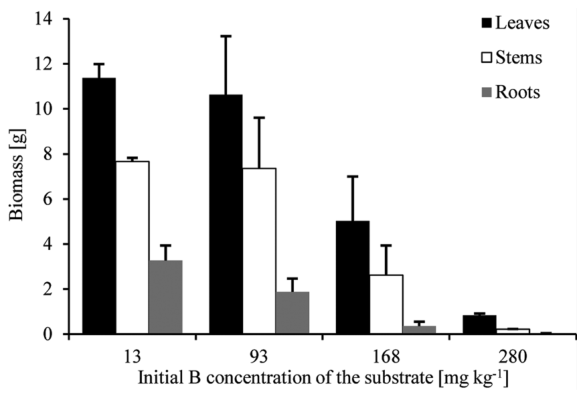
Figure 1 shows that the relative decrease in the biomass of the poplar plants was larger in the roots than in leaves and stems in the T168 and T280 treatments. The shoot:root biomass ratio increased from 6 in the control treatment to 25 and 57 in the T168 and the T280 treatments, respectively. The fact that high soil B concentrations had a stronger negative effect on root than on shoot biomass in P. nigra � euramericana indicates a higher B sensitivity of the roots or a mode of biological protection to absorb less B. High concentrations of soil B are known to inhibit root growth relative to shoot growth.30 Reduced growth may be a general response of poplar roots toward contaminants as poplar roots were shown to react in the same way toward elevated soil Zn and Cd concentrations.31图1表明,在T168和T280处理中,杨树根生物量的相对降幅大于叶和茎。地上部与根的生物量比由对照处理的6分别增至T168和T280处理的25和57。高土壤B浓度对 P. nigra × euramericana 根生物量的负面影响强于地上部,表明根系对B更为敏感,或存在一种减少B吸收的生物保护方式。已知高浓度土壤B会抑制根的生长,其抑制程度相对于地上部更强。30生长减缓可能是杨树根系对污染物的普遍响应,因为已有研究表明杨树根系对土壤Zn和Cd浓度升高也有同样的反应。31
Boron Accumulation and Allocation in the Plants. While in the control treatment shoot B concentrations did not differ among species, significant differences emerged at higher B treatment concentrations (Table 1). The bioconcentration factors (BCF) (plant/soil concentration quotients) ranged between 3.5 and 5 for all species and all treatments, except for B. juncea (BC: 1.5�2.7) in the B treatments. The highest BCF values were found for poplar in the T168 and T280. Brassica juncea was found to exclude B from entering its shoots. Shoot B concentrations in this species did not differ between T13, T22, and T45 and were still less than half of the surviving L. albus plants in the T93 treatment. The B concentrations found in B. juncea were in the same range as those reported by Ba~nuelos et al..32
植物中B的积累与分配。在对照处理中,各物种地上部B浓度无差异,但在较高B处理浓度下出现了显著差异(表1)。除B处理中的 B. juncea(BC:1.5~2.7)外,所有物种在所有处理中的生物富集系数(BCF)(植物/土壤浓度之商)均在3.5~5之间。最高BCF值出现在T168和T280处理的杨树中。Brassica juncea 表现出阻止B进入地上部的特性。该物种地上部B浓度在T13、T22和T45之间无差异,且仍不到T93处理中存活的 L. albus 植株的一半。B. juncea 中的B浓度与Bañuelos et al.32报道的范围相同。
If the B tolerance of P. nigra � euramericana was due to B exclusion from uptake by the roots, then we would expect nontolerant plants to have higher shoot B concentrations than B-tolerant poplars grown on the same substrate. We did not find such a relationship between the plant species used in this study. The ability of the poplars to accumulate higher concentrations of B than the other species was apparently due to a greater B tolerance in their leaf tissues, demonstrating that this characteristic can be a useful strategy to deal with elevated soil B concentrations. The phloem mobility of B in L. albus did not increase its B tolerance in comparison to P. nigra � euramericana, L. albus, and S. viminalis. Also, the lower B accumulation in B. juncea did not increase its B tolerance compared to the other species and was less successful under the conditions of our study. These results are consistent with findings that B can easily penetrate cell membranes, indicating that regulation of B entry into the symplast and further into the root xylem, by means of membrane transporters is ineffective.33 Unlike other nutrient elements, B is taken up by plants as the neutral species H3BO3 which is dominant in soil solution at pH <9.24.33 This species has a diameter of only 0.257 nm and thus may easily pass through cell membranes via aquaporins.34
如果 P. nigra × euramericana 的B耐受性源于根系对B吸收的排斥,那么可以预期,在同一基质上生长的不耐受植物的地上部B浓度应高于耐B的杨树。然而,本研究所用植物物种之间并未发现这种关系。杨树能够比其他物种积累更高浓度的B,显然是由于其叶组织具有更强的B耐受性,这表明该特性可能是应对土壤B浓度升高的有效策略。与 P. nigra × euramericana、L. albus 和 S. viminalis 相比,B在 L. albus 韧皮部中的移动性并未提高其B耐受性。同样,B. juncea 较低的B积累量也未使其B耐受性高于其他物种,且在本研究条件下表现较差。这些结果与B能够轻易穿透细胞膜的发现相一致,表明通过膜转运蛋白调控B进入共质体并进一步进入根木质部的作用是无效的。33与其他营养元素不同,B以中性形态H3BO3被植物吸收,该形态在pH <9.24的土壤溶液中占主导。33该形态的直径仅为0.257 nm,因此可通过水通道蛋白轻易穿过细胞膜。34
| B concentrationB浓度 | ||||||||
|---|---|---|---|---|---|---|---|---|
| treatment | L. alb | us | B. jun | cea | P. nigra�eu | ramericana | S. vim | inalis |
| [mg kg�1] | ||||||||
| T13 | 40.5 x | (3.44 | 43.5 x | (4.69 | 43.8 x | (0.29 | 48.6 x | (4.67 |
| T22 | 114.2 y I | (16.6 | 60.1 x II | (4.37 | N/A | 118.3 y I | (11.3 | |
| T45 | 174.6 yz I | (27.2 | 68.1 xy II | (17.2 | N/A | z | ||
| T93 | 304.4 z I | (20.7 | 136.4 y II | (19.1 | 392.4 y I | (28.7 | z | |
| aT13is the con within the sam | trol treatment. bS e treatment by ro | tatistically signii man numerals ( | ficant differences Mann-Whitney | between treatmen U-test,p< 0.05,N | ts are indicated by = 3). N/A: not a | characters and diff pplicable. c plant d | ferences between ied. | plant species |
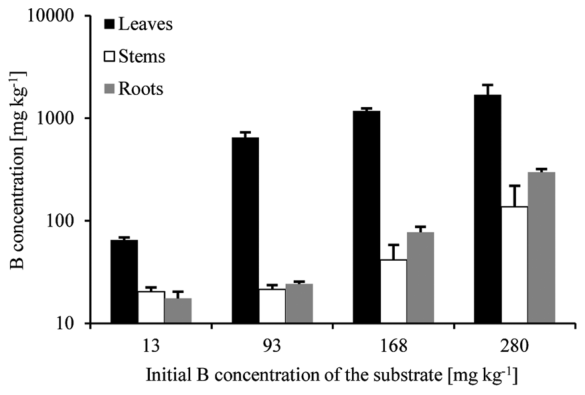
Figure 2 shows that there were no significant differences between root and stem B concentrations, which both increased in the poplar plants with the B concentration of the substrate. In the T168 and T280 treatments, the average leaf B concentration exceeded 1000 mg kg�1. This is in agreement with the notion that B is primarily passively transported with the transpiration stream and deposited in the leaves upon evaporation of the water and is consistent with previous reports.10,13图2表明,根与茎的B浓度之间无显著差异,二者均随基质B浓度的升高而增加。在T168和T280处理中,叶片平均B浓度超过1000 mg kg−1。这与B主要随蒸腾流被动运输、并在水分蒸发后沉积于叶片中的观点相一致,也与以往报道一致。10,13
Compared to the other tested species, P. nigra � euramericana has good potential for the phytomanagement of B contaminated sites. The total uptake of B into the aboveground biomass of P. nigra � euramericana during 4 months was 1 mg per plant in T13 and 8 mg per plant in T93, which represented about 2.1% of the total B initially presentinthe pots in T93. IntheT168 treatment, the total uptake of B was 7.2 mg per plant. In T168, the higher plant B concentration compensated the lower plant biomass in comparison to T93. However, in T168 the 7.2 mg B extracted were only 1% of the total B in the pot. This uptake was higher than found in Gypsophila arrostil and in the same range as reported for Pucinella distans, two species considered as potential B hyperaccumulator plants.35 The highest uptake found for one of the other species tested in this study was 0.7 mg B per plant in B. juncea. With an estimated annual leaf biomass production of 15 t ha�1 a�1 P. nigra � euramericana could extract 6.3 kg B ha�1 a�1 from contaminated topsoil containing 75 kg B ha�1. To prevent the extracted B from returning to the soil via leaf fall, removal of the leaves from the site would be necessary. For that purpose, poplars could be coppiced.13 The B rich leaves could be used as an organic fertilizer on B deficient sites or used as stock fodder.36 Only leaves from T13 and T93 would be suitable as stock fodder, as B concentrations >800 mg kg�1 may be toxic to livestock.37 Leaves from the T168 and T280 treatment could still be used as fodder if mixed with fodder produced on unpolluted soil.
与其他受试物种相比,P. nigra × euramericana 在B污染场地的植物管理方面具有良好潜力。4个月内,P. nigra × euramericana 地上生物量对B的总吸收量在T13中为每株1 mg,在T93中为每株8 mg,约占T93盆中初始总B量的2.1%。在T168处理中,B的总吸收量为每株7.2 mg。与T93相比,T168中较高的植物B浓度弥补了较低的植物生物量。然而,在T168中,提取的7.2 mg B仅占盆中总B量的1%。该吸收量高于 Gypsophila arrostil,并与 Pucinella distans 的报道值处于同一范围,这两个物种均被视为潜在的B超富集植物。35在本研究测试的其他物种中,最高吸收量为 B. juncea 的每株0.7 mg B。按估计的年叶片生物量产量15 t ha−1 a−1计,P. nigra × euramericana 可从含75 kg B ha−1的污染表土中每年提取6.3 kg B ha−1 a−1。为防止提取的B通过落叶返回土壤,需将叶片移出场地。为此,可对杨树进行平茬萌生。13富B叶片可作为有机肥施用于缺B土地,或用作牲畜饲料。36由于B浓度>800 mg kg−1可能对牲畜产生毒害,只有T13和T93处理的叶片适合用作饲料。37T168和T280处理的叶片若与未污染土壤上生产的饲料混合,仍可用作饲料。
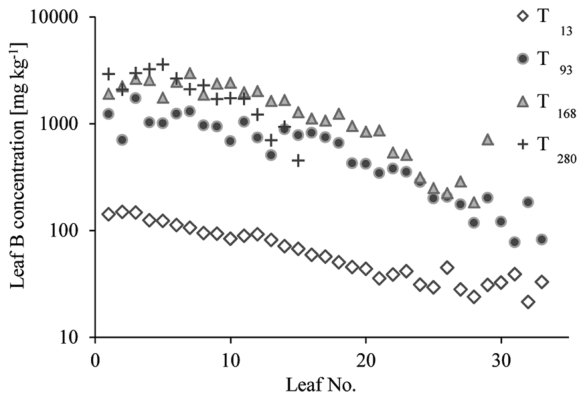
Partitioning of B in Populus nigra � euramericana Leaves. In all treatments, B concentrations decreased exponentially with leaf number from the lower (older) to the upper (younger) leaves of the poplar saplings (Figure 3). There was a more than 10-fold difference in average B concentration between the oldest and the youngest leaves in all B treatments. The B concentration ranges from top to bottom leaves were 22�185 (T13), 62�1725 (T93), 190�3241 (T168), and 298�3472 (T280) for the respective treatments, with only small differences between the highest treatments T168 and T280. These results have implications for the interpretation of data for B accumulation in poplar trees sampled in the field.18 It is usually only possible to collect and analyze a small number of leaves from a tree. As our results show, B concentration data from leaf samples may vary by an order of magnitude depending on the position of the sampled leaves. Robinson et al.10 found that leaf B concentrations also varied considerably with time over a growing season. Again, these findings are support that B accumulation in the leaves is primarily associated with the transpiration water flow and that there is little or no relocation of B in the phloem of poplars. The leaf B concentrations did not depend on the size of the leaves (data not shown). The leaves emerging in the middle of the growing season were larger than the leaves produced at the beginning and the end of the growing season, while the B concentration of the leaves that emerged in the middle of the growing season steadily increased with age.
Populus nigra × euramericana 叶片中B的分配。在所有处理中,B浓度随叶序由下部(较老)叶片至上部(较幼)叶片呈指数下降(图3)。在所有B处理中,最老叶片与最幼叶片的平均B浓度相差10倍以上。各处理从顶部叶片到底部叶片的B浓度范围分别为22~185(T13)、62~1725(T93)、190~3241(T168)和298~3472(T280),最高的两个处理T168与T280之间差异较小。这些结果对解释野外采集的杨树B积累数据具有重要意义。18通常只能从一棵树上采集并分析少量叶片。本研究结果表明,叶片样品的B浓度数据可能因采样叶片位置的不同而相差一个数量级。Robinson et al.10发现,叶片B浓度在一个生长季内也随时间有较大变化。这些结果再次支持以下观点:叶片中的B积累主要与蒸腾水流有关,而B在杨树韧皮部中很少或几乎不发生再分配。叶片B浓度与叶片大小无关(数据未列出)。生长季中期长出的叶片大于生长季初期和末期长出的叶片,而生长季中期长出叶片的B浓度随叶龄稳步增加。
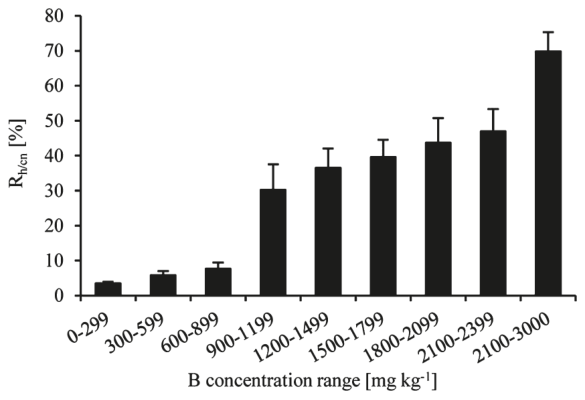
With increasing leaf B concentrations the fraction of chlorotic and necrotic areas on the sampled leaves increased (Figure 4). At leaf B concentrations <900 mg kg�1 Rh/cn was always <10%. The leaf B concentration range 900�1199 mg kg�1 was a threshold across which Rh/cn jumped to values above 30%. At leaf B concentrations >1200 mg kg�1 the value of Rh/cn increased linearly (r2 = 0.98; y = 4.07x + 27.21; p < 0.001), until a second threshold was reached at B concentrations >2100 mg kg�1, where Rh/cn increased to >70%. Tripler et al.38 found similar leaf necrosis effects associated with high leaf B concentrations in date palm. Increasing contaminant accumulation and leaf chlorosis/ necrosis with leaf age is also known for Zn and Cd, although these metals were stored in different tissues.39,40
随着叶片B浓度的升高,采样叶片上失绿和坏死区域所占比例增加(图4)。叶片B浓度<900 mg kg−1时,Rh/cn始终<10%。叶片B浓度900~1199 mg kg−1是一个阈值区间,超过该区间后Rh/cn跃升至30%以上。叶片B浓度>1200 mg kg−1时,Rh/cn呈线性增加(r2 = 0.98;y = 4.07x + 27.21;p < 0.001),直至B浓度>2100 mg kg−1时达到第二个阈值,此时Rh/cn增至>70%。Tripler et al.38在海枣中发现了与叶片高B浓度相关的类似叶片坏死效应。污染物积累及叶片失绿/坏死随叶龄增加的现象在Zn和Cd中亦有报道,尽管这些金属储存于不同的组织中。39,40
Distribution of B within Populus nigra � euramericana Leaves. Comparison of the ICP-OES measurements and the NR results showed that local tissue 10B accumulation in leaves was detectable by NR if concentrations in leaves exceeded 300 mg kg�1. The detection limit and the spatial resolution of neutron radiographs (130 μm) thus were sufficient for the determination of toxicity thresholds in P. nigra � euramericana leaf tissue. Boron concentrations in the leaves of B. juncea, S. viminalis, and L. albus were below the detection limit. Here, laser ablation ICP-MS could be an alternative.20
Populus nigra × euramericana 叶片内B的分布。ICP-OES测定结果与NR结果的比较表明,当叶片中浓度超过300 mg kg−1时,NR可检测到叶片局部组织中的10B积累。因此,中子照相的检出限和空间分辨率(130 μm)足以用于确定 P. nigra × euramericana 叶组织的毒性阈值。B. juncea、S. viminalis 和 L. albus 叶片中的B浓度低于检出限。对此,激光剥蚀ICP-MS可作为替代方法。20
Within individual leaves, the highest B concentrations occurred at the leaf margins and tips. The margins and tips were also the locations where chlorosis and necrosis occurred first and were strongest (Figure S2 & S3 (SI)). At average leaf B concentrations greater than 1000 mg kg�1, the leaf margins and tips curled. At higher total leaf B concentrations, necrotic spots occurred throughout the leaf. These spots contained >2000 mg B kg�1. Leaf tissue containing between 1000 and 2000 mg Bkg�1 waschloroticandtissuecontainingmorethan2000mgkg�1 was necrotic. The finding of B concentrations >7000 mg kg�1 in some spots in necrotic leaf tissue indicates that B accumulation continued in leaf tissue even after the onset of necrosis and that necrotic tissue can still receive B via the transpiration flow. Similar findings were reported by Reid and Fitzpatrick19 for barley. Deposition of B at high concentrations in discrete patches may be a tolerance mechanism by which a small patch of photosynthetic tissue is sacrificed in order to prevent overloading of the surrounding tissues. The ability of P. nigra � euramericana to accumulate higher B concentrations in its aerial tissue than the other species tested can be attributed to the high B tolerance of the living leaf tissue and the storage of B in dead leaf tissue.
在单个叶片内,最高B浓度出现在叶缘和叶尖。叶缘和叶尖也是最先出现失绿和坏死且程度最严重的部位(图S2和S3(SI))。叶片平均B浓度高于1000 mg kg−1时,叶缘和叶尖发生卷曲。在更高的叶片总B浓度下,整个叶片上均出现坏死斑点。这些斑点的B含量>2000 mg B kg−1。B含量为1000~2000 mg B kg−1的叶组织发生失绿,含量超过2000 mg kg−1的组织发生坏死。在坏死叶组织的某些斑点中发现B浓度>7000 mg kg−1,表明即使在坏死发生后,叶组织中的B积累仍在继续,且坏死组织仍可通过蒸腾流获得B。Reid和Fitzpatrick19在大麦中也报道了类似的发现。B以高浓度沉积于离散斑块中可能是一种耐受机制,即通过牺牲一小块光合组织来防止周围组织过载。P. nigra × euramericana 能够在地上组织中积累比其他受试物种更高的B浓度,可归因于活叶组织的高B耐受性以及B在死亡叶组织中的储存。
The B accumulation characteristics of P. nigra � euramericana are consistent with the criteria compiled by Branquinho et al.41 for hyperaccumulation. The BCF as well as the shoot to root concentration ratio were >1 in P. nigra � euramericana and the aboveground B concentration in two (T168 and T280) of three B treatments was more than 10-times higher than in the control (T13). In contrast to many metals,42 there is no established shoot threshold B concentration above which a plant is considered to be a B hyperaccumulator. For example, for Ni the threshold concentration used as criterion for hyperaccumulation is 1000 mg kg�1,43 which corresponds to 17.0 mmol kg�1. The equivalent mass concentration of B is just 172 mg kg�1 because of its 80% lower molar weight compared to Ni. This concentration was exceeded in some of the poplar leaves grown in the control treatment and in more than 85% of the leaves in the treatments with higher B concentrations. In addition, the accumulation of 1000 mg B kg�1, a 20-times higher tissue concentration than the 50 mg kg�1 that is generally considered to be toxic in tissues of most other plants, is an indicator of B hyperaccumulation in poplar.44 However, as the comparison with other species showed, B accumulation in poplars seems not to be active and they do not fulfill the criterion that hyperaccumulators should have at least 100-fold higher concentrations of the respective trace element than nonhyperaccumulators when grown in contaminated soil.43 This indicates that B hyperaccumulation in poplars is not hyperaccumulation in the strictest sense, but rather B hypertolerance and thus comparable to the passive arsenic hyperaccumulation in aquatic macrophytes described by Robinson et al.45 Our results indicate that poplar is better suited for phytomanagement of B contaminated soil than S. viminalis or B. juncea, which have been proposed for the phytoextraction of other trace elements.
P. nigra × euramericana 的B积累特征符合Branquinho et al.41归纳的超富集标准。P. nigra × euramericana 的BCF以及地上部与根的浓度比均>1,且在3个B处理中的两个(T168和T280)中,地上部B浓度比对照(T13)高10倍以上。与许多金属不同,42目前尚无公认的地上部B阈值浓度来界定B超富集植物。例如,Ni超富集的阈值浓度标准为1000 mg kg−1,43相当于17.0 mmol kg−1。由于B的摩尔质量比Ni低80%,其相应的质量浓度仅为172 mg kg−1。对照处理中部分杨树叶片以及较高B浓度处理中85%以上的叶片均超过了该浓度。此外,杨树可积累1000 mg B kg−1,比通常认为对大多数其他植物组织有毒的50 mg kg−1高20倍,这也是杨树B超富集的一个指标。44然而,与其他物种的比较表明,杨树对B的积累似乎并非主动过程,且不满足超富集植物在污染土壤中生长时相应微量元素浓度应至少比非超富集植物高100倍的标准。43这表明杨树的B超富集并非严格意义上的超富集,而是B超耐受,因而类似于Robinson et al.45所描述的水生大型植物对砷的被动超富集。本研究结果表明,与已被推荐用于其他微量元素植物提取的 S. viminalis 或 B. juncea 相比,杨树更适合用于B污染土壤的植物管理。
3’ ASSOCIATED CONTENT相关内容
bS Supporting Information. Details on the growing substrate and plant biomass and pictures of poplar leaves showing the pattern of necrosis. This material is available free of charge via the Internet at http://pubs.acs.org.
支持信息。有关生长基质和植物生物量的详细信息,以及显示杨树叶片坏死模式的照片。该材料可通过互联网 http://pubs.acs.org 免费获取。
4’ AUTHOR INFORMATION作者信息
Corresponding Author通讯作者
*Phone: +41 44 633 60 78; E-mail: rainer.rees@env.ethz.ch.
Present Addresses现地址
^Kroto Research Institute, University of Sheffield, Sheffield S3 7HQ, United Kingdom.
^Kroto研究所,谢菲尔德大学,Sheffield S3 7HQ,英国。
5’ ACKNOWLEDGMENT致谢
Funds for this study came from the Swiss National Science Foundation (SNSF). We would also like to thank Rene Saladin from the Soil Protection lab at ETH, Lidija Josic from PSI for help with the NR analysis and providing the 10B cross section data, and Anton Burkart and his team at WSL for the cuttings and tending the plants.
本研究由瑞士国家科学基金会(SNSF)资助。我们还要感谢苏黎世联邦理工学院(ETH)土壤保护实验室的Rene Saladin、保罗谢勒研究所(PSI)的Lidija Josic在NR分析方面提供的帮助以及提供10B截面数据,并感谢WSL的Anton Burkart及其团队提供插条和照料植物。
6’ REFERENCES参考文献
(1) Salisbury, F. B.; Ross, C. W. Plant Physiology, 4th ed.; Wadsworth Publishing Co., Inc.: Belmont, California, USA., 1992.
(1) Salisbury, F. B.; Ross, C. W. Plant Physiology, 4th ed.; Wadsworth Publishing Co., Inc.: Belmont, California, USA., 1992.
(2) Hunt, C. D. Dietary Boron: Evidence for Essentiality and Homeostatic Control in Humans and Animals. In Advances in Plant and Animal Boron Nutrition; Springer: New York, 2007; p 251.
(2) Hunt, C. D. Dietary Boron: Evidence for Essentiality and Homeostatic Control in Humans and Animals. In Advances in Plant and Animal Boron Nutrition; Springer: New York, 2007; p 251.
(3) Shorrocks, V. M. The occurrence and correction of boron deficiency. Plant and Soil 1997, 193 (1�2), 121–148.
(3) Shorrocks, V. M. The occurrence and correction of boron deficiency. Plant and Soil 1997, 193 (1�2), 121–148.
(4) Goldberg, S. Reactions of boron with soils. Plant Soil 1997, 193 (1�2), 35–48.
(4) Goldberg, S. Reactions of boron with soils. Plant Soil 1997, 193 (1�2), 35–48.
(5) Schulin, R., et al. Trace element deficient soils. In Trace Elements in Soils; Hooda, P., Ed.; Wiley-Blackwell Publishing: Chichester, U.K, 2010; p 175.
(5) Schulin, R., et al. Trace element deficient soils. In Trace Elements in Soils; Hooda, P., Ed.; Wiley-Blackwell Publishing: Chichester, U.K, 2010; p 175.
(6) Takano, J.; Noguchi, K.; Yasumori, M.; Kobayashi, M.; Gajdos, Z.; Miwa, K.; Hayashi, H.; Yoneyama, T.; Fujiwara, T. Arabidopsis boron transporter for xylem loading. Nature 2002, 420 (6913), 337–340.
(6) Takano, J.; Noguchi, K.; Yasumori, M.; Kobayashi, M.; Gajdos, Z.; Miwa, K.; Hayashi, H.; Yoneyama, T.; Fujiwara, T. Arabidopsis boron transporter for xylem loading. Nature 2002, 420 (6913), 337–340.
(7) Nable, R. O.; Banuelos, G. S.; Paull, J. G. Boron toxicity. Plant Soil 1997, 193 (1�2), 181–198.
(7) Nable, R. O.; Banuelos, G. S.; Paull, J. G. Boron toxicity. Plant Soil 1997, 193 (1�2), 181–198.
(8) Parks, J. L.; Edwards, M. Boron in the environment. Crit. Rev. Environ. Sci. Technol. 2005, 35 (2), 81–114.
(8) Parks, J. L.; Edwards, M. Boron in the environment. Crit. Rev. Environ. Sci. Technol. 2005, 35 (2), 81–114.
(9) Hathaway, R. Short-rotation coppiced willows for sheep fodder in New Zealand. New Zealand Agric. Sci. 1986, 20 (3), 140–142.
(9) Hathaway, R. Short-rotation coppiced willows for sheep fodder in New Zealand. New Zealand Agric. Sci. 1986, 20 (3), 140–142.
(10) Robinson, B. H.; Green, S. R.; Chancerel, B.; Mills, T. M.; Clothier, B. E. Poplar for the phytomanagement of boron contaminated sites. Environ. Pollut. 2007, 150 (2), 225–233.
(10) Robinson, B. H.; Green, S. R.; Chancerel, B.; Mills, T. M.; Clothier, B. E. Poplar for the phytomanagement of boron contaminated sites. Environ. Pollut. 2007, 150 (2), 225–233.
(11) Mastromatteo, E.; Sullivan, F. Summary-International Symposium on the health-effects of boron and its compounds. Environ. Health Perspect. 1994, 102, 139–141.
(11) Mastromatteo, E.; Sullivan, F. Summary-International Symposium on the health-effects of boron and its compounds. Environ. Health Perspect. 1994, 102, 139–141.
(12) Ba~nuelos, G. S.; Shannon, M. C.; Ajwa, H.; Draper, J. H.; Jordahl, J.; Licht, J. Phytoextraction and accumulation of boron and selenium by Poplar (Populus) hybrid clones. Int. J. Phytoremediation 1999, 1 (1), 81�86. DOI 10.1080/15226519908500006 (13) Robinson, B.; Green, S.; Mills, T.; Clothier, B.; Velde, M. v. d.; Laplane, R.; Fung, L.; Deurer, M.; Hurst, S.; Thayalakumaran, T.; Dijssel, C. v. d. Phytoremediation: Using plants as biopumps to improve degraded environments. Aust. J. Soil Res. 2003, 41 (3), 599–511.
(12) Ba~nuelos, G. S.; Shannon, M. C.; Ajwa, H.; Draper, J. H.; Jordahl, J.; Licht, J. Phytoextraction and accumulation of boron and selenium by Poplar (Populus) hybrid clones. Int. J. Phytoremediation 1999, 1 (1), 81�86. DOI 10.1080/15226519908500006 (13) Robinson, B.; Green, S.; Mills, T.; Clothier, B.; Velde, M. v. d.; Laplane, R.; Fung, L.; Deurer, M.; Hurst, S.; Thayalakumaran, T.; Dijssel, C. v. d. Phytoremediation: Using plants as biopumps to improve degraded environments. Aust. J. Soil Res. 2003, 41 (3), 599–511.
(14) Dellantonio, A.; Fitz, W. J.; Repmann, F.; Wenzel, W. W. Disposal of Coal Combustion Residues in Terrestrial Systems: Contamination and Risk Management. J. Environ. Qual. 2010, 39 (3), 761–775, DOI: 10.2134/jeq2009.0068.
(14) Dellantonio, A.; Fitz, W. J.; Repmann, F.; Wenzel, W. W. Disposal of Coal Combustion Residues in Terrestrial Systems: Contamination and Risk Management. J. Environ. Qual. 2010, 39 (3), 761–775, DOI: 10.2134/jeq2009.0068.
(15) Dellantonio, A.; Fitz, W. J.; Custovic,H.; Repmann, F.; Schneider, B. U.; Grunewald, H.; Gruber, V.; Zgorelec, Z.; Zerem, N.; Carter, C.; Markovic, M.; Puschenreiter, M.; Wenzel, W. W. Environmental risks of farmed and barren alkaline coal ash landfills in Tuzla, Bosnia, and Herzegovina. Environ. Pollut. 2008, 153 (3), 677–686.
(15) Dellantonio, A.; Fitz, W. J.; Custovic,H.; Repmann, F.; Schneider, B. U.; Grunewald, H.; Gruber, V.; Zgorelec, Z.; Zerem, N.; Carter, C.; Markovic, M.; Puschenreiter, M.; Wenzel, W. W. Environmental risks of farmed and barren alkaline coal ash landfills in Tuzla, Bosnia, and Herzegovina. Environ. Pollut. 2008, 153 (3), 677–686.
(16) Pulford, I. D.; Watson, C. Phytoremediation of heavy metal-contaminated land by trees�A review. Environ. Int. 2003, 29, 529–540. (17) Ba~nuelos, G. S.; Cardon, G. E.; Phene, C. J.; Wu, L.; Akohoue, S.; Zambrzuski, S. Soil boron and selenium removal by three plant species. Plant Soil 1993, 148 (2), 253–263.
(16) Pulford, I. D.; Watson, C. Phytoremediation of heavy metal-contaminated land by trees�A review. Environ. Int. 2003, 29, 529–540. (17) Ba~nuelos, G. S.; Cardon, G. E.; Phene, C. J.; Wu, L.; Akohoue, S.; Zambrzuski, S. Soil boron and selenium removal by three plant species. Plant Soil 1993, 148 (2), 253–263.
(18) Oertli, J. J. Nonhomogeneity of boron distribution in plants and consequences for foliar diagnosis. Commun. Soil Sci. Plant Anal. 1994, 25 (7�8), 1133–1147.
(18) Oertli, J. J. Nonhomogeneity of boron distribution in plants and consequences for foliar diagnosis. Commun. Soil Sci. Plant Anal. 1994, 25 (7�8), 1133–1147.
(19) Reid, R.; Fitzpatrick, K. Influence of leaf tolerance mechanisms and rain on boron toxicity in barley and wheat. Plant Physiol. 2009, 151 (1), 413–420.
(19) Reid, R.; Fitzpatrick, K. Influence of leaf tolerance mechanisms and rain on boron toxicity in barley and wheat. Plant Physiol. 2009, 151 (1), 413–420.
(20) Wu, B.; Zoriy, M.; Chen, Y.; Becker, J. S. Imaging of nutrient elements in the leaves of Elsholtzia splendens by laser ablation inductively coupled plasma mass spectrometry (LA-ICP-MS). Talanta 2009, 78 (1), 132–137.
(20) Wu, B.; Zoriy, M.; Chen, Y.; Becker, J. S. Imaging of nutrient elements in the leaves of Elsholtzia splendens by laser ablation inductively coupled plasma mass spectrometry (LA-ICP-MS). Talanta 2009, 78 (1), 132–137.
(21) Loria, L. G.; Jimenez, R.; Badilla, M.; Lhuissier, F.; Goldbach, H.; Thellier, M. Neutron-capture-radiography study of the distribution of boron in the leaves of coffee plants grown in the field. J. Trace Microprobe Tech. 1999, 17 (1), 91–99.
(21) Loria, L. G.; Jimenez, R.; Badilla, M.; Lhuissier, F.; Goldbach, H.; Thellier, M. Neutron-capture-radiography study of the distribution of boron in the leaves of coffee plants grown in the field. J. Trace Microprobe Tech. 1999, 17 (1), 91–99.
(22) Dickinson, N. M.; Pulford, I. D. Cadmium phytoextraction using short-rotation coppice Salix: The evidence trail. Environ. Int. 2005, 31 (4), 609–613.
(22) Dickinson, N. M.; Pulford, I. D. Cadmium phytoextraction using short-rotation coppice Salix: The evidence trail. Environ. Int. 2005, 31 (4), 609–613.
(23) Vamerali, T.; Bandiera, M.; Mosca, G. Field crops for phytoremediation of metal-contaminated land. A review. Environ. Chem. Lett. 2010, 8 (1), 1–17.
(23) Vamerali, T.; Bandiera, M.; Mosca, G. Field crops for phytoremediation of metal-contaminated land. A review. Environ. Chem. Lett. 2010, 8 (1), 1–17.
(24) Huang, L.; Bell, R. W.; Dell, B. Evidence of phloem boron transport in response to interrupted boron supply in white lupin (Lupinus albus L. cv. Kiev Mutant) at the reproductive stage. J. Exp. Botany 2008, 59 (3), 575–583, DOI: 10.1093/jxb/erm336.
(24) Huang, L.; Bell, R. W.; Dell, B. Evidence of phloem boron transport in response to interrupted boron supply in white lupin (Lupinus albus L. cv. Kiev Mutant) at the reproductive stage. J. Exp. Botany 2008, 59 (3), 575–583, DOI: 10.1093/jxb/erm336.
(25) Zawisky, M.; Basturk, M.; Derntl, R.; Dubus, F.; Lehmann, E.; Vontobel, P. Non-destructive B-10 analysis in neutron transmission experiments. Appl. Radiat. Isot. 2004, 61 (4), 517–523.
(25) Zawisky, M.; Basturk, M.; Derntl, R.; Dubus, F.; Lehmann, E.; Vontobel, P. Non-destructive B-10 analysis in neutron transmission experiments. Appl. Radiat. Isot. 2004, 61 (4), 517–523.
(26) Menon, M.; Robinson, B.; Oswald, S.E.; Kaestner, A.; Abbaspour, K. C.; Lehmann, E.; Schulin, R. Visualization of root growth in heterogeneously contaminated soil using neutron radiography. Eur. J. Soil Sci. 2007, 58 (3), 802–810.
(26) Menon, M.; Robinson, B.; Oswald, S.E.; Kaestner, A.; Abbaspour, K. C.; Lehmann, E.; Schulin, R. Visualization of root growth in heterogeneously contaminated soil using neutron radiography. Eur. J. Soil Sci. 2007, 58 (3), 802–810.
(32) Ba~nuelos, G. S.; Cardon, G. E.; Mackey, B.; Benasher, J.; Wu, L.; Beuselinck, P.; Akohoue, S.; Zambruzski, S. Boron and selenium removal in boron-laden soils by 4 sprinkler irrigated plant-species. J. Environ. Qual. 1993, 22 (4), 786–792.
(32) Ba~nuelos, G. S.; Cardon, G. E.; Mackey, B.; Benasher, J.; Wu, L.; Beuselinck, P.; Akohoue, S.; Zambruzski, S. Boron and selenium removal in boron-laden soils by 4 sprinkler irrigated plant-species. J. Environ. Qual. 1993, 22 (4), 786–792.
(33) Hu, H.; Brown, P. H. Absorption of boron by plant roots. Plant Soil 1997, 193 (1), 49–58.
(33) Hu, H.; Brown, P. H. Absorption of boron by plant roots. Plant Soil 1997, 193 (1), 49–58.
(34) Tanaka, M.; Fujiwara, T. Physiological roles and transport mechanisms of boron: perspectives from plants. Pflugers Arch.�Eur. J. Physiol. 2008, 456 (4), 671–677.
(34) Tanaka, M.; Fujiwara, T. Physiological roles and transport mechanisms of boron: perspectives from plants. Pflugers Arch.�Eur. J. Physiol. 2008, 456 (4), 671–677.
(35) Stiles, A. R.; Bautista, D.; Atalay, E.; Babao�glu, M.; Terry, N. Mechanisms of boron tolerance and accumulation in plants: A physiological comparison of the extremely boron-tolerant plant species, Puccinellia distans, with the moderately boron-tolerant Gypsophila arrostil. Environ. Sci. Technol. 2010, 44 (18), 7089–7095.
(35) Stiles, A. R.; Bautista, D.; Atalay, E.; Babao�glu, M.; Terry, N. Mechanisms of boron tolerance and accumulation in plants: A physiological comparison of the extremely boron-tolerant plant species, Puccinellia distans, with the moderately boron-tolerant Gypsophila arrostil. Environ. Sci. Technol. 2010, 44 (18), 7089–7095.
(36) Robinson, B.; Mills, T.; Green, S.; Chancerel, B.; Clothier, B.; Fung, L.; Hurst, S.; McIvor, I. Trace element accumulation by poplars and willows used for stock fodder. N. Z. J. Agric. Res. 2005, 48 (4), 489–497.
(36) Robinson, B.; Mills, T.; Green, S.; Chancerel, B.; Clothier, B.; Fung, L.; Hurst, S.; McIvor, I. Trace element accumulation by poplars and willows used for stock fodder. N. Z. J. Agric. Res. 2005, 48 (4), 489–497.
(37) Underwood, E. J.; Suttle, N. F. The Mineral Nutrition of Livestock; CAB International Publishing: Wallingford, UK, 1999.
(37) Underwood, E. J.; Suttle, N. F. The Mineral Nutrition of Livestock; CAB International Publishing: Wallingford, UK, 1999.
(38) Tripler, E.; Ben-Gal, A.; Shani, U. Consequence of salinity and excess boron on growth, evapotranspiration and ion uptake in date palm (Phoenix dactylifera L., cv. Medjool). Plant Soil 2007, 297 (1�2), 147–155.
(38) Tripler, E.; Ben-Gal, A.; Shani, U. Consequence of salinity and excess boron on growth, evapotranspiration and ion uptake in date palm (Phoenix dactylifera L., cv. Medjool). Plant Soil 2007, 297 (1�2), 147–155.
(39) Vollenweider, P.; Menard, T.; G€unthardt-Goerg, M. S. Compartmentation of metals in foliage of Populus tremula grown on soils with mixed contamination. I. From the tree crown to leaf cell level. Environ. Pollut. 2011, 159 (1), 324–336.
(39) Vollenweider, P.; Menard, T.; G€unthardt-Goerg, M. S. Compartmentation of metals in foliage of Populus tremula grown on soils with mixed contamination. I. From the tree crown to leaf cell level. Environ. Pollut. 2011, 159 (1), 324–336.
(40) Vollenweider, P.; Cosio, C.; G€unthardt-Goerg, M. S.; Keller, C. Localization and effects of cadmium in leaves of a cadmium-tolerant willow (Salix viminalis L.): Part II Microlocalization and cellular effects of cadmium. Environ. Exp. Botany 2006, 58 (1�3), 25–40.
(40) Vollenweider, P.; Cosio, C.; G€unthardt-Goerg, M. S.; Keller, C. Localization and effects of cadmium in leaves of a cadmium-tolerant willow (Salix viminalis L.): Part II Microlocalization and cellular effects of cadmium. Environ. Exp. Botany 2006, 58 (1�3), 25–40.
(41) Branquinho, C.; Serrano, H. C.; Pinto, M. J.; Martins-Louc-~ao, M. A. Revisiting the plant hyperaccumulation criteria to rare plants and earth abundant elements. Environ. Pollut. 2007, 146 (2), 437–443, DOI: 10.1016/j.envpol.2006.06.034.
(41) Branquinho, C.; Serrano, H. C.; Pinto, M. J.; Martins-Louc-~ao, M. A. Revisiting the plant hyperaccumulation criteria to rare plants and earth abundant elements. Environ. Pollut. 2007, 146 (2), 437–443, DOI: 10.1016/j.envpol.2006.06.034.
(42) Kramer, U., Metal Hyperaccumulation in Plants. In Annual Review of Plant Biology, Vol 61, Annual Reviews: Palo Alto, 2010; Vol. 61, p 517.
(42) Kramer, U., Metal Hyperaccumulation in Plants. In Annual Review of Plant Biology, Vol 61, Annual Reviews: Palo Alto, 2010; Vol. 61, p 517.
(43) Brooks, R. R.; Lee, J.; Reeves, R. D.; Jaffre, T. Detection of nickeliferous rocks by analysis of herbarium specimens of indicator plants. J. Geochem. Explor. 1977, 7, 49–57.
(43) Brooks, R. R.; Lee, J.; Reeves, R. D.; Jaffre, T. Detection of nickeliferous rocks by analysis of herbarium specimens of indicator plants. J. Geochem. Explor. 1977, 7, 49–57.
(44) Jones, J. B. J., Plant tissue analysis in micronutrients. In Micronutrients in Agriculture; 2nd ed.; Mortvedt, J. J., Cox, F. R., Shuman, L. M., Welch, R. M., Eds; SSSA: Madison, WI, U.S., 1991; p 477.
(44) Jones, J. B. J., Plant tissue analysis in micronutrients. In Micronutrients in Agriculture; 2nd ed.; Mortvedt, J. J., Cox, F. R., Shuman, L. M., Welch, R. M., Eds; SSSA: Madison, WI, U.S., 1991; p 477.
(45) Robinson, B.; Kim, N.; Marchetti, M.; Moni, C.; Schroeter, L.; van den Dijssel, C.; Milne, G.; Clothier, B. Arsenic hyperaccumulation by aquatic macrophytes in the Taupo Volcanic Zone, New Zealand. Environ. Exp. Botany 2006, 58 (1�3), 206–215, DOI: 10.1016/j. envexpbot.2005.08.004.
(45) Robinson, B.; Kim, N.; Marchetti, M.; Moni, C.; Schroeter, L.; van den Dijssel, C.; Milne, G.; Clothier, B. Arsenic hyperaccumulation by aquatic macrophytes in the Taupo Volcanic Zone, New Zealand. Environ. Exp. Botany 2006, 58 (1�3), 206–215, DOI: 10.1016/j. envexpbot.2005.08.004.
(27) Kuhne, G.; Frei, G.; Lehmann, E.; Vontobel, P. CNR—The new beamline for cold neutron imaging at the Swiss spallation neutron source SINQ. Nucl. Instrum. Methods Phys. Res. Sect. A-Accel. Spectrom. Dect. Assoc. Equip. 2005, 542 (1�3), 264–270.
(27) Kuhne, G.; Frei, G.; Lehmann, E.; Vontobel, P. CNR—The new beamline for cold neutron imaging at the Swiss spallation neutron source SINQ. Nucl. Instrum. Methods Phys. Res. Sect. A-Accel. Spectrom. Dect. Assoc. Equip. 2005, 542 (1�3), 264–270.
(28) Regent Instruments: WinRhizo Pro, c; 2009.
(28) Regent Instruments: WinRhizo Pro, c; 2009.
(29) Ba~nuelos, G. S.; LeDuc, D.; Johnson, J. Evaluating the Tolerance of Young Hybrid Poplar Trees to Recycled Waters High in Salinity and Boron. Int. J. Phytoremediation 2010, 12 (5), 419–439.
(29) Ba~nuelos, G. S.; LeDuc, D.; Johnson, J. Evaluating the Tolerance of Young Hybrid Poplar Trees to Recycled Waters High in Salinity and Boron. Int. J. Phytoremediation 2010, 12 (5), 419–439.
(30) Reid, R. J.; Hayes, J. E.; Post, A.; Stangoulis, J. C. R.; Graham, R. D. A critical analysis of the causes of boron toxicity in plants. Plant, Cell, Environ. 2004, 27 (11), 1405–1414.
(30) Reid, R. J.; Hayes, J. E.; Post, A.; Stangoulis, J. C. R.; Graham, R. D. A critical analysis of the causes of boron toxicity in plants. Plant, Cell, Environ. 2004, 27 (11), 1405–1414.
(31) Dos Santos Utmazian, M. N.; Wieshammer, G.; Vega, R.; Wenzel, W. W. Hydroponic screening for metal resistance and accumulation of cadmium and zinc in twenty clones of willows and poplars. Environ. Pollut. 2007, 148 (1), 155�165. DOI: 10.1016/j.envpol.2006.10.045
(31) Dos Santos Utmazian, M. N.; Wieshammer, G.; Vega, R.; Wenzel, W. W. Hydroponic screening for metal resistance and accumulation of cadmium and zinc in twenty clones of willows and poplars. Environ. Pollut. 2007, 148 (1), 155�165. DOI: 10.1016/j.envpol.2006.10.045