H´ector M. Conesa,1 Michael W. H. Evangelou,2 Brett H. Robinson,3 and Rainer Schulin2
1 Departamento de Ciencia y Tecnolog´ıa Agraria, Universidad Polit´ecnica de Cartagena, Paseo Alfonso XIII,
1 卡塔赫纳理工大学(Universidad Polit´ecnica de Cartagena)农业科学与技术系,Paseo Alfonso XIII,
48-30203 Cartagena, Spain
2 Institute of Terrestrial Ecosystems, Swiss Federal Institute of Technology (ETH Z¨urich), Universitaestrasse 16, 8092 Z¨urich, Switzerland
2 瑞士联邦理工学院(ETH Z¨urich)陆地生态系统研究所,Universitaestrasse 16, 8092 苏黎世,瑞士
3 Agriculture and Life Sciences, Lincoln University, Lincoln, Canterbury 7647, New Zealand
Correspondence should be addressed to H´ector M. Conesa, hector.conesa@upct.es
Received 7 October 2011; Accepted 2 November 2011
Academic Editors: R. Clemente and J. Ruelas-Inzunza
Copyright © 2012 H´ector M. Conesa et al. This is an open access article distributed under the Creative Commons Attribution License, which permits unrestricted use, distribution, and reproduction in any medium, provided the original work is properly cited.
版权所有 © 2012 H´ector M. Conesa et al.。本文为依据知识共享署名许可协议(Creative Commons Attribution License)发布的开放获取文章,允许在任何媒介中不受限制地使用、传播和复制,前提是正确引用原作。
Phytotechnologies are often shown as an emerging tool to remediate contaminated soils. Research in this field has resulted in many important findings relating to plant and soil sciences. However, there have been scant private and public investments and little commercial success with this technology. Here, we investigate the barriers to the adoption of phytotechnologies and determine whether it is still a fertile area for future research. The terminology used in phytotechnologies includes a confusing mish-mash of terms relating to concepts and processes increasing the difficulty of developing a unique commercial image. We argue that the commercial success of phytotechnologies depends on the generation of valuable biomass on contaminated land, rather than a pure remediation technique that may not compare favourably with the costs of inaction or alternative technologies. Valuable biomass includes timber, bioenergy, feedstock for pyrolosis, biofortified products, or ecologically important species.
植物技术常被视为修复污染土壤的新兴工具。该领域的研究在植物科学和土壤科学方面取得了许多重要发现。然而,这一技术获得的私人和公共投资甚少,商业上也鲜有成功。本文探讨了阻碍植物技术推广应用的障碍,并判断该领域是否仍是未来研究的沃土。植物技术所使用的术语中,与概念和过程相关的名词混杂纷乱,增加了树立统一商业形象的难度。我们认为,植物技术的商业成功取决于能否在污染土地上生产有价值的生物质,而不是作为一种单纯的修复技术——与不采取行动或其他替代技术的成本相比,单纯的修复技术可能并不具备优势。有价值的生物质包括木材、生物能源、热解原料、生物强化产品或具有重要生态意义的物种。
1Introduction引言
Soil contamination has become an important environmental problem worldwide because of its detrimental effects on human and ecosystem health, soil productivity, and socioeconomic well-being. In 1994, there were an estimated 22 million ha of contaminated soils worldwide [1]. The European Environment Agency has estimated the total costs for the clean up of contaminated sites in Europe to be between EUR 59 and 109 billion [2]. Soil remediation projects need to incorporate environmental, technical, legislative, and economic factors, all of which are site specific.
由于对人类和生态系统健康、土壤生产力以及社会经济福祉的不利影响,土壤污染已成为全球性的重要环境问题。1994年,全球污染土壤面积估计达2200万ha [1]。欧洲环境署估计,欧洲污染场地清理的总成本在590亿至1090亿欧元之间 [2]。土壤修复项目需要综合考虑环境、技术、法规和经济因素,而这些因素均具有场地特异性。
Environmental regulations often obligate the remediation of soil if threshold values are exceeded [3–5] or there is an unacceptable risk to agricultural production, ecosystems, or human health [6]. Such regulation has placed an economic imperative to develop low-cost remediation technologies for contaminated soils.
当超过阈值 [3–5] 或对农业生产、生态系统或人类健康构成不可接受的风险时 [6],环境法规通常要求对土壤进行修复。此类法规使开发低成本的污染土壤修复技术成为经济上的迫切需要。
Soil remediation techniques comprise in situ (non excavated soil) and ex situ techniques (soil is excavated). Ex situ remediation can be achieved on site, which requires the presence of a mobile decontamination unit, or off site, which requires that the soil be transported to a treatment facility (e.g., soil washing). Regulators tend to favour on-site techniques, which imply soil disposal as close to the source of contamination as possible [5, 7]. The idea of “soil recycling” instead of disposal has been included in official regulations such as the directive 2008/1/EC concerning integrated pollution prevention and control [8]. Moreover, European Union regulators proposed within the same Directive a guideline to select the most suitable technique according to criteria such as environmental friendliness, preexisting scientific knowledge, or required time. Such guidelines leave stakeholders to choose the best remediation technology for their site, considering the economic, environmental, and social variables.
土壤修复技术包括原位(不开挖土壤)技术和异位(开挖土壤)技术。异位修复可在现场进行(需配备移动式去污装置),也可在场外进行(需将土壤运至处理设施,如土壤淋洗)。监管机构倾向于采用现场技术,即尽可能在靠近污染源的地方处置土壤 [5, 7]。以“土壤循环利用”代替处置的理念已被纳入官方法规,如关于综合污染预防与控制的2008/1/EC指令 [8]。此外,欧盟监管机构在该指令中还提出了一项指南,依据环境友好性、已有科学知识或所需时间等标准选择最合适的技术。此类指南让利益相关方在综合考虑经济、环境和社会变量的基础上,为其场地选择最佳修复技术。
2Biological and Nonbiological Methods生物方法与非生物方法
Phytotechnologies have been defined as “the application of science and engineering to study problems and provide solutions involving plants” [9] or as “a set of technologies using plants to remediate or contain contaminants in soil, groundwater, surface water, or sediments” [10].
植物技术被定义为“应用科学与工程研究涉及植物的问题并提供解决方案” [9],或“利用植物修复或控制土壤、地下水、地表水或沉积物中污染物的一系列技术” [10]。
The costs of conventional methods to remediate soils (Table 1) are comparatively easy to estimate. They are usually based on known production and disposal rates, which permits an accurate estimate of the time required for remediation. However, these conventional engineering techniques can be prohibitively expensive (Table 1). These techniques generally have drawbacks such as generating high amounts of additional wastes that require disposal and are not suited for the treatment of soils that are to be reused for agricultural or similar purposes of plant/biomass production. For example, thermal treatments drastically alter the soil’s biological and physical properties, which are the base of soil fertility. Similarly, soil-washing plants produce a residual clay-cake that has to be disposed of in a landfill.
常规土壤修复方法的成本(表1)相对容易估算。这些成本通常基于已知的处理速率和处置速率,因而可以准确估计修复所需的时间。然而,这些常规工程技术的费用可能高得令人望而却步(表1)。这些技术通常存在一些缺陷,例如会产生大量需要处置的额外废物,且不适用于处理拟再用于农业或类似植物/生物质生产用途的土壤。例如,热处理会剧烈改变作为土壤肥力基础的土壤生物学和物理性质。同样,土壤淋洗装置会产生残余黏土饼,需送往填埋场处置。
To overcome these problems and to meet regulatory guidelines, scientific research in the last two decades studied in situ biological techniques which are environmental friendly as well as cost-effective. Among these techniques, phytotechnologies have received a particular high level of interest from the scientific community.
为克服上述问题并满足法规要求,过去二十年的科学研究着眼于既环境友好又具成本效益的原位生物技术。在这些技术中,植物技术尤其受到科学界的高度关注。
Phytotechnologies (or phytoremediation) include the removal of pollutants (phytoextraction) [11], their extraction from aqueous solution (e.g., rhizofiltration) [12], transformation (e.g., phytovolatilization) [13], or immobilization (e.g., phytostabilization) [14]. These techniques are frequently shown as promising tools for the remediation of contaminated sites. However, the successful application of these aforementioned technologies in commercial operations or field trials is scarce.
植物技术(或植物修复)包括污染物的去除(植物提取)[11]、从水溶液中提取(如根际过滤)[12]、转化(如植物挥发)[13]或固定(如植物稳定)[14]。这些技术常被视为修复污染场地的有前景的工具。然而,上述技术在商业运营或田间试验中的成功应用却很少。
There are many scientific reviews of various aspects of phytotechnology [14–18]. Here, we discuss constraints and opportunities of phytotechnologies in the current environmental market, with a view to elucidating bottlenecks that hinder the commercial uptake of these technologies. We focus on the need to better transfer phytotechnologies to the commercial sector and explore ways to improve the economic viability of these technologies.
已有许多科学综述探讨了植物技术的各个方面 [14–18]。本文讨论植物技术在当前环境市场中面临的制约与机遇,以期阐明阻碍这些技术商业化推广的瓶颈。我们着重讨论更好地将植物技术转移至商业部门的必要性,并探索提高这些技术经济可行性的途径。
3The Need of a Conceptual Normalization概念规范化的必要性
Standardization is a key factor in the development of commercial products and services. For instance, there are standards for the investigation of soil, air, and water contamination under ISO 17020 : 2004 (General criteria for the operation of various types of bodies performing inspection) (http://www .iso.org/). Soil remediation does not yet have a standard norm. However, increasing stakeholder demand and commercial needs could bring this about. Conventional remediation techniques, such as soil washing, thermal desorption, soil stabilization plants, would be easier to normalize than phytotechnologies, since yields and physicochemical processes are easier to predict and control than biological parameters, where complex physiological processes and ecological relationships play an overriding role. Therefore, it is imperative that phytotechnologies develop a distinctive image or brand in relation to commercial and environmental issues.
标准化是开发商业产品和服务的关键因素。例如,ISO 17020 : 2004(各类检验机构运作的通用准则)(http://www .iso.org/)规定了土壤、空气和水污染调查的标准。土壤修复尚无标准规范,但日益增长的利益相关方需求和商业需要可能会促成其出台。土壤淋洗、热脱附、土壤稳定化装置等常规修复技术比植物技术更易于规范化,因为其产量和物理化学过程比生物学参数更易于预测和控制,而在生物学参数中,复杂的生理过程和生态关系起着决定性作用。因此,植物技术必须在商业和环境问题方面树立独特的形象或品牌。
The number of concepts/processes in phytotechnologies has recently increased with the development of new research domains, and consequently new terms have been introduced to describe new techniques and findings in addition to the renaming of existing techniques (Figure 1). The high number of scientific terms for various processes, mechanisms, or techniques may lead to confusion in the marketplace. The nuances among concepts are often narrow. Non-specialized professionals may have difficulties to elucidate the most suitable technique for a given environmental issue. A review of the common terms that have been used in the last two decades in relation to phytotechnologies shows the lack of normalization among researchers. This is a natural consequence of the scientific progress. However, this confusion may hinder commercial acceptance. In particular, there is a common but wrong belief in the remediation market, as well as among some scientists, that phytotechnologies and in particular phytoremediation is synonymous with phytoextraction, a technology with limited potential application [19]. A comprehensive view of all the terms in use is even difficult for scientists. This can be seen in relation to rhizodegradation, defined as the use of rhizosphere processes involving microorganisms to remediate soils with organic pollutants [20]. That process has also been referred to as phytostimulation, enhanced rhizosphere degradation [20], rhizosphere bioremediation [21], plant-assisted bioremediation, or plant-aided in situ biodegradation [22].
随着新研究领域的发展,植物技术中的概念/过程数量近年来不断增加,因此除对现有技术重新命名外,还引入了新的术语来描述新技术和新发现(图1)。描述各种过程、机制或技术的科学术语数量繁多,可能在市场上造成混乱。概念之间的细微差别往往很小,非专业人士可能难以判断针对特定环境问题最合适的技术。对过去二十年与植物技术相关的常用术语的回顾表明,研究者之间缺乏规范化。这是科学进步的自然结果,但这种混乱可能会阻碍商业认可。特别是,修复市场以及部分科学家中存在一种普遍但错误的观念,即认为植物技术尤其是植物修复等同于植物提取,而后者是一种应用潜力有限的技术 [19]。即便对科学家而言,全面了解所有在用术语也很困难。这一点可从根际降解中看出:根际降解被定义为利用有微生物参与的根际过程修复有机污染土壤 [20]。该过程也被称为植物刺激、强化根际降解 [20]、根际生物修复 [21]、植物辅助生物修复或植物辅助原位生物降解 [22]。
In other cases, some terms promote confusion in relation to the mechanisms and biological processes that are involved: phytoimmobilization as it was described by Kaplan et al. [23] included two steps: first, metal phytoextraction and then, sequestration in top soil after leaf fall. Phytostabilization as defined by USEPA [22] refers to the contaminant immobilization in soil by accumulation/adsorption onto roots or precipitation within the rhizosphere, without previous translocation into leaves. The term, phytoextraction, introduced recently by Manousaki et al. [24], refers to the recovery of metals from plants that have the ability to excrete them. This implies phytoextraction, followed by excretion, and then deposition onto top soil, from where they must be removed. When phytostabilization is performed with the goal of returning contaminated land to its former natural state using native plants, the term phytorestoration [25] seems more adequate. Recently, phytoexclusion has been defined as a new technique within phytostabilization [17] to describe the use of excluders, that is, plants that have low bioaccumulation coefficients (shoot/soil metal concentration quotients). Although scientifically justified, the distinction between phytostabilization, phytorestoration, and phytoexclusion is unlikely to be made in the remediation market. Similarly, phytoremoval [26] could be considered as a synonym for phytoextraction. Phytopolishing [27] or plant-assisted remediation [28] are just other forms for phytoremediation.
在其他情况下,一些术语会造成对所涉及机制和生物过程的混淆:Kaplan et al. [23] 所描述的植物固定包括两个步骤:首先是金属的植物提取,然后是叶片凋落后金属在表层土壤中的封存。USEPA [22] 所定义的植物稳定是指污染物通过在根部积累/吸附或在根际内沉淀而固定于土壤中,且事先不向叶片转运。Manousaki et al. [24] 最近提出的植物排泄(phytoexcretion)一词,是指从具有排泄金属能力的植物中回收金属。这意味着先进行植物提取,随后排泄,再沉积到表层土壤,然后必须从表层土壤中将其去除。当以利用本土植物使污染土地恢复其原有自然状态为目标进行植物稳定时,“植物恢复” [25] 一词似乎更为恰当。最近,植物排斥被定义为植物稳定中的一项新技术 [17],用于描述利用排斥型植物,即生物富集系数(地上部/土壤金属浓度比)较低的植物。尽管在科学上有其依据,但修复市场不太可能区分植物稳定、植物恢复和植物排斥。同样,植物去除 [26] 可被视为植物提取的同义词。植物精修 [27] 或植物辅助修复 [28] 只不过是植物修复的其他说法。
Soil desorption Soil washing Soil stabilisation Soil oxidation Dig and dump Cost (euro/t) 40–100 25–40 40–50 60–70 60–90 Yield (t/h) 25–50 35–80 ∼20 ∼50 — Economic profit of metal accumulated by plants Phytoextraction Phytostabilization Phytoimmobilization Phytoexclusion Rhizodegradation Phytodegradation Phytofiltration Rhizofiltration Blastofiltration Biosorption Phytovolatilization Phytoaccumulation Phytotransformation Phytostimulation Plant-aided in situ biodegradation Rhizosphere bioremediation Plant-assisted bioremediation Plant-assisted degradation Enhanced rhizosphere degradation Metals are absorbed or bound in living or not living plant material Metals are absorbed or bound in roots Metals are absorbed or bound in seedlings Metals are accumulated in harvesting organs Phytomining Organic pollutants are degraded by plants through plant uptake (and metabolic processes) or through the release of compounds in rhizosphere (without the intervention of microorganisms) Contaminants are taken up by plants and volatilized to the atmosphere through leaves. Immobilization of the contaminant (metals) in soil by means of absorption/accumulation/ adsorption onto roots or precipitation within the rhizosphere Organic pollutants degraded in rhizosphere with the intervention of microorganisms Use of plants with low metal uptake Bioaugmentation-assisted phytoextraction Chelated-assisted phytoextraction Adding chelants to soil combined with plants Combined with mycorrhiza Aided phytostabilization Hydraulic control Metals are recovered from leaves excretions Improvement by using amendments Decrease pollutants in leaching Phytorestoration Phytostabilization employing native plant species Rhizoremediation Phytoextraction Metals are taken up into leaves which “store” them after falling onto soil
土壤脱附 土壤淋洗 土壤稳定化 土壤氧化 挖掘填埋 成本(欧元/t) 40–100 25–40 40–50 60–70 60–90 处理量(t/h) 25–50 35–80 ∼20 ∼50 — 植物积累金属的经济收益 植物提取 植物稳定 植物固定 植物排斥 根际降解 植物降解 植物过滤 根际过滤 幼苗过滤 生物吸附 植物挥发 植物积累 植物转化 植物刺激 植物辅助原位生物降解 根际生物修复 植物辅助生物修复 植物辅助降解 强化根际降解 金属被吸收或结合于活体或非活体植物材料中 金属被吸收或结合于根部 金属被吸收或结合于幼苗中 金属积累于收获器官中 植物采矿 有机污染物通过植物吸收(及代谢过程)或通过向根际释放化合物(无微生物参与)而被植物降解 污染物被植物吸收并通过叶片挥发至大气中 通过在根部吸收/积累/吸附或在根际内沉淀,使污染物(金属)固定于土壤中 有机污染物在微生物参与下于根际中降解 利用金属吸收量低的植物 生物强化辅助植物提取 螯合剂辅助植物提取 向土壤中添加螯合剂并结合植物 与菌根结合 辅助植物稳定 水力控制 从叶片排泄物中回收金属 利用改良剂进行改良 减少淋溶中的污染物 植物恢复 利用本土植物物种进行植物稳定 根际修复 植物提取 金属被吸收进入叶片,叶片凋落至土壤后将其“储存”
Figure 1: Current classification of most frequently used phytotechnologies for soil remediation.图1:当前最常用的土壤修复植物技术分类。
For Alkorta et al. [20], phytofiltration included rhizofiltration (use of roots) and blastofiltration (the use of seedlings) to adsorb metals from water. Arthur et al. [16] referred to phytofiltration as the use of plant material (living and not living) to recover metals, and to rhizofiltration when roots were employed. Gardea-Torresdey et al. [29] employed the term phytofiltration when referring to the use of plantderived materials for removing heavy metals from aqueous media.
Alkorta et al. [20] 认为,植物过滤包括根际过滤(利用根系)和幼苗过滤(利用幼苗)以吸附水中的金属。Arthur et al. [16] 将利用植物材料(活体和非活体)回收金属称为植物过滤,而将利用根系的情形称为根际过滤。Gardea-Torresdey et al. [29] 在提及利用植物源材料去除水介质中的重金属时使用了植物过滤一词。
Phytodegradation [30], which is also called phytotransformation [22], was applied for organic compounds that are degraded, either within the plants or through compounds such as enzymes released into the rhizosphere but without the intervention of microorganisms. Rhizodegradation describes the same process involving microorganisms. If in a second step, the contaminants (organic and elemental such as As, Hg, Se, etc.) are volatilized, then we talk about phytovolatilization.
植物降解 [30],亦称植物转化 [22],适用于在植物体内或通过向根际释放的酶等化合物降解、但无微生物参与的有机化合物。根际降解描述的是有微生物参与的同一过程。如果在第二步中污染物(有机污染物以及As、Hg、Se等元素)被挥发,则称为植物挥发。
Phytomanagement [31] describes the engineering or manipulation of soil-plant systems to control pollutant fluxes in the environment. Thus, the goal of phytomanagement may be simultaneously to alleviate deficiencies in essential trace elements such as Zn in produced crops and to reduce environmental risks posed by elevated concentrations of these elements in the soil. A key component of phytomanagement is that it should either cost less than other remediation technologies, or be a profitable operation, by producing valuable plant biomass products. Phytomanagement expresses the aggregation of complex phytoremediation techniques without distinguishing among involved processes.
植物管理 [31] 是指对土壤-植物系统进行工程设计或调控,以控制污染物在环境中的通量。因此,植物管理的目标可以是同时缓解所产作物中Zn等必需微量元素的缺乏,并降低土壤中这些元素浓度过高所带来的环境风险。植物管理的一个关键要素是,其成本应低于其他修复技术,或者通过生产有价值的植物生物质产品而成为盈利的运营。植物管理体现的是复杂植物修复技术的集合,而不区分其中涉及的具体过程。
The commercial success of phytotechnologies requires the distinction of scientific and commercial goals, namely, between processes and techniques. The explosion of new terms may bring an additional problem for the commercial development of phytotechnologies because it may confuse nonspecialized stakeholders who are not familiar with these fields. There is an imperative for researchers to clarify these concepts. Two points are essential: the need of a conceptual redefinition and the elucidation of the most attractive commercial nomenclature. We discuss these issues below.
植物技术的商业成功需要区分科学目标和商业目标,即区分过程与技术。新术语的激增可能给植物技术的商业发展带来额外问题,因为它可能使不熟悉这些领域的非专业利益相关方感到困惑。研究者亟须厘清这些概念。有两点至关重要:概念重新定义的必要性,以及确定最具商业吸引力的命名体系。下文将讨论这些问题。
4Phytotechnologies Must Include Economics: The Need of a Conceptual Change植物技术必须纳入经济学:概念转变的必要性
The first articles detailing phytotechnologies emphasised the low costs of this emerging technology. After more than two decades of scientific development in this topic, recent reviews [18] still consider phytotechnologies as an emerging tool, showing that the reliability of phytoremediation, even inside the scientific community, has not yet been achieved. Thus, it is unsurprising that nonscientific stakeholders in contaminated sites are sceptical about its current applicability or future prospects. Initial estimates of the phytoremediation market by Glass [32] considered it to have a market potential worldwide of 34–54 billion US dollars. Virtually none of this potential has been materialized in the subsequent decade.
最早详细介绍植物技术的文章强调了这一新兴技术的低成本。在该主题经过二十多年的科学发展之后,近期的综述 [18] 仍将植物技术视为一种新兴工具,这表明即使在科学界内部,植物修复的可靠性也尚未得到确立。因此,污染场地的非科学界利益相关方对其当前适用性或未来前景持怀疑态度也就不足为奇了。Glass [32] 对植物修复市场的初步估计认为,其全球市场潜力为340亿至540亿美元。而在随后的十年中,这一潜力几乎未能实现。
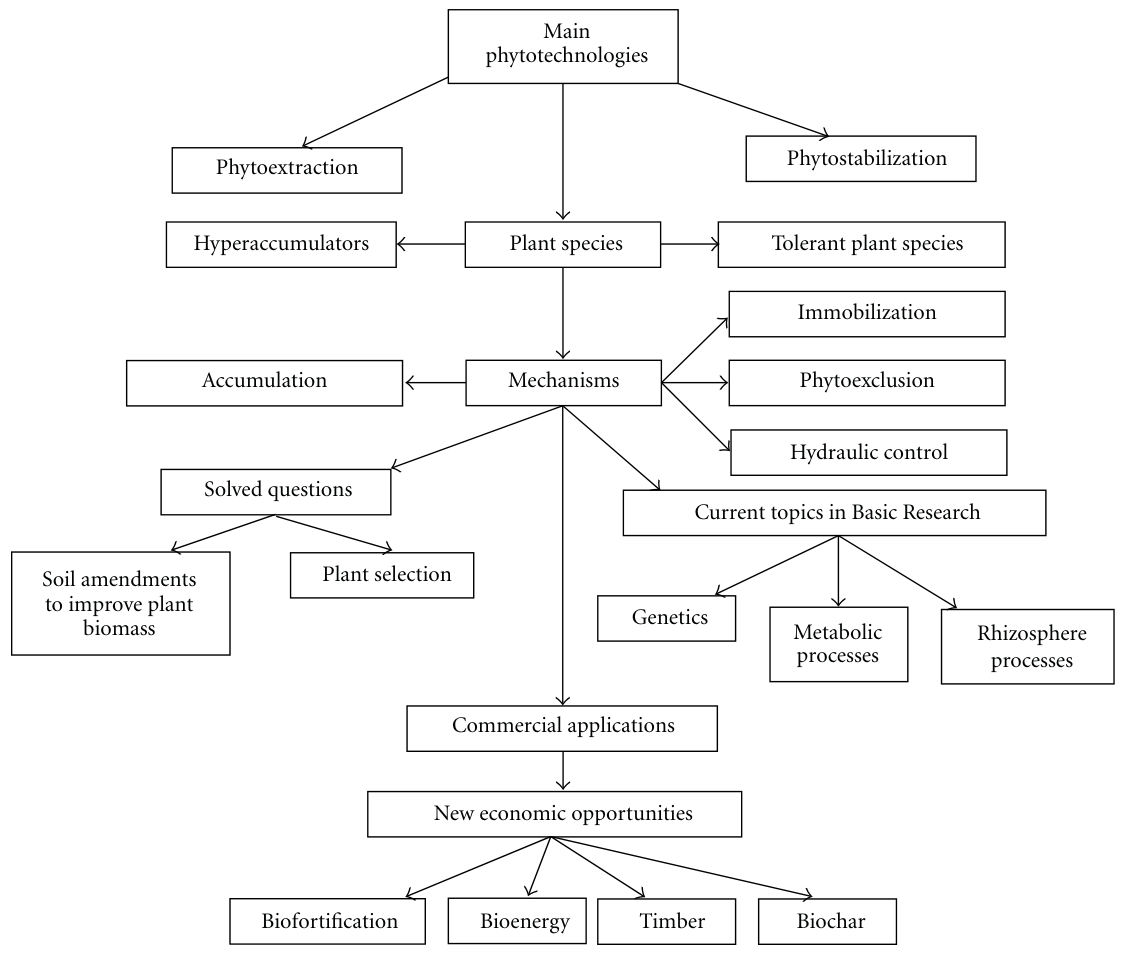
Current fundamental research in phytotechnologies (Figure 2) centres on two fields: (1) genetics/physiology/biochemistry in order to increasing plants’ tolerance and metabolism of organic pollutants and/or trace elements [33] and (2) rhizosphere processes that influence the phytoavailability of pollutants [28]. Although these topics provide insights into scientific questions, the problem of phytotechnologies low commercial attractiveness due to its lack of revenues still remains. To overcome this issue, it has been proposed to use phytotechnology projects as a way of obtaining profitable outputs (Figure 2)
当前植物技术的基础研究(图2)集中于两个领域:(1)遗传学/生理学/生物化学,旨在提高植物对有机污染物和/或微量元素的耐受性及代谢能力 [33];(2)影响污染物植物有效性的根际过程 [28]。尽管这些课题为科学问题提供了见解,但由于缺乏收益,植物技术商业吸引力低的问题依然存在。为解决这一问题,有人提出将植物技术项目作为获取盈利产出的途径(图2)。
The original concept of phytoremediation focused on phytoextraction, while phytostabilization received much less attention [13]. The initial focus of phytotechnology was to remove pollutants from soils, by degradation and volatilization in case of organics and extraction in case of metals. Suitable phytoextraction projects relied on high metal extraction rates by the plant species used for remediation [34]. Thus, the research focused on the search for hyperaccumulator plant species [35] or using biotechnology (study of metabolic mechanisms, genetic engineering) to increase metal uptake [15, 36]. This development has resulted in many important findings in plant science that relate to plant-pollutant interactions [37, 38] and to the selection of plant species with hyperaccumulation characteristics [39].
植物修复的最初概念侧重于植物提取,而植物稳定受到的关注要少得多 [13]。植物技术最初的重点是从土壤中去除污染物:对有机物而言是通过降解和挥发,对金属而言则是通过提取。适宜的植物提取项目依赖于修复所用植物物种的高金属提取速率 [34]。因此,研究集中于寻找超富集植物物种 [35],或利用生物技术(代谢机制研究、基因工程)提高金属吸收量 [15, 36]。这一发展在植物科学领域取得了许多与植物-污染物相互作用 [37, 38] 以及具有超富集特性植物物种的筛选 [39] 相关的重要发现。
For some common metals, such as Pb, there are no reliable reports of any hyperaccumulator species; therefore, chelant-assisted phytoextraction offered a possible solution. In chelant-assisted phytoextraction, various aminopolycarboxylic acids have been applied to soil to enhance the solubility of trace element cations [40, 41]. Although plant uptake is increased, chelant-assisted phytoextraction has been comprehensively discredited [42, 43], because of the high leaching: plant uptake ratio of the contaminants and the persistence of chelants in the environment.
对于Pb等一些常见金属,尚无可靠的超富集植物物种报道,因此螯合剂辅助植物提取提供了一种可能的解决方案。在螯合剂辅助植物提取中,人们向土壤施用各种氨基多羧酸以提高微量元素阳离子的溶解度 [40, 41]。尽管植物吸收量有所增加,但由于污染物淋溶量与植物吸收量之比很高,且螯合剂在环境中具有持久性,螯合剂辅助植物提取已被全面否定 [42, 43]。
Successful phytoextraction requires the cleansing of the soil to a level that complies with environmental regulations. Field trials or commercial operations that demonstrate successful phytoextraction are conspicuously absent. Selenium volatilization using genetically engineered Brassica juncea (L.) is one of the few examples of a successful field application of phytoextraction [44]. Theoretically, repeated cropping of plants could cleanse contaminated sites, provided the harvested amounts of metals exceed further inputs, until the soil metals concentrations in the long term reach acceptable levels [31].
成功的植物提取要求将土壤净化至符合环境法规的水平。能够证明植物提取取得成功的田间试验或商业运营明显缺乏。利用基因工程改造的Brassica juncea (L.) 进行硒挥发是植物提取成功田间应用的少数实例之一 [44]。理论上,只要收获带走的金属量超过进一步的输入量,反复种植植物就可以净化污染场地,直至土壤金属浓度在长期内达到可接受水平 [31]。
The development of phytoextraction brought additional issues of practicability, such as the further treatment of biomass, accumulation of pollutants in food chain, or the social and institutional acceptability of using of transgenic plants [45], which were ignored for decades. Back-of-the-envelope calculations show that phytoextraction is not suitable to remediate soils with moderate or high heavy metal contents since it would take an unacceptable time to remove those [31, 46]. Such calculations, for example, rule out the use of phytoextraction in former mining areas. Moreover, there are concerns regarding the entry of metals into the food chain [47]. There has been a progressive shift away from phytoextraction towards phytostabilization. Most plants growing on metalliferous soils are not hyperaccumulators, but excluders of heavy metals. The use of excluders is the base of phytostabilization (Figure 2). Excluder plants may also transform metals into less toxic or mobile forms without extracting them from soil [34] through absorption and accumulation by roots, adsorption onto roots, or precipitation within the rhizosphere [48]. Recent reviews and studies indicate that phytostabilization has more scope of application than phytoextraction [17].
植物提取的发展带来了其他一些实用性问题,如生物质的后续处理、污染物在食物链中的积累,以及使用转基因植物的社会和制度可接受性 [45],而这些问题在数十年间一直被忽视。粗略计算表明,植物提取不适合修复重金属含量中等或较高的土壤,因为去除这些金属所需的时间长得令人无法接受 [31, 46]。例如,此类计算排除了在废弃矿区使用植物提取的可能。此外,人们还担心金属会进入食物链 [47]。研究重点已逐渐从植物提取转向植物稳定。大多数生长在含金属土壤上的植物并非超富集植物,而是重金属排斥型植物。排斥型植物的利用是植物稳定的基础(图2)。排斥型植物还可以通过根系吸收和积累、在根部吸附或在根际内沉淀 [48],将金属转化为毒性较低或迁移性较弱的形态,而无需将其从土壤中提取出来 [34]。近期的综述和研究表明,植物稳定比植物提取具有更广的应用范围 [17]。
The term phytotechnology relates to biochemical processes that can permanently modify an ecosystem. Plants affect evapotranspiration rates, mobilise, immobilise, or extract metals and other chemicals from soil, introduce organic matter into soil, and also release a variety of chemicals by exudation [19]. The original categorization of a project as phytostabilization or phytoextraction may change as the project progresses. Recently, Robinson et al. [31] and Dom´ınguez et al. [49] have extended the phytoremediation concept to more applied projects, showing it as an integrative tool to manage restoration works at large scale using plants for hydraulic control and limitation of metal uptake. This new way of understanding phytotechnologies as phytomanagement is based on the use of the contaminated land for the production of economic yield [31]. Here, remediation is redefined within a dynamic system, which maintains the risks of the contaminants at a safe level and where the factor “soil” generates an economic gain (energy crops, pasture, biofortified products, etc.). That means that phytotechnologies no longer have the sole goal of soil remediation but also of generating economic benefits, and this necessitates redirecting current research lines to more applied aspects.
植物技术一词涉及可永久改变生态系统的生物化学过程。植物会影响蒸散速率,活化、固定或从土壤中提取金属及其他化学物质,向土壤中输入有机质,并通过分泌作用释放多种化学物质 [19]。一个项目最初被归类为植物稳定或植物提取,其类别可能随着项目的推进而改变。最近,Robinson et al. [31] 和 Dom´ınguez et al. [49] 将植物修复概念拓展至更具应用性的项目,将其作为一种综合工具,利用植物进行水力控制并限制金属吸收,以管理大尺度的修复工程。这种将植物技术理解为植物管理的新方式,是以利用污染土地生产经济产出为基础的 [31]。在此,修复被重新定义于一个动态系统之中:该系统将污染物风险维持在安全水平,同时“土壤”这一要素产生经济收益(能源作物、牧场、生物强化产品等)。这意味着植物技术不再以土壤修复为唯一目标,还要产生经济效益,这就需要将当前的研究方向转向更具应用性的方面。
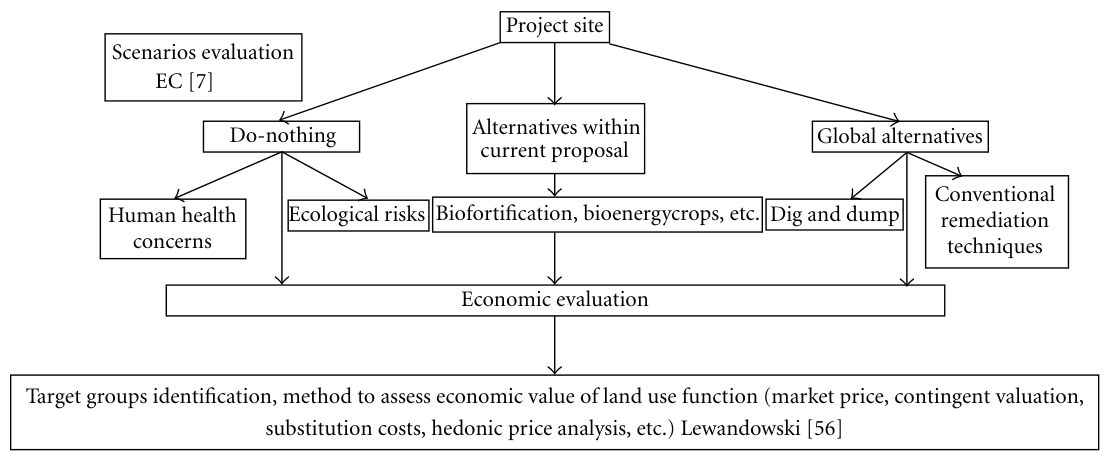
4.1. Economic Evaluation. According to Lewandowski et al. [50], the quantification of land use functions in biophysical terms requires site-specific information on the landscape, site conditions, or plant species and the identification of target groups which may have benefits from phytotechnologies (farmers, authorities, industries, etc.). This implies that evaluation costs are site-specific and, therefore, that general economic assumptions or yield rates cannot be estimated without site-specific studies. As an initial step in the economic evaluation of phytomanagement projects, some scenarios have to be established in the decision-making process. Potential scenarios (Figure 3) in waste management according to the EC [7] are the following:
4.1. 经济评价。根据 Lewandowski et al. [50],以生物物理术语量化土地利用功能,需要有关景观、场地条件或植物物种的场地特异性信息,并需识别可能从植物技术中获益的目标群体(农民、主管部门、工业企业等)。这意味着评价成本具有场地特异性,因此,没有场地特异性研究就无法估算一般性的经济假设或产量水平。作为植物管理项目经济评价的第一步,需要在决策过程中设定若干情景。根据EC [7],废物管理中的潜在情景(图3)如下:
(i) a do-nothing scenario (“business as usual”), without investments,
(i)无投资的不作为情景(“一切照旧”),
(ii) some available alternatives inside the current proposal,
(ii)当前方案内部的若干可选替代方案,
(iii) global alternatives to the project.
(iii)项目的整体替代方案。
One of the main barriers for the application of phytotechnologies is the absence of economic studies or cost evaluations. Efforts have been recently made in studying at local or regional scales the economic profits of bioenergy production in contaminated lands [51, 52]. The presentation of phytoremediation as novel low cost remediation technology may not be borne out if the time when the land is out of production is taken into consideration. In a real cost evaluation, “time consuming” is assumed to be an additional cost, and this makes the cost of phytoremediation uncertain because it is difficult to evaluate. Large remediation operations usually come in association with big projects (urban, commercial, industrial). Most commercial soil remediation occurs in relation to the growth of urban areas, where low levels of contaminations must be reached, change of soil use or toxic spills, where urgent solutions are needed to maintain sociopolitical acceptance. In these cases, conventional remediation options are often the best option due to their rapidity, despite their high initial cost. This makes it difficult for phytotechnologies to compete. Therefore, they are relegated to projects with low economic value and the following profile: (a) long term period is possible; (b) current use of soil does not imply risks for people/ecosystems. These kinds of projects are usually restricted to marginal areas without short term economic value, such as former mining areas [47, 53], landfills, abandoned shooting ranges [54], or postindustrial sites [55].
植物技术应用的主要障碍之一是缺乏经济研究或成本评估。最近已有研究在地方或区域尺度上探讨在污染土地上生产生物能源的经济收益 [51, 52]。如果将土地停产的时间考虑在内,将植物修复作为一种新型低成本修复技术的说法可能难以成立。在实际成本评估中,“耗时”被视为一项额外成本,由于难以评估,这使得植物修复的成本具有不确定性。大型修复工程通常与大型项目(城市、商业、工业)相关联。大多数商业性土壤修复发生在城市扩张(须达到较低的污染水平)、土地用途变更或有毒物质泄漏等情形下,这些情形需要紧急解决方案以维持社会政治层面的接受度。在这些情况下,尽管初始成本较高,常规修复方案因其快速性往往是最佳选择。这使植物技术难以与之竞争。因此,植物技术被局限于经济价值较低且具有以下特征的项目:(a)允许较长的修复周期;(b)土壤的当前用途不对人类/生态系统构成风险。此类项目通常仅限于不具短期经济价值的边缘区域,如废弃矿区 [47, 53]、垃圾填埋场、废弃射击场 [54] 或后工业场地 [55]。
Lewandowski et al. [56] assessed economic value of phytoremediation combined with biomass production in a Cd polluted soil. According to these authors, assessing the economic value of that combined option requires the accounting of market price of the biomass, contingent valuation/willingness-to-pay or substitution costs/replacement costs.
Lewandowski et al. [56] 评估了在Cd污染土壤中将植物修复与生物质生产相结合的经济价值。据这些作者所述,评估这一组合方案的经济价值需要核算生物质的市场价格、条件价值/支付意愿或替代成本/重置成本。
4.2. Commercial Management. There are differences between Europe and North America in the commercial management of phytotechnologies. North America has higher private investment in phytotechnologies, and this has resulted in a larger number of profitable private companies. In contrast, Europe is more focused on solving fundamental issues and in describing biological mechanisms [57]. Consequently, North America is far ahead of Europe in the application and commercialisation of phytotechnologies. Phytoremediation companies have undergone structural and conceptual development in the last 15 years. The first phytoremediation companies were regional manufacturers offering phytoextraction of radionuclides and trace elements (e.g., Phytotech Inc.), or the removal of organics from soil and groundwater by means of trees (e.g., Phytokinetics Inc.). Many of these companies went out of business, because there are few sites that can be remediated solely by phytoextraction. Nowadays, for fieldscale remediation, phytoremediation companies team up with large engineering firms, if the latter do not already have an integrated phytoremediation division. Some phytoremediation companies have abandoned the clean up business and practice phytomanagement: most phytotechnology projects aim to prevent contaminant leaching into groundwater (Ecolotree) and the treatment of effluent (Bioplanta). As phytoremediation is a field that is highly dependent on the economic climate, some companies such as Bioplanta Inc. have found additional sources of income, such as methane production in bioreactors or the extraction of active compounds from plants to boost profits. Although some companies have made profits from the field of phytoremediation, the actual breakthrough of this technique has yet not been made. The reason could be that in contrast to other environmental technologies such as renewable energy production by solar panels, wind turbines, and so forth, this technique does not produce profitable outputs. The use of contaminated land for the production of energy crops could reduce the importance of cleanup times while producing a revenue stream [51]. Moreover, “pure environmental” benefits (e.g., CO2 friendly, increase of biodiversity) must be considered and, therefore, incorporated to the economic evaluation.
4.2. 商业管理。欧洲与北美在植物技术的商业管理方面存在差异。北美在植物技术方面的私人投资较多,由此产生了更多盈利的私营公司。相比之下,欧洲更侧重于解决基础问题和描述生物学机制 [57]。因此,北美在植物技术的应用和商业化方面远远领先于欧洲。过去15年间,植物修复公司经历了结构和理念上的发展。最早的植物修复公司是提供放射性核素和微量元素植物提取服务(如Phytotech Inc.)或利用树木去除土壤和地下水中有机物(如Phytokinetics Inc.)的区域性企业。其中许多公司已经倒闭,因为仅靠植物提取即可修复的场地很少。如今,对于田间尺度的修复,植物修复公司会与大型工程公司合作(如果后者尚未设立植物修复部门的话)。一些植物修复公司已放弃清理业务,转而从事植物管理:大多数植物技术项目旨在防止污染物淋溶进入地下水(Ecolotree)以及处理废水(Bioplanta)。由于植物修复是一个高度依赖经济环境的领域,Bioplanta Inc. 等一些公司已开辟了额外的收入来源,如在生物反应器中生产甲烷或从植物中提取活性成分,以增加利润。尽管一些公司已从植物修复领域获利,但该技术尚未取得真正的突破。原因可能在于,与太阳能电池板、风力涡轮机等可再生能源生产等其他环境技术不同,该技术不产生盈利性产出。利用污染土地种植能源作物可以在产生收入流的同时降低清理时间的重要性 [51]。此外,还必须考虑“纯环境”效益(如CO2友好、生物多样性增加),并将其纳入经济评价。
4.3. Emerging Opportunities. Biofortification aims to increase the concentration of essential trace elements in crops to improve human health and agricultural productivity [58]. Micronutrients such as Fe and Zn are deficient in many diets [59]. Physiologically accumulated micronutrients in plants provide a more readily assimilable source of micronutrients than in the form of inorganic supplements [58]. Some field experiments have shown positive results in relation to Se-fortified vegetables [60]. According to Qaim et al. [61], biofortification is likely to gain in importance in the future, as indicated by the large number of related international research programs recently launched. However, more evidence, including medical trials, toxicity assessment, and appropriate dosages is needed before biofortified products be available for the consumers [62, 63].
4.3. 新兴机遇。生物强化旨在提高作物中必需微量元素的浓度,以改善人类健康和农业生产力 [58]。许多膳食中缺乏Fe和Zn等微量营养素 [59]。与无机补充剂形式相比,经生理过程积累于植物中的微量营养素是更易被吸收的微量营养素来源 [58]。一些田间试验在富硒蔬菜方面取得了积极结果 [60]。根据 Qaim et al. [61],正如近期启动的大量相关国际研究计划所表明的,生物强化在未来的重要性可能会日益提升。然而,在生物强化产品供应消费者之前,还需要更多证据,包括医学试验、毒性评估和适宜剂量 [62, 63]。
Phytotechnologies may increase revenues from nonproductive polluted soils if linked with biomass production [56, 64]. Among the different options, the production of biofuels, nonconsumable agricultural products, or wood is economically viable in many countries. Biofuels are highly depended on subsidies, and they will establish themselves commercially only when the oil price exceeds 120 US $ per barrel [65]. In contrast to biofuel production, production of biochar could give a new perspective on the production of biomass on contaminated land. Biochar is charcoal created from the pyrolysis of biomass. The addition of biochar to soil has been suggested as a means to sequester carbon, thereby reducing the effects of human-induced climate change caused by CO2 emissions [66].
如果与生物质生产相结合,植物技术可增加非生产性污染土壤的收益 [56, 64]。在各种选择中,生产生物燃料、非食用农产品或木材在许多国家具有经济可行性。生物燃料高度依赖补贴,只有当油价超过每桶120美元时才能在商业上立足 [65]。与生物燃料生产不同,生物炭的生产可为在污染土地上生产生物质提供新的前景。生物炭是由生物质热解产生的炭。有研究提出,向土壤中添加生物炭可作为固碳手段,从而减轻由CO2排放导致的人为气候变化的影响 [66]。
The economics of biochar will depend on the plant species used and the farming intensity applied (fertilisers, pesticides, herbicides) as this will affect operational costs. Monocultures are vulnerable under inadequate soils or stress conditions (drought, pathogens) making it an important issue to reach sustainable system to guarantee the economic and ecological stability of the local environment [67]. Therefore, crops are best when rotated or, if possible, a multispecies community must be established. Additionally, the use of food producing from agricultural species such as maize, rape, and sunflower contains the risk that the contaminants contained in the harvest may enter food or fodder, thus posing a risk to humans and animals. In addition to agricultural species, tree plantation could be an option, with rotation periods of up to 25 years [68]. This rotation would be similar to rotation periods of forestry and would have reduced expenses compared to short-term rotations because of lower plantation costs. This implementation, however, would make it unsuitable for short-term financial outputs. Since the land is anyway not producing revenue and the trees have phytostabilising potential, short rotation periods are less important.
生物炭的经济性将取决于所用植物物种和所采用的耕作强度(化肥、杀虫剂、除草剂),因为这些将影响运营成本。单一栽培在土壤条件不佳或胁迫条件(干旱、病原体)下较为脆弱,因此建立可持续系统以保障当地环境的经济和生态稳定性是一个重要问题 [67]。因此,作物最好轮作,或在可能的情况下建立多物种群落。此外,利用玉米、油菜和向日葵等农业物种生产食品存在风险,即收获物中所含的污染物可能进入食品或饲料,从而对人类和动物构成风险。除农业物种外,植树造林也可作为一种选择,其轮伐期可长达25年 [68]。这种轮伐期与林业的轮伐期相似,且由于种植成本较低,与短期轮作相比可降低开支。然而,这种实施方式不适合获取短期财务产出。由于这些土地本就不产生收益,且树木具有植物稳定潜力,短轮伐期的重要性较低。
Another possibility may be phytomining; the use of plants to mine metals [69] has been shown to be economically feasible for certain metals such as nickel [70, 71]. However, practical aspects, especially efficiency of land use will prohibit its widespread use [31]. Greater efforts in developing rates, modelling, treatment times, and monitoring schemes are still necessary to provide a better practical view of this technology [30, 72].
另一种可能是植物采矿;利用植物开采金属 [69] 已被证明对镍等某些金属在经济上可行 [70, 71]。然而,实际问题,尤其是土地利用效率,将妨碍其广泛应用 [31]。仍需在速率确定、建模、处理时间和监测方案方面付出更大努力,以便为该技术提供更好的实践视角 [30, 72]。
4.4. Adoption of a New Concept. Traditionally, phytotechnology projects had the sole aim of remediating the site. There is a lot of information on candidate plant species for these technologies, especially regarding plant metal-accumulation and tolerance [46, 73]. Mesocosm experiments have been employed to reveal the capabilities and limitations of soil conditioners [74]. The results of some successful field trials in specific sites are also available [31, 44].
4.4. 采用新概念。传统上,植物技术项目的唯一目标是修复场地。关于这些技术的候选植物物种已有大量信息,尤其是在植物金属积累和耐受性方面 [46, 73]。中宇宙试验已被用于揭示土壤调理剂的能力与局限 [74]。一些特定场地的成功田间试验结果也已见报道 [31, 44]。
Unlike other remediation systems such as capping and soil removal, phytotechnologies systems are site dependent. It is impractical to conduct long-term field trials to optimise phytotechnology systems for each site. Therefore, models that calculate the performance of phytotechnology systems are crucial. Such models could eliminate unnecessary field trials by revealing where phytotechnologies will likely meet environmental regulations and where they are more costeffective than competing technologies. Without such models, the improvement of phytotechnologies requires field trials to determine the feasibility and optimal management strategies for the site. This further delays the operation.
与覆盖和土壤移除等其他修复系统不同,植物技术系统依赖于场地条件。针对每个场地开展长期田间试验以优化植物技术系统是不切实际的。因此,计算植物技术系统性能的模型至关重要。此类模型可以揭示植物技术在哪些地方可能满足环境法规要求、在哪些地方比竞争技术更具成本效益,从而免除不必要的田间试验。若没有此类模型,改进植物技术就需要开展田间试验以确定其可行性和场地的最佳管理策略,这会进一步推迟运营。
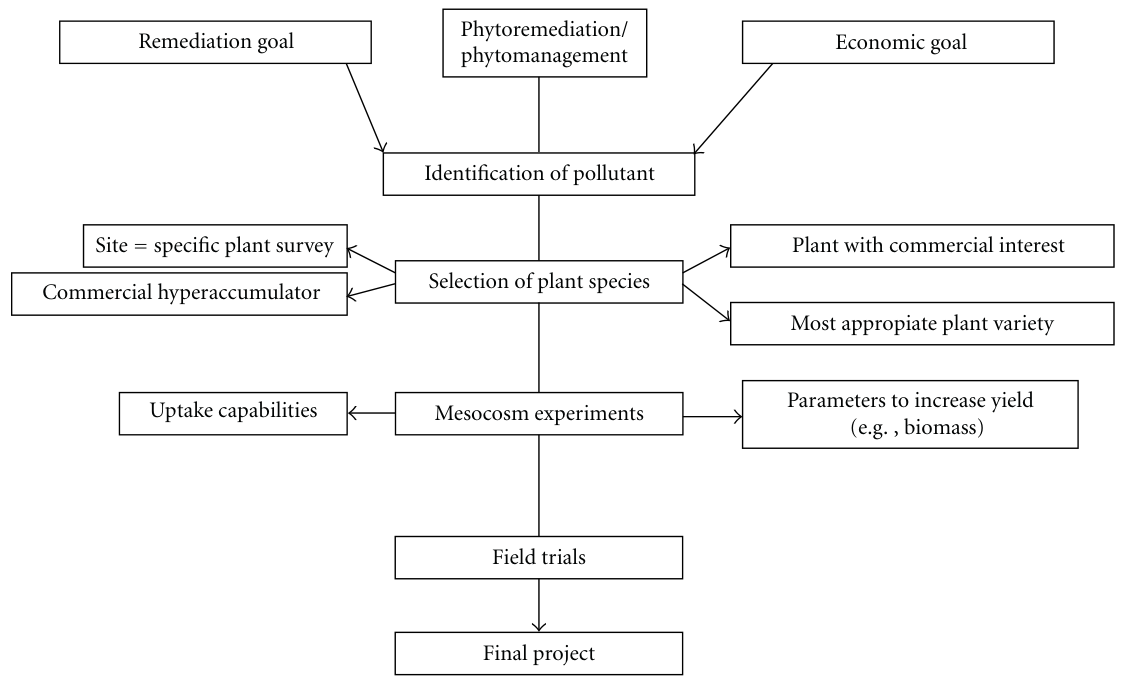
Approaching phytotechnologies from a commercial perspective, such as has occurred in the United States, is more likely to increase the attractiveness of this technology. Figure 4 shows the current implementation pathway for phytotechnologies using this system. The critical success factor for this system is that the remediation goal and the economic goal are given equal weightings.
像美国那样从商业角度推进植物技术,更有可能提高该技术的吸引力。图4展示了采用这一体系的植物技术当前实施路径。该体系成功的关键因素在于对修复目标和经济目标赋予同等权重。
5Conclusions结论
Research in phytotechnologies has enhanced our understanding in the fields of plant and soil sciences. However, more effective and commercially feasible techniques are still required. Therefore, to make phytotechnologies more commercially attractive, we propose:
植物技术研究增进了我们对植物科学和土壤科学领域的认识。然而,仍需要更有效且商业上可行的技术。因此,为使植物技术更具商业吸引力,我们建议:
(i) clearly distinguishing processes from techniques to improve communication and cooperation by the commercial sector,
(i)明确区分过程与技术,以改善与商业部门的沟通与合作,
(ii) the exploitation of new economic opportunities such as the production bioenergy, biochar, and biofortified crops,
(ii)开发新的经济机遇,如生产生物能源、生物炭和生物强化作物,
(iii) the application of economic studies and economic evaluations as well as a new implementation protocol. Phytotechnologies will forever remain a promising tool for soil cleaning if they are not linked to the production of valuable biomass products.
(iii)开展经济研究和经济评价,并采用新的实施规程。如果不与有价值的生物质产品生产相结合,植物技术将永远只是一种有前景的土壤净化工具。
Acknowledgments致谢
Dr. H´ector M. Conesa thanks the Spanish Ministerio de Ciencia e Innovacion and UPCT for funding through the “Ramon y Cajal” programme (Ref. RYC-2010-05665). Michael W. H. Evangelou would like to thank the DFG (German Research Foundation) for funding his research fellowship.
H´ector M. Conesa博士感谢西班牙科学与创新部(Ministerio de Ciencia e Innovacion)和UPCT通过“Ramon y Cajal”计划(编号RYC-2010-05665)提供的资助。Michael W. H. Evangelou感谢DFG(德国研究基金会)资助其研究员职位。
References参考文献
[1] GACGC (German Advisory Council on Global Change), World in Transition: The Threat to Soils, Economica Verlag GmbH, Bonn, Germany, 1994.
[2] CEC (Commission of the European Communities), Communication from the Commission to the Council, the European Parliament, the Economic and Social Committee and the Committee of the Regions: Towards a Thematic Strategy for Soil Protection, COM(2002) 179 final, European Commision, Brussels, Belgium, 2002.
[3] S. Bundesrat, 814.12 Verordnung vom 1. Juli 1998 ¨uber Belastungen des Bodens (VBBo), Switzerland, 1998.
[4] MHSPE (Ministry of Housing, Spatial Planning and Environment), Netherlands: Circular on Target Values and Intervention Values for Soil Remediation, Ministry of Housing, Spatial Planning and Environment, Amsterdam, The Netherlands, 2000.
[5] BOE (Bolet´ın Oficial del Estado), “Real Decreto 9/2005, de 14 de enero, por el que se establece la relaci´on de actividades potencialmente contaminantes del suelo y los criterios y est´andares para la declaraci´on de suelos contaminados,” (BOE no. 15 de 18.01.05), pp. 1833–1843, 2005. Spain. (in Spanish).
[6] F. A. Swartjes, “Risk-based assessment of soil and groundwater quality in The Netherlands: standards and remediation urgency,” Risk Analysis, vol. 19, no. 6, pp. 1235–1249, 1999.
[7] EC (European Comission), Guide to Cost-Benetfit Analysis of Investment Projects: Evaluation Unit DG Regional Policy European Commission, Structural Fund-ERDF, Cohesion Fund and ISPA, 2002.
[8] EU (European Union), “Directive 2008/1/EC of the European Parlament and of the Council of 15 January 2008 concerning integrated pollution prevention and control,” (29-01-2008), 2008.
[9] UNEP (United Nations Environment Programme), “Freshwater management series no. 7 phytotechnologies: a technical approach in environmental management,” 2003, http://www .unep.or.jp/ietc/publications/freshwater/fms7/index.asp.
[10] ITRC (Interstate Technology and Regulatory Cooperation), “Phytotechnology technical and regulatory guidance and decision trees, Revised Technical/Regulatory Guidance Interstate Technology & Regulatory Council Phytotechnologies,” U.S. 2009, http://www.itrcweb.org/Documents/PHYTO-3.pdf.
[11] I. Raskin, “Phytoextraction: the use of plants to remove heavy metals from soils,” Environmental Science and Technology, vol. 29, no. 5, pp. 1232–1238, 1995.
[12] V. Dushenkov, P. B. A. Nanda-Kumar, H. Motto, and I. Raskin, “Rhizofiltration: the use of planst to remove havy metals from aqueous streams,” Environmental Science and Technology, vol. 29, pp. 1239–1245, 1995.
[13] I. Raskin, R. D. Smith, and D. E. Salt, “Phytoremediation of metals: using plants to remove pollutants from the environment,” Current Opinion in Biotechnology, vol. 8, no. 2, pp. 221– 226, 1997.
[14] D. E. Salt, M. Blaylock, N. P. B. A. Kumar et al., “Phytoremediation: a novel strategy for the removal of toxic metals from the environment using plants,” Bio-technology, vol. 13, no. 5, pp. 468–474, 1995.
[15] U. Kr¨amer, “Phytoremediation: novel approaches to cleaning up polluted soils,” Current Opinion in Biotechnology, vol. 16, no. 2, pp. 133–141, 2005.
[16] E. L. Arthur, P. J. Rice, P. J. Rice et al., “Phytoremediation—an overview,” Critical Reviews in Plant Sciences, vol. 24, no. 2, pp. 109–122, 2005.
[17] N. M. Dickinson, A. J. M. Baker, A. Doronila, S. Laidlaw, and R. D. Reeves, “Phytoremediation of inorganics: realism and synergies,” International Journal of Phytoremediation, vol. 11, no. 2, pp. 97–114, 2009.
[18] A. P. G. C. Marques, A. O. S. S. Rangel, and P. M. L. Castro, “Remediation of heavy metal contaminated soils: phytoremediation as a potentially promising clean-up technology,” Critical Reviews in Environmental Science and Technology, vol. 39, no. 8, pp. 622–654, 2009.
[19] B. Robinson, R. Schulin, B. Nowack et al., “Phytoremediation for the management of metal flux in contaminated sites,” Forest Snow and Landscape Research, vol. 80, no. 2, pp. 221– 224, 2006.
[20] I. Alkorta, J. Hern´andez-Allica, J. M. Becerril, I. Amezaga, I. Albizu, and C. Garbisu, “Recent findings on the phytoremedation of soils contaminated with environmentally toxic heavy metals and metalloids such as zinc, cadmium, lead, and arsenic,” Reviews in Environmental Science and BioTechnology, vol. 3, pp. 71–90, 2004.
[21] J. L. Schnoor, “Phytoremediation of soil and groundwater,” Technology Evaluation Report TE-02-01, Ground Water Remediation Technologies Analysis Center (GWRTAC), Pittsburgh, Pa, USA, 2002.
[22] USEPA (United States Environmental Protection Agency), Introduction to Phytoremediation, EPA/600/R-99/107, Boston, Mass, USA, 2000.
[23] D. I. Kaplan, A. S. Knox, T. G. Hinton, R. R. Sharitz, B. P. Allen, and S. M. Serkiz, “Proof-of-concept of the phytoimmobilization technology for TNX outfall delta,” Final Report, Westinghouse Savannah River Company, Aiken, SC, USA, 2001. [24] E. Manousaki, J. Kadukova, and N. Kalogerakis, “Phytoextraction and phytoexcretion of Cd and Pb by the salt cedar (Tamarix Smyrensis Bunge): a new combined phytoremediation process,” COST Action 859—Phytotechnologies in practice—biomass production, agricultural methods, legacy, legal and economic aspects October 14–17, Verneuil-en- Halatte, France, 2008.
[25] W. A. Peer, I. R. Baxter, E. L. Richards, J. L. Freeman, and A. S. Murphy, “Phytoremediation and hyperaccumulator plants,” Topics in Current Genetics, pp. 299–340, 2006.
[26] V. Campos and M. A. F. Pires, “Phytoremoval of arsenic from soil,” Communications in Soil Science and Plant Analysis, vol. 358, no. 15-16, pp. 2137–2146, 2003.
[27] Z. D. Parris, M. K. Banks, A. P. Schwab, and J. C. White, “Phyto-polishing of land-treated manufactured gas plant
(MGP) soil,” Intertational Journal of Phytoremediation, vol. 6, p. 188, 2004.
[28] W. W. Wenzel, “Rhizosphere processes and management in plant-assisted bioremediation (phytoremediation) of soils,” Plant and Soil, vol. 321, no. 1-2, pp. 385–408, 2009.
[29] J. L. Gardea-Torresdey, G. De la Rosa, and J. R. Peralta-Videa, “Use of phytofiltration technologies in the removal of heavy metals: a review,” Pure and Applied Chemistry, vol. 76, no. 4, pp. 801–813, 2004.
[30] L. A. Newman and C. M. Reynolds, “Phytodegradation of organic compounds,” Current Opinion in Biotechnology, vol. 15, no. 3, pp. 225–230, 2004.
[31] B. H. Robinson, G. Ba˜nuelos, H. M. Conesa, M. W. H. Evangelou, and R. Schulin, “The phytomanagement of trace elements in soil,” Critical Reviews in Plant Sciences, vol. 28, no. 4, pp. 240–266, 2009.
[32] D. J. Glass, “US and international markets for phytoremediation,” Tech. Rep., D. Glass Associates, Needham, Mass, USA, 1999.
[33] D. N. Dowling and S. L. Doty, “Improving phytoremediation through biotechnology,” Current Opinion in Biotechnology, vol. 20, no. 2, pp. 204–206, 2009.
[34] R. L. Chaney, M. Malik, Y. M. Li et al., “Phytoremediation of soil metals,” Current Opinion in Biotechnology, vol. 8, no. 3, pp. 279–284, 1997.
[35] A. J. M. Baker, S. P. McGrath, C. M. D. Sidoli, and R. D. Reeves, “The possibility of in situ heavy metal decontamination of polluted soils using crops of metal-accumulating plants,” Resources, Conservation and Recycling, vol. 11, no. 1–4, pp. 41– 49, 1994.
[36] S. P. McGrath and F. J. Zhao, “Phytoextraction of metals and metalloids from contaminated soils,” Current Opinion in Biotechnology, vol. 14, no. 3, pp. 277–282, 2003.
[37] M. M. Lasat, “Phytoextraction of toxic metals: a review of biological mechanisms,” Journal of Environmental Quality, vol. 31, no. 1, pp. 109–120, 2002.
[38] X. Yang, Y. Feng, Z. He, and P. J. Stoffella, “Molecular mechanisms of heavy metal hyperaccumulation and phytoremediation,” Journal of Trace Elements in Medicine and Biology, vol. 18, no. 4, pp. 339–353, 2005.
[39] R. R. Brooks, Ed., Plants that Hyperaccumulate Heavy Metals, CAB International Publishing, Oxford University Press, 1998.
[40] J. W. Huang and S. D. Cunningham, “Lead phytoextraction: species variation in lead uptake and translocation,” New Phytologist, vol. 134, no. 1, pp. 75–84, 1996.
[41] M. J. Blaylock, D. E. Salt, S. Dushenkov et al., “Enhanced accumulation of Pb in Indian mustard by soil-applied chelating agents,” Environmental Science and Technology, vol. 31, no. 3, pp. 860–865, 1997.
[42] B. Nowack, R. Schulin, and B. H. Robinson, “Critical assessment of chelant-enhanced metal phytoextraction,” Environmental Science and Technology, vol. 40, no. 17, pp. 5225–5232, 2006.
[43] M. W. H. Evangelou, M. Ebel, and A. Schaeffer, “Chelate assisted phytoextraction of heavy metals from soil: effect, mechanism, toxicity, and fate of chelating agents,” Chemosphere, vol. 68, no. 6, pp. 989–1003, 2007.
[44] G. Ba˜nuelos, N. Terry, D. L. Leduc, E. A. H. Pilon-Smits, and B. Mackey, “Field trial of transgenic Indian mustard plants shows enhanced phytoremediation of selenium-contaminated sediment,” Environmental Science and Technology, vol. 39, no. 6, pp. 1771–1777, 2005.
[45] A. K. Wolfe and D. J. Bjornstad, “Why would anyone object? An exploration of social aspects of phytoremediation acceptability,” Critical Reviews in Plant Sciences, vol. 21, no. 5, pp. 429–438, 2002.
[46] H. M. Conesa, A. Faz, and R. Arnaldos, “Heavy metal accumulation and tolerance in plants from mine tailings of the semiarid Cartagena-La Uni´on mining district (SE Spain),” Science of the Total Environment, vol. 36, no. 1, pp. 1–11, 2006.
[47] H. M. Conesa, A. Faz, and R. Arnaldos, “Initial studies for the phytostabilization of a mine tailing from the Cartagena- La Union Mining District (SE Spain),” Chemosphere, vol. 66, no. 1, pp. 38–44, 2007.
[48] M. H. Wong, “Ecological restoration of mine degraded soils, with emphasis on metal contaminated soils,” Chemosphere, vol. 50, no. 6, pp. 775–780, 2003.
[49] M. T. Dom´ınguez, T. Mara˜n´on, J. M. Murillo, R. Schulin, and B. H. Robinson, “Trace element accumulation in woody plants of the Guadiamar Valley, SW Spain: a large-scale phytomanagement case study,” Environmental Pollution, vol. 152, no. 1, pp. 50–59, 2008.
[50] I. Lewandowski, M. Londo, U. Schmidt, and A. P. Faaij, “Biomass production in multiple land use systems: categorization of feasible land use functions and their Quantification by the example of phytoremediation,” in Proceedings of the 2nd World Conference and Technology Exhibition on Biomass for Energy, Industry and Climate Protection, pp. 54–57, Rome, Italy, May 2004.
[51] N. Witters, S. van Slycken, A. Ruttens et al., “Short-rotation coppice of willow for phytoremediation of a metal-contaminated agricultural area: a sustainability assessment,” Bioenergy Research, vol. 2, no. 3, pp. 144–152, 2009.
[52] E. Meers, S. van Slycken, K. Adriaensen et al., “The use of bio-energy crops (Zea mays) for ’phytoattenuation’ of heavy metals on moderately contaminated soils: a field experiment,” Chemosphere, vol. 78, no. 1, pp. 35–41, 2010.
[53] M. O. Mendez and R. M. Maier, “Phytoremediation of mine tailings in temperate and arid environments,” Reviews in Environmental Science and Biotechnology, vol. 7, no. 1, pp. 47– 59, 2008.
[54] B. H. Robinson, S. Bischofberger, A. Stoll et al., “Plant uptake of trace elements on a Swiss military shooting range: uptake pathways and land management implications,” Environmental Pollution, vol. 153, no. 3, pp. 668–676, 2008.
[55] C. J. French, N. M. Dickinson, and P. D. Putwain, “Woody biomass phytoremediation of contaminated brownfield land,” Environmental Pollution, vol. 141, no. 3, pp. 387–395, 2006.
[56] I. Lewandowski, U. Schmidt, M. Londo, and A. Faaij, “The economic value of the phytoremediation function—assessed by the example of cadmium remediation by willow (Salix ssp),” Agricultural Systems, vol. 89, no. 1, pp. 68–89, 2006.
[57] N. Marmiroli, M. Marmiroli, and E. Maestri, “Phytoremediation and phytotechnologies: a review for the present and the future,” in Viable Methods of Soil and Water Pollution Monitoring, Protection and Remediation, I. Twadowska, M. M. Haggblom, and S. Stefaniak, Eds., vol. 69, pp. 403–416, NATO Science Series IV Earth and Environmental Sciences, 2006.
[58] P. J. White and M. R. Broadley, “Biofortifying crops with essential mineral elements,” Trends in Plant Science, vol. 10, no. 12, pp. 586–593, 2005.
[59] F. Branca and M. Ferrari, “Impact of micronutrient deficiencies on growth: the stunting syndrome,” Annals of Nutrition and Metabolism, vol. 46, no. 1, pp. 8–17, 2002.
[60] G. S. Ba˜nuelos, “Phyto-products may be essential for sustainability and implementation of phytoremediation,” Environmental Pollution, vol. 144, no. 1, pp. 19–23, 2006.
[61] M. Qaim, A. J. Stein, and J. V. Meenakshi, “Economics of biofortification,” Agricultural Economics, vol. 37, no. 1, pp. 119–133, 2007.
[62] D. N. Cox and K. Bastiaans, “Understanding Australian consumers’ perceptions of selenium and motivations to consume selenium enriched foods,” Food Quality and Preference, vol. 18, no. 1, pp. 66–76, 2007.
[63] F. J. Zhao and S. P. McGrath, “Biofortification and phytoremediation,” Current Opinion in Plant Biology, vol. 12, no. 3, pp. 373–380, 2009.
[64] L. A. Licht and J. G. Isebrands, “Linking phytoremediated pollutant removal to biomass economic opportunities,” Biomass and Bioenergy, vol. 28, no. 2, pp. 203–218, 2005.
[65] W. E. Tyner, “Policy update: cellulosic biofuels market uncertainties and government policy,” Biofuels, vol. 1, pp. 389–391, 2010.
[66] J. Lehmann, “Bio-energy in the black,” Frontiers in Ecology and the Environment, vol. 5, no. 7, pp. 381–387, 2007.
[67] P. Schr¨oder, R. Herzig, B. Bojinov et al., “Bioenergy to save the world: producing novel energy plants for growth on abandoned land,” Environmental Science and Pollution Research, vol. 15, no. 3, pp. 196–204, 2008.
[68] B. Klasnja, S. Kopitovic, and S. Orlovic, “Wood and bark of some poplar and willow clones as fuelwood,” Biomass and Bioenergy, vol. 23, no. 6, pp. 427–432, 2002.
[69] R. R. Brooks, M. F. Chambers, L. J. Nicks, and B. H. Robinson, “Phytomining,” Trends in Plant Science, vol. 3, no. 9, pp. 359– 362, 1998.
[70] R. L. Chaney, J. S. Angle, A. J. M. Baker, and Y.-M. Li, “Method for phytomining of nickel, cobalt, and other metals from soil,” U.S. Patent, no. 5,711,784, 1998.
[71] Y. M. Li, R. Chaney, E. Brewer et al., “Development of a technology for commercial phytoextraction of nickel: economic and technical considerations,” Plant and Soil, vol. 249, no. 1, pp. 107–115, 2003.
[72] L. van Nevel, J. Mertens, K. Oorts, and K. Verheyen, “Phytoextraction of metals from soils: how far from practice?” Environmental Pollution, vol. 150, no. 1, pp. 34–40, 2007.
[73] R. C. Gonz´alez and M. C.A. Gonz´alez-Ch´avez, “Metal accumulation in wild plants surrounding mining wastes,” Environmental Pollution, vol. 144, no. 1, pp. 84–92, 2006.
[74] H. M. Conesa, B. H. Robinson, R. Schulin, and B. Nowack, “Growth of Lygeum spartum in acid mine tailings: response of plants developed from seedlings, rhizomes and at field conditions,” Environmental Pollution, vol. 145, no. 3, pp. 700– 707, 2007.